Bastion: How does the "Web3 Coordinator" led by a16z enable enterprises to seamlessly connect to the encrypted world?


Written by: Lucy, BlockBeats
Edited by: Jack, BlockBeats
In the eyes of Silicon Valley fans, web3 will eventually replace web2, even for already successful platforms like Facebook or YouTube. Therefore, even if the downturn in cryptocurrencies has hindered the demand for web3, companies in many industries still have a strong interest in entering the blockchain.
In the first decade of web3 development, security and usability were often at opposite ends of the trade-off spectrum, making it extremely difficult for developers or businesses to build a good user experience. How to switch from Web2 to Web3? How to break through the technical fortress? Faced with the confusion of most companies, a16z gave the answer-choose Bastion.
In Bastion's view, the future of web3 does not mean that every interaction needs to be conducted on-chain, and it says that it is currently building a system that can intelligently choose on-chain or off-chain paths to seamlessly support the most innovative web3 products and initiatives.
What is Bastion?
Bastion is an interpretation of the future of interaction supported by web3 infrastructure. It can seamlessly integrate compatible Web3 infrastructure into enterprise technology, reduce the complexity of user on-chain operations, and provide off-chain value to enterprises, giving them a web2 user experience. Bastion aims to become the ultimate orchestration layer for traditional enterprise construction in web3, by coordinating multiple components to achieve results greater than the sum of the parts, so that enterprises will no longer need to build multiple solutions internally.
“Many of the products and services we use every day can be fundamentally improved with blockchain technology,” commented Riyaz Faizullabhoy, co-founder of Bastion. Bastion claims to have the ability to “facilitate cost-effective transactions at the speed of Web2 while opening up new avenues for growth.”
Navigate the cryptocurrency regulatory environment with a custodial wallet API
Faced with increasing regulatory scrutiny of the crypto industry, U.S.-based Bastion will face challenges in navigating the complex regulatory environment. Arianna Simpson, general partner at a16z crypto, said in a statement: “We have long believed that for web3 to reach its full potential, the space needs a compliant, secure custodial wallet infrastructure for NFTs and tokens.”
The cryptocurrency industry has come under scrutiny following the collapse of FTX last year. Since then, cryptocurrency companies have been trying to isolate their funds from those of their customers by adopting self-custody wallets. Self-custody wallets give wallet holders full control over their funds and crypto assets, essentially shifting the burden of managing user funds from Web3 organizations to individual and corporate customers. Several corporate organizations and Web3 companies, including Ripple, TON Foundation, and Fireblocks, have already entered the cryptocurrency custody space with wallets.
For example, cryptocurrency custody service provider Fireblocks leverages MPC-CMP technology running in a hardware-based trusted execution environment, presenting a true multi-layered security architecture, so its non-custodial wallet-as-a-service solution targets fintech companies, brands, and Web3 startups. Mainstream banks such as HSBC, BNY Mellon, and BNP Paribas have partnered with other cryptocurrency custody service providers such as Fireblocks to build their own platforms to hold and transfer digital assets.
For example, cryptocurrency custody service provider Fireblocks leverages MPC-CMP technology running in a hardware-based trusted execution environment, presenting a true multi-layered security architecture, so its non-custodial wallet-as-a-service solution targets fintech companies, brands, and Web3 startups.
Related reading: Fireblocks Entrepreneurship History: Valuation Tripled in Half a Year, Shopify in the Web3 Field
However, under the narrative logic of self-hosted wallet developers, private keys are kept locally on the user's hardware terminal, and the user has full custody of the private key, and the user can import a string of private keys into multiple different platforms at the same time. Therefore, a disclaimer clause is tacitly agreed: the asset loss caused by the loss of private keys shall be borne by the user. Last year, BitKeep lost up to 8 million US dollars in a hacker attack, exposing the problem of self-hosted wallets, which once shook the "consensus" of the oldest industry track of encrypted wallets.
Related reading: "BitKeep Security Incident Thoughts: Self-Hosted Wallet Issues and Potential Changes"
According to the announcement, Bastion also hopes to bring the corporate sector into the blockchain through a custodial wallet that complies with global regulations. Faced with competition in an already crowded market, unlike its competitors, Bastion has proposed a custodial wallet API, private key storage backed by secure hardware, accessible through a powerful and easy-to-use API that abstracts complex interactions that may require multiple transactions on the chain in order to improve the complexity of crypto wallets.
Bastion’s adoption of a custodial wallet model provides control and security to enterprises, enabling end users to enjoy the benefits of digital ownership without the hassle of managing a wallet. Bastion maintains wallet private keys, allowing on-chain transfers while also making password recovery simple for end users. Instead of entering a 12 or 24-word mnemonic, users use their web2 credentials to seamlessly log into their account without realizing that Bastion and blockchain technology are running in the backend.
In addition, Bastion has hired Caroline Friedman, former Chief of Staff and Regulatory Strategy Advisor at Kraken, to help Bastion navigate the complex cryptocurrency regulatory landscape.
Enable Web2 businesses to launch Web3 experiences
In an interview with The Block, Bastion’s founder said: “We see Bastion as the ultimate destination for consumer brands like Nike and Starbucks to enter web3 to create a seamless and fun experience similar to web2.”
As an enterprise-centric web3 coordinator, Bastion hopes to make web3 accessible, powerful, secure and compliant in the face of problems such as users’ difficulty in operating and protecting wallets, slow blockchain finalization time, and single product processes that usually require several on-chain transactions but gas fees soaring, so that businesses using Bastion can focus on building products with excellent user experience in web3.
In addition to improving the complexity of crypto wallets, Bastion will also start from the isolation of payment platforms and insufficient interaction between brands and customers, and propose two solutions: smart transaction routing and customer analysis. These solutions are the foundation of Bastion's proprietary web3 infrastructure services and differentiate it from other web3 infrastructure providers.
Smart transaction routing can identify when a transaction requires blockchain and when it does not, thereby speeding up transactions while improving transaction economics and customer experience. In other words, the smart transaction routing system can intelligently choose whether a transaction is on-chain or off-chain, providing scalability and cost efficiency for enterprises and instant transaction times for users. If smart routing determines that the transaction does not need to be on-chain, Bastion will process the transaction off-chain, making the interaction instant and gas-free, which will reduce the barriers to implementing web3 technology in the enterprise.
Over time, the Bastion product suite will continue to accumulate data and analyze it, providing deep customer analysis to provide key metrics on everything users do on and off-chain. Tracking analysis allows enterprises to understand users' on-chain and off-chain activities outside of their own platforms, allowing them to provide customized product and service recommendations to end users, and using blockchain technology, allowing them to provide smoother interactions between web2 ecosystems.
Riyaz Faizullabhoy added: "With Bastion, startups and traditional enterprises now have a pragmatic and accessible platform to improve complex e-commerce processes, including subscriptions, buy now pay later, loyalty programs, etc. We are pushing the boundaries of what businesses can provide in an increasingly digital world."
Bastion Team and Financing
As mentioned earlier, there are difficulties in the development of Web3, and problems of this scale are not something that anyone can solve. For a long time, a16z has believed that ultimately excellent teams will build excellent products by eliminating the complexity of Web3 development.
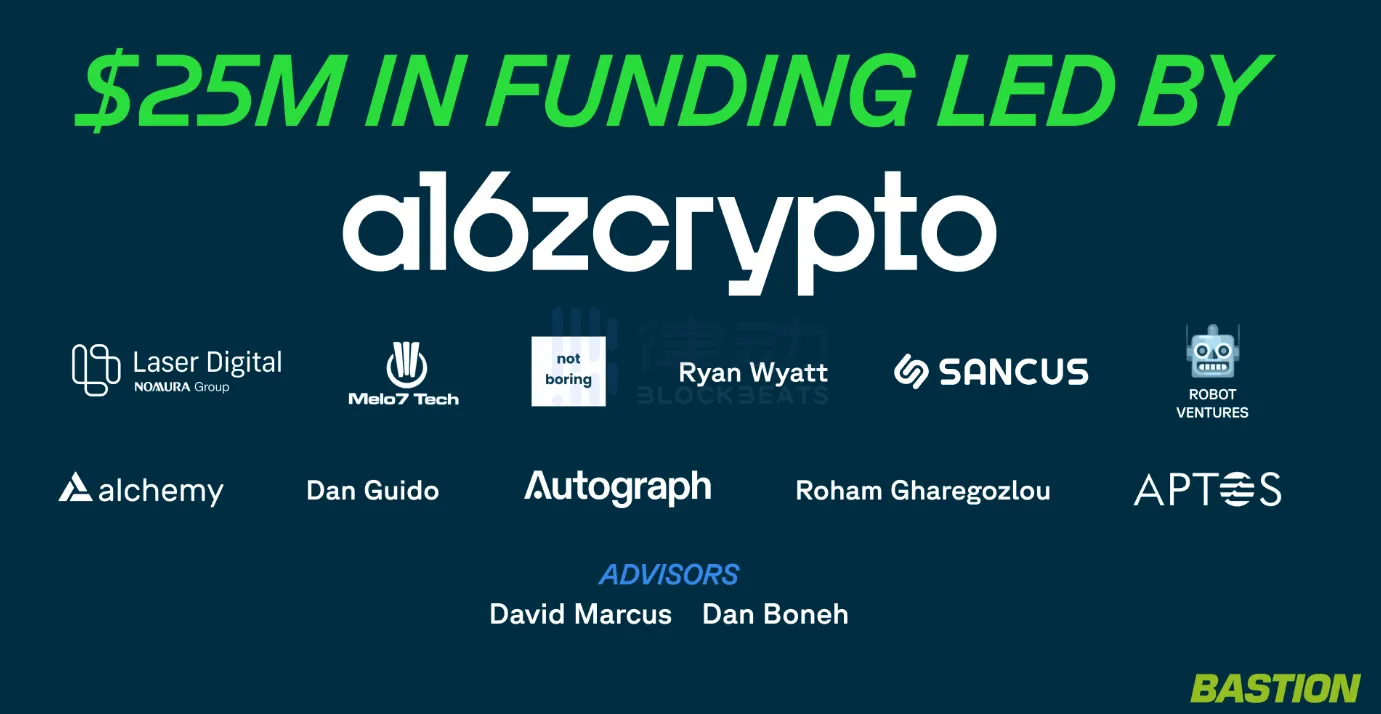
On September 18, according to Bloomberg, Bastion completed a $25 million seed round of financing, led by a16z crypto, and participated by Laser Digital Ventures, Robot Ventures, Not Boring Capital, etc. under Nomura Group. Bastion's two founders, Nassim Eddequiouaq and Riyaz Faizullabhoy, were both appointed by a16z, but their cooperation began 7 years ago.

7 years ago, Nassim and Riyaz met at Docker and worked together to ensure the security of Docker. Docker is an infrastructure platform designed to simplify running applications. It has become a ubiquitous technology among developers and cloud workloads because it accelerates the speed of launching consistent, secure and reliable applications, providing a seamless default security user experience.
Then, the two joined Anchorage Digital, which was their first professional foray into digital assets. As founding engineers of Anchorage Digital, Nass and Riyaz secured billions of dollars worth of cryptocurrencies for institutions and jointly built a hardware-backed private key storage platform, which eventually became the technology supporting the first federally chartered crypto bank. Subsequently, Riyaz and Nassim joined Meta's security infrastructure and blockchain department in 2019 with a one-month time difference. They turned their focus to large-scale consumer scale, designed and led the wallet infrastructure and custody plan of Meta's cryptocurrency wallet Novi.
Two years later, the two left at the same time and joined a16z, serving as CTO and CISO respectively. During their time at a16z, Nassim and Riyaz worked closely with many business founders and teams. The three previous work experiences made Nassim and Riyaz realize that the industry needs more than just wallets. Enterprises need a holistic platform that takes full advantage of the advantages of web3 and web2 to achieve user journeys while focusing on creating excellent products.
So in February of this year, Riyaz and Nassim founded Bastion and welcomed the first employee Caroline Friedman. Caroline joined Bastion as the company's chief of staff after leaving a16z Crypto. In her new role, she will help Bastion cope with the complex cryptocurrency regulatory environment. At the same time, Bastion stated that its team is composed of world-class security, engineering, compliance and operations experts from top companies that have built wallet infrastructure on a large scale.
Welcome to join the official BlockBeats community:
Telegram Subscription Group: https://t.me/theblockbeats
Telegram Discussion Group: https://t.me/BlockBeats_App
Official Twitter Account: https://twitter.com/BlockBeatsAsia

 Related Articles