Jcokerace, the angel investor with the most investments in the history of cryptocurrency, how did he achieve tokenless on-chain governance?

Author: Kaori, BlockBeats
"We need to make governance a feature of the app and integrate it into the user experience. This is a problem I have been thinking about, as well as how to make governance more interesting." This is the encryption mission set by David Phelps, founder of the on-chain governance platform Jcokerace.
If you are deeply involved in community governance, you may understand the indifference of most members to voting, or as a small holder, you may find that you cannot influence the voting results and give up researching proposals for voting. After the DeFi wave swept the blockchain world, the topic of DAO governance became very hot, and more and more projects began to make efforts in on-chain and off-chain governance.
On August 15th, Jcokerace, a blockchain governance platform, completed a $2 million pre-seed round of financing. Investors included 1kx, Boys Club, Seed Club Ventures, and over 90 angel investors, making it the project with the most angel investors in the history of cryptocurrency. It is worth mentioning that as an application-based project, most of Jcokerace's investors are users of the platform.

Jcokerace 是什么?
Jcokerace is what?
"Governance" vs "Competition", Tokenless Governance
Jcokerace is a platform that allows communities to create, execute, and reward decisions by deploying competitions on any EVM chain. These competitions allow users to submit responses to a particular problem and vote for their favorite responses. Use cases include bounties, hackathons, grants, award ceremonies, prediction games, protocol feature requests, DAO governance, and more.
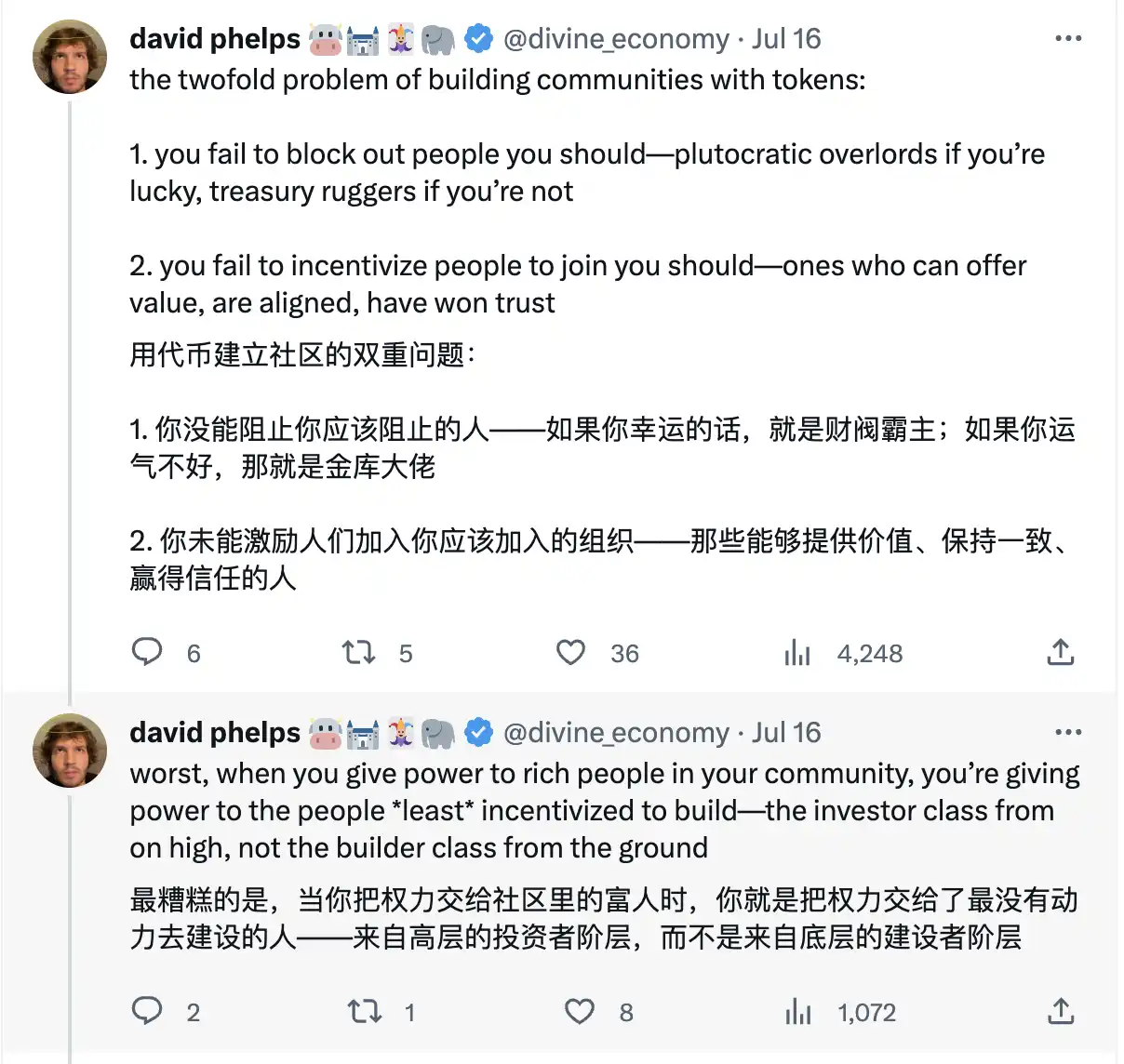
Jcokerace founder David Phelps has some reservations about the term "governance" - unless you're a hacker or a player trying to empty the treasury, "governance" is a bad system, which is why Jcokerace is switching to the term "contests".
The main governance method in the blockchain community is through token voting, but this method is gradually being questioned. As Vitalik said, "Paying $500 for a 0.0001% chance to influence the outcome of some votes is not a good deal. The only people who think this is a good deal are millionaires and hedge funds." Therefore, a pure token holder voting system can lead to inequality, misaligned incentives, and potential attacks through vote buying.
Related reading: "Vitalik Buterin: Governance Beyond Token Voting"
Jcokerace's "Contests" operate by creating a contest on the website, posting a question, and allowing people to submit answers to the question. Other users can then vote on their favorite answer, and if desired, a reward pool can be added for the winner to receive a prize. The eligibility to vote is determined by the person who posted the question, and the person who ultimately posted the question also receives a list of user data.
For example, if you want to create an on-chain "competition" for Twitter users who follow you, hoping they can provide more suggestions for your creation, just ask them to add the address to Guildhall, export it to column A of the spreadsheet, give them the desired voting weight in column B, and finally upload the CSV file to the Jcokerace website to complete the creation of the "competition". Some people submitted their proposed creative suggestions, while others submitted some content creation topics. When you think there are enough proposals, you can start voting, and the proposal person who ultimately gets more votes will receive the reward you set.
Phelps believes that every social media platform is a competition. For example, on Twitter, you can propose an idea to the world and ask, "What do you think about this?" Then, a group of people can express their agreement by liking and retweeting. Liking and retweeting are essentially votes - you are participating in a competition to compete with other content for visibility.
Jcokerace started raising funds after the FTX incident in 2022, and now, with the release of version v3, it has finally gained some discussion momentum. However, I think this is also due to the support of the community behind Jokedao. Regardless of whether it is Jokedao or Jcokerace, David Phelps (design, marketing, and BD) and Sean McCaffery (smart contract engineer) are the most core contributors.
David Phelps also provided me with a lot of fun in writing this article. His humorous writing style made Jcokerace's mirror article full of interest, but what really represents his personal style is his Twitter account.

David Phelps was once labeled as "anti-token". When asked if he cared, he said a friend told him that as a founder, the most important value is to be turned into an emoji. "Anti-token" may be remembered by more people, so Phelps gladly accepted it. However, this does not mean that Phelps is really against tokens, but rather believes that tokens may be more suitable as incentives rather than governance measures.
Modular Community's Descendant Coin World
Jcokerace v1 focuses on expanding the scope of on-chain governance, where the community can not only vote but also submit their responses based on voting prompts, giving them greater voice. Jcokerace v2 focuses on expanding the group of people who can execute on-chain governance, allowing anyone to easily launch a "competition" for no-code smart contracts with just a few clicks of the mouse.
Jcokerace v3 focuses on expanding the types of communities that can run on the chain. v3 replaces token voting with an on-chain whitelist, allowing for customization of who can submit proposals, who can vote, and how much voting power they have. According to the Jcokerace team, getting rid of tokens means that communities of any size can be launched.
Assuming you host a "competition" that offers a prize of 10,000 yuan for the best product suggestion or best user of the month. Anyone who wants to participate has the incentive to spend as much time as possible using your product carefully, and this 10,000 yuan is actually the cost of acquiring new users to deeply engage with the product and community. Because you can freely decide the voting weight of each address, you can provide double voting rights to those who have held your project tokens for more than a year or participated in previous "competitions", incentivizing them to hold tokens and continue to participate in the "competition". The voting incentive not only allows you to give voting rights to the most valuable community members, but also encourages everyone to contribute more value to the community in order to gain more power.
For users who submit product suggestions, even if they do not win the competition, the number of votes they receive will become on-chain reputation proof - these proofs are the best basis for you to receive airdrops for your project, as they are the only reliable indicator of the value they create for your project. Therefore, your users will also be motivated to continue participating in order to gain reputation for airdrops, voting rights, and/or access rights.
This is a modular community that Jcokerace v3 wants to build for the world of descendant tokens.
The existence of modular communities is based on the "competition" permissions set by users on Jcokerace. The community may become fixed over time, or it may evolve with each competition, merging multiple other communities, and even integrating different communities to submit proposals (people who follow you on Twitter) and vote (representatives selected in the competition).
How to create your own competition on Jcokerace
After all that has been said, let's take a look at some of the cases that differ from traditional on-chain governance on Jcokerace. Eco launched a "competition" to collect product feedback, and awarded the top three winners who submitted product or feature requests with 17,500 $ECO. CoinDesk launched a competition to determine "the person who has had the greatest impact on the cryptocurrency, blockchain, and web3 industry in the past year." What if you want to create your own "competition"? How do you operate it?
1. Open the Jcokerace website https://jokerace.xyz/, connect your wallet, and click "create contest".
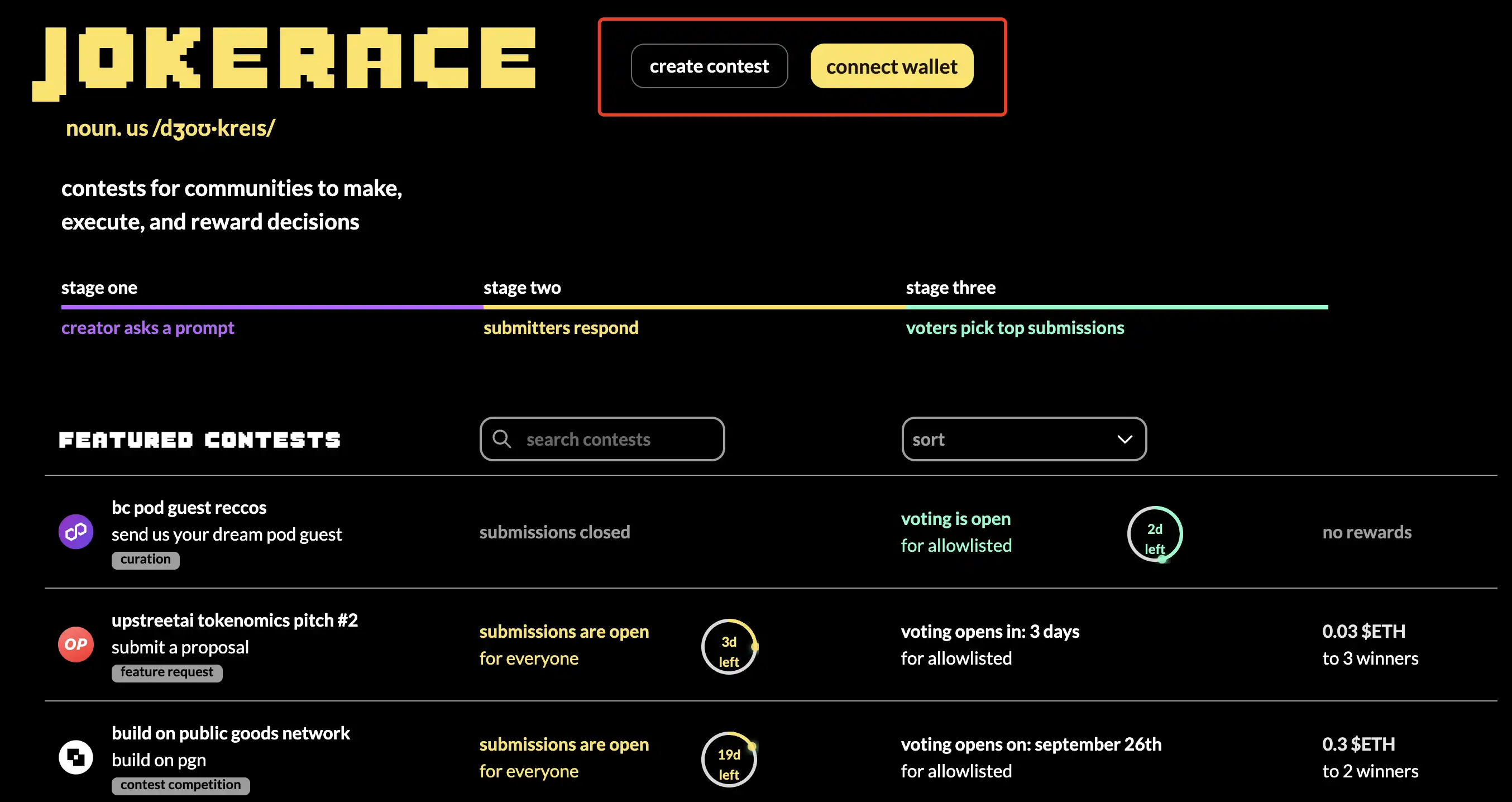
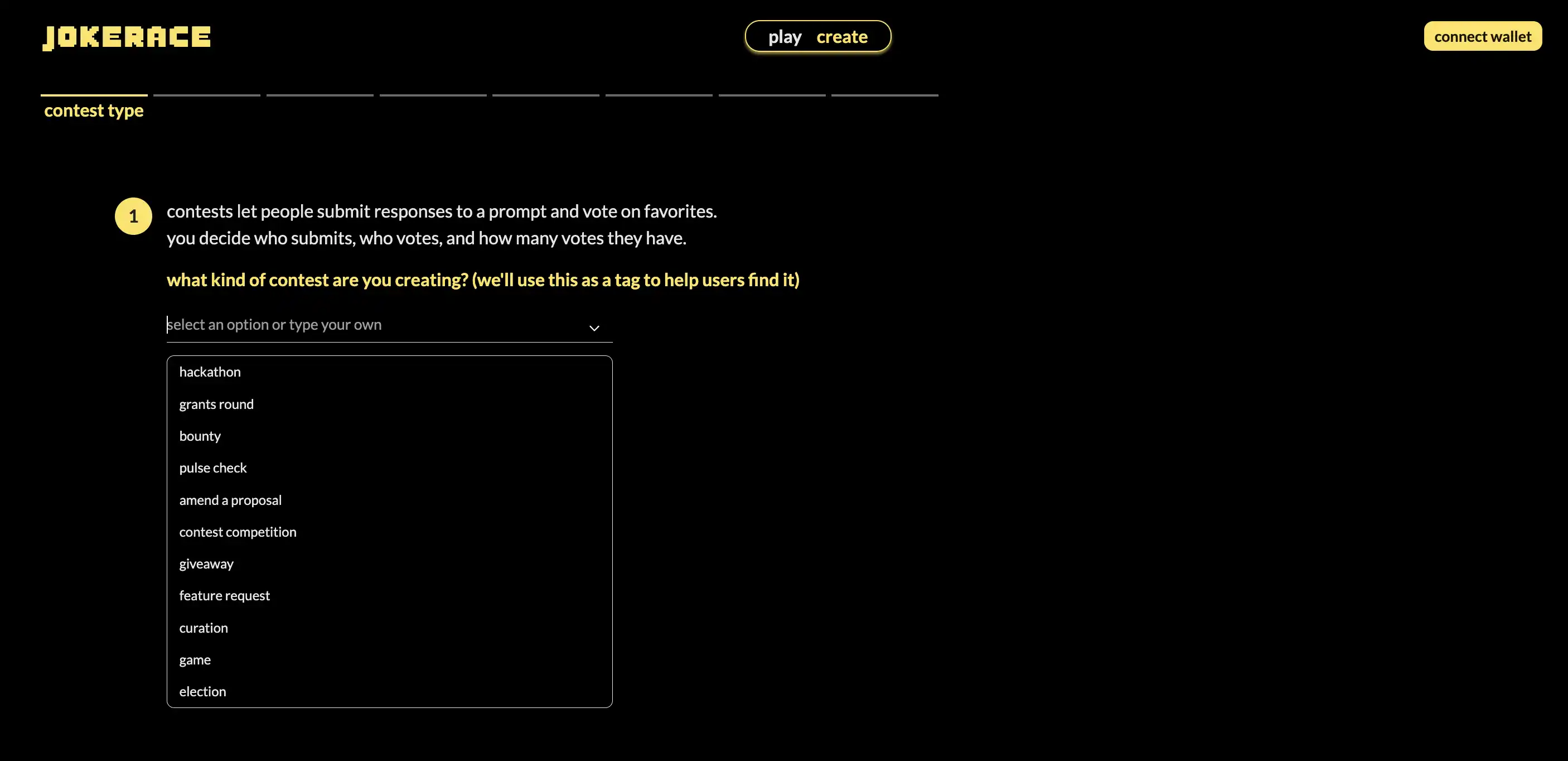
2. Choose your "competition" type and give it a clear and easy-to-spread name. The third step is to write a concise prompt for the "competition", such as "submitting projects", "proposing representatives", or "predicting the market".
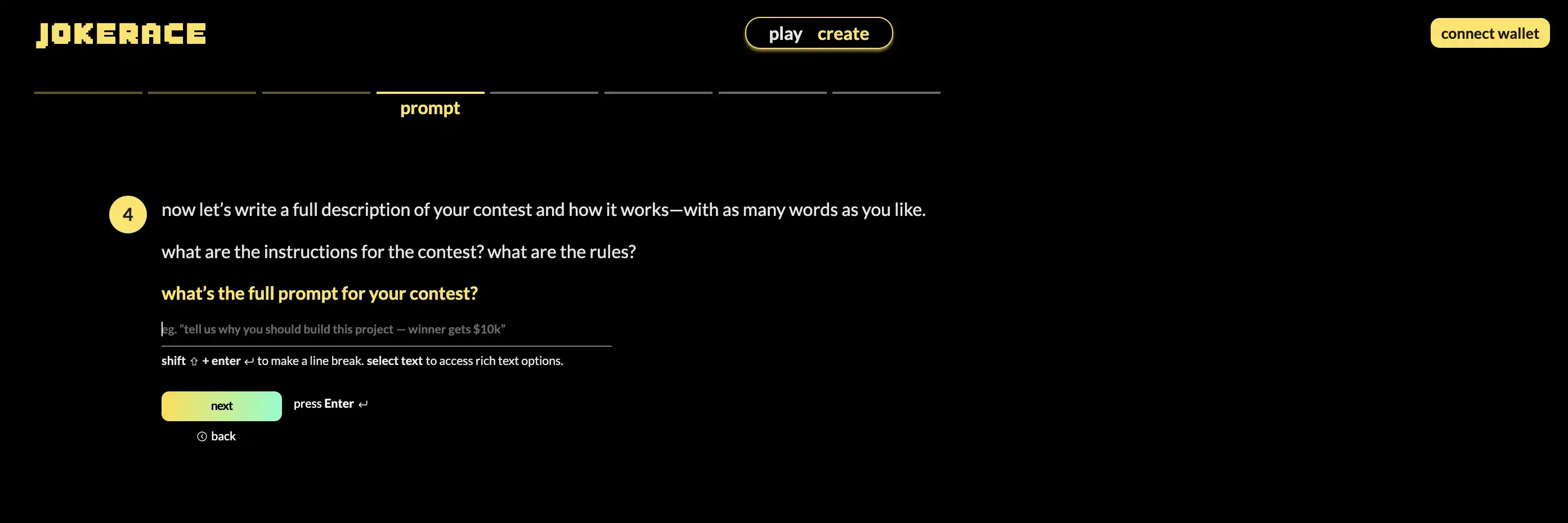
3. Write a detailed "competition" description.
4. Set various time nodes.

5. Submit the whitelist of eligible voters.
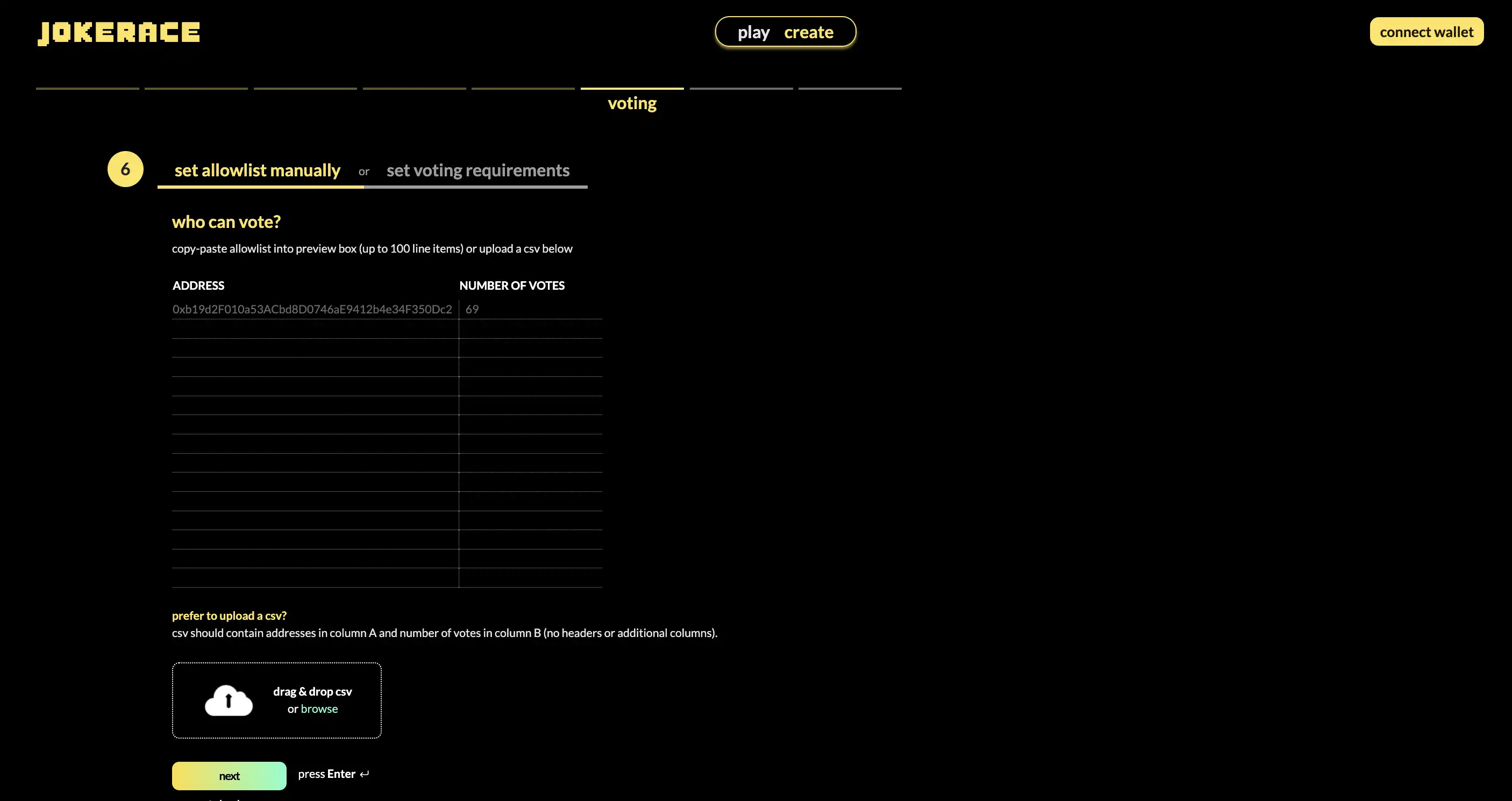
6. Determine who can submit proposals, which can be anyone or just the whitelist submitted in the previous step.
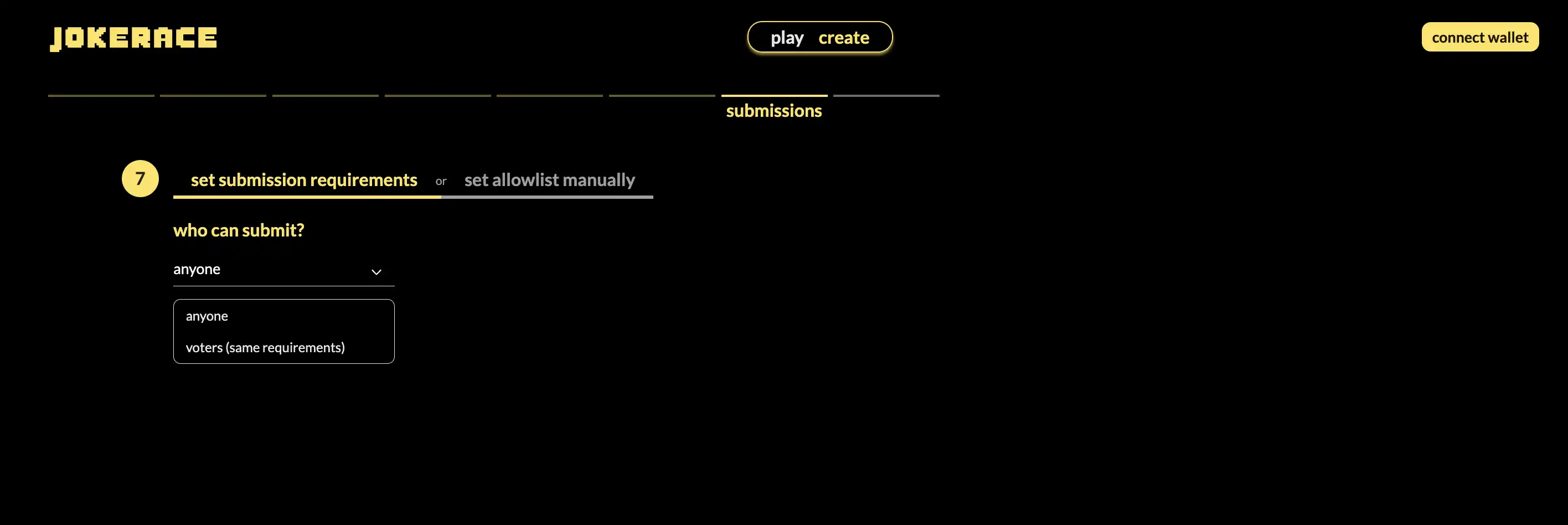
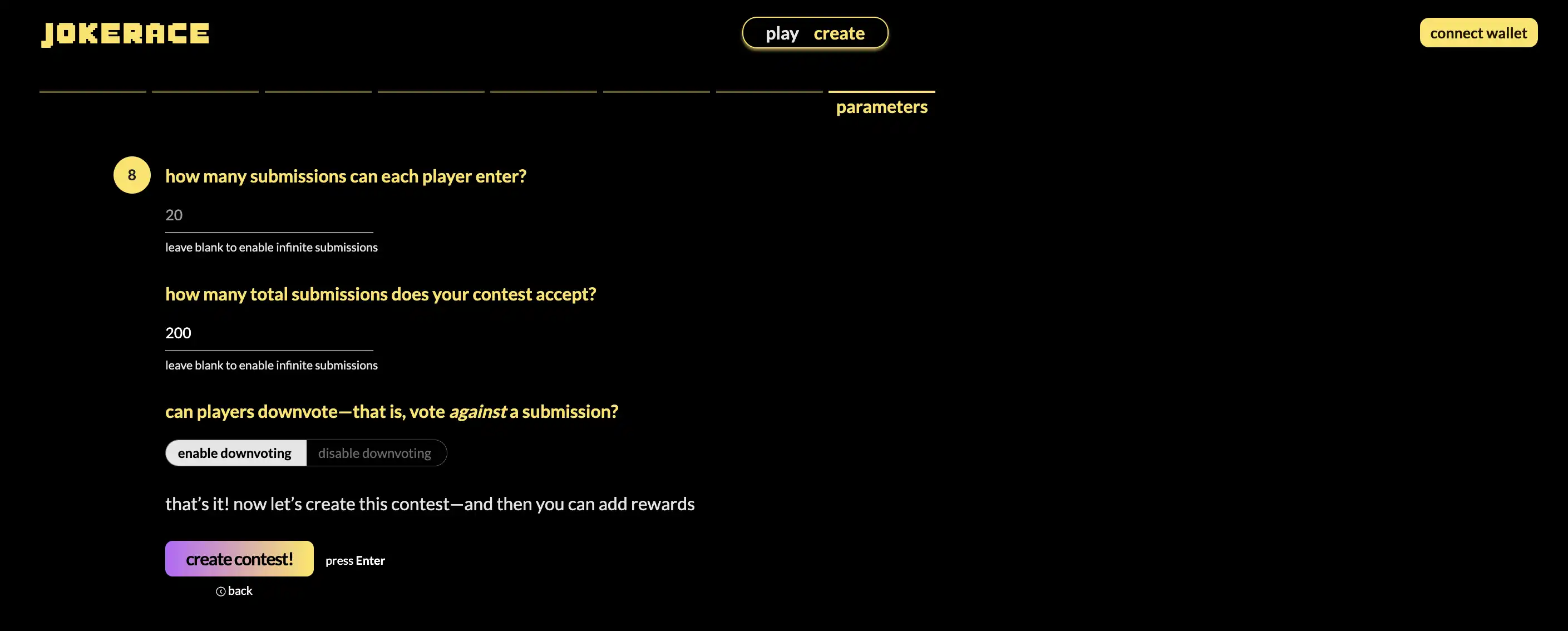
7. The final step is to set some submission quantity requirements for "competitions".
Written at the end
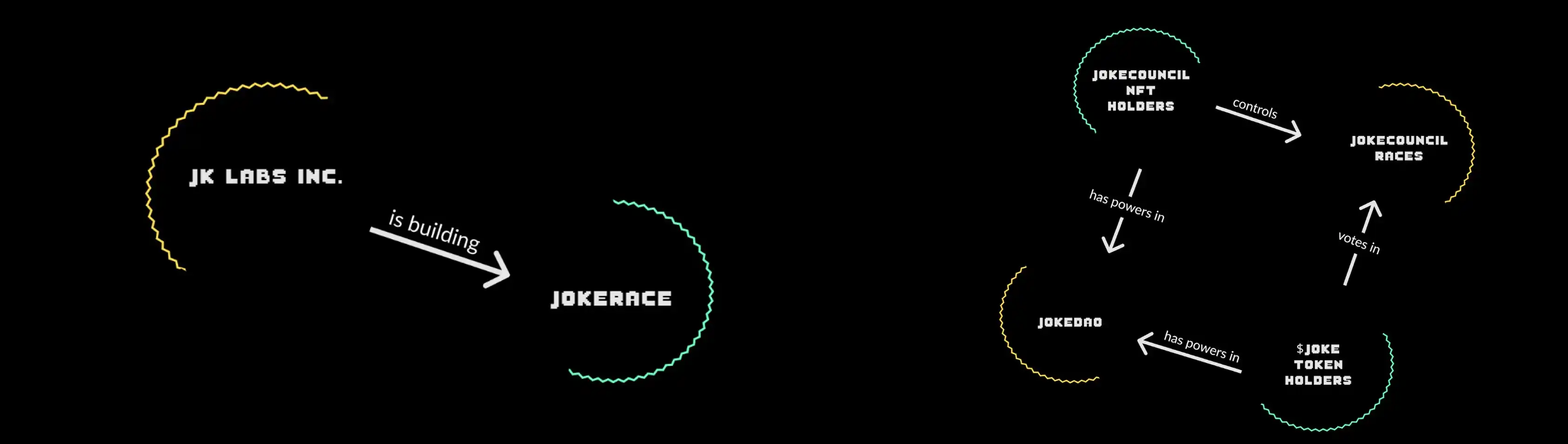
After understanding what Jokerace is doing, let's talk about JK Labs behind Jokerace and Jokedao, which has a similar name. In short, Jokerace is a competition platform built by JK Labs and is part of the brand "Jokerace". The brand currently includes Jokerace and an independent NFT community called the Joke Council, which was born out of a weekly joke competition. Jokedao is the name of this community and has its own multi-signature to manage its token $JOKE.
In traditional society, people have always believed that conspiracy is a terrible thing. However, in a small group, people gather together, discuss, negotiate, and compromise with each other, and have the ability to achieve what they want together. This is not only a good thing for governance itself, but also can establish lasting social relationships. But governance is difficult, and the road to decentralized governance on the Web is even longer and harder.
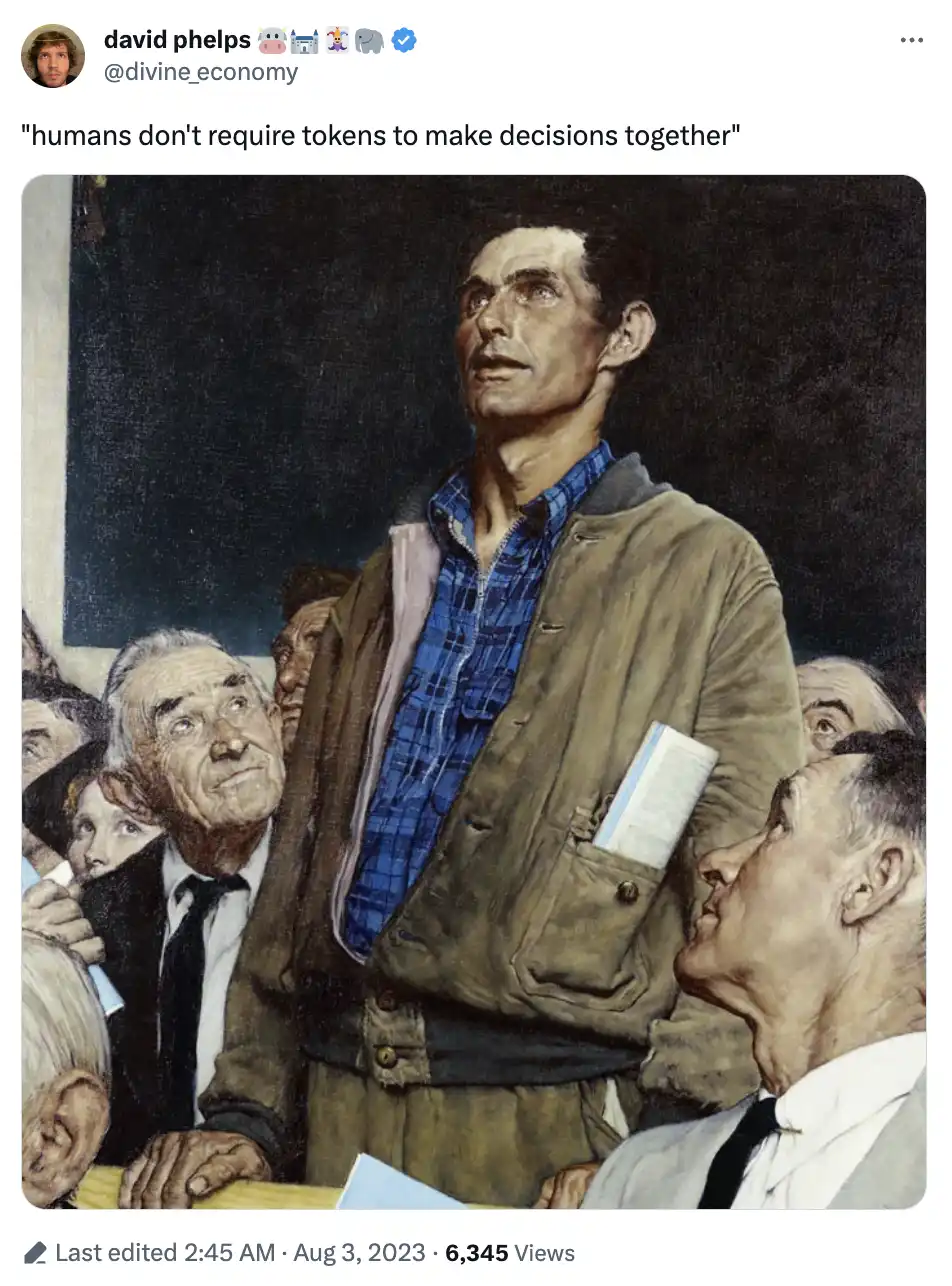
But as Jokerace founder David Phelps believes, "Tokens still play an important role in other aspects such as incentive mechanisms, but should not dominate community governance. We need to think about new possibilities in the post-token era."
Welcome to join the official BlockBeats community:
Telegram Subscription Group: https://t.me/theblockbeats
Telegram Discussion Group: https://t.me/BlockBeats_App
Official Twitter Account: https://twitter.com/BlockBeatsAsia

 Related Articles