WSJ Exclusive: Musk Buys Twitter, Things You Didn't Know

Original Title: " The Real Story of Musk's Twitter Takeover "
Original Source: " The Wall Street Journal "
Original Author: Walter Isaacson
Original Translation: czgsws, BlockBeats
Elon Musk, the world's richest person, founder of OpenAI and SpaceX, former owner of X (formerly Twitter), and CEO of Tesla, will have his personal biography "Elon Musk: Tesla, SpaceX, and the Quest for a Fantastic Future" officially released on September 12. This book, written by Walter Isaacson, the author of "Steve Jobs," a well-known contemporary American biographer, has excerpts of the "Twitter War" section previewed by "The Wall Street Journal." BlockBeats has organized and translated it as follows:
Gamer Addiction
In April 2022, everything was going unusually well for Elon Musk. Tesla's stock price had increased 15-fold in five years, surpassing the combined value of the next 9 automakers. SpaceX had launched rockets into orbit in the first quarter of 2022 twice as many as all other companies and countries combined. Starlink satellites had just successfully created a private internet, providing network services to 500,000 users across 40 countries, including Ukraine.
If Musk could navigate through 2022 smoothly, it would be a brilliant year, but that was evidently not his nature.
Shivon Zilis, an executive at Neuralink (Musk's company focused on implanted brain-machine interfaces) and the mother of Musk's two children, noticed in early April that Musk, despite his successes, was like a gaming addict unable to unplug and feeling restless.
Shivon Zilis had advised Musk at the time: "You don't have to always be in a state of war, or rather, when you are in a wartime period, do you find greater psychological comfort?"
"This is part of my default setting, I have always wanted to push the chips back onto the table or challenge the next level of the game." Musk replied.
Fate would have it that this unsettling period of success coincided with some soon-to-expire stock options, leaving him with about $10 billion in cash.
“I didn't want to leave it in the bank,” he said, “so I asked myself what product do I like, which is a simple question: Twitter.” In January of that year, Musk secretly instructed his private-equity manager, Jared Birchall, to start buying Twitter stock.
Musk's aggressive takeover of Twitter, renaming it X, signaled his current modus operandi: impulsive and irreverent. It was a playground that appealed to him. It had many of the features of a campus, including teasing and bullying. But for Twitter, the smart kids were the ones who gained followers. They weren't the ones who were pushed down the stairs and beaten up like Musk was as a child; having it would make him king of the campus.
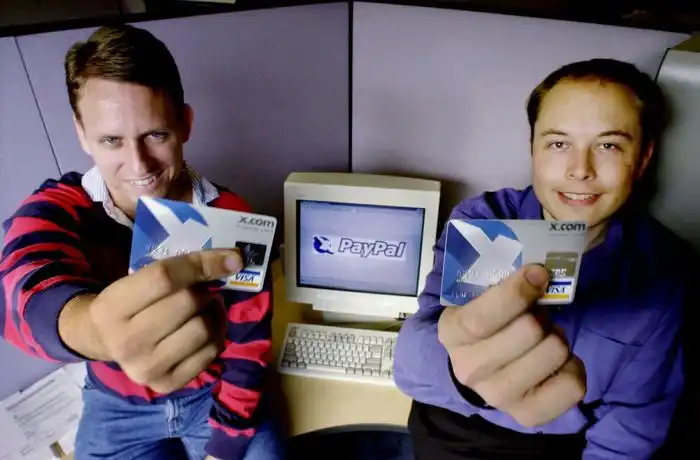
Elon Musk (right) and Peter Thiel's company merged to form PayPal in October 2000. Photo Credit: PAUL SAKUMA/AP
A New Perspective
Over two decades ago, Musk founded a company called X.com, aiming to create a “universal app” that could handle all of an individual's financial transactions and social relationships. After it merged with PayPal, a payment service co-founded by Peter Thiel, Musk fought hard to keep X.com as the name of the merged entity, but his new colleagues resisted. By then, PayPal had become a trusted brand, much like Twitter now with its recognizability and brand effects, whereas the name X.com was associated with some “dirty website.” Musk was ousted but remains resolute to this day.
Musk said, “If you want to be a niche player, PayPal is indeed a good name, but if you want to take over the world financial system, then X is a better choice.”
When he started buying Twitter stock, Musk saw Twitter as a way to achieve his original vision, feeling that the name Twitter was too narrow in scope.
Musk said, "Twitter could become what X.com should have become, and we can help save free speech in the process."
At that time, a new concern began to surface as Musk grew increasingly worried about the dangers of what he called the "awakening culture," believing this virus was infecting America.
Musk solemnly stated, "Civilization will never advance to a multiplanetary model unless the 'awakening culture' virus is stopped."
Musk's anti-awakening sentiment was to some extent triggered by his eldest child Xavier's (then 16) decision to transition.
"Hey, I'm transgender, and my name is now Jenna," the child texted Musk's brother's wife. "Don't tell Dad."
Later, Jenna cut off all ties with Musk, considering any wealthy person to be evil. Despite Musk's attempts at reconciliation, Jenna refused to spend time with Musk. Part of this was attributed to the ideology absorbed by Jenna at the progressive Crossroads School in Los Angeles where she was enrolled. He believed, Twitter has been influenced by left-wing voices.
"Twitter Needs a Fire-Breathing Dragon"
On the evening following the revelation of his purchase of Twitter stock, Musk called then Twitter CEO Parag Agrawal, and they decided to meet secretly with Twitter board chairman Bret Taylor for dinner on March 31.
Musk found Agrawal likable. "He's a very nice person," he said. But that's the problem. If you ask Musk what traits a CEO needs, being a genuinely nice person wouldn't make the list. One of his mottos is managers should not aim to be likable. After that meeting, he said, "Twitter needs a fire-breathing dragon, and Agrawal is not that."
At that time, Musk had not yet considered taking over Twitter personally. Following their meeting, Agrawal invited him to join the Twitter board, to which he agreed, but the calm was short-lived.
Musk's X.com Vision
On the afternoon of April 6, the day after Musk announced joining the Twitter board,
Musk's close friends — Luke Nosek and Ken Howery — expressed caution at the gathering, "This could be trouble." Musk happily acknowledged at the meeting, "Obviously, the asylum is run by the inmates." He referred to Twitter's staff.
The Twitter logo on the New York Stock Exchange floor, November 2021. Photo by: RICHARD DREW/AP
Musk reiterated his simple view that if Twitter stops trying to restrict user speech, it would benefit democracy. Although Howery agreed with Musk's liberal view of free speech, he gently pushed back. "Should it be like a phone system, where what goes in on one end comes out the same on the other? Or do you think of it more as a system that manages global discourse, maybe introducing some intelligence into the algorithm to differentiate the priority of things or de-prioritize them?"
"Yes, it's a tricky question," Musk replied. "Another question is how much should free speech be elevated or amplified, maybe the way tweets are promoted should be more open, maybe it's an open-source algorithm on GitHub so people can filter it."
Musk then threw out some other ideas. "What if we charge people a small amount, like two dollars a month, for verification?" he asked. Musk believed that getting users' credit card information would eliminate "bots," provide a new revenue source, and further his goal of transforming Twitter into a payment platform, much like his vision for X.com, where people could make transfers, tip, and pay for stories, music, and video content. Because Howery and Nosek had worked with Musk at PayPal, they liked the idea.
"It could fulfill my original vision for X.com and PayPal," Musk said with a smile.
The next day, Musk's brother Kimbal told him during lunch that it would be best to launch a new blockchain-based social media platform. Musk was very interested in this idea and got into a dazzling state. Half-jokingly, he said, maybe it could have a payment system using Dogecoin (DOGE), a semi-serious cryptocurrency that Musk had been quietly funding. After lunch, he sent Kimbal several text messages elaborating on the idea of "a blockchain social media system that can both facilitate payments and enable short messaging like Twitter."
He then flew to Lanai, Hawaii, for a quiet date with an occasional companion, Australian actress Natasha Bassett. However, Musk did not treat it as a relaxing mini-vacation but instead spent four days pondering how to deal with Twitter.
Most of the first night, Musk struggled to fall asleep, troubled by the issues facing Twitter. When he looked at the list of users with the most followers, he found that they were no longer very active. So, at 3:32 a.m. Hawaii time, he tweeted: "Most 'top' accounts tweet very little, and the content is sparse. Is Twitter dying?"
Approximately 90 minutes later, Twitter CEO Agrawal texted Musk: "You are free to tweet 'Is Twitter dying?' or any other Twitter-related content, but I must responsibly tell you that it does not help me make Twitter better in the current context." It was a restrained message, carefully worded.
When Musk received the message, it was just past 5 a.m. in Hawaii, but he was still wide awake. He harshly replied, "What have you done this week? I will not join the board; it's a waste of time. I will propose taking Twitter private."
Agrawal was shocked. "Can we talk?" he plaintively asked.
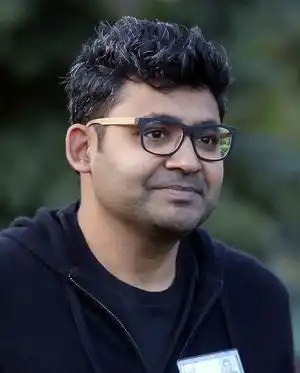
Parag Agrawal, photographed in July 2022, was the CEO of Twitter when Musk acquired it. Photo credit: KEVIN DIETSCH/GETTY IMAGES
Within three minutes, Twitter board chairman Taylor texted Musk, asking for a similar conversation. "Can you give me five minutes to understand what's going on?" he asked Musk.
"Fixing Twitter by chatting with Agrawal is not going to work," Musk replied. "Strong action is needed."
Musk's "One Proposal"
Musk said that when he arrived in Hawaii, he realized clearly that he would not be able to fix Twitter by joining the board or turning it into X.com: "I decided I didn't want to be co-opted into being a board member or be some kind of sycophant on the board." There was another factor. Musk was in a manic state at the time, acting impulsively.
As usual, his thoughts swung wildly with his mood. Just as he was aggressively pursuing the acquisition of Twitter, he was also texting with Kimbal about their idea to start a new social media company. "I think we need a new social media company based on blockchain and including a payment feature," he wrote.
But by later that afternoon (Saturday, April 9), he had settled back on the idea of acquiring Twitter. "It already has a certain user base, and it needs that booster to kick off X.com," he texted his private business manager Birchall.
Subsequently, Musk flew to Vancouver to meet his on-and-off girlfriend, Claire Boucher, a performing artist known as "Grimes." She had been urging Musk to come see her so she could introduce their son X (yes, X) to her parents and elderly grandparents. But when she was about to drive to her parents', she decided to leave Musk at the hotel. "I could tell he was in stress mode," she said.
Indeed, he was. Later that afternoon, Musk texted Twitter board chairman Taylor formally declaring his decision. "After several days of serious consideration—this is obviously a serious matter—I have decided to continue with the privatization of Twitter." he said.
That evening, girlfriend Grimes returned to the hotel to find Musk engrossed in a new video game called "Elden Ring" to unwind, as he had downloaded the game onto his laptop. The game featured intricately rendered cryptic clues and a bizarrely twisted plot that demanded the player's full attention, especially in timing attacks. Musk spent a lot of time in the game's most perilous area. "He didn't sleep," Grimes said, "He played until 5:30 a.m."
Shortly after the game, Musk tweeted: “I made an offer.”

On October 26, 2022, just before the completion of his acquisition of the company, Musk jokingly walked into the Twitter headquarters holding a tank. Photo Source: Musk's personal Twitter account
Subsequently, Musk began seeking outside investors to help fund his acquisition. He approached his brother Kimbal, who declined. The fundraising efforts saw greater success under the leadership of Oracle co-founder Lawrence Joseph “Larry” Ellison. “Yes, of course,” Ellison replied when Musk asked if he was interested in investing in the deal.
“How much could you put in?” Musk inquired. “I'm not asking you to do anything, but this deal is oversubscribed, so I have to cut down or kick out some participants.”
“A billion,” Ellison said, “or you name the number.”
Ellison hadn't tweeted in a decade. In fact, he didn't remember his Twitter password, so Musk had to personally reset it for him. But Ellison saw the importance of Twitter. “It's a real-time news service and there's nothing better, so if you agree that it's important for democracy, then I think it's worth investing in.”
“My bullshit detector went off like a red alert”
Sam Bankman-Fried (SBF), a person eager to be part of the deal, is the founder of the cryptocurrency exchange platform FTX, but he soon fell from grace. Morgan Stanley urged Musk to call SBF, calling him the “lead for the social media blockchain integration engineering” and investing $5 billion in the acquisition deal.
Despite discussing with Kimbal the idea of building a social network on the blockchain, Musk found this approach too slow to support the fast-paced nature of Twitter posts. So he didn't want to meet SBF. When his banker insisted by reiterating that SBF “can pay $5 billion,” Musk responded directly to the information with a “dislike” expression. “A blockchain Twitter is impossible because a peer-to-peer network cannot support such high bandwidth and latency requirements,” Musk stated, noting he might meet SBF at some point as long as it doesn't involve a grueling blockchain debate.
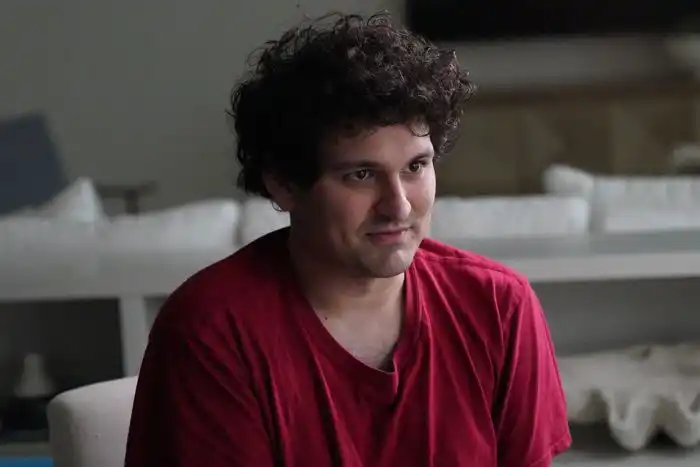
In December 2022, Musk turned down FTX founder Sam Bankman-Fried's proposal, who texted Musk saying he was "very excited about what you will do with TWTR." Photo credit: KENNY WASSUS/WSJ
SBF then texted Musk directly saying he was "very excited about what you will do with TWTR." SBF mentioned he owned $1 billion worth of Twitter stock, which meant that once Musk took it private, his Twitter stock would convert into shares of the new company.
"Sorry, who was this message from?" Musk replied to the text. When SBF apologized and introduced himself, Musk responded briefly, "You're welcome to join."
Musk's demeanor led to a subsequent call from SBF in May. "My BS detector went off like a Geiger counter in Chernobyl," Musk said. SBF started speaking rapidly, all about himself. "He talked like he was running a mile a minute," Musk said. "I thought he'd be asking me questions about the deal, but he kept telling me what he was doing. I was like, 'Buddy, slow down.'" However, this feeling was mutual, as SBF also thought Musk seemed unhinged, and after a half-hour call, SBF ultimately did not invest.
Completion of Acquisition
Musk successfully raised funds, and Twitter's board accepted his plan at the end of April. That evening, Musk didn't celebrate but instead flew to the Starbase rocket launch site in southern Texas. There, he attended a routine nighttime meeting about redesigning the Raptor engine and spent over an hour contemplating how to handle the unidentified methane leak issue they were facing. While news of the Twitter deal was the hottest topic globally, SpaceX engineers knew he liked to focus on the task at hand, so nobody brought it up. Later, he ran into Kimbal at a roadside café in Brownsville where local musicians played. They stayed until 2 a.m., sitting at a table near the stage, just listening to the music.

In April 2023, the SpaceX Starship rocket launched for testing in Boca Chica, Texas. Photo credit: PATRICK T. FALLON/AFP/GETTY IMAGES
During the months between reaching the deal agreement and finalizing the transaction, Musk's emotions were turbulent. "I am very excited about finally achieving X.com, just as it should, using Twitter as a catalyst!"
A few days later, his mood darkened further. "I need to live at Twitter headquarters, the situation here is too difficult to handle, really frustrating, I can hardly sleep there." Musk expressed doubt about taking on such a chaotic challenge. "I have a bad habit of biting off more than I can chew," Musk admitted in a long conversation. "I think I just need to think a little less about Twitter."
A whistleblower and others' revelations further convinced him that Twitter had lied about its actual user numbers, and his initial $44 billion bid was too high. He wanted a more appropriate deal price. Throughout September, he would call his lawyers three or four times a day. At times he would get excited, insisting they could beat the lawsuit filed by Twitter in Delaware. "They are throwing bricks at the dumpster they are in," he said of the Twitter board. "I can't believe a judge would smoothly approve this deal; it won't get public acceptance."
Musk's lawyers eventually convinced him that if they took the case to court, he would surely lose, and it was best to just close the deal as per the original terms. By then, Musk had even regained some enthusiasm for taking over the company. "You could say I should be paying a premium because all the people running Twitter are fools and idiots; the potential of Twitter is so huge, there are many things I can fix." In the end, Musk agreed to finalize the deal in October.

On October 27, 2022, Musk celebrated the completion of the Twitter deal with a bottle of Pappy van Winkle bourbon whiskey. Photo credit: WALTER ISAACSON
"All these damn birds have to go"
Elon Musk is planning to visit Twitter in San Francisco on Wednesday, October 26 for an exploration and to prepare for the formal completion of the acquisition scheduled for Friday. As he roamed around the headquarters, he seemed quite surprised. The headquarters is located in a 10-story Art Deco-style building built in 1937, formerly a merchandise mart, now renovated with a tech-chic aesthetic featuring amenities like a coffee bar, yoga studio, gym, and game room. The spacious cafeteria on the ninth floor offers complimentary meals ranging from handcrafted burgers to vegan salads. The restroom bears a sign saying "All-Gender Restroom," and as Musk flipped through cabinets full of Twitter-branded merchandise, he found a T-shirt emblazoned with “Stay Woke”, which he waved as an example of what he believes has permeated the company .
There is a fundamental disagreement between Twitter and Musk regarding the business metaverse. Twitter prides itself on being a friendly platform where indulgence is considered a virtue. “We absolutely have a high degree of empathy, care deeply about inclusivity and diversity; everyone needs to feel safe here,” said Leslie Berland, who served as Chief Marketing and HR Officer until Musk fired her. The company has established permanent remote work options and allows for a monthly mental "health day." One of the company's commonly used phrases is “psychological safety”. Careful not to cause discomfort.
Upon hearing the term "psychological safety," Musk smirked, finding it hard to agree. He sees it as the enemy of urgency, progress. His favorite catchphrase is “Hardcore”. He believes discomfort is a good thing, a weapon against complacency. Holidays, work-life balance, and "mental rest" days are not for him.
He first found it amusing, then grew disgusted by the ubiquitous sight of Twitter's iconic blue bird logo throughout the company. Musk is not a lively person; he enjoys darkness and stormy drama, not cheerful and light-hearted chit-chat. “All these damn birds have got to go,” he told a mid-level manager.
The Twitter acquisition was set to complete on Friday. By the time the stock market opened that morning, a smooth transition plan was in place. Funds would be transferred, stocks delisted, and Musk would take control. This would allow Agrawal and his senior Twitter lieutenants to collect severance packages and stock options.
But Musk had other plans. On the afternoon before the scheduled closing, he meticulously orchestrated a jiu-jitsu maneuver: he would force a swift after-hours close. If his lawyers and bankers timed everything right, he could “reasonably” dismiss Agrawal and the other Twitter executives before their stock options vested.
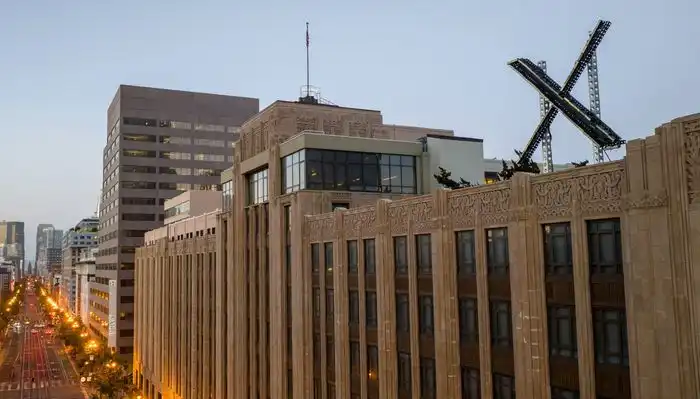
On July 29, 2023, the newly built X sign on the roof of Twitter's headquarters in San Francisco. Photo Source: JOSH EDELSON/AFP/GETTY IMAGES
This is bold, even brutal. But Musk saw it as fair, convinced that Twitter's management had misled him. Late Thursday afternoon, as the plan unfolded, Musk told everyone, "Choose to shut down tonight and shut down again tomorrow morning, there will be a $200 million delta in the cookie jar."
At 4:12 p.m. Pacific Time, once they confirmed the funds had been transferred, Musk pulled the trigger to complete the transaction. At that moment, his aide handed dismissal letters to Agrawal and his three top lieutenants. Six minutes later, Musk's head of security arrived in the second-floor conference room, announcing that everyone had "exited" the building, and their email access had been cut off.
Immediate email cutoff was part of the plan. Agrawal had his resignation letter ready on the grounds of a change in control. But after his Twitter email was cut off, it took him a few minutes to send the document to his Gmail. By then, he had already been fired by Musk.
"He tried to resign," Musk said.
"But we beat him to it," replied his gun-slinging lawyer, Alex Spiro.
Original Article Link
Welcome to join the official BlockBeats community:
Telegram Subscription Group: https://t.me/theblockbeats
Telegram Discussion Group: https://t.me/BlockBeats_App
Official Twitter Account: https://twitter.com/BlockBeatsAsia