The first group of people using AI for stock trading perfectly missed the US tech stock bull market

Original Title: "AI Funds Are Missing Out on the AI Stock Boom"
Original Author: Bob Henderson, WSJ
Original Translation: Logicrw, BlockBeats
Although it's still early days, AI has not shown a significant advantage in its role as an investment manager so far.
At least 13 exchange-traded funds (ETFs) have used AI applications to manage their portfolios. However, almost all of these funds have failed to deliver strong returns in this year's tech-driven market surge. Their performance has lagged behind benchmark indices like the S&P 500. This is ironic given investors' enthusiasm for the AI theme and reflects the limitations of technology in the highly competitive field of stock picking.
Take the WisdomTree U.S. AI Enhanced Value Fund, for example, with the ticker symbol AIVL and assets under management of $385 million. This year, the fund has a total return of 2.2%, while an ETF tracking the Russell 1000 Value Index (AIVL's benchmark) has risen by 4.5%.
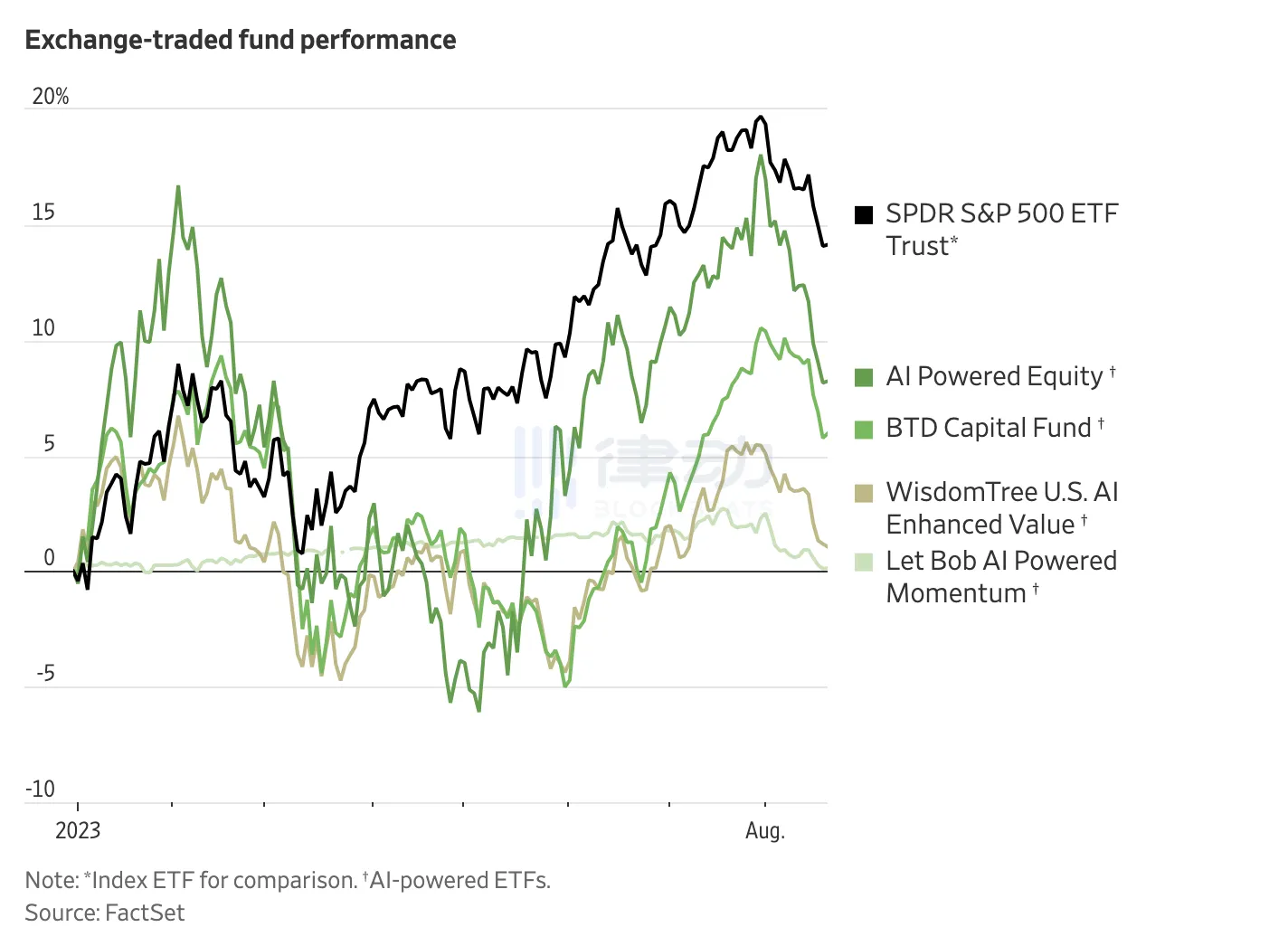
The primary reason for AIVL's underperformance is its AI's refusal to buy shares of Facebook's parent company and AI giant, Meta Platforms. The latter's stock price has surged over 135% since last December, partly due to the company's investments in AI-related technologies.
"Meta's stock price has skyrocketed very, very, very impressively, and the algorithm thinks it's overvalued," said Chrissy Bargeron, a stock client investment manager at Voya Investment Management. The company developed this algorithm for WisdomTree's funds.
ETFs leveraging AI technology, much like chatbots such as ChatGPT, make predictions by harnessing AI's ability to discover patterns in vast amounts of data. Investment managers choose a trading strategy, then train AI on extensive historical information to guide it on trading based on the most effective past strategies.
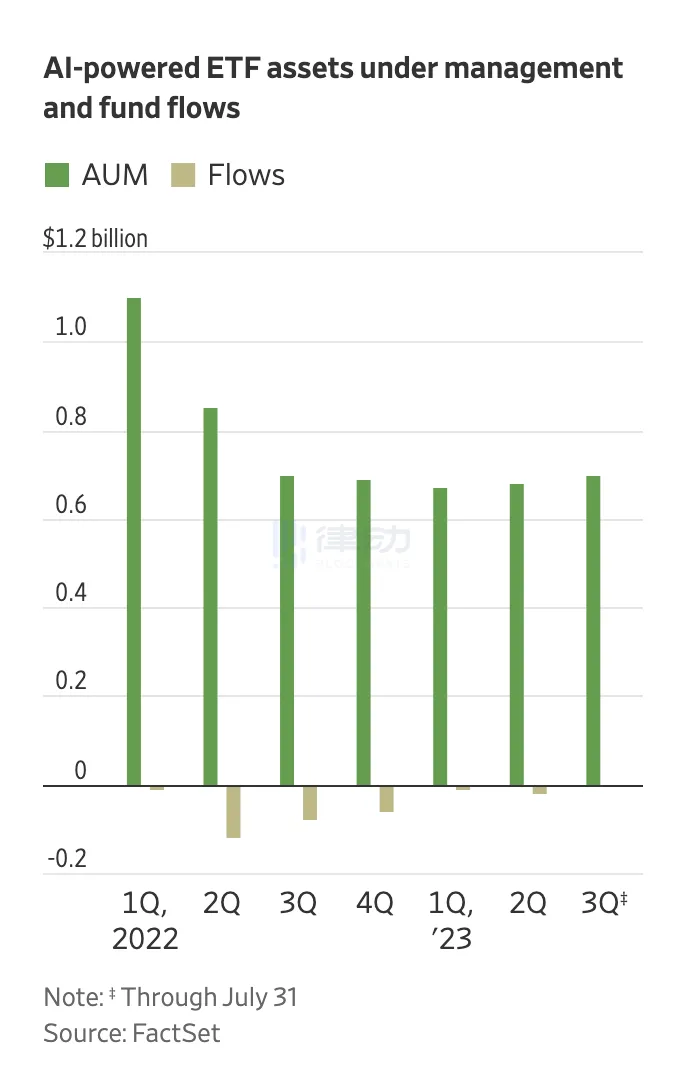
Possibly due to this underperformance, despite investor enthusiasm for AI-themed stocks and actively managed ETFs, they have not been drawn to AI-reliant funds. According to The Wall Street Journal's analysis, the 13 firms oversee about $670 million in assets, just a tiny slice of the $7 trillion ETF market, and have seen outflows of more than $300 million this year and last.
AI-reliant funds promise to circumvent various costs of human decision-making in investing and bring hedge fund-like technology to the masses. According to research by Eric Ghysels, a professor of economics and finance at the University of North Carolina at Chapel Hill, AI can indeed sometimes better time stock trades than individual investors. However, Ghysels notes that AI cannot adapt quickly enough in paradigm-shifting events such as 9/11 or the Russian invasion of Ukraine, making it unable to consistently outperform a professional money manager in the long term.
Ghysels states, "Perhaps one day it will, but for now, AI is still limited to mimicking history."
Ghysels argues that the human brains driving these robot funds often blame their underperformance on the strategies they set for the AI. Voya's Bargeron says that AIVL is seeking value investment opportunities in a challenging environment for value stocks.
Supporters argue that as AI continues to undergo retraining with new data, its performance will improve over time, although evidence supporting this view is not conclusive.
The earliest AI-driven exchange-traded fund was launched in 2017, called the AI Powered Equity ETF, with the ticker AIEQ. It runs on IBM's Watson supercomputer and makes bets based on the analysis of millions of news articles, social media posts, analyst reports, and financial statements. This year, it has risen by 9%, mainly lagging the overall market due to spreading its bullish bets too thin across too many stocks, missing out on the surge of the "seven tech giants" driving the market in the first five months of 2023.
AIEQ outperformed major indices in its initial years, but in 2022, it suffered a significant blow due to a stock market crash triggered by a sharp Fed rate hike. Since inception, AIEQ has a total return of about 44%, while over the same period, the SPY ETF tracking the S&P 500 index has a return of 93%.
"This is machine learning, not machine knowing," said Art Amador, Co-Founder and COO of EquBot. The AI fintech company collaborated with IBM to develop the technology behind AIEQ. Amador said, the next time the Fed takes last year's actions, AIEQ's AI will say, 'Ah! I know this!'
This learning curve presents a challenge for investors. Jack Butler, a 60-year-old irrigation product company owner from Encinitas, California, said that on the one hand, it may be wise to get in early before AI funds fully develop and eliminate investment opportunities in the market. On the other hand, the illusions of programs like ChatGPT and other errors give him pause.
He said, "I think there will be early mistakes, and I really don't want to be part of those mistakes."
Original Article Link
Welcome to join the official BlockBeats community:
Telegram Subscription Group: https://t.me/theblockbeats
Telegram Discussion Group: https://t.me/BlockBeats_App
Official Twitter Account: https://twitter.com/BlockBeatsAsia

 Related Articles