On this day in history | Eight-year block size war, the balancing philosophy of blockchain revelation.

Until today, block size has been one of the most discussed topics among blockchain developers. How much content a block can hold affects the hardware requirements of nodes and thus the decentralization of the entire chain. Different views on this issue have also led to different consensus designs, and of course, many well-known forks. Looking back at the brief history of cryptocurrency, all of this may have started eight years ago today.
On August 15, 2015, two early Bitcoin technology pioneers, Gavin Andresen and Mike Hearn, announced in a blog post that their new version of BitcoinXT would implement the BIP-101 proposal without requiring a vote from miners, and would be activated directly. This day later became known as the "block size war outbreak day".
Blockchain Crossroads
Since the birth of Bitcoin in 2009, the Bitcoin community has been divided on some key issues. Among them, the debate over the size of the Bitcoin block has been the most intense. This controversy originated from the original design of Bitcoin. The mysterious founder, Satoshi Nakamoto, set a limit of 1 megabyte for the size of each block to prevent meaningless transactions and data expansion. However, as Bitcoin became more popular, this limit began to appear inadequate, leading to network congestion and longer confirmation times for transactions. In fact, as early as 2013, core developer Jeff Garzik proposed doubling the block size to 2 megabytes, sparking the Bitcoin community's initial discussion on block size.
In 2015, the controversy escalated. Developers who supported expanding the block initiated the Bitcoin XT project, attempting to directly increase the block size to 8 megabytes.
On the one hand, Gavin Andresen and Mike Hearn, two original developers who had in-depth communication with Satoshi Nakamoto, tend to increase the block size to 8 megabytes as a strategy to cope with the growth of transaction volume. On the other hand, core developers such as Greg Maxell, Luke-Jr, and Pieter Wuille warn that excessive expansion may lead to fewer nodes being able to run full nodes, reducing the decentralization of Bitcoin. They even suggest that a hard fork may cause chaotic division of the network, and pursuing unlimited expansion of blocks is not the best solution for scalability.
Meanwhile, in 2015, Ethereum was born. Its founder, Vitalik Buterin, although a staunch supporter of big blocks, had his ideas focused on the Ethereum blockchain. He believed that the scalability of the chain should have no boundaries, and that all smart contracts and data should be included in the chain, while providing larger blocks and lower transaction fees.
This controversy later evolved into a serious split within the Bitcoin community. The two sides engaged in multiple rounds of intense discussions around block size, but were never able to reach a consensus. The block size war initially revolved around how the network could be scaled to handle increased transaction volume, but later evolved into a philosophical debate about the ultimate goal of Bitcoin and the "political drama" of how to manage this open source project.
In 2017, developers who supported large blocks initiated a hard fork of Bitcoin, creating Bitcoin Cash with a block size directly increased to 8 megabytes. This caused the Bitcoin community to officially split into two factions. Those who supported small blocks continued to maintain the original Bitcoin blockchain, while those who supported large blocks created a new Bitcoin Cash blockchain. Thus, the Bitcoin block size controversy led to the first and largest fork in blockchain history.
After the fork, the two chains developed separately, and the controversy over block size continued. Bitcoin maintained a block size of 1 megabyte, while Bitcoin Cash further increased the block size to 32 megabytes in 2018. In the end, the small block camp won the block size war. However, winning one battle does not mean the war is over, as new BIPs are constantly being proposed and there are still many debates between the small block camp and the big block camp.
Brc20, Ordinals: A New Battlefield for Power Struggles
The Bitcoin Taproot upgrade inadvertently opened up a new design space, allowing users to engrave any content on the blockchain. In 2023, the Bitcoin ecosystem gained some unexpected gameplay, including brc20, ordinals, and Bitcoin NFTs. With the emergence of these gameplay options, new controversies have arisen and escalated, but many consider them to be another form of the block size war.
First of all, the emergence of these gameplay methods has led to a surge in Gas fees. From the perspective of miners, this is undoubtedly a good thing, because from the summer of 2021 to early 2023, the Bitcoin block space is almost a barren land, and miners' income is very low. But for some people who cannot afford high Gas fees, this is not a good thing. "I mainly work in Africa. They don't have the privilege like you to pay these high fees. They really need BTC, while you guys are just playing," Bitcoin educator and Anita Posch wrote on Twitter.
More importantly, BRC20 and Bitcoin NFT have challenged the 1M limit block size. The most notable example is the founder of Meme NFT Taproot Wizards, Udi Wertheimer, who planned the largest block and transaction in Bitcoin history with a block size of nearly 4MB, which is called "the largest Bitcoin block ever" and has been criticized by many as an attack on Bitcoin.
Blockstream CEO Adam Back, Bitcoin Core developer LukeDashjr and others believe that this will cause the Bitcoin blockchain size to rapidly expand, requiring a significant increase in the requirements for devices running full nodes, leading to a decrease in the number of full nodes on the network and a decrease in censorship resistance. At the same time, unexpectedly large transactions and blocks will impact the ecosystem facilities such as wallets, mining pools, and browsers, causing some facilities to malfunction, such as certain transactions failing to be parsed correctly. In addition, mining pools or miners may choose to mine without downloading or verifying such transactions and blocks in order to reduce synchronization and verification time, which brings security risks.
They even harshly criticized the Taproot Wizard's behavior, stating: "This is an attack on Bitcoin. The Bitcoin block has a 1M limit, and the Taproot Wizard's 4M data is put on the chain in the witness, bypassing the 1M limit for both blocks and transactions. From this perspective, this is not innovation, but an attack on vulnerabilities!"
Related reading: "An Analysis of Bitcoin Meme NFTs: What is the Taproot Wizard paying tribute to and expressing?"
Udi's response to this is that he himself owns a large amount of BTC, and he did this to make it stronger. Like anything that can withstand pressure, something that doesn't kill it will make it stronger. He wants to prove a point: the vitality around Bitcoin has stagnated, and he wants to change this. He knows that if people like him really pose a threat to Bitcoin, then Bitcoin should fail.
Let's take a look at BRC20 again. Although the popularity of BRC20 has decreased compared to a few months ago, it still has a significant influence. Since April 23, 2023 (when BRC20 started trading), the UTXO set of Bitcoin has expanded from 5 GB to 6.8 GB.
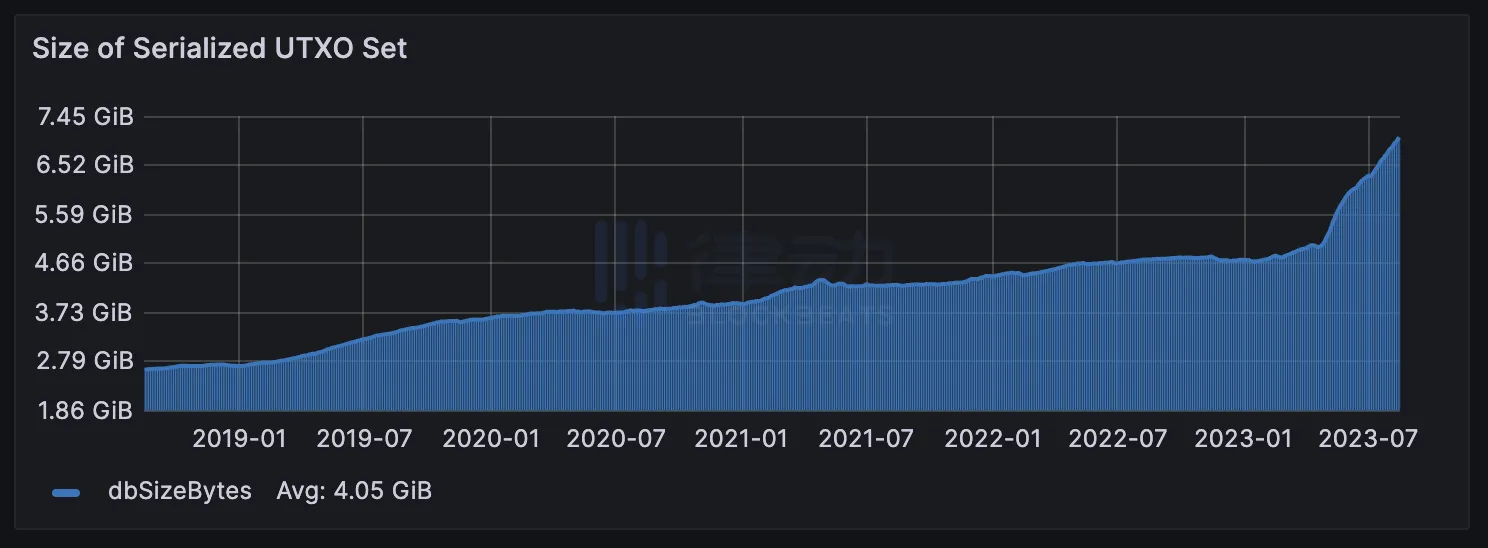
Bitcoin enthusiast Ajian (@AurtrianAjian) believes that the design of BRC20 has a significant impact on the security, scalability, and decentralization of the protocol. Firstly, because it is not attached to UTXO, it cannot rely on the anti-double spending mechanism of UTXO itself. BRC20 is built entirely on the "first come, first served" principle based on the order of block transactions. Without this "first come, first served" as the final backing, it is fundamentally unable to prevent negative balance and other forms of double spending.
However, there are also many supporters who believe that it is a mistake for some Bitcoin supporters to refuse to use the network for new types of assets such as Ordinal NFT and BRC-20. Nic Carter, co-founder of investment firm Castle Island Ventures, has spoken about this issue. Considering the cypherpunk culture of the Bitcoin movement and its foundation in libertarian economics, it is unreasonable to demand scrutiny of these non-economic use cases.
Power Balance: Who Decides the Future of Bitcoin?
Behind these debates, it's not just about technical differences, but more deeply about the purpose of Bitcoin and its underlying philosophical principles. Governing decentralized open-source projects remains a challenge. What determines the future of Bitcoin? Developers? Miners? Nodes? Community?
We all know that Bitcoin has no CEO. The governance structure of Bitcoin is composed of users who pay transaction fees, miners who build the Bitcoin blockchain, and node operators who verify transaction ledgers. This decentralized structure to some extent ensures the security and decentralization of Bitcoin, but also brings challenges to governance. As for the position of miners, it is more driven by incentives. They choose the consensus on the future of Bitcoin based on the incentives they receive.
For core developers, German engineers, entrepreneurs, and investor MICHAEL believes that we can admire them, we can donate to them, but we must never consider them as our allies. This is because core developers are software developers. The essence of all developers is to like to patch and improve code, add new features, and remove old ones. We obviously need their work and should reward it. However, we must also supervise and criticize their work, as we can never know exactly when and which core developers succumb to "I Can Fix Bitcoin Syndrome", so we need to assume that they all have it and do not trust every line of code they write.
From the perspective of nodes and communities, the Bitcoin Improvement Proposal process seems to be an informal procedure. Only less than 1% of Bitcoin users operate nodes, and 99% of Bitcoin users are just "leisure" users who temporarily hold Bitcoin in their custodial accounts, completely detached from the discussion. If they don't operate nodes, are their opinions still important? This is an interesting question, but Bitcoin would argue that their opinions are not important. The block size war has pitted 99% of Bitcoin users against the 1% of people who are technically savvy, and when some of the 99% of Bitcoin users become node operators, it leads to a hard fork.
From various perspectives and backgrounds, people's visions and expectations for Bitcoin cannot be stopped. The "block size war" of Bitcoin has revealed the intense conflict and intersection of technical views in the blockchain world. This debate not only reshapes the development context of Bitcoin, but also prompts many people to realize that when building blockchain technology, various design purposes and strategies must be carefully weighed. How to find consensus on core issues in the future blockchain community, and carry out healthy competition along the technical path, this road is still long and far.
However, one thing is certain: the spirit and culture of Bitcoin will never wither away due to community disagreements. Each and every one of us is not only a witness to this history, but also a participant deeply involved in it.
Reference content:
1.https://www.coindesk.com/consensus-magazine/2023/05/09/theres-no-such-thing-as-high-fees-on-bitcoin/;
2.https://michaelantonfischer.com/i-can-fix-bitcoin-syndrome;
Welcome to join the official BlockBeats community:
Telegram Subscription Group: https://t.me/theblockbeats
Telegram Discussion Group: https://t.me/BlockBeats_App
Official Twitter Account: https://twitter.com/BlockBeatsAsia