Conversation with Paradigm's Research Director: How DeFi 2.0 will change everything?
Compiled and organized by: Deep Tide TechFlow
Dan Robinson is a GP and research director at Paradigm. Over the years, he has put a lot of thought into the DeFi market, auctions, and liquidity, with a particular focus on Uniswap and Uniswap V3. Recently, Uniswap Labs released UniswapX, a new Dutch auction mechanism that Dan believes will change the patterns of DeFi, MEV, and chain interoperability.
The following is the main content of this conversation, which was interpreted and organized by DeepTech, and the main points were outputted:
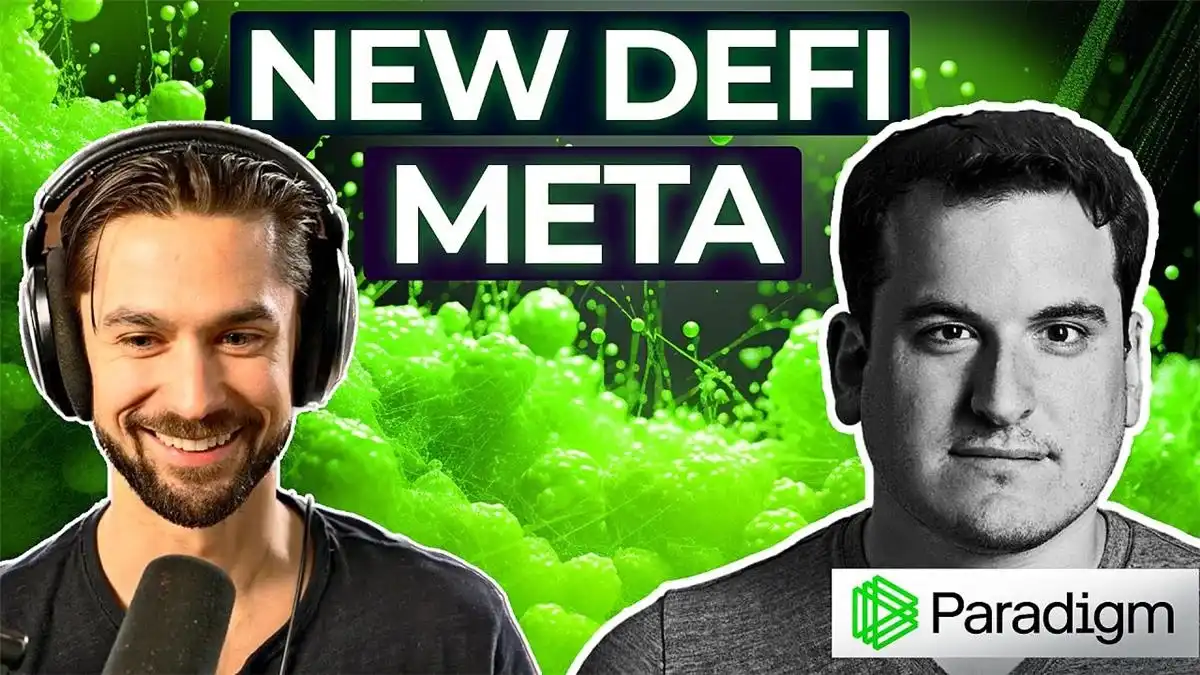
Host: David, Bankless
Speaker: Dan Robinson, GP and Research Director at Paradigm.
Original title: "DeFi 2.0: How This Changes Everything with Paradigm's Head of Research, Dan Robinson"
Video attribution: Bankless Podcast
Program: Link.
The content to be translated is:
Release time: August 3rd
The Importance of Decentralized Trading Research
Dan mentioned his recent tweet on Twitter about Uniswap X. This tweet, in the form of research, outlines his five reasons for how he believes Uniswap X will change decentralized trading, MEV, and interoperability.
(Note from DeepTech: The tweet includes a white paper, interested readers can click on the link to view it.)
Dan emphasized the importance of decentralized trading research, especially in reducing the value leaked from the system. He mentioned three main MEVs: EIP-559 burning, hedging and rebalancing losses, and price changes before and after transactions.
Uniswap V4 focuses primarily on reducing the losses suffered by liquidity providers due to arbitrage, while Uniswap X focuses primarily on protecting traders and ensuring they receive the best execution price.
Dan emphasized that the core of decentralized exchange (DEX) research should focus on two main participants: Swappers and Liquidity Providers. He believes that research should concentrate on maximizing the value between these two, while reducing the value obtained by other participants such as MEV, arbitrageurs, and the Ethereum protocol itself.
"Intent" Model & Dutch Auction Mechanism
The core idea of Uniswap X is to shift from a specific trading path to the user's trading intent. In traditional trading methods, users select a specific trading path and then submit the transaction. Compared to traditional trading methods, Uniswap X provides greater flexibility and better price execution.
Dan further discussed the advantages of the "intent" model. In this mode, users no longer submit specific transaction paths, but rather submit their transaction intentions. In Uniswap X, users only need to sign an offline message indicating their transaction intention, which is then processed by the entire MEV structure, packaged into a transaction, and included on the chain. The advantage of this approach is that it provides greater flexibility, allowing users to obtain the best transaction price rather than being limited to a specific transaction path.
The Dutch auction mechanism is a key component of Uniswap X. In a Dutch auction, the price starts from a high point and gradually decreases over time. The advantage of this mechanism is that when the price drops to a point where a buyer considers it a profitable transaction, they can immediately purchase it without waiting for the auction to end, ensuring that users can trade at the best price they deem fit.
Dan mentioned that Dutch auction is one of the mechanisms he frequently uses, as it is an excellent decentralized price discovery tool.
Dan also mentioned that Uniswap X has opened up a new frontier of exploration. This new design space requires further infrastructure and tools to achieve its maximum efficiency. He mentioned several possible innovations, such as batch auctions, ring trades, and encrypted orders.
Dan continues to discuss the advantages of the "intent" model. This model provides greater flexibility and expressive power, allowing users to define the transaction scope they want, rather than a specific transaction path. Since this model is off-chain, the cost of computation is zero. This means that a large number of order matches can be made without being limited by blockchain computation.
Dan described MEV (Miner Extractable Value) as a natural force. Although MEV may lead to certain unfair trading behaviors, if understood and utilized correctly, protocol designers can use MEV to improve and optimize the trading process.
He likened MEV to a group of robots that automatically and intelligently search for trading opportunities that can bring additional benefits to miners. Dan mentioned several possible innovations, such as using sealed batch auctions and encryption technology for trading.
("Sealed batch auction" means that within a specific time window, all participants will submit their buy and sell orders, but these orders are kept confidential. Only at the end of the auction will all orders be revealed and matched and settled according to certain rules. The advantage is that it can prevent certain market manipulation strategies, such as front-running, because participants do not know about other people's orders when submitting orders. In addition, by processing all orders within a time window, it can also improve market liquidity and efficiency.)
The Importance of Cross-Chain Technology in Uniswap X
Dan discussed the importance of cross-chain technology in Uniswap X. He believes that cross-chain transactions will be revolutionary. He mentioned the cross-chain exchange feature that Uniswap X plans to launch later this year.
He further explained the working principle of cross-chain technology, especially how to use cross-chain bridges to move assets from one chain to another without the need for intermediary representative assets. (Representative assets: usually refers to creating a token on the target chain that represents the original asset on the source chain.)
Dan pointed out that some cross-chain technologies may create a representative asset, which could become a security risk. For example, if you move Ethereum from the main chain to Optimism through cross-chain, you may receive a representative Ethereum instead of the real Optimism Ethereum.
He believes that it is best to use official cross-chain technologies created for specific chains, as these cross-chain technologies will create real, official assets rather than representative assets.
Dan predicts that future cross-chain technology will be more efficient and secure. He believes that cross-chain technology will become an important part of the cryptocurrency ecosystem because they allow assets to flow freely between different chains.
Uniswap V4's Innovation, Suave's Decentralized Off-Chain Solution
Dan discusses the shift to Uniswap V4 and emphasizes how it benefits liquidity providers. He mentions the background of Uniswap V3, particularly how it improves capital efficiency. He explains that Uniswap V3 allows liquidity providers to choose the price range they want to provide liquidity for, thus improving capital efficiency. Uniswap V4 further expands on this innovation, allowing for more customization and strategies.
Dan mentioned some possible innovations for Uniswap V4, such as setting initial prices, changing fees, or restricting trades for specific users.
Dan discussed the profit and loss issues of liquidity providers (LPs) in Uniswap V3. He mentioned that despite Uniswap V3 providing higher capital efficiency for LPs, most liquidity providers in the pool are still losing money according to his understanding. He mentioned several possible reasons, including excessive liquidity provision, liquidity providers attempting to earn higher returns, and liquidity providers may not understand their true profit and loss situation.
Dan mentioned some possible solutions, such as adjusting fees, using the new features of Uniswap V4 to increase the profitability of liquidity providers, and developing new product features to attract liquidity providers.
The host mentioned the application layer of Uniswap, especially Infinity Pools, which is a new application that uses Uniswap LP tokens as assets. Dan believes that this application may increase the demand for Uniswap LP tokens, thereby creating higher returns for liquidity providers.
Dan introduced Suave, a platform aimed at decentralizing all off-chain infrastructure for decentralized operations that currently require some form of trust.
Dan emphasized the importance of Suave, comparing it to the huge leap from Bitcoin to Ethereum. Suave provides similar capabilities for off-chain operations, allowing for complex operations to be executed off the chain while maintaining decentralization.
The emergence of Suave provides application developers with powerful tools, allowing them to execute code efficiently and privately off-chain, while relying on decentralized guarantees.
Source Link
Welcome to join the official BlockBeats community:
Telegram Subscription Group: https://t.me/theblockbeats
Telegram Discussion Group: https://t.me/BlockBeats_App
Official Twitter Account: https://twitter.com/BlockBeatsAsia
 Related Articles