Recent POW Project Overview: Dynex, Microvision Chain, Neurai
Original Author: Duoduo, LD Capital
After Ethereum transitioned to a POS model, most of the attention in the market has been on POS-based public chains. However, the POW model is still in development. Typical representatives, such as KAS, have proposed a new POW blockchain model. Due to KAS's continuous rise, new POW projects have gradually attracted funding and community attention. This article introduces several recent POW projects with decent market performance.
1. Market Performance

Source: coingecko, LD Capital
Remark: The data in this article is up to August 1, 2023.
From the table above, we can see that these projects have been launched for less than a year, with a market capitalization below 50 million USD, and have seen good price gains in the past two months.
In addition, the teams of Dynex and Neurai are anonymous and have not disclosed information publicly. The co-founder of Microvision Chain (Twitter: @Jason_K0001) is Chinese, and the official website does not disclose specific resume experience.
2. Narrative
The new POW projects have each put forward their narrative emphasis based on the current market environment and hot topics.
Dynex
Dynex is a neural-form supercomputing blockchain based on the DynexSolve chip algorithm, proposing the Proof of Useful Work (PoUW) method to enhance the speed and efficiency of decentralized networks.
DynexSolve can run a "neuromorphic chip" that outperforms traditional computing methods in a range of computing tasks. Neuromorphic computing is a natural platform for many AI and machine learning today. Dynex aims to provide computing power for AI, machine learning, fintech, biomedicine, etc., based on this.
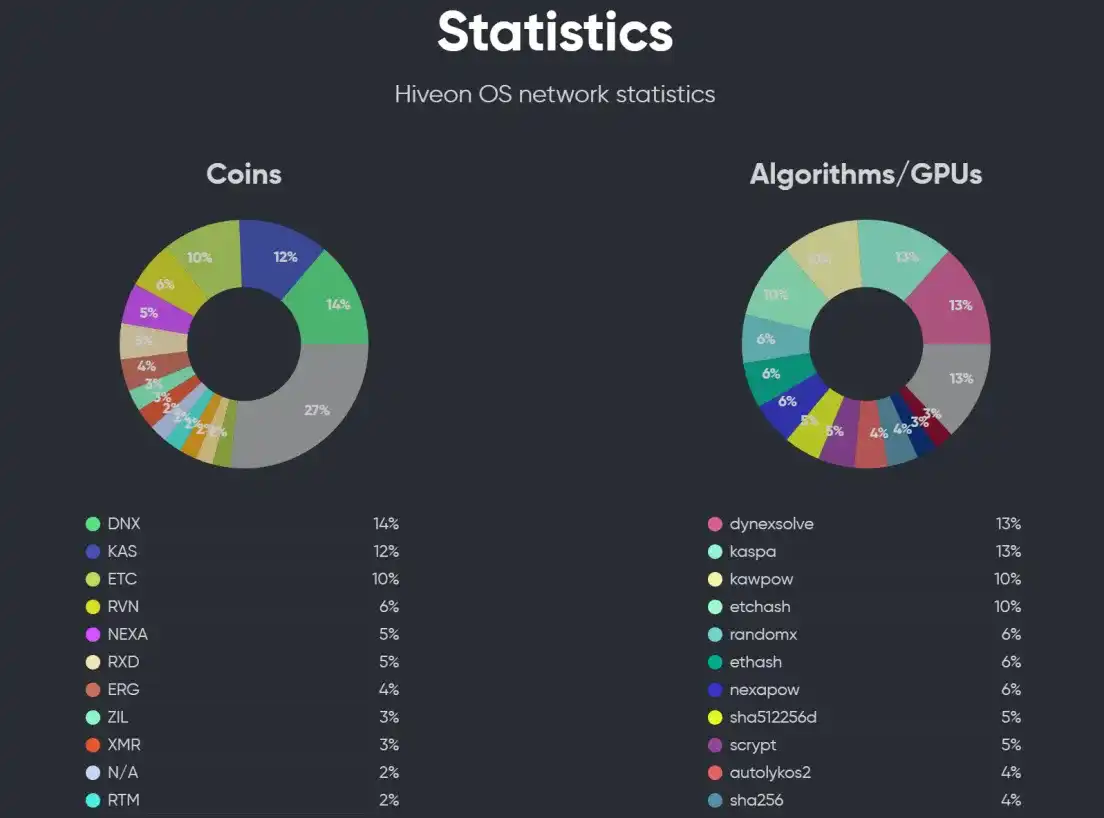
Dynex primarily utilizes GPU computing power, and according to the hiveon.com computing power management platform, DNX's current computing power share has reached 14%, making it the largest POW token within the platform's computed power range.
Microvision Chain
The goal of Microvision Chain is to establish a highly scalable PoW public chain, serve as a Bitcoin Layer 2, improve efficiency, and reduce costs. The protocol mainly proposes improvements in three aspects: 1) Smart contracts based on the UTXO account model, enabling application development; 2) Built-in decentralized identity protocol supporting cross-chain, where all on-chain data belongs to the same ID; 3) To attract new users, participation does not require purchasing or holding cryptocurrency and can also be done through Web3 applications.
According to the official website, the core team members of the project published a UTXO model scaling method in November 2021 and applied for a patent. The patent is titled "Method and system for hierarchically cutting data in blockchain transaction, and storage medium." In May 2022, the testnet went live, validated by the High-Performance Computing Center of the University of Science and Technology of China, with smart contract execution speed exceeding 5K TPS.
Neurai
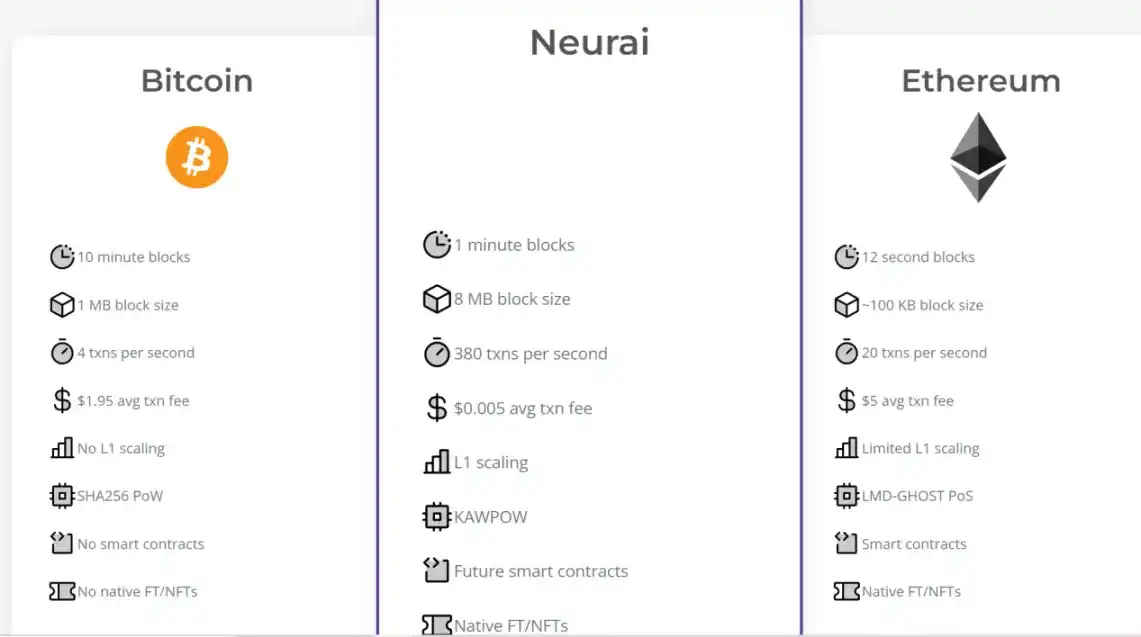
Neurai aims to be a comprehensive platform that can utilize artificial intelligence algorithms. Through the power of AI, it conducts data analysis, predictive modeling, decision-making, and connects blockchain assets to IoT devices. Contrasting with Bitcoin and Ethereum, Neurai's key technical parameters are as follows:
Source: Neurai Official Website
It is evident that Neurai aims to increase transactions per second, reduce transaction fees, and eventually support smart contract implementation.
III. Computing Power
According to Mining Pool's data, the computing power of each project is as follows:

Source: Mining Pool, LD Capital
Note: The computing power unit: H/s is the smallest unit, performing one random hash collision calculation per second, abbreviated as Hash/s.
1KH/s=1000H/s, 1MH/s=1000KH/s, 1GH/s=1000MH/s, 1TH/s=1000GH/s, 1PH/s=1000TH/s, 1EH/s=1000PH/s.
Comparing the hash power rankings of some top market cap, well-known POW public blockchains, BTC ranks first in hash power, BCH is 7th, BSV is 12th, KAS is 29th, DASH is 31st, and LTC and DOGE are 38th and 39th, respectively. It can be seen that Microvision Chain has a relatively high hash power ranking.
It is worth noting that according to the hash rate management platform hiveon.com, DNX's current hash rate share has reached 14%, making it the largest pow token within the platform's GPU hash rate range, surpassing the KAS token's hash rate. There is a significant discrepancy between this and Miningpool's statistics, likely due to different data collection methodologies.
Source: Hiveon
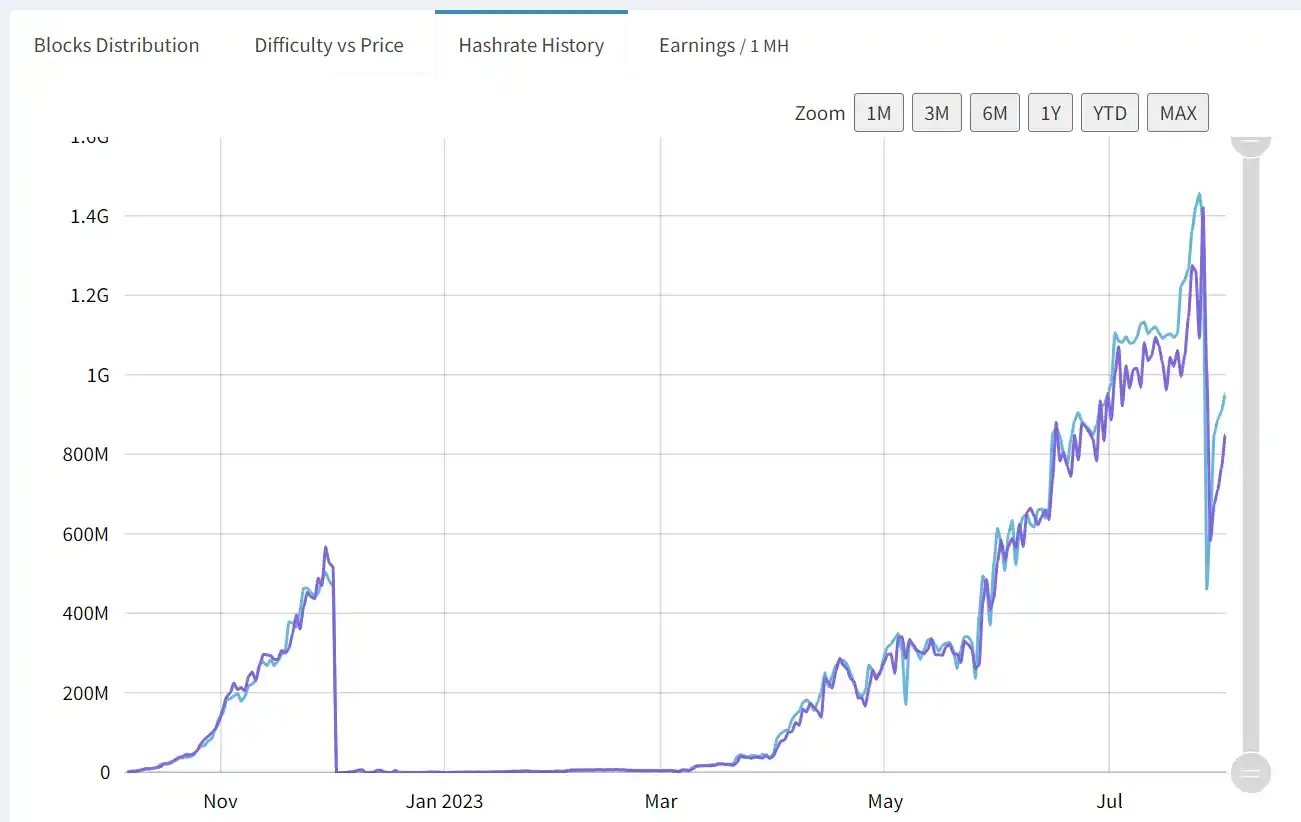
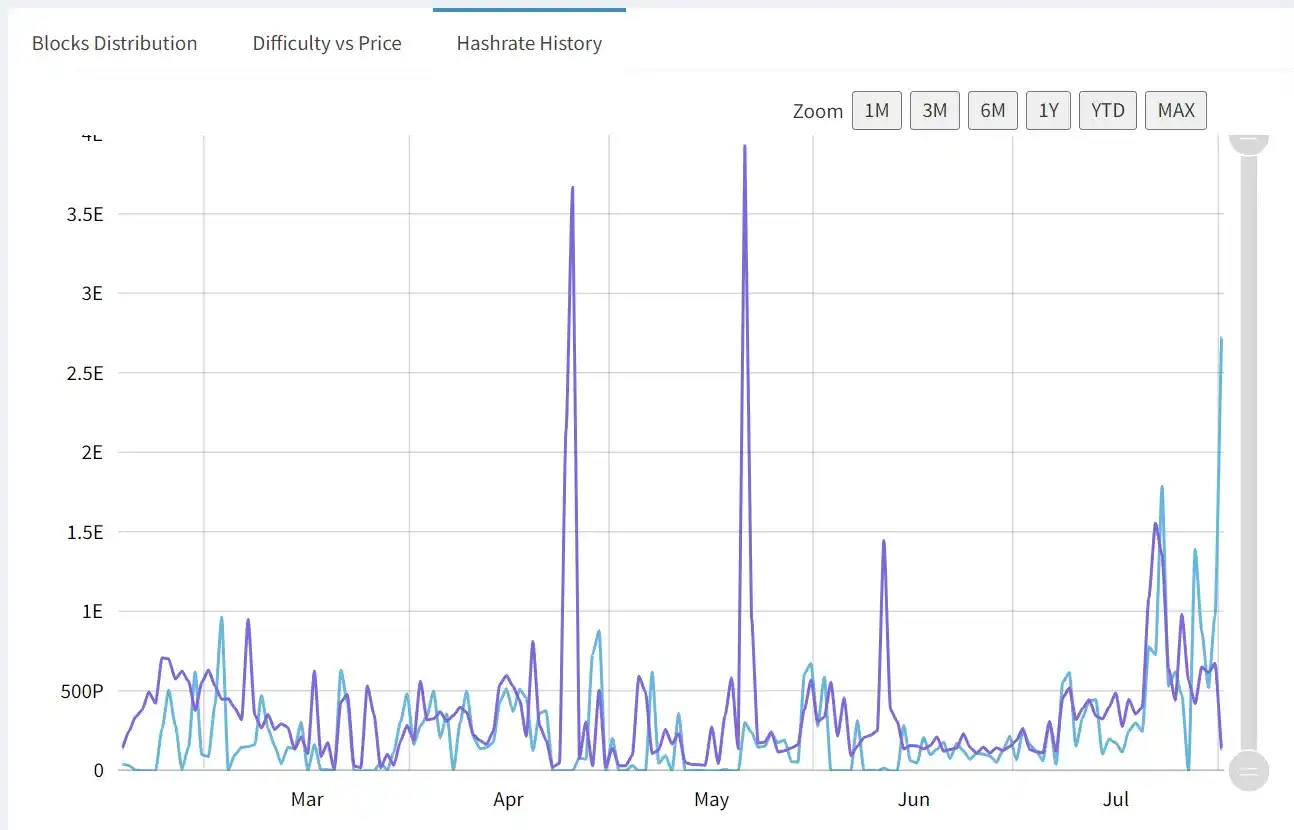
Below is the hash rate change chart for various protocols displayed by Miningpool:
Dynex: Overall in an upward trend. Recent algorithm upgrades have caused a decrease in hash rate.
Microvision Chain: Hash rate is oscillating with no significant growth or decline.
Neurai: The recent hash rate shows a growth trend, mainly driven by retail miners, while known pools' hash rate is declining.
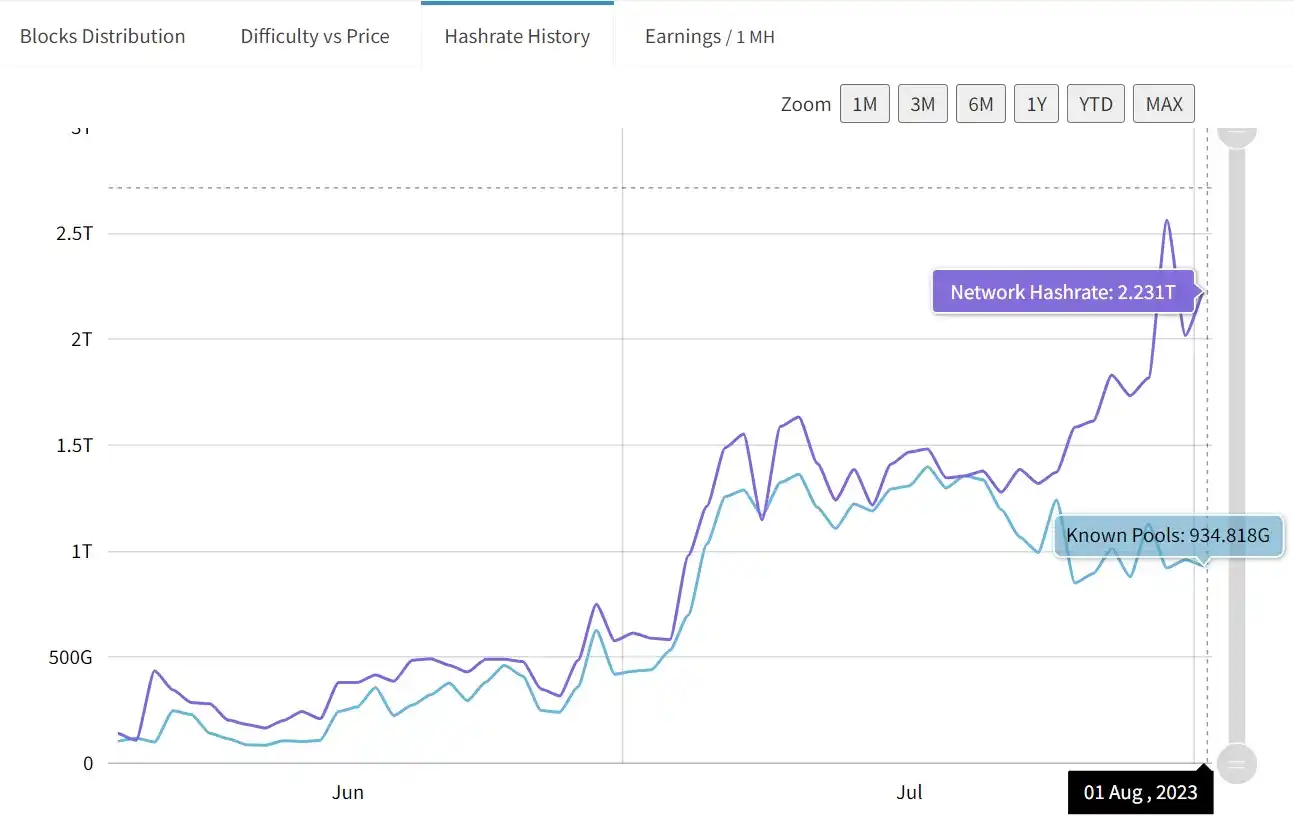
Overall, Dynex holds an advantage in GPU hash power and shows an overall upward trend in hash rate. However, recent hash rate drops due to algorithm upgrades should gradually recover. In addition, KAS is now transitioning to the use of specialized mining machines, with its previous GPU hash power transitioning to DNX mining, further boosting DNX's hash rate. Microvision Chain has a relatively high hash power ranking but is highly centralized with fluctuating hash power. Neurai has more retail miners participating, leading to a higher level of decentralization and a growing hash rate.
4. Economic Model
Dynex
No ICO, no pre-mine, no team allocation. Total supply of 1 billion tokens, with 64.61 million tokens already released, accounting for 64% of circulation; the release is rapid, with circulation expected to reach around 80% after two years. The chart below shows the token release schedule and the reward token amount per block on the blockchain. The token reward per block continuously decreases according to a specific formula, forming a smooth curve.
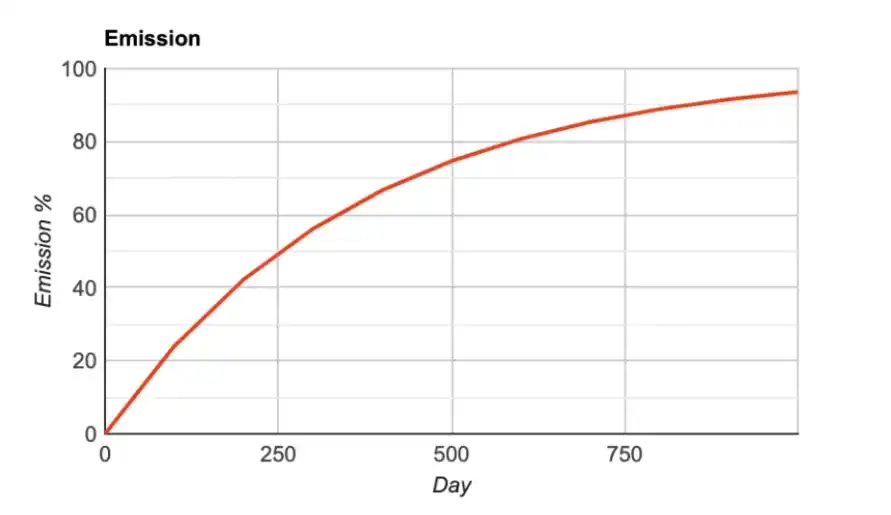
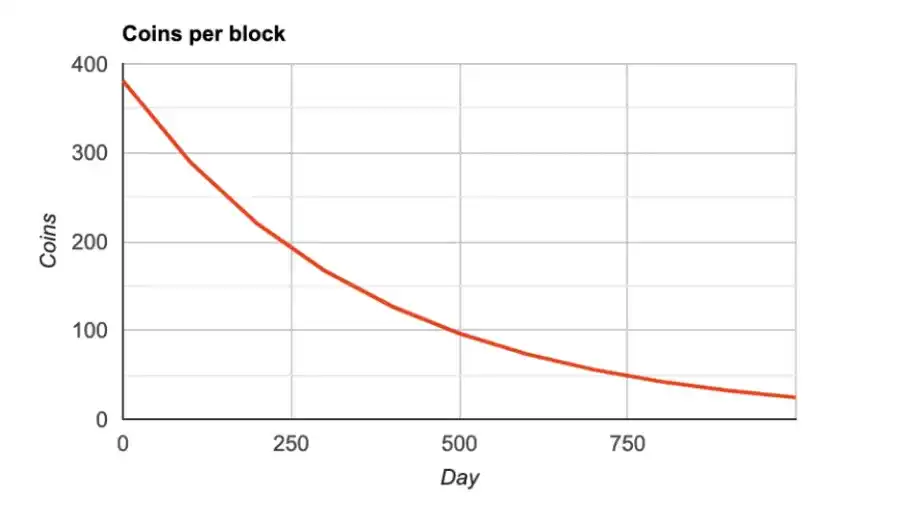
The current reward per block is around 173 DNX, with approximately 2 minutes per block. Based on this, the monthly emitted token amount is estimated to be around 2.67 million tokens, calculated at a price of $0.6; the monthly release value is approximately $2.2 million.
Microvision Chain
The token release of the Microvision Chain is not purely based on a POW model; it also includes allocations for the project team and DAO builders, more resembling a combination of POW and POS.
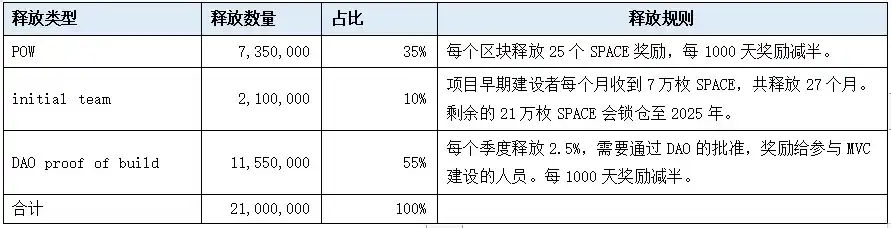
Following this release schedule, the monthly token release for the first 1000 days is approximately 274,000 tokens, with an annual release of around 3.28 million tokens; the total release over 3 years is 9.86 million tokens, with circulation reaching 47% after three years. Calculated at a price of $12, the monthly release value would be $3.28 million, and the annual release value would be $39 million.
Neurai
The total token supply is 21,000,000,000 tokens, with 5,873,595,098 tokens currently in circulation, accounting for 28% of circulation.

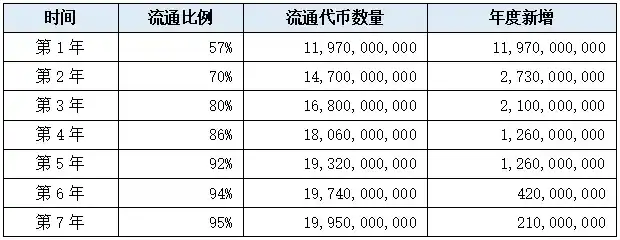
If calculated at a price of $0.00081, the next monthly addition would be approximately $810,000 in value, about 17% of the current market cap.
It can be seen that the token distribution of Dynex and Neurai follows a pure POW model. Microvision Chain has 65% of its tokens distributed not following a POW model, giving the project team significant control. The early release ratio of all three tokens is relatively high, with early mining participants holding a large number of tokens. These tokens are both potential selling pressure and potential pumping power.
5. Issues
Among the three projects mentioned above, the most commonly questioned aspect is their team's strength and technical feasibility. In the Dynex and Microvision Chain communities, there are occasional FUD against the project team, with the main argument being that the project's whitepaper is a "patchwork" of multiple papers, the videos demonstrated by the project team do not represent new technology, but rather some dubious concepts.
The narratives of these three projects all require strong research capabilities and technical development capabilities, while Dynex and Neurai have anonymous teams that have not disclosed member information; although Microvision Chain has a co-founder who is semi-anonymous (active on Twitter, participating in interviews, etc.), there is no industry visibility or experience in other well-known projects.
Currently, many investors participating in such projects are funds that have profited from KAS investments, and there is a certain degree of overlap in the community.
"Original Article Link"
Welcome to join the official BlockBeats community:
Telegram Subscription Group: https://t.me/theblockbeats
Telegram Discussion Group: https://t.me/BlockBeats_App
Official Twitter Account: https://twitter.com/BlockBeatsAsia