In-depth analysis of Orbiter Finance: Cross-chain bridge transformation, poised to become a universal Ethereum-based protocol.
Original Title: "Orbiter: Cross-Chain Bridge Transformation, Will Become a Universal Ethereum Basic Protocol"
Original Source: HotairballoonCN
One, Industry Trends and Current Situation
The emergence of blockchain technology has brought many advantages such as distributed ledgers and decentralization, but it has also led to the formation of a relatively isolated ecosystem for each blockchain. Different blockchains cannot directly interact with each other, which has brought many limitations and challenges to the application of blockchain technology. Therefore, how to achieve interoperability between different blockchains has become an important issue.
To solve this problem, cross-chain bridge technology has emerged. Cross-chain bridge is a technical means that can establish connections between different blockchains, enabling cross-chain communication and asset transfer.
Through cross-chain bridges, users can transfer assets from one blockchain to another, and also execute cross-chain smart contracts, promoting the integration and development of the blockchain ecosystem.
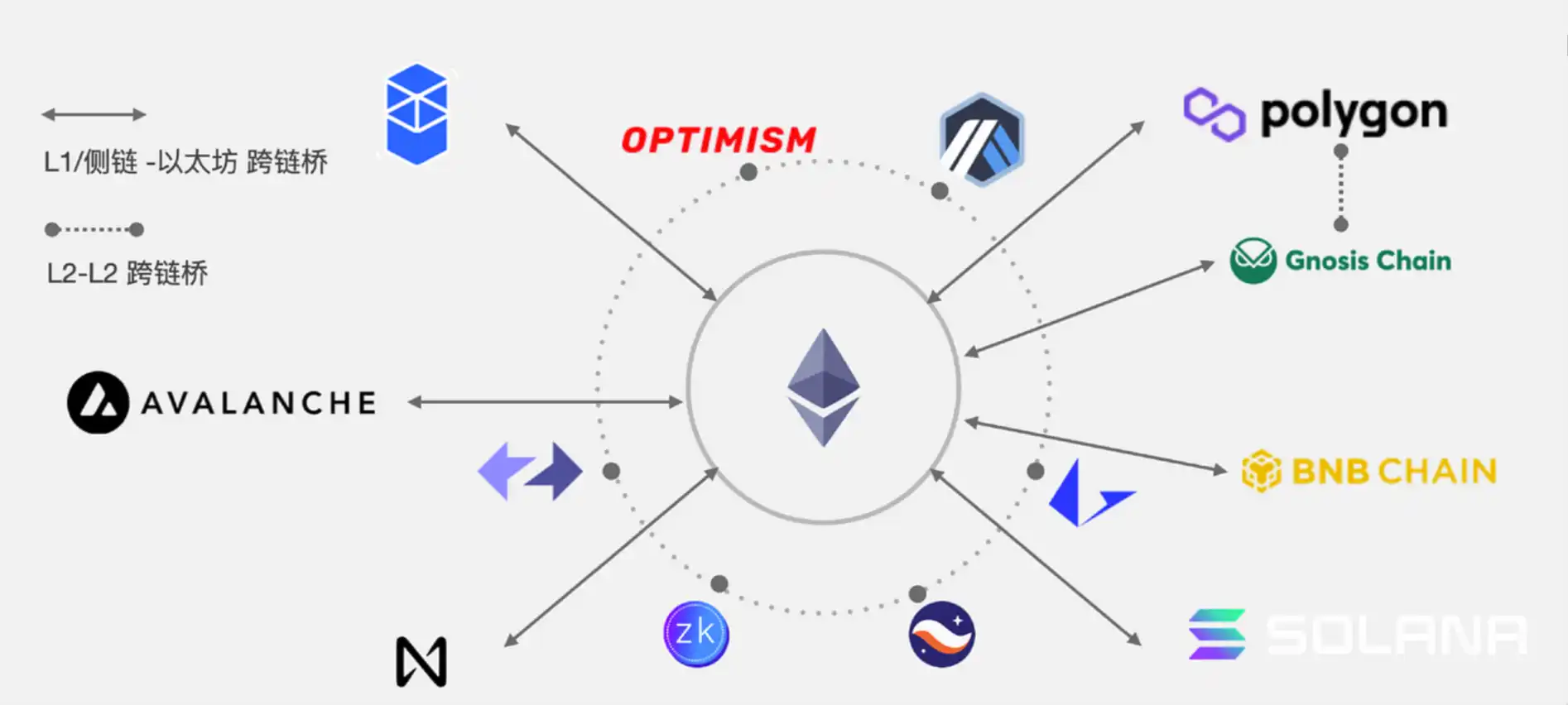
Therefore, cross-chain bridge is one of the key technologies to achieve interoperability between different blockchains, which is of great significance for the practical application and promotion of blockchain technology.
1. Cross-chain bridge technology is becoming increasingly mature, with its demand and role becoming more prominent.
In the past, users generally completed cross-chain operations through centralized exchanges, such as transferring assets to centralized exchanges first and then withdrawing them to the target chain.
With the continuous improvement of the public chain ecosystem and the popularization and development of DeFi technology, the usage scenarios of digital assets are becoming more and more diverse, and liquidity is significantly enhanced.
For example, the demand for cross-chain asset transfer is increasing as DApps need to participate in staking, financial management, etc. on different chains. This has led to the emergence of cross-chain bridge applications. Nowadays, people are increasingly inclined to use cross-chain bridge technology to directly transfer assets between different chains, rather than relying on centralized exchanges for cross-chain transactions.
In the current public chain landscape, the development of the Ethereum ecosystem is still the most mature and complete, and more and more DApps choose to develop on the Ethereum ecosystem.
However, Ethereum is known as the "noble chain" by many people. Not only is the gas fee relatively expensive, but the speed cannot meet the high real-time requirements of DApps. Therefore, more and more Ethereum Layer2 solutions have emerged. They improve performance while also inheriting the underlying security of Ethereum.
For example, the four Layer2 giants of Ethereum, known as Arbitrum, Optimism, Starknet, and Zksync, have developed rapidly and formed their own ecosystems. Each Layer2 ecosystem has accumulated a large number of users and assets.
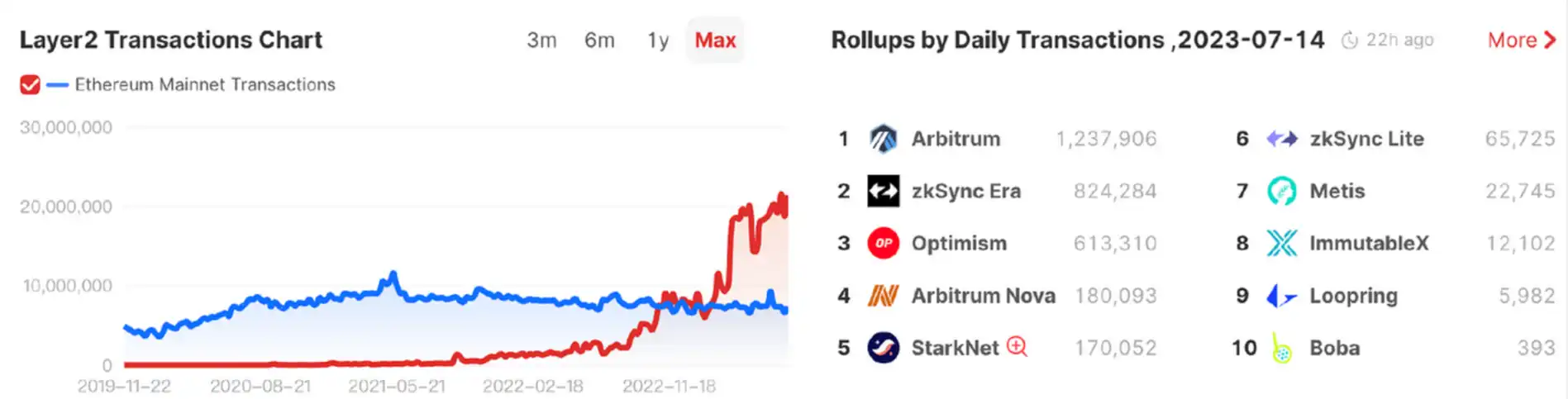
The prosperity of the Ethereum Layer2 ecosystem has also given rise to the demand for cross-chain assets of Ethereum Layer2, and Orbiter Finance has emerged in this context.
Under the previous Layer2 framework, rollups could not be directly transmitted between each other.
If a user wants to transfer assets from Rollup A to Rollup B, they often need to wait for a long time.
1) Transfer assets from Rollup A to the mainnet;
2) Then transfer the assets from the mainnet to Rollup B.
The mainnet acts as an intermediary, and both transfers must go through the Ethereum mainnet. This not only slows down the process, but also incurs two gas fees, resulting in high time and gas costs.
Orbiter Finance is a decentralized cross-Rollup bridge that allows users to transfer assets across Ethereum mainnet, StarkNet, zkSync, Loopring, Arbitrum, Optimism, Polygon, Immutable X, and BNB Chain.
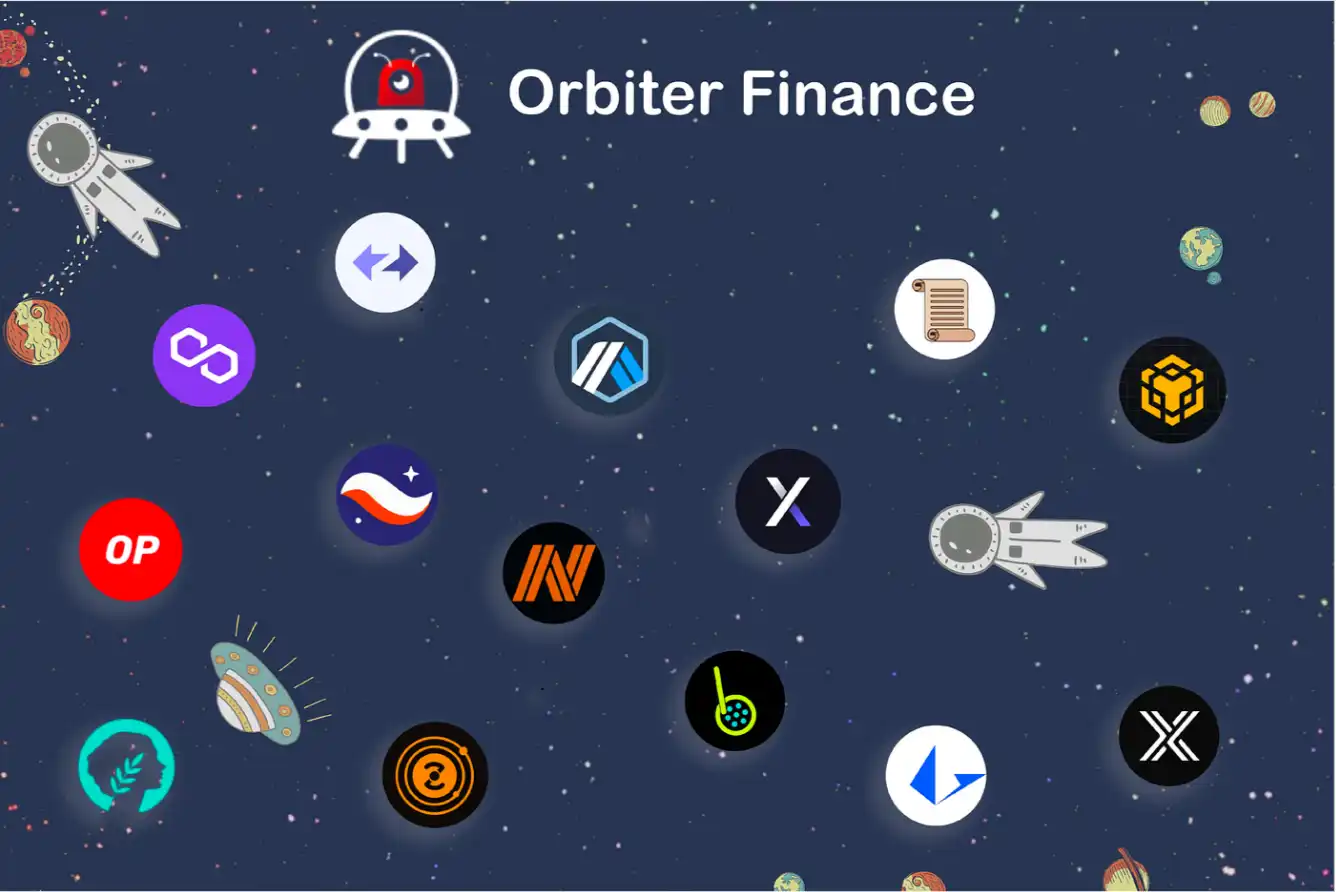
Orbiter Bridge provides users with excellent experiences such as low fees and fast speed through its unique market-making model. Currently, it only supports transfers of four currencies: ETH, USDC, USDT, and DAI.
Three, Financing Situation
Orbiter completed its first round of financing in November 2022, with participation from Tiger Global, Matrixport, A&T Capital, StarkWare, Cobo, imToken, Mask Network, Zonff Partners, but the amount of financing was not disclosed.
In addition, Vitalik has also donated 16 ETH to him.
Four, Orbiter Finance Features
1. Security
Based on the security of rollup technology, Orbiter does not have the risk of cross-chain bridges like Layer1 <> Layer1.
First of all, we need to be clear that Orbiter Finance aims to solve the problem of cross-rollup, not cross-chain (heterogeneous chain) issues.
Strictly speaking, Orbiter is a cross-Rollup bridge, rather than a cross-chain asset transfer between two completely independent (heterogeneous) blockchains (such as from the Bitcoin network to the Ethereum network).
Asset cross-chain (Layer1 <> Layer1) between two independent heterogeneous blockchains. The security of the cross-chain protocol conforms to the bucket theory, which means that the upper limit of the security performance of the cross-chain protocol is determined by the lower security chain.
Ethereum founder Vitalik has written an article on this topic, in which he proposed a concept called "shared security", which means exactly what it sounds like.
For example, A and B are two heterogeneous chains, with A chain having higher security and B chain having lower security.
So, when assets are transferred across chains in this network, the security is determined by the security of chain B (the chain with lower security).
However, the cross-rollup projects use the same Ethereum data layer, and each rollup can prevent 51% attacks. Based on this, Orbiter has proposed a cross-rollup mechanism that can inherit the security of Ethereum L2.
That is to say, Orbiter enables asset cross-chain transfers between different Ethereum Layer2 solutions.
For example, Orbiter cross-chains between zkSync and Arbitrum, which are isomorphic chains.
Whether it's zkSync and Arbitrum, or Orbiter, all three are built on top of Ethereum and inherit the security of the Ethereum network. This can prevent 51% double-spend attacks.
Additionally, Orbiter's anti-cheating and excess margin mechanisms also ensure the safety of users' assets when conducting cross-chain operations.
2、Low cost & Instant
In the Orbiter cross-chain protocol, asset transfer occurs between the Sender and Maker's EOA addresses on the source and target networks, respectively, without interaction with the contract address. This is a significant difference between Orbiter and other bridging protocols.
EOA, short for Externally Owned Account, literally translates to "externally owned account". It is the most commonly used account type that we encounter when using blockchain.
To put it simply, EOA is actually our personal account, which is our wallet address, and it is different from contract accounts with interactive functions.
What are the benefits of using EOA addresses in the Orbiter cross-chain protocol?
The biggest advantage is low cost and fast speed.
Due to the elimination of unnecessary contract interactions, there is no need for a dedicated intermediary to mint/destroy assets, and the Sender (asset exchange party) and Maker (market maker, i.e. the party that undertakes cross-chain exchange demand) can directly transfer funds.
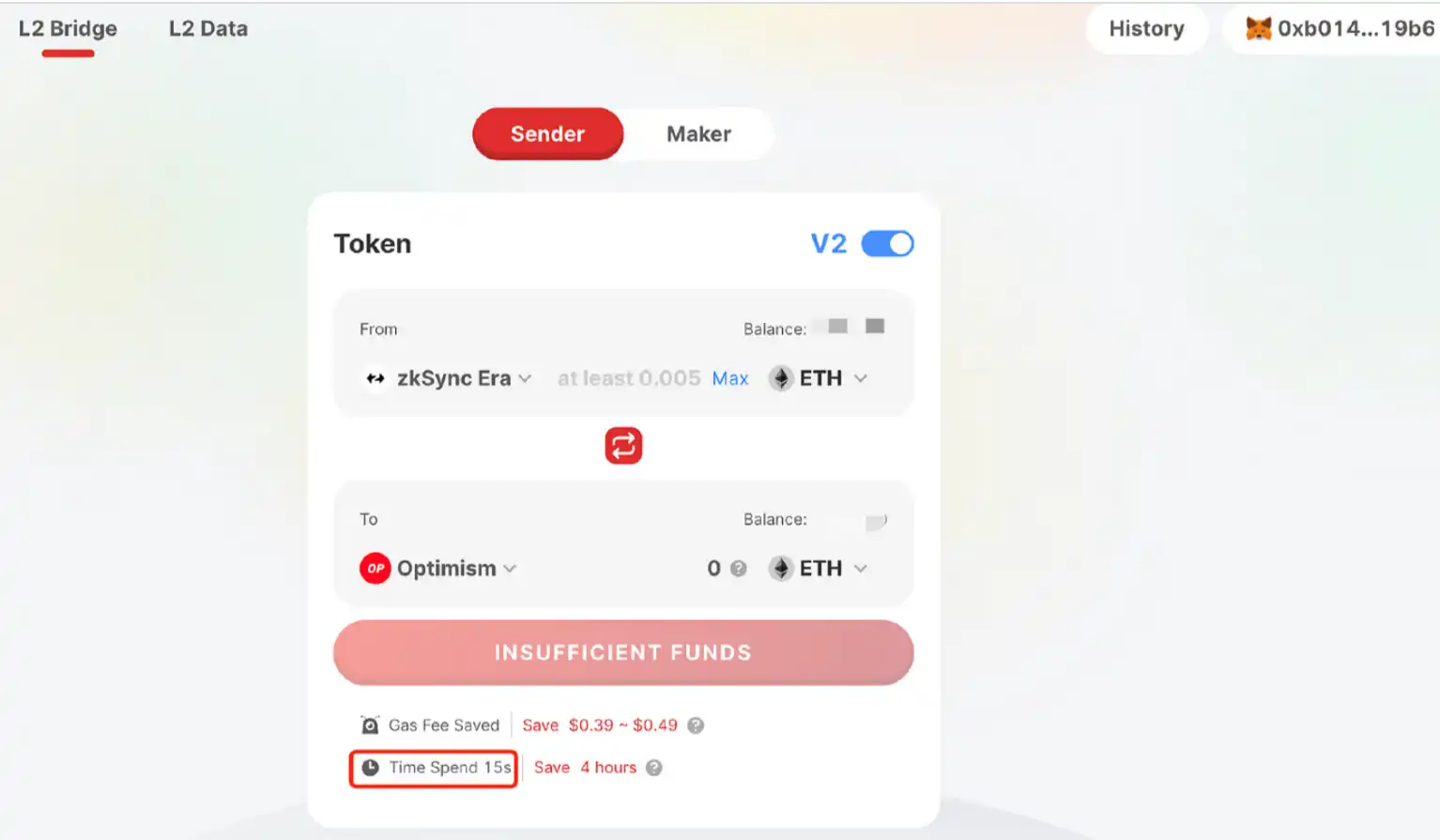
Most traditional cross-chain bridges take about 10 minutes or longer to complete asset cross-chain transfers, but with Orbiter, users can complete asset cross-chain transfers in an average of 30 seconds.
In the Orbiter cross-chain protocol, there is no need to mint assets.
As we all know, Bitcoin, as the highest market value cryptocurrency, has not fully realized its liquidity potential due to high gas fees and slow transmission speed.
In order to introduce the highest market value cryptocurrency BTC into the Ethereum DeFi ecosystem and promote its liquidity, a common practice is to wrap BTC, for example, wrapping it as an ERC20 token WBTC on Ethereum, thereby unlocking the liquidity potential of BTC. This is actually a cross-chain approach.
However, the Orbiter cross-chain protocol supports native assets on Ethereum and does not require any wrapping or other operations.
For example, A wants to transfer its 0.1ETH from zkSync chain to Arbitrum chain.
The general process of completing cross-chain using Orbiter (excluding fees) is:
1) As a Sender, transfer 0.1 ETH to the address of B (one of the Makers, which can be understood as a cross-chain intermediary) on zkSync. This step only occurs on the zkSync chain.
2) As a Maker (cross-chain intermediary), B received 0.1 ETH on zkSync.
3) After receiving 0.1 ETH on zkSync chain, B transfers 0.1 ETH to A's Arbitrum address on Arbitrum chain. This step only occurs on the Arbitrum chain.
4) B received 0.1 ETH on the Arbitrum chain.
Looking at the entire cross-chain process, it can be seen that there is no need for asset encapsulation and other steps, but rather the transfer of native assets between different addresses.
During this process, the two token transfers occurred on Ethereum's Layer2 network, which has very low transaction fees and faster speeds.
An inappropriate example.
This is like communication between Chinese and American people. Due to different language, culture, and religious beliefs, communication between the two sides requires translation as an intermediary, which of course increases the cost of communication.
And if it is communication between people from Hunan and Hubei, because they both have similar cultural backgrounds and beliefs, they do not need a translator as an intermediary, and communication will be much smoother, and the cost will of course be much lower.
Five, Operating Mechanism
1. Two Roles
In Orbiter Finance, there are two roles, Sender and Maker.
Sender is the initiator of cross-chain transfers, the demand side of cross-chain transactions, while Maker is the liquidity provider, the counterparty of Sender and the recipient of cross-chain services.
When Sender initiates a transfer, Maker provides liquidity, while the smart contract ensures the security of the entire process.
Before Maker provides cross-rollup to Sender, it needs to deposit extra margin in the Orbiter contract and set service fee rules in the protocol.
During the execution process, Sender sends assets to Maker on the Resource network, and Maker sends assets back to Sender on the target network.
If Maker engages in misconduct, such as failing to transfer assets to Sender on the target network after receiving them from Sender.
At this point, the Sender can use the Maker's margin to initiate an arbitration request with the contract and receive excess compensation.
2、Maker Operation Process
In the Orbiter cross-chain protocol, a client will be provided to Maker. Of course, Maker can also deploy a client by themselves, which can automate the payment process and complete some backend operations automatically.
In the Maker client, the data of the user's cross-chain currency, amount, and cross-chain network will be monitored. Based on the monitored data, the client can perform corresponding automated operations. This is a normal process.
3、Decentralized Anti-Cheating Mechanism
However, Maker may also have the possibility of wrongdoing.
In order to deal with the problem of Maker's misbehavior, Orbiter has adopted a solution of "pre-trust + dispute arbitration".
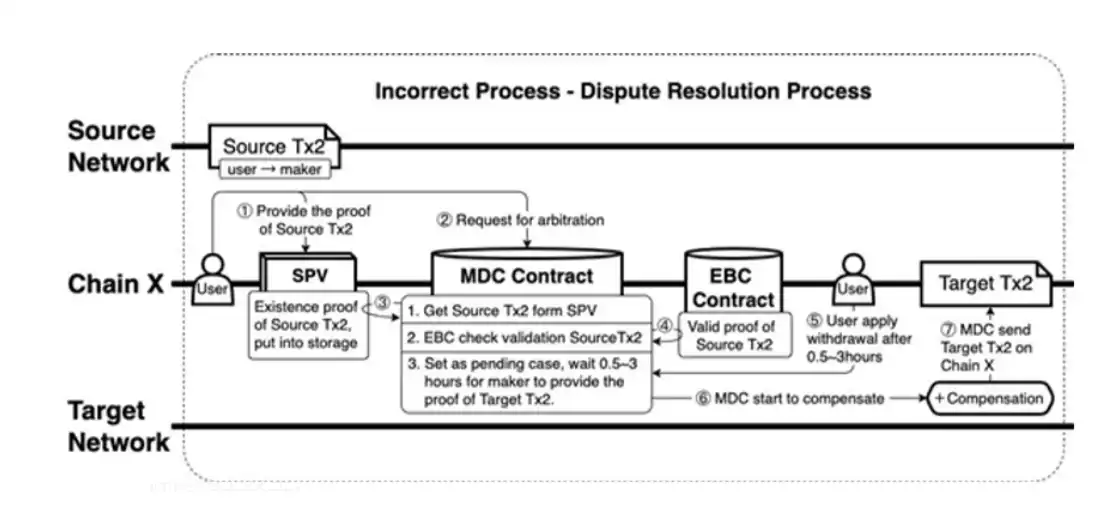
On the contrary, if Maker fails to provide relevant on-chain transactions within the specified time, Sender can trigger the MDC contract to make arbitration.
6) MDC contract starts compensating Sender.
7) The MDC contract will send the tokens and compensation (approximately $15) back to the Sender on the MDC contract deployment domain. The tokens returned and compensation given to the Sender will be deducted from Maker's collateral deposit.
4、Margin Call Mechanism
In addition, in order to prevent Maker from acting maliciously, Orbiter Finance has also introduced an excess margin mechanism.
In the Orbiter protocol, Makers need to provide two types of funds: one for liquidity, which is used to exchange funds for users, and the other is excess margin.
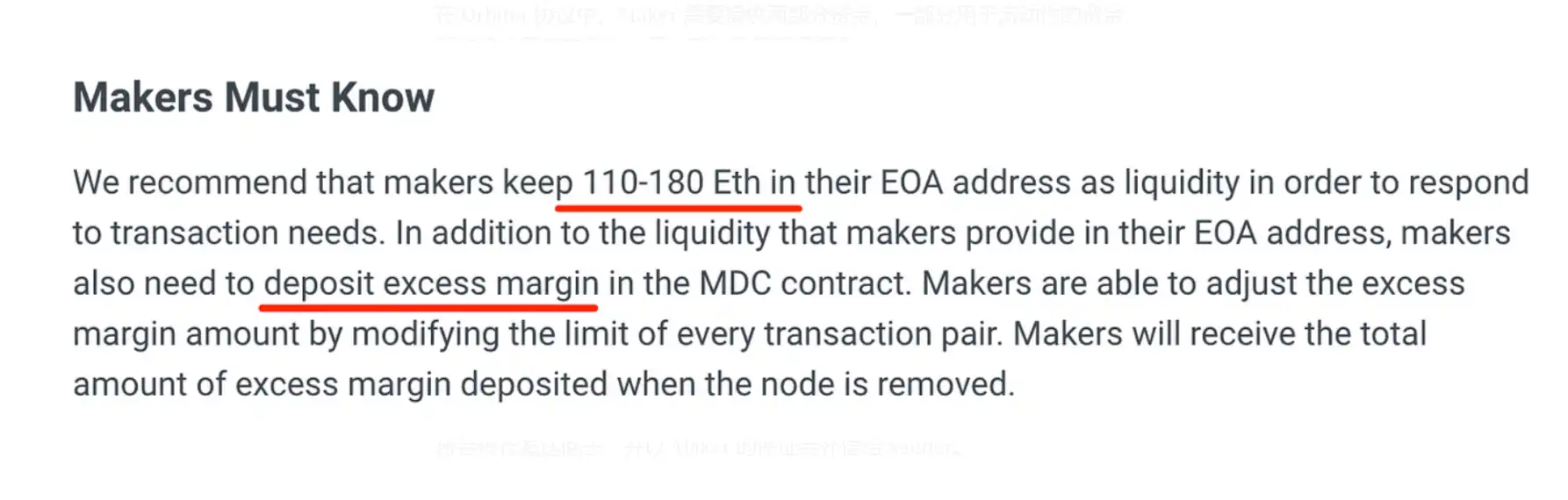
If the Maker is dishonest and causes the Sender to not receive the token as scheduled on the target network, all of the Sender's losses will be paid out of the excess margin, and the Sender will also receive compensation, which also comes from the Maker's excess margin.
So, in the Orbiter protocol, does Maker have enough motivation to provide good service?
First of all, in the mechanism of Orbiter, Maker can obtain considerable income from each cross-chain service (without impermanent loss risk).
Secondly, if Maker fails to timely send correct information to Sender, the MDC contract of Orbiter will send it back and compensate Sender with Maker's margin.
Therefore, the design of Orbiter not only prevents Makers from acting maliciously, but also incentivizes them to provide better services.
5、费用
Translation:
5. Fees
For Sender, the cost of Orbiter includes transaction fees and withholding fees.
Transaction fees: Fees paid to the platform and Maker, charged as a percentage of the transfer amount.
预扣费:预付给 Maker 的费用,用于 Maker 支付目的地网络转账时的 Gas 费用。
Prepaid fee: The fee paid in advance to Maker for the purpose of paying Gas fees when Maker transfers to the destination network.Due to the instability of Gas fees, Orbiter will adjust the fees based on the Gwei of the destination network to ensure that Orbiter's fees are lower than the average level, but such adjustments are not frequent.
Six, Orbiter advantages
1. Cross-chain speed and fees
Through https://chaineye.tools/bridge we can query the speed and cost of some cross-chain bridges on Ethereum L2.
If we transfer 1000 USDC from the OP chain/ARB chain to the ZK chain, let's take a look at the fees and speed of these cross-chain bridges:
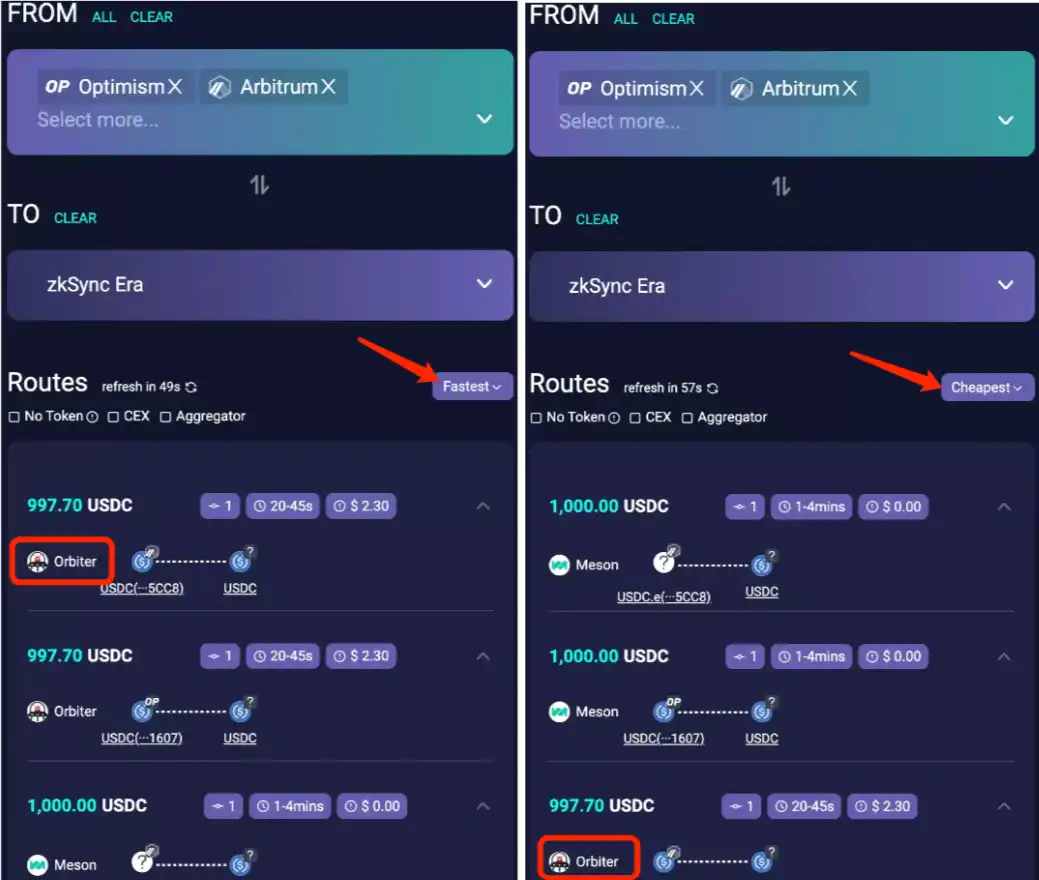
You can see that Orbiter has the fastest speed, completing cross-chain transactions in about 20-45 seconds, while Meson, ranked second, takes 1-4 minutes.
And if ranked by transaction fees, Orbiter ranks second, but the top-ranked Meson has a fee of 0. Meson also offers 5 transactions/$5000 daily with no handling fees.
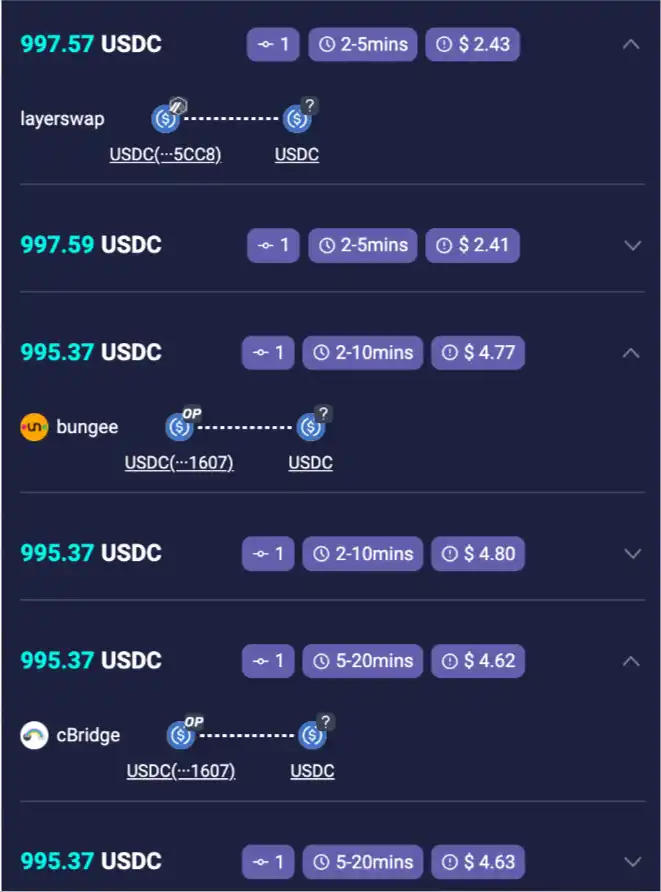
Same scenario, let's take a look at the time required for other cross-chain bridges:
Layerswap: 2-5 minutes, cost: 2.44U
bungee: 2-10 minutes, cost: 4.77U
cBridge: 5-20 minutes, cost: 4.62U
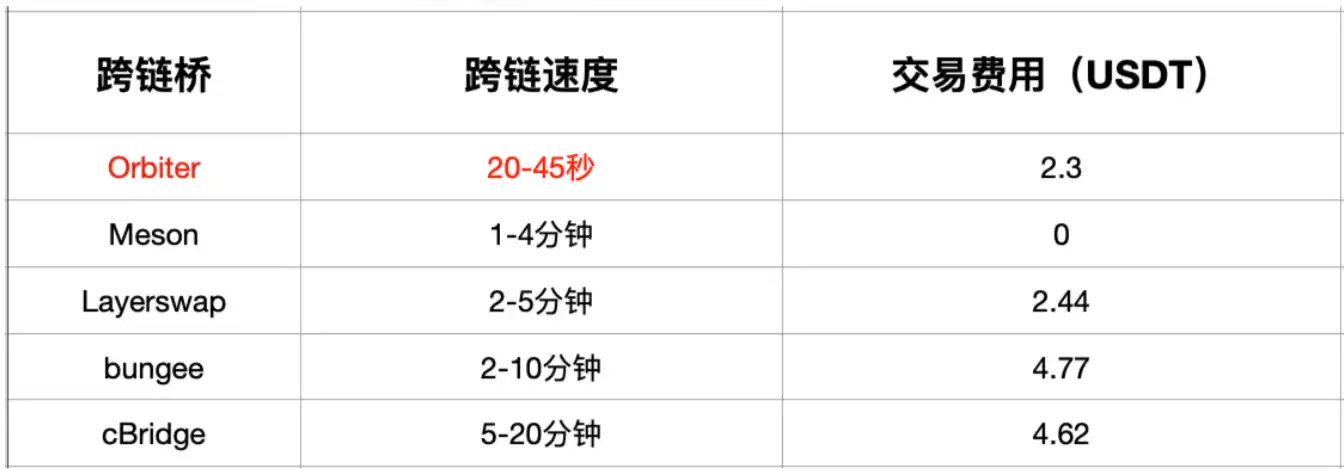
When conducting cross-chain operations, speed and cost are both important factors we consider. Through comparison, it can be seen that Orbiter is still very outstanding in terms of overall speed and transaction fees, especially with cross-chain speed being much faster than other cross-chain bridges.
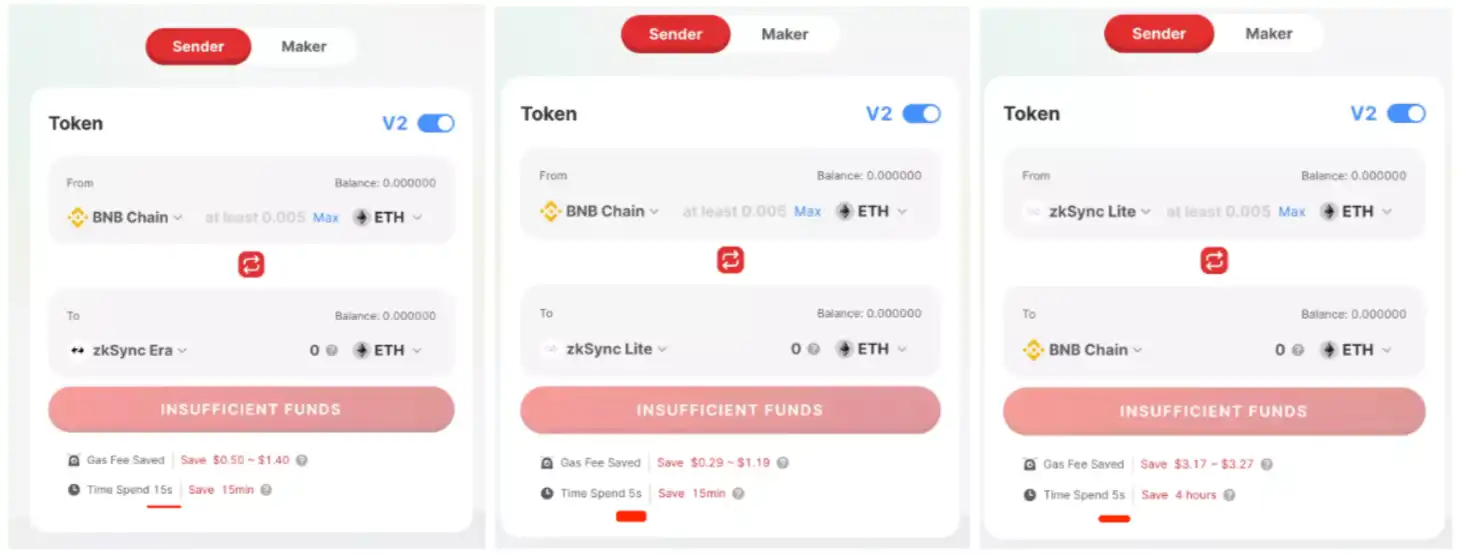
In the Orbiter cross-chain bridge, the time required for cross-chain transactions is generally around 30 seconds. The slowest transaction is from the Ethereum mainnet to the Layer 2 network, or vice versa, which takes about 45 seconds. The fastest cross-chain transaction is between the BNB chain and the ZK chain, which can be completed in just 5 seconds. Other Ethereum Layer 2 cross-chain bridges usually take more than 2 minutes.
2、Security
In the Orbiter cross-chain protocol, decentralized anti-cheating and over-collateralization mechanisms prevent the risk of inaction by market makers after receiving funds, ensuring the safety of user funds and enhancing the security of the protocol.
Plus, Orbiter is built on Ethereum and inherits its security, so Orbiter has a great advantage in ensuring fund security.
3、Active Users
You can view some active users of cross-chain bridges through https://www.orbiter.finance/data.
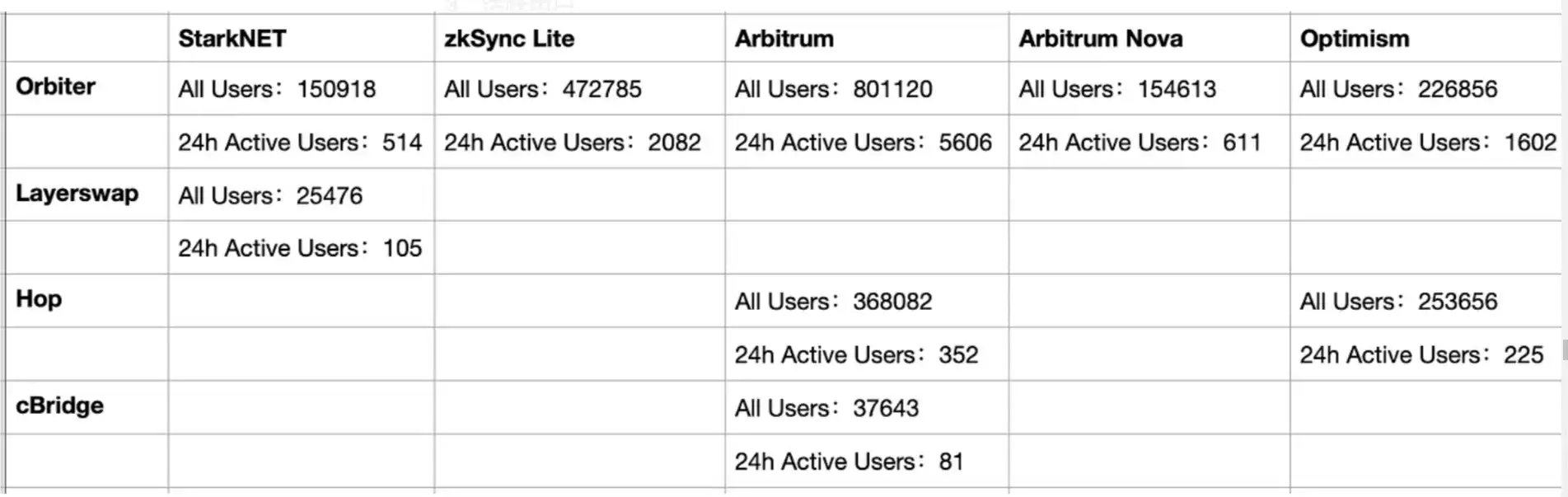
According to the data statistics of Orditer L2 Data platform, Orbiter has advantages in both active users and user breadth.
4、Official endorsement recommendation
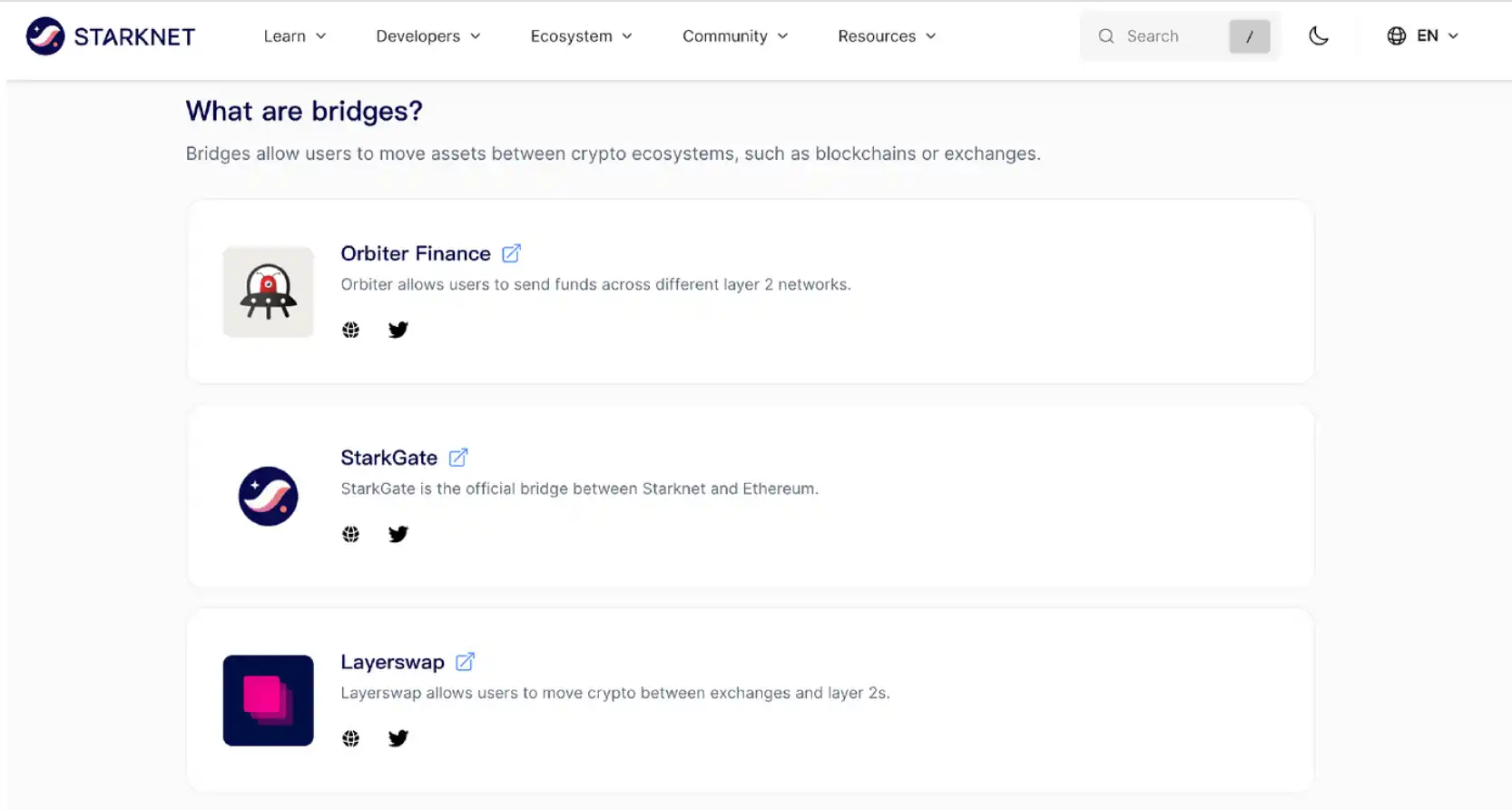
StarkNET's official website has recommended Orbiter cross-chain bridge, and it is the top recommendation.
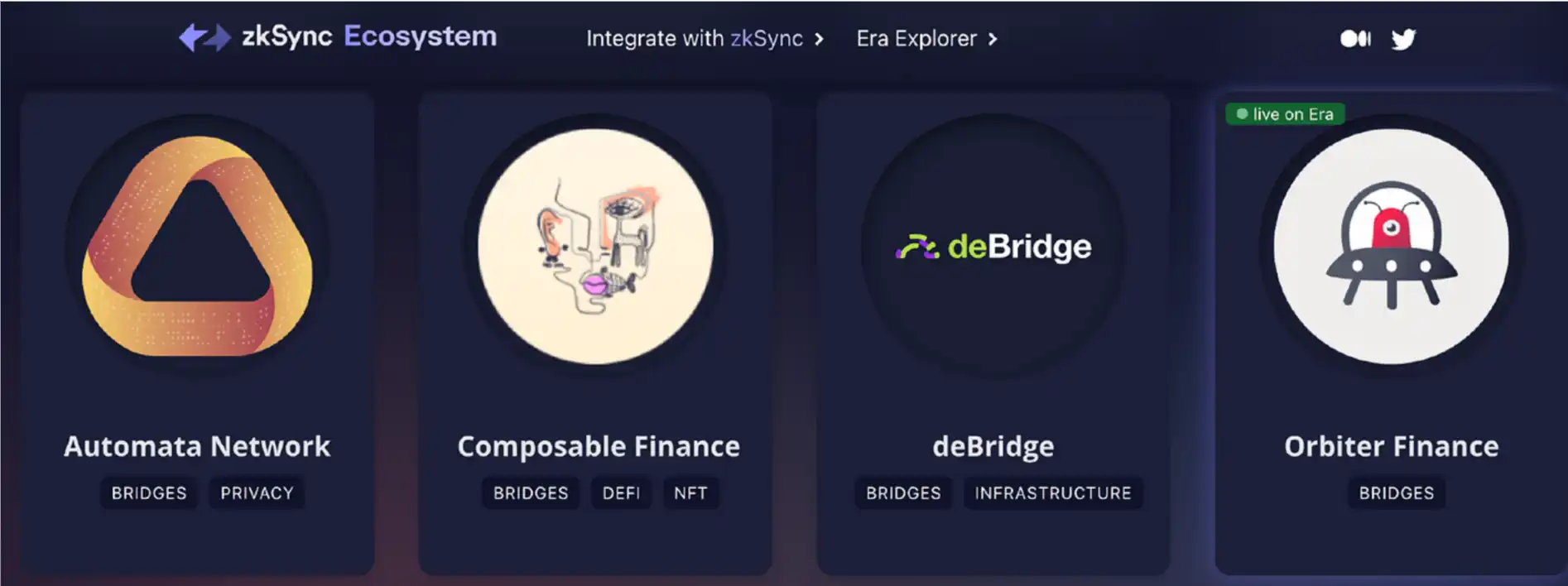
Zksync's official website recommends Orbiter in the cross-chain bridge.
Optimism has also recommended Orbiter cross-chain bridge in the sub-ecosystem of cross-chain bridge projects.
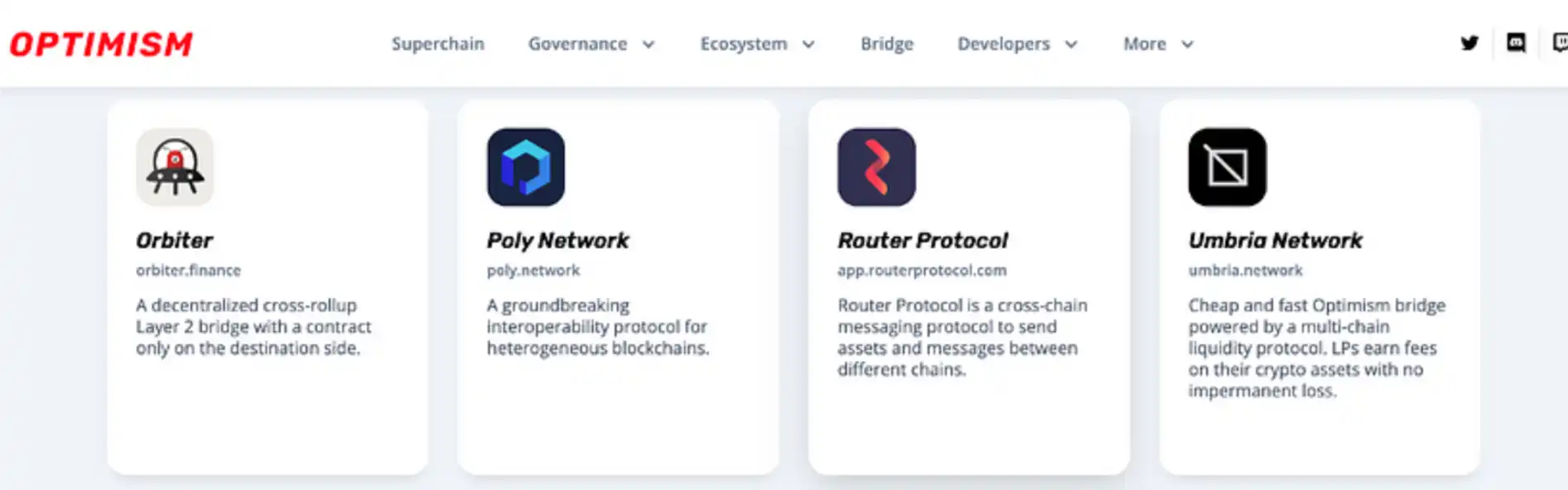
Orbiter's cross-chain bridge has received official endorsement, which naturally increases its credibility. Moreover, the official recommendation will also bring Orbiter many users.
5、L2 Data
除了跨链的功能,Orbiter 还推出了一个 L2 Data(数据看板)。
Apart from cross-chain functionality, Orbiter has also launched an L2 Data dashboard.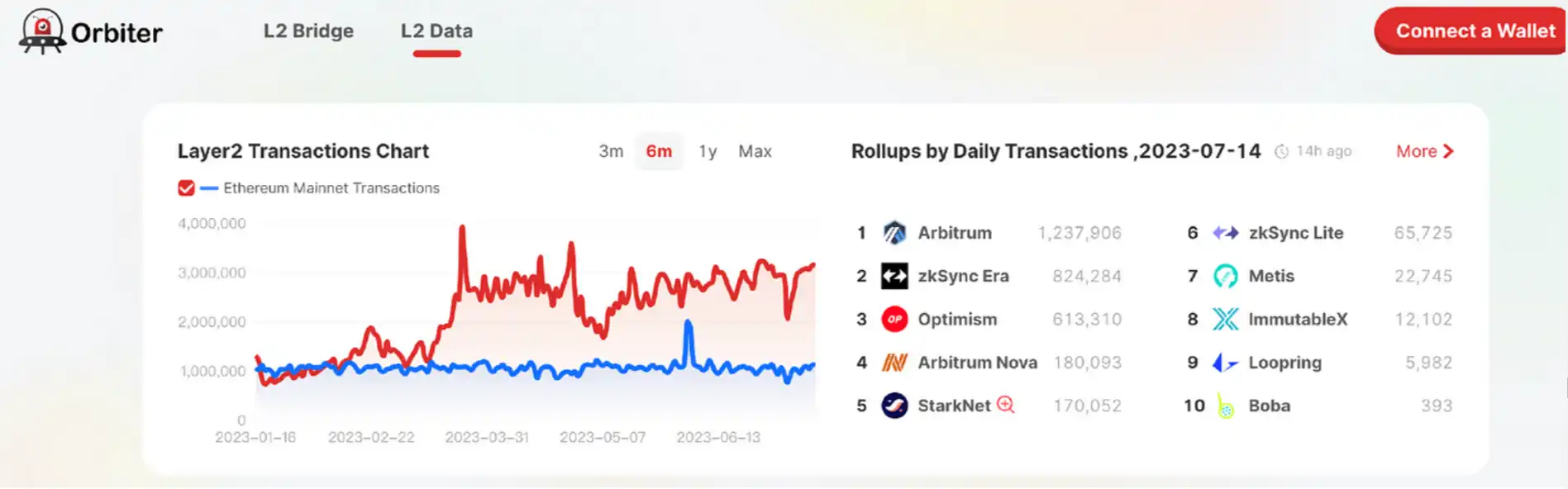
L2 Data supports Arbitrum, Optimism, Starknet, and zkSync data, including metrics such as accounts and transactions, TVL, users and user age, active user ratio, new user ratio, interactions, and new contracts.
Orbiter L2 Data is committed to providing more comprehensive, scientific, and effective Rollups ecosystem data for individual investors, institutions, and developers.
L2 Data is also a unique feature of Orbiter that distinguishes it from other cross-chain bridges.
Seven, Future Outlook
1. Cancun Upgrade, L2 Explosion, Increased Cross-Chain Demand
According to the data from Orbiter L2 Data platform (https://www.orbiter.finance/data), the total number of transactions on Ethereum L2 has surpassed that of Ethereum mainnet since the end of last year.
Currently, the total number of transactions on Ethereum L2 is more than three times that of the Ethereum mainnet, which includes a large number of interactive behaviors for airdrops.
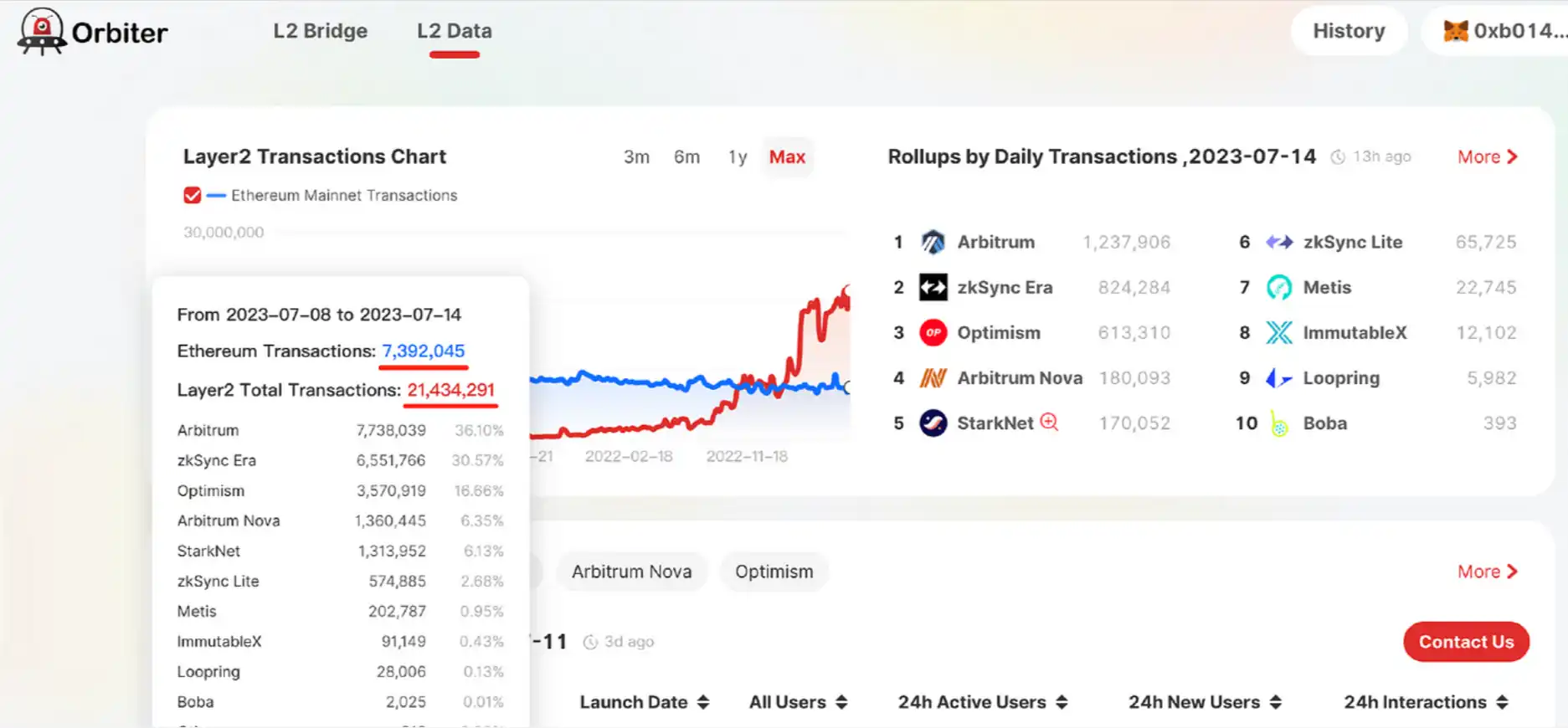
However, even if some transactions are for the purpose of claiming airdrops, the data at least illustrates the current development status of the Ethereum L2 ecosystem. After all, Layer2 networks have lower fees and higher scalability, and more and more projects are choosing to build their own projects on Ethereum Layer2 or migrate to Ethereum Layer2 from other chains.
With the completion of the Ethereum Cancun upgrade (possibly by the end of the year, currently without a specific time), the transaction fees on the Ethereum Layer2 network will be significantly reduced. As the transaction fees on the Layer2 network approach 0, it is likely to bring about a big explosion in the Ethereum Layer2 ecosystem.
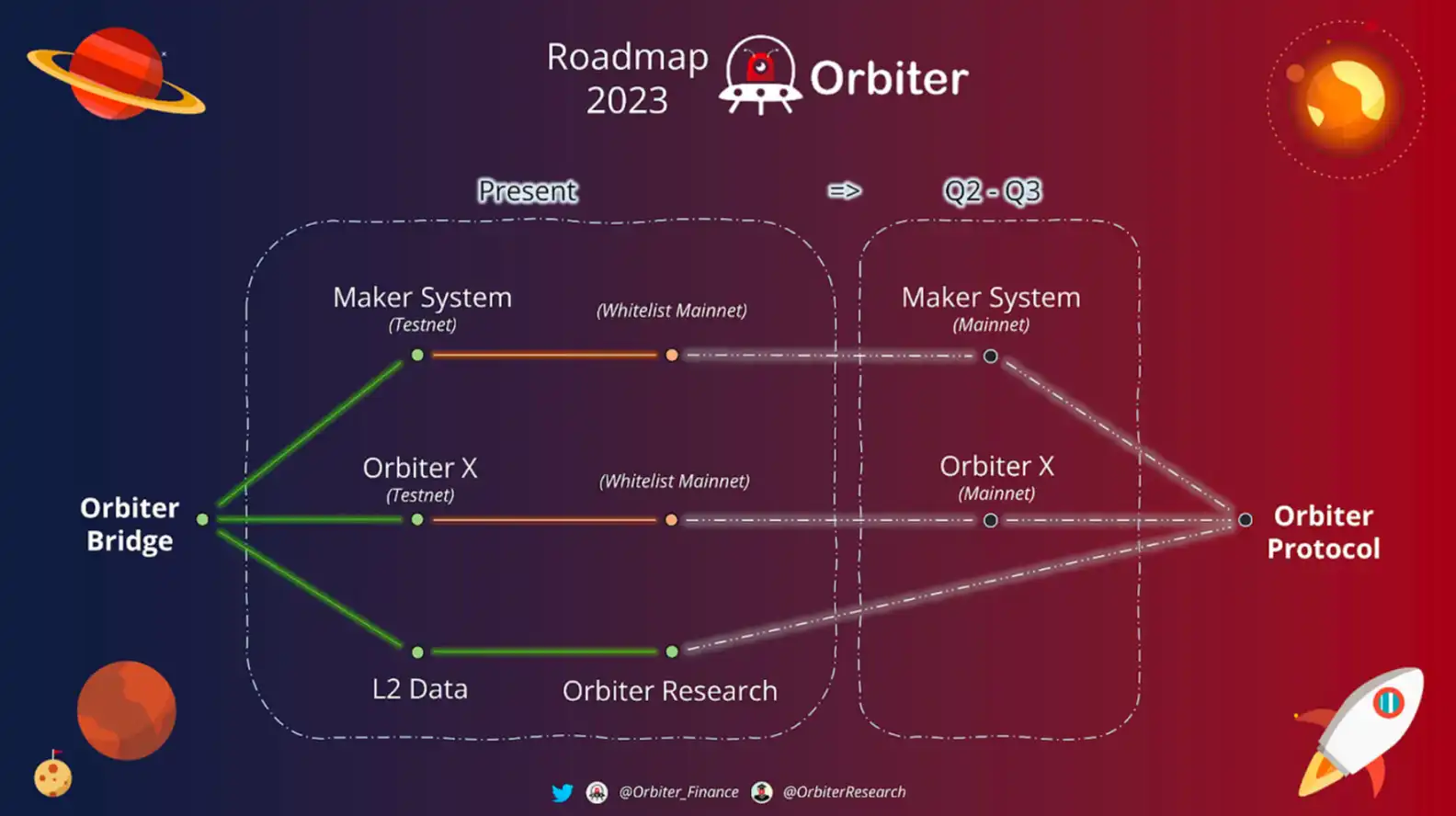
At that time, Orbiter will not only be a cross-chain bridge protocol, but also a universal Ethereum basic protocol, which undoubtedly increases our imagination space for the future of Orbiter.
3、Expectations for the issuance of platform tokens
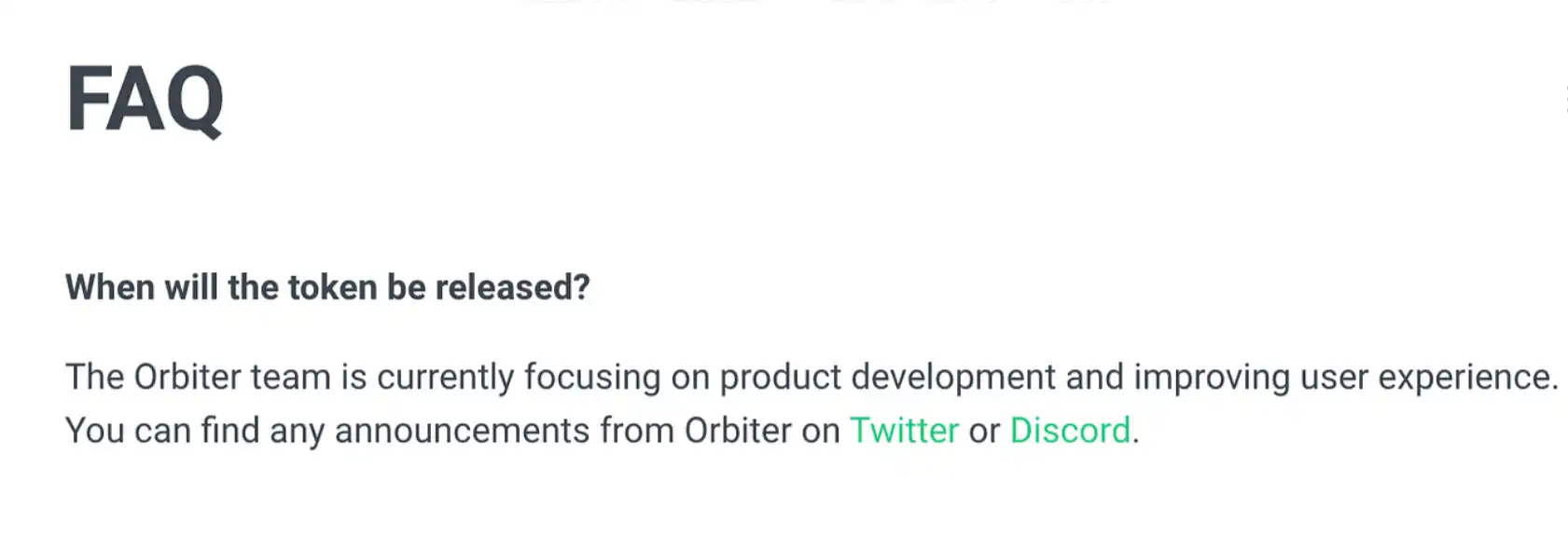
However, there have always been rumors about Orbiter issuing native tokens. Due to the expectation of the project team issuing coins, many users use Orbiter in order to participate in airdrops.
In short, with the explosion of Ethereum Layer2, the demand for cross-chain bridges will also increase dramatically. As a leader in the Layer2 cross-chain bridge segment, Orbiter, with its ambitious vision of becoming an Ethereum basic protocol, is sure to continue to develop and may become a leader and standard setter in Ethereum L2 cross-chain bridges. Additionally, since the project has not yet issued native tokens, Orbiter is a project that is definitely worth our continued attention.
Original Link
Welcome to join the official BlockBeats community:
Telegram Subscription Group: https://t.me/theblockbeats
Telegram Discussion Group: https://t.me/BlockBeats_App
Official Twitter Account: https://twitter.com/BlockBeatsAsia

 Related Articles