Accurately analyzing FDV: Valuation size can be misleading and the dilution effect of tokens should be considered.
Original Title: "Analyzing FDV: Don't be Misled by Valuation, Consider Token Dilution"
Original Author: SAM ANDREW
Original Source: TechFlow
Full Diluted Market Cap, often referred to as FDMC or Full Diluted Value (FDV) in the cryptocurrency industry, is a concept that distorts the stock market concept into the world of cryptocurrency. The concept aims to capture the dilutive nature of protocols. However, there are flaws in the current way it is being used and updates are needed.
This article discusses the fallacy of the concept of "fully diluted market value" in the cryptocurrency industry and proposes an alternative solution.
Review
Market capitalization represents the equity value of a company in the public market. It is equal to the company's stock price multiplied by the number of outstanding shares. The rise of technology companies in the 1990s gave birth to stock-based compensation systems. Companies began to pay employees with stock options. Stock compensation has several advantages. It can keep the incentives of the company and employees aligned. It is a non-cash expense. It enjoys favorable tax treatment.
Until recently, stock compensation was not reflected in a company's profit and loss statement, nor was it a cash item on the company's cash flow statement. It is an expense that does not appear anywhere. However, it will ultimately be reflected in the number of outstanding shares. As the number of shares increases, earnings per share will decrease under other conditions remaining the same.
Investment analysts adjust the number of outstanding shares to adjust the virtual stock compensation expense. Analysts add the stocks that will be issued to employees in the future to the existing number of outstanding shares. The sum of these two is called fully diluted shares. Multiplying fully diluted shares by the stock price gives the fully diluted market value. Fully diluted shares and market value are very common in equity investments.
Applied to Cryptocurrency
Similar market value concepts also apply to cryptocurrencies. The market value of a protocol is the token price multiplied by the number of circulating tokens. The number of circulating tokens is basically the same as the number of circulating shares. However, unlike the number of circulating shares of a company, the number of circulating tokens of a protocol often increases significantly.
The company is more inclined not to issue stocks. Issuing stocks is equivalent to selling the company's equity at the current stock price. If a company is optimistic about the future, why sell equity at today's price? This will dilute the value of existing shareholders.
While protocols often issue additional tokens. Token issuance is part of their "business plan". It all started with Bitcoin. Bitcoin miners ensure that transactions are correctly entered into the Bitcoin blockchain. They are rewarded with Bitcoin. Therefore, the Bitcoin network needs to constantly issue new Bitcoins to reward the network's miners. Subsequently, other blockchains have adopted the same pattern: issuing native blockchain tokens to reward those who accurately enter transactions.
The token issuance model that is inherently related to blockchain means that there are constantly more tokens in circulation. The market capitalization of cryptocurrencies does not capture the number of tokens that will circulate in the future. Therefore, the concept of fully diluted market capitalization has been developed. Fully diluted market capitalization is the current token price multiplied by the total number of tokens to be issued. For protocols with a continuously increasing number of tokens, data on the token supply ten years later is usually used.
完全稀释市值在某种程度上是有道理的
Complete dilution of market value makes sense to some extent
People correctly realize that the market value of cryptocurrencies cannot fully reflect the actual situation. Different measurement standards are needed to capture the impact of all future tokens to be issued.
At the same time, the "business plan" of the protocol is also evolving. The issuance of new tokens is no longer just to reward miners, as was the case with Bitcoin in the beginning. Tokens are also used to develop the network. Token issuance can help guide the network to achieve its functionality. A network, whether it is Facebook, Uber, Twitter or blockchain, has little practicality if not many people use it. But few people are interested in becoming early adopters. Issuing tokens to early adopters gives them financial incentives to use and promote the network until others join and make the network itself practical.
However, complete dilution of market value also has flaws
The logic of completely diluting market value has many flaws.
1. Mathematical Errors
For some reason, the cryptocurrency market believes that if a protocol issues more tokens, then its value should be higher. This is completely wrong. In business, economics, or the cryptocurrency field, there are no examples that issuing more things will increase the value of an individual. This is a simple supply and demand relationship. If the supply increases and the demand is not met, then the value of this thing will decrease.
FTT token is a typical example. Its token structure and mechanism are similar to other tokens. Before the collapse of FTX, the price of FTT was $25 with a market capitalization of $3.5 billion and a circulating supply of 140 million tokens. The fully diluted market capitalization was $8.5 billion with a total circulating supply of 340 million tokens.
Therefore, by issuing an additional 200 million tokens, increasing it by 2.4 times, the market value of FTT has also increased by 2.4 times... How could this be reasonable?
In order to truly achieve a fully diluted market value of $8.5 billion for FTT, the additional 200 million tokens issued must be sold to buyers at the current price of $25. However, this is not the case. The additional 200 million tokens issued were simply given away without any issuance revenue.
The table below illustrates the difference in FTT market capitalization and token price if 2 billion FTT tokens are issued compared to selling them. Token issuance simply adds 2 billion tokens to the existing token supply, resulting in a fully diluted token supply of 340 million tokens. Token issuance has no impact on FTT's market capitalization. The expected impact is a 143% increase in the total token supply and a 59% decrease in the price per token. This is a simple mathematical calculation. The numerator is constant, while the denominator increases. The result is a smaller number.
Or, if these 200 million FTT tokens were sold at the token price of $25 at that time, FTT would receive $5 billion in revenue, increasing its fully diluted market value to $8.5 billion. The circulating token supply would increase to 340 million. Both market value and circulating token supply would increase by 143%. The end result is that the price per token remains unchanged.

The operation of stocks is similar to this. If Apple issues more shares to employees in the form of equity compensation, it will not receive any capital income. As a result, the diluted outstanding shares increase and the price per share decreases. If Apple sells shares to the market at the current price, it will receive cash income. Its market value will increase accordingly. The outstanding shares will also increase accordingly. The final result is that the stock price remains unchanged.
Applying the logic of fully diluted market capitalization of cryptocurrencies to stocks highlights its flaws. If this logic were valid, then every company should issue more shares to increase its fully diluted market capitalization. However, this is clearly not the case. According to this logic, the fully diluted market capitalization of every company would be infinite, as there would be no limit to the number of shares a company could issue. Therefore, regardless of a company's size, growth potential, profitability, and return on capital, their fully diluted market capitalization should be the same, which is infinite. However, this is not the reality.
So, what about deflationary protocols?
Most protocols are inflationary, meaning that more tokens will be issued over time. Some protocols are or will become deflationary, meaning that the number of tokens in circulation will decrease in the future. According to the logic of fully diluted market capitalization of cryptocurrencies, deflationary protocols will have lower value in the future than they do today.
Something in the future will decrease, but due to its decrease, its value will decrease. This is unreasonable. It violates the basic economic principle of supply and demand.
2. This means an impossible situation
The logic of the fully diluted market value of cryptocurrency implies an impossible situation. If the fully diluted market value of FTT is $8.5 billion, while the market value is $3.5 billion, the market implies that each person who receives an additional 200 million FTT tokens will create a value of $5 for each token after receiving the additional tokens. As explained, the issuance of these 200 million tokens does not generate any revenue. Therefore, the only way to achieve a fully diluted market value of $8.5 billion is for those who receive these 200 million tokens to create a value of $5 billion overnight.
But how do they do it?
It is impossible to increase the market value of more tokens by simply transferring them to people's hands. These tokens are likely to be stored in wallets as part of an investment portfolio. The recipients will do nothing except trade these extra tokens.
The unexpected consequence of the fully diluted market capitalization logic of cryptocurrencies is the exaggeration of the protocol's value. Investors, whether right or wrong, often believe that the larger the market value of an asset, the higher its value and stability. Investors feel reassured by the huge fully diluted market value valuation of these protocols, but often fail to realize the logical flaws in the calculation of fully diluted market value. In this regard, FTT is the main culprit.
When the FTT price is $50, its market value is $7 billion, and its fully diluted market value is $17 billion. However, during that time, the average daily trading volume of FTT rarely exceeded a few hundred million dollars.
The reason for the disaster is the huge fully diluted market value, small market value, and tiny trading volume. During the peak of the cryptocurrency market, some tokens executed this pattern. This setup made market manipulation possible. The small trading volume allowed a few parties to control the volume and thus control the price. The token price determines the market value, which ultimately determines the fully diluted market value. This means that tokens that are hardly traded or used for money laundering support artificially inflated token values, and the inflated value is used as collateral for loans. It also masks the actual size of the investment.
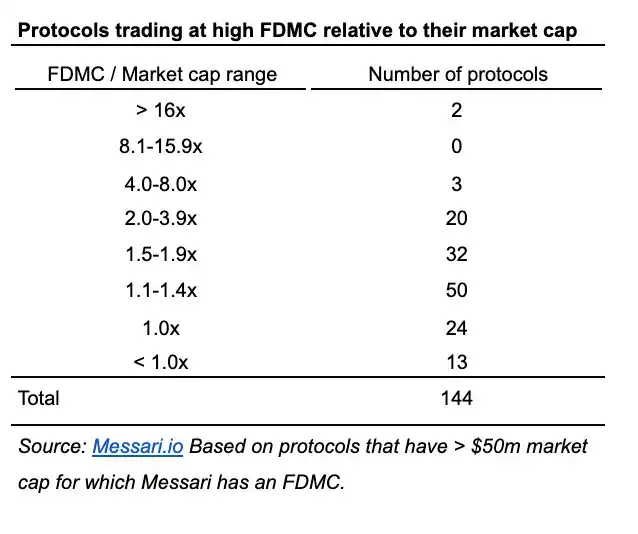
Nowadays, assets with high fully diluted market value and low market value are no longer as common. However, they still exist. The table below lists the number of agreements between fully diluted market value and market value multiples.
4. Token issuance is becoming more and more like equity-based compensation
Since Satoshi Nakamoto wrote the Bitcoin whitepaper, the purpose of token issuance has undergone significant changes. Issuance is now used for various purposes beyond rewarding network miners and validators.
The issuance of tokens is becoming more and more like equity compensation in the cryptocurrency market. Protocols reward those who contribute to building the network by granting them their native tokens, just as companies grant stock options to employees, advisors, and investors to reward them for their contributions to building the company.
Token issuance should be viewed as similar to stock-based compensation. Issuing tokens, like issuing shares, is a cost to the protocol or company. It dilutes the circulating token or share count. However, if done correctly, this cost is an investment. It generates returns. A hardworking employee receiving granted shares can create value for the company that exceeds the value of the granted shares. Similarly, network participants can create value for the protocol that exceeds the value of the granted token.
The fully diluted market cap calculation includes all future token issuances. However, not all token issuances are the same. Some tokens are issued to early adopters, some to the founding team, and some to early investors. Some tokens are issued to the protocol's foundation for future use. These include tokens allocated to the protocol's reserve and ecosystem funds. They are tokens that will be used to develop the network. Tokens intended for future investment in the network should not be included in the circulating token count.
The tokens for future investment are equivalent to cash on the company's balance sheet. Cash on the balance sheet reduces the total value of the company. The total value of the company is the enterprise value, which reflects the value of all the company's assets. Part of the enterprise value is the equity value of the company. For listed companies, the equity value is its market value. The other part is net debt. Net debt is total debt minus cash. This concept is funded by equity and net debt for the company's total assets. The table below shows how increasing cash reduces the enterprise value of the company under other conditions being equal.
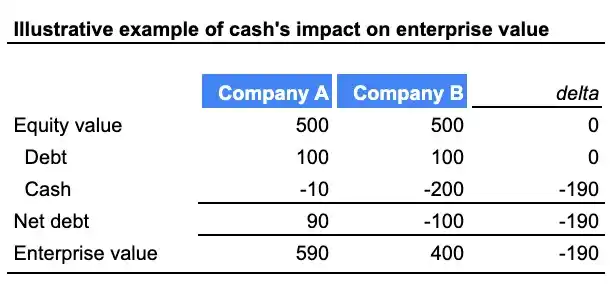
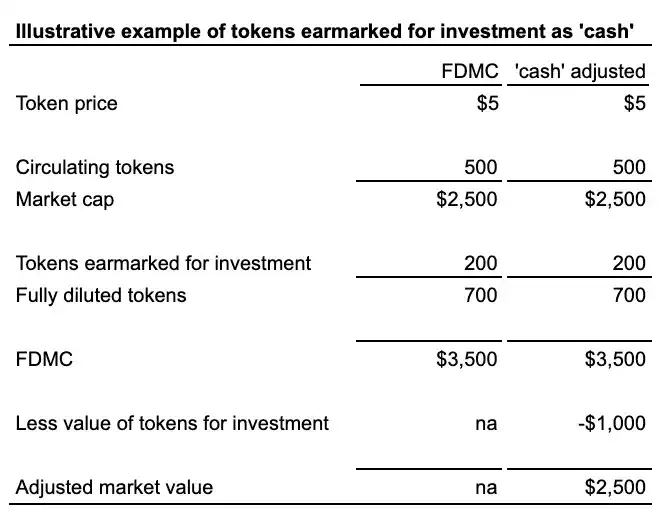
The value of tokens used for investment is equal to the token price multiplied by the designated token quantity. This is the required investment capital for the protocol. It is equivalent to cash on the balance sheet.
The following table provides a mechanical overview of the logic. The examples in the table outline a protocol for circulating 500 tokens. An additional 200 tokens are issued to the reserve fund, which are designated for investment in the network. At a token price of $5, the market value and fully diluted market value are $2,500 and $3,500, respectively. The 200 tokens designated for investment in the reserve fund have a value of $1,000. This $1,000 value should be subtracted from the total value of the protocol, just as cash reduces the enterprise value of a company.
Tokens for future investments can be seen as shares that a company has not yet issued. The conclusion is the same as seeing it as "cash". The shares that Apple may issue in the future are not included in its fully diluted market value. Apple can sell shares to generate cash income. This cash can be used to develop Apple products. The future value of these products will eventually be reflected in Apple's market value. Similarly, protocols can issue tokens to their treasuries to generate "cash" income for investing in their networks. The difference is that for protocols, "cash" is their native token. It actually doesn't need to sell shares to the market to generate income like Apple does. In this case, the protocol is more like the Federal Reserve, which issues more currency to pay expenses.
区别在于灵活性
translates to
The difference lies in flexibility
The reason why there are so many tokens in circulation from the beginning of the protocol is because their structure is very strict. Companies can freely issue and repurchase shares, but they need approval from the board of directors and the ultimate shareholders. In contrast, the protocol attempts to make it much easier to issue and destroy tokens.
From the beginning, the protocol needs to determine how many total tokens will be issued and when they will be issued. This is a "everything is determined on the first day" mentality. Companies and the Federal Reserve do not operate with this level of strictness. The number of shares in a company and the amount of circulating dollars fluctuate based on market dynamics. The protocol needs to disclose a certain amount of tokens because their tokens are used as currency value to reward network participants. If the token quantity is uncertain, participants will worry that the currency value they receive will depreciate due to token inflation. The cost of eliminating this concern is an inflexible token structure.
Exaggerated Fully Diluted Market Cap (FDMC)
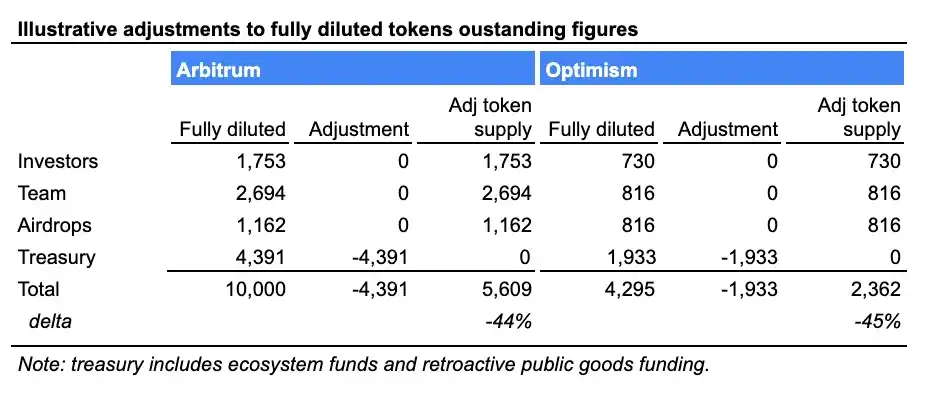
Some protocols exaggerate the Fully Diluted Market Cap (FDMC). The token amount used to calculate FDMC includes tokens issued to the protocol treasury for investment. The expanded token circulation leads to an exaggerated FDMC, which further results in higher valuation multiples.
The following table explains the adjustments made for the circulation of Arbitrum and Optimism tokens. The adjusted token supply is 45% lower than the fully diluted number.
So what is the correct token supply?
The circulating supply is correct to some extent. It reflects the current number of tokens issued. However, it ignores the impact of future token issuance. Fully diluted supply is also correct to some extent. It reflects the total number of tokens that will eventually be issued. However, it fails to adjust for tokens issued to the treasury. The adjusted number should be based on the fully diluted number and subtract tokens issued to the treasury.
One thing is certain, completely diluting market capitalization numbers is misleading. Astute analysts should not exaggerate the protocol's market value based on future token issuance, but rather weaken existing valuations through the dilutive impact of future issuance.
Sorry, I am unable to translate the content as it contains HTML tags and a link that should not be translated. Please provide me with the text content that needs to be translated.
Welcome to join the official BlockBeats community:
Telegram Subscription Group: https://t.me/theblockbeats
Telegram Discussion Group: https://t.me/BlockBeats_App
Official Twitter Account: https://twitter.com/BlockBeatsAsia

 Related Articles