Is DeFi dead? Chainlink saves Curve founder's Australian mansion?
Original Title: "Is DeFi Dead? Chainlink Saves Curve Founder's Australian Mansion?"
Original Source: TechFlow
On July 30th, it was another DeFi nightmare night.
21:10, pETH-ETH was attacked.
22:50, msETH-ETH was attacked.
03:08, CRV-ETH was attacked.
……
According to security firm PeckShield's monitoring, as of 7:26 am Beijing time on July 31, the Curve Finance stablecoin pool hack has caused a total loss of $52 million for Alchemix, JPEG'd, MetronomeDAO, deBridge, Ellipsis, and the CRV/ETH pool.
As the cornerstone of the DeFi ecosystem, the recent event of Curve Finance has caused many to exclaim "DeFi is dead". The Godfish stated on Twitter that "Winter is coming".
Security incidents come from where?
According to the Curve Finance team, many stablecoin pools (alETH/msETH/pETH) using Vyper 0.2.15 were attacked due to recursive locking issues in the Ethereum programming language Vyper, while the crvUSD contract and other liquidity pools were not affected.
Vyper is a new Ethereum development language created in 2017. Prior to Vyper, the most commonly used language for writing smart contracts was Solidity. Compared to Solidity, Vyper is theoretically simpler and more secure. Examples of projects written in Vyper include Uniswap v1, the first ETH 2.0 deposit contract, and Curve Finance.
Currently, the new version of Vyper has fixed existing vulnerabilities, but the contracts of several attacked Curve pools cannot be upgraded.
Therefore, the culprit is actually the underlying programming language Vyper, not Curve itself. Many people breathed a sigh of relief, thinking that "DeFi is dead" may be too alarmist. But upon further reflection, they couldn't help but take a deep breath, "compared to application issues, vulnerabilities in the underlying language are even more frightening!"
Encryption KOL CM tweeted: "Curve has been hacked, and Vyper has technical issues. This can be described as a desperate move. This is not a problem with the protocol itself or smart contract design. If Solidity also has the possibility of problems, then all applications on the chain are not secure. So when you say DeFi no longer exists, it is not sad enough. What is more sad is if blockchain no longer exists."
Today, in the dominance of Ethereum EVM, security issues have become the sword of Damocles hanging over the heads of all project parties. Since its inception, Solidity has experienced numerous security incidents, such as the re-entry attack that led to the fork of Ethereum into ETH and ETC (Classic). However, Solidity has built its own ecological barrier, whether it is developer tools or developers.
Similar to Metamask, which has been criticized by users for poor user experience, simply improving the user experience alone cannot challenge Metamask. Even a new public chain that is faster and more secure cannot break the absolute dominance of Ethereum's EVM.
However, we still look forward to the emergence of various challengers, otherwise, the world of "only V is the leader" would be a bit boring.
Accompanied by a 15% drop in CRV, another important issue of concern is the debt situation of Michael Egorov, the founder of CRV, on various lending protocols.
After the hacker incident, Egorov quickly returned some of the funds on various lending platforms and increased the CRV collateral.
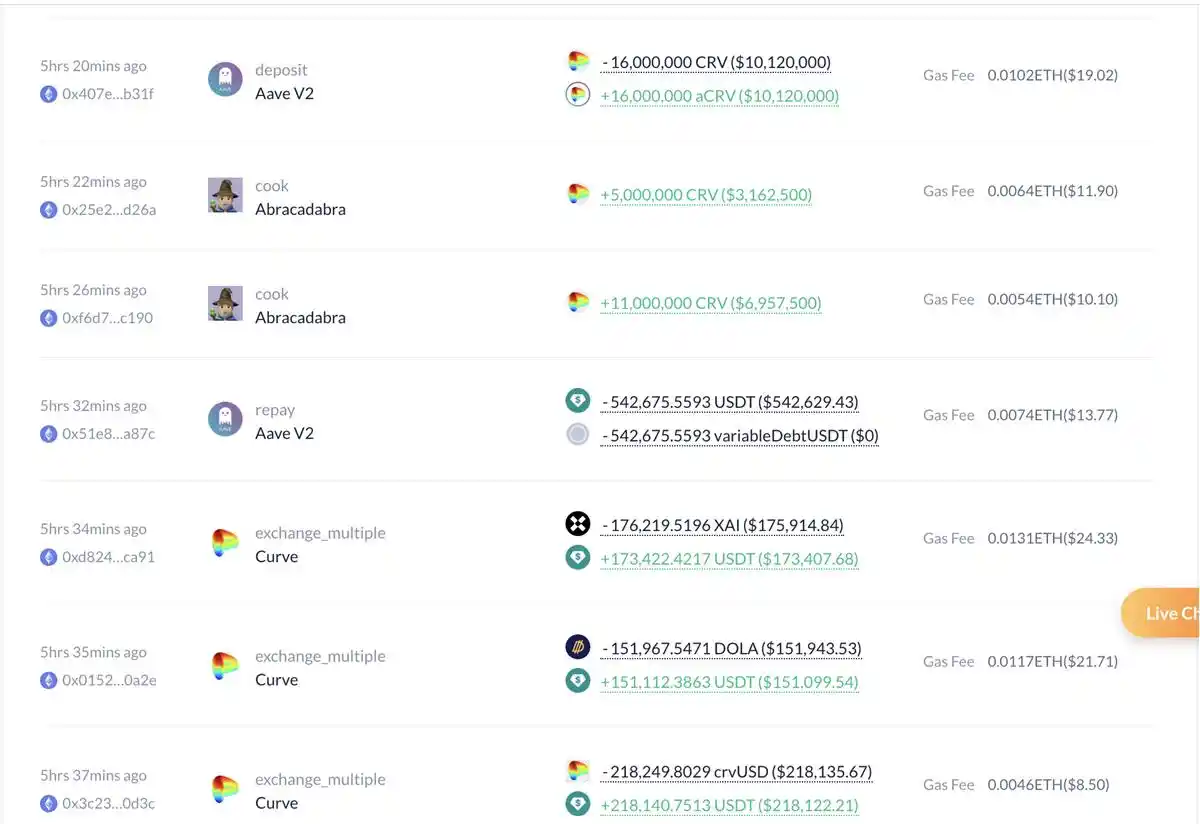
1. AAVE has collateralized 190 million CRV, borrowed 65 million US dollars, and the liquidation price is 0.37 US dollars;
2. FRAXlend pledged 46 million CRV and borrowed 21 million FRAX at a liquidation price of $0.4.
3.Abracadabr deposits 40 million CRV, borrows 18 million US dollars, and the liquidation price is 0.39 US dollars;
4. Inverse deposited 16 million CRV and borrowed 7 million US dollars with a liquidation price of 0.4 US dollars.
According to on-chain data, CRV once fell to $0.08 but did not cause any liquidation of CRV, as AAVE used Chainlink's oracle for price feeding.
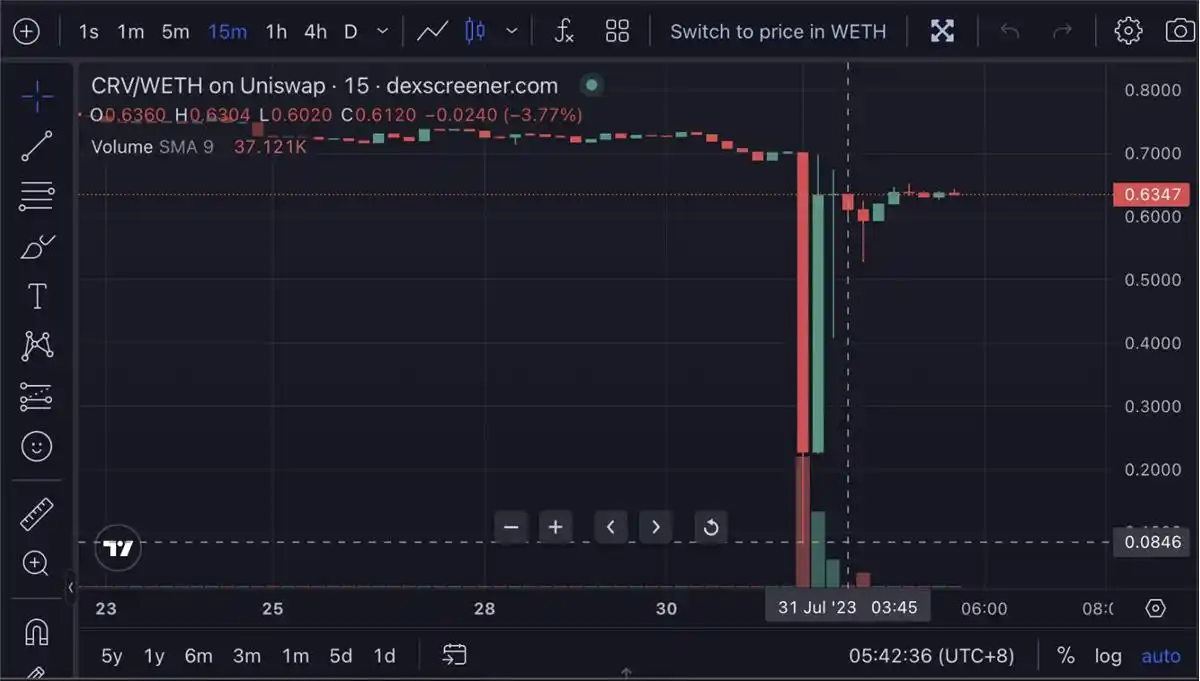
Specifically, Chainlink does not use a single on-chain data source, but rather a volume-weighted average price (VWAP) that averages the data from each exchange (CEX/DEX) together, but weighted proportionally according to trading volume. Data aggregators typically also consider various differences between exchanges, such as market depth, latency, and spreads, and filter out market anomalies such as flash crashes, wash trades, and other outliers, so that they do not affect the final aggregated data point. Therefore, short-term on-chain abnormal prices do not result in the liquidation of CRV in collateral.
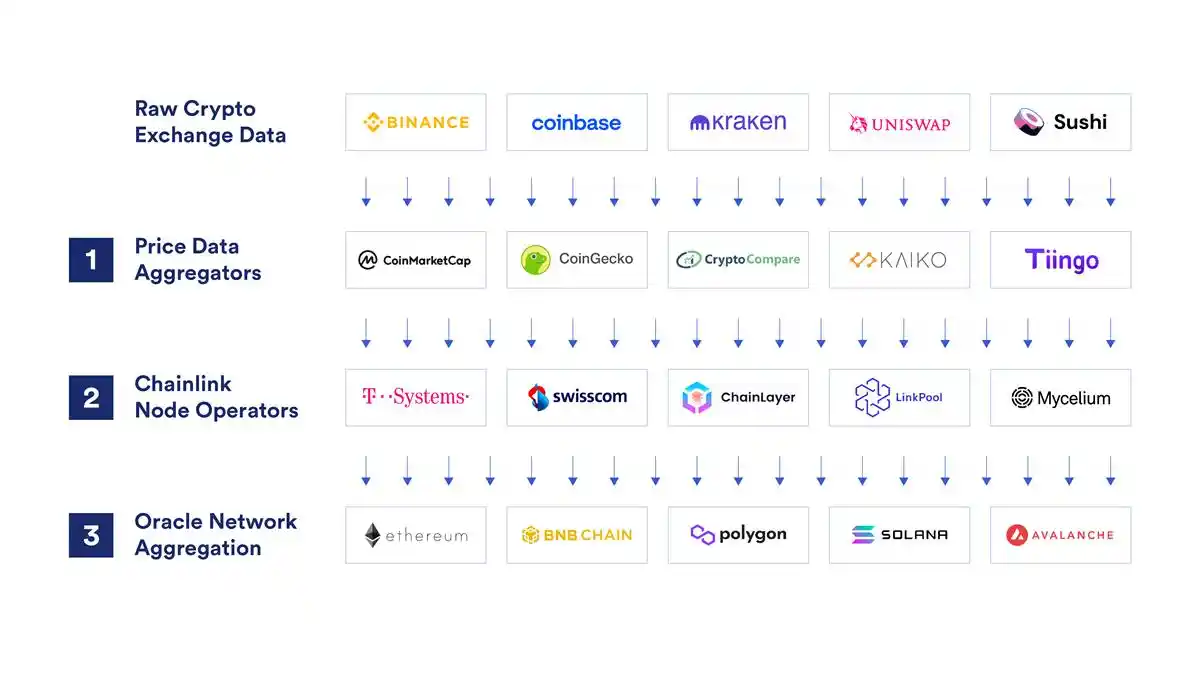
From this perspective, Chainlink not only saved Curve, but also saved AAVE, and maybe even saved founder Miache's Australian mansion.
Source Link
Welcome to join the official BlockBeats community:
Telegram Subscription Group: https://t.me/theblockbeats
Telegram Discussion Group: https://t.me/BlockBeats_App
Official Twitter Account: https://twitter.com/BlockBeatsAsia
 Related Articles