Google's major policy update: Can Web3 welcome a massive number of Android users?
Original Title: "Google's Major Policy Update, Can Web 3.0 Attract a Massive Android User Base?"
Original Source: METAERA
1. Introduction to Google Play Store Policies
- Google announced an update to the Play Store policy, allowing apps and games that contain NFTs to enter the platform.
- The new regulations require games that use tokenized assets to clearly indicate their use of blockchain elements.
- To protect the legitimate rights and interests of users, Google will prevent developers from exaggerating the potential profits brought by NFTs.
- The new policy also prohibits any "loot box" mechanism that violates the Gambling Eligibility Requirement.
- Reddit has partnered with Google to establish a policy aimed at creating a fair competition environment that promotes user trust and responsible use of blockchain technology.
It should be noted that Google has taken a tough stance on blockchain-based applications in the past. In 2018, Google banned cryptocurrency mining applications and has since maintained the ban. However, Google recently allowed the decentralized data storage application ArDrive Mobile and included the blockchain game Axie Infinity Origins in some markets in 2022. In addition, Google Cloud announced in April 2023 that it will help developers build applications on Polygon to accelerate the startup process.
Through this change in Google Play policy, it can be seen that Google has begun to actively embrace Web 3.0. What prompted Google's attitude change? On the other hand, as another technology giant, what is Apple's attitude towards the global leading mobile application market? What will Web 3.0 bring to Google? And how will Google influence the development of Web 3.0? We will explore these questions next.
二、苹果与谷歌在对待 NFT 态度上的异同
Translation:
2. The Differences and Similarities in Apple and Google's Attitudes towards NFTs
As a tech giant on par with Google, Apple's policy stance on blockchain and NFTs is also worth noting. As early as October 2022, Apple clarified restrictions and rules on the use of non-fungible tokens (NFTs) and blockchain games through its new guidelines for the App Store.
NFT Trading: Apple has made it clear that applications can use in-app purchase functionality to sell NFTs and related services, such as minting and transferring these tokens.
NFT and related content: NFT assets can be browsed and used within their respective applications, but cannot be used to unlock additional features or content. Apple prohibits the use of NFTs as a means of accessing exclusive parts of an application, such as a membership card for accessing the application.
Payment Mechanism: For NFT transactions, users must use Apple's in-app payment mechanism. As Apple does not support cryptocurrency payment options, this method cannot be used for payment. Apple takes up to 30% of the share from in-app payments. This limits the types of services that can be offered involving NFTs and creates pricing issues for NFTs, as they must be purchased through in-app purchases at preset prices (e.g. $14.99), which does not align with the market's dynamic pricing mechanism.
Cryptocurrency and blockchain games: For cryptocurrency transactions, Apple's guidelines stipulate that applications can provide "cryptocurrency trading or transmission" in countries or regions where they have obtained licenses and operate cryptocurrency exchanges.
Overall, although Apple's new policy allows NFTs to exist in the App Store, there are some important restrictions, especially in terms of payment mechanisms and how NFTs interact with app content. In comparison, Google's policy change has almost lifted all restrictions on blockchain applications, with only a few remaining restrictions mainly reflected in software and hardware aspects:
Soft Limitation: Developers must maintain transparency to users regarding tokenized digital assets. If a game or application sells or allows users to obtain tokenized digital assets, developers must clearly declare this to players. In addition, developers are not allowed to exaggerate any potential benefits of the game or trading activities, nor conduct related promotions to mislead players.
Hard restriction: Chain games with "loot box" mechanism must comply with Google's gambling eligibility requirements. This restriction is quite strict because there are relatively few countries where gambling is legalized. The "loot box" mechanism refers to the fuzzy value of game items, such as treasure chests obtained by playing games, items or heroes divided according to rarity (such as SR, SSR, etc.). This mechanism is essential in many chain games. However, if the game operator determines the value of randomly dropped items such as treasure chests and heroes, it will involve the issue of game economy regulation. If the regulation is not appropriate, it can easily cause the collapse of the economic system.
Here is a brief comparison of blockchain policies between IOS App Store and Google Play:

Table: Comparison of Blockchain Policies between IOS App Store and Google Play
Three, Google Play Development and Attitude Shift towards Blockchain
What prompted Google Play to change its attitude towards blockchain and NFTs, and what benefits will this policy change bring to Google Play? Analyzing the history and development of Google Play, since its launch in 2012, it has become one of the largest mobile app markets in the world, with a user base far exceeding that of the iOS App Store, but there is a huge gap in revenue and consumer spending. For example, in the first half of 22, Google Play generated about $21.3 billion in revenue through in-app purchases and subscriptions, a 7.4% decrease compared to the same period in 2021. In contrast, in the first half of 2022, the iOS App Store generated about $43.7 billion in revenue through in-app purchases and subscriptions, a 5.6% increase compared to the same period in 2021.
Upon closer examination, the reasons can be summarized as follows:
- iPhone users have stronger purchasing power.
- Apple's policies and commission system. Apple charges a commission of 30%, forcing developers to increase the prices of iOS applications. In contrast, Google Play has a lower commission of 15%.
- iOS users are more willing to pay for apps, resulting in a larger number of top-tier apps on iOS compared to Android. For example, in the first quarter of 2019, the revenue from the iOS App Store was 1.48 times that of Android. Top developers also earn 64% more revenue through iOS than Android.
- The revenue share of the gaming category is higher on iOS, and the spending level of gaming users is higher than that of other category applications.
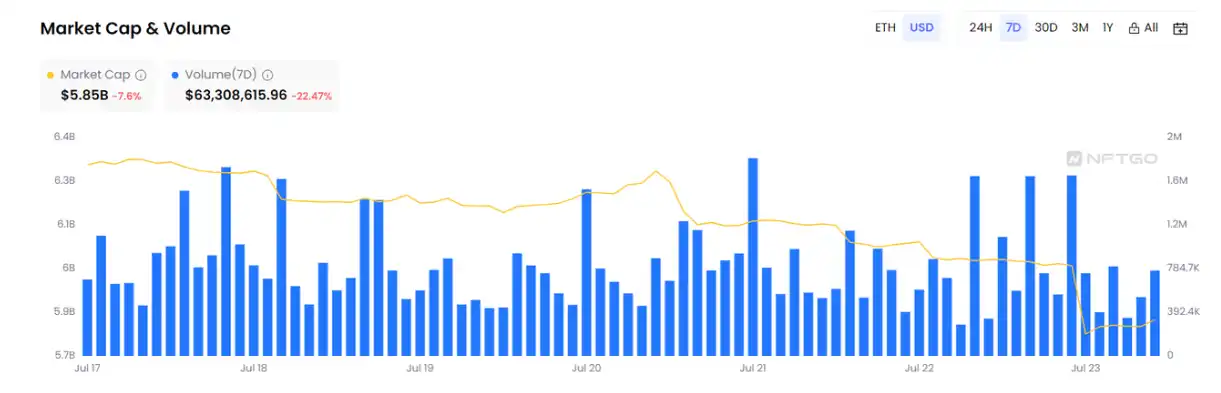
Table: Comparison of Blockchain Policies between IOS App Store and Google Play
Allowing blockchain applications to be listed may help to some extent in compensating for the disadvantages of Google Play:
1. NFT, as a non-fungible token, naturally has the function of collecting royalties. If top developers release applications on Google Play with NFT assets attached, it can significantly increase their income level.
2. Even though the cryptocurrency market is currently in a bear market and the NFT market has shrunk by more than 80% from its peak, the current market value of Ethereum NFTs alone is close to $6 billion. When combined with the NFT market values of Bitcoin, Solana, Polygon, and other chains, it should be over $7 billion. When the cryptocurrency market recovers, the market value will expand several times over.
3.GameFi is one of the largest funding tracks in the blockchain industry, which will to some extent increase the proportion of game revenue from Google Play's total revenue.
Four, Impact on the Blockchain Industry
Compared to the billions of users on Google Play, the number of users in the entire Web 3.0 world is only a fraction, let alone NFT and GameFi.
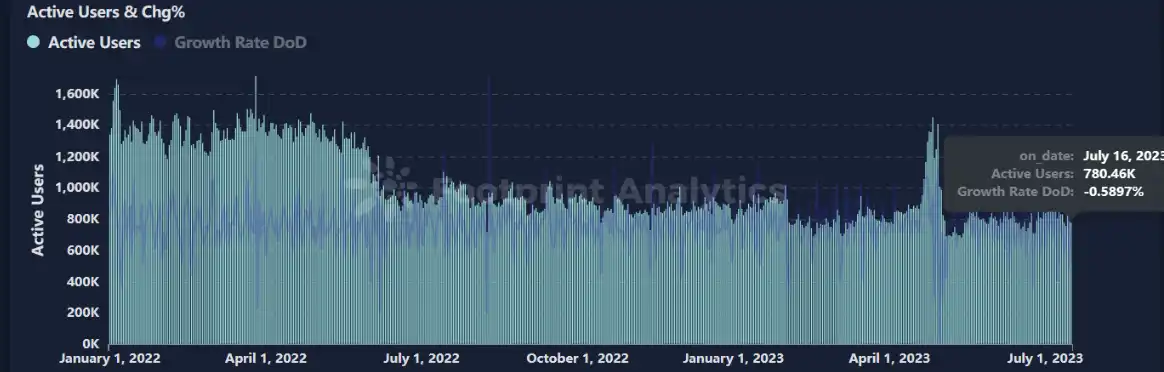
Image: Daily active users of blockchain games. Image source: Footprint
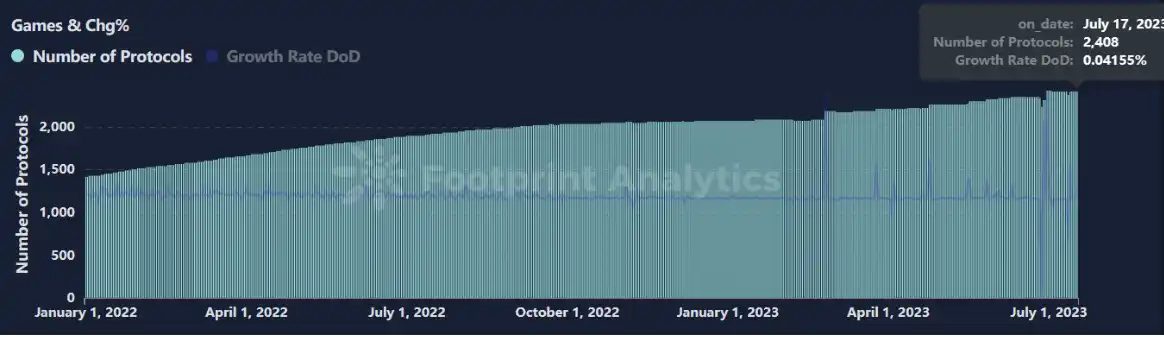
Image: Number of blockchain games. Source: Footprint
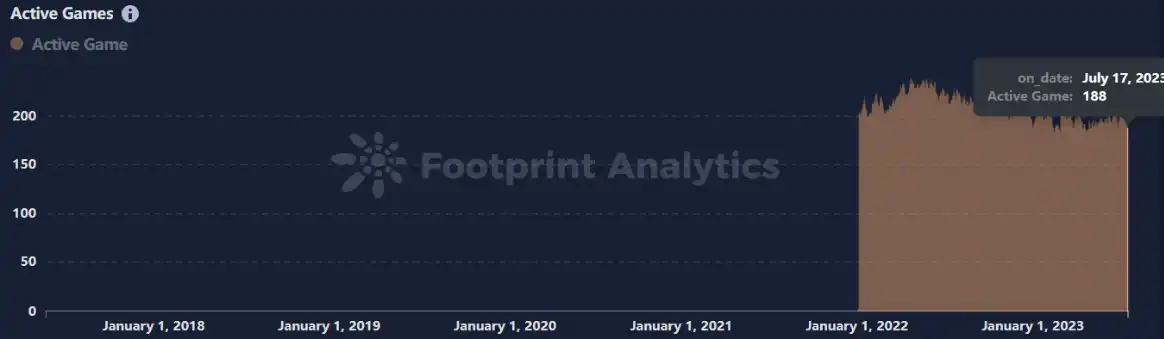
Image: Number of active chain games. Image source: Footprint
As of July 16, 2023, the daily average number of active accounts in GameFi is about 780,000. The total number of existing games is about 2,400, with less than 200 active games.

图:NFT 的日均交易地址数 图源:Footprint
Translation:
Image: Daily average transaction address of NFT. Image source: Footprint.
As of July 18, 2023, the daily average number of NFT transaction addresses is only 34,000.
From a long-term perspective, even if Google Play's policy change can only bring a 0.1% conversion rate for NFT and GameFi, it will still result in a multiple increase in the user base of NFT and GameFi. Although Google Play's policy also restricts the hype and false advertising of blockchain applications, it is believed that it can still bring a large number of new users to the blockchain field, especially in the area of chain games, when the bull market returns, because GameFi users have many similarities with Google Play in terms of regional distribution and mobile phone model distribution.
Geographical distribution:
The largest proportion of users in Southeast Asia, with Southeast Asian users accounting for 41% of the total in the first half of 2022.
Next are the users from North America and Western Europe, accounting for 16% and 15% respectively in the first half of 2022.
The proportion of users from developing countries is also growing rapidly, such as the Philippines, Vietnam, India, and so on.
Device Distribution:
Overall, Google Play allows blockchain games and NFT applications to enter the platform, marking a significant milestone for the wider adoption of blockchain technology on mainstream platforms. Google's attitude has shifted from prohibition to openness and inclusivity towards blockchain applications, opening the door for the development of blockchain games and NFT applications on the Google Play platform. Developers can now use digital assets to create richer and more immersive user experiences, such as using NFTs to enable users to own in-game content, which will drive innovation in blockchain gaming. At the same time, Google has a massive user base and strong traffic support, providing developers with a new platform and channel to expand blockchain applications globally, accelerating the globalization of blockchain gaming applications.
Reference materials
[1]https://android-developers.googleblog.com/2023/07/new-blockchain-based-content-opportunities-google-play.html
[2]https://www.nbcnews.com/tech/crypto/apple-tightens-rules-crypto-nfts-app-store-rcna53905
[3]http://www.gamelook.com.cn/2022/07/489251
[4]https://finance.sina.com.cn/stock/usstock/c/2019-06-19/doc-ihytcitk6331429.shtml
[5]https://cn.cointelegraph.com/news/2022-gamefi-industry-report
[6]https://mirror.xyz/0x64e3CA260E244e43CBA1b0Eb1950F413BA900933/7SbNRxhYXCzp6wwZ2vH-7K0AdnauKqgrf1VSnPZ1V4o
Original article link
Welcome to join the official BlockBeats community:
Telegram Subscription Group: https://t.me/theblockbeats
Telegram Discussion Group: https://t.me/BlockBeats_App
Official Twitter Account: https://twitter.com/BlockBeatsAsia

 Related Articles