After LSDfi, Logarithm and LPDfi will trigger the next wave of DeFi narrative.

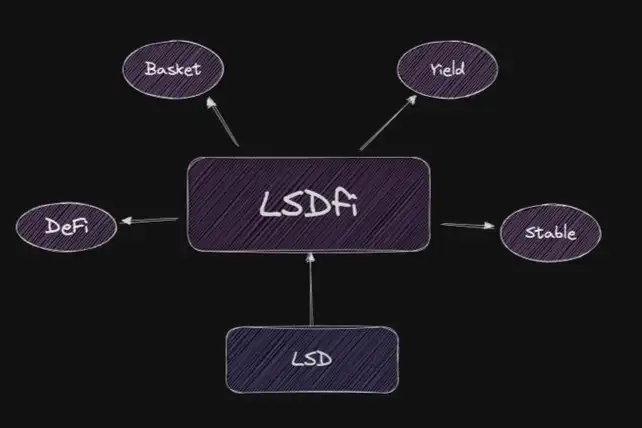
LSDfi has risen to prominence with the upgrade of Ethereum, sweeping through the entire DeFi field like a torrent and bringing about the LSD (Liquidity Staking Derivatives) war. LSDfi refers to the ability of stakers to convert their staked ETH into a tradable asset, increasing liquidity and lowering the barrier to entry for users to stake any amount of ETH and earn LST, while also generating multiple sources of income. This enhances liquidity and solves the problem of idle ETH in users' hands, bringing considerable TVL to many DeFi protocols focused on the LSD track.
LSDfi's explosive popularity, in addition to catching up with Ethereum's upgrade, is more about solving the practical problem of encrypted user income, making it an important part of the DeFi narrative. Today, we will explain in detail a new narrative - LPDfi (Liquidity Providing Derivatives - liquidity providing derivatives), this article will mainly introduce the existing problem of poor liquidity in the DeFi field and what practical problems LPDfi's appearance has solved. Can it become the next major narrative of DeFi?

DeFi Protocol Liquidity Issues
Previously, the release of Uniswap V3 significantly improved the capital efficiency of the DeFi market, but also brought some liquidity issues. For example, liquidity providers who provide liquidity through CLMM (Concentrated Liquidity Market Maker) face some strategic issues. The main problem with CLMM is that it needs to constantly rebalance LP positions to avoid impermanent loss. This strategy is usually complex and difficult to execute.

There have also been some protocols in the market that offer active liquidity management solutions to handle algorithmic MM strategies. These protocols are crucial for CLMM. However, currently, liquidity management protocols are only effective within a relatively wide range. Many market makers try to avoid asset volatility by purchasing options, but the liquidity of DeFi options is also insufficient, and it is costly to hedge against impermanent loss. In addition, the concept of options is relatively complex for retail investors. Moreover, in the DeFi field, there is no option basket that can effectively hedge against impermanent loss of active LP positions.
Another strategy for hedging impermanent loss is to short volatile assets using Money Markets (AAVE or Compound). This strategy is effective but has lower capital efficiency. Currently, all methods for hedging impermanent loss are unable to fully utilize the potential of Uniswap V3, which is a problem that Logarithm Finance is working hard to solve.
Logarithm Finance and LPDfi
(This content does not require translation as it contains only HTML tags and no Chinese characters.)
Firstly, let me briefly introduce Logarithm Finance. Logarithm Finance is a decentralized liquidity management and market-making protocol designed for market makers and DeFi users. Users do not need to constantly manipulate their positions to find high APY, but can profit from market-making activities.
And its introduction of the LPDfi concept aims to transfer liquidity through various LPDs and hedge against volatile assets, achieving the highest available capital efficiency in the market. Logarithm Finance mainly provides liquidity for LP-based protocols, actively managing LP positions while earning higher returns. The protocol mainly targets earning automatic compound fees on Uniswap-like AMMs and minimizing the risk of volatile assets by creating short positions in Delta-neutral strategies on composable DEXs.

Logarithm Finance Products
Logarithm Finance will launch two main products - Nautilus Vault and Liquidity Shell. Logarithm will guide LPD liquidity (Liquidity Shell) and hedge impermanent loss using Nautilus Vaults, playing an important role in the development of the entire LPDfi narrative.
Liquidity Shell - LPDfi's main product for storytelling

Logarithm Liquidity Shell helps Logarithm users increase their returns by routing LP tokens to the best liquidity venues in the market, and is the main product that guides the narrative of emerging LPDfi. Simply put, Liquidity Shell can be seen as a yield aggregator platform or liquidity router, aimed at providing Logarithm users with the highest possible returns by deploying deposited assets into various strategies of LPDfi protocols (Panoptic, Smilee, Infinity Pools, Limitless, etc.).
Aside from bringing high returns to users, this product also benefits other LPDfi protocols. Essentially, its liquidity routing mechanism can provide better liquidity for LPDfi protocols such as Panoptic and Smilee, thereby improving the liquidity of DEXs such as Uni V3. In addition, Liquidity Shell can also eliminate the costs, risks, and complexities associated with liquidity mining. These different aspects of the LP process can be simplified because it is built on top of LPDfi protocols.
Liquidity Shell plans to enable cross-chain functionality in the future to improve LP routing efficiency, allowing users to gain a wider range of returns and bring liquidity to LPDfi protocols beyond Ethereum and L2. Ultimately, Logarithm is committed to becoming the destination for LPD liquidity.
The operating method of Liquidity Shell is to guide user deposits to the highest-yielding strategy protocol in LPDfi. To maximize efficiency, users can deposit single-sided liquidity and decide whether to use the Nautilus Vaults strategy. If users choose to use Nautilus Vaults, their LP positions will be hedged using the GMX perps Delta-neutral strategy. In addition, users can also choose to bypass Nautilus Vaults and only use Liquidity Shell, which will allow them to obtain higher returns through Liquidity Shell's asset deployment strategy.
Nautilus Vault - LPDfi's derivative product of narrative
Nautilus Vaults is the first product of Logarithm Finance, where users can deposit USDC to gain high APR strategies. Logarithm Finance will utilize the logic of Nautilus Vaults to build other products, such as Liquidity Shell and leveraged LP mining, to release more liquidity for market makers.
The operating method of Nautilus Vaults is that users need to deposit USDC into Nautilus Vaults. There is no time limit for adding and withdrawing liquidity, but there may be TVL restrictions depending on market fluctuations. The size of the Vaults depends on the available liquidity of decentralized derivative trading platforms. Nautilus Vaults is committed to cooperating with other trading platforms to achieve the maximum market capacity of Vaults.
When USDC is deposited, the protocol will open a narrow range of active high-volume LP positions on Uniswap V3, while using decentralized derivative trading platforms to hedge volatile assets. Backtesting data shows that Nautilus Vaults' APR exceeds 12%.
Users can choose auto-compound APR to get more significant returns. All deposits are in the form of USDC. In the future, Logarithm Finance also plans to build other products based on Nautilus Vaults, such as creating a one-stop liquidity management layer on LP-based protocols.
LPDfi Development Prospects
Overall, the advantages of LPDfi include:
LPDfi has achieved cross-chain liquidity aggregation by aggregating liquidity from different chains, bridging the divide between various DEXs and achieving true cross-chain liquidity. Users can easily move assets between different chains at any time.
Improved capital utilization efficiency. In LPDfi, the liquidity provided by users can serve multiple DEXs at the same time, enhancing the efficiency of capital utilization. Users can enjoy high liquidity and earn more profits.
Risk decentralization and stability enhancement are achieved by LPDfi through liquidity reserves on different chains. Compared to relying on a single platform, LPDfi has stronger stability and risk resistance capabilities.
Reduce slippage, improve trading execution efficiency, and liquidity aggregation reduces the slippage of transactions within LPDfi, resulting in lower costs for user transactions and higher execution efficiency.
As we can see, Logarithm Finance has the potential to become a cross-chain liquidity hub, connecting the entire decentralized trading network and driving DeFi towards a more advanced stage of development.
Introduction to Other LPDfi Projects
除了 Logarithm,市面上一些涉及到 LPDfi 协议都有:
Except for Logarithm, there are some LPDfi protocols on the market:
Panoptic
Panoptic is an options DeFi protocol based on Uniswap. The protocol utilizes Uniswap v3 liquidity positions to mint, trade, and provide liquidity for options that are available 24/7.
Related reading: "Panoptic: Top institutions optimistic about new options market based on Uniswap".
Limitless
Limitless Finance is a leveraged tool built on top of Uniswap V3 that is non-liquidating and permissionless. It aggregates spot and lending liquidity under one framework, reducing liquidity fragmentation between trading and lending. Limitless reduces impermanent loss and provides higher returns for liquidity providers. Borrowers will be able to borrow any liquidity asset provided by LPs. They enjoy non-liquidation and extremely high LTVs by paying a premium to LPs (lenders). Traders can use up to 2000x leverage to long/short assets without experiencing forced liquidation on price.
Smilee Finance
Smilee Finance is the first protocol for decentralized volatile assets, providing liquidity similar to DEX to earn predictable USDC APR, hedging on-chain asset risks, and aiming to reduce impermanent loss. In addition, Smilee can also be used to build new volatility products, such as bearish LP positions that profit from impermanent loss instead of suffering from it.
Infinity Pools
Infinity Pools will not be introduced in detail here, you can refer to "InfinityPools: Is the perpetual contract with no liquidation and 1000x leverage a reality?".
Welcome to join BlockBeats at LoDong:
官方社群 Telegram 订阅群 translates to
Official Community Telegram Subscription Group.
Welcome to join the official BlockBeats community:
Telegram Subscription Group: https://t.me/theblockbeats
Telegram Discussion Group: https://t.me/BlockBeats_App
Official Twitter Account: https://twitter.com/BlockBeatsAsia

 Related Articles