What is XMTP, the social protocol that collaborates with Coinbase and Lens?
Original title: "What is XMTP, the social protocol that collaborates with Coinbase and Lens?"
Source: Planet Daily
Recently, Coinbase Wallet released a video explanation on its official Twitter account, announcing the integration of Coinbase Wallet with the open-source communication network XMTP to collaborate on instant messaging between wallet addresses.
After understanding, XMTP not only collaborates with Coinbase Wallet, but also helps the newly released decentralized social media protocol Lens Protocol v2 to open instant messaging module this week. In addition, applications within the XMTP network ecosystem can communicate with each other.
In the current Web3 social arena, many social projects are promoting decentralization as their core feature, aiming to compete with Twitter. However, most of these projects are all talk and no action. XMTP, on the other hand, seems to be taking a unique approach by exploring the true needs of the crypto-native scene, such as NFT markets, wallets, and DeFi.
What is the current state of technology development for this project, what partnerships have been established, and how will instant messaging bring changes to Web3 project design? Odaily Star experienced this product and shares an overview of the project, evaluation insights, and some thoughts below.
XMTP Project Overview
XMTP is positioned as the underlying communication infrastructure for more secure and private transmission of Web3 messages, including identity authentication, end-to-end encryption, interoperable inboxes, and message relay functionality.
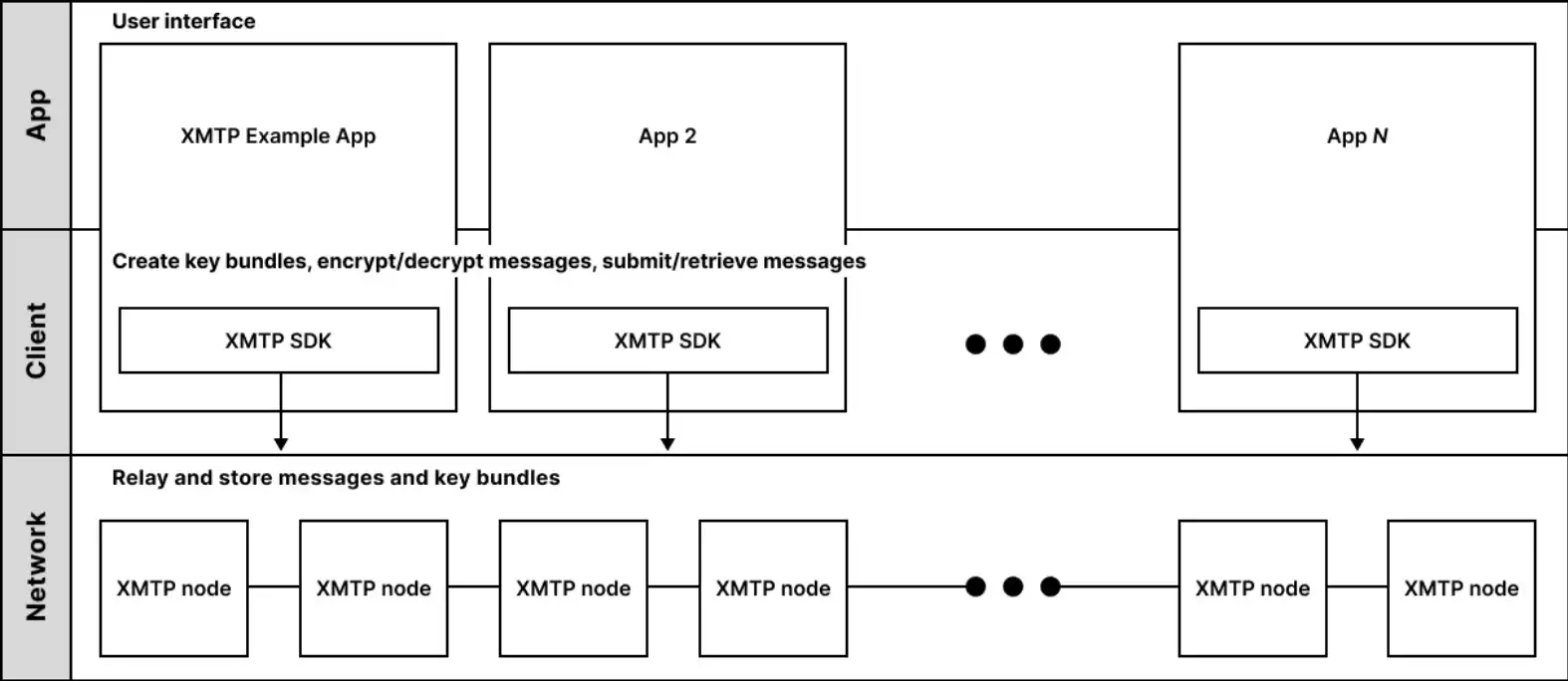
XMTP's overall structure is divided into three layers: network layer, client layer, and application layer.
1. Network layer.
XMTP Network Layer is built through the joint operation of peer-to-peer nodes, which provide message APIs that allow client applications to exchange messages with each other through the XMTP network.
The
node stores the envelope (the packaging style of the message, including the sender and receiver) in the topic (the node transmitter involved in the message), forwards it to other nodes, and allows the envelope to be retrieved by client applications. In simple terms, node operation is similar to other projects, mainly responsible for message synchronization, packaging, and delivery.
XMTP network layer is currently operated by the project team itself, and will be decentralized through open node registration and incentive policies in the future.
2. Client Layer
The client layer is composed of clients built through the XMTP SDK. The client is responsible for creating XMTP identities, encrypting and decrypting data, and communicating with the XMTP network. Simply put, the XMTP SDK is built and used by the corresponding project party and is not directly related to the user.
3. Application Layer
The application layer is composed of projects in the XMTP ecosystem. XMTP takes the to B route and does not directly acquire customers from the C end. Instead, it establishes partnerships with other Web3 protocols or products to achieve message transmission between blockchain accounts at the application layer, enriching its own ecosystem and forming network effects. Currently, participants in the XMTP ecosystem include CyberConnect, Lens, Coinbase, Converse, ENS, unstoppable domains, and others.
From the perspective of XMTP technology, XMTP aims to create a basic communication infrastructure network that can break down communication barriers for projects connected to this network. For example, in Web2, WeChat and Alipay cannot communicate with each other because they each have their own social communication networks and cannot pass messages across barriers. However, in the XMTP ecosystem, users can connect with each other through their wallet addresses as unique identifiers and achieve effective message delivery within the XMTP network.
It is worth noting that in August 2021, XMTP raised $20 million in Series A financing led by a16z, with participation from Coinbase Ventures, StarkWare, and other institutions and individuals. With this, XMTP can collaborate with Coinbase Wallet and other partners, which is not surprising.
Instant Messaging Experience
Due to XMTP's integration not only with Coinbase Wallet, but also with Lens, the Odaily Star Daily tested this feature through two products.
1. The following image shows the instant messaging between Coinbase Wallet wallets, which is relatively smooth and has good timeliness for sending and receiving information.
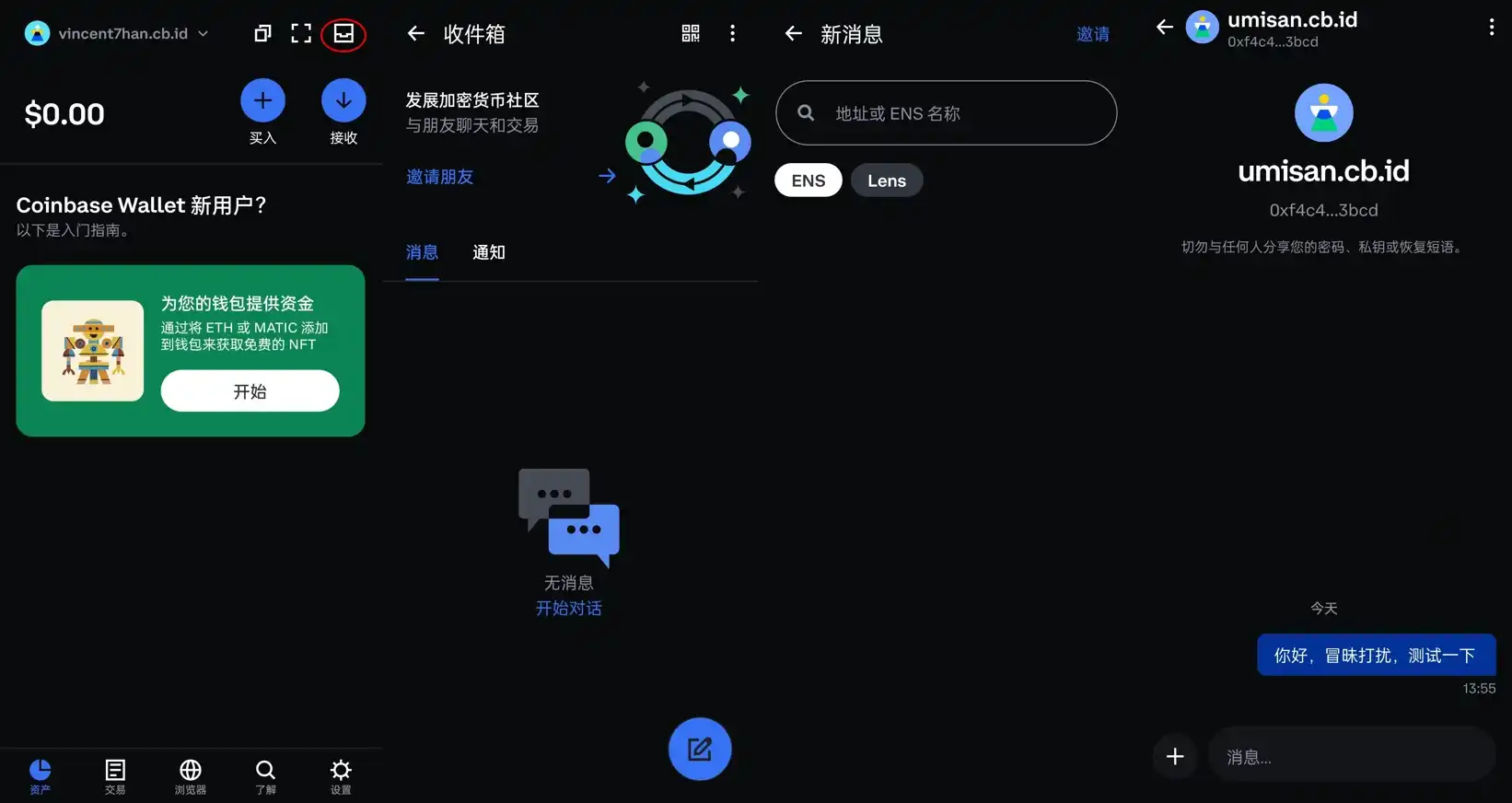
The above picture shows the Coinbase Wallet from left to right, from the initial interface to the message sending interface, to the contact search interface, and finally to the chat content interface. As XMTP is also integrated with ENS, the experience of finding specific users is relatively good.
However, the subjects of the experiment in the above picture were randomly selected, and they could chat directly without the other party's consent, which raises concerns about privacy (similar to receiving harassing messages). However, it is more convenient and accurate for the implementer.
2. The following figure shows the interoperability communication between Coinbase Wallet and Lens, both of which are in the XMTP communication ecosystem and can conduct real-time communication.
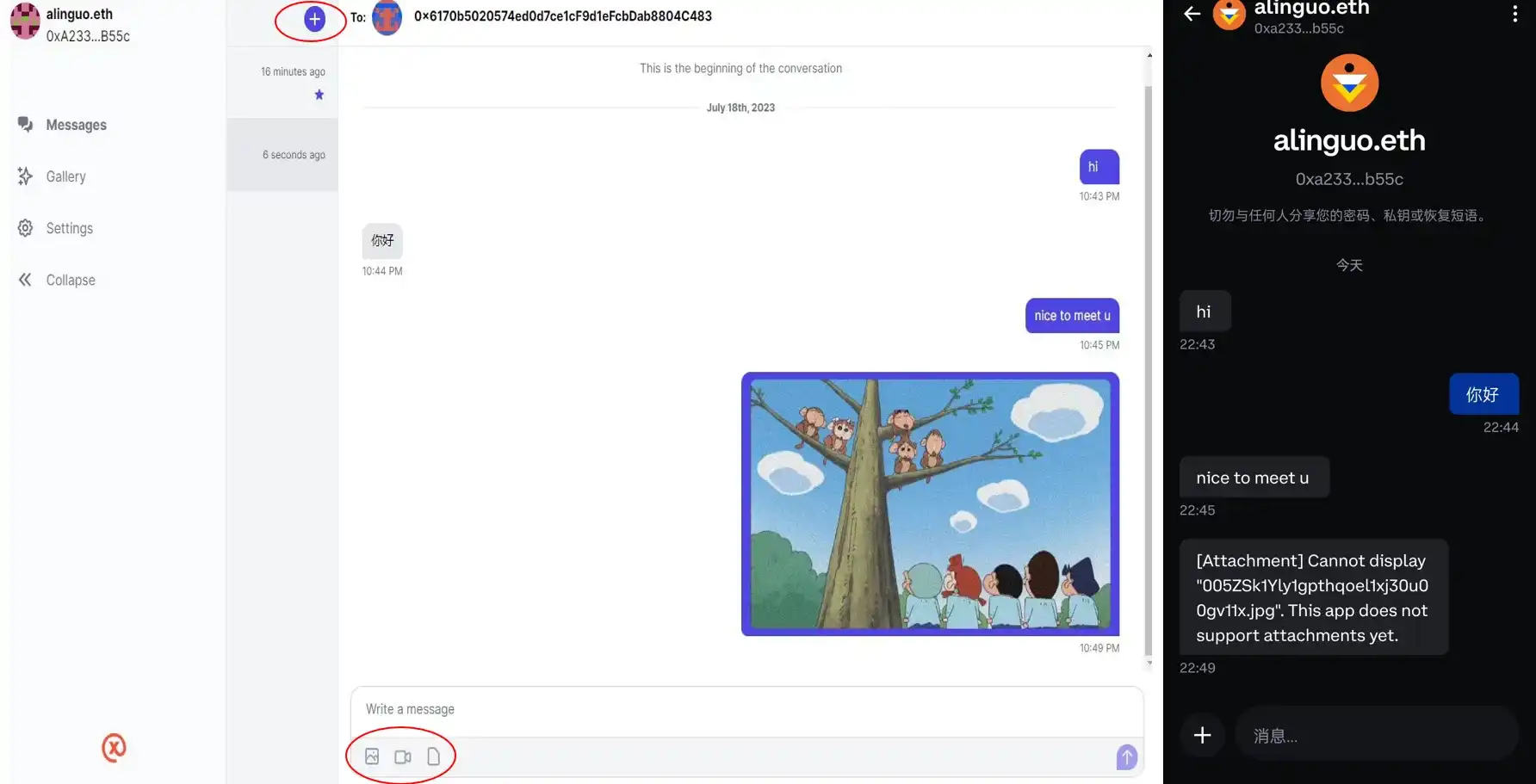
The left image is the Lens interface, and the right image is the Coinbase Wallet interface. Currently, the real-time messaging between the two is strong. As can be seen from the red circle at the bottom of the left image, in addition to message transmission, images, files, and other content can also be sent. However, Coinbase Wallet does not currently support functions other than text.
XMTP can bring to Web3?
SocialFi, as a not-so-hot niche, often faces skepticism about whether decentralization and token economics are pseudo-demands for social media. Indeed, most users would choose functionality over decentralization. Web3 social applications are clearly inferior in telling the story of "mass adoption", and "small and beautiful" products are difficult to support network effects and contribute to ecological construction.
Faced with such a challenge, XMTP has provided its answer approach - aiming at the demand of the native Crypto scene.
Its official website has envisioned some scenarios in the v2 documentation:
Decentralized social networking: just like using WeChat. Discover new friends, create groups, share emojis, send group files.
Project Marketing: During the early promotion of a new project, the project team can choose to send marketing messages to NFT and Token holders who match their target audience, which can be more helpful in assisting the project team with cold-starting.
Customized client function: Help specific needs of B-end customized services, which can conduct financial transactions, AI customer service, simplify DAO operation fluency, etc. in chat.
DeFi: Sending secure transaction confirmations, notifications, token transfers, NFT minting, etc.
GameFi: real-time message delivery, group chat for multiple people, in-game notifications, etc.
We also imagine some specific scenarios beyond this, such as:
1. Asset risk warning: Recently, there have been frequent cross-chain bridge asset risks. If the project party discovers this, they can notify the user group using it as soon as possible, which can reduce some losses.
2. The bargaining function of the NFT market: When users purchase NFTs on Opensea, they may come across a desired PFP but the price is not ideal. It is not enough to simply provide a desired offer. If they can communicate with the owner in a timely manner, the chances of a successful transaction will be greatly increased. (Currently, this function can be achieved through OTC swap, which is also integrated with XMTP.)
3. NFT owner community building: Through the ecological project linkage of XMTP, for example, NFT project parties can find owners through Lens and Coinbase Wallet and initiate instant contact. (Discord is also possible, but not Web3.)
As a bottom-level communication protocol, if the richness of the XMTP ecosystem continues to increase in the future, the possibility of interoperability between projects in the ecosystem will increase, and unexpected scenarios may emerge. From this perspective, XMTP is at least easier to explain in narrative.
Original article link
Welcome to join the official BlockBeats community:
Telegram Subscription Group: https://t.me/theblockbeats
Telegram Discussion Group: https://t.me/BlockBeats_App
Official Twitter Account: https://twitter.com/BlockBeatsAsia

 Related Articles