Lens or Nostr? Find the ultimate solution to the future of social media

"Perhaps through the Aave team and Ethereum network, more premium protocols will be added to Lens, and the more premium projects Lens will have, the more 'legitimacy' Lens will have."
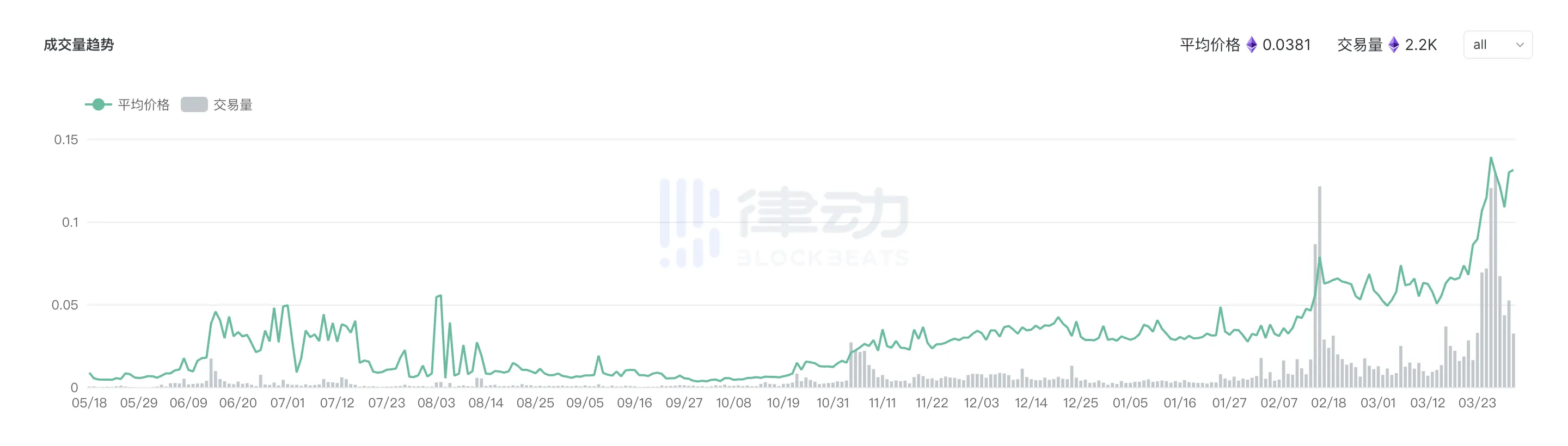
In Chinese "CT circles," this is the prevailing view of the Lens Protocol, the current social protocol for celebrities. Indeed, recently Uniswap, Gitcoin, Nexus Mutual, Aave, and other premium agreements have all chosen Lens as their alternative social media. Statistically, Lens is gaining momentum. Lens protocol profiles NFT's average floor price reached an all-time high of 0.14 eth on March 26 and remains near $250. The number of holders also reached an all-time high of over 110,000.
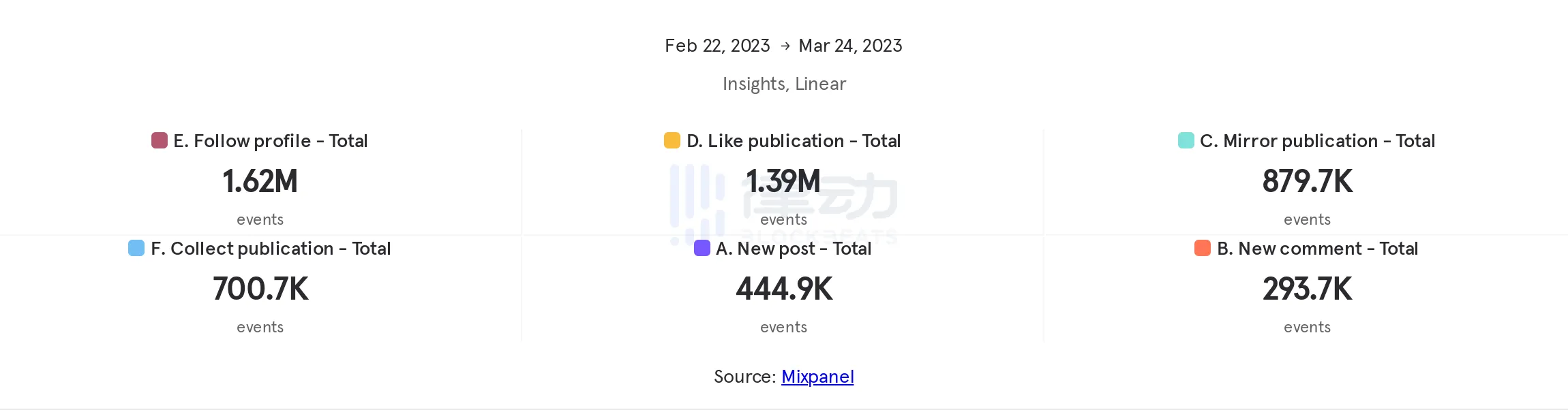
While Lens protocol profiles NFT flooring prices are on the rise, Lenster, the top app in the ecosystem, also reported a significant increase in active data over the past month: Between Feb. 22 and March 24, 4.5 million page views, 20,000 daily active users, 71,000 weekly active users, 210,000 monthly active users, 445,000 new posts, 294,000 comments, and 880,000 mirror actions.
While the community is congratulating Lens and Lenster for their tremendous growth and engagement in just 30 days, Nostr and Damus, which led to public key sharing two months ago, seem to have received less attention.
Two months ago, everyone was wondering how the boxy Nostr would lead the way in a new social paradigm. Now Lens is the hot dog on the track. With the advent of 2023, the social circuit of DeFi and NFT, which is far from hot, is rapidly stirring with the Lens airdrop Anticipation. At this time, BlockBeats has interviewed aLE, the early promoter of Nostr Chinese community, Dashuo, the initiator of Lens Chinese community, and Liu Guo, the co-founder of Matter-Lab. To see what track co-founders think about the future of Nostr, Lens, and SocialFi.
"Protocols are like electricity, applications are like machines plugged into wires."
In August 2019, MIKE MASNICK published a paper, "Protocols, Not Platforms: Technical Approaches to Free Speech," at the end of which he wrote: "Moving to agreements, not platforms, is a 21st century approach to free speech. Rather than relying on a 'marketplace of ideas' within a single platform, which could be hijacked by malicious hijackers, an agreement could lead to an ideal marketplace in which competition would take place to provide better services, thereby minimizing the influence of malicious users without completely cutting off their ability to speak."
The main tenet and spirit of this article has influenced many people and even become the bible of many protocols today: protocols are like electricity, and applications are like machines plugged into wires. Right now our accounts and information are controlled by apps, but if we can protect our individual rights at a more basic level of electricity, then human rights are more likely to be protected. Developing more decentralized protocols is an effective way to protect individual rights.
More or less under the influence of Protocol, Not Platform: A Technological Approach to Free Speech, Twitter founder Jack Dorsey left the company to support a new social protocol, BlueSky, and then the Nostr protocol and Lens protocol.
No financing, no Token Nostr
On November 20, 2019, fiatjaf began developing Nostr with the goal of creating a simple, open, global, decentralized, censor-resistant social protocol. On his blog that day, he wrote: "Nostr is the simplest open protocol, based on encryption keys and signatures, does not rely on any trusted central server, does not rely on peer-to-peer technology, and creates a censoring resistant global social network once and for all."
fiatjaf is a person with a strong humanistic concern, hoping to help everyone's rights be respected and protected, and to make people human. As a technologist, the hundreds of books he recommends on his website are all about sociology and philosophy.
A year later, in November 2020, when the first group of participants gradually expanded, "Nostr's groups changed from basic groups to super groups in Telegram, And started discussing the possibility of decentralizing social networks, the possibility of funding such projects, the possibility of Nostr supporting smart contracts, and the name of the Nostr protocol.
Nostr is not a Web3 product and protocol, and it is not even related to Web3, which is also misunderstood by many users. It may be more in favor of Web5 proposed by Jack Dorsey in 2022 than Web3. At that time, Jack Dorsey turned his nose up at Web3, believing that Web3 was nothing but Web2 monopolized by VC from equity to token, so he proposed Web5.
Indeed, because social networks are essentially a public good, they are called public squares. Nowadays, excessive capital intervention, including direct tokenization, is the main cause of power intervention, content, user relationship alienation. We have already seen this phenomenon in the DeFi field, which is caused by the oligopoly caused by the control of various upper proxy coins over the lower protocol, such as CVX and CRV, and also seen from the recent Uniswap voting event, VC's monopoly over DeFi voting rights.
DeFi is a financial service, so it's not a fatal issue, but it's a different story for social networks, which is a central issue in the public square of free speech.
Jack Dorsey argues that the nature of Web3 does not escape the monopoly of capital, and that institutional financing, whether in the form of equity or tokens, must be abandoned if the problem is to be solved at the economic level. Nostr is exactly what he wants, no institutional financing, no token model, which is why Jack Dorsey donated 14 BTCS to Nostr and made the platform public.

It seems that even before Lens came online, it was destined to be juxtamed with Nostr. As mentioned earlier, Jack Dorsey has been critical of Web3 and seems to be mocking the concept of Web3 by going so far as to skip Web4 and propose building Web5.
While Jack Dorsey's criticism of Web3 has received a lot of buzz and anticipation, it has also received a lot of pushback, including from Stani Kulechov, CEO and founder of Aave, a well-known Defi protocol. Stani couldn't stand Jack Dorsey's taunts and started arguing with him on social media, while the Aave team internally debated whether to make a decentralized social protocol.
"Since Jack Dorsey built Aave on Bitcoin, Aave should also build Twitter on Ethereum."
In July 2021, Jack Dorsey hinted that Square would create a new business to build a platform for "unmanaged, license-free, and decentralized financial services." Stani Kulechov thinks this is pretty close to what Aave is doing, so he quotes Jack Dorsey's tweet and quips: "Since Jack Dorsey is going to build Aave on Bitcoin, Aave should also build Twitter on Ethereum." Hinting at the Lens protocol, Stani previewed the social graph project again at the LisCon conference.

In February 2022, Stani publicly announced the Lens protocol on Twitter in the form of a signed letter, and it officially went live on Polygon mainnet in May of that year after testing.
Lens is positioned very differently from Nostr: Lens Protocol is a composable and decentralized social graph and protocol on which developers can easily build social media platforms and design meaningful social experiences without resorting to feedback mechanisms to lock users' attention. Lens uses NFT technology to ensure that users fully own their data while using Lens, and creators can unlock new ways to profit.
Its features are summed up nicely on the Lens website: "With Lens Protocol, you are in control. You own your personal data, where you use it, how you use it, and even how you can profit from it. It means you have control over your content and it's in your wallet as an NFT. It's not just easy. That's what digital identity is supposed to be about: it's all yours."
Because you own your data, you can bring it to any application built on top of the Lens Protocol. As the true owners of content, creators no longer need to worry about losing content, viewers and livelihoods to the whims of individual platforms' algorithms and policies. In addition, every application that uses Lens Protocol benefits the entire ecosystem, turning a zero-sum game into a collaborative one.
With such different value propositions, Nostr and Lens have different or even opposite solutions to many specific questions.
How do Nostr and Lens guarantee revenue for creators
Back to the hot news of Web2 in recent days, many UP hosts on B website that have been following for a long time have posted videos that temporarily stop updating, indicating that they will not upload new content in the short term. In terms of the reasons for stopping updating, most of the UP owners said that the decrease of platform revenue and the difficulty of balance of payments were the main reasons for stopping updating. How to guarantee the income of the creator and support the creator economy has gradually become a social problem.
In an interview with BlockBeats, aLE, an early participant in the promotion of Nostr Chinese community, said: "The realization of creators can be realized in many ways, but if they rely on the platform, they will face a problem that the platform will prevent you from realizing or pump water for you."
aLE believes that it is important to create A direct path between creator A and payer B, which does not exist in traditional Web2. Web2 is done in a roundabout way that involves payer B exchanging cash for coins, coins to the platform, platform to the creator, and the creator monetising the coins. The path is tricky and fraught with trade friction. Therefore, we can see that many creators now open their own online stores, hoping to shorten the realization path and reduce friction costs. However, it is difficult for the online stores and main businesses to be on the same platform at the same time, which is not a good solution.
Nostr's "zap Culture"
On Nostr, one feature that can develop an economy is zap. When anyone expresses their favorite, not with "like," but with "zap," sending a certain amount of sat to support your favorite content, the creator economy has the potential to grow. As more people naturally enjoy zap's own content, zap culture will spread across the Nostr network, creators will be motivated to produce higher quality content, and the commercial flywheel will turn.
BTCStudy contributor A sword that can not discuss the value of Nostr without mentioning the lightning network, otherwise is to buy casket return pearl. Access to Lightning Network Payments has also been an idea of Jack Dorsey, who has long wanted to replace like with repost and zap, because these two operations are value exchange and have a reputation and money cost.

When BlockBeats experiences the Nostr protocol, they often see a sentence of "Please give me your invoice", which actually means that please give me your Lightning network payment address. You can directly give the other party your payment address, or you can set a payment amount and then give the address to the other party. Nostr's integration with the Lightning network makes it very simple for creators to monetize their content.
"What the creator receives on Nostr is BTC," aLE said. "In fact, in many countries, BTC can be used to purchase any service directly without going through the currency exchange process. Any person, token, platform or protocol sandwiched between Creator A and payer B is a devious barrier to the creator economy."
Lens deals with the question of how to ensure creators' profits and support the creators' economy in a different direction.
Value that flows through the Lens protocol
In an episode of Decrypt's gm podcast, Lens founder Stani elaborates on using the Lens protocol and compares it to Bitcoin: "With Bitcoin, users basically own their own money and their own store of value. With Lens, users can own their own social capital and their own social presence." Stani argues that financial capital is something that most people have, but social capital is something that everyone in the world has.
"Lens is a social network that runs on a chain consisting of a dozen smart contracts. For example, when users collect payment, the cash flow will flow through Lens. We also put forward a new concept, value flowing through the agreement." Daishron, the founder of Lens, is also bullish about Lens's value system. According to publicly available data, the number of Lens Profiles NFT held by Daishron Single address reached 61, ranking 2nd in the Owners TOP 100.
Lens is a modular social network, a fact that many people overlook and one of Lens's great strengths. Lens will also add some new modules on a regular basis. For example, two modules have been added recently. One is that creators can transfer their earned tokens directly to the Aave deposit pool for low-risk or risk-free financial management. Revenue collected by users will be split among several co-creators.

Daishron believes that owning something in Web3 should mean owning it within the protocol, rather than saying I'm hooked up to Bitcoin or Ethereum, and the thing I'm hooked up to doesn't have a value effect. For example, I used to buy some meaningful posts through a separate agreement, but this did not create a value effect, because it is a separate product, it does not form a social network. Nostar or farcaster, for example, have no way to let value flow in. The current value Internet and value Web3, if their value does not flow through the protocol, will have no meaning.
"The benefit of Lens to allow value to flow through the protocol is also security, and most of what we do is we use ERC20, which requires licensing and licensing. If you add unlimited amounts of currency, if you have this multi-layered strategy, then we have dozens and hundreds of clients, each of which requires you to apply for all sorts of permissions. Suppose at this time there is a website that applies for token permission is forged, the user is not you have no control, so he is the official to make a white list in this way, to ensure security. "Said Big Shuo.

According to data presented at dune by Six Dgree Labs, the Lens agreement has an economy of $5.32 million, although most of that revenue comes from NFT trade and less from creator support such as subscription collection.
The top 1,000 creators on Lens have more than 1.8 million followers, accounting for 43.7 percent of the total. Although the head effect is still significant, the number of fans is relatively evenly distributed among the top 1000 head creators, indicating that the content quality of head creators is high.
In terms of favorites data, Lens has more than 1.13 million favorites, far more than comments and retweets, but only 25,000 map NFT and 76,700 dynamic favorites, almost the same as the number of retweets and comments. It's clear that while the number of favorites on Lens is large, there aren't a lot of content with a collection or payment value. Most users don't participate in the collection, and ordinary creators still can't benefit financially. (BlockBeats note: For more on Lens Creator Economy, head over to theWeb3.0 Creator Economics Report: State of the Art and Imagination of CreatorFi")
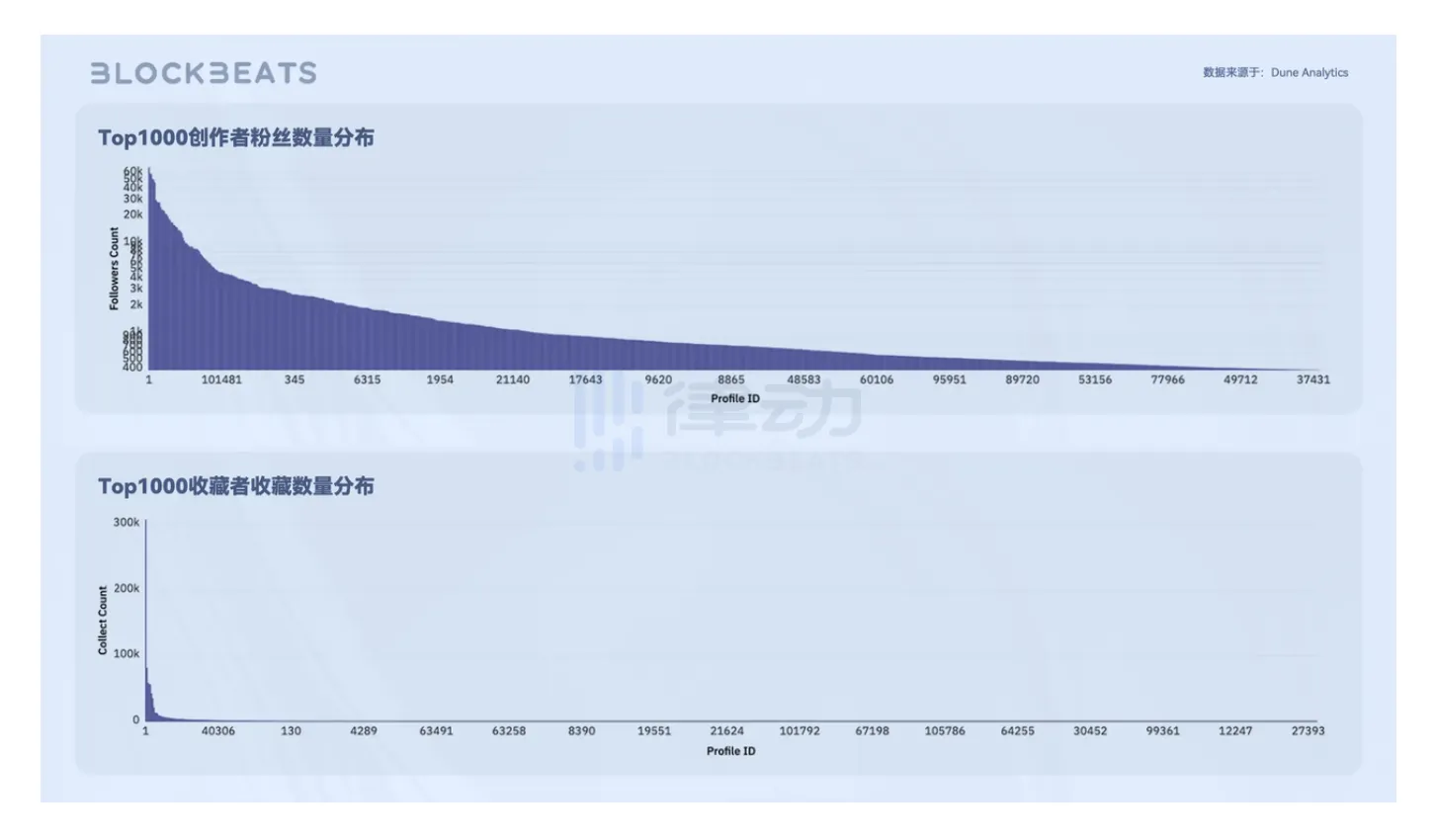
It is not difficult to see that Lens ecology is still in the early stage of content production, and most content applications have yet to be developed. The number of creators who rely on content creation to accumulate audience is limited by the number and types of applications. So for now, most of Lens's high-profile users are bridging their influence on other traditional social apps.
There are also some community opinions that say Lens' design, from a business model perspective, is like creating an AMM for social and content monetization, and that Lens' direction is more promising in that it could inspire a lot of monetization and business model innovation in the future.
In this regard, Liu Guo, co-founder of Mature-Lab, believes that how to abstract something out of the social scene is indeed a new opportunity that has not been addressed by previous social protocols. Lens, Deso, and many other Social tokens are part of this value proposition and narrative. But this is different from AMM. AMM solves the general problem of how to construct an automatic market for tokens or NFT. This is a real problem with clear boundaries. Whatever Token or NFT is used for will be useful, so it is valid as infrastructure.
Does a decentralized social protocol necessarily need Blockchain?
In addition to how to ensure revenue for creators and support the creator economy, the Nostr and Lens communities also disagree on whether blockchain is needed for decentralized social protocols.
As a social graph based on an EVM-compatible public chain, Lens says yes. And Lens is not only based on blockchain, it's also built on NFT, so if you follow someone on Lens, for example, you'll get a fan's NFT.
Here's Daishron's take on the matter: "No one can decide what should or shouldn't be online, and all the assumptions are based on what we know about social networks. Let's say we have someone else's post on Lens that 10 years later has become a famous quote. What does it mean that I own that post? We have no way to determine the future possibilities, so we should put it all on the chain, because we don't know which content will be of great value in the future."
In fact, the details of what you post on Lens are still unlinked. Instead of linking all the bloated data, like images and videos, Lens links what you post or collect at the moment. To put it simply, social behavior logic, social relations on the chain, the specific content is not on the chain.
The benefit of linking is that other developers will always be able to index this information from the link, and even if Lens is discontinued, developers will still be able to retrieve much of this data from the link. Web3 actually wants to build a set of open platform, open everything is the best state. The larger open platform of Web3 is to make all information open, transparent, and public, which is reflected in most of the social behavior chain.
Many in the community also believe that the Aave team will be able to make Lens multi-chain or its own chain in the future, and that the throughput will increase and the cost of using Lens will only get lower or even lower to zero. This rumor isn't out of the blue. In a recent Twitter Space, the Aave team also talked about chain-related issues and revealed that there will be some progress in the coming days.
Although Daishron's idea is somewhat contrary to Nostr's, he does agree that blockchain itself cannot carry such a large capacity, and in everything including the application of blockchain, there needs to be a game between conservatives and radicals. On this issue, Lens is the radical, while Nostr is the conservative.
Social Chaining: The Game between conservatives and Radicals
Nostr believes that blockchain is not the only solution to returning ownership and control of user information to users themselves. So Nostr is not built on any chain, nor is it built on top of Bitcoin and the Lightning network, although it integrates the Lightning network, it has nothing to do with blockchain and Web3 in nature.
In order to better understand Nostr, aLE of the Nostr community has been doing some Web1 related work recently, such as building a website of his own, and found that Nostr, as the author of Nostr said at the very beginning, found a compromise between Web1 and Web2. Rather than a more roundabout way through blockchain and smart contracts.
Nostr is built on some basic protocols of the Internet, such as information protocol, domain name protocol and DNS. Everyone can take a repeater by themselves, so that everyone can upload information and Web3 data ownership.
aLE is against linking content other than transactions. Not all information needs to be or is necessary to be built on chains. Blockchain is fine for using as a ledger of transactions, but it is unnecessary to use it to store some social information. The cost transfer on the link is still borne by the users. The cost of setting up a repeater on Nostr only needs 200 yuan a year, which is much lower than the cost of social information link, and the data will not be lost. He thinks Nostr approaches the problem from a different Angle, one that doesn't require blockchain or global consensus.
Liu Guo also believes that from this perspective, Nostr is on the right track. Blockchain is essentially a decentralized ledger, and the ledger should do what the ledger needs to do. The ledger can do very little, automated asset trading related and some variant assets (domain names), these should be on the chain, but everything else should not be on the chain, otherwise it is an extremely redundant and unrealistic system.
This has been a very big point of contention between the Ethereum community and the bitcoin community, such as the recent Bitcoin NFT, which some Bitcoin fundamentalists see as a form of block inflation and object to so much information being linked. On February 1, bitcoin mining company Luxor discovered the largest bitcoin block ever. At 3.96MB, just shy of Bitcoin's 4MB limit, the block contained a meme NFT called Taproot Wizards. Blockstream CEO Adam Back, Bitcoin Core developer LukeDashjr and others have even harshly criticized this as not innovation, but an attack on Bitcoin. (BlockBeats note: To read more about memeNFT, the largest bitcoin block of all time, go to theWhat is Taproot Wizard paying tribute to Bitcoin memeNFT?")
Is today's social protocol the final answer?
Generally speaking, if one thing can replace another thing, it needs to be more than 10 times better to make people want to switch, because all switching has migration cost and friction. If nothing is better than it, but worse than it, no one will be willing to use this thing. Almost all of the decentralized social protocols out there have a problem with the user experience.
Now Lens and Nostr and many other decentralized social protocols, one of the things that's often said about their advantages over traditional social platforms is that you don't sign up for apps with your phone number or email. Instead, you sign up for apps with your wallet and mnemonics, which is faster and easier.
But according to the actual experience of many users, they don't feel faster and more convenient. To log in and register the Lens mobile app, for example, you have to download the wallet from the mobile client, log in to the wallet, and sign your name, a process that takes no faster than some Web2 products. The same goes for Damus who signed up for Nostr. It is no faster to get a pad and pen and copy down the private key, and many unknowledgeable users will even copy the private key as the public key, risking losing or stealing it.
Liu's answer is that "the user's body and feedback are always the most honest." So when designing his social networking product Matters Lab, you can choose to sign in by email only, but email information is also required when signing in with your wallet. Controlling public and private keys is a much more difficult task for users than using mobile phones and mailboxes. So he also looks forward to social recovery wallet applications, which will be one of the future directions of decentralized social protocols.
Both Lens and the Nostr community acknowledge that their product experiences are not ideal, but the goal of creating a next-generation social and distributed network is not to outdo the Internet giants in terms of user experience. aLE agrees that in terms of user experience, such as UI design and interface, Nostr does a bit worse, but not ten times worse. Let's not talk about the user experience for a moment. After all, we can't expect too much from the first operational design, and the user experience of Twitter in the first year or two is unlikely to be perfect.
"To put it bluntly, everyone was airdropped for Lens."
Going back to the recent spike in Lens's various metrics, many believe this is due to the fact that a large portion of the value of the space id and arb airdrops have been selected to flow into Lens to capture the value and impact of the next airdrop. At the same time, there were rumors that Lens would be valued at $80 million to $120 million, with a token price of just $1. Some Kols have also come out to say that this is a mini bull market in the era of airdrops, and that the floor value of Lens may be overvalued compared to the value of airdrops, alerting everyone to the risks.

According to the data of dune, from the perspective of time distribution, users' attention and content Posting behaviors are mainly concentrated in May 2022, November 2022 and February 2023. The first two time nodes are the initial period of protocol launching and the period of user influx in Southeast Asia.
For the most interesting time, the most recent spike, in February, was due to a beautiful misunderstanding by Stani, intentionally or not. On social media, he posted a block height out of the blue, and the community exploded. Almost everyone thought it was Lens snapping a block height and that the airdrop was coming soon. Those with or without Lens protocol profiles NFT were thrilled. And began a wave of extremely heated interactions.
In the heat of the moment, some people are asking why the Stani block height is Ethereum, and isn't the Lens protocol built on polygon?

Sure enough, a few days later, Stani tweeted that it was personal news and that the Ethereum block was the time of his wife's pregnancy, indirectly clarifying that it had nothing to do with the airdrop. As you can see, every increase in Lens data is closely related to the popularity of the project. At present, Lens ecological behavior is mainly focused on the user's first taste and the airdrop expectation.
"To put it bluntly, it's all for air drops." Indeed, that seems to be the unspoken thinking of almost everyone who buys Lens protocol profiles NFT. And why do you know and come to Nostr? The obvious answer is basically Jack Dorsey.
Jack Dorsey brought Nostr celebrity
As an early participant and promoter of Nostr in the Chinese community, aLE officially studied Nostr because Jack Dorsey tweeted about Nostr on social media. When Musk saw the signs of Nostr, he immediately blocked the topic and entry of Nostr. That caught his attention.
Since the Nostr website does not provide much explanatory text, and Github information is prominently displayed on the website, the majority of outbound traffic goes to Github, which can be seen from the skyrocketing number of Nostr protocol stars on GitHub.
According to star-history, we can see that the spike in numbers occurred at exactly the same time that Jack Dorsey was using his own viral effect to promote Nostr on social media. In December 2022, Jack Dorsey donated 14 bitcoins to Nostr and added the public key of his Nostr account to his Twitter profile. In February 2023, Jack Dorsey wrote a post celebrating Damus's launch. Thanks to Jack Dorsey's fame, the steady growth of Nostr took off, and many people who were watching or had never heard of it began to take it seriously.

The release of Damus on February 1st immediately caught the attention of many Web3 users. More and more users shared their account public keys in various Internet communities to follow each other, and even formed a wave of spreading effect in the Web2 circle. Within two days, Damus reached the first place in the App Store social free list.
But 10 days later, Nostr's daily activity dropped from 93,000 on February 2 to 37,000 on February 9, a 60% drop from its peak. Some users were quick to deride Nostr's fleeting nature. Cos Cosine, founder of Slow Fog, says that Nostr is a very cytopunk thing, and that even if the heat falls, it is expected. But to no one's surprise, Nostr hit another record high on February 16th, and then stabilized after the volatility ended.
According to nostr.band and Nostr. io, the number of daily Nostr posts reached 484,000 on February 16. At present, the total daily activity, including Posting, private messages, forwarding and other behaviors, is basically maintained at more than 500,000, and the daily activity of high-quality users is maintained at about 8,000 to 10,000. As of April 1, the number of Nostr public key addresses has reached 533,000, and the number of Repeaters is 458.


Many have also raised the question of whether airdrop incentives and celebrity status can move users away from their original social platforms.
In an interview with BlockBeats, Liu Guo, Cofounder of Matter-Lab, also a contestant in the social sector, gave his opinion on this issue: It's only during the early bubble period that ideas, air-drop incentives, or other factors are useful. This kind of thing is kind of like herbicides or like a cavitation ingredient. It's certainly effective in the short term, but it doesn't really bring life to the design in the long term. Getting users to migrate to a new platform or protocol is all about providing a better user experience or irreplaceable requirements.
aLE believes Nostr has a lot of room to grow in terms of user experience, but it has already met some of its users' irreplaceable needs: "The emergence of Nostr has brought the Bitcoin community back together." Before Nostr, all Bitcoin holders were very lonely, and they desperately needed a decentralized public protocol and application to exchange ideas with more like-minded people.
On some previous platforms, the word BTC was often not even pronounced, and the existing censorship would hurt a lot of people, making it difficult to form a consensus among the crowd. In fact, such a dilemma does not only exist for BTC enthusiasts. He also believes that the essence of social networking is social relations. If BTC lovers have their own small circle, and the rest of the circle goes to Nostr, then one person does not go to Nostr or stay on the original platform to post their own, in fact, it will be awkward.
Beyond Lens and Nostr, is there an alternative to decentralized social?
When faced with this issue, the crypto community tends to be divided. Daigron clearly prefers Lens, which he believes will be localized to various language communities in the future. "Lens is very innovative," he says. "If you can create something fun, people will want an account to play it. "
aLE, who describes himself as a member of Nostr's marketing team, says it's easy to see why. In his opinion, Nostr is comparable to a public chain project like Ethereum, rather than a Farcaster on Ethereum or a Lens on Polygon. Of course, there will be many protocols in the future, but it is hard to predict whether they can replace Nostr. The biggest challenge for the protocols is whether they can integrate this new protocol into their own protocols, so that they can survive for a longer time.
Liu thinks that neither Lens nor Nostr is the ultimate solution to decentralized social protocols, but if you had to choose between Lens and Nostr, Nostr would probably go in the right direction: "Regardless of the Web label and narrative, a product or scene with market fit will stand out. Now, when people flee Twitter, most of them don't choose Nostr, but secure scuttlebutt, Mastodon, and the activtypub protocol behind it, which are all more robust systems. It's just that they're not in the narrow Web3 community, where these topics are not usually discussed, but they're now an alternative Social Network."
With that in mind, Liu and his team are trying to take Matters.News in a more contextualized social direction. Matters.News is based on a decentralized ecosystem, a writing community with open source code and creator autonomy. Here, creators can write, publish, read and discuss, and at the same time, establish the rules of "living together and deciding together" for the community, which can be further applied to other communities in the de-centered ecology in the future. At the same time, the works of the creators will be uploaded to the nodes of the InterPlanetary File System (IPFS) to realize the distributed storage of the works, which cannot be deleted and changed.

From the perspective of vocabulary, for example, Nostr does not conform to the current consensus of "fat protocol, thin application". It focuses on high conciseness. However, on the other hand, high conciseness cannot describe complex operations with the existing vocabulary in the protocol, while a mature protocol may have stronger generality and can describe more things. The application layer can do a lot more on top of that.
The maturity of user experience is a topic that can never be revolved around. Mastodon has a series of relatively perfect infrastructure around the activtypub protocol. According to the feedback of many users after their own experience, it has reached a state that is no worse than Twitter. This is much more mature than Lens and Nostr, and the application layer or protocol tools are more complete.
Mastodon, which was founded in 2016, amassed about 500,000 active users before Musk bought Twitter last year, and has been flooding in since Musk slashed staff and changed Twitter's verification policies, causing a lot of confusion. At its peak, more than 130,000 new users were added daily. It reached 2.5 million active users in early December and has dropped to 1.8 million active users since January, but that is still an order of magnitude higher than Lens and Nostr, both agreements.

Compared with Nostr, which started in 2019, and Lens, which will start in 2022, the number of users and reputation will be much higher. It will take a long time for Nostr and Lens to become more mature as problems are discovered and solved.
Lens and Nostr both became popular "in the name of Web3," but all the protocols and apps in the circle naturally had a 100k spell ceiling that quickly hit the 100k mark and began to fall. The application scenarios for decentralized social protocols seem more difficult than Defi protocols. How to define application scenarios and get users out of their social walls is a question that should be considered by all.
After all, there are not only the familiar Lens, Nostr, and Farcaster, but also Activtypub, Bulesky, DeSo, and Secure Scuttlebutt, among many other well-established protocols.
Welcome to join the official BlockBeats community:
Telegram Subscription Group: https://t.me/theblockbeats
Telegram Discussion Group: https://t.me/BlockBeats_App
Official Twitter Account: https://twitter.com/BlockBeatsAsia

 Related Articles