Social media leader Lens launches V2 version, showcasing five new features.

On July 17th at 16:55, at the Web3 Encryption Feast in Paris, Stani Kulechov, the founder of the social protocol Lens Protocol, shared his views on social protocols on the main stage of the EthCC venue. He also shared his personal good news and the joy of becoming a father.
At the same time, more importantly for users, Stani announced the launch of Lens Protocol V2 and shared a detailed introduction of V2 on site.
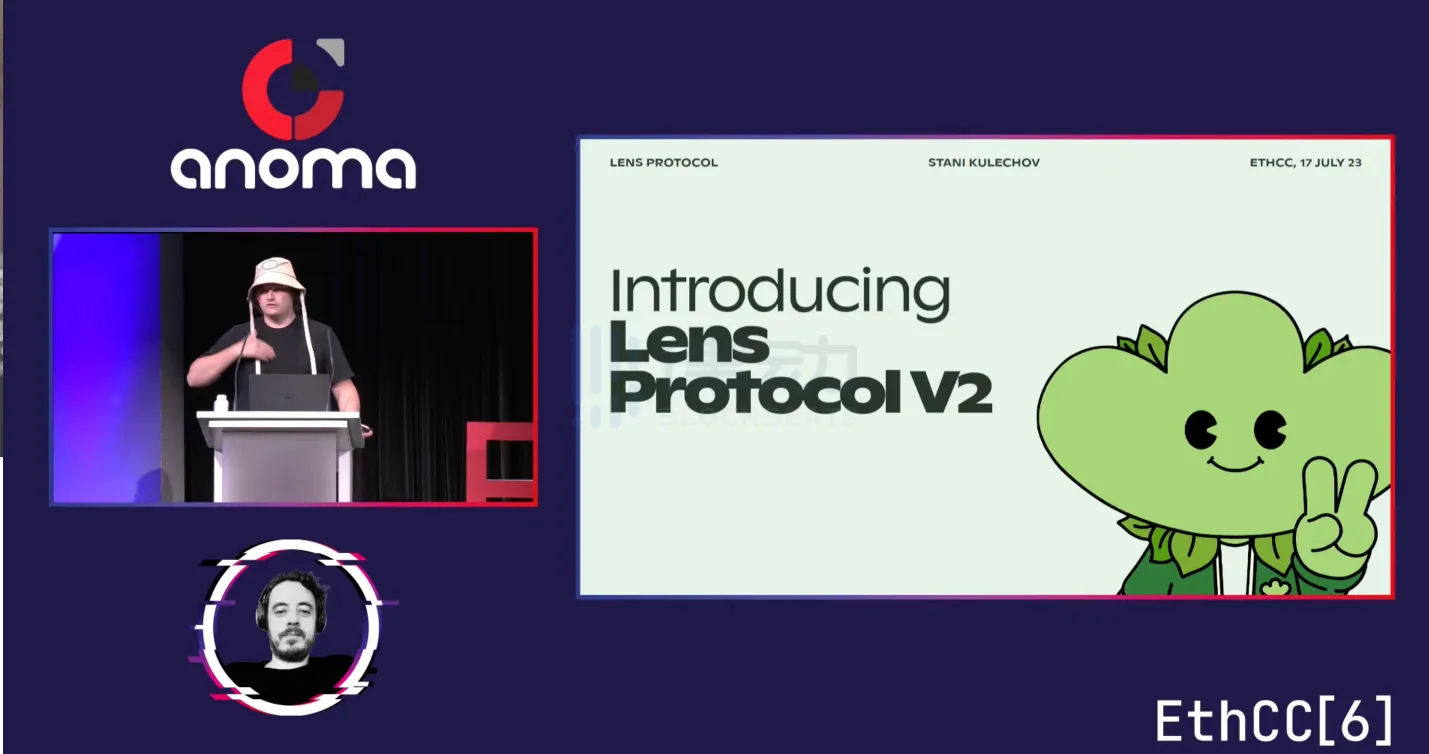
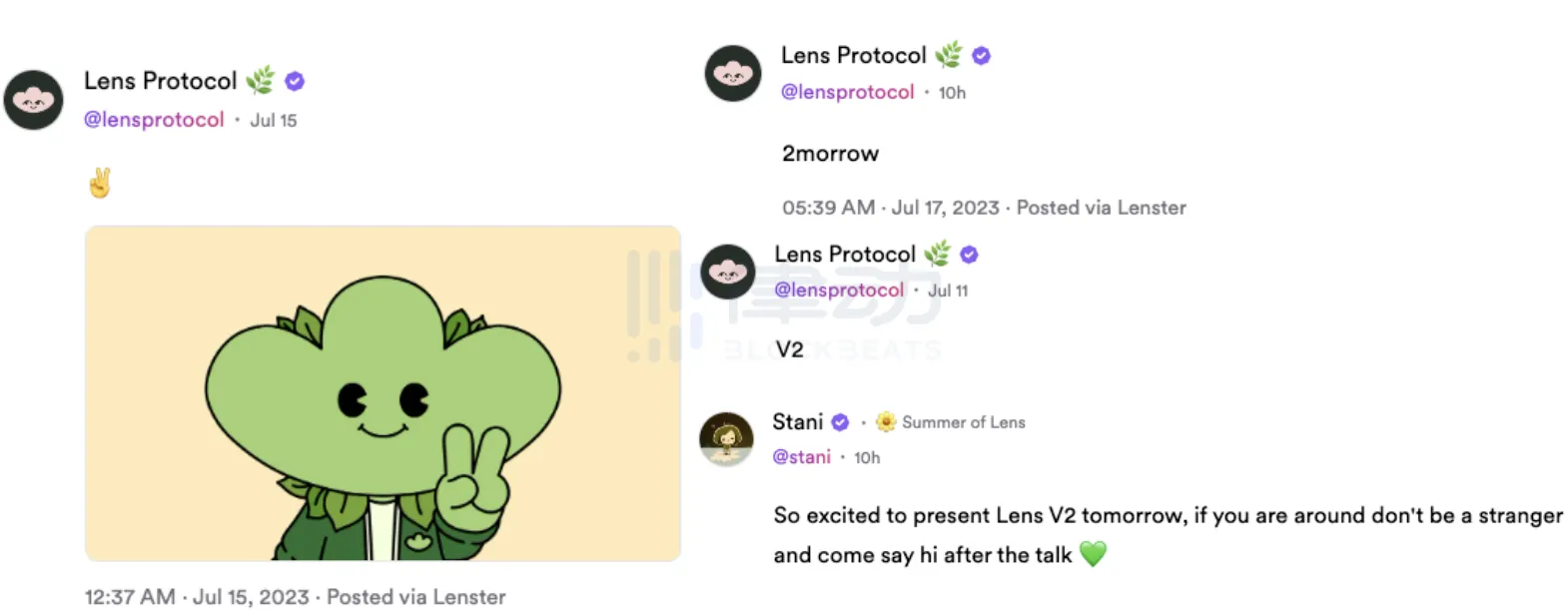
The warm-up of Lens Protocol V2 has started a few days ago, and Lens officials have been continuously releasing related content.
Although the floor price of NFT Lens Protocol Profiles in the Lens Protocol ecosystem has decreased to some extent due to the launch of a small-scale new invitation system test, the community's discussions have gradually become more active.

And the reason why the community attaches so much importance to this Lens v2 version is not only because of the powerful airdrop expectations and user experience, which makes the community highly relevant to every move of the Lens official, but also because the community once asked: "What is missing for Lens to start public beta testing?"
Stani's concise and direct answer was "V2".

Although Stani did not mention the issue of public registration when the V2 version was launched, it does not affect the explosive level of this V2 version. Let's take a look at what new features are worth looking forward to.
Lens v2 is online, what are the new features?
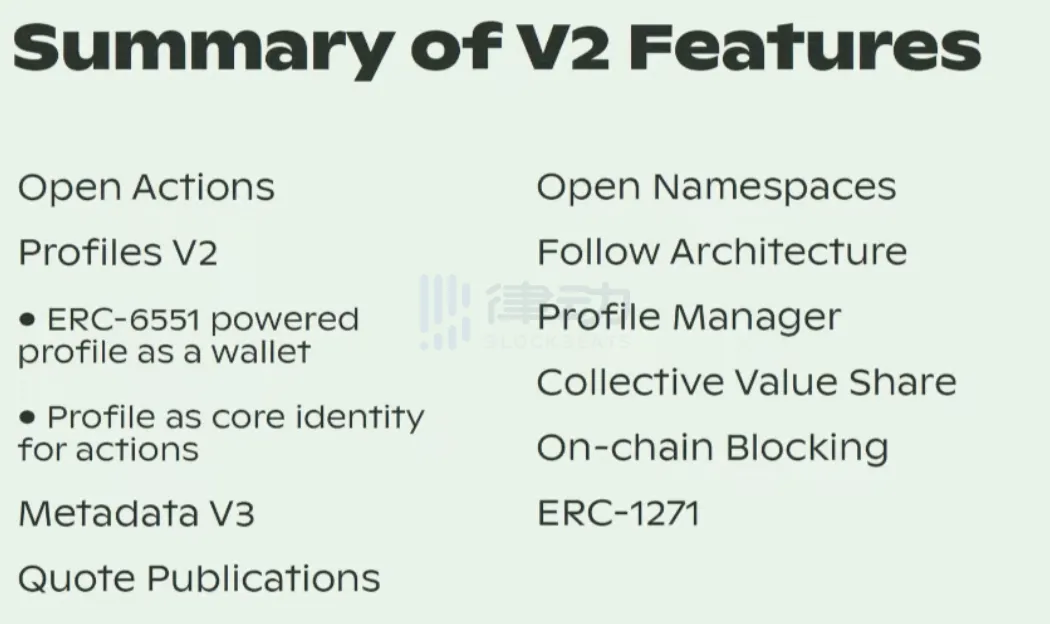
According to the content revealed by Stani at the Paris Ethereum EthCC event, we can discover some new features of Lens v2: V2 brings greater control to builders, integrators, and those exploring web3-driven experiences. With a focus on "openness and composability, shared benefits, trust, and security," users can now directly execute external smart contract operations within Lens publications, while also adding the ability to interact with smart contracts within social media in Lens V2. Lens V2 retains its unique open design space, providing choices for developers and integrators.
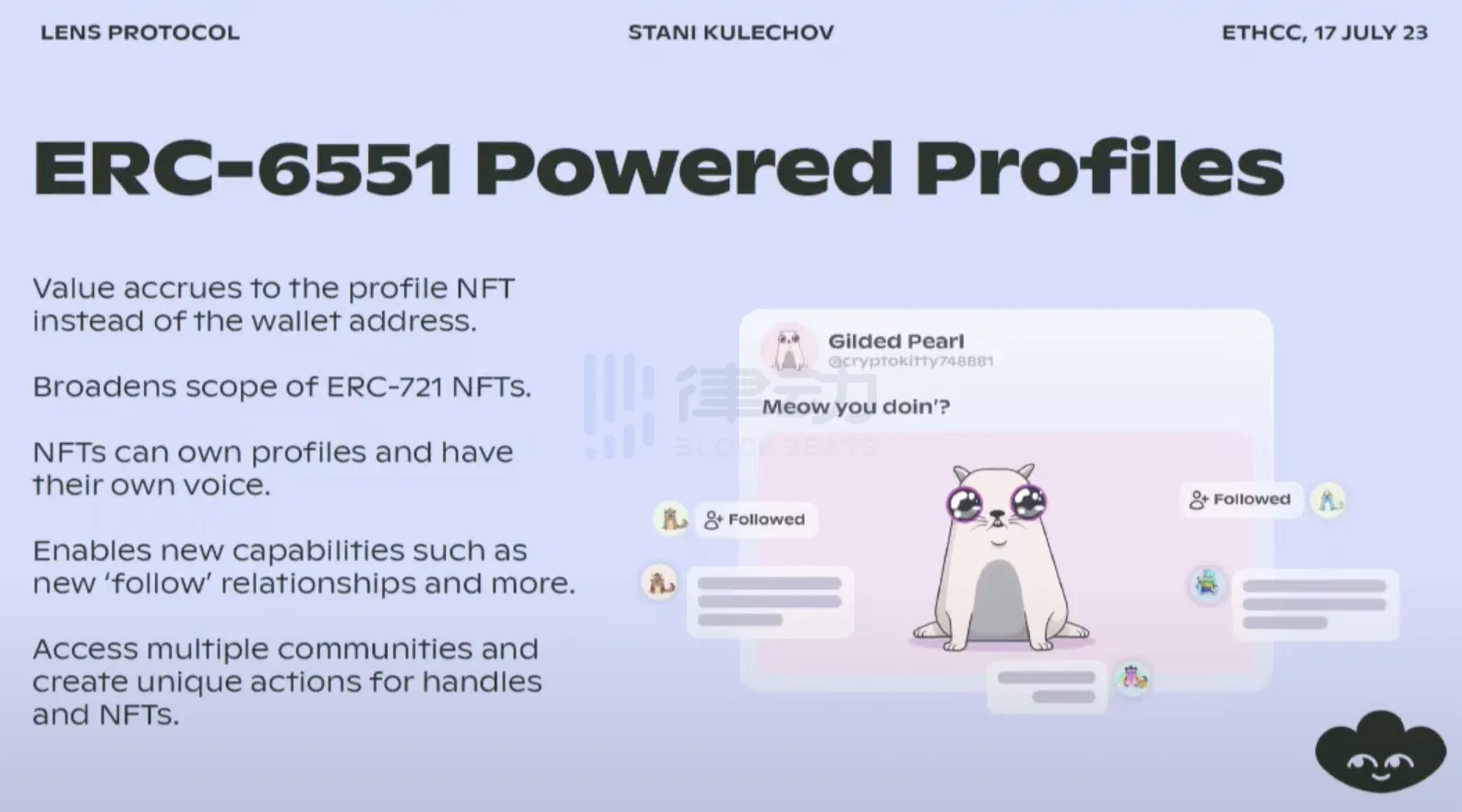
Introducing ERC-6551
In Lens v2, the value is accumulated to the configuration file NFT instead of the wallet address, expanding the scope of application of ERC-721 non-tariff barriers. New features are enabled, such as new "follow" relationships. Support for accessing multiple communities and creating unique operations for handles and NFTs.
V2 demonstrates powerful composability by providing support between configuration files and ERC-6551. It offers NFTs the ability to have their own social relationships, discourse power, and monetization opportunities. For example, CryptoKitty can have a Lens profile, follow other CryptoKitties, and publish content to create its own value chain.
The configuration file serves as the core identifier for all operations. In V2, the "follow" relationship is changed from the relationship between the configuration file and the wallet to the relationship between configuration files. This change means that all social operations occur between configuration files. This improves the developer's experience with Lens operations by eliminating wallet-based operations.
V2 introduces a new following architecture. The "following" relationship in V2 has changed from the relationship between the configuration file and the wallet to the relationship between configuration files. This change means that all social interactions occur between configuration files.
NFT tokenization is now optional. All "follow" relationships are attached to the individual profile rather than the follower. If you move your profile from one address to another, your social network will also move with your profile.
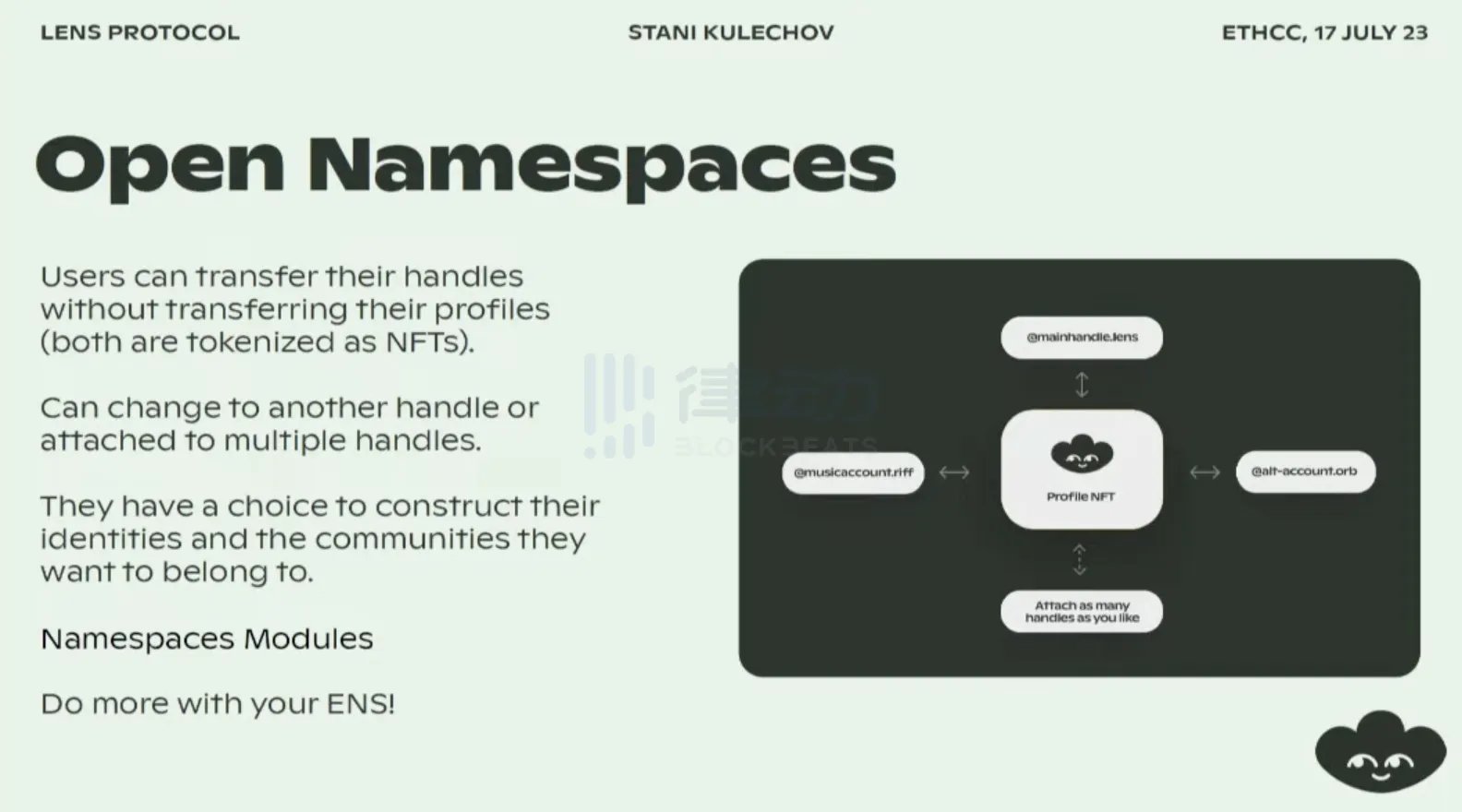
Open the namespace. With Lens V2, the handling of configuration files is different from that of handles. People can transfer their handles without transferring personal data, and both are marked as NFT.
The configuration file can be cast without a handle, changed to another available handle, or attached to multiple handles, which can be the canonical.lens namespace or any other namespace. In the future, open namespaces will be accompanied by namespace modules to create community interaction based on handles.
Open Operation
With the Lens v2 version, users can now directly execute external smart contract operations within Lens to enable any external smart contract operation on Lens publications. This feature can even be extended to cross-chain operations with oracle support, such as operations on Ethereum and L2s. This includes whitelisting, music publishing, music construction, NFT construction, buying and selling ERC-20 or NFT, joining a DAO, donating to Gitcoin, voting on proposals, and more.
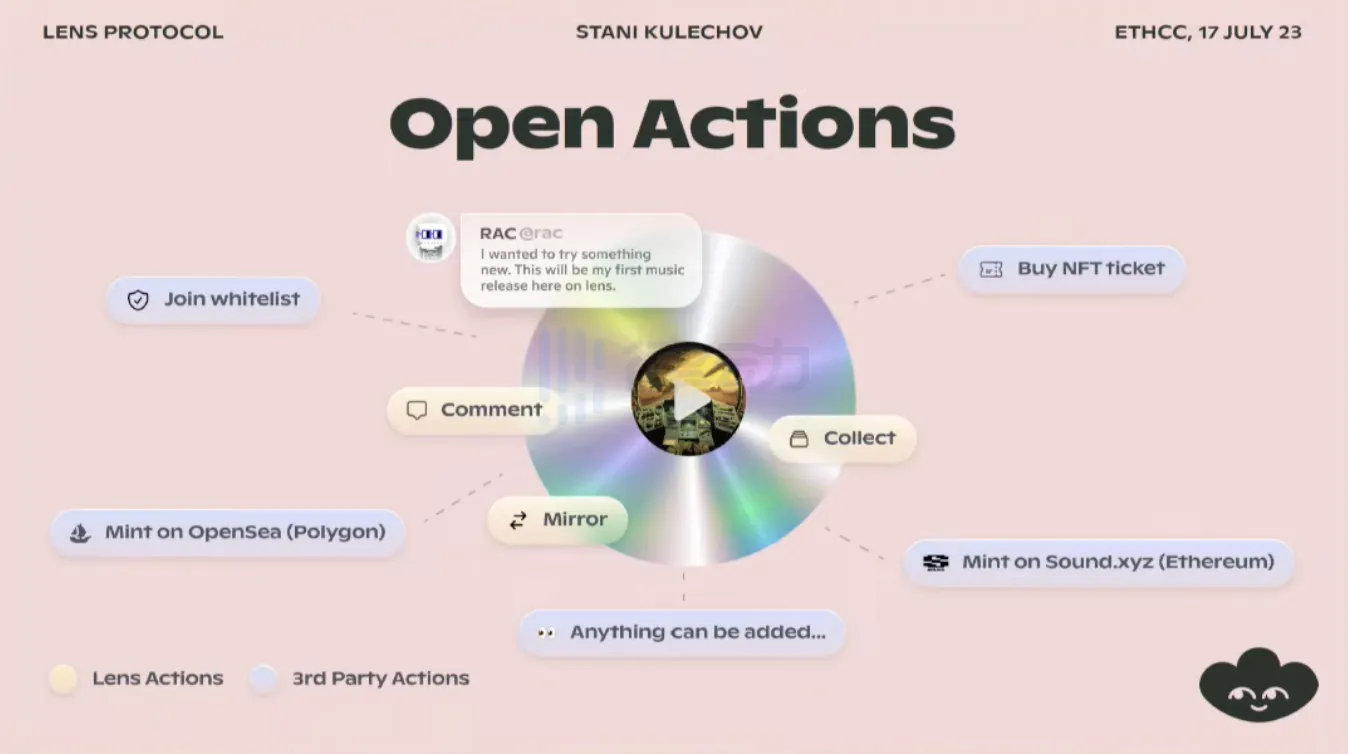
Open operation: "Open operation" is a Lens application that wants to directly perform external operations on Lens to create a more native user experience. Through open operations, users and developers can "bring smart contracts" to enable any external smart contract operation on Lens publications - this can even be extended to cross-chain operations with oracle support (such as operations on Ethereum and L2s).
For example, through the OpenSea "Mint" open action, users only need to click on the "Mint" on the Lens post, and it will directly mint NFT through the OpenSea contract on Lens. The application can integrate with various third-party markets and protocols to be executed as an open operation in posts created by users.
All operations can be inserted into the Lens collective value sharing chain, so that personnel, applications, algorithms or other services that add, distribute, amplify, curate or other types of value can share value between them. By inserting any web3 social application and supporting bidirectional integration, Lens Open Action extends the composability and modularity of Lens itself. Therefore, many types of innovative Internet projects and monetization models can be developed, in which social network collaboration increases their audience and the total value of their content and rewards each other.
Lens v2 has created an open operation that allows creators to directly mint NFT collectibles on Lens, showcasing the benefits that builders in web3 can derive from shared networks. With Lens v2, users can create an open operation that can be used throughout the entire Lens network in the application, making your innovation visible. Open operations can be proposed and built together as LIPs.
Collective Value
Collective value sharing has achieved a new network effect, which grows with each interaction. The value chain rewards personnel, applications, algorithms, and network contributions. Individual contributors and the ecosystem share benefits. Lens believes that the value chain can reward the positive contributions of personnel, applications, algorithms, and networks.
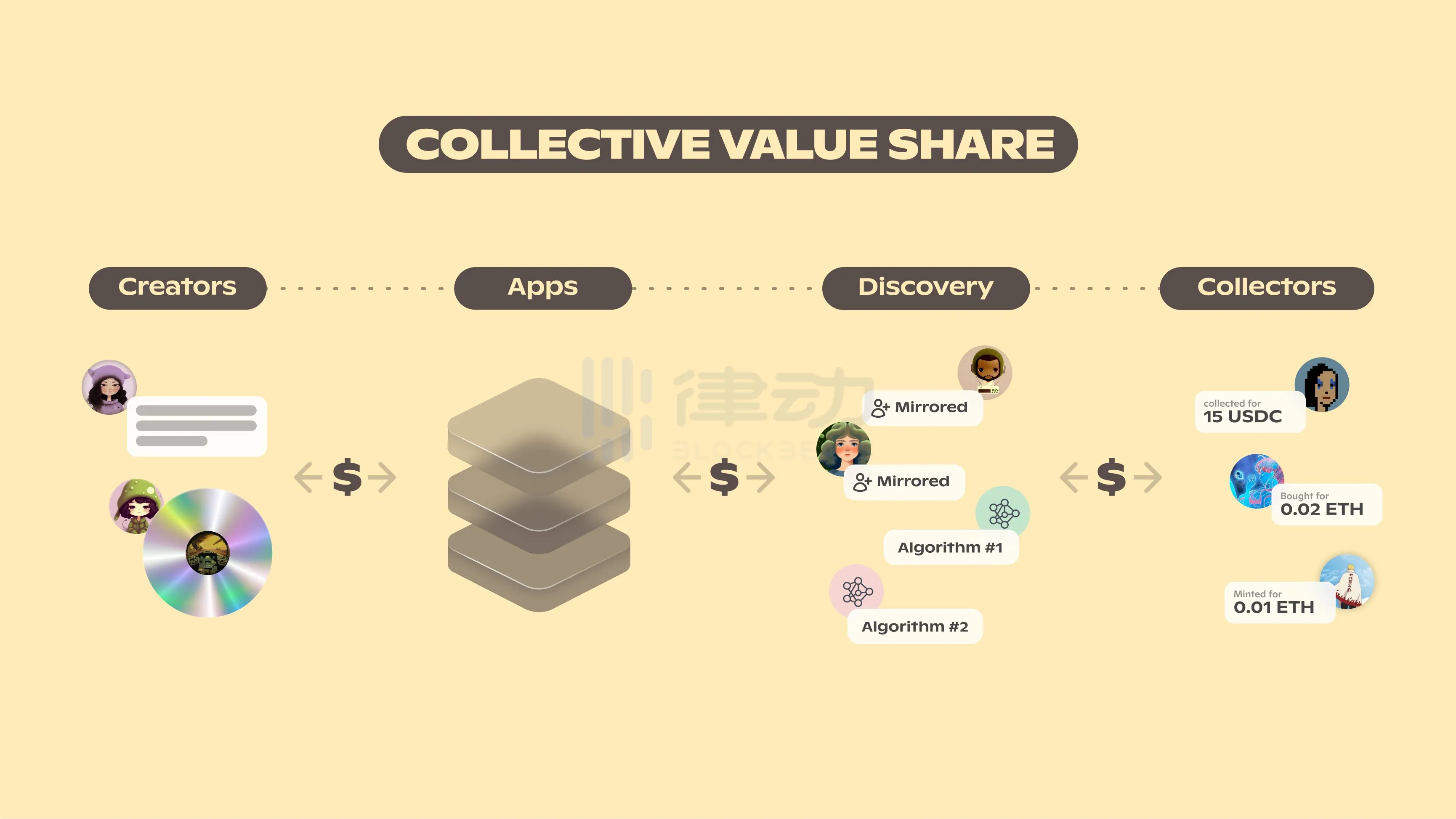
With the help of Lens V2, Lens has increased opportunities for value sharing between users, algorithms, curators, and applications. Everyone can share revenue and reward collaborative actions. For example, someone can post on Orb; another user can comment, and another user can collect it - perhaps on another application like Buttrfly, where algorithms present content to curators who bring in more viewers. In this case, the original publisher may want to share revenue to reward users, applications, and algorithms that contribute to every step of the value chain, strengthening the value chain and ecosystem partnerships and their business models.
This new programmable currency layer can be expanded to reward any user or application that adds value to actions. It allows people to choose to implement monetization models that reward beneficial and altruistic behavior, which in turn supports collaboration between networks and the growth of sustainable ecosystems on shared networks.
Access to Asset Management
Under the Lens v2 version, users can delegate operations to any wallet, following the relationship between the configuration file and the wallet. Alternatively, the configuration file can be stored directly on a hardware wallet and used together with another wallet. When one or more addresses are used, the DAO or community configuration file can be stored on multiple signatures. The improved configuration file manager provides stronger security.
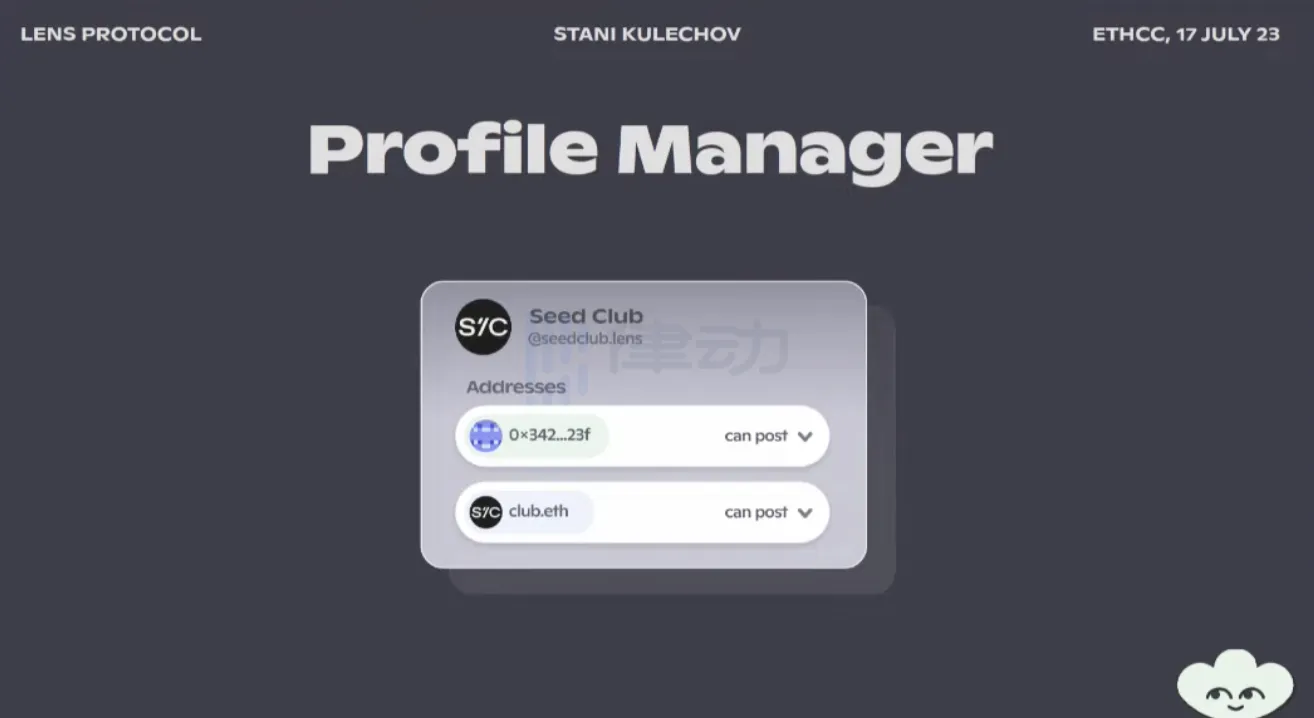
Open Namespace
In the Lens v2 version, the new description file manager feature allows Lens configuration files to delegate social operations to different wallets. The description file manager improves the security layer of Lens configuration files, allowing users to store their configuration files directly in hardware wallets and use them with any other wallet. This feature also enables DAO or community configuration files to be stored in smart contracts and used from one or more other addresses. Social operations can be delegated to applications to improve the user experience of gasless and signatureless transactions. Users can also set an address that follows the account abstraction standard as the description file manager, unlocking exciting new use cases for configuration file management.
Some security-related features, such as burning description files and transferring description files that require asset management, are excluded from the description file manager to include additional security layers. The description file manager allows you to build different configuration presets, provide rules for different use cases, and switch between them. These rules can be adjusted through LIP proposals.
除此之外,Lens v2 的新功能还有:
In addition, Lens v2 also has the following new features:
Improved the security of configuration files. LIP-4 introduces a configuration file protector, which enhances the security of configuration files and minimizes the risk of phishing attacks taking over the configuration files. V2 also adds native reference publications, promoting greater engagement and creating a simplified standard for the implementation of the entire protocol. It is equivalent to referencing tweets. V2 adds on-chain blocking. Blocked profiles cannot follow, comment, mirror, reference, collect, or perform any open actions on their content. This can be enforced in the Lens application and will adhere to the on-chain blocking standard by default.
Lens v2 will also host a public Code4rena smart contract security competition, inviting the community to discover errors and improvements in the protocol and share their findings directly on Lens. For more information on the Lens protocol V2 architecture, please visit the documentation.
Lens hopes to bring social capital back to users
Ever since Elon Musk launched the limited flow policy, Twitter users have been temporarily restricted from reading tweets. Shortly after, Zuckerberg launched Threads, a new application that competes with Twitter. Lens seems to have become anxious and is taking frequent actions.
From announcing the launch of the Optimistic L3 extension solution Bonsai's test version, which will handle large-scale transactions, to securing a new round of $15 million Tencent Global investment, to releasing the LIP-4 proposal, which proposes to introduce "Profile Guardian" to help Lens users guard against phishing attacks, as well as launching a new invitation system test and the most important news in recent times - the release of Lens v2. Lens has made rapid progress in recent times.
During an episode of Decrypt's "gm" podcast, Stani explained in detail the use of the Lens protocol and compared it to Bitcoin: "When using Bitcoin, users basically have their own money and their own value storage. With the Lens protocol, users can have their own social capital and their own social presence." Stani believes that financial capital is something that most people have, but social capital is something that everyone in the world has.
Today, Stani is still practicing the idea of returning social capital to users through Lens. The details of the released Lens Protocol V2 also seem to bring Lens closer to their original vision, which is to establish an open and decentralized social layer for the network, benefiting all social media stakeholders (builders, users, creators, and brands).
Reference document: "Introducing Lens V2"
Welcome to join the official BlockBeats community:
Telegram Subscription Group: https://t.me/theblockbeats
Telegram Discussion Group: https://t.me/BlockBeats_App
Official Twitter Account: https://twitter.com/BlockBeatsAsia

 Related Articles