If the Bitcoin spot ETF is approved in the United States, how will it affect the market?
Original Title: "What Impact Will the Bitcoin Spot ETF Market Size Forecast Bring?"
Original Source: Wu Shuo Blockchain
Quick Overview
- For investors, they are eagerly anticipating a Bitcoin spot ETF. Let's take a look at what opportunities and impacts this product will bring.
- Nearly $29 billion has been invested in existing Bitcoin funds globally, but many Bitcoin funds in the United States have flaws that could be addressed through a spot ETF.
- We do not know the ultimate success rate of such a product, but we hope that our analysis can provide guidance for investors seeking frameworks and more information.
Evaluating the potential size of spot ETFs
Since BlackRock unexpectedly submitted an application for a Bitcoin spot ETF on June 15th, the price of Bitcoin has risen by more than 20%. Considering the excitement among investors about the possibility of the US finally approving a spot ETF, especially since it has been 10 years since such a product was first registered, we want to explore what this financial product could mean for the investment community and the price of Bitcoin. Approval is not certain, so we encourage investors to weigh the probability of potential fund flows.
Bitcoin funds already have a considerable asset management scale
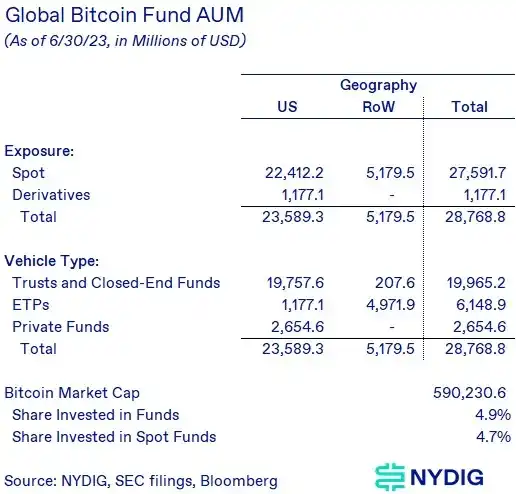
First of all, it is important to understand that although the United States has never had a Bitcoin spot ETF, a large amount of investment has already been made in existing structures, including trusts such as the Grayscale Bitcoin Trust (GBTC), US-based futures-based ETFs, spot-based ETFs outside the United States, and private funds. Our analysis shows that the assets under management of these products are $28.8 billion, of which $27.6 billion is invested in spot products. Note: our measurement does not include private funds that may exist outside the United States, which are more difficult to integrate.
Optimistically speaking, there are flaws in the existing options.
The optimistic point of view for spot ETF is that although a large amount of funds have been invested in Bitcoin funds, investors have several drawbacks with their existing choices, which spot ETFs can alleviate. In addition to the investor protection provided by exchange-traded products, the BlackRock and iShares brands' notoriety, familiar purchase and sale methods through securities brokers, simplified position reporting, risk measurement, and tax reporting, spot ETFs may bring some significant benefits compared to existing alternatives - better liquidity than private funds, lower tracking error than trusts/closed-end funds (CEFs), and possibly lower costs (definitely lower than GBTC), although fees have not yet been disclosed.
通过黄金市场寻找类比
translates to
Find Analogies through the Gold Market
Considering that Bitcoin is often compared to gold (we prefer to think of Bitcoin as an upgraded version of gold), we believe it is helpful to observe the existing gold supply and holding methods. As of the end of June, the assets under management of global gold ETFs exceeded $210 billion, with nearly half, $107.3 billion, in North America. Surprisingly, global ETFs only hold 1.6% of the total existing gold supply, while central banks (17.1%), bars and coins (20.6%), jewelry (45.8%), and others (14.9%) hold larger shares of gold holdings. Although Bitcoin is not held by central banks (except for El Salvador) and is not used as an input for other products like gold, a larger portion of Bitcoin supply is held in various fund formats (4.9%) compared to gold (1.6%). If we only look at the private holdings of these two assets, basically all of the Bitcoin is more favorably proportioned compared to gold ETFs and bars and coins. Private investment shares of gold ETFs are 7.4%, while various Bitcoin funds' shares are 4.9%. Private investment in gold still mainly holds bars and coins (92.6% of private investment).
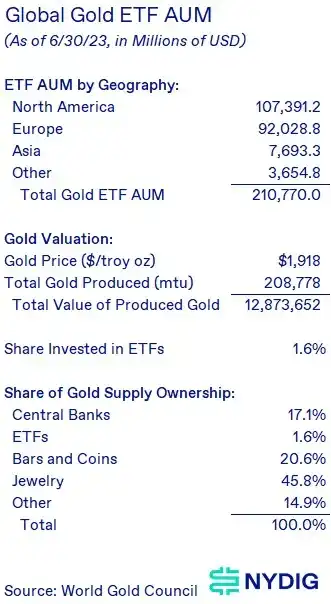
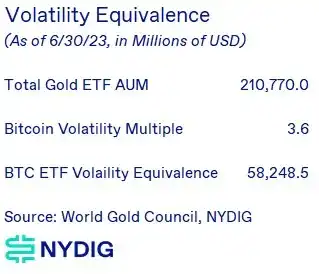
From the absolute amount of US dollars, these numbers are shocking - the investment in gold funds exceeds 210 billion US dollars, while the investment in Bitcoin funds is only 28.8 billion US dollars. Bitcoin's volatility is about 3.6 times that of gold, which means that on an equivalent volatility basis, investors will need 3.6 times less Bitcoin than gold to achieve the same level of risk exposure. Nevertheless, this will still lead to an increase in demand for Bitcoin ETFs by nearly 30 billion US dollars.
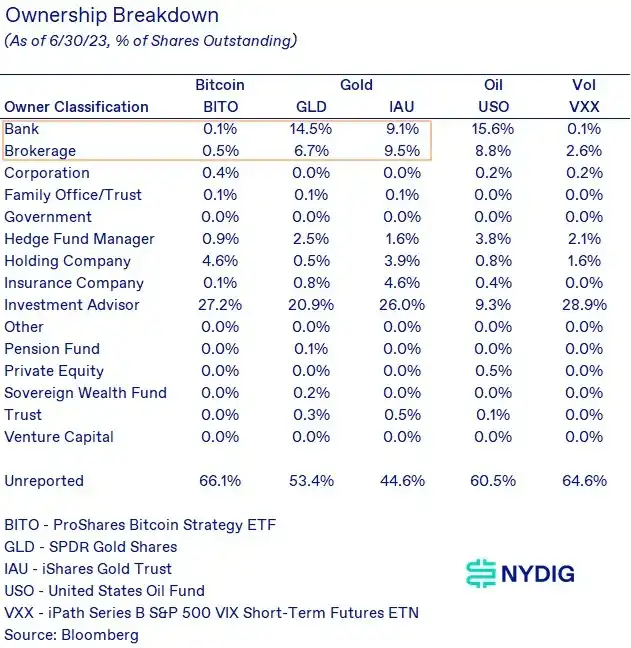
Comparison of Bitcoin Futures ETF Exposure between Banks and Brokers
By comparing the types of investors who own gold ETFs and other ETFs (such as oil and volatility), we can better understand where the demand for Bitcoin spot ETFs may come from. First, the existing major futures ETF, ProShares Bitcoin Strategy ETF (BITO), has received strong support from investment advisors. If anything, investment advisors are more over-indexed on their Bitcoin ownership than on gold ETFs. However, the big opportunity comes from banks and brokers, whose ownership of BITO ETF is much lower than that of gold ETFs. We believe there are two reasons - fund structure and recommendation. In terms of fund structure, futures-based ETFs are unlikely to be owned by these types of investors because the cost of rolling futures is higher than holding spot (we measured a 6% annualized rate for Bitcoin futures before BITO was released).
For investors who do not have access to the spot market, such as the oil market, banks and brokers have shown a willingness to hold futures-based products such as USO. We believe a bigger issue is that many banks and brokers have not recommended a strategic allocation to bitcoin in client portfolios. As a result, their advisors and in-house funds have not classified bitcoin as an asset class. While spot ETFs may help institutions overcome the hurdle of owning futures-based ETFs, it may not address the strategic allocation side. To change this, banks and brokers may need to recognize the potential for bitcoin to enhance returns and reduce risk (diversification) in investment portfolios.
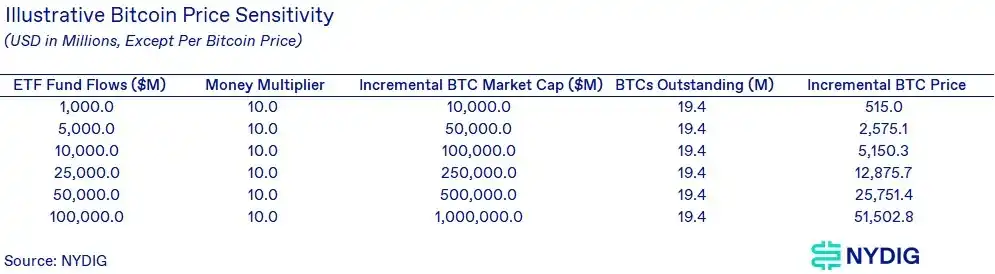
Scene Price Sensitivity
Although it is only for illustrative purposes, we believe it may be helpful for investors to understand how potential spot ETFs could affect the price of Bitcoin. These are, of course, scenario analyses, and reality may differ from expectations. These scenarios do not embed any discounting and rely on a currency multiplier of 10.0 times (11.36 times observed in 2018), where every $1 AUM flowing into the ETF would impact the value (market cap) of Bitcoin by $10.
In the worst case scenario, the $1 billion ETF AUM will be comparable to the existing futures-based BITO ETF. In the best case scenario, $100 billion will exceed the combined AUM of GLD and IAU, which is $85 billion. While we do not know the ultimate success of a spot Bitcoin ETF, these seem to be useful ways to frame the analysis. We encourage readers to make their own assumptions and remind them that the digital asset market is not always rational.
The price of Bitcoin has risen significantly since BlackRock's application was submitted. We can use the same framework in reverse to obtain the market's implied ETF AUM based on price changes. This analysis suggests that all price changes since the application was submitted are due to speculation on the ETF, ignoring any other possible price impacts such as the recent SEC ruling on Ripple Labs.

Reviewing the success of GLD ETF
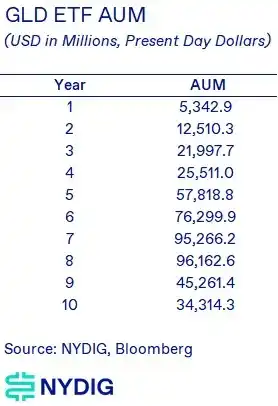
The GLD ETF, released on November 18, 2004, is still a high standard for successful ETFs. Its release, novelty, subsequent growth, and success are still impressive even nearly 20 years later. Therefore, when we consider the success and growth of spot Bitcoin ETFs, we feel it is necessary to emphasize the development path of this product. Its success was not smooth sailing, as interest in gold waned after the global financial crisis, but for those considering how spot Bitcoin ETFs may develop, this may be helpful.
Final Thoughts
Since the first registration application for a spot Bitcoin ETF was submitted 10 years ago, investors are once again excited about the prospect of existing applications being approved. While we do not know the ultimate success of such a product, or whether it will ultimately enter the market, our analysis hopes to provide assistance in thinking about future roadmaps. Spot ETFs are still not guaranteed, so we encourage participants to weigh their decisions based on the likelihood of final approval. If the process of past Bitcoin ETFs is any guide, the road ahead may be very winding. There may be many ups and downs and twists and turns, and we are committed to analyzing any new information.
Original article link
Welcome to join the official BlockBeats community:
Telegram Subscription Group: https://t.me/theblockbeats
Telegram Discussion Group: https://t.me/BlockBeats_App
Official Twitter Account: https://twitter.com/BlockBeatsAsia

 Related Articles