Interview with OPNX: We aim to build the "perfect cryptocurrency trading platform" for the post-FTX era.

Actually, after the FTX incident, many people felt sorry for this once unicorn that came and went in a hurry. "By Traders, For Traders", no matter what you say, FTX has indeed brought many cryptocurrency users an unparalleled trading experience compared to other platforms. In addition to cryptocurrencies, you can also trade stocks, foreign exchange, commodities, and even withdraw funds with one click through USDC. This is indeed a platform that professional traders dream of. Unfortunately, this billion-dollar empire that focuses on public ledger technology was ultimately burned down due to clandestine violations. Along with it, the compliance dreams that cryptocurrency institutions were about to achieve, as well as the huge liquidity created by SBF for the market, were also gone.
After FTX went bankrupt, many friends around me hoped that a trading platform could replicate FTX's original functions on their own platform. Currently, this has not happened. From another perspective, simple replication cannot fundamentally solve the problem that FTX once had, which is that when discussing centralized trading platforms, you can never escape "trust". This seems to be another "impossible balance" in the current world of encryption. Before DeFi establishes sufficient innovation and capital efficiency, you do need an efficient centralized team to truly concentrate and guide market liquidity. At this time, users must trust that the platform will not do evil. Unlike optimistic fraud proof, we do not have the ability to challenge the authenticity.
How to build a more efficient encrypted trading platform under the premise of openness and transparency? This is the problem that OPNX is trying to solve. In their own words, "what should a perfect encrypted trading platform look like in the post-FTX era?" The vision itself is not a problem, but what makes most people unable to accept it is the two men behind OPNX. As the founders of "Thunderbolt Institution", Su Zhu and Kyle now open a trading platform with transparency as their banner, which may cause some stress response to "scythe".
From a large extent, this is also one of the biggest obstacles that OPNX currently faces: it is difficult to regain the trust of the market. But perhaps it is this difficulty that gives OPNX its value, that is, to create a more perfect trading platform without trust, which is also the team's original vision. Personally, I love those wonderful "Comeback Stories" and am willing to put down the filter and seriously understand the new narrative brought by OPNX. On the one hand, the 75-person team of OPNX is not just Su Zhu and Kyle. On the other hand, the cryptocurrency industry is not lacking in "Comeback Stories". What we least want is to miss the next opportunity because of prejudice.
With this mindset, I conducted an in-depth interview with OPNX CEO Leslie Lamb during the Hong Kong Web3 conference in April. At that time, many of OPNX's features were still just ideas. Two months later, OPNX has undergone many updates and changes. Recently, we contacted Leslie again and asked her about platform trading volume, new products, and future directions.
Here is the original interview between BlockBeats and OPNX CEO Leslie Lamb:
Trading volume breaks through 30 million US dollars, does OPNX have any "brushing" behavior?
On June 16th, the daily trading volume of OPNX exceeded 32 million US dollars, reaching a historical high. Just two months ago, the daily trading volume of OPNX had just exceeded the 10 million US dollar mark. To be honest, this data really surprised me because based on my personal experience, I haven't encountered too many OPNX users around me. And in the week after the new high data was released, some people began to question it.
On June 22nd, a cryptocurrency analyst on Twitter, @0xLoris, stated in a tweet that by analyzing the BTC perpetual contract daily trading volume data of the cryptocurrency claims and trading platform OPNX, and comparing it with that of top trading platforms, it was found that OPNX may have "false trading". Loris pointed out that the normal volume and price data displayed by top trading platforms have consistent volume and price fluctuations and stable baseline characteristics. However, OPNX's volume and price data shows that the price fluctuation is extremely small in the range where the trading volume is enlarged, while the price fluctuation is very large in the range where the trading volume is reduced. In addition, OPNX's daily trading volume has an independent and obvious pattern relative to price fluctuations, which leads to the judgment that OPNX may have "false trading".
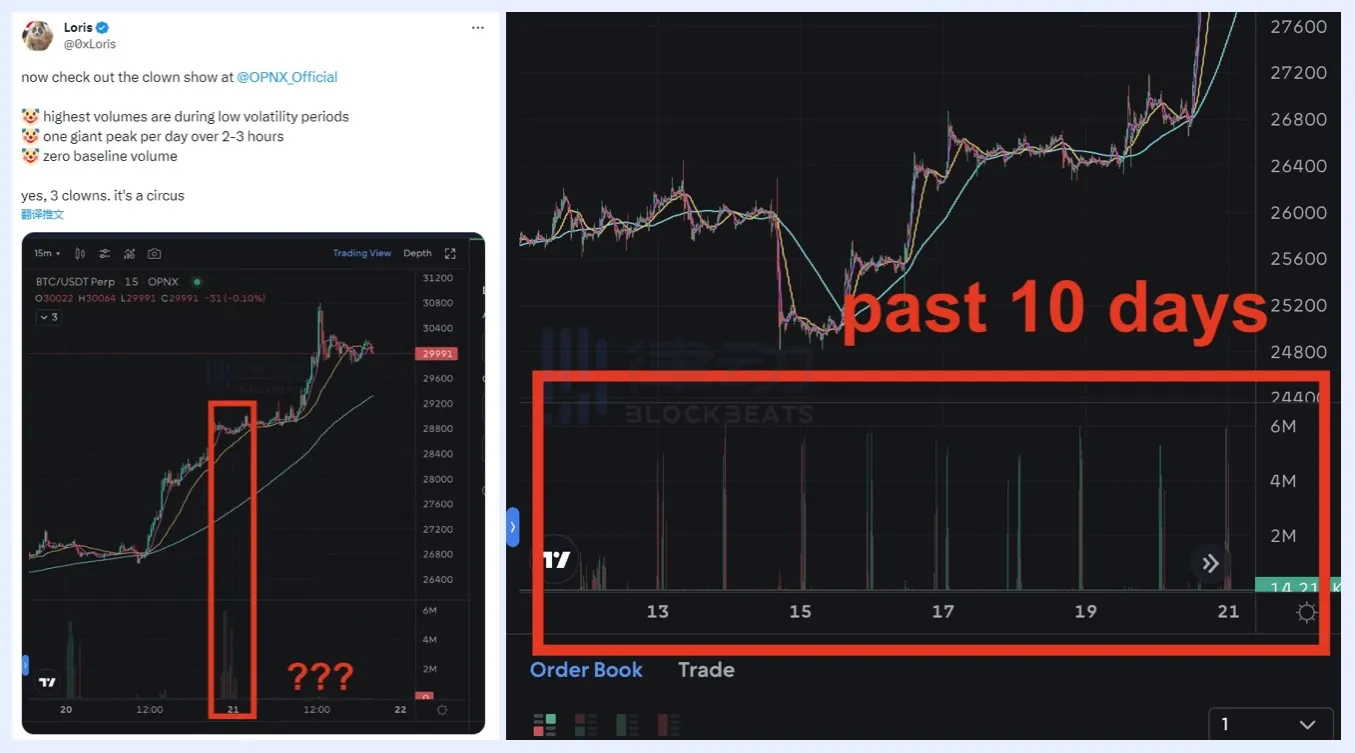
Although this tweet has been deleted, people's doubts about the trading volume of OPNX have not diminished. So, does OPNX engage in volume brushing? What is the reason for the abnormal trading volume?
BlockBeats: Since our last interview in Hong Kong, OPNX has made a lot of progress. Trading volume has increased from 10 million to 30 million, Celsius debt trading has been launched, and the platform coin OX and Launchpad have been released. Besides these, what other progress has been made that people may not have noticed?
Leslie: I believe that OPNX is more of an ecosystem rather than just a trading platform. Last time we talked, a lot of things were theoretical and discussed in future tense. We hope to establish a cryptocurrency trading platform that supports debt trading and facilitates the transfer of Celsius and FTX debt. We also hope to establish a trading platform with a public market-making plan to guide sustainable liquidity into the platform. However, at that time, OPNX had just launched, so these visions seemed quite distant.
And now we have been online for more than two months, and the platform has developed into an ecosystem centered around the OX token. I think this may be a place that many people have not noticed. People may think that OPNX is just an independent trading platform, but in fact, you can enter the OPNX ecosystem through different entrances.
Some people may have seen the price changes of OX on CoinGecko, or have seen discussions about OX in our Telegram community or on Twitter. Some people may be FLEX holders and have decided to exchange it for OX at a ratio of 125:1, and then lock it in our equity and governance platform, The Herd, to earn APY rewards. Others may be liquidity providers or market makers who want to benefit from the incentives provided by OPNX, so they need to hold OX to pay transaction fees and receive discounts.
BlockBeats: First of all, congratulations on OPNX's trading volume exceeding 30 million US dollars, which is a remarkable achievement. What categories of transactions are included in this 30 million US dollars of trading volume? Which category of transactions accounts for the majority?
Leslie: It includes all transactions of OPNX. Perpetual trading may now be the largest trading venue, which I think is usually the case for every derivative trading platform. Currently, perpetual trading accounts for the majority of trading volume, followed by spot trading.
BlockBeats: Recently, a market researcher named @0xLoris pointed out on Twitter that there may be false trading data in the BTC perpetual contract daily trading volume of OPNX. Although the tweet has been deleted, we would still like to hear your response. Is what @0xLoris said true?
Leslie: I have a few points to make. Firstly, I do not have the ability to change people's views on something, especially given the numerous market scandals that occurred in the last cycle. I believe this is a bit delusional, as everyone has the right to hold their own opinions on certain matters. What we are really trying to do is provide and execute what we believe is the best product, constantly building upon it to benefit people in terms of staking, trading, and investing. This is our goal.
I don't want to talk about specific competitors, but you will find that for any trading platform, there will be various FUD. Many of these FUDs are fake, and many are even slanderous. We don't have an internal market-making team, nor do we have an internal market-making plan like Alameda and FTX. What we can see is that many trading platforms are moving away from this model. Because everyone realizes that fundamentally, it doesn't make sense for a trading platform to compete with its customers in this way.
For OPNX, the most important thing is to establish a diverse user base. Therefore, we hope to establish liquidity for a public market-making plan, as we believe this is the most sustainable way. As long as a certain threshold is reached, you can receive corresponding rewards.
BlockBeats: Yes, in the previous interview, you mentioned that OPNX did not have an internal market-making plan. So do you think that the situation described by @0xLoris is caused by a third-party market maker?
Leslie: If we discover any fraudulent behavior on the platform, we will notify market participants. This is unfair to those who participate in the public market-making program and ultimately provide real liquidity to the market, as they are also competing for the same reward pool. So we have taken some measures to alleviate these issues and actively monitor all activities on the platform.
BlockBeats: In your opinion, what will be the main business of OPNX in the future? Will it be cryptocurrency trading or debt trading?
Leslie: This is a good question. The answer to this question will evolve over time. For now, my answer is to build a cryptocurrency trading ecosystem that is not only about cryptocurrencies, but also includes debt trading and more.
About FTX Debt, Launchpad, and oUSD
Shortly after the trading volume on the platform exceeded 30 million US dollars, OPNX launched its first Launchpad project Raiser on June 25th, and plans to allocate 10% of the native token RZR's supply to the staking users of OPNX platform token OX, which has attracted some attention in the market. However, compared with Launchpad, OPNX's innovation in debt trading and platform lending and clearing is more attractive to me.
BlockBeats: OPNX has now launched Celsius debt trading, and FTX debt trading is also about to be launched. Compared with the former, will FTX's debt registration process be further optimized?
Leslie: Yes, in fact, we already have a complete processing flow. For FTX, the registration process is even more efficient and simplified than Celsius. Users only need to answer four to five questions and undergo a video verification.
The reason why only four questions are needed is because Heimdall (OPNX's debt tokenization partner) has already accessed the necessary database. So you only need to provide some simple questions and answers, such as the ID number applied for FTX, and then they can verify whether these information match the database in the background. Video verification is also very simple, just answer two to three questions. After completing this process, you will be identified as qualified or unqualified. Overall, if there is no significant backlog in the application channel, this process can be completed in about 20 minutes. After that, you will receive FTX debt points in your OPNX account and have the right to exchange points for reOX tokens.
Our target users are those who are already active traders, who wish to continue participating in the market and understand the market cycles and potential for growth in cryptocurrency trading. Our view is that if you hold FTX debt and want or need immediate liquidity, you may have already sold your debt on the secondary market, either selling to another person at a price you are willing to accept or using other OTC trading platforms. So what we are trying to attract now are those who, despite having debt on FTX, still want to participate in cryptocurrency market trading. This is the best option because they can effectively turn their debt into something usable and participate in the growth.
Leslie: As I mentioned before, this is indeed because we are building an ecosystem while enhancing the practicality of OX.
Currently, the revenue of OX holders mainly comes from two sources. One is from Justice Token (JT), of which we will airdrop 10% of each JT supply to OX holders according to a certain lock-up plan. Users can track the airdrop process on our governance platform The Herd. The first Justice Token is DUDAS, and its airdrop has already begun, which will be sent to OX stakers and Milady NFT holders. The second source comes from Launchpad projects like Raiser. We will also airdrop these Launchpad tokens to OX stakers in proportion for a period of time.
BlockBeats Note: Justice Token is a mechanism for OPNX platform to return the cost of damage to the community affected by defamation. By returning the cost of damage to the affected community, it creates a fairer and more popular environment for innovators and newcomers in the industry. JT can be understood as a meme token, without intrinsic value and endorsement, and no expected return. OPNX can decide to distribute different JT to OX token stakers in proportion.
According to the official whitepaper, each specific defamation case will have a JT ERC-20 token, with a maximum supply of 1 billion JT. 75% of the supply will be distributed to OX token stakers in The Herd within 6 months, 20% will be allocated to JT-OX liquidity providers, and the remaining 5% will be directly donated to the Milady community. The initial focus of JT will be on defamation cases related to OPNX, and will later expand to non-OPNX related cases.
Looking back at the previous market cycle, even if we only look at the two largest trading platforms at the time, Binance and FTX, they were not platforms with a single solution. Users did not come just to find one product or service, but because the platform was comprehensive enough to provide many different solutions for different users.
Therefore, we also hope to establish a similar ecosystem. In this ecosystem, you can learn about other upcoming projects that we have reviewed and believe are building practical and usable products. You can also benefit financially by becoming an OX holder. This not only allows you to profit from the growth of the OPNX ecosystem, but also provides you with more liquidity, more users, and a complete feedback loop on the platform. This is what we want to build.
BlockBeats: Will future projects launched on OPNX Launchpad also focus on areas such as lending and debt like Raiser?
Leslie: No, Launchpad projects do not necessarily have to correspond with the products being developed on the core trading platform.
Choosing Rasier as the first project for OPNX Launchpad is because when we consider the narrative of credit creation, it was the ultimate reason that drove the last market boom, where people were able to access credit either through leverage or by pledging cryptocurrencies on third-party platforms for returns. As a system, credit was established through cryptocurrencies, and we believe it will continue to be a theme for the next cycle, but in a more secure and innovative way.
Therefore, Raiser is a project that links lending activities with your social credit. It is a social credit lending system aimed at exploring how the ability to obtain credit can be linked to our online digital identity in a very innovative way. However, the next project we bring to Launchpad may be completely different from this and unrelated to OPNX's own products.
Related reading: "Detailed explanation of Raiser (RZR), the first Launchpad project of OPNX."
BlockBeats: In addition to Launchpad, OPNX has recently launched oUSD to address bankruptcy and collateral issues in platform trading. Can you explain the logic behind the launch of oUSD?
Leslie: First of all, it should be noted that oUSD is not a stablecoin, which is a very important point. Although oUSD may sound like a stablecoin, it is actually a form of credit currency. This allows traders to use non-stablecoin collateral (such as BTC, ETH, OX, SOL, etc.) to trade on the OPNX platform without relying on external lenders.
If we think about the funding model of mainstream trading platforms in the previous cycle, users mainly relied on injecting external capital into the platform, such as stablecoins like USDT or USDC, to expand credit through the investment portfolio margin system. However, this dependence on external funds will cause many problems for the platform in a market downturn, as no one is willing to lend money and users cannot fully utilize the investment portfolio margin system.
而 oUSD 是一种让 OPNX 能够提供这种投资组合保证金功能的方式,为用户提供这种信用货币,以便他们能够在交易平台上使用更多的资本,特别是交易期货。这是我们现在正在开创的一种新方法。
And oUSD is a way for OPNX to provide this portfolio margin functionality, providing users with this credit currency so that they can use more capital on trading platforms, especially when trading futures. This is a new method that we are currently pioneering.I think what needs special attention is that this is how we introduce provable solvency. oUSD can show people that the collateral in the system is actually isolated on the chain and kept in smart contracts that are legally separated from the trading platform. Only when the trading platform releases information that requires the collateral to be moved to a liquidation position will the collateral be moved to the trading platform. Otherwise, you will see that the collateral is indeed separated from the trading platform.
Related reading: "Interpreting the credit currency oUSD on the OPNX platform."
This is different from FTX's portfolio margin approach, as FTX users cannot know whether the platform's funds are separate from or mixed with their own funds. Obviously, they are mixed, because FTX actually uses user funds for some things. So, the biggest frustration at the end of the previous cycle was that people discovered that large trading platforms and various institutions were indeed using user funds.
The opacity of fund mixing makes it impossible for third parties to figure out what happened to the funds on the trading platform. Therefore, I believe that the most important thing is that oUSD can help people understand this new standard of provable solvency. It goes beyond models such as Proof of Reserve, allowing traders to know the health of the trading platform at any time and to know that the trading platform has not used or misappropriated customer assets.
After the FTX era, how to build a "perfect cryptocurrency trading platform"?
OPNX is positioned as a debt trading platform in the cryptocurrency market. Currently, OPNX mainly focuses on debt trading for Celsius and FTX. However, OPNX is not just about debt trading, which is also the reason why it was originally named "GTX". The team ultimately hopes to explore the future of centralized cryptocurrency trading platforms after FTX and find a way forward.
BlockBeats: It must be admitted that although OPNX has made many innovations in products and mechanisms in the past two months, the market's attitude towards OPNX is still dominated by distrust, and the platform's positioning is not clear. What plans does OPNX have to clarify its positioning to the market and gradually onboard more users?
Leslie: Yes, that's a great question. I can't give a very satisfying answer. I think everyone is still trying to figure out, especially after last year's series of market setbacks, how to re-attract institutions to be interested in the cryptocurrency field again? How do we attract new institutional investors? And how do we attract those investors who did not participate in the previous market cycle?
From a macro perspective, I believe this starts with transparency. Although transparency is not crucial in traditional financial institutions, nor are traditional financial markets accustomed to highly transparent financial markets, the relative lack of transparency in the cryptocurrency market has led to significant complaints. In fact, the opposite is true: cryptocurrencies are technically more transparent than traditional financial markets. However, ironically, transparency has always been an issue in this market. Despite being more transparent technically, many of the transactions processed by trading platforms are not on-chain.
Therefore, how to handle funds, how to handle hot wallets and cold storage isolation, and other issues may be very opaque, which ultimately led to the collapse of FTX. This is due to poor risk management and confusion about how funds are handled, which means that all parties who work with them cannot understand the actual situation of the trading platform at any time, as well as the leverage risk that the platform bears. In the end, their users suffered losses, including institutions and individual traders.
Therefore, improving the transparency of the trading platform is one of the many things we are doing, which plays a core role. From our public market-making plan to provable solvency, the combination of these different things will make users more willing to trade on an open and transparent trading platform. Obviously, this requires sufficient support from liquidity, because no matter how transparent your trading platform is, people will not come if it does not have pricing power. So these two aspects must work together, ensuring both liquidity and transparency.
However, we believe that if we establish a transparent and correct trading platform model, it will be able to play a self-propelling role in the next market cycle. If we continue to execute and establish a diversified user base, and increase more liquidity, people will begin to understand what a cryptocurrency market trading platform should look like.
We hope that the initial driving force of the trading platform comes from retail traders. Of course, as time goes by and we enter the next bull market, more institutional investors will start pouring in. We hope they will consider OPNX as a choice to trade alongside other large trading platforms. We learned from the previous market cycle that you should not put all your assets on one platform, but rather hope to manage your risks on different platforms.
In short, we hope to become the preferred product for users of both decentralized and centralized trading platforms in the future. So I want to say that our goal is to make transparency the core and make institutional traders question why they couldn't achieve this in traditional finance.
BlockBeats: In your last interview, you mentioned that OPNX's initial vision was to create a "perfect cryptocurrency trading platform" in the "post-FTX era". After establishing transparent trading of debt and cryptocurrencies, will OPNX introduce more RWA asset trading like FTX did before?
Leslie: We focus on non-securities assets, not stocks. Of course, we also hope to achieve other types of RWA assets in the future. But for now, we only need to do a good job of tokenizing debt and litigation, which are our Debt Token and Justice Token. Currently, we are still working hard to expand in these two areas, ensuring that our early users, such as OX pledgers, can benefit from these developments.
However, in the long run, if we extend the time frame to three to five years, we have no reason not to include other categories of assets in the tokenization model. People have tried this model in the past, especially in the real estate industry. But this is actually related to market timing. If we propose the idea of debt trading before all these crypto institutions go bankrupt, it doesn't make much sense because the product has no market fit and no one will care.
We believe that the current market appetite for FTX debt is not for trading FTX debt. In fact, market participants want to unlock the value of their debt and use this value as collateral or in other forms to trade cryptocurrencies. Essentially, this is what everyone wants to do.
Therefore, being able to facilitate this process and allowing people to return to the cryptocurrency market faster is much better than waiting for FTX to distribute assets to creditors. We don't know when that will happen, so it's important to have the ability to handle claims. This is also something I mentioned in the last interview, that we hope the industry can recover faster. What we can do is help unlock a large amount of liquidity that is still trapped in different claims and allow this liquidity to flow back into the cryptocurrency market.
BlockBeats: For cryptocurrency trading platforms, regulation and compliance have become increasingly important topics. In the two months following the Web3 conference in Hong Kong, the SEC has filed lawsuits against Binance and Coinbase, causing a huge impact on the market. As a cryptocurrency trading platform, how does OPNX plan to address its compliance issues in future development?
Leslie: We still believe that obtaining regulatory approval is valuable. We are currently operating in a jurisdiction that is more friendly towards cryptocurrencies, and this jurisdiction is actually working with various types of cryptocurrency companies, not just trading platforms. If a region wants to promote more innovation, then there should be a clear regulatory path. This is exactly the message that Hong Kong is conveying, that they have an inherent interest in developing and regulating the Web3 industry.
Nowadays, more Hong Kong institutions are starting to provide banking services to cryptocurrency companies. Therefore, we will start from this jurisdiction and ensure that OPNX is on the path to obtaining regulatory compliance through dialogue with local regulatory authorities. Of course, we will continue to pay attention and maintain channels of dialogue with all jurisdictions that are developing in the Web3 field.
We have not shown any preference for a particular region in obtaining licenses. Regulatory agencies have always been evaluating the market, and they have clearly been paying attention to market trends and other countries' regulatory agencies, and this situation is constantly evolving. So for us, it is important not to focus on just one, but to focus on multiple regions and ensure that communication channels are open.
BlockBeats: Finally, is there anything else Leslie would like to say to the readers?
Leslie: I hope we can fulfill our promise and develop useful products for our users. We have many different options, and we could choose to no longer participate in the cryptocurrency industry. However, we chose to stay because we hope to use our expertise to promote and improve this industry. So, I would like to express my gratitude to BlockBeats for their continuous attention to us.
We hope to engage people in a more interactive way in the OPNX project. Recently, we are establishing a multilingual ambassador program, which will have ambassadors from Chinese, Japanese and other communities. For those who truly want to participate in the development of OPNX, we welcome them to apply for the ambassador program. I believe this may be the biggest thing we have yet to address, which is how to get your community more actively involved in the work of OPNX.
Welcome to join the official BlockBeats community:
Telegram Subscription Group: https://t.me/theblockbeats
Telegram Discussion Group: https://t.me/BlockBeats_App
Official Twitter Account: https://twitter.com/BlockBeatsAsia
 Related Articles