IOSG Ventures: How can Web3 games dance on the edge of the SEC?

Original author: Simon, IOSG Ventures
Since its inception, the electronic gaming industry has always been high-risk and high-reward. The global gaming market has reached 350 billion dollars and is still rapidly growing, attracting countless practitioners to join in. In the traditional gaming field, the dynamic game between industry and regulation, from preventing minors from addiction to defining gambling, has always been the crux of the industry's development and adaptation.
As for web3 games, the addition of more financial elements and SEC regulation intervention will only make the challenges faced by practitioners more complex. With regulation in mind, there will be even more to be done.
This article starts from the perspective of web3 games, and explores the points to pay attention to in the US regulatory system from aspects such as product design, business model construction, operation and distribution:
The following are not financial/investment advice, but it is recommended that founders discuss and research with their teams.
What are Securities & Why Do They Matter?
Compared to other products, the R&D cost of games is high. In the traditional gaming industry, game developers commonly finance their projects by seeking funding from publishers, selling equity to venture capitalists, or seeking investment from angel investors. Web3 provides game creators with a new way to raise funds from the general public outside of crowdfunding platforms: by selling tokens/NFTs.
The new financing methods have brought new paradigms, providing new survival space for small and medium-sized developers, but at the same time, they have also brought new troubles for financing. For example, many crowdfunding platforms and issuance platforms have avoided digital assets, the applicability of various securities definitions to tokens, and various uncertainties. Traditional game investors also have many concerns about web3 games.
Howey Test
If a game's token is deemed a security, it will fall under the jurisdiction of the SEC. Whoever sells these tokens and how much they can sell will be directly constrained by relevant regulations. The most direct impact on tokens is that they will not be traded on compliant centralized exchanges in the United States. When it comes to the definition of securities, we have to mention the Howey Test.
Howey Test is a test used by the SEC to determine whether a cryptocurrency should be classified as a security. The regulatory body evaluates the investment currency, joint enterprise, and expected profits to make a judgment. Specifically, a project is scored, and the higher the score, the more likely the token is to be classified as a security. Once it is determined to be a security, it means that the token needs to be subject to the same strict regulation as securities, with a much higher issuance threshold, and if the issuer does not meet the qualifications, they will also face serious legal risks.
Most blockchain projects, including Ethereum, are trying their best to avoid risks and prevent their cryptocurrencies from being classified as securities by avoiding high scores in the Howey Test.
The Howey Test primarily evaluates the following four factors to determine a score:
(1 ) Capital investment;
(2 ) Invest in a joint venture;
(3 ) Looking forward to obtaining profits;
(4) Does not directly participate in operations, relying solely on the efforts of the initiator or third party.
It should be noted that the Howey Test has not been directly adopted by the court and is only used for reference. Some blockchain projects claim to have passed the Howey Test, usually meaning that they did not score high and will not be considered securities, and that the blockchain project complies with US law. Finally, the so-called passing of the Howey Test by the project party is generally a corporate behavior of law firms, rather than being recognized by US courts.
Game projects often comply by setting up different entities. Setting up coin issuance entities and operating entities (marketing, research and development, operations, etc.) offshore in the US, however, does not completely avoid regulatory risks. In practice, the SEC considers all active participants in securities issuance, including all third-party affiliated entities. Setting up different operating and coin issuance entities does not escape SEC jurisdiction. Since this kind of deception is not advisable, let's face the problem. From the perspective of Hauwei testing, what are the specific risk points?
#1: An Investment of Money
This is the simplest and easiest test condition to meet. If you sell game coins, game assets, game content to players, or just airdrop/give away these things to players. As long as the project party directly/indirectly benefits (such as a promotion email that requires the recipient to follow the game's Twitter in exchange for a game discount code), it meets the requirements of capital investment.
#2: In a Common Enterprise
Investing in a common enterprise refers to whether the interests of the participants are tied together. This usually means that
1. The common interests among investors (horizontally)
2. Common interests between investors and issuers (vertically)
1. The common interests among investors (horizontal)
To meet this requirement, investors are usually required to put their investments in the same pool and share the profits and losses together. For games, some may argue that NFTs in the game are unique assets and their ownership belongs to a single investor. The earnings/losses of investors who invest in two different pairs of Stepn shoes are independent of each other, refuting the claim that NFTs in the game are not securities. However, in the case of Dapper Labs, regulators said that NBA Top Shots NFTs were actually collected by the issuer into a collection, which attracted more attention and buyers in the form of this collection. In this practical operation, as long as the floor price rises, all investors in this series of NFTs will benefit together, and vice versa. Therefore, the argument that there is no commonality between NFT investors does not hold.
2. The common interests between investors and developers (vertical)
In Web3 games, there is also a beneficial alliance between investors and project issuers. Even after purchasing NFTs, the relationship between the two parties still exists. Most game NFT issuers can benefit from royalties in the secondary market. When the price of NFTs is driven up, the issuer's profits will also increase, sometimes even more than the primary sales. Many game projects also have their own marketplaces and take a cut from them. The NBA Top Shot is a good example, where developers not only receive royalties but also benefit from their own marketplace. Therefore, any price increase in this collection will directly benefit Dapper Labs.
The developers of the game / issuers of NFTs will continue to benefit from the assets sold / issued.
#3: With The Expectation of Profit
This one is relatively ambiguous. Do game players expect to profit from buying assets? Has the project team clearly designed a mechanism for interest? Regulation generally evaluates from product design, marketing information, game player profile, purchase motivation, and input cost. It is very important to emphasize information such as "play to earn", "p2e", and "subsequent dividend rights" in marketing and promotion. In addition, whether the buyer's profile is reasonable and whether the amount of assets sold is reasonable will also be taken into consideration.
"What? Someone spent 1 million yuan to buy 80% of the skins in your game and they're not even a player of your game?" This is very suspicious. In the case of Telegram, many holders of Grams Tokens are not potential users (of course, how to define this is also ambiguous), but rather VCs and other speculators.
It is worth noting that,
1) Unlike explicit interest design, the appreciation of assets themselves is not considered as expecting profit. For example, recently the skins of CS GO have skyrocketed, but owning skins does not generate profits (such as dividends), and the profits from reselling in the secondary market cannot be considered as expecting profit.
2 ) If the buyer benefits from the asset through their own efforts, this can also avoid this rule. For example, if Xiaohong rents Stepn's running shoes to Xiaoming outside the project, this is not part of the project's interest design.
NFT royalties, marketplace commission, game revenue sharing, and NFT mining are all common basic operations used by many gamefi projects to attract web3 users. However, many projects are overly emphasizing these features during the financing stage, as if holding up a sign to regulators that we are a securities issuer.
#4: From the Efforts of Others
This refers to not directly participating in operations, but relying solely on the efforts of the initiator or a third party.
Finally, as mentioned above, regulators will also examine the degree of dependence of asset issuers on buyers' profit needs. In other words, the more the price of NFT depends on the success or failure of the project's operation or game, the more it will resemble a security. In the context of gaming, this is a critical point.
Aside from the conventional token price dependence on the project team, the price of game props is highly dependent on the utility provided by the game. In many cases, even during token issuance, the game itself has not yet been fully developed or launched, and asset prices can be said to be 90% determined by the project team rather than individual user efforts.
However, from this perspective, we can think of some countermeasures that game teams can use:
including but not limited to requiring users to put in more personal effort before profiting: participating in "staking" before profiting, completing certain tasks/growth goals in the game, etc.
Alternatively, one could avoid issuing tokens too early and wait until the game has matured before doing so.
Or increase the utility of assets in other cases, such as in games of other companies. These can more or less reduce the dependence of asset buyers on the issuer.
Off-topic: A fully on-chain game with sufficient decentralization is also a potential solution.
However, developers do not need to be overly concerned. The conclusion of the Howey Test is based on case & event, which means that the results of the Howey Test only affect the qualification of a certain token in a certain asset issuance, and do not affect other tokens of the same type. If $GMT is deemed a security one day, it does not mean that all governance tokens of dual-currency models are securities.
At the beginning, designing a compliant token model can avoid issuing tokens that may be classified as securities, which is cost-effective for issuers. However, if you want to choose a safer financing method, you can directly design a financing architecture according to the SEC's criteria, which specifies how many times a company can issue securities, how much money can be raised, who can be sold to, how much can be sold, disclosure obligations, and related obligations to protect investor rights.
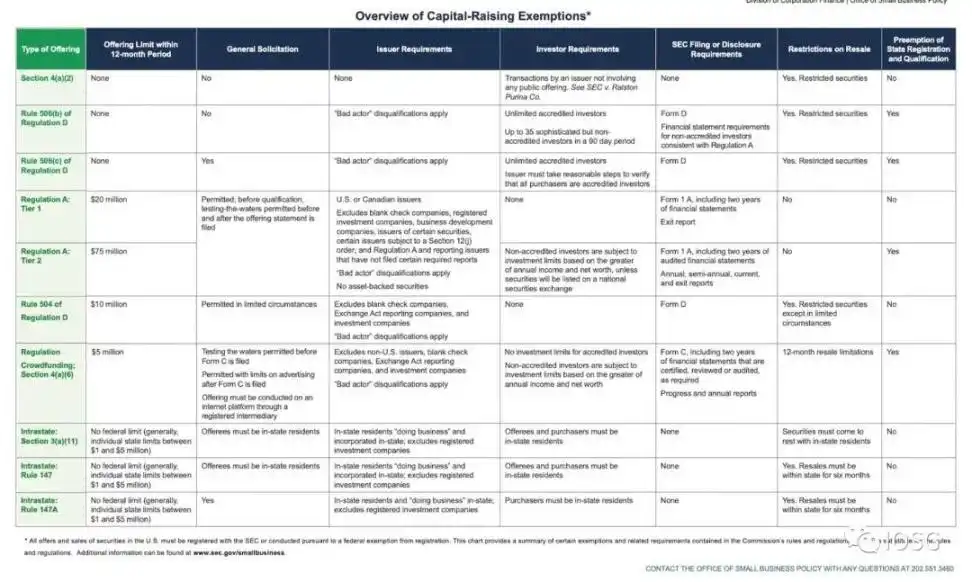
Source:www.sec.gov/education/smallbusiness/exemptofferings/exemptofferingschart
How to Dance on the Edge of a Knife: Pitfalls to Avoid When Designing Tokenomics
同质化代币 Fungible Tokens(FT)
Fungible Tokens (FT)
First, let's briefly review the common FT token designs in the industry: web3 games usually adopt a single-token model or a dual-token model.
In a single-token model, the only token has two types of utility: governance and in-game consumption.
In the dual currency model, governance and in-game consumption utilities are allocated to two different tokens. The governance token typically has a fixed supply and theoretically allows owners to participate in decision-making regarding game development and operations to some extent. The utility token, on the other hand, usually has no fixed upper limit and is used as a currency for in-game circulation and pricing.
However, before adopting the dual-currency model and deciding how many tokens/supply to issue, developers should carefully consider the functions that each token/NFT will actually perform, as well as how the project's value capture will be realized and distributed.
Designing token economics solely based on the ease of manipulation will only expose the project to more regulatory risks.
The project team needs to re-examine, including but not limited to:
- What is the necessity of each token's existence?
- Are the buyers of these tokens gamers/consumers in the game or real players?
- Although the issuer of the two tokens is the same, according to the previously discussed Howey Test, utility tokens and governance tokens often have vastly different test results. If the core design of the game can bypass some sensitive regulatory aspects, it may not be necessary to issue dual tokens or tokens at all. So why add risk to the project?
Governance tokens are generally sold to retail investors through private sales/IEO and other financing activities, while utility tokens are obtained by players in the game after completing certain in-game tasks. Under the requirements of the Howey Test, the issuance and holders of utility tokens are relatively less like securities. However, is it enough to simply design tokens as utility tokens?
Unfortunately, in order to regulate the economic lifecycle and prevent gold farmers from excessively squeezing the value of the ultility token, development teams often have to step in and adjust gameplay mechanics after the game goes live, affecting the way tokens are produced and consumed to maintain price stability. This clashes with the last rule of the Huobi test, "From the Efforts of Others."
Simply abandoning the past token model is not enough to face the pressure of current regulation.
Non-Fungible Tokens (NFT)
The application of NFT in web3 games is also very common, from roles, skins to mimic real world assets such as land and buildings. At first glance, these digital assets are far different from securities. As analyzed in the previous section, the non-fungible characteristics give NFT a certain degree of resistance in the Howey test. However, it should be noted that for certain series, individual NFTs are still highly homogeneous, such as certain repetitive materials (mahjong, poker NFTs) that exist in large quantities in some games, which may be regarded as a common enterprise by regulators, even for a single NFT. With the development of NFTFi and the fragmentation of NFTs, NFTs are gradually becoming more homogeneous, which makes them more like securities.
There is one more thing worth mentioning. In the first generation of Gamefi, many games treated NFTs as a threshold for entering the game, a tool for gold farming. Players needed to purchase Axies or running shoes (investing a certain amount of cost) in order to experience the game.
This pre-investment increases the investment attribute of buying NFTs, making the tendency of buyers expecting profit more obvious. Instead of using NFTs as a threshold, it is more desirable to make the game's selling point as free 2 play/free-mint, like limitbreak.
Another feasible design is to make the NFTs in the game have a lifespan - with time/use, they wear out in value, or the game's economic system is periodically reset. In Tarkov, Battlestate Games periodically resets the game's economy, and in Zelda, most weapons wear out with attacks. These designs can alleviate the tendency of buyers to expect profit.
延展讨论
translates to
Extended Discussion
SAFTs
SAFT is a common financing method in projects, and game projects are no exception. When combined with Howey Test, the situation of SAFT becomes very ambiguous.
In theory, in SAFT, the purchase of tokens is divided into two steps. Investors first receive a protocol that allows them to purchase tokens in the future, and then after TGE, investors receive tokens. Therefore, at first glance, there is reason to believe that the tokens themselves are not securities.
However, in practical operations, taking the Telegram case as a reference, the court would consider that Howey Test should be applied when signing the SAFT, rather than during the TGE. In other words, all agreements related to token signing will be taken into consideration.
Utilize tokens that have already been issued on the market.
The Securities Act of 1933 and the Securities Exchange Act of 1934 regulate companies with assets exceeding 10 MM and 500+ shareholders. So, can a Web3 gaming company find a token issued by a private entity that does not meet the above requirements and use it as its own token?
Perhaps such an operation can help Web3 companies avoid becoming issuers of securities. However, the cost is that game companies need to rely on the compliance capabilities of third parties and give up some of their value capture capabilities. Therefore, it is recommended to conduct the most detailed due diligence on the token issuer.
Insights
1) Game project parties should pay attention to regulatory risks, and dealing with regulation in the future will become the norm in the industry. As a product with a large user base targeting the consumer market, games will definitely be in the spotlight. It is important to leave room for maneuver in product design, rather than issuing tokens just for the sake of it.
2 ) Pay attention to the decentralization of the project's economic system and product operation. This is not just a marketing gimmick or a story told to the community, but also a safety cushion for the project when facing regulation.
3 ) From any perspective, Game-fi now seems to be a high-risk business. Game-fi may be a proven model, but it is not suitable for the current environment. If possible, focus on more interesting innovations, even if it will be more difficult.
Welcome to join the official BlockBeats community:
Telegram Subscription Group: https://t.me/theblockbeats
Telegram Discussion Group: https://t.me/BlockBeats_App
Official Twitter Account: https://twitter.com/BlockBeatsAsia

 Related Articles