How to evaluate the quality of an X to Earn project's economic model?

Original Title: "How to Judge the Quality of an X to Earn Project's Economic Model?"
Original Source: veDAO Research Institute
Is the economic model important for a Web3 project? Maybe 8 out of 10 people would say it is important. However, to some extent, the economic model is not that important. Either the economic model paradigm of most projects has a high degree of convergence, or the proportion of token distribution is often not as professional as it seems. In fact, most of the token distribution values are more of a decision made by the founding team based on reference to mature solutions in the market.
Now, let's go back to the question above, is the economic model important for a Web3 project? It is important, but it needs to be combined with various factors such as the project's vision, product quality, etc., rather than simply playing digital games by piling up complex formulas in the economic model.
In fact, a good project target may not necessarily use the latest economic model, and even this model may not be very complex, but it must be the most scientific economic model, which should be combined with the product features.
veDAO article, aimed at popularizing the elements of economic models for readers, so that everyone can be more proficient in the project screening process.
First of all, we need to understand what an economic model is.
Economic model: in English, Tokenomics is a combination of the words Token and Economics. As the name suggests, it refers to the economic operation of the cryptocurrencies issued by different projects within the blockchain ecosystem. Its main function is to lead the supply, usage, distribution, incentives, utility, governance, monetary policy, and more of project tokens.
With the rise of the DeFi concept and the increase in on-chain participation channels such as interaction, airdrops, stake, and IDO, users have more opportunities to participate in project growth and early stages. Therefore, the importance of project economic models has also increased. At its core, it is the mechanism behind all on-chain behavior. As a project party, you must use tokens to incentivize all participants to maintain the spontaneous operation of a complex economic incentive system. As a participant in the decentralized revolution, you must study and observe the advantages and disadvantages of different tokenomics to choose investment targets, because tokens are the mainstream financing method of Web3 projects, and tokenomics is an important factor affecting investment returns.
The Importance of Economic Models
There is a saying: "From 0 to 1, it's all about the product. From 1 to 100, it's all about the economic model." A high-quality product needs good quality to drive the first step, and then an economic model to keep the flywheel turning.
Therefore, the economic model is important for a product for the following reasons:
1. Replace traditional buying
For Internet products, the economic model provides a new business model. If the survival of traditional products depends on offering low user prices even if it means bearing the pressure of losses in the early stages of the project, and investing a huge amount of money to acquire users and achieve market dominance, and then aggregating user relationships and recovering costs after gaining a competitive advantage in the market.
So after having tokens, the task of seizing the market can be handed over to the tokens. On the one hand, by managing the market value, creating a value window for the tokens, attracting more people to hold them, and completing the user's mental possession. In this process, the appearance of the token's value window often spontaneously attracts more users and market attention, indirectly completing the traditional task of buying volume.
During the DeFi Summer period, the struggle between Uniswap and Sushiswap was a classic case: as the pioneer of DEX, Uniswap initially did not want to issue tokens, but Sushi attracted a large number of users from Uni through token airdrops. At its peak, Sushi users accounted for 70% of Uni's users, causing Uni to feel a sense of crisis.
The cold start and rise of Sushiswap is built on the "vampire attack" process against Uniswap. When Sushiswap went live, it quickly attracted liquidity by allocating SUSHI to early LPs. With each block update, a certain amount of SUSHI is released and allocated to LPs. Initially, Sushi required the provided liquidity to be LP Tokens from specific pools in Uniswap, which caused the locking amount of Uniswap to quickly rise after Sushi went live.
Two weeks after going live, Sushiswap initiated liquidity migration, transferring all LP Token liquidity that participated in SUSHI mining in specific pools on Uniswap back to Sushiswap, thus completing the rapid plunder of liquidity.
2. Reduce the difficulty of investment and financing, shorten the cost recovery cycle
As mentioned above, traditional internet products often need to first occupy the market before they can achieve profitability. This is also one of the reasons why JD.com and Bilibili have been continuously losing money. However, aside from policy risks, a Web3 product that issues tokens will often issue its own tokens before the project's functions are about to go online, and use an economic model to pre-position revenue. This allows the project to reinvest the funds that are returned into the development of the project, making the flywheel turn faster.
It must be admitted that in the current context of web3, the main way for projects to make money is still through selling coins. However, when a project has the conditions to issue coins but chooses not to, it means that the pressure for profit is completely transferred to the quality of the product, which brings it back to the competition format with traditional internet products.
This phenomenon is not uncommon in the Web3 industry, especially for teams that have shifted their focus from gaming to blockchain. Due to the unique nature of gaming, these teams often attract many professionals from the Web2 industry. Therefore, due to natural fear of going global and regulation, or the limitations of traditional gaming operation ideas, even though they are developing blockchain games, they have been hesitant to issue coins. This puts tremendous pressure on the team's operations and reduces the success rate of entrepreneurship.
Not only that, for pure Web3 projects, not issuing coins also means being passive in the Web3 market. Taking Opensea as an example, it once held over 98% of the market share. With a transaction fee of 2.5%, its highest monthly revenue exceeded 350 million US dollars.
However, due to Opensea's slow iteration speed and desire to pursue equity financing, they have not issued tokens. As a result, they have been targeted by projects such as looksrare, x2y2, and blur, who are using token airdrops and incentives to attract Opensea's top users.
Economic Model Classification
Currently in the industry, regarding the classification of the X to Earn project's economic model, its token types can be divided into four categories: governance tokens, utility tokens, special tokens, and NFTs.
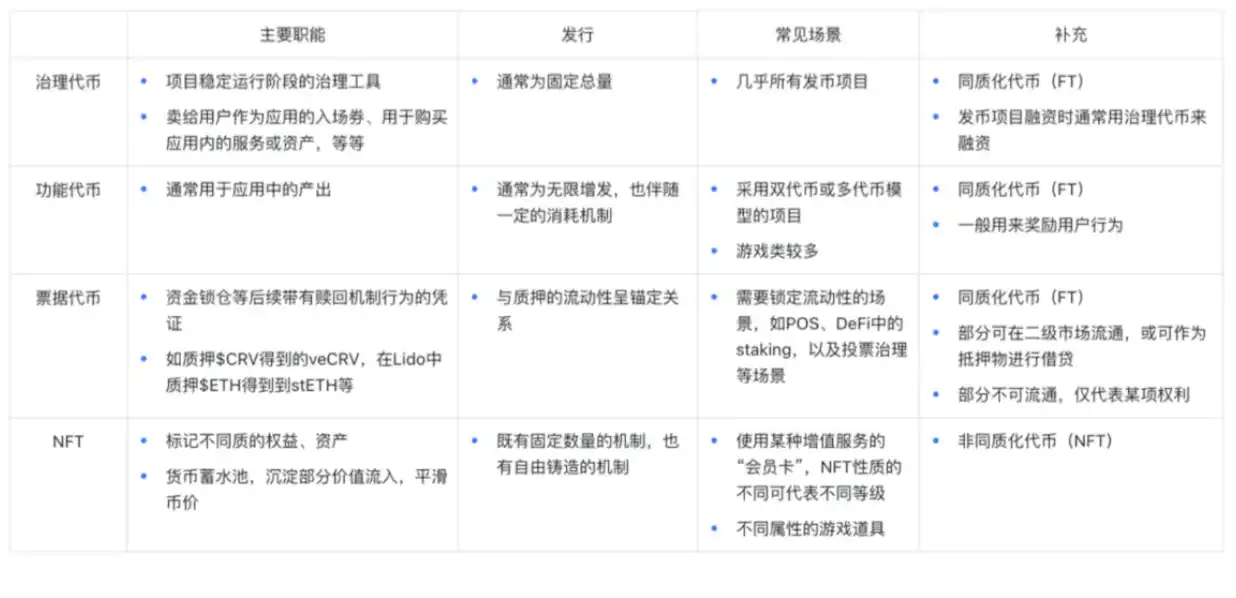
Based on the combination of these four tokens, the current mainstream solutions can be divided into single-token, dual-token, and three-token models.
Single Coin Model: Refers to a single token issued based on the ecological content itself. This type of token often only carries a single governance function (such as UNI), or it may have both governance and utility functions.
However, this model, due to its fixed supply, means that if it only carries on-chain governance functions, the value of the currency is difficult to reflect, and the willingness of holders to hold will decrease as the project iteration speed slows down.
If both governance and utility are combined, it means that users will obtain more tokens through various means, ultimately leading to an explosion in inflation rate, while also affecting the market's valuation of the token during IDO.
Therefore, many project parties have optimized on this basis, either by splitting governance and utility functions, which is called the dual-currency model, or by expressing utility functions in the form of points.
Dual Currency Model: The so-called dual currency generally refers to the combination of governance currency and utility currency, with the addition of NFT elements. The earliest proposal was made by Near, whose issued stablecoin USN can be integrated into the protocol layer as NEAR's native asset for paying gas and storage fees. This can be seen as the earliest prototype of utility currency. Since then, the dual currency model has been further developed, with Axie being a well-known example.
The emergence of the dual-token model has greatly delayed the death spiral cycle of the original single-token model. By linking the utility token with the governance token, the selling pressure of the governance token is transferred and consumed, reducing the risk of project failure. However, on the other hand, managing a dual-token system is not just twice as difficult considering the possible correlation between tokens. When there are more than one type of token in the system, it is necessary to consider how to allocate value reasonably. In addition, since functional tokens are often infinitely issued, they are prone to inflation. If excessive inflation or other related reasons cause a price drop, more tokens need to be issued to maintain a sufficient level of incentive for users, which will further strengthen inflation.
Three-Coin Model: This solution is not a popular choice in the Web3 market, as the three-coin model was generally seen as a patch on the dual-coin model at the time, but there have been some innovations since then. The most well-known three-coin model is the VCT model that appeared last year: in addition to the traditional governance coin and utility coin, a token for capturing asset value was added.
VCT Token has a strong correlation with Utility Token: in terms of quantity, regardless of inflation or deflation, the ratio between the two always remains 1:1; in terms of price, since each Utility Token can be "exercised" at any time (exchanged from the project party for one VCT Token, and then exchanged for a stablecoin equivalent to the current VCT Token price), the price of Utility Token is always greater than or equal to the price of VCT Token.
Additionally, VCT Token has no impact on regular players and will not increase their burden. It is not traded on the secondary market and will only be used during the "exercise" process. The "exercise" process is irreversible and can only be done once for each utility token and VCT. After the "exercise" process, both the utility token and VCT Token will be destroyed.
For example:
The utility token quantity of a certain game = VCT = 10000.
The total value of VCP, which includes revenue from advertising and fiat currency, is 10000 USDT.
At this time, 1 VCT = 1 USDT.
When the utility token of the game is massively sold off, it continuously drops from 3 USDT.
Through the "exercise" mechanism, players will feel that they can lock in a return rate of at least 1 USDT, so they will not panic. Instead, due to the deflationary expectation of "exercise", it will effectively suppress the downward trend of utility tokens.
When this model was proposed, it sparked a heated discussion. Prior to this, many game teams had already used a certain proportion of governance tokens to specifically exercise the role of VCT. In other words, with the premise of future related functions, is it necessary to introduce new currencies? In addition, the "three-currency" model represented by VCT is also based on the initial ability of the game to capture sufficient value, that is, icing on the cake. However, it cannot solve the problem of where the initial liquidity comes from, and cannot provide timely help.
Several Elements of Economic Models
After discussing the classification of the X to Earn economic model, we need to pay attention to several dimensions:
Firstly, there are three major elements in an economic model:
Supply: Refers to the source of the target token, which is usually divided into two ways:
Public offering behaviors: ICO, IEO, IDO, Launchpad, Fair Launch (Benddao model, equal cost for everyone), ILO (X2Y2 model, initial liquidity offering, now commonly used by most small projects).
Incentives: Airdrop, TVL investment incentives, Stake incentives, Volume incentives (projects mainly based on exchanges), Liquidity (DEX main battlefield), P2E (X to Earn model).
Three terms to pay attention to:
tokens?
TGE: How many circulating tokens are there at the time of token issuance?
Cliff: How long does it take to unlock after being frozen?
Vesting: How long does it take for tokens to unlock?
Requirement: Refers to the usage scenarios of the target token, which generally includes: value storage, spending, mining, governance, protocol revenue, and collateral.
Memes, speculative demand (sector rotation).
Value Capture: Ultimately, the token value capture path needs to be addressed: service fee payment (MV=PY), buyback & burn (less commonly used now with staking), Staking protocol income, and buyback rewards.
Summary
Generally speaking, a good economic model should have the following characteristics: low inflation rate, high incentives, low selling pressure, rich usage scenarios, sufficient liquidity, and governance mainly from the B-end.
In addition, when we invest in projects such as public chains that require decentralized autonomy, we need to analyze whether their economic models have incentives for maintainers and value capture for tokens to ensure that the project can provide users with continuous and stable services while allowing network maintainers to capture value and reduce selling pressure from maintainers.
When we invest in projects involving large-scale fund transactions such as DeFi, the focus of analysis should be on how the economic model coordinates the distribution of interests between LP and governance token holders, including whether income can incentivize LP to continue providing liquidity, and whether governance token holders can allocate reasonable income.
But speaking of which, good products are the key to user retention. Just like what was mentioned earlier, the economic model can only achieve a conversion rate of 1-100, but the most difficult part, 0-1, relies on the quality of the product itself and operational methods.
Original link
Welcome to join the official BlockBeats community:
Telegram Subscription Group: https://t.me/theblockbeats
Telegram Discussion Group: https://t.me/BlockBeats_App
Official Twitter Account: https://twitter.com/BlockBeatsAsia

 Related Articles