Mint Ventures: Head-to-head Dex battle on zkSync: Syncswap vs iZiswap.

Original author: Alex Xu, Research Partner at Mint Ventures
This issue of the project overview focuses on the head-to-head competition between the top DEXs in the emerging L2 ecosystem zkSync. We will attempt to answer the following questions:
- Why is it necessary to pay attention to zkSync and its Dex track?
- What is the current status of the zkSync transaction race project?
- How do the various competing projects compare in terms of quality and what are their respective advantages? Who is more likely to come out on top?
The following article represents the author's current perspective at the time of publication, and may contain factual errors and biases. It is intended for discussion purposes only, and the author welcomes corrections from other industry professionals.
Why should we pay attention to zkSync and its Dexs?
zkSync: L2 New Year, a strong competitor among L2 solutions
2023 is the year of L2.
Regarding business data, while the TVL (total value locked) of various public chains represented by Ethereum remains low, the TVL of L2 (layer 2) has grown rapidly this year, breaking new records.
Source: https://defillama.com/chain/Ethereum?tvl
Source: https://l2beat.com/scaling/tvl
除了链上资金之外,链上的活跃数据同样印证了这一点,自去年 10 月 L2 的实际 TPS 有效超过以太坊之后,今年该数据进一步迅速上升,目前 L2 网络的实际 TPS 已经是以太坊的 3 倍左右,未来这个数据显然还会继续攀升。
Translation:
Aside from on-chain funds, the active data on the chain also confirms this point. Since October last year, the actual TPS of L2 has been effectively exceeding that of Ethereum. This year, the data has further increased rapidly. Currently, the actual TPS of the L2 network is about three times that of Ethereum. Obviously, this data will continue to rise in the future.
Below is a comparison between the actual TPS of L2 and Ethereum:
Source: https://l2beat.com/scaling/activity
Other than business data, the Cancun upgrade coming in October this year will significantly reduce the cost of L2 and promote further migration of users and applications to L2.
In terms of competitive landscape, L2 is similar to L1, with a strong network effect built by users, developers, and funds, which is second only to stablecoins in the Web3 world, and has a very obvious first-mover advantage.
In the OP Rollup field, the Arbitrum and OP duopoly has been established, and there may be a future battle. Perhaps there will also be a Coinbase L2 Base built on the OP stack, but there are likely to be few new players who can enter the game in the short term.
And the battle in the ZK Rollup field has just begun. ZK, as a long-term direction supported by the Ethereum Foundation and Vitalik, is bound to occupy a place in the increasingly fierce L2 war in the future. Following this year's completion of the airdrop by Arbitrum, zkSync has become the next highly anticipated L2 airdrop project. Its TVL and user activity have continued to rise. In less than 3 months after its launch, it has become the second largest TVL L2 project after Arbitrum and Optimism, and also the ZK Rollup project with the largest TVL and user base. Currently, the on-chain project types are gradually becoming more diverse, including DeFi infrastructure and meme projects like Cheems.
Overall, zkSync has taken the lead in the competition for ZK L2.
Dexs: The Infrastructure for User and Fund Aggregation
Dex, lending, and stablecoins are the most basic financial trio for L1&L2. However, when we refer to the development of L1 and L2 in the past, it is easy to find that there is usually only one "native Dex" for each chain. Here, the author defines the standard for "head" in two ways, at least one of which must be met:
- TVL and transaction volume business data are far higher than competitors, with at least one market share exceeding 50%.
- The token has been listed on top-tier trading platforms such as Binance.
Data source: Defillama Time: 2023.6.7 Table: Mint Ventures
As the head of the chain, Dex enjoys more advantages compared to other competitors, such as:
- Mindedness is prioritized, making it easier for users to trade and provide liquidity on the platform, and increasing trustworthiness.- Business advantages, more likely to win the favor of other partners, become the first stop for liquidity deployment or cooperation launchpad business.
- Convenient traffic makes top DEXes easier to be mentioned and referenced in various business rankings, news, and research reports, gaining more free exposure and natural traffic.- The cross-border network effect advantage formed by leading liquidity and trading volume.
- Token is easier to log in to the header of Cex, gaining liquidity premiums and more holding users.
As a relatively new L2 ecosystem, zkSync is still in the early stages of growth for users, funds, and developers. The market landscape for various tracks has not yet solidified, and brand projects on other chains have not completed cross-chain deployment (such as Uniswap V3 and Aave). Native projects still have time to compete for and consolidate their positions.
However, the future Dex landscape of zkSync will most likely be similar to other L1&L2 solutions, with only one native Dex at the top (or occupied by Uniswap V3).
So the question is, who will become the top native Dex of zkSync in the future?
zkSync Dexs Race Landscape
Currently, there are numerous Dex projects in the zkSync industry, each adopting different mechanisms. However, from a business data perspective, there has been a trend towards market share concentration.
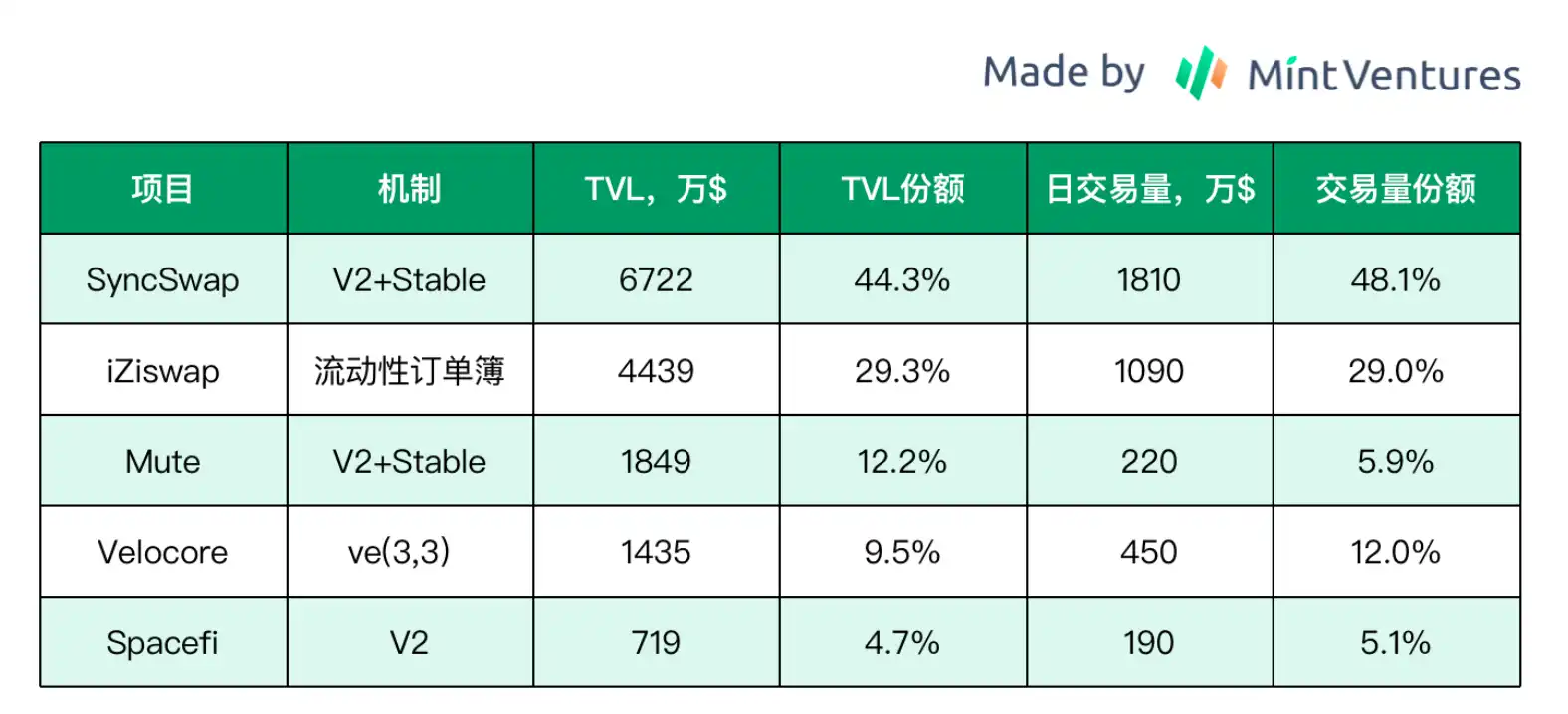
Data source: Defillama and official project data Time: June 6, 2023 Table: Mint Ventures
PS: The term "份额" is calculated based on the total business volume of the top five Dexes.
On the business mechanism side, 3 out of the top 5 Dex (SyncSwap, Mute, and Velocore) have adopted the V2 dynamic pool + stable pool model, with Velocore also using a ve(3,3) mechanism similar to Velodrome in its economic model, while also operating a liquidity market business.
However, based on the core business data of TVL and trading volume, currently the top-tier Dexs in zkSync are SyncSwap and iZiswap. The future leading Dex is most likely to emerge from these two.
Syncswap vs iZiswap
Next, the author will sort out and compare the basic information of these two first-line DEXs in the zkSync ecosystem, mainly covering project mechanism design, business indicators, economic models, and team situations, etc.
Syncswap
Mechanism Design
Pool Type
Overall, Syncswap does not have much innovation in the product mechanism of Dex. It adopts the multi-pool mechanism commonly used in ve(3,3) projects. Currently, it mainly relies on Uniswap v2's Classic Pool (mainly suitable for trading pairs with large exchange rate fluctuations) and Curve's Stable Pool (suitable for trading pairs with stable exchange rates).
Below is a list of pools on Syncswap:
Source: https://syncswap.xyz/pools
Transaction Fees
Syncswap refers to its fee mechanism as "Dynamic Fees", but in reality it is not the dynamic fee mechanism that we understand (where the higher the asset price volatility, the higher the fee rate to compensate for LP's impermanent loss). Perhaps a more accurate expression would be "customizable fees".
Specifically, the transaction fees for Syncswap include the following features:
- Fee adjustable: Different pools can set different fee rates, with a maximum limit of 10%.
- Directional rate: Different rates are set based on the transaction direction (buy/sell), for example, 0.1% for buying and 0.5% for selling.
- Fee Discount: Reduction of transaction fees based on token collateral.- Fee allocation agent: can directly allocate the fees of the pool to external addresses.
As we can see, Syncswap's Dynamic Fees are actually not related to "dynamic" in any way, but rather provide more extensive customization of permissions.
Business Performance
We conducted a statistical analysis of Syncswap's business from four perspectives: trading volume, number of users, liquidity, and transaction fees (LP fees and protocol revenue).
Trading Volume and Number of Users
In addition, although the SYNC token has not yet been listed, Syncswap has launched a token incentive program called "Loyalty Program". The main target of this program is the fees generated by specific trading pairs, similar to "transaction mining".
Source: https://syncswap.xyz/rewards
The token mining rules for the Loyalty Program are as follows:
- When users trade in designated trading pairs, the more transaction fees they generate, the more ySYNC tokens they receive as activity reward vouchers. The amount of ySYNC tokens received is equal to the transaction fees contributed by the user.- A planning cycle is called an epoch, and except for the genesis epoch (epoch1) which lasts for a month, all subsequent epochs last for one day.- Users can exchange rewards based on ySYNC, but the rewards are issued in veSYNC. If users want to sell, they need to unlock veSYNC first.
The genesis epoch of the Loyalty Plan is from April 10th to May 10th this year, with a total reward of 900,000 veSYNC. The final ySYNC obtained by participating users is 1,189,624.5, which means that users paid a total of $1,189,624.5 in transaction fees on the designated trading pairs during the event, with a corresponding cost of $1.32 per veSYNC.
However, the Loyalty Program is currently in a suspended state, with only one phase completed.
Team and Financing
Syncswap's team is anonymous, and the size and personnel of the team are unclear. Currently, there is no disclosure of financing news.
iZiswap
Mechanism Design
iZiswap is one of the products of iZUMi Finance. iZUMi is a DeFi project that provides Liquidity as a service (LaaS) for multiple chains. iZiswap is the Dex product of its liquidity service. Other products currently available include:
LiquidBox: A liquidity incentive service centered around the concentrated liquidity mechanism (Uni V3 and its derivative modes), which can assist project parties in customizing liquidity incentive bonds based on price ranges.
Funding Services: Provides project parties with financing methods similar to convertible bonds in traditional finance.
This article mainly focuses on the top Dex competition in the zkSync ecosystem, so it will mainly focus on the situation of iZiswap related to this on the zkSync network.
iZiswap's main innovation lies in the proposal and implementation of DL-AMM.
DL stands for Discretized Concentrated Liquidity, and DL-AMM does not use the constant product formula. Instead, liquidity is placed at discrete price points, with each price point following the constant sum formula L = X * P + Y / P.
Countless discrete price points are connected to form a complete AMM price curve similar to Uniswap, as shown on the left in the following figure.
Source: https://assets.iZUMi.finance/paper/dswap.pdf
The liquidity in DL-AMM will be divided into two categories: LP liquidity and limit order liquidity. The two will be combined and distributed in different price ranges, as shown in the right figure.
In addition, based on the characteristic of iZiswap's liquidity point distribution, it also provides a trading interface version of the order book (iZiswap Pro), which provides users with a trading experience similar to CEX.
Source: https://iZUMi.finance/trade
Speaking of liquidity order book, it is easy to associate with the more well-known Dex project Trader Joe, which launched Liquidity Book (LB) in November 2022, also distributing liquidity in point form and using a constant formula for liquidity at specific price points instead of a constant product.
For specific information about Trader Joe, you can read the author's research report "The Second Wind Ignited by Arbitrum? Comprehensive Analysis of Trader Joe's Business Status, Token Model, and Valuation Level".
In fact, the concept of Trader Joe's liquidity order book is likely to have originated from iZUMi's proposal of DL-AMM. iZUMi's paper on DL-AMM, "iZiSwap: Building Decentralized Exchange with Discretized Concentrated Liquidity and Limit Order," was released in November 2021, and iZiswap was launched in May 2022 (first on BNBchain), both well before Trader Joe's LB function went live. Trader Joe also acknowledged and referenced iZUMi in its V2 whitepaper.
除了 DL-AMM 之外,iZUMi 还设计了基于集中流动性的流动性激励服务 LiquidBox。基于 V2 的流动性挖矿激励很简单,用户将 LP 凭证质押即可获得代币奖励,这等于是在激励全部价格区间的流动性。但 V3、DL-AMM 和 BL 这类集中流动性的激励设计则要复杂得多。
Assuming a token with a price of $100, an LP provides liquidity in the range of $95-$105 with $1000, while another LP provides liquidity in the range of $10-$20 with $1000 (one-sided order). The utilization efficiency of the former's liquidity is much higher than that of the latter. If we refer to the V2 model and provide the same reward based on liquidity value, it is obviously unreasonable.
LiquidBox is a place for users to deposit liquidity and receive incentives, while for incentive providers (usually token projects and iZUMi), it can allocate the obtained liquidity into differentiated intervals to achieve the liquidity goals desired by the project party.
LiquidBox's solution is to provide three options, which are jointly determined by the liquidity incentive party (usually the token project party and iZUMi) to decide which one to adopt:
1. One-side mode: The project tokens deposited by users in the liquidity will not be stored in the pool, but will be staked separately to reduce the quantity of project tokens in the pool and lower the resistance during price increase. The other half of the value coins (ETH or stablecoins) will be allocated to the left side of the current token market price to strengthen the buy orders during price decrease. This actually achieves the effect of "increasing token buy orders and reducing token sell orders" for the project party. For users, if the project token price rises, there will be no impermanent loss caused by "selling all the way up". Of course, if the token price falls, the impermanent loss caused by the price decrease will be amplified because the project tokens have not been sold at a high price. Therefore, this can be understood as a mechanism that encourages users to stake tokens and not sell, and jointly participate in the (3,3) market-making.
The following image shows the comparison between single-sided mode and V2:
Source: iZUMi Document
2. Fixed Range Mode (Fix range): This is relatively easy to understand, which means to incentivize liquidity in fixed price ranges. It is more suitable for stablecoins and wrapped assets incentives.
Fixed interval incentives, source: iZUMi document.
3. Dynamic Range: Users participate in liquidity mining by providing liquidity within a range of (0.25Pc, 4Pc) around the current price (Pc). The width of the price range can also be set by the project party, such as (0.5Pc, 2Pc). The benefit is that there will be better liquidity around the market price range, but if the token price fluctuates dramatically beyond the user's initial market-making range, the user will need to frequently withdraw LP and re-stake while bearing impermanent loss, resulting in higher operational costs.
In actual situations, currently active LiquidBox mostly choose dynamic mode.
In addition, LiquidBox supports LP participation and incentive staking for Uniswap V3 and iZiswap, with most of the activated incentive pools on the zkSync network.
Business Performance
Trading Volume and Number of Users
The author also uses on-chain data to compare iZiswap's data with Syncwap's data. The trading volume in the past 30 days (2023.5.8-6.7) was $195,025,494, with a corresponding daily average trading volume of $6,500,849. The trading volume in the past 7 days (2023.6.1-6.7) was $60,007,769, with a corresponding daily average trading volume of $8,572,538.
The above transaction data roughly matches the 24-hour trading volume statistics of Dexscreener and the official pools.
Source: https://dexscreener.com/zksync/iziswap
Source: https://analytics.iZUMi.finance/Dashboard
Similar to Syncswap, iZiswap has an even more extreme ETH-USDC trading volume, with the trading volume of the two pools accounting for 85.8% of the daily total trading volume, followed by stablecoins and the native token IZI.
Liquidity
When it comes to liquidity statistics, there is a significant discrepancy between the data provided by iZiswap and Defillama. The official dashboard displays current liquidity at 44.78 million USD, while Defillama's data shows 25.95 million USD.
iZiswap's official liquidity data disclosed.
Defillama's ranking of TVL statistics for DEX on zkSync
The reason is that the official statistics of liquidity include many stablecoins and packaged assets issued by iZUMi itself, such as iUSD (debt financing stablecoin) and slstETH, slUSDT (packaged assets based on Ethereum collateral, cross-chain issuance), as shown below.
However, in the current market environment, it is difficult to promote self-operated stablecoins and packaged assets because of the single-point risk of third-party acceptance of assets. Most users and mainstream defi do not accept third-party issued packaged assets. At the same time, according to iZUMi's feedback, packaged assets represented by slstETH are still in the preparation period and have not officially started operation. Therefore, when observing TVL, we should rely on the data from Defillama's statistics, which is more reliable.
After mentioning the encapsulation and self-operated stablecoin TVL, the TVL of iZiswap is similar to Syncswap, with ETH Pool accounting for 86.8%.
As far as liquidity incentives are concerned, currently iZiswap has opened a considerable number of LiquidBox mining pools on zkSync, all of which adopt a dual incentive model of project tokens and IZI tokens.
Source: https://iZUMi.finance/farm/iZi/dynamic
The author has calculated the token rewards for the current dual mining and found that the majority of the token rewards for each liquidity incentive are funded by the project party. However, there are also a few pools where the value of IZI tokens is higher due to the project party token price decline.
Currently (June 14, 2023), the total number of LiquidBox liquidity incentive tokens for IZI on zkSync is 60180 per day, worth approximately $1208.
Trading fees and protocol revenue
iZiswap's data dashboard displays the fee generation of each pool. Below is the ranking of the top 10 pools by weekly fees.
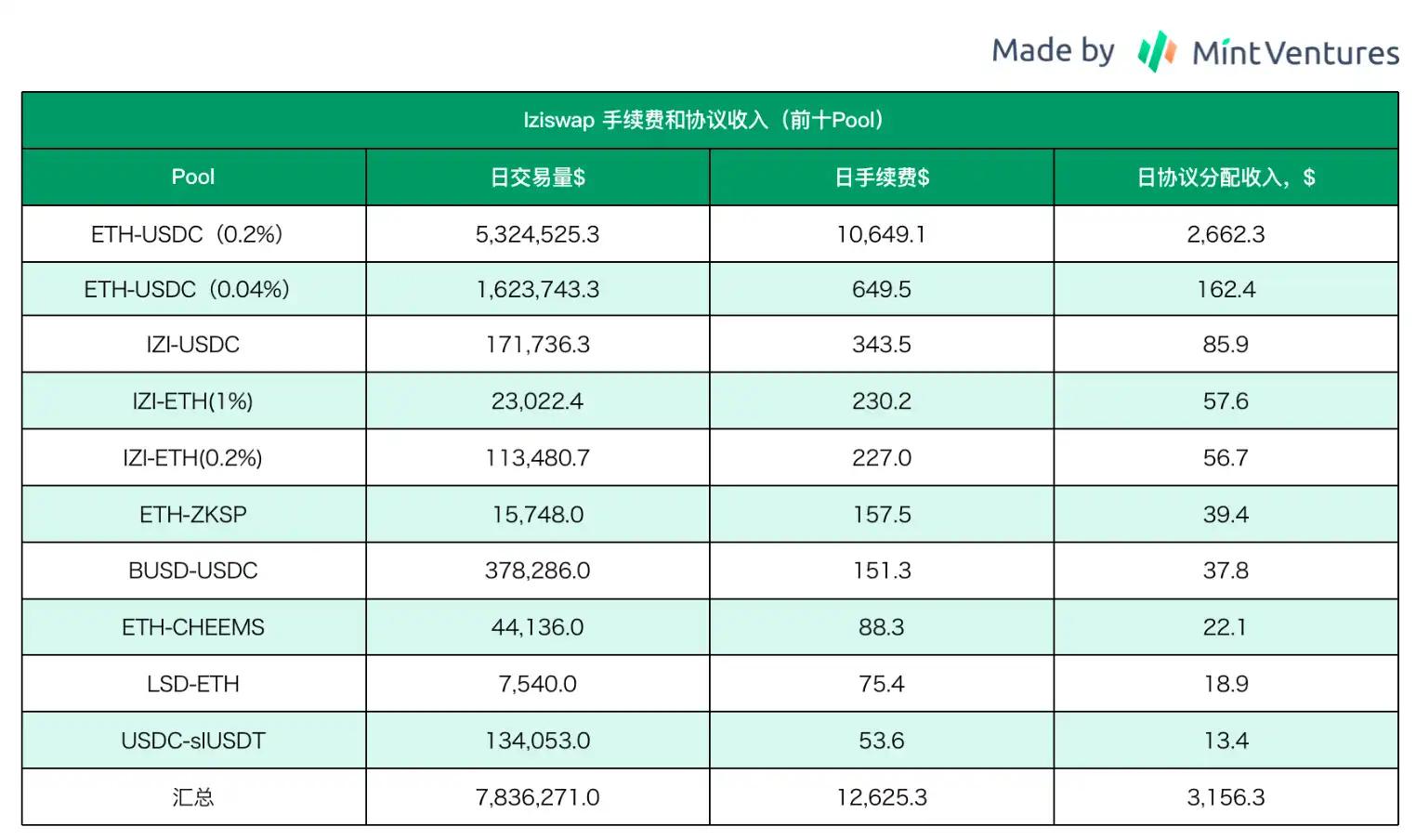
Data source: iziswap official. Time: June 14th, 2023. Compiled by Mint Ventures.
PS: Revenue allocation agreement refers to the allocation of income to izi token users, which is 25% of the transaction fee.
Compared to Syncswap's daily protocol revenue of $11,631.4, iZiswap's daily protocol revenue is $6,312.5. However, according to the token design, 50% of this revenue will be used to repurchase iUSD and as market funds, which means only 25% of the transaction fees will be allocated to IZI token users.
Economic Model
iZiswap is a product module of iZUMi and is currently the main module generating revenue. In terms of business volume and development prospects, zkSync is currently the main battlefield for iZiswap.
Total amount, allocation, and supply
Its token distribution and release speed are as follows:
Source: https://docs.iZUMi.finance/tokens/tokenomics
According to CMC data, the current total unlocked token amount is 787,400,000, but 276,091,843.3IZI are currently in ve staking.
Token Usage
IZI's token has three planned uses:
1. Governance voting: Used to vote on the direction of token emissions (not yet online).
3. Accelerated earnings: After pledging, you can accelerate your mining on LiquidBox, up to 2.5 times, similar to Curve's boost mechanism.
The intrinsic value of the Dex token in the VE model mainly comes from two sources: 1. The governance right value used to command liquidity, whose price is determined by the liquidity price of the corresponding Dex and is influenced by the liquidity procurement demand of other projects on the same chain; 2. The cash flow discount of transaction fee dividends.
Currently, the ve voting function of iZiswap has not yet been launched, and the distribution of transaction fees is split in half by the bond repurchase module, suppressing the intrinsic value of the token.
Team and Financing
According to the information disclosed by Rootdata, the founder of iZUMi Finance is Jimmy Yin, who graduated from Tsinghua University. The current team size is 20+.
According to the data disclosed by rootdata, iZUMi has undergone a total of 4 rounds of financing in the past.
2021.11: Seed round, $2.1 million, corresponding to a valuation of $14 million.
2021.12: A round, $3.5 million, corresponding to a valuation of $35 million.
2022.5: Raising 30 million US dollars through Solv for convertible bond financing, used for liquidity operations.
2023.4: Raised $22 million through Solv for fund-raising in the form of funds for liquidity operations.
It is worth noting that iZUMi's recent two rounds of financing did not use the direct sale of tokens, but instead used bonds or funds to raise funds. The purpose of the financing is not only for project expenses and team recruitment, but also for liquidity operations (market making). The operating income can be used for team income and financing returns.
Conclusion
In the competition of the zkSync head Dex, Syncswap is relatively conventional in terms of product mechanism, without impressive native innovation. On the other hand, iZiswap has more abundant native exploration in its product, but it is not optimistic whether it can be converted into user and capital growth at present. This is because from the specific business data, Syncswap currently occupies a significant leading position in both TVL and trading volume, and its token has not been distributed yet. The expectation of project airdrop has strong attraction to users' funds and trading behavior, enjoying lower operating costs (while iZiswap still has daily token incentive expenses).
However, the current issue faced by both parties is that zkSync, being a relatively new project, has a limited number of native projects with vitality. The majority of liquidity and trading volume for both DEXs are related to ETH.
In the future, more native projects will be born on zkSync. Which platform will these projects choose to deploy their initial liquidity on? Will it be zkSync, which has more advanced business, or iZiswap, which has more diverse mechanisms and gameplay? This also leaves some suspense for future competition. In addition, Uniswap had previously voted to deploy V3 to zkSync in October 2022, and may enter this new market at any time, bringing greater competitive pressure.
We look forward to the future development.
Original article link
Welcome to join the official BlockBeats community:
Telegram Subscription Group: https://t.me/theblockbeats
Telegram Discussion Group: https://t.me/BlockBeats_App
Official Twitter Account: https://twitter.com/BlockBeatsAsia

 Related Articles