Is USDT facing severe selling pressure due to market makers exiting?

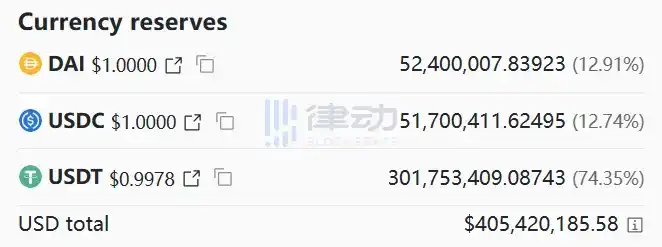
According to the data, in the past 24 hours, a total of 99 million USDT were sold in Curve's 3pool, with a net outflow of 64.4 million US dollars. In the past 3 days, a total of 205 million USDT were sold in 3pool, with a net outflow of 130 million US dollars. At the same time, according to the latest official data from Curve, the proportion of USDT in 3pool has reached 74%, totaling 301,753,409. The proportions of DAI and USDC are 12.91% and 12.74%, respectively.
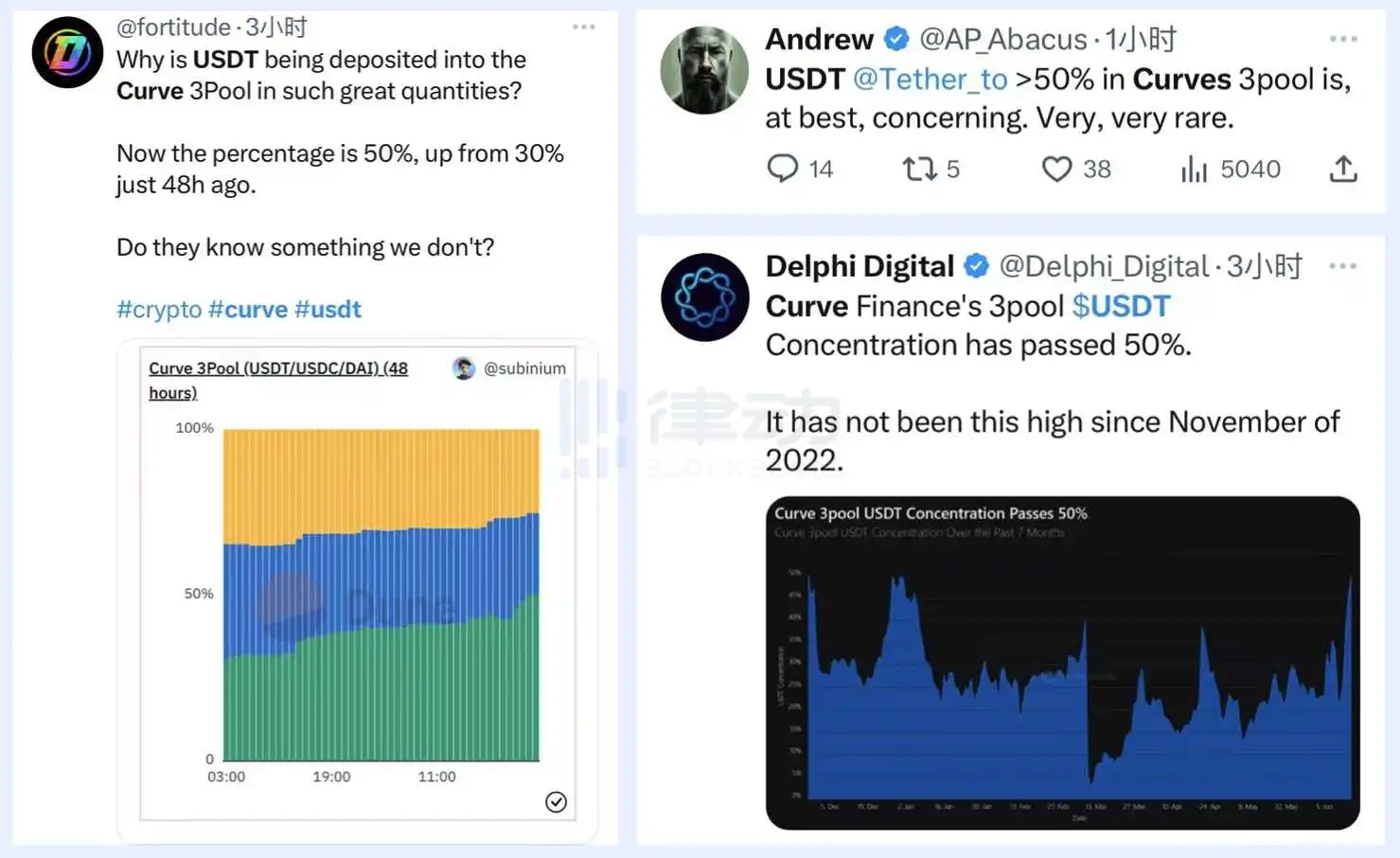
And in the past 48 hours, the concentration of USDT in Curve 3pool has risen to 50%, and then sharply increased from 50% to 74% in just one hour. This has raised concerns in the community, as everyone seems a bit puzzled by the sudden selling pressure of USDT. Could it be that someone knew some key information in advance? After all, the last time the concentration of USDT in Curve 3pool exceeded 50% was during the FTX crash in November 2022, and since then, the concentration of USDT has not reached such a high level.
Are market makers exiting?
Today's selling pressure on USDT cannot help but remind us of the rapid depletion of market liquidity in the past month. Recently, the market has performed poorly and seems to have entered a situation of liquidity shortage. Especially on June 10th, the "15-minute crash" event caused a general drop of more than 20% in altcoins and a corresponding drop in mainstream currencies. It is worth noting that at that time, the market had not yet been affected by the SEC's regulatory crackdown. As for the speculation about the cause of the "15-minute crash", rumors have also emerged in the market about Jump Trading and DWF withdrawing liquidity and delisting.
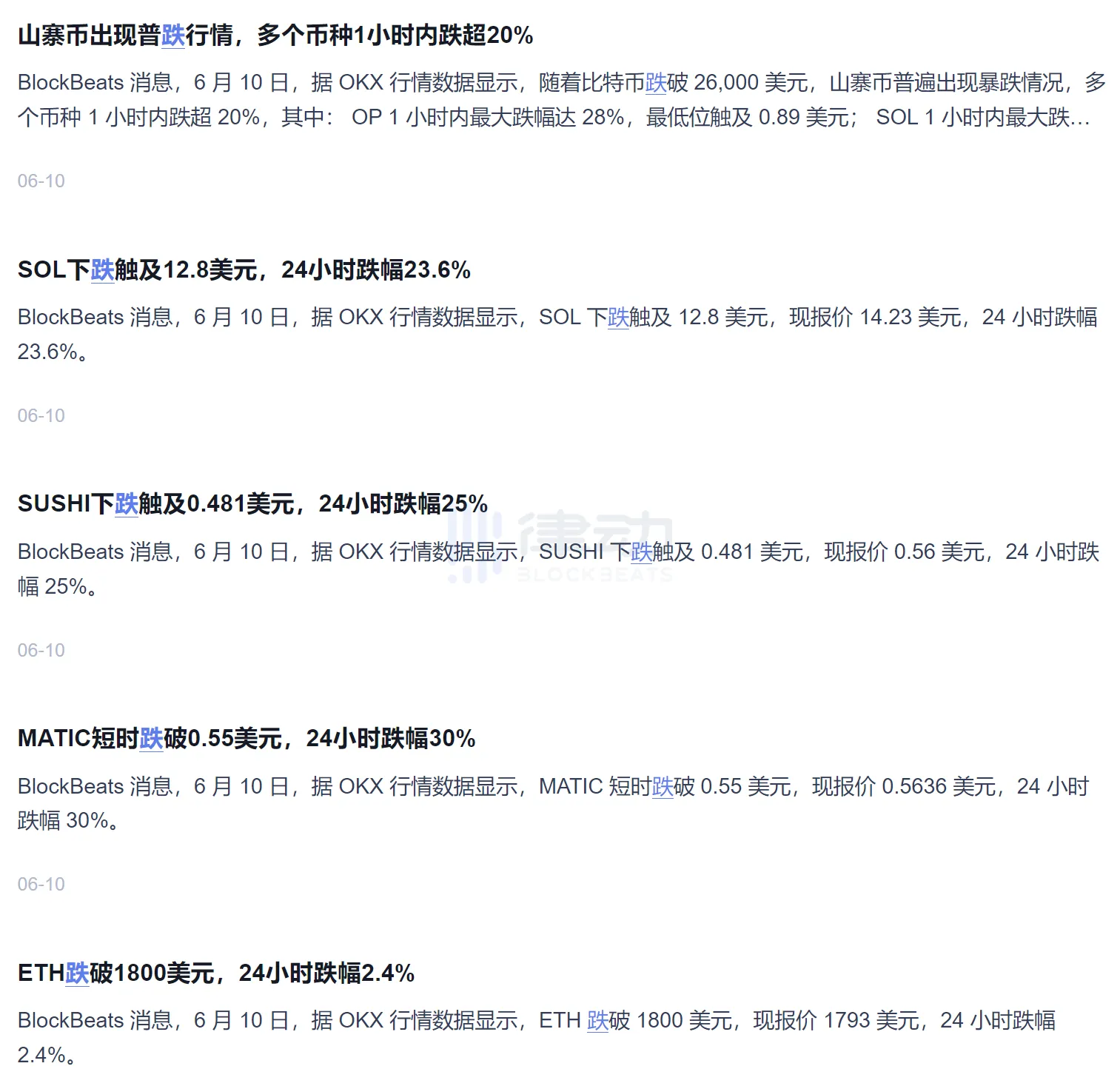
In fact, this speculation is not groundless. Today, Andrei Grachev, Managing Partner of DWF Labs, tweeted that the 24-hour spot trading volume in the market has dropped to $23 billion, the lowest since the winter of 2019. He revealed that trading platforms are beginning to require projects to have a certain trading volume and liquidity, otherwise they will be delisted. Retail activity is also relatively low, but for those who want to speculate, make money, or lose money, they still need something to meet their needs. Even large-cap currencies can experience price fluctuations of 20-30% within 24 hours.
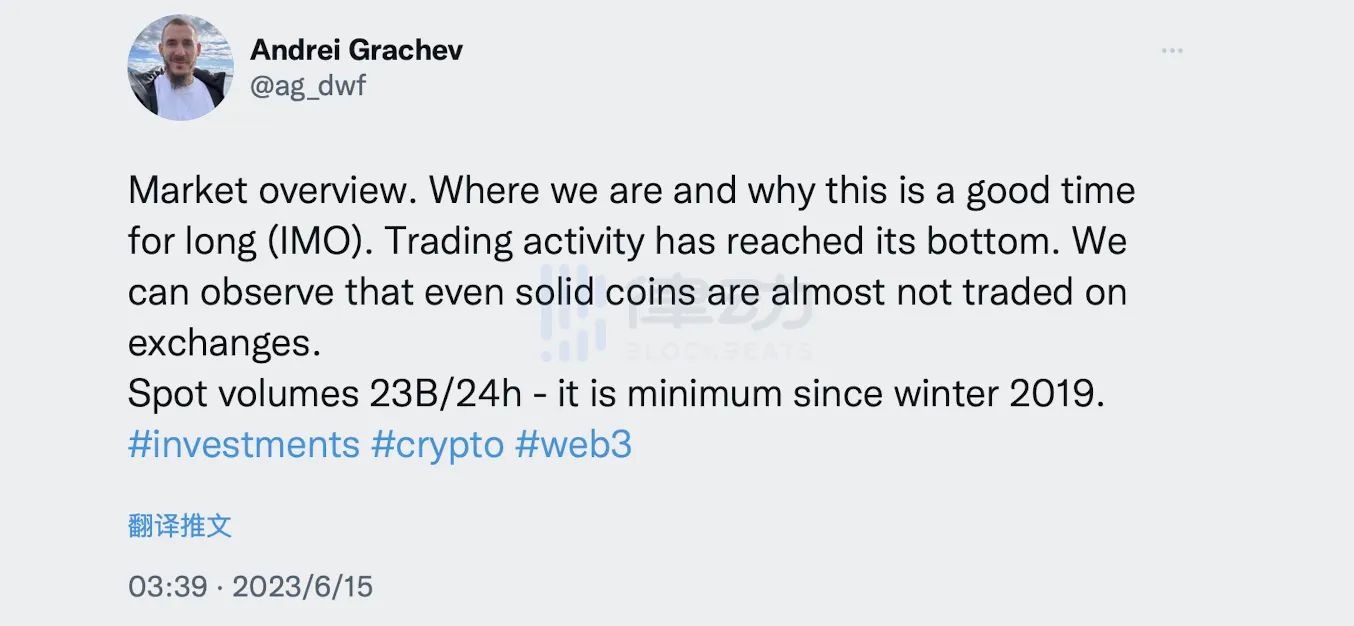
In addition, Grachev explained that IDOs, IEOs, and direct listings are no longer popular, and many are waiting for new things to emerge, including the Binance Launchpad project, as it always promotes retail activity. If a project succeeds, many will try to emulate it. "Projects, trading platforms, market makers, and other market participants are working behind the scenes to fix the market. Although there is no 100% solution, these efforts will definitely bring some benefits to the market. We are currently in a low period of market activity, but the future of prices is still uncertain. In the next few months, our market activity is expected to increase and promote price increases, which also depends on our luck."
Andrei Grachev's statement is clearly reflected in the former shining star of the industry, Sui. Previously, Sui, which had a strong IEO launch on OKX, Kucoin and other trading platforms, saw its token price soar briefly before falling into a slump. Despite OKX's repeated support for new projects in the Sui ecosystem, the price of its token, SUI, remained very low and continued to decline. According to insiders from institutions, due to the exhaustion of liquidity and the huge selling pressure from IEO, many institutions and market makers are unwilling to provide liquidity for SUI. A former star public chain seems to be slipping towards the edge of "project failure" again.

As the most commonly used virtual asset by market makers, most institutions hold USDT. Under various implications, we cannot help but wonder if today's severe skew in the Curve 3Pool pool is also related to institutional exits?
Will USDT decouple?
With the resurgence of FUD surrounding USDT, some people in the market are eager to short USDT (BlockBeats note: see "How to hedge USDT shorts on the chain by following institutions?"). Will USDT once again experience a serious decoupling?
Some voices from the community have expressed doubts about this. A Twitter user named Spreek (@spreekaway) stated that Curve's liquidity pool is now very small and is no longer an important source of liquidity. Overall market liquidity has decreased, and Curve seems to have lost its pricing power.
Spreek pointed out that it is worth noting that in the last Tether decoupling event, Curve's fund pool was about 6 times larger than it is now. Some people believe that before redemption, secondary liquidity is usually consumed first because the redemption fee is 10 basis points. This time, the outflow of funds required to deplete secondary liquidity is less than last time. By observing the trading volume when the price reaches the redemption price, you can understand the level of attention people are paying to this. If there are many trades below the redemption price, it indicates that people are paying more attention.

When the liquidity of a stablecoin is too concentrated, once the supply or liquidity of the stablecoin is threatened or fluctuates, it may have a significant impact on the entire Curve platform and users. This may lead to market instability and uncertainty. Excessive concentration may lead to uneven liquidity, with some stablecoins having excess liquidity while others have insufficient liquidity, which may affect the efficiency and cost of transactions and have a certain impact on price formation.
"Will USDT experience severe decoupling again?" In response to this question, Tether CTO Paolo Ardoino stated on Twitter that the current market is volatile and uncertain, making it easy for attackers to exploit this common sentiment. "But Tether is always ready, let them come, we are ready to redeem any amount of funds."
BlockBeats reminds that with the development of the market, the concentration of USDT in the Curve 3pool is still increasing, and users should pay attention to the relevant risks. At the same time, BlockBeats will continue to pay attention to the changes in the Curve ecosystem to understand its dynamics and impact. Please follow BlockBeats' continuous coverage.
Welcome to join the official BlockBeats community:
Telegram Subscription Group: https://t.me/theblockbeats
Telegram Discussion Group: https://t.me/BlockBeats_App
Official Twitter Account: https://twitter.com/BlockBeatsAsia

 Related Articles