LD Capital: Analysis of Sui ecosystem data and token release status.

Original author: duoduo, LD Capital Research
Sui has been online for more than 40 days since its launch on May 3. As one of the representative projects of the Move-based public chain, Sui represents a different development direction from Ethereum L2. Since its launch, there has been controversy, especially regarding its token issuance and release model. Some people think it may follow in the footsteps of ICP, while others think it may be similar to new public chains in 2021.
Currently, how is the development of Sui's ecosystem? What is the recent token release and demand like?
One, On-chain Data
1. TVL
As of June 13th, Sui's TVL is $15.22 million, of which DEX Cetus accounts for over 60% of the TVL. Among all public chains and layer 2 solutions, this TVL ranks 54th. Its peak TVL reached $36.01 million, which is a decrease of over 50%.
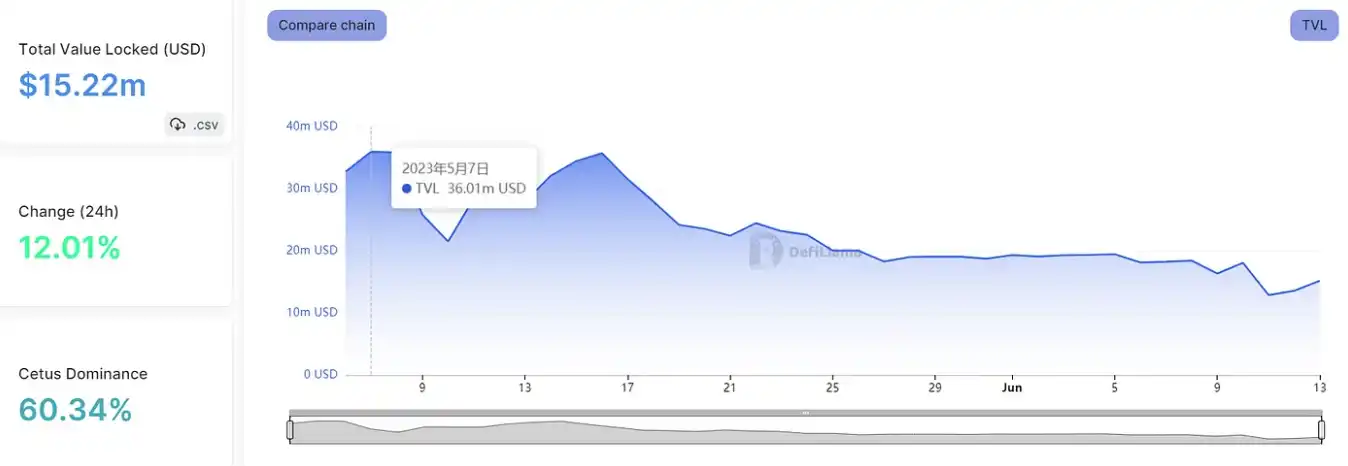

Compared to another representative project in the move industry, Aptos, whose current TVL is $42.11 million and has reached a peak of about $65 million since its launch, ranking 34th in TVL.

2. Trading Volume
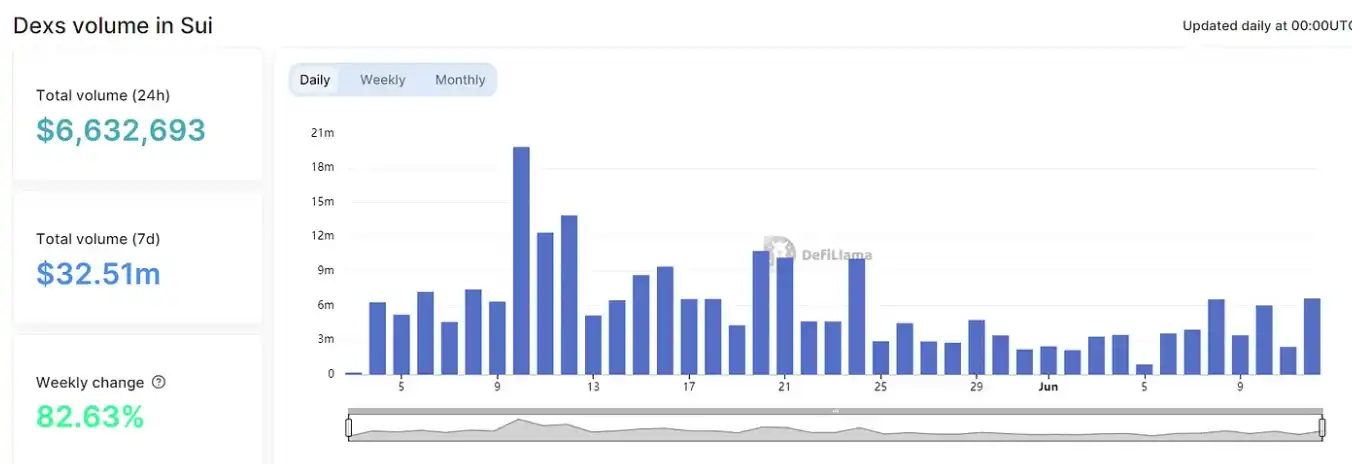
The highest daily trading volume on Sui DEX occurred on May 10th, exceeding $19 million, and has since declined. Since June, the daily trading volume has mostly been between $3 million and $6 million, with lower trading volume.
3. Activity
Since its launch, the total number of transactions in the encryption industry is 16.53 million times, with an average TPS* of 3. The total number of active addresses is 850,000, and the number of active nodes is 104. As shown in the figure below, the highest TPS since its launch was 26, which occurred on May 12th during Turbos IDO.
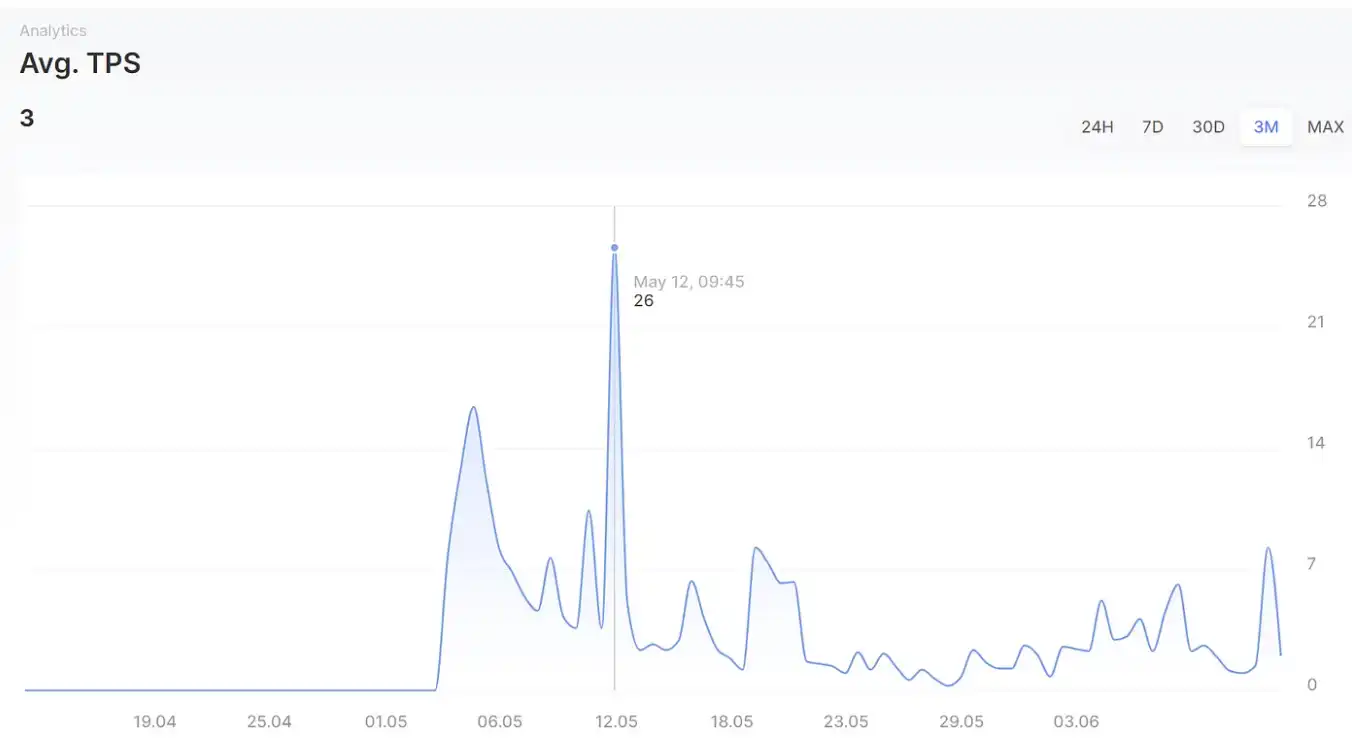
*Note: Here TPS refers to the actual TPS in operation, not the theoretical TPS that can be achieved.
Compared to Ethereum L2 TPS, currently, Sui's actual TPS is still very low.
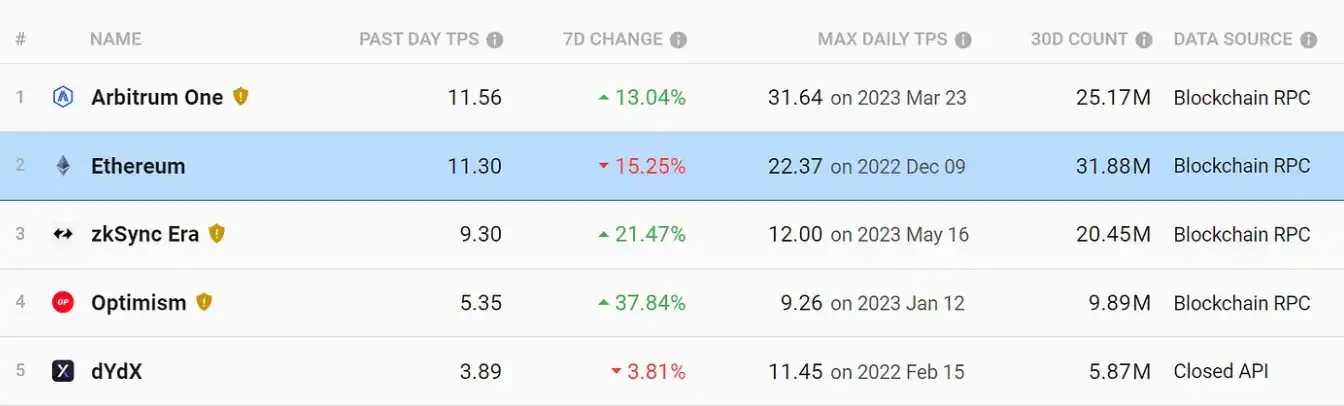
From the perspective of daily active addresses, the highest daily active address appeared on May 20th, reaching 130,000. The main reason was that on May 19th, Cetus opened its unlicensed pool function and the meme project conducted a full network airdrop. Normally, the daily active addresses are less than 10,000.

4. Cross-chain Bridge
Currently, there are 3 cross-chain bridges that can transfer funds to Sui, namely Wormhole, kriya.finance, and WELLDONE. However, there is no corresponding data dashboard for the specific cross-chain amounts, so it is not possible to know.
二、生态项目
translates to
2. Ecological Projects
As of June 14th, there are a total of 66 projects listed on the sui.directory on the Sui official website. These projects are self-declared and filled out by the project parties, and many of them are still in testing and have not yet officially launched.
A brief summary has been made for projects that have launched and issued tokens. The basic situation is as follows:
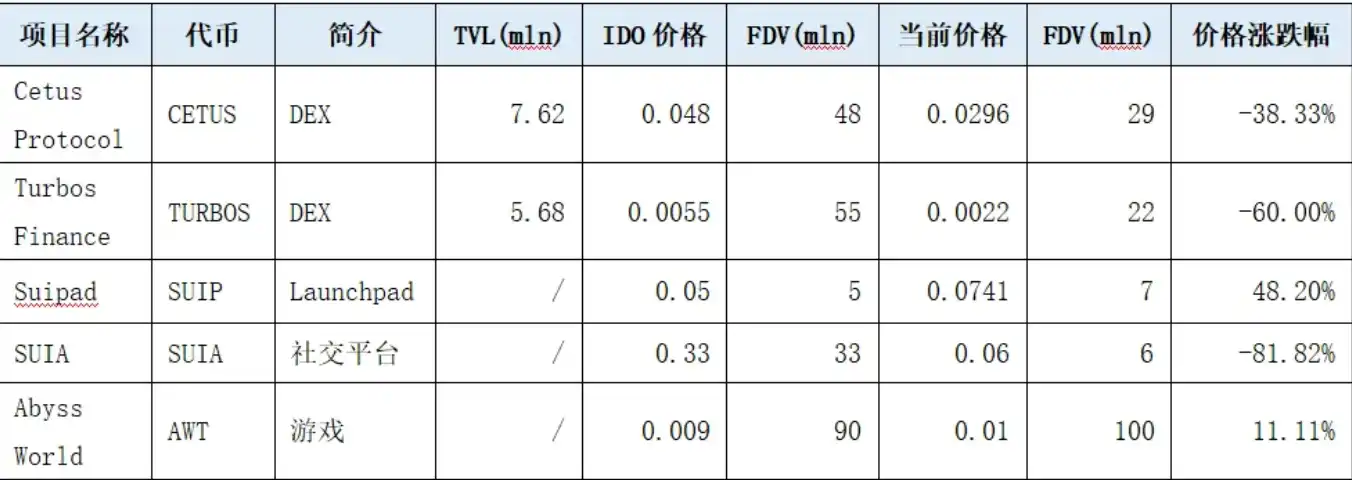
Source: coingecko, defillama, LD Capital
As can be seen, most of the ecological projects on Sui have performed poorly after going online. As two head DEX projects, both have broken. The social platform SUIA has fallen by nearly 81.82%. Suipad has performed relatively well, mainly because the pricing during IDO was relatively low, with FDV being only $5 million.
Users and funds on Sui are relatively limited, which led Abyss World to choose Polygon as the network for their IDO on June 1-4, instead of Sui.
The community is most concerned about the release of Sui tokens. This is a token distribution and unlocking diagram from token.unlocks, using data from Binance-related reports. The total number of tokens is 10 billion, with an initial circulation of 528 million, accounting for 5.28% of the circulation.
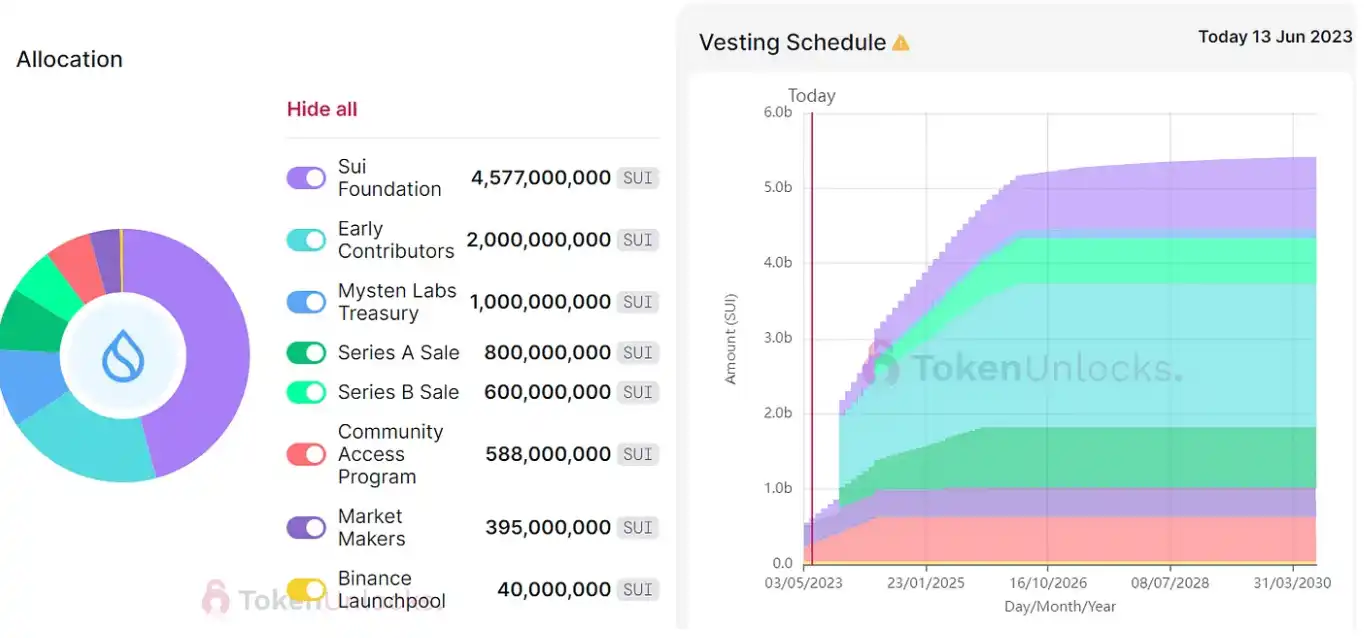
In May to October 2023, Sui will have two types of releases. One type is the release of tokens previously issued through IEO on exchanges, and the other type is the release of incentive tokens obtained by staking nodes.
The IEO price is 0.1 USD per SUI, and a total of 450 million tokens will be involved in the IEO. 1/13 of the tokens will be unlocked during the public sale, and the remaining tokens will be unlocked in 12 equal monthly installments. Therefore, approximately 34.61 million tokens will be released each month.
SUI token node staking can receive token incentives, with a total of 1 billion tokens used for node staking incentives.
In the first 90 epochs (1 epoch = 1 day), a reward of 1.11 million SUI tokens will be given out each day. After that, the reward will decrease by 10% every 90 epochs. Currently, there are approximately 7.4 billion SUI tokens staked in the system, with an average APY of 5.61%. Based on this calculation, the circulating supply of these tokens will increase by 33.3 million each month for the first three months after launch, and by 30 million each month from the fourth to the sixth month after launch.
According to this, the IEO release and node staking incentive release for the first three months is 67.94 million tokens, accounting for 0.67% of the total token supply, equivalent to a market value of approximately 47.55 million US dollars; for the fourth to sixth months, it is 64.61 million tokens, accounting for 0.64% of the total token supply, equivalent to a market value of approximately 45.22 million US dollars.
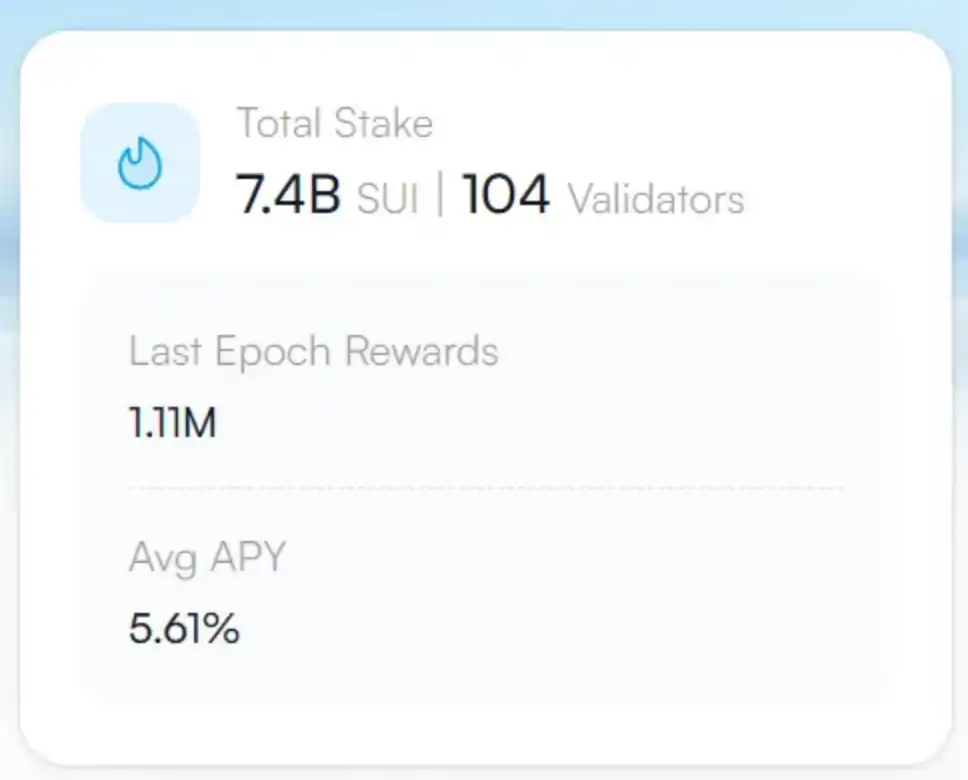 The content you provided is:
Source: suivision
In November 2023, six months after Sui's launch, a large amount of tokens will be unlocked. If more than 1 billion tokens are unlocked on that day, the circulating tokens will double.
From the perspective of token demand, according to the analysis of on-chain data and ecological projects mentioned above, the trading volume is low and the number of users is scarce, indicating that there is no significant demand for SUI tokens in the short term.
Four, Comparison of Aptos Token Release Models
Compare the token release of the projects Move and Aptos to see the similarities and differences.
The total supply of Aptos tokens (excluding the staking incentive portion) is 1 billion, with an initial circulation of 130 million, accounting for 13%. In the first year after launch, the community and foundation-held portion of tokens will unlock 4.54 million tokens each month, accounting for 0.45% of the total token supply, equivalent to a market value of approximately $28 million.
Starting from the second year after going online, in addition to the release of some tokens by the community and the foundation, a portion of tokens will also be released to core contributors and investors each month. From the 13th to the 18th month, 20 million tokens will be released each month, accounting for 2% of the total token supply; from the 19th to the 50th month, 6.75 million tokens will be released each month, accounting for 0.67% of the total token supply.

In addition, Aptos also has node staking incentives. This part of the tokens is not included in the initial issuance of 1 billion tokens mentioned. Currently, the highest reward rate (APY) for network staking is 7%, and the reward rate decreases by 1.5% each year until it reaches 3.25%.
Currently, there are a total of 860 million APT tokens staked on the network, accounting for nearly 86% of the total supply of 1.039 billion tokens. Of the total supply, 39.5 million tokens were issued as part of the node staking incentive. As Aptos has been launched for approximately 8 months, the monthly staking incentive is approximately 4.9 million tokens, accounting for 0.49% of the total token supply.

As we can see, compared with Aptos, Sui belongs to a low-circulation, high-inflation token. However, the initial circulation of SUI is lower than that of APT, equivalent to 50% of APT; the monthly token unlocking amount in the first 6 months is higher than that of APT by 50%. The first large-scale release of SUI occurred 6 months after its launch, while APT was released 12 months after its launch. SUI adopts a one-time release, with a large number of tokens entering the market on the day of unlocking, while APT adopts a monthly unlocking mechanism with a buffer period.
Overall, SUI will face a larger token supply than APT in the first year, while APT will have a large supply in the second year.
Five, Conclusion
From the perspective of on-chain data and ecological projects, Sui has insufficient users and transactions, and is still in the process of cold start. It needs to attract users and capital inflows through continuous activities and construction.
However, considering Sui's current operational activities, the team is currently more focused on the development of technology, including holding hackathons, hosting developer events around the world, etc. User incentive measures have not yet been launched temporarily.
Meanwhile, on the one hand, in the bear market environment, funds and users tend to be conservative. On the other hand, Ethereum's layer 2 is also continuously developing. For existing users, it is more convenient and secure to transfer funds from Ethereum to layer 2, which has attracted a large amount of on-chain funds. In comparison, Sui's difficulty in attracting funds and users has increased.
From the perspective of token economics, compared to Aptos, another Move-based public chain, Sui's token release pressure is concentrated in the first year. In the case of insufficient demand, matching such a large token supply leads to greater selling pressure on SUI tokens.
Original Link
Welcome to join the official BlockBeats community:
Telegram Subscription Group: https://t.me/theblockbeats
Telegram Discussion Group: https://t.me/BlockBeats_App
Official Twitter Account: https://twitter.com/BlockBeatsAsia

 Related Articles