The first year of Sui ecosystem's explosive growth was led by the flagship project Scallop, which explored ecological opportunities.
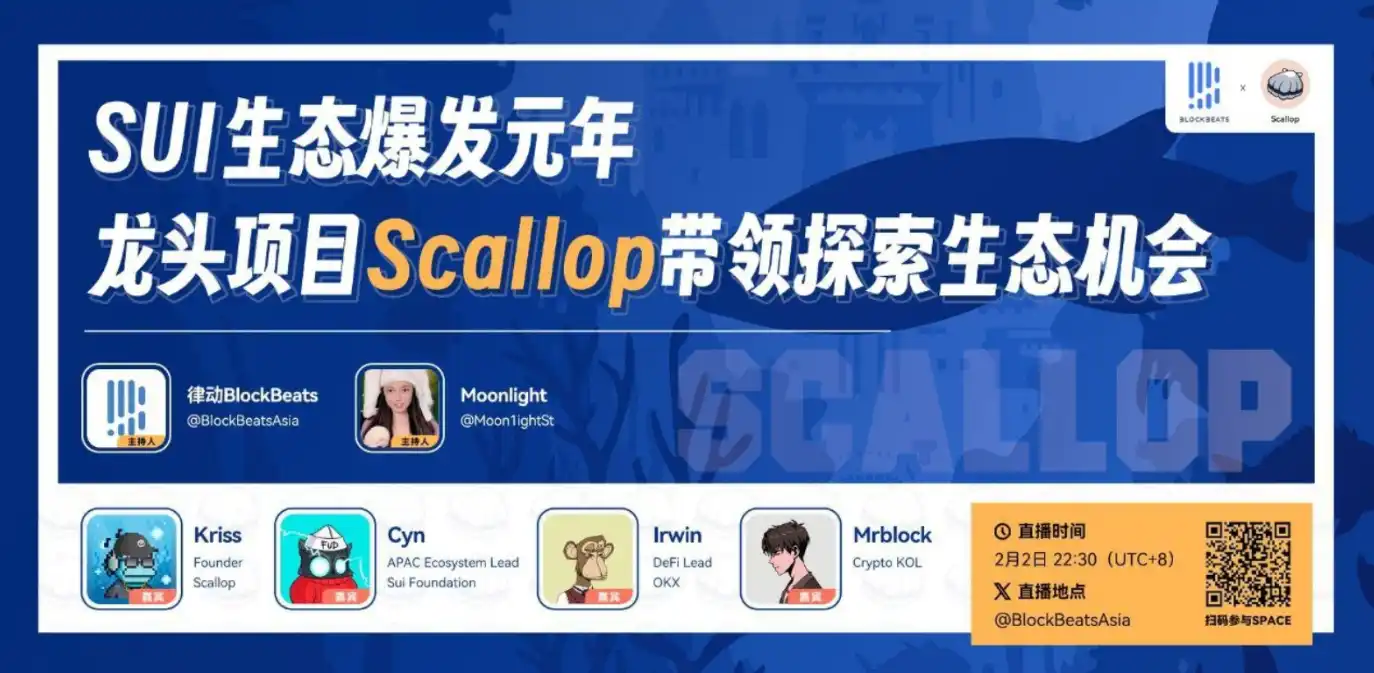
Recently, with the soaring of the SUI token, the overall Sui ecosystem TVL has also exceeded 500 million US dollars, and several dark horse projects have emerged in the ecosystem. Among them, the lending project Scallop, with a TVL of over 100 million US dollars, has steadily ranked among the top players. Last week, Kriss, the founder of Scallop, was a guest on the BlockBeats Twitter Space of Rhythm, with the theme of "Scallop, the leading project in the first year of Sui ecosystem explosion, exploring ecosystem opportunities", and detailed the current Scallop product structure and ongoing airdrop activities. In addition, Cyn, the Asia-Pacific ecosystem leader of Sui Foundation, Irwin, the DeFi department leader of OKX, and Mr.Block, a crypto KOL, also connected to the Rhythm live broadcast room to discuss the current opportunities and challenges of the Sui ecosystem.
Following is the text version of this issue's Space content:
Host: Thank you all for participating in this Space. Please introduce yourselves, including your research direction, experience, interests, or the project you are working on in the Crypto field.
Kriss: I am the CEO of Scallop. I started as a full-stack developer and later expanded into network security. I am also an ethical certified white-hat hacker. I first heard about Blockchain and Crypto before 2017, but I didn't get involved until I started mining Ethereum in 2017. In 2021, a friend introduced me to Solana, and I started building DeFi protocols directly on Solana. I have participated in some hackathons and online competitions. In 2022, I learned about Sui, and at that time, there were reports that Meta's Blockchain Team had disbanded and formed Layer1. We thought this was a great opportunity, and we already had some DeFi background, but we weren't that mature yet. So we decided to build the foundation of DeFi on the new public chain Sui. Starting at the end of 2022, we participated in many security competitions of Sui or Move, as well as some international hackathons, and achieved very good results.
Irwin: Hello everyone, I'm Irwin from OKX, mainly responsible for DeFi. We started developing Web3 wallets last year. Of course, DeFi is also one of our main modules or businesses. Sui has their own Launchpad, and we also participated in Sui's project Cetus. So now our Web3 wallet also cooperates with Scallop and other protocols in the Sui ecosystem.
Mr. Block: I'm Chris, and I have a channel called Mr. Block. I'm doing angel investments and incubating some projects, including the recently announced Puffer finance, so I'm very focused on the LRT and LSD areas.
Cyn: I am mainly responsible for the development of the Asian ecosystem at the Sui Foundation. Currently, I am focusing on DeFi, which has many tracks. Before joining the Sui Foundation, I was the second early builder of the Bonfida project on Solana. I also joined the entire Solana ecosystem in March 2021 and experienced Solana's explosive growth in 2021 and some small fluctuations in 2022. I hope to successfully replicate the experience I accumulated in Solana on Sui and work hard to make the Sui ecosystem bigger and stronger. Prior to entering the cryptocurrency industry, I spent over two years in traditional finance.
Host: Currently, Sui's total locked value (TVL) has reached a historical high of $500 million. Besides the price increase, what other factors have contributed to the popularity of Sui's ecosystem? What do the guests think is the main reason for the rapid growth of TVL?

Kriss: Personally, I think it all started with the Learn to Earn event with OKX. Our product had reached 900,000 addresses, and after the mainnet launch, people began to pay attention to Sui. A few months after the mainnet launch, we started to try out some of the ecological projects on Sui, including the integration of the OKX SDK and some incentive plans launched by the Sui Foundation. Of course, there were also some activities in our own ecosystem, including conferences and the launch of new features, which I think have indeed caused some reverberations in the industry.
Cyn: I think Kriss did a great job just now in terms of promoting products, including improving market conditions. There may be two points on my end:
The first point is that from the perspective of the overall market trend, the attention to Non-EVM high-performance public chains is actually significantly increasing, including the previously popular Solana, which has also benefited from this wave. Under the hype of the previous airdrops, the popularity of Sui has also been boosted. The main track of Sui currently is still DeFi, including many projects that have been launched and have developed well, and there are also expectations of airdrops for these projects in the market. We can also see that there are a large number of users starting to interact with DeFi on Sui, which is one of the reasons driving the growth of TVL.
The second reason is that if you try to interact with DeFi projects now, you will find that these DeFi projects have relatively good yields as the trading volume and user numbers grow. A relatively good yield is actually another reason that drives retail or institutional investors to participate in the DeFi ecosystem.
Irwin: We have been collaborating with Sui in the early stages, as mentioned earlier on Cryptopedia, which is our Learn to Earn platform. We are also promoting Sui itself and some of its projects. The user traffic we bring in has found Sui's chain to be very smooth. In our product, we have a Bridge function that allows users to directly cross-chain from many different EVM chains or non-EBM chains.
So if users want to participate, they can directly participate on the Sui platform, and of course, the Sui Foundation also provides support. Each protocol will generally reward users who participate on the platform for the first time. However, there is another point that I personally think is quite new compared to Solana and Ethereum. If you look at its staking amount or staking ratio, it is actually quite high, with more than 80% currently. Compared to Ethereum's 22-23%, Solana's 60%, so more than 80% is actually quite high.
Of course, this is because Ethereum did not have this LSD functionality when it started. Sui had already planned to expand in this direction when it started, so I think conversion is a good thing for a new chain. Your users can naturally get higher returns, whether on OP or on lending, and their collateralization ratio is very high compared to using other chains.
Mr. Block: I don't think the core TVL growth is about what kind of cooperation or infrastructure has been added now, as these things were already present last year. I believe the focus now is on the rotation of sectors, which started with Solana. As we all know, a large part of the ecosystem of Sui and Aptos comes from Solana. As Chris just mentioned, they all looked at Solana first before discovering these projects.
Ecological projects have come to Sui, and we see other Solana series products, even Jupiter is discussing whether to go to Sui and Aptos. I think this is just a sectoral change. Retail investors are predicting the "next Solana", so we see that the TVL of Sui and Aptos are rising at the same time. Therefore, these three are usually compared together and can be a good reference point. At the beginning of 2021, when the EVM chain came out, we saw Binance chain launched, Polygon launched, Avalanche, etc., and its TVL changed accordingly.
So if you were to ask the same question at that time, why did it suddenly rise? It couldn't be because of good infrastructure or good events. In fact, everyone was predicting the next group of people who were mysteriously manipulating things behind the scenes. They might go to another place because the Crypto Market is controlled, and even the project parties don't know who is in control. So I think most of these TVLs will be used to predict each other's values.
Another point is that if we look at the on-chain data, Sui is currently around $500 million, but there are a few large transfers from a few associated accounts, so we can estimate that half of the lock-up volume may come from a few large holders who may want to increase TVL and at the same time go long on the coin price. It's a bit like Solana last year, which was around $200 million with a price of around $10, when a large holder suddenly transferred more than $200 million to the Solana chain. At the beginning, we saw media reports that Solana's lock-up volume had increased, and the price of SOL began to rise. With the second and third waves, retail investors and developers will also become restless, and its ecosystem will rise, a bit like a pile of dry firewood that needs a small flame to slowly ignite it.
So I think we shouldn't be too superstitious about thinking that Sui is a special chain just because it revolves around the movement of funds from point A to point B. However, it is very important for projects that are already positioned within it. For example, Scallop is the most important infrastructure within this ecosystem. If these big players want to enter and create TVL, they will definitely choose to go to lending platforms. If they choose to go to platforms like Cetus or other Dex platforms today, they may have to bear some of the losses and liquidity issues without compensation.
However, if he chooses to go to Scallop, he can not only turn over the handling fee including the annualized rate, but also achieve the goal we mentioned earlier, to make TVL and go long on the entire market. So I think this explanation can be thought of as a macro economy in the currency circle. If we think of each public chain as a country, then the country will have its own micro economy. I think it's a bit like these three countries are very close, and people from big countries are starting to speculate on new countries. This will benefit projects that have already been built inside, like Scallop.
Host: What do the guests think are the core advantages of the Sui public chain? What factors make Sui different from other public chains? What are the significant advantages of Sui public chain in terms of performance, security, scalability, or developer friendliness? In addition, how will these advantages of Sui public chain affect its position and application development in the future blockchain ecosystem?
Kriss: Then let me explain in more detail. After all, our team is the first DeFi project authorized by Sui. We have been following Sui's various development tools, as well as updates, iterations, and changes to the design before Sui was launched on the testnet.
I believe there are two core advantages. The first is its consensus, which allows for very fast settlement times and surpasses the parallel computing of previous high-performance public chains. For example, its Swim move object can combine transactions with different targets, as long as it determines that these two transactions are not directly related and their order is not important, transactions can be inserted in between. Therefore, it does not require sorting like traditional blockchains, waiting for settlement, or calling the same hedging problem at the same time, or some NEB issues. This is a very outstanding design.
Next, regarding security, the Solidity engineers I know all believe that Solidity is a language that needs improvement and is not perfect enough for the current needs of smart contracts. This is why there are so many Rust-based public chains such as Cosmos and Solana, which aim to improve security and performance using different languages. Additionally, parallel processing is used to solve problems.
So why is Move so special? Move is not just a language, but a language based on Rust, designed for the development of smart contracts. Why is Move so highly praised? It comes from Meta, which uses traditional Web2 resources to gather the world's smartest people to design a framework specifically for smart contract development using the latest and safest DJ language. You can imagine how excellent its security, operability, composability, and scalability are.
As for the developer experience of using it, let me give an example. If two people like you want to make a transaction and exchange the same thing in a pool, and a contract is on Solana, if there is no Anchor Solana, it may take two to three hundred lines of code. However, with Sui move, it may only account for one-third of the overall code.
Why is there a difference? It's because Solana requires too much effort to verify things, whether it's the permissions for program-derived accounts, read and write permissions, access permissions, or ownership permissions. But Sui Move, as we just mentioned, is specifically designed for smart contracts and property interactions on the chain, and it helps you with all the checks. All the preparation work is done so that you can focus on the logic without having to do extra security permission checks. The framework has already done over 80-90% of the work for you.
Cyn: I mainly look at it from the perspective of supporting the ecosystem. I can feel that the level of attention given to the project by both sides, including the level of support for ecological projects, is very different. For example, like Sui, the foundation provides funding and investment support. During the bear market, I understand that many public chains did not actively provide funding support to early developers, but since our mainnet went live in May 2023, we have provided funding support of approximately $4 million. Scallop is also one of the excellent projects we supported early on.
First of all, supporting projects is crucial to ensure that early-stage ecological projects have enough funds to develop on the chain with peace of mind and comfort, without worrying about the problem of running away. This is something that Sui public chain does particularly well. The second point is that after deciding to build on Sui and receiving some financial support, Sui officials will provide comprehensive assistance and support, including many technical supports. For example, if the project encounters some technical development problems, there is a 7*24 online senior support team that will provide the highest efficiency support to these consultants and developers in the first time.
At the same time, we also have our own growth team, such as working with some well-known third-party institutions to do activities. In July last year, the Cryptopedia event I organized was mainly responsible for actively connecting with project parties, and collaborating with excellent third-party partners such as OKX Wallet and OKX Earn Product to obtain more users and corresponding trading volume and TVL. Finally, we also have a dedicated marketing team, who often organize AMAs and a content team that regularly gives great exposure to many ecological projects in the DeFi track, writing articles and analyzing why they can successfully build products and projects.
Sui is truly point-to-point. From the beginning of the project, we decided to build on Sui. From the actual product development to the strategy of having our own market and subsequent financing, we have always provided very active support across all departments. We hope to maximize our assistance to developers in achieving their Web 3 career goals on Sui. Therefore, I believe that Sui's support for early developers and projects can completely distinguish it from other public chains, which is a huge advantage.
Irwin: Personally, I think that from a high-level perspective, Sui has a unique design that uses an Object Centric mechanism, which is different from other blockchains. Other blockchains use a single Ledger or a TX transaction-based system. In Sui, each asset or token is an Object, similar to NFTs. If we look at Ethereum-type protocols, these tokens actually have centralized risks, such as the USDT smart contract, which is actually on a centralized USDT smart contract. So if someone wants to operate, attack, or take away your coins, it is because it is collected in a Ledger form.
But Sui is different, the token you own is an object, which can be understood as a form of NFT. Therefore, this design is particularly unique and important in DeFi. It may be used in games or in the area of digital identity. Sui can develop in this direction, and of course, it can also be used in DeFi.
Mr. Block: I am quite interested in seeing if the Sui Foundation will have any desire to collaborate and support any LSD RT projects in the future.
Host: It seems that the DeFi track of Sui is entering a period of explosive growth. As one of the top three protocols in terms of TVL on the Sui network, what role does Scallop Lend play in the DeFi track? What do the guests think are its main advantages and differences from other similar products?
Kriss: Let me first talk about the role we play in the ecosystem. In fact, what you see on DefiLlama is that we are a lending protocol, but our definition is not just that. The platform provides lending and trading, UI trading tools for flash loans, as well as two layers of developer SDK and trader SDK. Additionally, we have a comprehensive one-stop solution for UI swaps or bridges.
The positioning in the ecosystem includes our first SDK Sui Kit, which is now the unofficial largest Typescript SDK, containing Suiet Wallet, Typus Finance, and Shinami, all of which use our SDK to develop some of their products. Our own provided SDK allows Sui ecosystem, and you only need 4 lines of Typescript to initiate a lightning raid, even including Output. Compared to the traditional way, you need to deploy a smart contract and then interact with it. If we take Aave's official GitHub Repo as an example, the Repo has 78 lines of code.
If we talk about the difference between us and other products, there are two directions. The first direction is for lending products outside the ecosystem, and I think we have a lot of advantages. It is demonstrated in Build on top of Sui, which includes the most important security aspects and some previously nightmare-inducing attack cases, such as fake account replacement attacks and lightning loan manipulation of oracles. However, these attacks are impossible to occur on the BM of Sui move due to its design logic and underlying language reasons.
We have designed an oracle consensus layer in our protocol. Currently, we are using Pyth as the oracle because they use a pull-based model, which generates the most timely consensus for us to obtain quotes. We plan to replicate Switchboard and Super Oracle to participate in this consensus, which is in line with the characteristics of Sui Move, which has a high degree of composability. We can design each oracle as a module under this oracle formula, which can be modularized and scalable. We call this oracle formula layer X-Oracle.
There are also significant differences between our product/ecosystem and those of external competitors. In terms of finance, we differ from our competitors in our risk management approach, which involves a combination of Compound V3, Solend V2, and Euler's excess collateral lending model. Meanwhile, our competitors primarily use Aave V3, which I believe is similar to Compound V2 in that it combines lending assets with collateral assets and includes a dual-line excess collateral interest rate model.
The difference in our agreement includes the three-line interest rate model plus soft liquidation. Soft liquidation only brings the liquidation back to a healthy threshold when liquidating bad debts of users. We will not sell all of your collateral or a percentage of it. Other platforms may use LTV, but we include two parameters, borrowing and liquidation, to create a different parameter.
For the oracle part, some competitors have adopted single oracle machines, while others have adopted centralized oracle machines. We are also the only open source lending protocol on the Sui ecosystem, and we have derivatives for lending, which is currently the largest derivative on Sui, surpassing all LSDs. It is called S Coin, and in the future, there may be similar interactive operations on Cetus or Bucket Protocol. In addition, we have lightning loans and developer SDK, as well as UI trading arbitrage tools, which I think is what sets us apart from other lending protocols in the ecosystem.
Cyn: I think Kriss explained it very clearly just now. Let me add a little bit here. First of all, Move language is very easy to use and has very strong security. The biggest product built on Move actually has this unique advantage. From the perspective of long-term users, the overall user experience is very smooth. Scallop UI design and user experience are both very excellent. I strongly recommend everyone to experience it.
Irwin: Sui has supported several of our needs, so we are very grateful for their help. One of the designs is the adjustment of collateral weights. In case of an emergency liquidation, some assets cannot be liquidated. Therefore, they have this design where all collateral is balanced under normal market conditions, making it safer.
Mr. Block: Actually, I have a very deep impression of Scallop. The first time I met them was in 2022. Their team has been working hard. I have met them many times at various events and can see that their BD is very capable. This is very important for a project because I have invested in many similar projects, such as Paradigm, which had a good hand but failed to play it well. This is often due to the CTO leaving or development issues, which led to the decision to give up. Choosing the right team is crucial.
Most of the protocols on these Layer2s are actually very similar to Layer1, so I won't specifically promote how powerful the innovation is, but encourage projects to first secure their position. Since the code is similar, it's the team's execution ability and how to design the token economic model that matters, because you can have the same contract, but the token economic model is completely different, and the fees you receive may be different. Have you tried to get funding as much as possible? Scallop has also obtained funding and cooperated with OKX to use this funding as a reward to increase TVL, which is actually a correct approach.

Host: For many users, the incentive measures to join the Sui ecosystem are very attractive. What types of airdrop incentives does the Sui ecosystem currently provide for users? What activities are currently underway and how can users participate?
Kriss: Starting from Q4 last year, Foundation initiated a plan to fully support early DeFi projects, and therefore provided us with some subsidies to incentivize early liquidity providers. We also received this help and designed our own incentive models, including the ability to earn incentives for doing mortgages and lending on Scallop.
We have implemented a one-click Lending function that allows you to earn multiple returns (reinvestment). The first return you will receive is the basic Scallop lending return, which is the return earned from someone borrowing money and paying interest. Afterwards, we will automatically put the S Coin that you should have received into the S Coin staking mechanism. Of course, this can be withdrawn at any time.
S Coin has an average APR of 20% from Q4 until now. Although the recent outbreak of the Sui ecosystem has caused a shortage of supply, the APR has decreased to around 15%-20%. However, I think this is a very good opportunity because the SUI received is not locked. I have also personally put some tokens into it in the past few months. If it is borrowing, we also provide incentives. When you put collateral, if you lend assets, we now have incentive APRs for USDC, USDT, and SUI. Even in the current Borrow APY of SUI, assuming a payment of 0.73%, the reward APR is 7.13%. At the same time, it means that you mortgage tokens and then borrow SUI out, the more you borrow, the more money you can earn.
We saw the trendiest operation, which just raised the upper limit of the liquidity of LSD-FSUI collateral. Now users can first exchange SUI for FSUI, which itself has a liquidity index reward of nearly 4%, and then lend out SUI to get a 7% reward. With SUI, users can go back to the collateral lending pool to earn 15-20% APR. This is equivalent to choosing to exchange for liquidity collateral tokens and then doing a leveraged operation of liquidity collateral tokens in a cycle.
What are the benefits of the other one? We are currently conducting an airdrop activity as a pre-launch event before the coin issuance. The final phase is currently underway, and there is a points system that allows you to exchange points for "pearls," which can be redeemed for our native assets after they are released. Therefore, you can enjoy both Sui's official sponsorship and Scallop's own subsidies at the same time, making it a great incentive opportunity. This is a genuine encouragement for users to use the product, which represents potential opportunities for the future.
Cyn: Kriss actually mentioned two plans earlier, one is the incentive measures for APY in DeFi, and the second is this airdrop opportunity. From the perspective of Sui official, there is currently no official airdrop in the name of Sui. It mainly depends on some activities of the project party. Of course, many DeFi projects are actively planning the timing of their token issuance, so Q1 and Q2 will be very exciting months.
At the same time, I would like to add that, in order to celebrate Chinese New Year, there will soon be a market activity related to ZK send. However, the specific details of this activity will not be revealed too much. If you are interested, you can follow the SUI Chinese Twitter account to keep up with more official market activity news. Meanwhile, SUI has always had an on-chain Odyssey activity, which has now completed three phases, with two game themes and one DeFi theme. The fourth phase will also be officially launched in the coming months, which is also a more interesting market activity that you can follow.
Irwin: Currently, we have been supporting SUI all along. The first project we promoted was Scallop, followed by Navi. Now we are promoting Cetus, and there will be another batch of about 7-8 Sui projects that will be active on OKX Web3. We also hope that everyone can try OKX Web3's wallet, especially for non-EVM chains, which may be around 4-5.
Host: What do the guests think about the contribution of current incentive airdrops to the growth of Sui ecosystem TVL? After the incentives end, how should the project plan to retain users and continue to promote development?
Kriss: First of all, I have to say that this is a very good question, because the market has been doing well recently and we have been in contact with potential investors quite a bit. This is actually the question that I think professional investors have been asking the most recently. The first part of this question also includes why we chose to enter the lending track. We have always known that the time for airdrop activities and incentive activities supported by the official team is limited. That is to say, the game time is limited, and more importantly, we need to have a reasonable economic model for this product to be truly successful.
So our choice is based on the need for rigidity. In e-commerce, there is a large market for lending protocols, as Mr. Block just mentioned. It needs a place for hedging or for those who want to go long or short. It also includes tools such as UI trading arbitrage tools that we mentioned earlier, to assist users in using our smart contracts, or even using smart contracts from other projects on Sui. We can also extract some, such as transaction fees, to strengthen the economic model. On the one hand, it is to build ecological infrastructure, and on the other hand, it has a reasonable economic model to sustain the team and continue to operate. It even includes company market value management and token prices.
Just now I talked about composability, which is why I talked about avoiding low-level tags. Now there are three protocols, including Kai Finance, Typus Finance, and Sui Pearl, which are built on top of the Scallop lending protocol and include yield aggregators or options products. After Scallop goes through its lifecycle, like Orca, they may later issue tokens and go through halving. After the lifecycle of these underlying protocols is over, they will become a behind-the-scenes force supporting protocols like Kai Finance and perhaps Typus Finance. These protocols may be about to raise funds and issue coins to continue incentivizing their users, but the contracts are based on Scallop, just as Jupiter's aggregator is based on Ocar, making the entire ecosystem a flywheel effect that turns the ecosystem. It's hard to say what kind of major blow the market will encounter, but I believe that even if Sui encounters a big blow like Solana later on, as long as this flywheel is turning, Sui can still become the next influential public chain.
Cyn: Every time Kriss speaks, it's full of practical knowledge. I personally feel that every time I listen to a project sharing, I can learn a lot of new things. From an ecological perspective, my main focus is on how to retain users after the airdrop. Currently, the recent wave of heat is mainly focused on the DeFi track. From the perspective of the entire ecosystem, the DeFi track is very important, but the growth of the entire ecosystem cannot rely solely on one track. Therefore, for 2024 or 2025, I am also looking forward to other track projects making great progress, such as the gaming track.
Because compared to DeFi, the lifecycle of games will be longer, such as 3A type games, the construction speed will actually be much slower, and sometimes it may not be possible to completely build the product throughout the entire cycle. In fact, when Sui just went online, many people thought that Sui would mainly focus on games, and now there are about 40 game partners. It is also hoped that by 2024, some larger games can officially log in to Sui, such as our cooperation with NHN, a large Web2 game company in South Korea, and another game studio in South Korea that has a game called "Soul Eater Samurai", which is expected to log in to Sui in 2024. I definitely hope that this wave of DeFi heat can bring more users in, and then transfer to games. Interesting games in the game track can provide users with different projects to try, and new types of assets in games can also feed back to DeFi.
Games can also embed many DeFi features, such as directly embedding Scallop's functions, and mutually benefiting each other. Through such a closed loop, Sui can be taken to new heights. Based on my personal experience, Solana started its first wave in March 2021 because of the IDO and good returns. However, in July and August 2021, NFT became popular, leading to the emergence of Magic Eden and many NFT marketplaces. Until the end of 2021, Stepen won the hackathon award and stood out, driving the overall rise of the Solana ecosystem from the end of 2021 to March 2022, playing a role in promoting development.
Based on the previous experience with Solana, I may have some expectations for the Sui ecosystem in 2024. Currently, we see a wave of DeFi projects issuing tokens and attracting a large number of users through airdrops. Other tracks are also thriving, such as gaming, IP, and SocialFi, with some outstanding projects that can continue to attract users' attention and encourage them to interact with other different projects, while at the same time taking the Sui ecosystem to the next level.
Irwin: I joined in 2016 and had 6 years of experience in investment before that. I managed a DeFi fund and mainly made small profits with large sums of money. Therefore, security is the most important point. No matter how much incentive there is, if there is a problem, it is impossible to compensate for your principal, or it is difficult to do so. We can see that several protocols have been hacked recently, but I won't mention their names here, and they cannot be compensated. So, of course, security is the most important, and the design of DeFi, if it can survive after a black swan event, without bad debts, its liquidation method is very smooth, and risk control has been operating and surviving in ordinary situations. I think this is the most important. Some early projects, such as Arbitrum, Uniswap, and even Curve, have experienced one or even several black swan events and can still survive, so they can gain the trust of many whales or institutions.
Of course, now that the market is hot, I think every chain should have a DeFi protocol that can survive when the market is not so good. In addition, projects that can be noticed by foundations or other chains are those with a comfortable user experience, how to exit the chain, how much slippage there is, and how much loss there will be. Another point is liquidity, the smoothness of buying and selling liquidity on this chain, can it be achieved? I think these are the issues that retail investors, foundations, and others will pay attention to after the initial hype phase.
Host: From a long-term perspective, how do you view the future development of the Sui protocol ecosystem? At the same time, what are your views on the overall trend of the cryptocurrency market?
Kriss: Regarding the Sui ecosystem, I think we really need to pay attention to security and risk management in finance. It also involves transparency and the design of the entire protocol. We all know that the cryptocurrency market is highly volatile and there are many black swan events. Any seemingly stable system may collapse, so we need to do a good job in auditing and risk management in finance.
For example, the leverage ratio and mortgage ratio should not be too high, because if one place collapses, there will be a downward spiral effect, which will severely damage the entire ecosystem and may cause some chain reactions, such as involving centralized trading platforms, which will inevitably deal a fatal blow to the entire ecosystem project. This will cause the entire industry and ecosystem to regress for at least half a year or more.
I have witnessed similar things happening in the Solana ecosystem with my own eyes, and I feel very sorry about it. I hope this kind of thing will not happen again. I think Sui has done a great job in developing the infrastructure from a very young blockchain to what it is now. It is very impressive to achieve such results even in a bear market, and I feel very honored. One direction I can still explore is decentralized governance. After the infrastructure is more complete, TVL is higher, more users join, more liquidity is added, and more users with technical expertise join, we can consider exploring this direction.
Cyn: First of all, in the DeFi space, our current focus is to bring in native stablecoins such as USDC or USDT. Once a product or infrastructure has native stablecoins available on Sui's DeFi ecosystem, not only will the TVL, including trading volume, be taken to another level, but it can also lead to more products and gameplay. Currently, our parent company Mysten Labs is also actively developing its own products, such as ZK Login and ZK Send, which are very innovative features. At the same time, for the DeFi part, Sui also plans to build a native bridge that directly supports cross-chain from Ethereum to Sui. In the long run, each ecosystem or public chain needs to find its own unique narrative. Looking at it now, every public chain race is very homogenized, such as DeFi, games, and SocialFi. Some chains may be strong in on-chain DeFi, while others may be strong in other aspects.
For Sui, we also need our own unique narrative and a particular track where we have a distinct advantage. Perhaps currently, Sui has only been online for less than a year and its development is not as extensive, and its advantages are not as apparent. I hope that in the next one to two years, with more innovative and high-quality developers joining the entire ecosystem, we can see more novel products emerge, fully showcasing the underlying advantages of our products, so that Sui can carve out its own path and completely differentiate itself from other public chains.
Mr. Block: I think there are too many public chains and Layer2 solutions in the blockchain ecosystem. The most serious problem is the fragmentation of liquidity, which has many reasons. Airdrops and point rewards are some of the reasons. Every public chain wants liquidity, but it is dispersed, which can cause price fluctuations. It is difficult to predict what the future will be like and how liquidity will be integrated. With over 50 Layer3 public chains now, I would like to see more cooperation or integration between public chains in the future. Currently, I only see Mr. Sun successfully achieving this through direct acquisition of other chains.
Additionally, this fragmented situation has led to a phenomenon where major projects emerge, so it is important to pay attention to lending. There are three main lending projects on Sui, including Scallop and Navi Protocol; there are also three on Arbitrum, three on Optimism, three on Near, three on Avalanche, three on Fantom, and three on ZetaChain; there are three on BSC and three on Sei. Counting them up, there are over 30, but individual investors do not have enough money to buy so many coins, liquidity providers do not have enough money to provide so much liquidity, and VC investments are also completely fragmented.
Before, VC in the Web2 era were so fortunate. They invested in the US version and then invested in the Chinese version. They invested in the US version of Instagram and then invested in the Chinese version. They invested in the US version of Uber and then invested in the Chinese version. Today, they have to invest in a Beijing Uber, a Shanghai Uber, a Hangzhou Uber, a Shenzhen Uber, and a Guangzhou Uber. Now, every chain has lending and every chain has a Dex, with about three or four competing. These public chains are also very tired. Do you want to provide funding? You can't not support them, so you have to support them all, resulting in fragmented liquidity.
I once met a super powerful team in September. They were all doing airdrops, and in addition to doing airdrops, they also went to grab money from public chains, which is also a phenomenon. In fact, these codes are all similar, especially for EVM chains. After you finish here, you can immediately go to another chain and do the same thing, with various packaging. Each chain has a Dex, and each chain has an inscription, and each chain has a lending platform.
Actually, a very obvious problem is that most VCs don't think they have the ability to solve the problem, and the second point is that if they solve it, they will miss the opportunity to make money. Look at Binance, they didn't launch another similar project until they finished the previous one. But eventually, this market share will be eaten up by OKX, and they will be forced to launch it as well, which is also the norm in the market. The actual problem is also a centralization problem, with most chains being overly centralized, including Ethereum itself. Even Ethereum, as the most decentralized public chain, has this problem, so you can imagine the severity of the problems with other public chains, not to mention that most pure state sequencers are in a neutral form.
Host: Thank you for the wonderful sharing from the guests. We have gained a lot.
The above is the content edited and organized by Space.
Welcome to join the official BlockBeats community:
Telegram Subscription Group: https://t.me/theblockbeats
Telegram Discussion Group: https://t.me/BlockBeats_App
Official Twitter Account: https://twitter.com/BlockBeatsAsia