Overview of House hearing: SEC enforcement actions criticized, new crypto regulations may take years.
Original Title: "Overview of the House Hearing: SEC Enforcement Actions Criticized, Cryptocurrency Regulations May Take Years"
Original Source: BitpushNews
As the US Securities and Exchange Commission (SEC) intensifies its comprehensive crackdown on the cryptocurrency industry and files lawsuits against Binance and Coinbase, the House Agriculture Committee held a dual-panel hearing on digital asset regulation on June 6th.
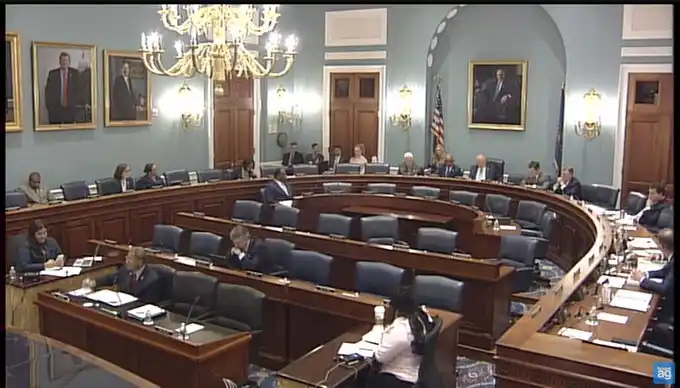
This hearing can be described as a "all-star lineup", chaired by Rostin Behnam, Chairman of the Commodity Futures Trading Commission (CFTC), with Paul Grewal, Chief Legal Officer of Coinbase, Dan Gallagher, Chief Legal and Compliance Officer and Corporate Affairs Officer of Robinhood, participating in the second panel discussion of the hearing. The second panel of witnesses also includes former CFTC Chairman Christopher Giancarlo, former CFTC Commissioner and former SEC General Counsel Dan Berkovitz, and former Acting Chairman of the CFTC Walt Lukken.
Enforcement supervision is not sustainable, and the division of regulatory responsibilities is not a "zero-sum game"
Several legislators have expressed concerns about the current law enforcement and regulatory model in the United States. Republicans, especially those on the House Agriculture Committee, have criticized Gensler's approach to cryptocurrency regulation, arguing that his agency has gone "too far."
Pennsylvania Republican Congressman and committee chairman Glenn Thompson said at the hearing: "Although I cannot and will not speak to any specific allegations against [Coinbase], I do want to point out that this behavior is exactly why we are holding this hearing today. Enforcement and regulation are not the appropriate ways to manage markets, fully protect customers, or promote innovation."
The Republican representative from South Dakota, Dusty Johnson, discussed whether the SEC should specifically regulate digital assets. Behnam believes that the division of regulatory responsibilities for cryptocurrency in the United States is not a "zero-sum game." He said, "I will not take away any legislative or legal authorization that the CFTC may obtain from others. However, there is indeed a regulatory vacuum, and there is a gap in the regulation of digital commodity assets."
During the conference, Behnam focused his comments on the need for clear classification of cryptocurrency tokens, existing regulatory enforcement practices, and the call for clear regulatory guidelines. He believes that it is urgent to expand the CFTC's power in the field of cryptocurrency commodities and points out that few exchanges have formally listed assets as commodities.
Behnam further asserts that the issue is not about the CFTC or SEC taking legal action against illegal entities, but rather the need to strengthen congressional power to manage risks related to encryption and establish clear regulations.
Behnam also warned of potential financial instability risks: "The volatility of the cryptocurrency market has basically stabilized in the past six months. If it fluctuates and grows again, we may face serious financial stability issues."
SEC Refuses Industry Communication and Dialogue
Coinbase's Chief Legal Officer, Paul Grewal, criticized the SEC for enforcing regulations in the digital asset industry without clear rules, stating that this approach is damaging America's economic competitiveness and companies like Coinbase that are committed to compliance. He called for the establishment of "fair rules" for cryptocurrencies.
The legislator did not inquire about specific allegations against Coinbase, but discussed issues mentioned in the lawsuit, such as token classification and exchange registration. Grewal responded that Coinbase underwent a lengthy review process in accordance with SEC requirements before being approved for direct listing in 2021.
He said, "Under the current situation of the US Securities and Exchange Commission... they repeatedly emphasize 'come in and register', but just like the situation encountered by Robinhood, when Coinbase tried to discuss how to register... after months and months of discussion, we are still being ignored."
Grewal said: "I am still digesting the charges I received today. What I can say in more detail is that we have had a lot of interactions with the SEC, not only dating back to several months, but several years."
In the lawsuits between Coinbase and Binance, Solana (SOL), Cardano (ADA), and Polygon (MATIC) have been classified as securities. Currently, all three can be traded on Robinhood's cryptocurrency platform. Dan Gallagher, Robinhood's Chief Legal Officer and former SEC commissioner, stated during a hearing that they are considering how to handle the tokens listed on their platform.
All members of the group and most legislators agree on the way forward for cryptocurrency, that is, Congress should take immediate action to address current regulatory loopholes to protect consumers and promote innovation.
CFTC fights for budget, two parties have no consensus on new digital asset bill
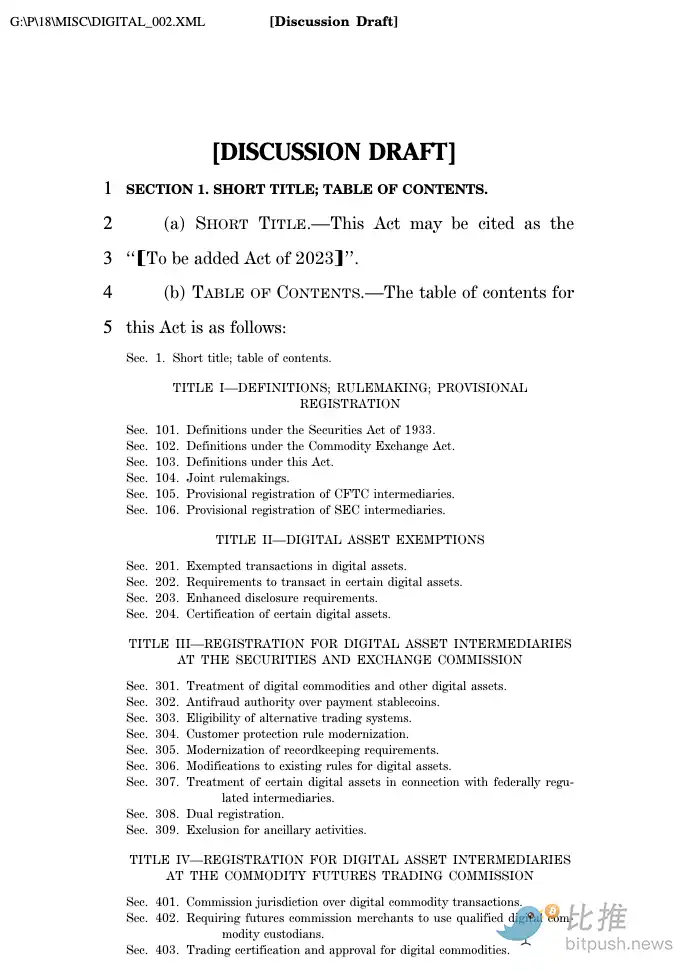
The draft of the digital asset bill proposed by Committee Chairman Glenn Thompson and House Financial Services Committee Chairman Patrick McHenry was discussed at the hearing. The Thompson-McHenry bill will change the way securities and commodities are defined based on the method of asset trading (whether obtained from the issuer or purchased on an exchange) and the degree of decentralization. The bill will also provide new definitions for digital commodity brokers and traders without changing the core components of the market structure.
Thompson said, "We hope to have a bipartisan joint committee legislative proposal." Republican Congressman Dusty Johnson (SD - R) said that there is "uncertainty" about whether digital assets are securities or commodities, and this bill will help fill those gaps.
Democratic committee members pointed out that the 162-page bill is "extremely complex" and was only introduced last week, so it will take time to study. CFTC Chairman Rostin Behnam described it as "handcuffing regulatory agencies".
Behnam's interest in the new bill is mediocre, but he specifically calls on Congress to authorize the CFTC to fill the regulatory gap in digital asset regulation. Behnam stated that even if Congress passes new legislation to create a clearer path for digital assets to transition from securities status to commodity status, don't expect new US crypto rules to be implemented immediately. Currently, the CFTC's budget is $360 million, and it has applied to increase its budget for the next fiscal year to $410 million, while the appropriations committee recommends $345 million. Behnam said that if the budget is cut, the agency can only let employees take leave.
Behnam said: "Implementing new regulatory rules will take at least one to two years, and additional funding needs to be granted by Congress. I estimate that this may take three to four years."
Welcome to join the official BlockBeats community:
Telegram Subscription Group: https://t.me/theblockbeats
Telegram Discussion Group: https://t.me/BlockBeats_App
Official Twitter Account: https://twitter.com/BlockBeatsAsia

 Related Articles