Arbitrum's Second Spring? A Comprehensive Analysis of Trader Joe's Business Status, Token Model, and Valuation Levels.
Original Title: "Arbitrum's Second Spring? Comprehensive Analysis of Trader Joe's Business Status, Token Model, and Valuation"
Original Author: Alex, Mint Ventures
1. Report Highlights
1.1 Core Investment Logic
Trader Joe's core advantage lies in its resilient, highly deliverable, and innovative team, as well as its excellent product experience and innovative liquidity order book, which have led to rapid user growth. Currently, Arbitrum is the main engine driving its business growth.
Although the intense competition in the Dexs track continues, which means that there is no strong bargaining power for traders and liquidity providers in various projects in the track, most projects are operating at a loss or with thin profits. It is difficult to improve this market competition situation in the short term. However, due to the dual cyclical nature of the cryptocurrency market and the Dexs track, projects represented by Trader Joe are still expected to outperform the market in a bull market.
1.2 Main Risks
Mainly due to intense competition, the main market of Avalanche, is facing ecological shrinkage and competition from Uniswap v3. Arbitrum, as the current main growth market, is still in the stage of low prices and subsidies in exchange for volume. The growth of transaction volume and fees is not yet stable and relies more on business brought by event-based projects.
1.3 Valuation
Currently, Trader Joe enjoys higher valuations compared to similar projects on multiple indicators such as PF, PS, and PE. Please refer to section 4.2 for valuation levels.
2. Basic Information of the Project
2.1 Business Scope of the Project
Trader Joe is a comprehensive DeFi project, with businesses including spot Dex, decentralized lending (Banker Joe), NFT trading platform (Joepeg), and launchpad (Rocket Joe). Trader Joe's current trading business spans Avalanche, Arbitrum, and BNBchain. Among them, spot trading is Trader Joe's current core business and its relatively leading business sector.
2.1.1 Spot Dex
Trader Joe's spot Dex business, as its current main business, has made many product and mechanism innovations, which are reflected in its V2 product - Liquidity Orderbook (LB for short).
The actual liquidity order book is a new innovation of the centralized liquidity concept of Uniswap V3. Essentially, it is a combination of the "order book" and "liquidity pool" mechanisms.
a. Order Book: A collection of Bin
LB has introduced the price range unit "Bin" based on centralized liquidity, where one Bin (flow box) represents a range filled with liquidity.
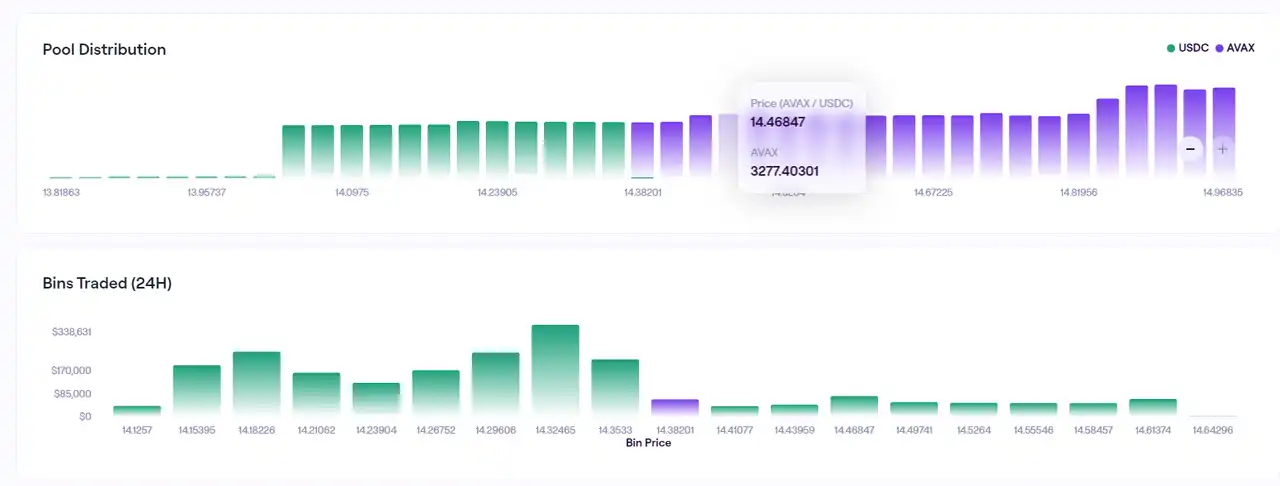
Trader Joe's Bin distribution and trading volume for AVAX-USDC trading pair
Each Bin in every liquidity pool has a fixed and equal width, and the difference between adjacent Bins is called the "Bin step". For example, the Bin step for the AVAX-USDC trading pair in the above image is 20BP=0.02%. The Bin step for each pool in a trading pair is a parameter that can be set by the creator, so different pools with different Bin steps can be created for the same trading pair.
Trader Joe's Bin is similar to the order book matching mode-based order price of CEX, and the Bin step is the minimum unit between the order prices of CEX.
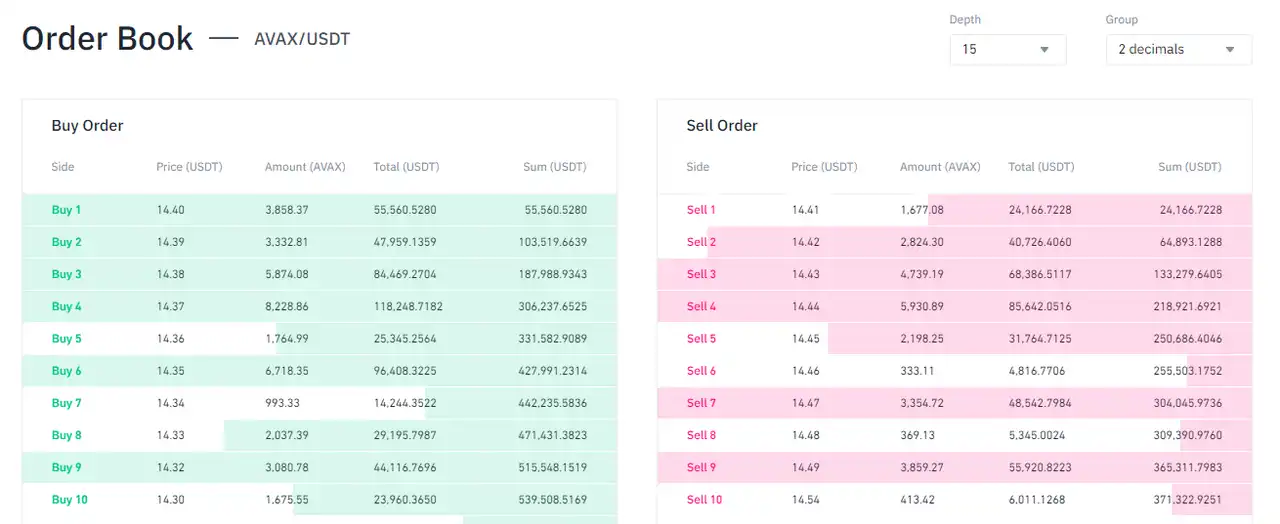
Binance's Avax-USDT trading pair order book situation
So, Trader Joe's Dex is a custom order book with Bin as the order trading unit width.
b. Liquidity: Bin Capacity
Uniswap V3's mechanism concentrates liquidity within a price range using the constant product formula X*Y=K, while Trader Joe disperses liquidity into equally sized price ranges called Bins. The liquidity within each Bin follows the equation P·X+Y=K (where P=Y/X), and each Bin serves as a liquidity pool, representing the smallest unit of liquidity management.
Although both adopt the concept of concentrated liquidity, the core innovation of Bin's order book model, compared to Uniswap V3, lies in the fact that its liquidity is vertically aggregated in each Bin, while V3's liquidity is horizontally distributed and vertically stacked heterogeneously.
In simpler terms, Uni v3's LP is an independent entity that directly stacks liquidity based on cross-price ranges and liquidity amounts. On the other hand, LB vertically stacks liquidity into different price ranges based on the price span of liquidity, and liquidity within the same bin range is homogenized.
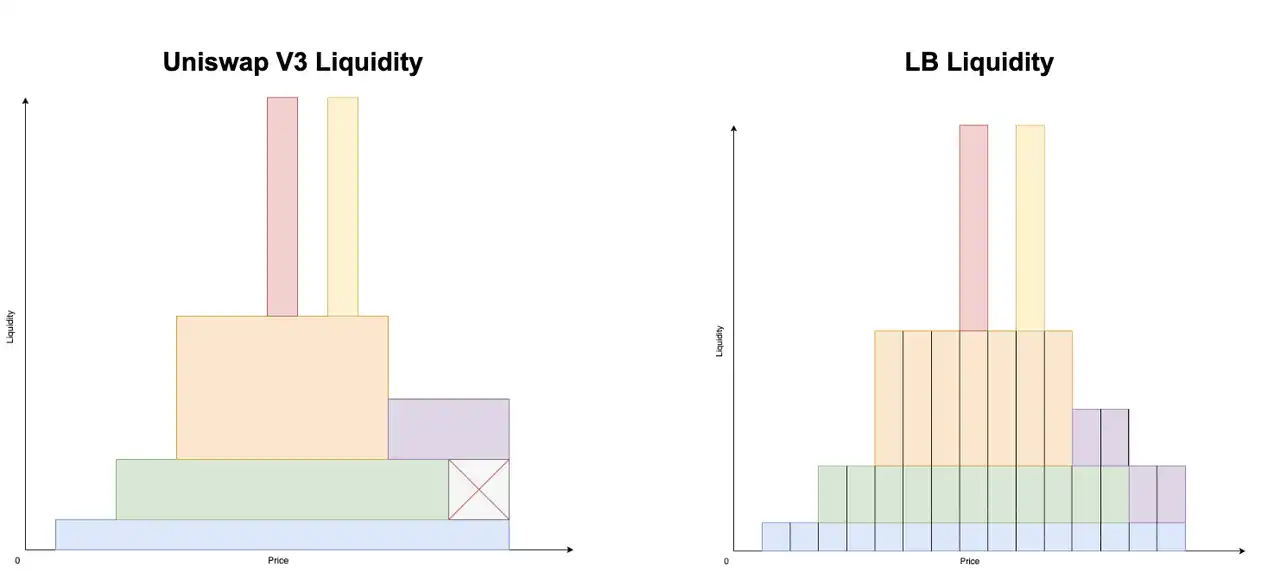
Comparison of Uni V3 and LB liquidity structures, with liquidity on the vertical axis and price on the horizontal axis, and different colored blocks representing different users.
Source: Trader Joe V2.1 documentation
Based on the vertical aggregation liquidity of Bin, the liquidity token of LB follows a standard similar to ERC1155. Before introducing the characteristics of LB liquidity token, let's briefly describe the token standard of ERC1155.
ERC-1155 was developed by Enjin to solve the problem of a single token smart contract only being able to support either homogeneous tokens (ERC20) or non-fungible tokens (ERC721). The ERC-1155 token contract can support both homogeneous and non-fungible tokens within a single token contract. In the ERC1155 contract, each token is identified by its ID rather than the contract address, which means that the contract can manage multiple tokens with different IDs. Under the same ID, there may be many homogeneous tokens or a single non-fungible token.
The most common application scenario for ERC-1155 is in the gaming industry, as gaming systems typically include both homogeneous tokens and non-homogeneous tokens.
LB adopts a similar approach to ERC-1155, utilizing its ID system concept. Specifically:
The LB liquidity tokens within the same bin are homogeneous. Homogeneous liquidity tokens can first reduce gas consumption, and secondly provide the possibility of simplifying the fee calculation and the entire accounting system in the protocol.
Different Bins have different IDs to distinguish the homogenized liquidity flow within each Bin.-
The combination of points 1 and 2 allows LPs of LB to easily adopt more complex strategies to allocate their liquidity and achieve diverse goals.
As shown in the following figure, Trader Joe provides a variety of LP deployment options to meet the needs of users:
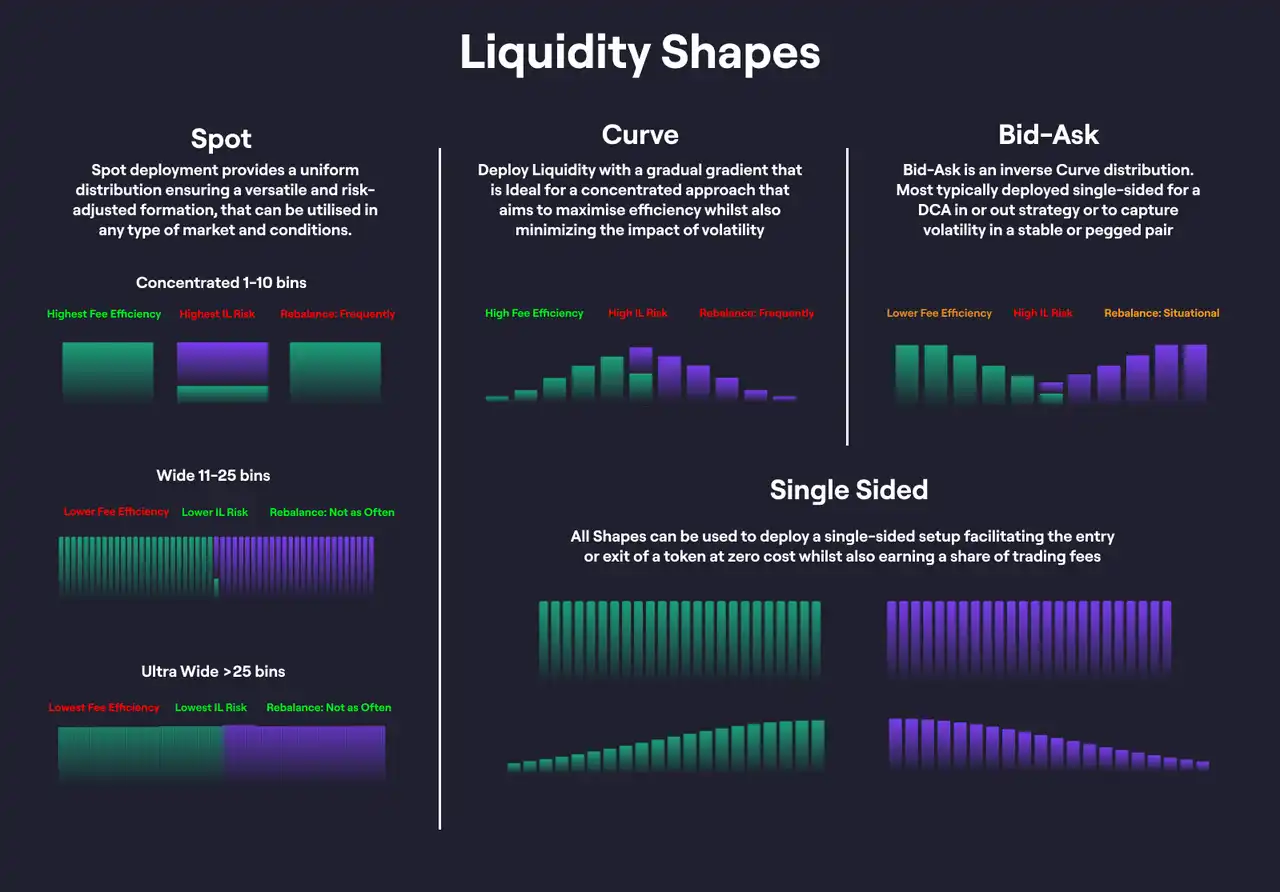
Image source: Trader Joe's document
In addition, the characteristics of Trader Joe's LB include:
Before the liquidity within the same Bin is exhausted, the price of the transaction remains unchanged. Therefore, the advantage of the transaction quote makes it easier to capture the trading volume from the routing, but this also amplifies impermanent loss.
Introduced variable fees, meaning that the higher the volatility of the Token price, the higher the transaction fee rate. LP's impermanent loss is compensated by increasing transaction fee revenue.
Improved composability - Compared to Uni V3's LP tokens which use the ERC-721 NFT format (which is less easily integrated into ERC20-focused Defi), the LP tokens of the liquidity order book built on Bin use a format similar to the ERC-1155 standard. In theory, this makes its LP tokens more similar to homogenous ERC20 tokens, and therefore have better composability.
And based on the convenience of Bin's market-making and order placement strategies and easy combinability, other projects and users can try more gameplay based on liquidity order books.
Project team's attempt
"White Lotus", launched on May 9th, utilizes Trader Joe's order book model for token issuance and Ponzi mechanism operation:
The total supply of the project token LOTUS is 30,000,000 tokens. The tokens will be sold through the Trader's JOE pool with a uniform level of order placement. The starting price for the first token in the bin is $0.20 USD, and the price for the last token in the bin is $4.2 USD. The ETH used by users to purchase LOTUS will be locked in the pool as liquidity. The order interval for LOTUS bins is 5 bins. The specific distribution of the order placement is shown below:
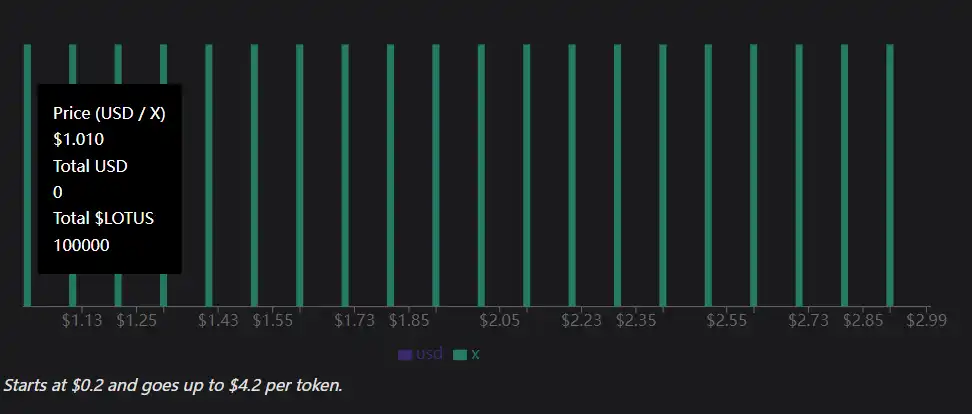
Image source: White Lotus document
-
When users sell LOTUS, a 10% tax will be levied, of which 8% will be permanently destroyed to cause token deflation, and the remaining 2% will be used to reward LOTUS stakers.
LOTUS has an automatic liquidity rebalancing mechanism. Every time the price moves 5 bins, the liquidity rebalancing will be automatically executed, and the liquidity of ETH in the pool will be redistributed as follows:
-
Take 10% of the ETH in the pool as "direct trading liquidity" and place it in the Bin adjacent to the current active price, making it easy for users to buy and sell within the current price range.
-
Calculate the "floor price" of LOUTS by dividing the total ETH value/LOTUS, and place the remaining 90% of ETH in the bin with the floor price for all LOTUS circulating tokens to be sold at any time.
After a certain rebalancing, the liquidity order situation of LOTUS is as shown in the following figure:
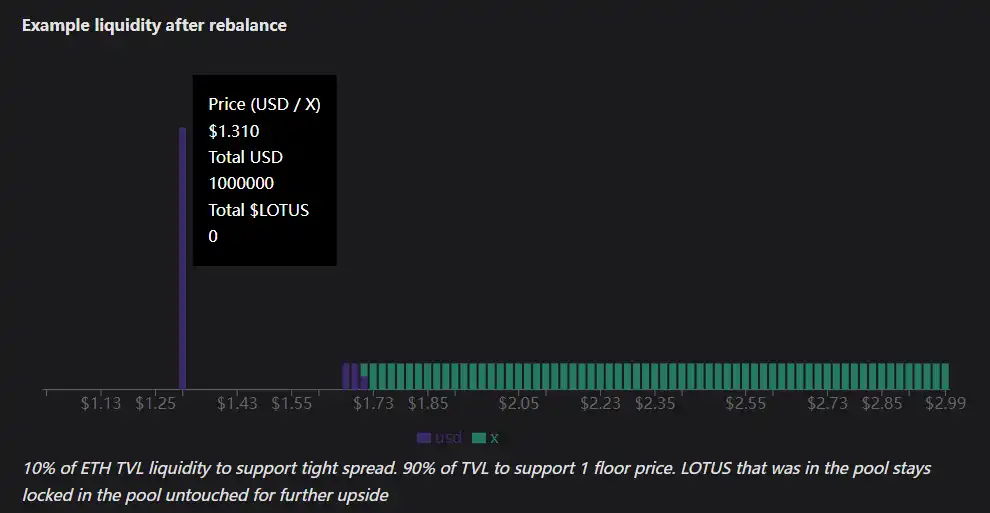 3. In an ideal scenario, due to the limited total supply of LOTUS, there is a spiral upward momentum for LOTUS as token burning and bottom price increase with trading.
However, due to various reasons (other users creating separate transaction pools without contributing to fees and burning, a large vacuum between centralized liquidity and bottom price), White Lotus quickly failed after its launch. However, subsequent imitations such as Jimbo also adopted Trader Joe's liquidity order book as their underlying mechanism.
User Practice
LB's convenient market-making experience has also received good feedback from users. After the ARB Token airdrop in March of this year, its on-chain trading volume remained high, and it naturally gained the largest liquidity and trading volume on Uniswap V3 on Arbitrum. However, at that time, Trader Joe also became the second largest Dex in terms of ETH-ARB trading volume, accounting for 45% of the volume generated, thanks to LB's product experience and market-making reward operation activities.
In addition, Trader JOE v2 is also suitable for implementing asset selling and bottom-fishing through its order placement function using the "dollar-cost averaging (DCA)" strategy.
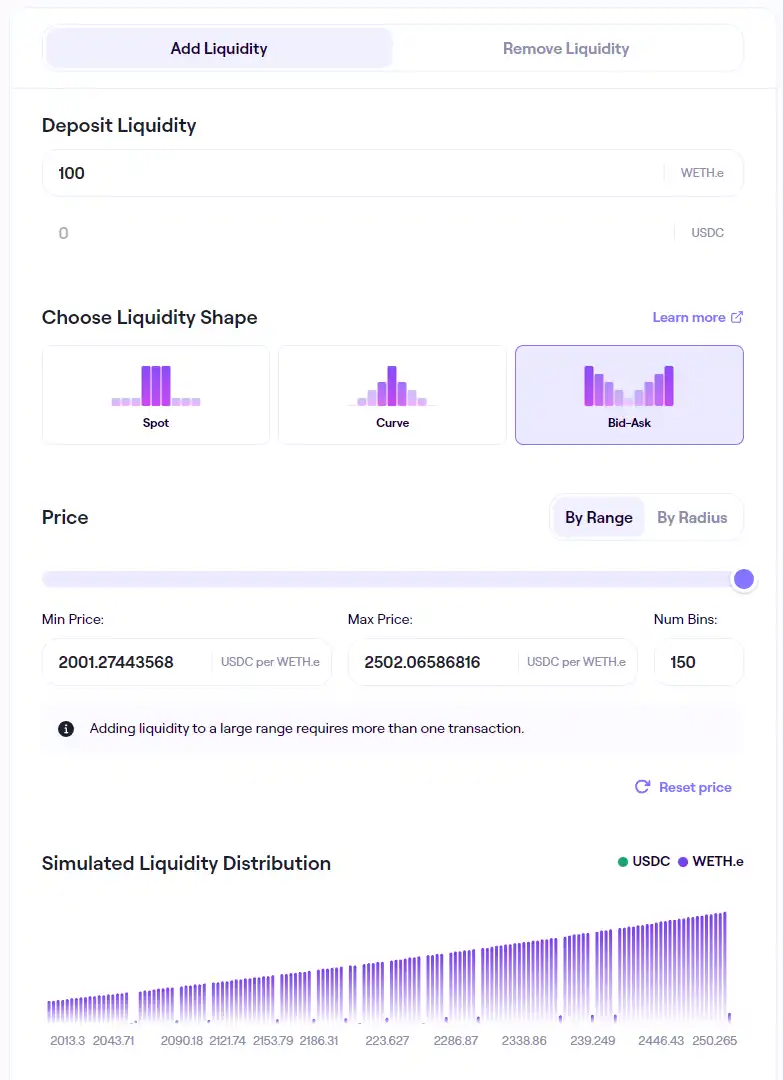
For example, if a user has a requirement to sell 100 ETH at a profit as the price increases within the price range of $2000-$2500, and wants to sell more as the price goes up, ultimately clearing the position at around $2500, this is a variant of the Dollar Cost Averaging (DCA) liquidation strategy.
This requirement can be easily achieved through LB V2. We only need to deposit 100ETH on one side, set the selling range (2000-2500), and choose the Bid-Ask mode (the selling order quantity increases as the price rises) to conveniently meet this requirement.
As shown in the figure below:
On the contrary, if you want to buy $100,000 worth of ETH at a price range of $1300-$1800 with increasing buy-ins as the price drops, this is a variant of the dollar-cost averaging (DCA) strategy. We only need to deposit $100,000 USDC unilaterally, set the buy-in range (1300-1800), and choose the Bid-Ask mode. When ETH falls into this range, the position will be automatically established, as shown in the figure below:
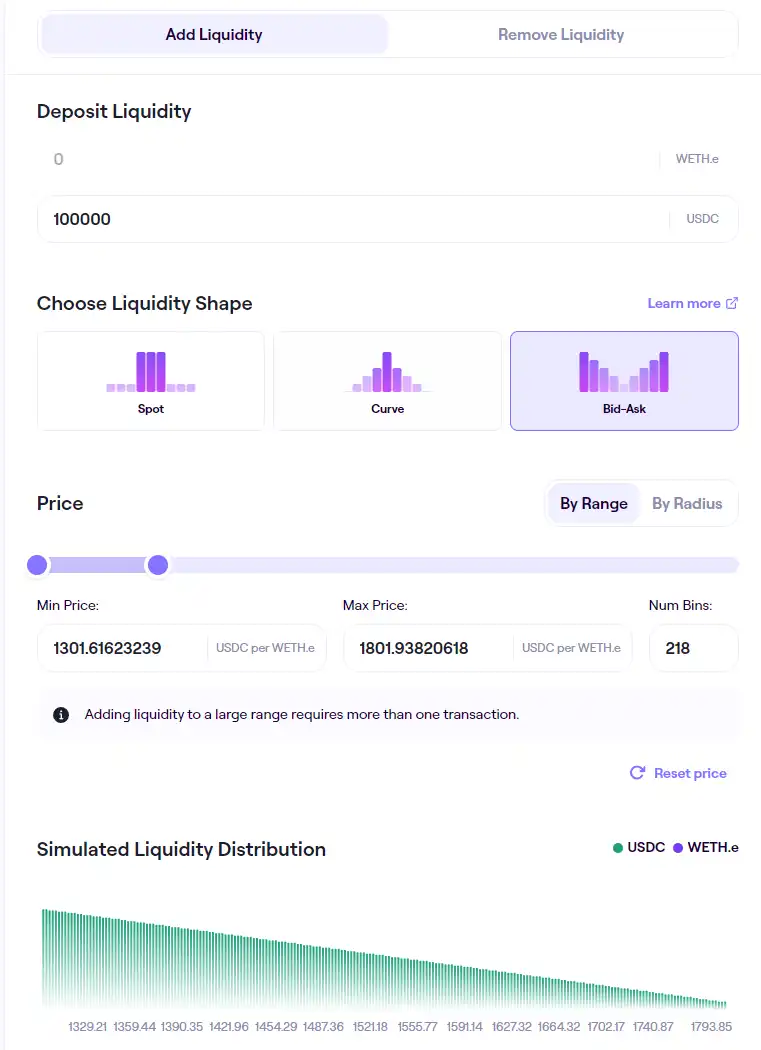
Overall, Trader Joe's liquidity order book is based on bins and order book models, which reduces the management threshold for LPs in centralized liquidity. This convenience also provides more diverse trading and market-making strategies.
In addition, among the numerous Dex platforms that I have researched, Trader Joe's product interaction experience ranks among the top. Specifically, this includes:
-
Simple and elegant UI design and intuitive page layout make it easy for even new users to get started.
-
The data dimensions of order pool and pledge amount are rich, detailed, and easy to understand. I believe that this is very important for DeFi financial products. Real-time and transparent business data is one of the main characteristics of DeFi products compared to TradFi. However, data visualization is equally important.
2.1.2 Borrowing and Lending: Banker Joe
Banker Joe is a lending product released by the project party in 2021, forked from Compound and Cream. At its peak, it had a TVL of up to $1 billion, but currently, the deposit funds for lending business have shrunk to around $10 million, making a small contribution to the project's operation and profit, and it is not currently a development focus of the project.
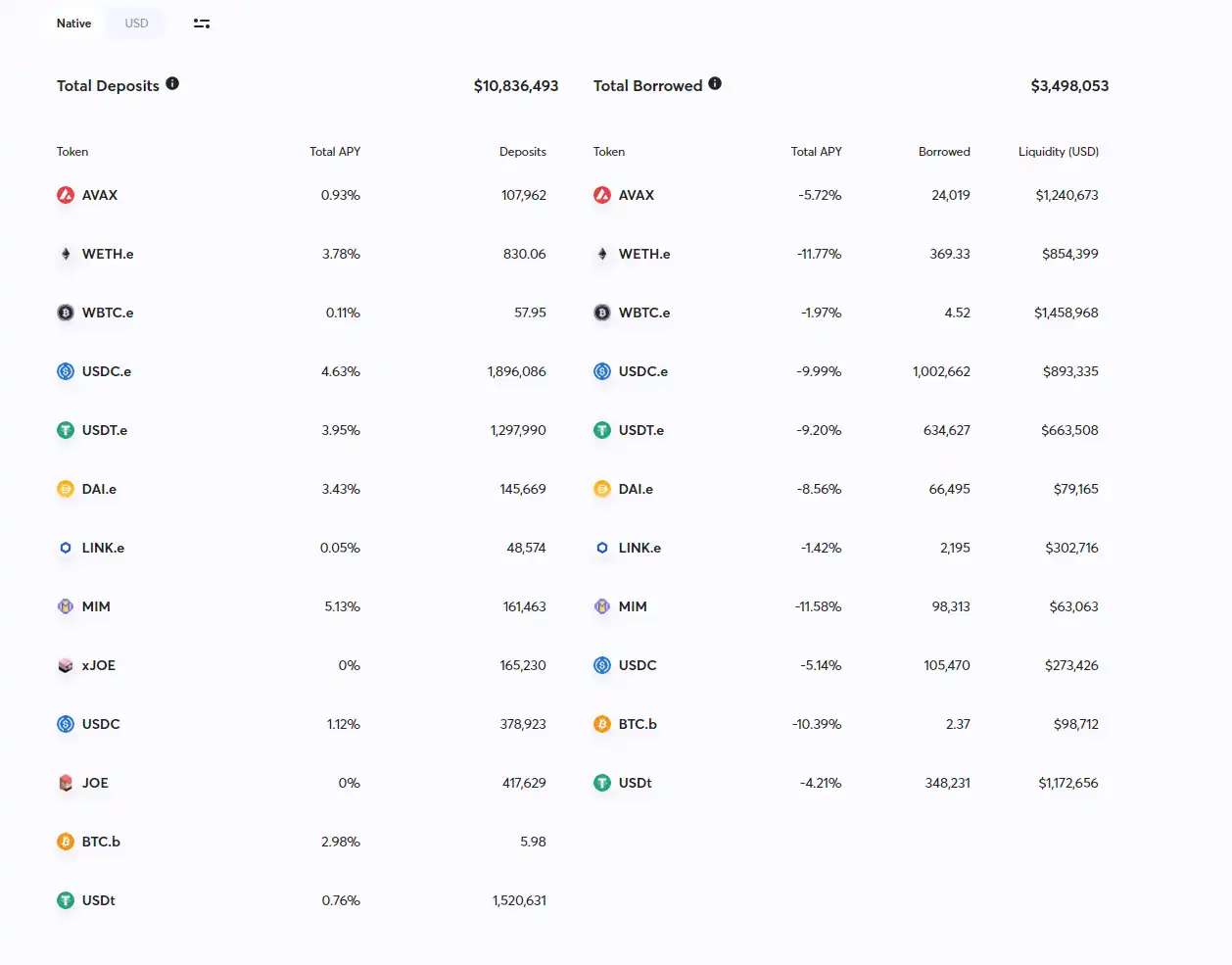
Current Banker Joe business data, source: https://v1.traderjoexyz.com/lend
2.1.3 NFT Trading: Joepegs
Joepegs was launched in April 2022 and currently supports NFT trading on Avalanche and BNBchain. However, judging from the trading volume, the NFT trading volume on both chains is not high.
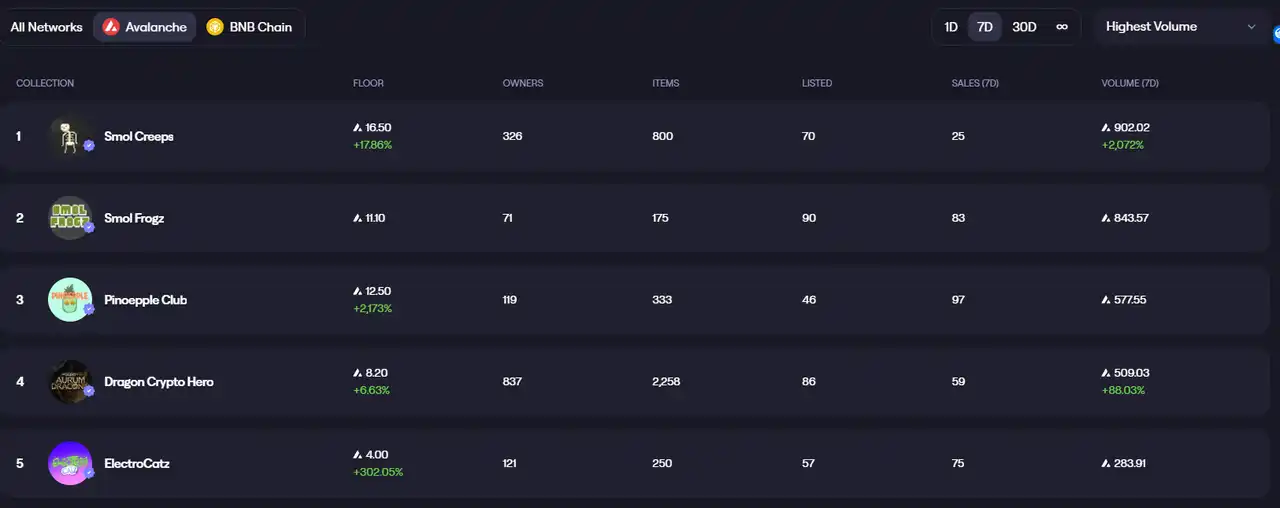
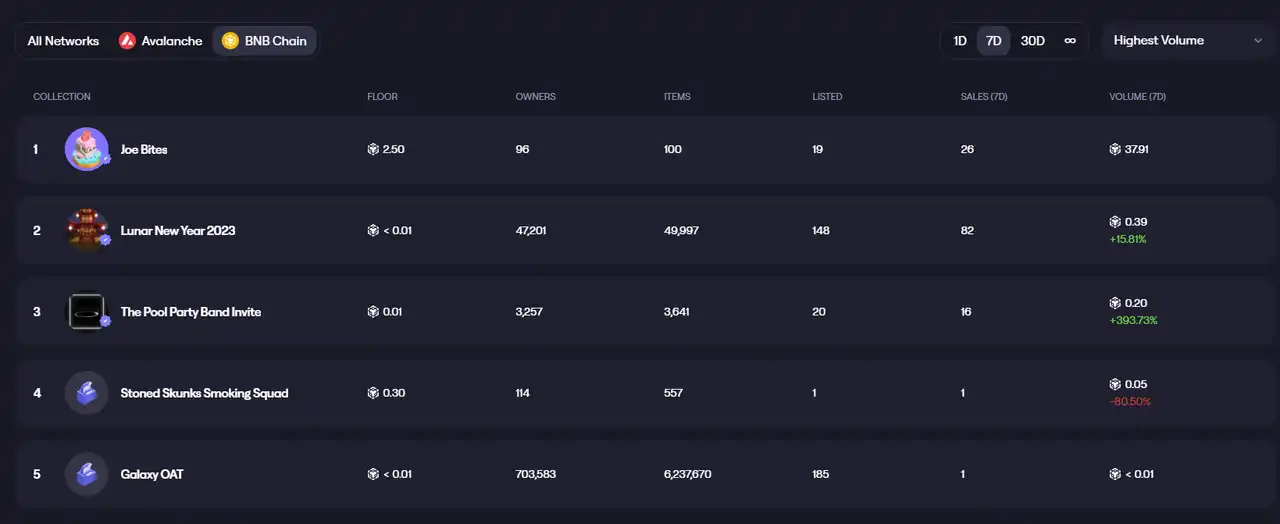
Joepegs' Avalanche NFT trading volume, the largest NFT series by trading volume, had a total trading volume of 902 AVAX (approximately $12,600) in the past 7 days, while the highest trading volume NFT on BNBchain had only 37.9 BNB (approximately $11,470) last week.
The business of the NFT sector also made a modest contribution, which belongs to the edge business (but the project party is still actively promoting it at present).
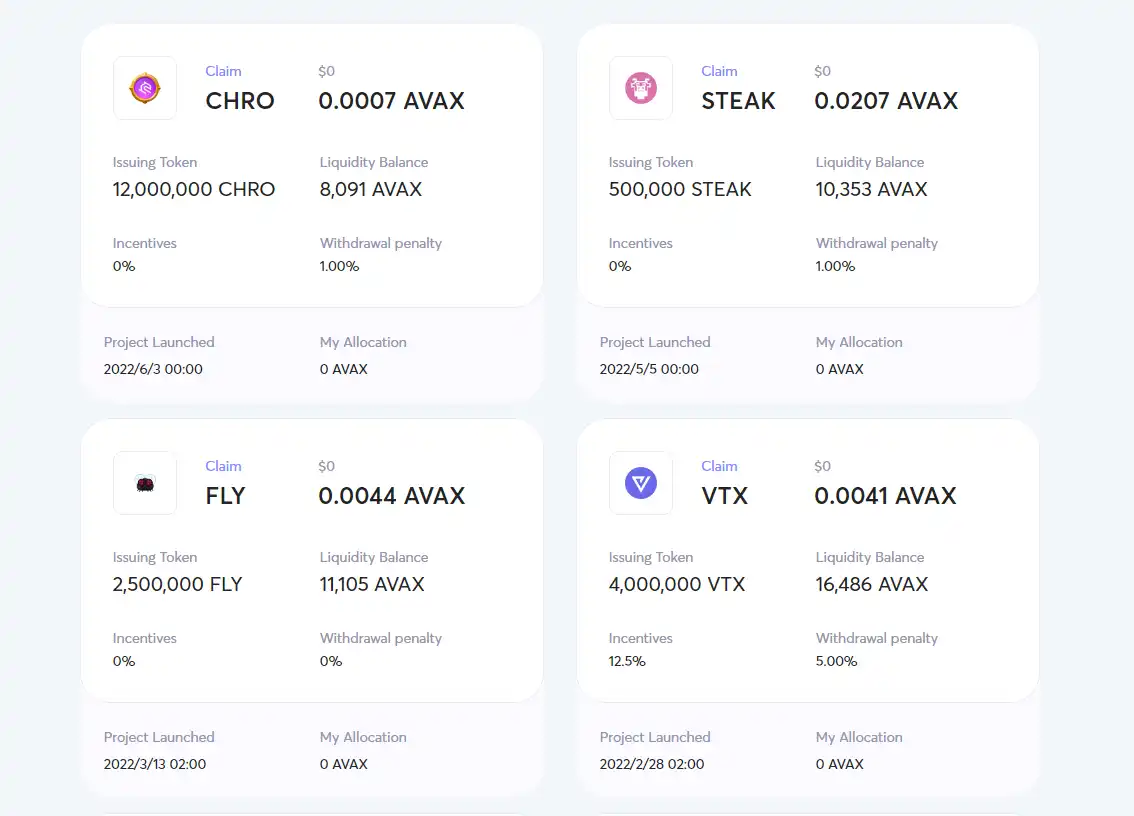
In addition, Trader Joe also launched the launchpad module Rocket Joe in early 2022, but now the business is basically stagnant, and the last collaborative launch project was CHRO in June 2022.
2.2 Project History and Roadmap
The following are the important milestones of the Trader Joe project since its launch, as of mid-May 2023.
|
时间 |
Time |
Event
2021.6
On June 1st, the project was officially announced. The Trader Joe contract code will be open sourced in the latter half of the month, and the project will officially launch at the end of June.
2021.9
Received a strategic investment of $5 million, led by Defiance Capital, GBV, and Mechanism Capital, with other participants including Three Arrows Capital, Coin98 Ventures, Delphi Digital, Avalanche Foundation, and Stani Kulechov, the founder of Aave. The financing valuation is $50 million.
2021.10
A lending product Banker Joe has been launched, which is a fork of Compound and Cream on the Chainlink oracle for asset pricing.
2021.10
Trader Joe and Avalanche jointly launched a $20 million liquidity mining program, with each providing $10 million worth of Joe and $10 million worth of Avax.
2022.1
Launchpad product Rocket Joe has been released. Users who stake Joe Token will continue to receive rJOE points as a requirement for participating in the launchpad.
2022.2
Release of the revised economic model, namely Staking V2, introducing the veJoe mode. VeJoe is generated based on Joe staking, and the longer the staking duration, the more veJoe will be generated. VeJoe is used to accelerate users' liquidity mining earnings.
2022.4
2022.8
2022.11
2022.12
2023.1
2023.1
2023.1
2023.2
Announced partnership with Layer0 to turn Joe into a native multi-chain token.
2023.4
Trader Joe V2.1 version has been officially released.
2.3 Team Situation
On May 13th not long ago, @cryptofishx emotionally reviewed his experience during the bear market of 17-18 on Twitter. At that time, he was a 30-year-old doctor who lost all his profits and 2/3 of his capital in the bear market. He used his business time to learn programming and advanced mathematics, obtained two relevant degrees in two and a half years, entered Google, and then founded Trader Joe part-time and achieved success.
On May 17th, @cryptofishx emotionally posted a statement and pinned it on Twitter:
"When we first founded Joe, I made a commitment to myself to ensure that we would still be a part of this project after 2 years, as that is the time period in which most projects disappear. Our 2nd birthday is coming up soon, and I am very happy to say that we are still here, building with the same energy as the first day."
This may be an example of the founder who still maintains a good entrepreneurial state and has ample emotions for the project.
Trader Joe's other co-founder, @0xmurloc, has disclosed less information, with public records only mentioning that he is a full-stack engineer and product manager. Prior to starting full-time entrepreneurship in 2021, he worked as a product manager at a recently listed unicorn and holds a degree in electronic engineering from a prestigious university.
The author also consulted with Trader Joe's community staff regarding the issue of team size, but they stated that they are unable to disclose any related information at this time.
In the rapidly changing market competition and impetuous entrepreneurial environment of the encryption world, the diligence of the Trader Joe team is still impressive. On the one hand, this is reflected in their attempts and implementation of multiple product directions (Dex, lending, launchpad, NFT trading platform) in just two years, actively following the trends and demands emerging in the market. More importantly, they have actively innovated on the core foundation of Dex, and their design and experimentation on the economic model have also been very proactive (see the "Token Model" analysis section for details).
2.4 Financing and Important Partnerships
According to public information, Trader Joe has only undergone one institutional financing round, which took place in September 2021, three months after the product was officially launched. The financing amount was $5 million, with a valuation of $50 million at the time. The round was led by Defiance Capital, GBV, and Mechanism Capital, with other participants including Three Arrows Capital, Coin98 Ventures, Delphi Digital, Avalanche Foundation, and Aave founder Stani Kulechov.
3. Business Analysis
3.1 Industry Space and Potential
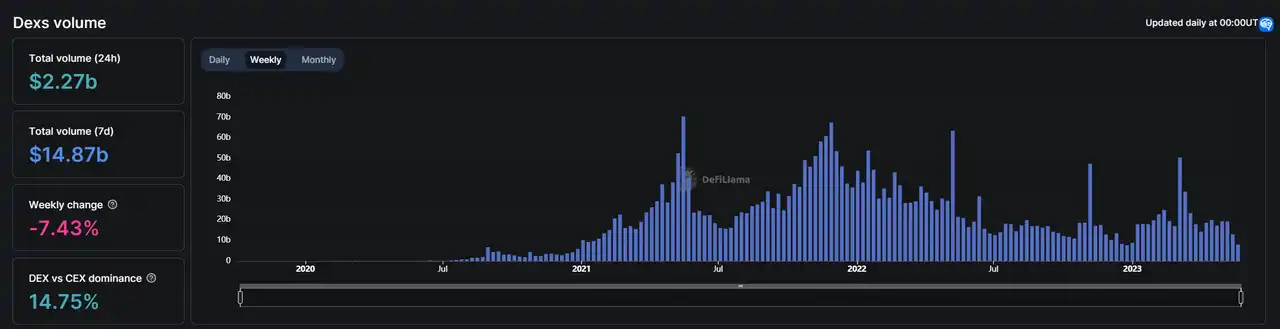
According to DeFillama data, the 24-hour total trading volume of DEXs is 2.27 billion US dollars, accounting for 14.75% of the total cryptocurrency spot trading volume. Although this data is still not high, it has increased by nearly 100% compared to the data reported in the research article "A Deep Dive into the Leading AMM Platform Curve Finance" (written in February 2023) that the author last read.
Data source: https://defillama.com/dexs
As for the business of the Dexs track itself, in addition to spot trading, there is also a liquidity procurement business. Representative projects operating this business mostly use the ve Token model pioneered by Curve (representing the project Balancer), or the ve (3,3) model modified based on the ve model (representing the project Velodrome). If we only look at the revenue from bribery paid by other project parties for purchasing liquidity on Dexs, we will find that this part of the revenue seems to be much higher than Dexs' spot trading. However, if we regard the Token incentives of ve-type Dexs itself as the "liquidity procurement cost" and the bribery revenue as the "liquidity sales revenue", then most Dexs operating this business are currently in a loss-making state (without considering the "indirect income" obtained by purchasing Tokens for governance rights).
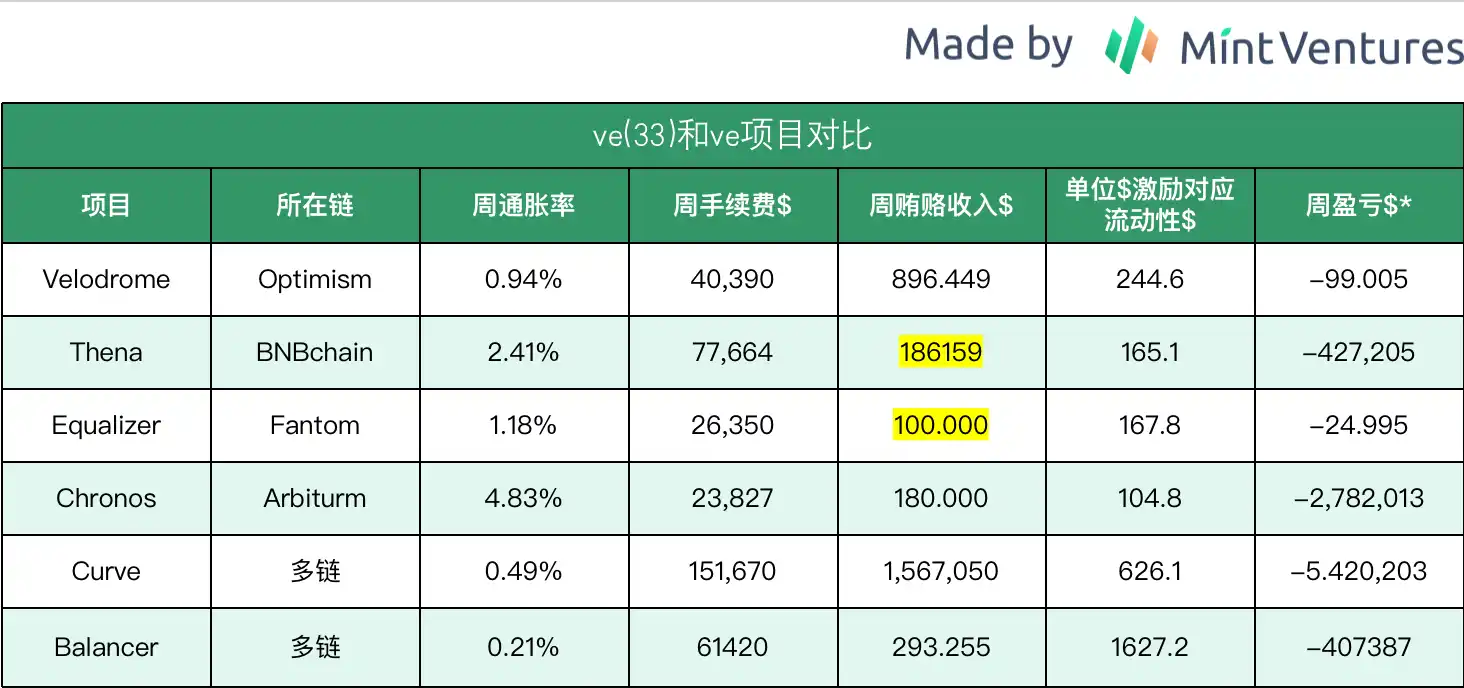
PS: 1. The above data statistics and calculation time are as of May 5, 2023. The highlighted data is estimated. The original report is from Mint Ventures."From Velodrome to Chronos, ve(3,3) is back, is it a better Dex model?"
2. The basic data used for calculation mainly comes from official disclosures and Defillama.
3. The bribery income of Curve and Balancer uses bribery data from Votium, Hiddenhand, and Votemarket.
*[Profit and loss] here refers to income (fees + bribes) - liquidity emission incentives.
Dexs is driven by the growth of the industry, in addition to the overall increase in the size of the cryptocurrency market. There are several key factors contributing to this growth:
,以及对隐私保护的关注,都促进了加密货币的发展。
加密货币行业涌现出了许多新技术,例如ZKS、STARK、SCROLL等,这些技术都在不断地推动着行业的发展。
未来,加密货币有望成为数字经济的重要组成部分,为人们的生活和工作带来更多便利。
The composability of the DeFi ecosystem where Dex is located greatly improves users' capital efficiency and freedom.
Most native Web3 projects choose Dexs as their first stop for trading and deploying liquidity.
On the other hand, as a business model with the clearest and most basic track, Dexs has also entered the stage of fierce competition in the red ocean. The head Uniswap V3 continues to provide services for free, while other improved versions based on various micro-innovations emerge one after another. The token subsidies of various Dexs also show no signs of stopping, and the entire industry is in a state of bearing the brutal competition losses after taking the subsidies into account.
To get out of this state, besides expecting the business growth brought by the recovery of the encryption market, it is more important whether Dexs can find a way to build solid barriers and start realizing profits.
3.2 Business Situation
In this section, the author will provide statistics and analysis on business data such as TVL, trading volume, fees/revenue, and active user count for Trader Joe Dex. However, due to lower business volume, lending and NFT businesses have a smaller impact on the project's fundamentals and will not be analyzed in detail here.
3.2.1 TVL
During the peak of the last bull market, Trader Joe's TVL reached as high as $2.6 billion. However, as the market entered a bearish phase, liquidity quickly drained away. Currently, the total TVL of Dex (V1, V2, V2.1 combined) is around $110 million.
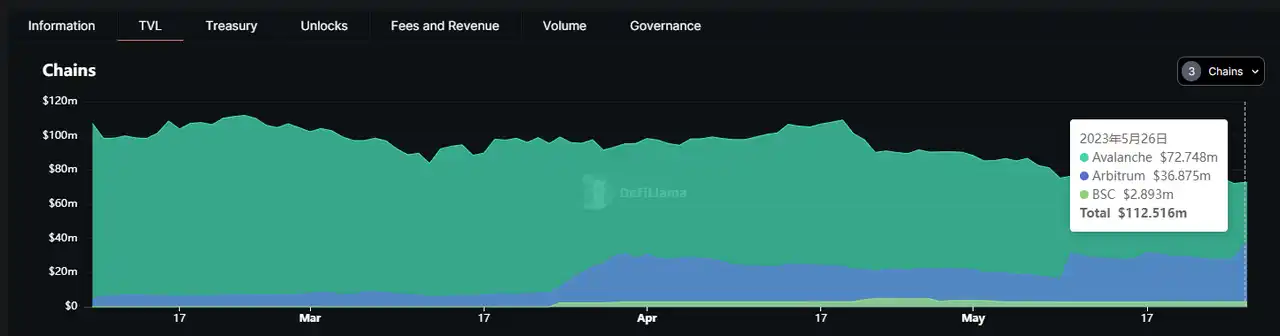
Trader Joe's TVL composition, data source: https://defillama.com/protocol/trader-joe
其中 Avalanche accounts for 65%, Arbitrum accounts for 33%, and BNBchain accounts for 2%. From the TVL trend in the above chart, it can be seen that the liquidity of Trader Joe on Arbitrum continues to rise, while Avalanche corresponds to a decline.
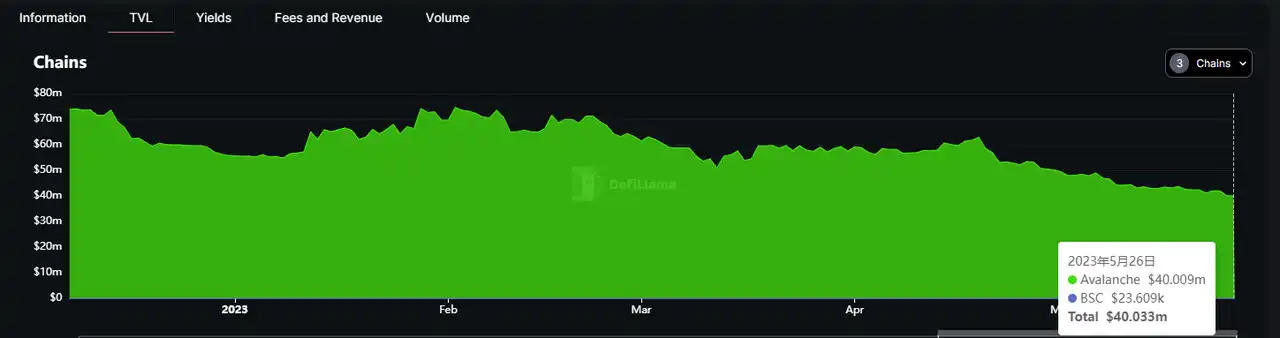
V1 TVL trend, data source: https://defillama.com/protocol/trader-joe
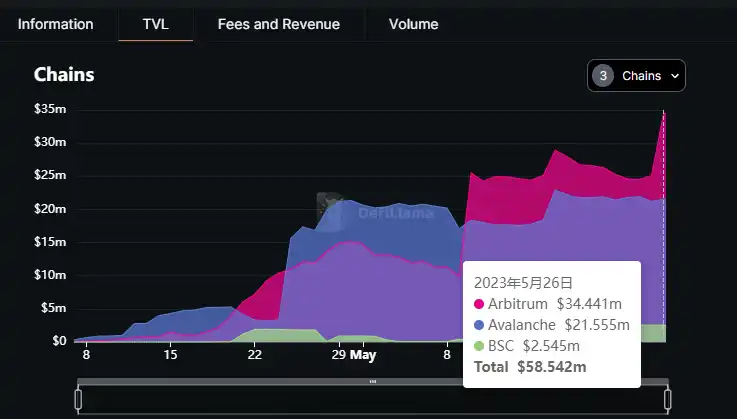
V2.1 TVL trend, data source: https://defillama.com/protocol/trader-joe
Observing the data of Trader Joe's V1 and V2.1, it can be found that V1 has been in a slow decline since the beginning of this year, while V2.1 has been rapidly increasing, with the main source of data growth also coming from the increase in Arbitrum business volume.
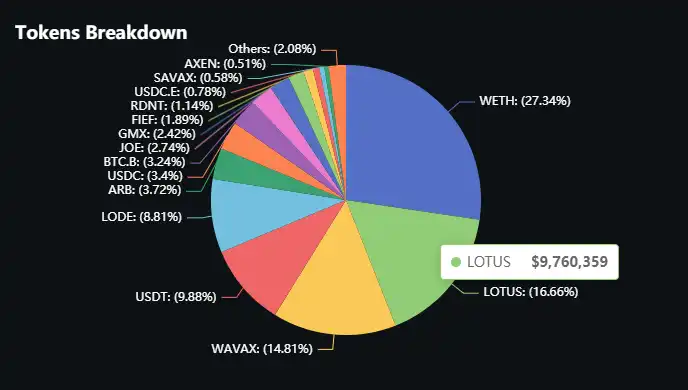
V2.1 TVL composition, data source: https://defillama.com/protocol/trader-joe
We will take a closer look at the Token composition in V2.1TVL and find that in addition to common mainstream Tokens such as ETH, the Token of the White Lotus project, which uses Trader Joe's order book as a liquidity distribution mechanism mentioned earlier, ranks second, accounting for 16.66% of the total liquidity.
3.2.2 Trading Volume & Transaction Fees
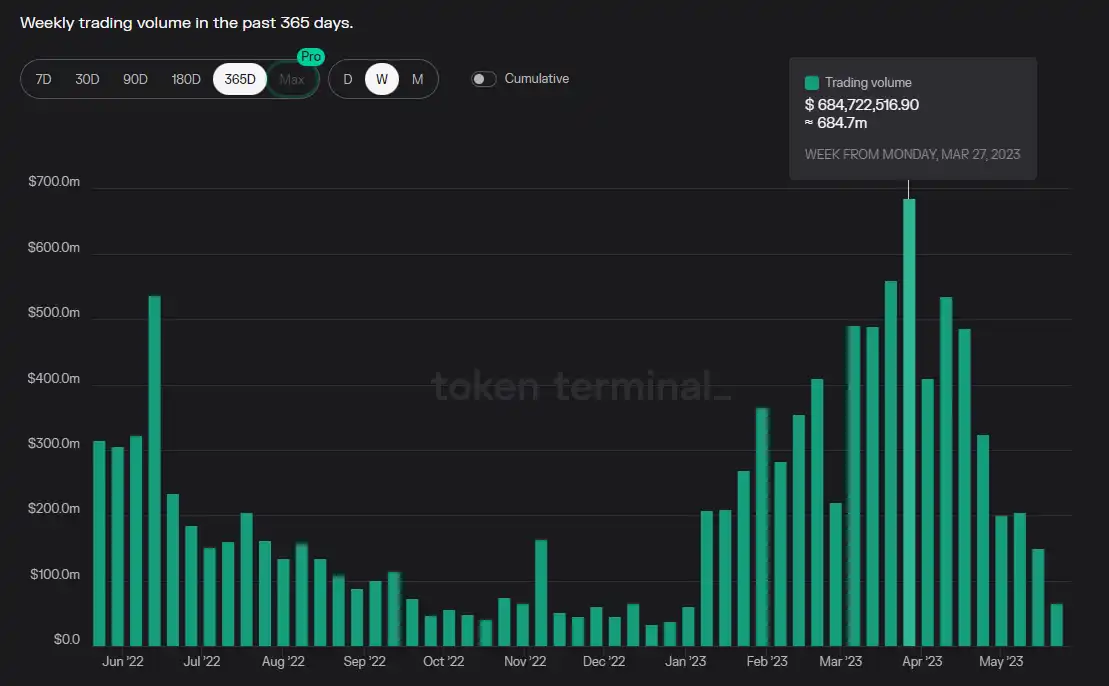
Data source: https://tokenterminal.com/terminal/projects/trader-joe
From the perspective of trading volume, Trader Joe hit a new high in late March of this year, which is the most active period of trading since the Arbitrum airdrop. At that time, the weekly trading volume reached 688 million US dollars, the highest in a year.
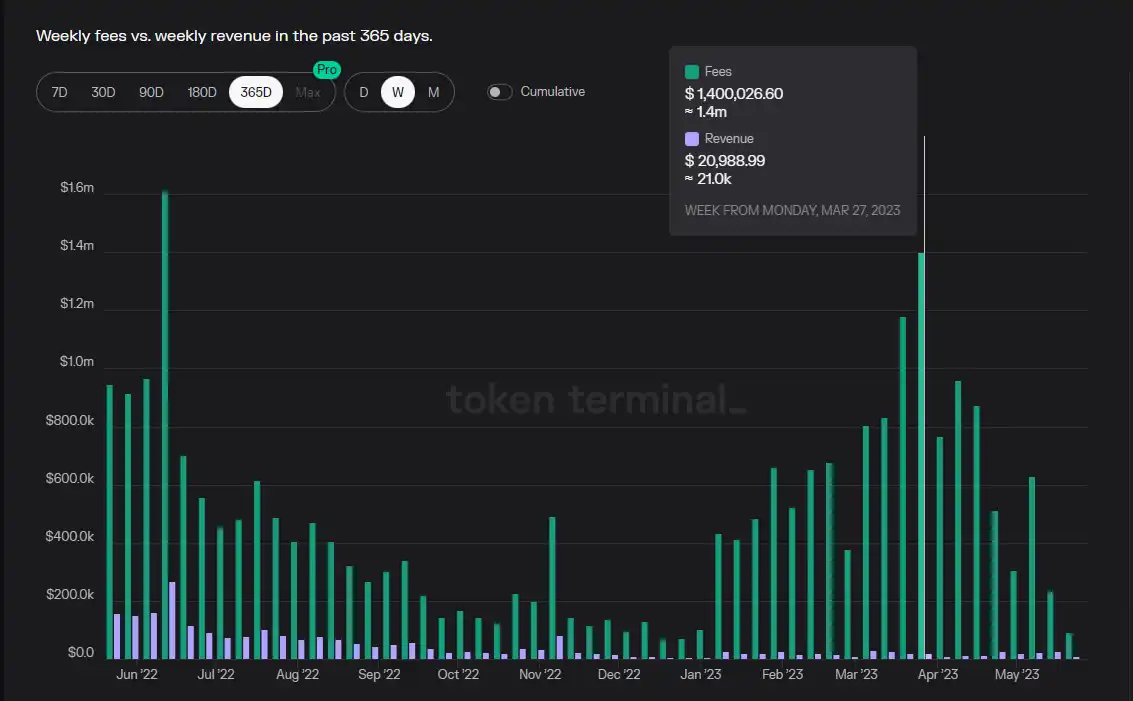
Data source: https://tokenterminal.com/terminal/projects/trader-joe
However, during the same period when trading volume returned to a new high, Trader Joe's commission income was far less than the commission income during last year's peak period. The commission income for this week at the end of March was $21,000, which is less than 1/10 of the weekly commission of $260,000 at the peak in June last year.
The reason for this is because since the launch of Trader Joe's V2 in November last year until April this year, all of V2's transaction fees were allocated to LPs. It was only with the recent launch of V2.1 that protocol fees were collected again and distributed to Joe's stakers. In addition, the protocol revenue for different protocols such as Curve is 50% of the transaction fees, while Trader Joe's protocol revenue ratio has multiple modes.
-
V1: All transactions are charged 0.05% as protocol revenue.
V2: No protocol fees will be charged, and all protocol fees will be distributed to LPs.
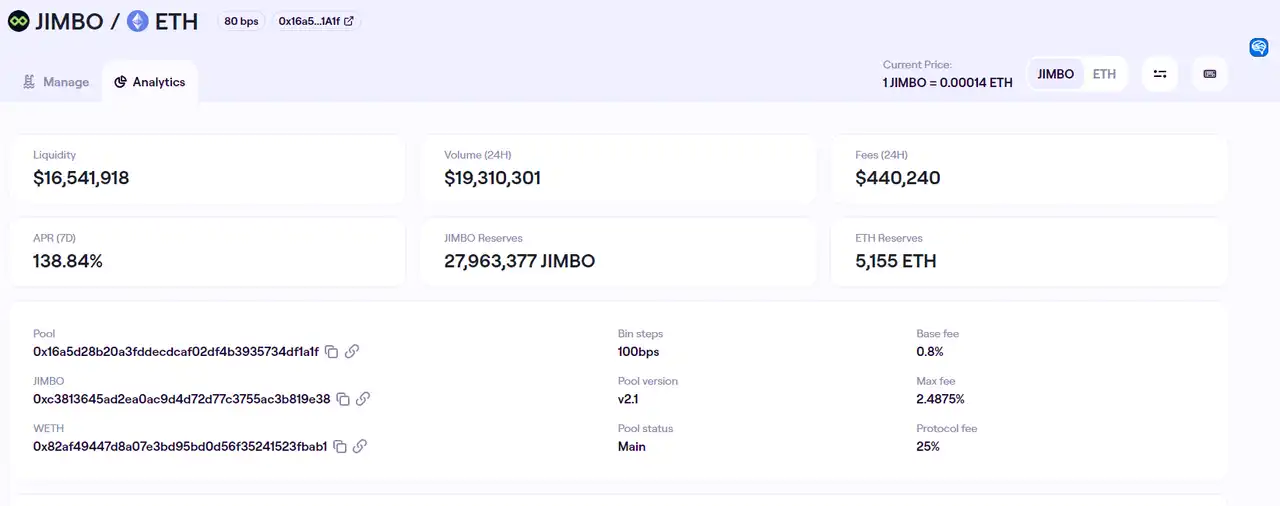
V2.1: Different LB pools charge different protocol fees at rates ranging from 0-25%. For example, in the JIMBO/ETH pool shown below, the base transaction fee rate is 0.8%, the dynamic fee rate upper limit is 2.4875%, and 25% of the protocol fee is charged as the protocol fee.
After the launch of V2.1, the protocol revenue/total transaction fee ratio of Trader Joe has been rising again since hitting bottom in March of this year (0.62%), and currently the protocol revenue accounts for 9.57% of the total transaction fee.
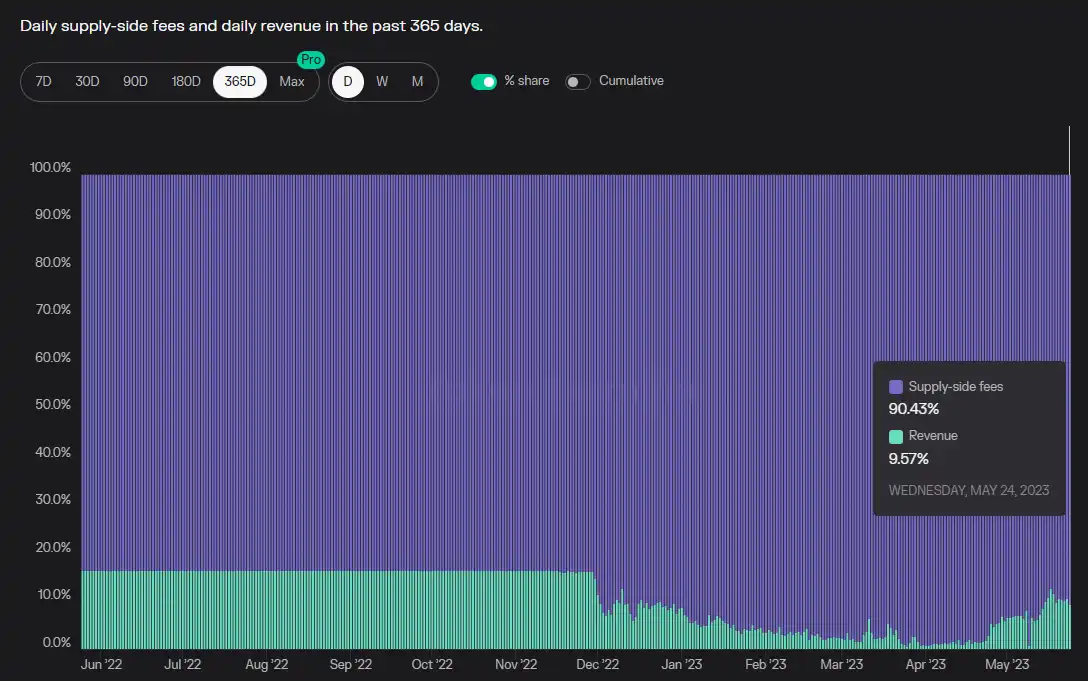
Data source: https://tokenterminal.com/terminal/projects/trader-joe/revenue-share
In order to have a comprehensive understanding of the fee design for Trader Joe's V2.1 protocol, the author has conducted a statistical comparison of the protocol fee rates for several LB Pools with high trading volume on the chain where Trader Joe is located. The details are as follows:
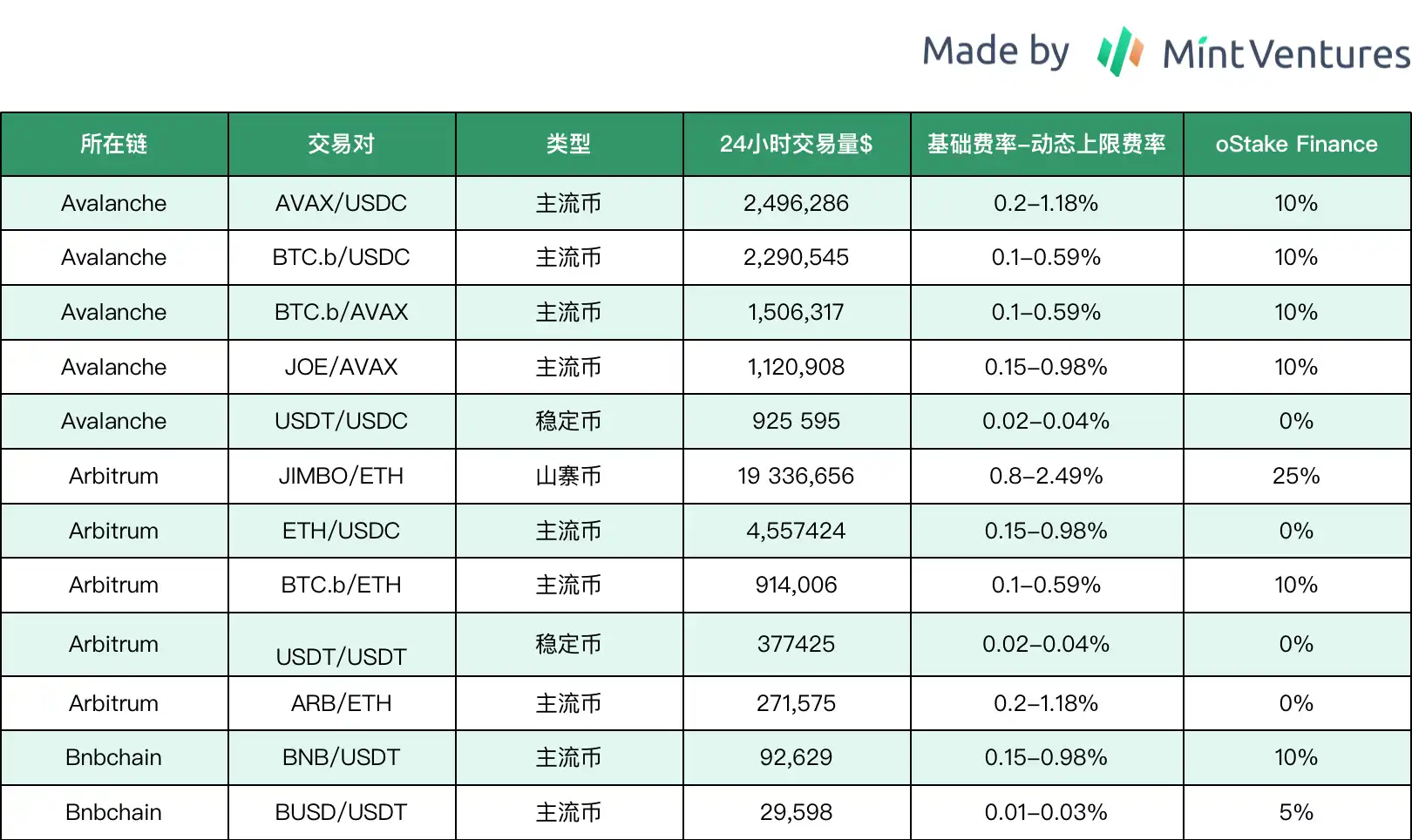
Statistical Time: 2023.5.26
From the above table, we can see that Trader Joe's current pricing strategy for protocol fees is:
1. Focus on developing the Arbitrum market and adopt a strategy of charging minimal or no protocol fees.2. Mainstream stablecoins generally adopt a free strategy, only earning business data (trading volume and TVL) without making money.
3. BNBchain's business can be basically ignored, so normal fees are charged.
4. For new projects, especially those designed based on the LB mechanism (such as JIMBO and LOTUS), higher fees are charged.
3.2.3 Active Users
Data source: https://tokenterminal.com/terminal/projects/trader-joe
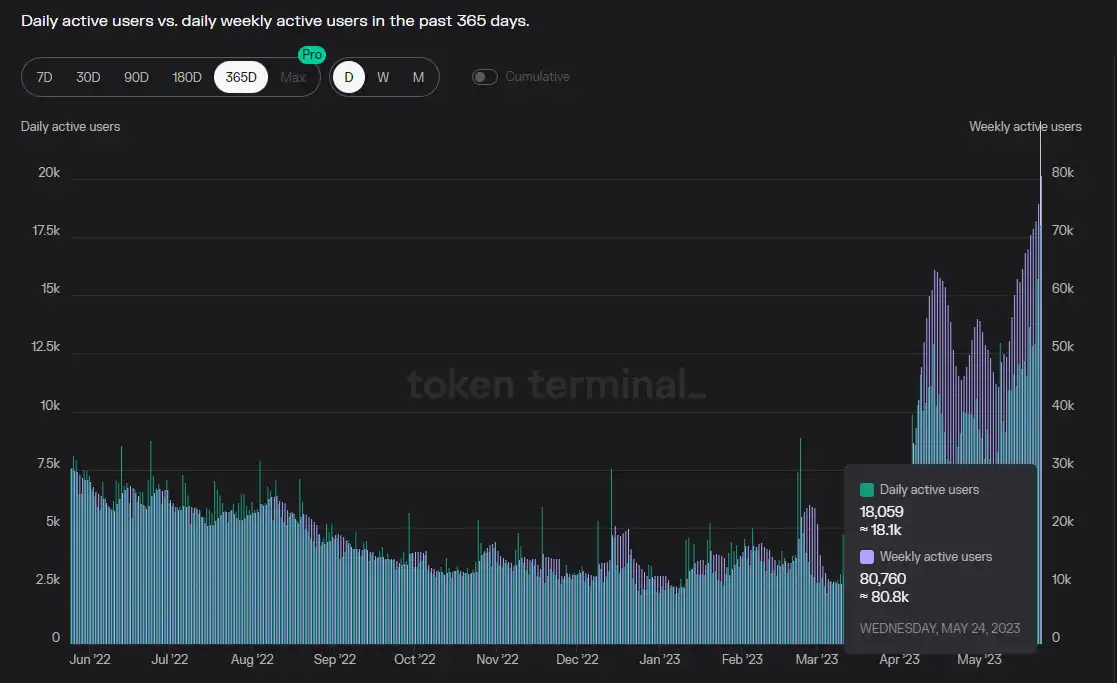
Since the deployment of V2.1, the number of active users on Trader Joe has significantly increased, reaching a new high since the protocol's inception. The recent daily active address count is 18,000, with weekly active addresses exceeding 80,000 (according to Defillama data, it is 110,000), and the monthly active address count is nearly 200,000. The continuous growth of C-end users is likely due to Trader Joe's excellent product interaction experience.
3.3 Project Competition Landscape
From what we can see, Trader Joe has made Avalanche its main business base and is currently focusing its main efforts on expanding its business on Arbitrum, which will be its main source of growth in the near future. We will focus on Trader Joe's market share on Avalanche and Arbitrum.
3.3.1 Avalanche
Avalanche is one of the fastest growing L1s in the previous bull market, but during the bear market, its market share in both TVL and trading volume has been continuously declining. The TVL ratio has dropped from a peak of 9.8% to the current 1.51%, and the trading volume ratio has dropped from 9.84% to the current 1.19%.
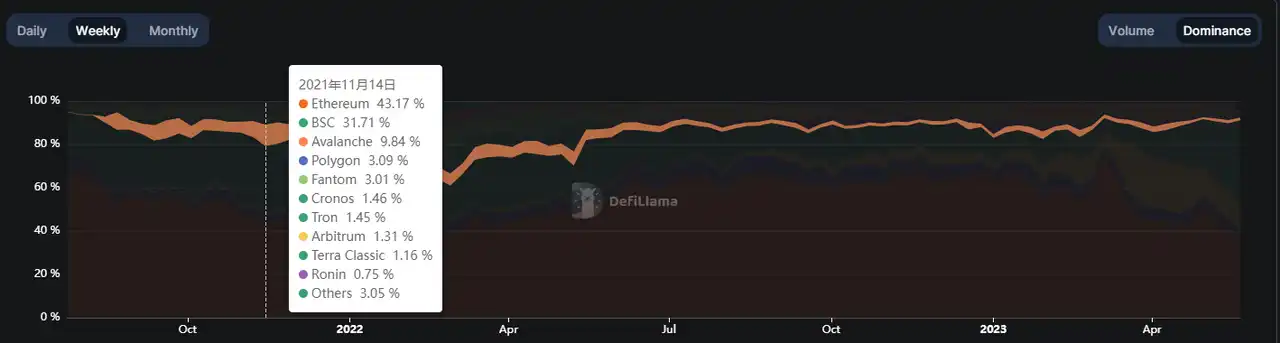
Avalanche trading volume market share, data source: https://defillama.com/dexs/chains
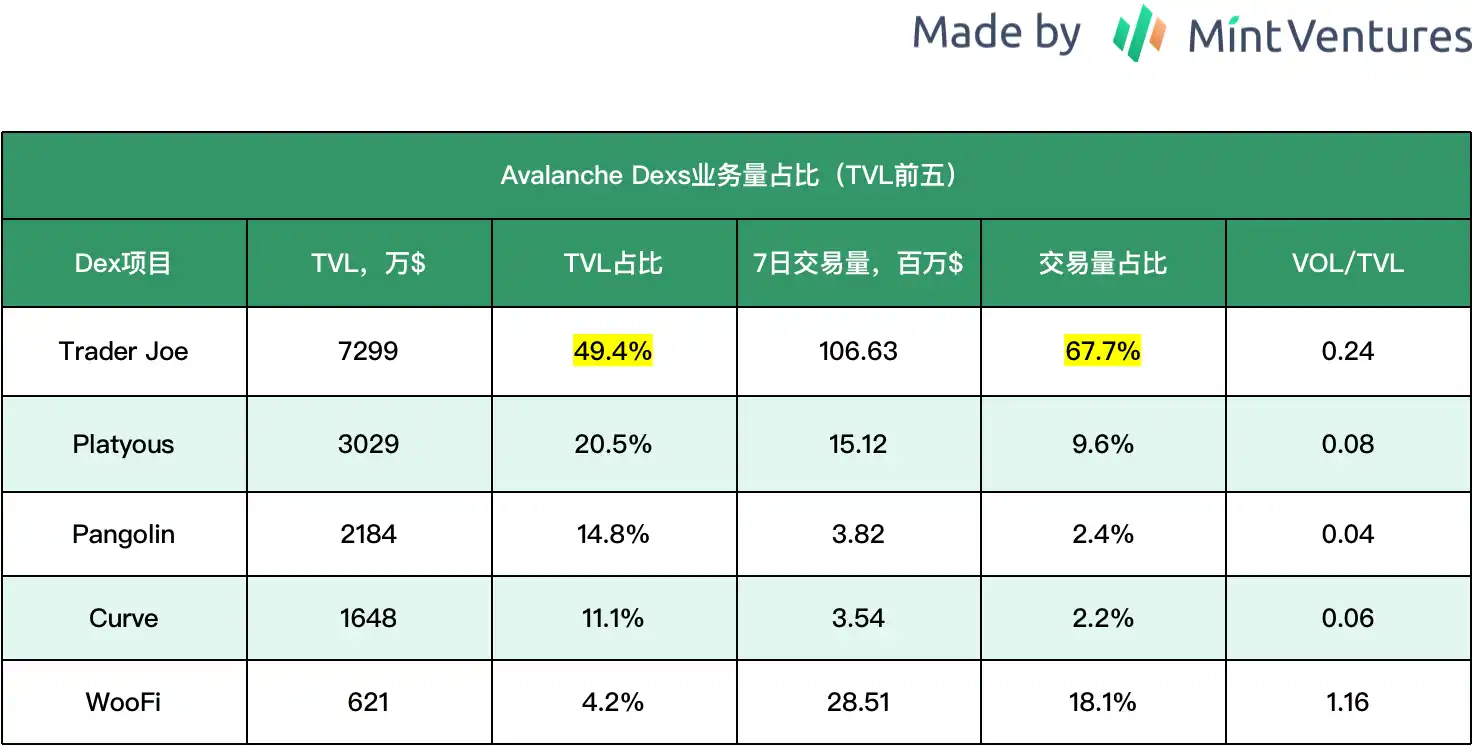
On Avalanche, Trader Joe has an early establishment and development time, with significant advantages in both TVL and trading volume.
3.3.2 Arbitrum
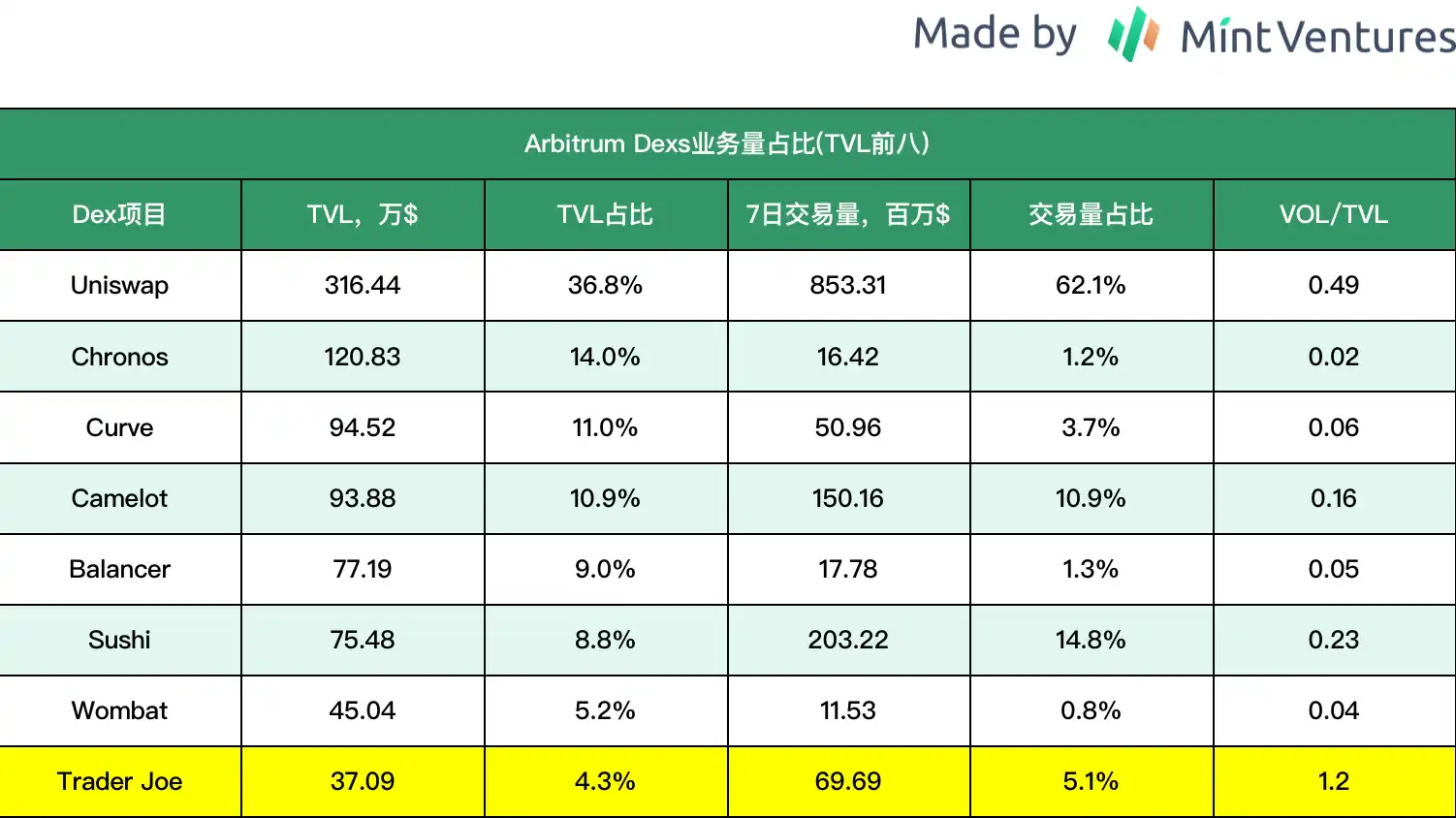
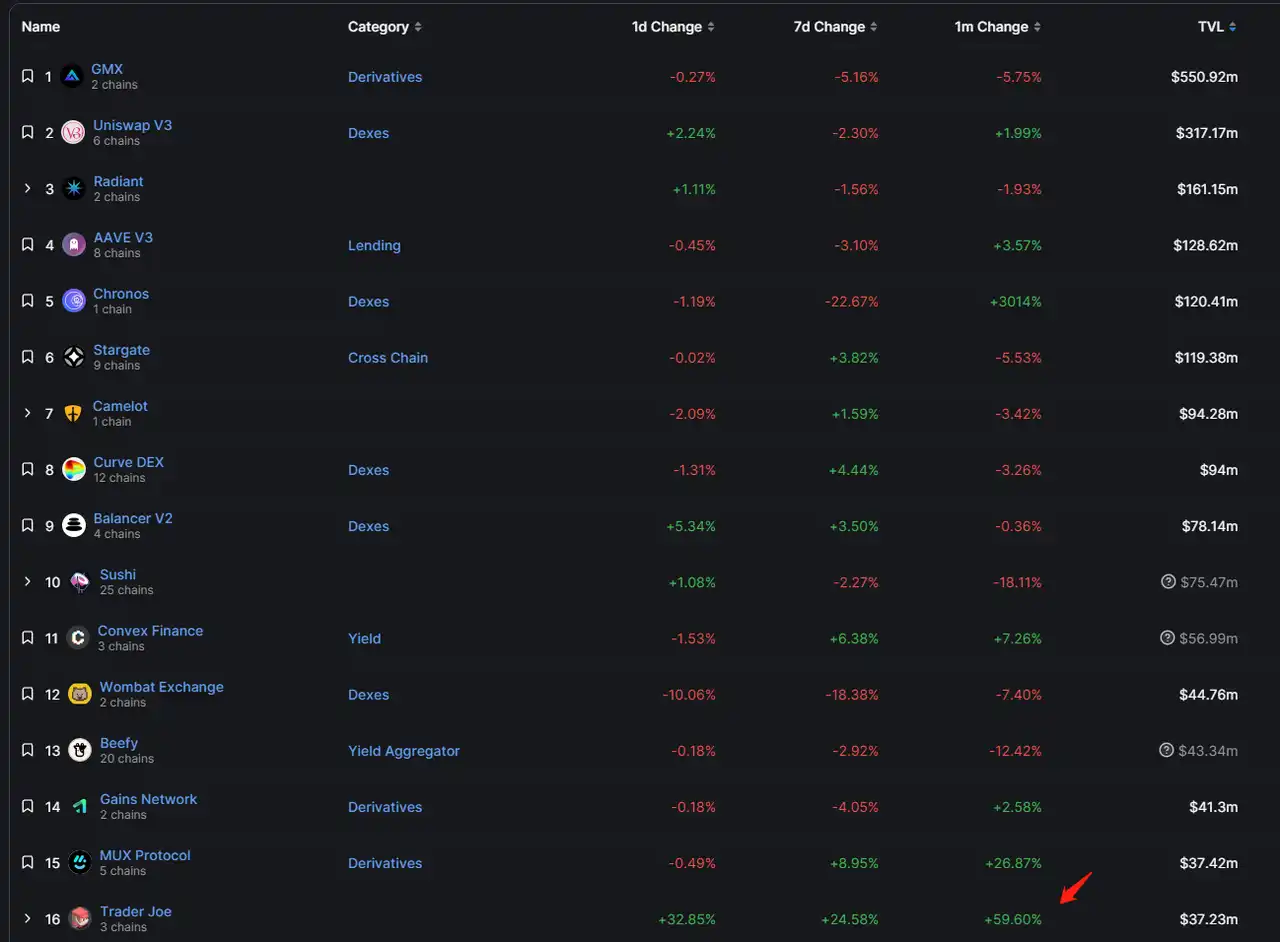
In the above image, the three red circles represent three driving events that have propelled Trader Joe's TVL and trading volume to rise rapidly. However, the underlying logic behind them is slightly different.
a. ARB Airdrop Event
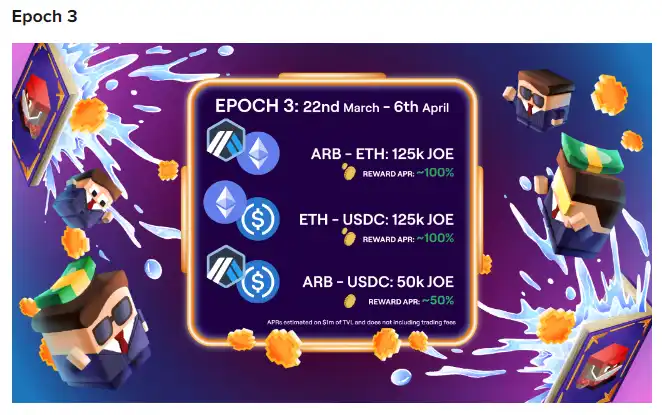
Trader Joe provided 175,000 JOE Tokens as rewards for ARB's liquidity pool (LP) as a market maker LP after the ARB airdrop in the third epoch.
*The liquidity order book reward plan is a dynamic incentive plan for LPs by Trader Joe, similar to a flexible marketing campaign. The author will provide specific details in the Token Model section.
b.LOTUS and JIMBO Launch
LOTUS has been introduced earlier as a Ponzi DeFi project based on Trader Joe for token issuance and price stabilization. JIMBO, on the other hand, is an improved fork version of LOTUS (with two versions, V2 being the top-ranked in terms of trading volume in the image below). These two products have brought tremendous TVL growth to LB (because the ETH and bottoming funds raised are all left in LB), and also created significant trading volume and fee income due to the huge price fluctuations of the tokens during the early stages of their launch. As shown in the figure below, JIMBO's 24-hour trading volume reached $20 million on May 25th, with liquidity reaching $16 million, while LOTUS still has a liquidity of $13 million.
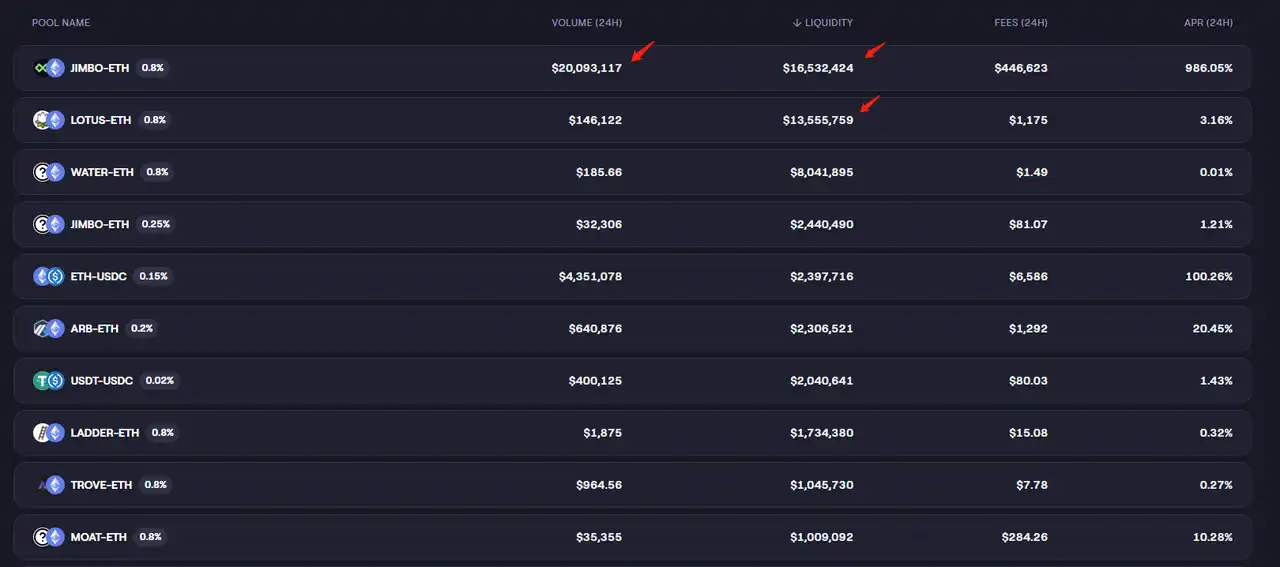
Image source: https://traderjoexyz.com/arbitrum/pool
LOTUS and JIMBO's Ponzi properties may determine the limited lifespan of the project, and the trading volume around such projects is often pulsatile, lacking sustainability.
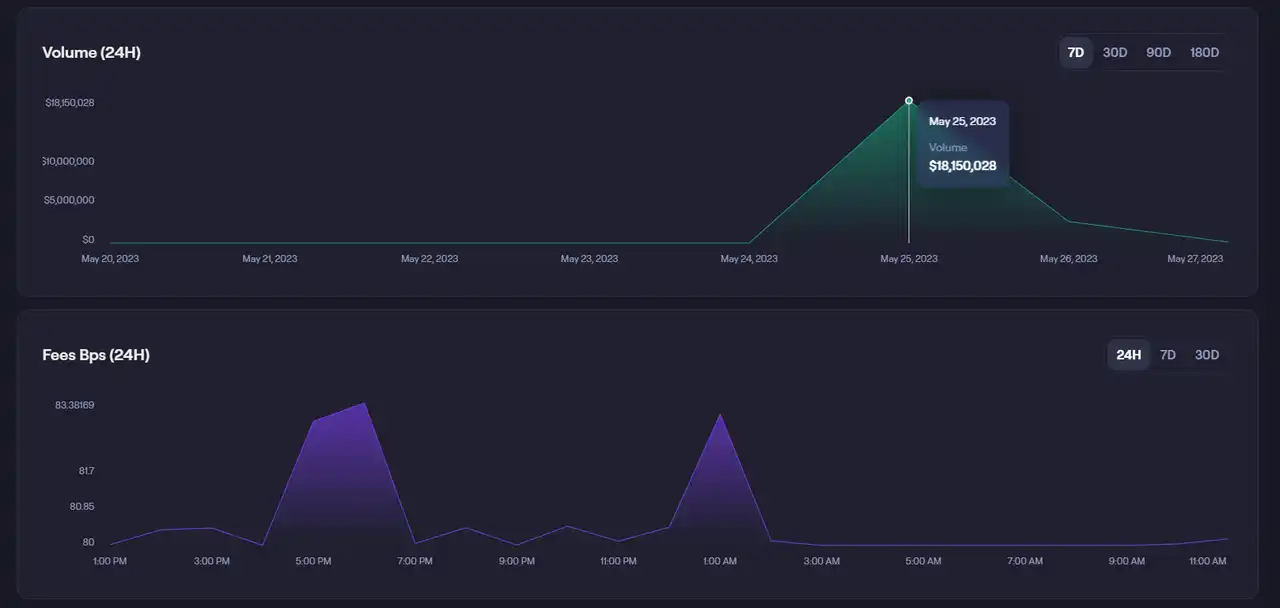
For example, JIMBO V2's LB Pool, the daily trading volume reached 18 million US dollars after the project went online, and quickly dropped to 2.7 million US dollars the next day.
However, based on Trader Joe's interesting attempt and decent fundraising effect using the LB mechanism, it may inspire more projects to build their own liquidity or design more imaginative gameplay based on LB in the future, thus bringing more TVL and trading volume to Trader Joe. However, the sustainability of the incremental trading and liquidity created by these new projects still remains to be observed.
3.4 Token Model Analysis
3.4.1 Token Total Supply, Distribution, and Release Rate
Trader Joe's Token is JOE, with a total upper limit of 500 million. It will be unlocked over 30 months. The Token distribution ratio for JOE is as follows:
分配数量
开发团队
50%
社区激励
20%
基金会
15%
私募投资者
10%
创始团队
5%
Proportion
Liquidity Incentive
50%
Community Treasury
20%
Development Team
20%
Strategic Investors
10%
According to the official unlocking conditions, as of May 27th this year, the total unlocked token amount of 500 million should be around 488 million tokens:
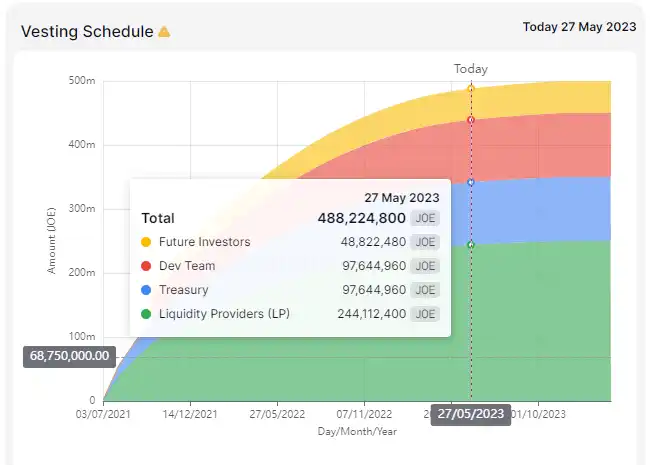
Data source: https://token.unlocks.app/joe
However, according to the circulating supply data provided by the official website, the actual circulating token amount is around 340 million, while other unlocked but non-circulating JOE tokens are mostly in a staking state.
It is worth mentioning that, unlike most other DEX or DeFi projects that still maintain high incentive emissions, Trader Joe's normal liquidity incentive emissions are already very low. Currently, only 850 JOE Tokens (worth about $300) are emitted daily, which is close to 0. After deducting the small emission incentives, Trader Joe has achieved positive profits for 5 consecutive weeks.
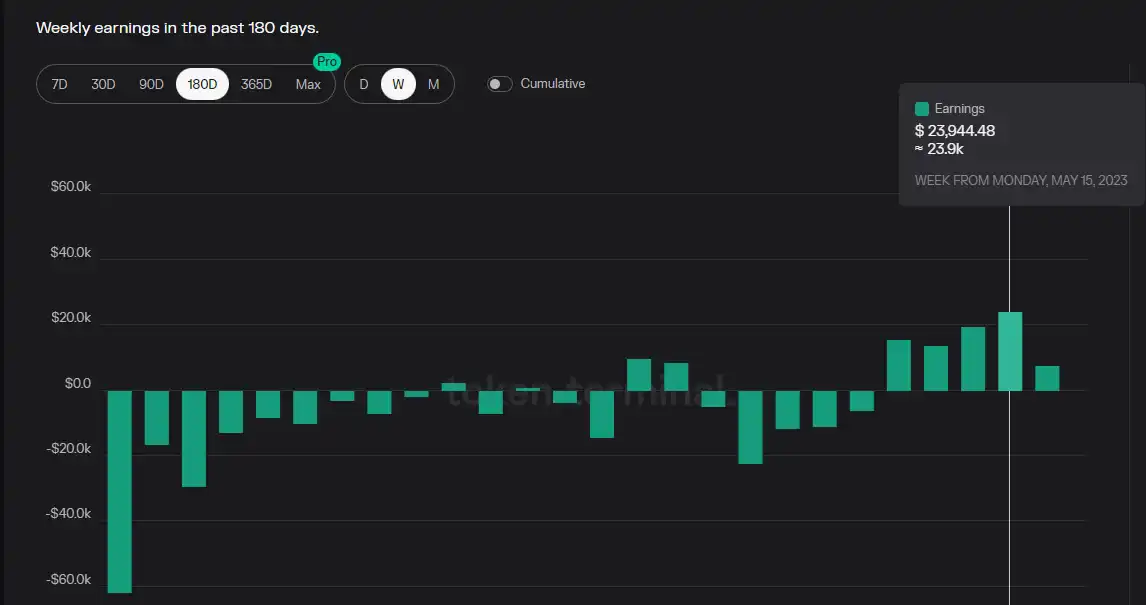
Trader Joe Profit Chart, Source: https://tokenterminal.com/terminal/projects/trader-joe
This does not mean that Trader Joe is no longer incentivizing liquidity. Instead, the team has adopted a phased, short-term, and flexible incentive approach around the LB mechanism, known as the "Liquidity Book Rewards Program." This program incentivizes LPs who provide liquidity in specific LB pools (such as ARB-ETH and ARB-USDC during the ARB airdrop period). Unlike traditional liquidity incentive programs, this program has the following characteristics:
-
Adopting the integral PK system, the calculation object of the integral is not liquidity or trading volume, but "the market-making fees obtained by LP during the activity period". This means that LPs need to provide sufficient liquidity and adjust the liquidity range in a timely and dynamic manner to keep their liquidity in the price range with intensive transactions in order to obtain rewards.
-
Without transparency, in order for users to receive rewards, they need to ensure that their transaction fees capture more than 1% of the total amount in the pool in order to participate in the distribution of rewards.
-
Short cycle, with weeks as the activity unit, allows plans to be flexibly and continuously adjusted according to market changes and hotspots, continuously reducing the "cost-effectiveness ratio" of subsidies.
In my opinion, this is a Token incentive scheme based on a centralized liquidity mechanism, which balances liquidity and trading volume quite well.
3.4.2 Token Use Case
The Trader Joe team has explored multiple dimensions of JOE use cases, including:
Apart from the common industry risks such as smart contract security, regulation, and sluggish development of the encrypted business, Trader Joe's biggest risk comes from the increasingly fierce competition in the Dexs environment.
At one end of the Arbitrum network, despite the rapid growth in liquidity and user volume of Trader Joe, there are still hidden concerns.
Regardless of the growth in liquidity or trading volume, it is driven by short-term events or projects with strong Ponzi mechanisms, and it remains uncertain whether long-term business retention and growth can be maintained. Especially in terms of trading volume, after the trading volume peaks brought by ARB airdrops, LOTUS, and JIMBO issuances, we quickly observed a decline in trading volume and trading share.
The Dexs track where Trader Joe is located seems to have matured, and Trader Joe's business model and products have also matured.
The track where Trader Joe operates is facing fierce competition, and currently, no Dex has a clear competitive advantage, including Trader Joe. However, Trader Joe still has some significant strengths, including:
1. A team with excellent resilience, delivery capability, innovation capability, and operational capability.
2. Excellent product experience.
The Dexs track is still the most fundamental infrastructure in the Web3 business world, with the largest amount of funds and users. As the industry cycle turns warmer, the long-term valuation of this track is still expected to rebound from the current bottom.
What are the main variable factors in the operation of the project? Are these factors easy to quantify and measure?
It is a brutal competition situation in the Dex industry. On a quantitative level, we can track and observe the data of liquidity, trading volume, and profit levels of projects to confirm changes in their market share. On a qualitative level, it is crucial to observe whether there are more new projects issuing and configuring liquidity based on Trader Joe's LB.
What is the management and governance approach of the project? How is the DAO level?
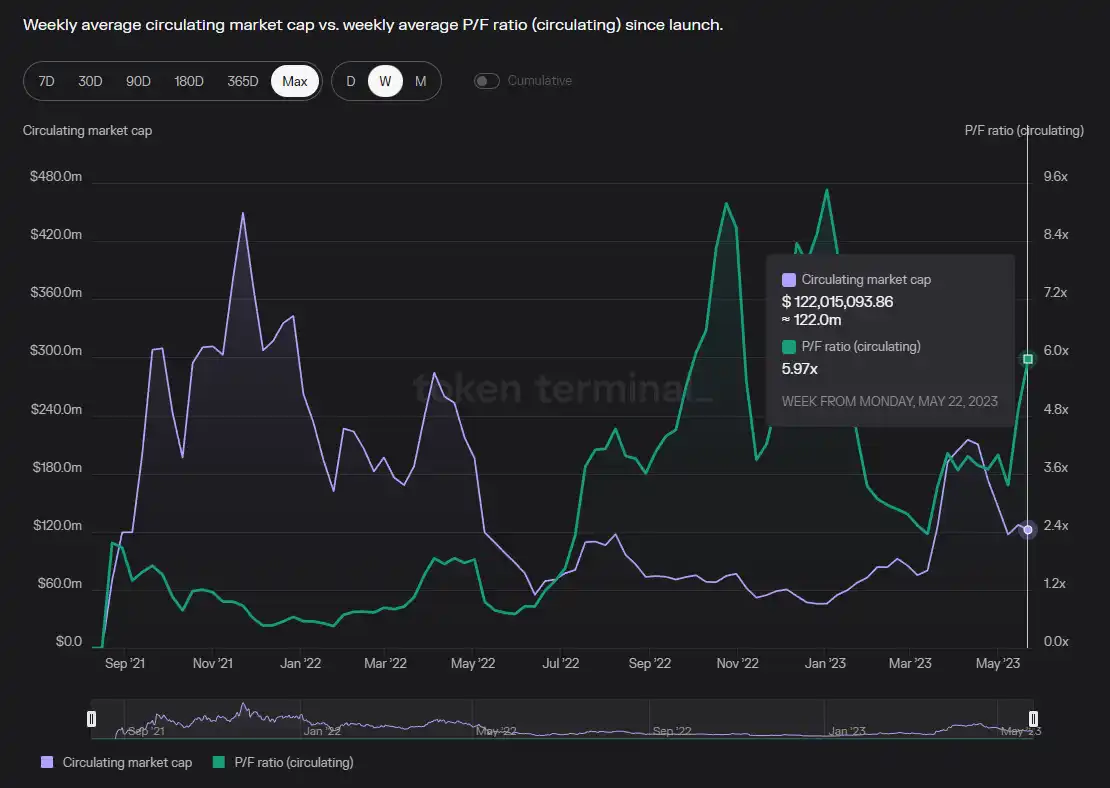
Specifically, during a bull market cycle: market trading volume is active, transaction fees rise rapidly, although market capitalization is also rising, the growth rate of trading volume is significantly higher than the rate of market capitalization growth, ultimately resulting in a decrease in PF and PS.
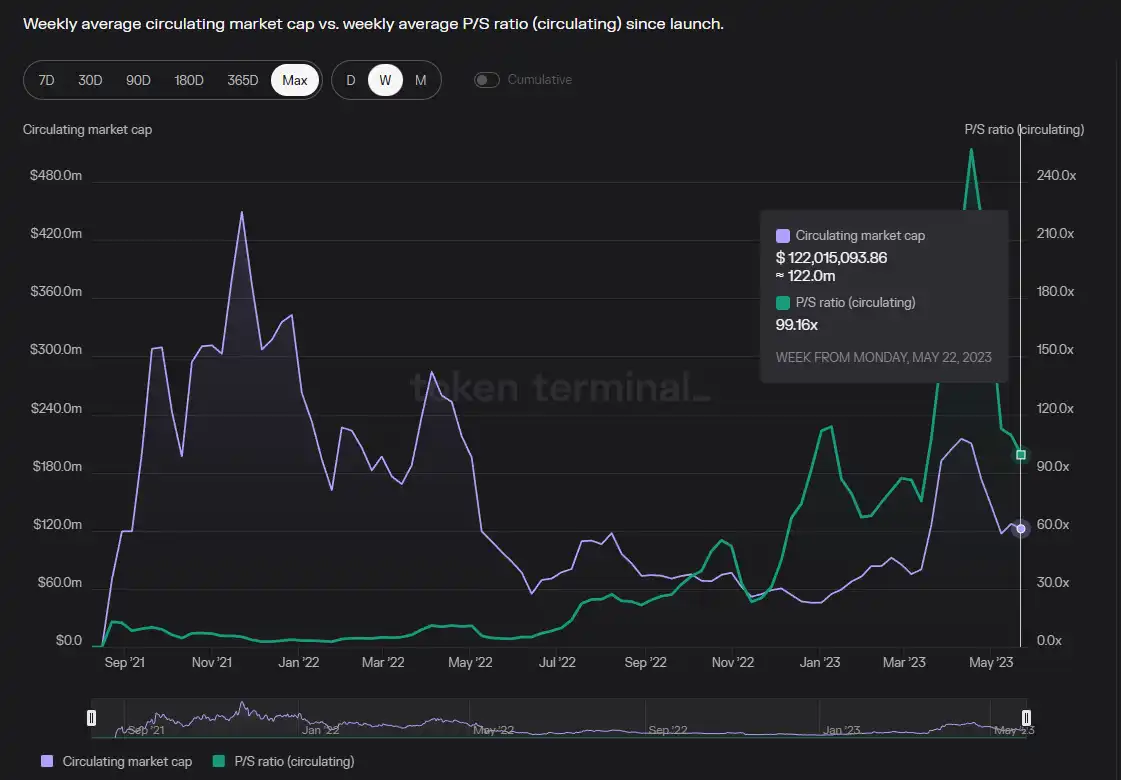
PS value, time span: 2021.8-2023.5, data source: https://tokenterminal.com/terminal/projects/trader-joe
And as we enter the bear market, trading volume and protocol revenue quickly shrink. Although the market value also declines synchronously, the decline rate is slower than the decrease in revenue, ultimately resulting in a rapid increase in the ratio of expenses to income.
Horizontal Valuation Comparison
Among the many DEXs, we have excluded projects such as Curve, Balancer, and Velodrome that engage in liquidity trading outside of transactions, and have chosen to compare Uniswap, Pancakeswap, Sushiswap, Quickswap, and Trader Joe, which have more similar business models.
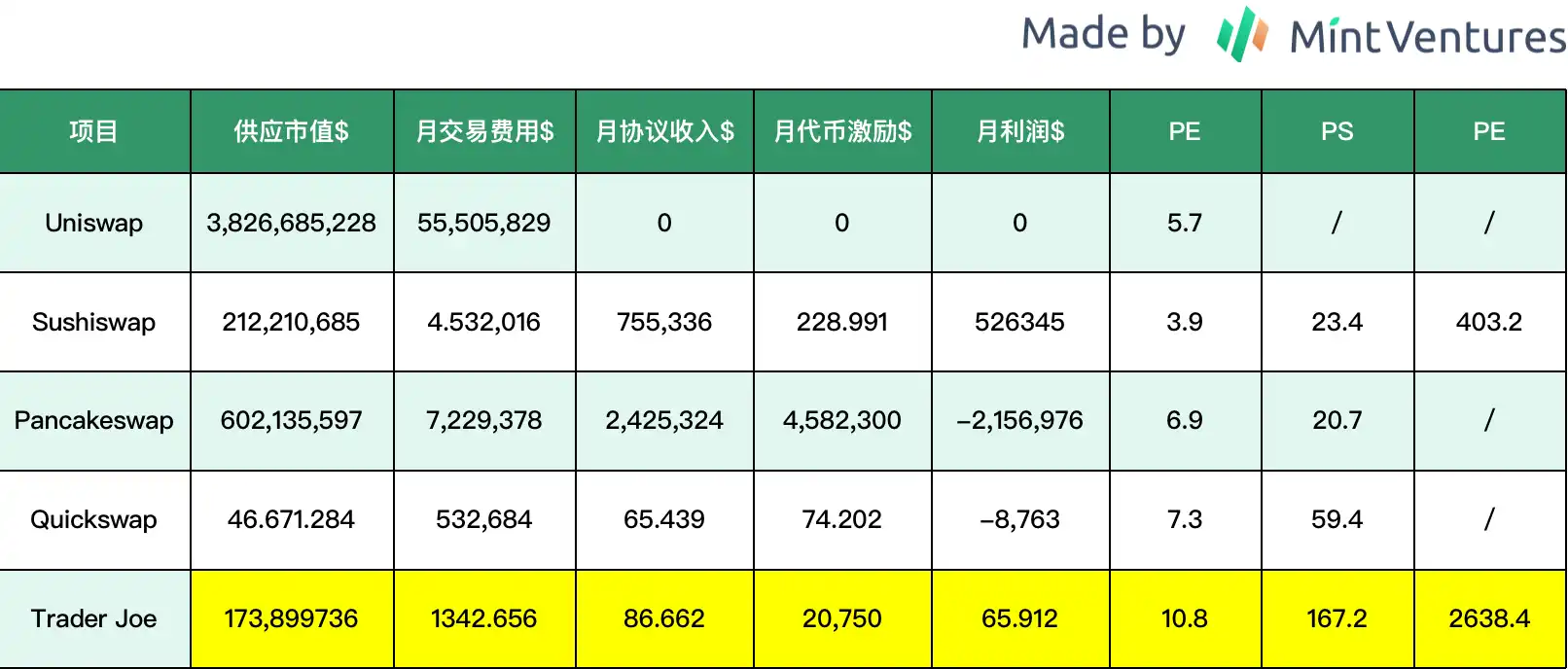
From the comparison of the above data, it can be seen that regardless of the cost ratio, income ratio, or profit ratio, the current market has given relatively high valuation to Joe. This relative premium valuation to the market peers may come from the optimism about the resilience and innovation ability of Trader Joe's core team, or the expectation for the future development of the LB mechanism. It's a matter of perspective.
4.3 Summary
Trader Joe's core strengths lie in its resilient, highly capable and innovative team, excellent product experience, and innovative liquidity order book, which have enabled rapid user growth. Currently, Arbitrum is the main engine driving its business growth.
However, the intense competition in the Dexs track continues, which means that each project in the track does not have strong bargaining power for traders and liquidity providers. Most projects are operating at a loss or with thin profits, and it is difficult to improve this market competition situation in the short term. However, due to the dual cyclical nature of the cryptocurrency market and the Dexs track, projects represented by Trader Joe still have the potential to outperform the overall market.
5. Reference
Midaswap: Joe V2: Perhaps the appearance of an unfinished "Uniswap V4".
Trader Joe Document: https://support.traderjoexyz.com/en/
Liquidity Book Document: https://docs.traderjoexyz.com/Market cap data: https://www.coingecko.com/Liquidity and trading volume data: https://www.coingecko.com/, https://defillama.com/home.
Token unlocking data: https://token.unlocks.app/原文链接Translation:
Original article link
Welcome to join the official BlockBeats community:
Telegram Subscription Group: https://t.me/theblockbeats
Telegram Discussion Group: https://t.me/BlockBeats_App
Official Twitter Account: https://twitter.com/BlockBeatsAsia

 Related Articles