Wanwu Research Institute: From ERC20, 721, 1155 to 3525, elaborating on the path of RWA towards Web3 Mass Adoption.
Original Title: "Research Institute of All Things: From ERC20, 721, 1155 to 3525, Describing in Detail the Path of RWA towards Web3 Mass Adoption"
Original Source: "Spinach Spinach Research Institute of All Things"
Since the birth of blockchain technology in 2008, the cryptocurrency market has experienced rapid development. However, the total market value of the entire cryptocurrency market is still not as high as that of Apple, and Web3 still lacks practical applications in the real world. However, a new research report from Citibank, "Money, Tokens and Games," may change this situation. In the report, Citibank sees Real World Asset Tokenization (RWA) as the next major narrative, believing that it could have a huge impact on the development of Web3, bringing the blockchain and Web3 industries the next billion users and potentially trillions of dollars in economic activity.
In the narrative of Real World Asset Tokenization (RWA), the author of this article, a researcher at Wanwu, believes that the ERC-3525 standard has enormous potential. This is a semi-fungible token (SFT) standard that combines the characteristics of ERC-20, ERC-721, and ERC-1155, making it more effective in representing and managing more complex assets such as bonds, coupons, invoices, futures, options, and ABS. In this way, ERC-3525 has great potential to promote the development of RWA and drive the widespread application of Web3 in the real world.
This article compares the components of ERC-20, ERC-721, ERC-1155, and ERC-3525 to help readers understand the differences between these token standards. Then, it explores the digital world modeling concept of ERC-3525 from three levels and finally looks at the areas where ERC-3525 is worth paying attention to in the future. Finally, many thanks to Samo, a teacher at the Institute of Everything Research, for his careful optimization and polishing of this article!
Table of Contents
Background Introduction
Comparison of Existing ERC Token Standards - How to Understand ERC-3525?
ERC-20
ERC-721
ERC-1155
ERC-3525
Understanding ERC-3525 as a digital world modeling concept from three perspectives
可拆分组合的超级 NFT
Translated to English:可拆分组合的超级 NFT
Super NFT that can be split and combined
Universal digital container.Visual smart contract.What ERC-3525 application areas are worth paying attention to in the future?
Real-World Assets (RWA) on the chain
Virtual assets or commodities.Social, identity fields, and tokenized accounts.Before introducing ERC-3525, let's first introduce what EIP and ERC are:
EIP, short for Ethereum Improvement Proposals, is a framework within the Ethereum community that allows anyone to propose improvements or updates to the Ethereum network. These proposals can involve the Ethereum protocol itself, related client APIs, or provide standards for other projects within the Ethereum ecosystem.
ERC, short for Ethereum Request For Comment, is a special type of EIP that focuses on application-level standards such as smart contract design patterns and interface definitions. These ERCs typically provide a standard template for Ethereum application developers to ensure that different projects and applications can have a shared interface or standard. All ERCs are EIPs, but not all EIPs are ERCs. EIPs cover a wider range, including changes to underlying protocols and so on.
ERC-3525 was created on December 1, 2020 by the core members of Solv Protocol, with the support of core developers in the Ethereum community. The process from initial proposal to community acceptance took 20 months and was refined through several drafts. In September 2022, it was officially adopted as an ERC token standard. As a standard created by a team of Chinese core members for Ethereum, ERC-3525 has also attracted a new wave of attention in the industry.
Comparison of Existing ERC Token Standards - Understanding ERC-3525
ERC-3525 is a semi-homogeneous token (SFT) standard. Many people may think of ERC-3525 as a Frankenstein's monster of ERC-20 and ERC-721 when they first learn about it. However, in reality, ERC-3525 is a fundamental and versatile standard that even has overwhelming advantages over ERC-20, ERC-721, and ERC-1155 in certain fields. In the following content, we will compare the key components of other token standards (ignoring names, symbols, and other attributes) and their advantages and disadvantages to help you understand ERC-3525.
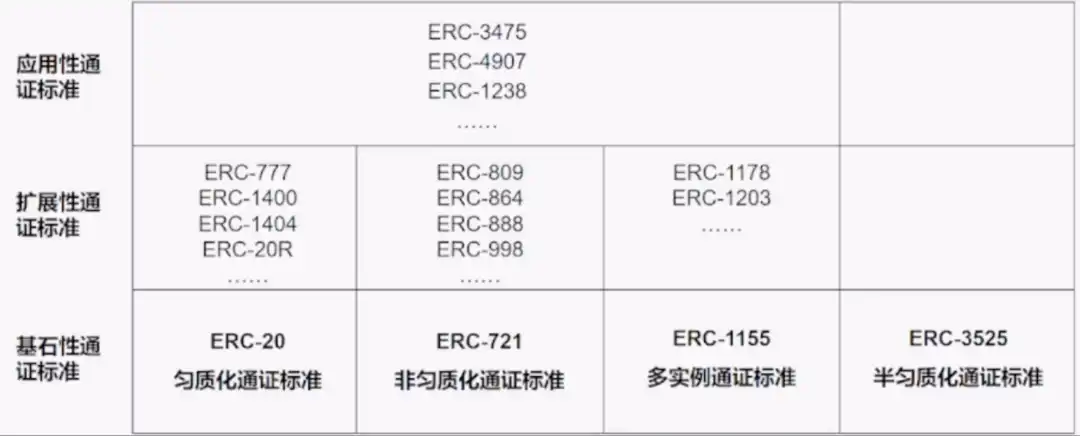
Image source: solv.finance PPT
ERC-20
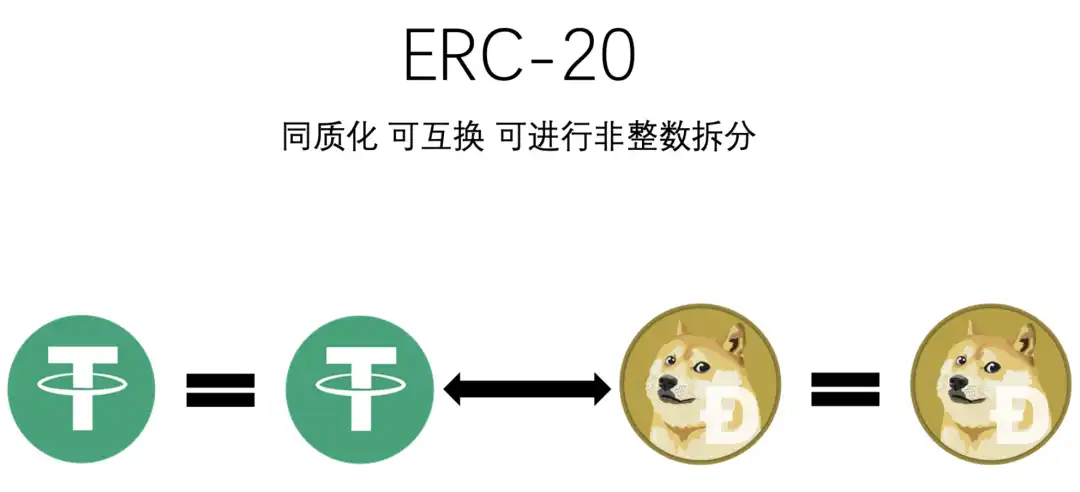
ERC-20 is one of the most widely used token standards for Ethereum applications, which is a homogeneous token, meaning that each token is functionally and financially equal without any distinction. This is why they are called "homogeneous". Stablecoins are an important example of ERC-20 applications, and each stablecoin is homogeneous and interchangeable, representing the same value.
Key components: address and value. Address refers to the address of the asset owner, while value represents the amount of tokens owned by that address. Under the ERC-20 standard, each address can be associated with a balance (value) that represents the amount of tokens held by that address. All balances are the same and there is no distinction between them.
Feature advantages: ERC-20 tokens correspond to interchangeable assets, just like traditional currencies or stocks, which makes ERC-20 very useful in many applications, such as representing company shares or serving as trading pairs on decentralized exchanges (DEXs). ERC-20 is also widely used in DeFi applications, such as lending platforms and liquidity mining, and ERC-20 tokens can be split into non-integer amounts, so you can own 0.5 ERC-20 tokens.
Limitations: Due to the fact that ERC-20 tokens are completely interchangeable, they cannot be used to represent unique or non-fungible assets, such as art or collectibles.
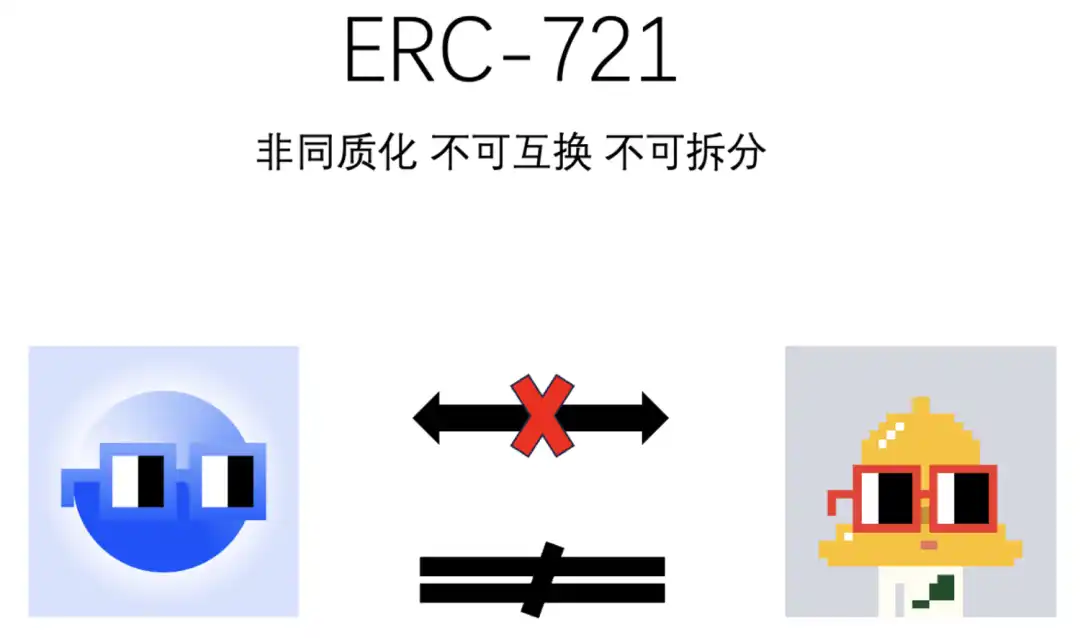
When it comes to ERC-721, we have to mention Non-Fungible Tokens (NFTs). Well-known NFTs such as Bored Ape Yacht Club and Azuki belong to the ERC-721 standard, which describes how NFTs should be created and managed on the Ethereum blockchain.
Unlike ERC-20 tokens where each unit is equivalent, each unit of ERC-721 tokens is unique and non-fungible, making them an ideal choice for representing unique digital or real-world assets such as art, real estate, collectibles, etc. The earliest NFT CryptoPunk was not based on the ERC-721 standard, but on the ERC-20 standard. However, the emergence of CryptoPunk led to the creation of the ERC-721 standard, which has become the foundation for many valuable NFT applications.
Key components: tokenId and owner. TokenId is a unique identifier used to distinguish different ERC-721 tokens, while owner is the address of the token owner. Under the ERC-721 standard, each token is different and unique, distinguished by the ID attribute, and each ID is associated with an owner.
Features and Advantages: ERC-721 tokens are non-fungible, meaning each token is unique. This makes them ideal for representing unique items or assets such as artwork, collectibles, real estate, or other unique assets. This also makes them highly valuable in creating and trading digital art and other unique digital assets.
Limitations: Due to the non-fungible nature of ERC-721 tokens, they cannot be effectively used to represent interchangeable assets such as currency or stocks. They lack liquidity advantages and have poor composability as they cannot be divided. You cannot own 0.5 ERC-721 tokens.
ERC-1155
ERC-1155 is a multi-instance token standard that combines the features of ERC-20 and ERC-721, aimed at handling multiple types of tokens more efficiently and flexibly. In the previous ERC-20 and ERC-721 standards, a new smart contract needed to be deployed for each different token. This means that if you want to create a new token, you need to deploy a new contract, which may result in duplicated code and expensive gas fees. Additionally, complex interactions may need to be handled between different contracts.
ERC-1155 provides a way to manage multiple types of tokens in a single smart contract, where each token can be homogeneous (like ERC-20 tokens) or heterogeneous (like ERC-721 tokens). For example, in a game, you can use ERC-1155 to create different types of weapons (heterogeneous) such as sticks, knives, and guns, where each weapon in each type (heterogeneous) is homogeneous. For instance, weapon #1 and weapon #10 in the same type (heterogeneous) are exactly the same (homogeneous), but knives and guns are different (heterogeneous).
Key components: id, value, and owner. Id is a unique identifier used to distinguish different ERC-1155 tokens, value represents the quantity of tokens for a specific id, and owner is the address of the token owner. Using the example of weapons, different types of weapons represent different IDs, and the quantity of weapons for each type (ID) is the value. The weapons (value) for each type are the same.
Features and Advantages: ERC-1155 tokens can represent both interchangeable and non-fungible assets simultaneously, making them very useful in a variety of applications. For example, a game may use ERC-1155 tokens to represent a player's equipment type (non-fungible) and equipment quantity (fungible).
Limitations: Although the flexibility of ERC-1155 tokens makes them useful in many cases, this flexibility also makes understanding and implementing ERC-1155 potentially more complex than ERC-20 or ERC-721, and they cannot represent assets that can be partially exchanged, such as bonds or futures, and cannot be split into non-integer amounts. You cannot own 0.5 ERC-1155 tokens.

ERC-3525
ERC-3525 is a semi-fungible token (SFT) standard that combines the characteristics of ERC-20, ERC-721, and ERC-1155. It is more complex than ERC-1155, but can be used to express and manage complex digital financial assets such as securities, bonds, options, futures, swaps, insurance policies, etc. Compared to other token standards, ERC-3525 is more versatile and represents a digital world modeling concept that can be understood from three levels: super NFTs that can be split and combined, universal digital containers, and visual smart contracts.
Key components: id, value, Slot and Address. Each SFT has an id property equivalent to ERC-721 to identify it as a globally unique entity, allowing SFT to be transferred and approved between addresses in a way that is compatible with ERC-721. In addition, each token also contains a value property, representing the quantity nature of the token, similar to the "balance" property of ERC-20 tokens.
Address represents an address that has a Slot and ID. Each address can have any number and type of ID and Slot. The unique property of Slot is that Values of different IDs with the same Slot can be transferred and exchanged, while Values with different Slots cannot be transferred or exchanged. A Slot can have many types of IDs, but different IDs can only have one Slot.
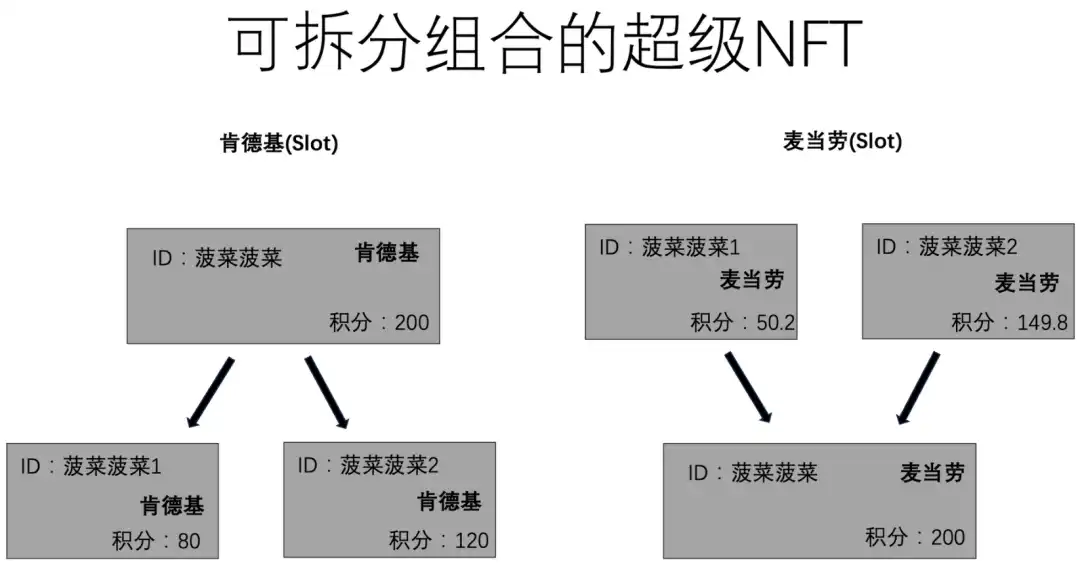
The focus of ERC-3525 is on Slots. Simply put, a Slot represents a category, and there will be many IDs under the same Slot. Although each ID has its own Value and is different, different IDs under the same Slot can be considered the same and can be exchanged, combined, or split. Taking a membership card as an example, suppose the membership card has two Slots, KFC and McDonald's. Each KFC and McDonald's membership card has a different ID representing different people's membership cards, such as Satoshi Nakamoto's card and V God's card. Each person's membership card has a Value to represent their points.
Take the membership card as an example. Suppose the membership card has two slots, KFC and McDonald's. Each KFC and McDonald's membership card has a different ID representing different people's membership cards, such as Satoshi Nakamoto's card and V God's card. Each person's membership card has a Value to represent their points.
So in the same Slot, which is the KFC membership card, the points in the Nakamoto card and the points in the V God card are considered the same thing. Nakamoto can transfer points to the V God card and receive points sent from the V God card. Nakamoto can also split the points in their own point card into main card and subsidiary card (two different IDs, with arbitrarily assigned point values), and can also merge the main card and subsidiary card back together.
And in different Slots, KFC and McDonald's, as two different companies, KFC's points cannot be transferred to McDonald's points card, so they do not have the transferability, exchangeability, and combinability between Value and ID.
Feature advantages: ERC-3525, due to its more complex structure, can be used to represent various complex digital structures such as securities, bonds, options, futures, swaps, insurance policies, membership cards, etc. In addition, because it is a semi-homogeneous token, each token can have its own characteristics and rules, making this standard very flexible and powerful. And, due to the existence of Slots, ERC-3525 can achieve transfer from ID to ID, just like Satoshi Nakamoto's point card transferring points to Vitalik Buterin's point card, and also support non-integer splitting and combination.
Limitations: The complex structure of ERC-3525 makes it difficult to understand. Due to the existence of Slots, there are more centralized features in the technical structure. The development difficulty is high.

Understand ERC-3525 as a digital world modeling concept from three perspectives
ERC-3525, due to its more complex structure compared to other token standards, represents a universal token standard that, through its data structure's composability, enables the creation of various complex token structures in the digital world, much like using LEGO blocks to create various complex models in the real world. It can be said that ERC-3525 represents a digital world modeling concept. To gain a deeper understanding of ERC-3525, it can be understood from three aspects: super NFTs that can be split and combined, universal digital containers, and visual smart contracts.
可拆分组合的超级 NFT:
Splitable and combinable super NFTs:
ERC-3525 can express three token standards, ERC-20, ERC-721, and ERC-1155, by simply converting its attributes. For example, to express ERC-20, the Value under the same Slot and with only one ID can represent a fungible token.
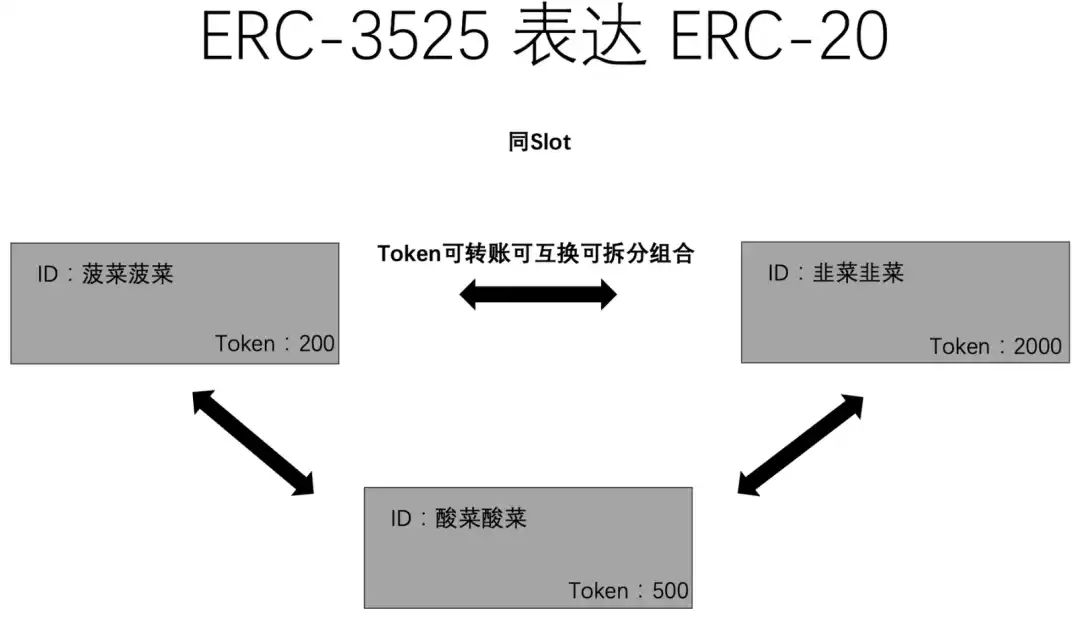
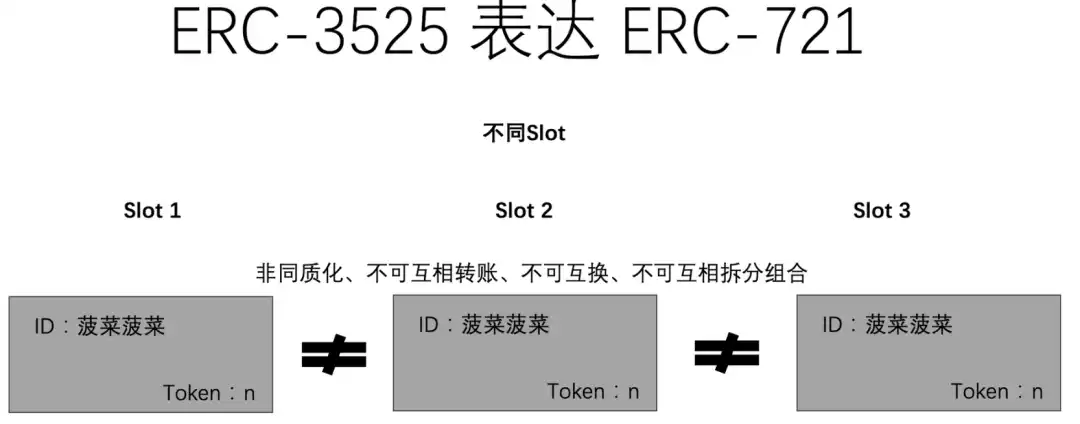
Expressing ERC-721: When the slot is different, only one ID can represent non-fungible tokens.
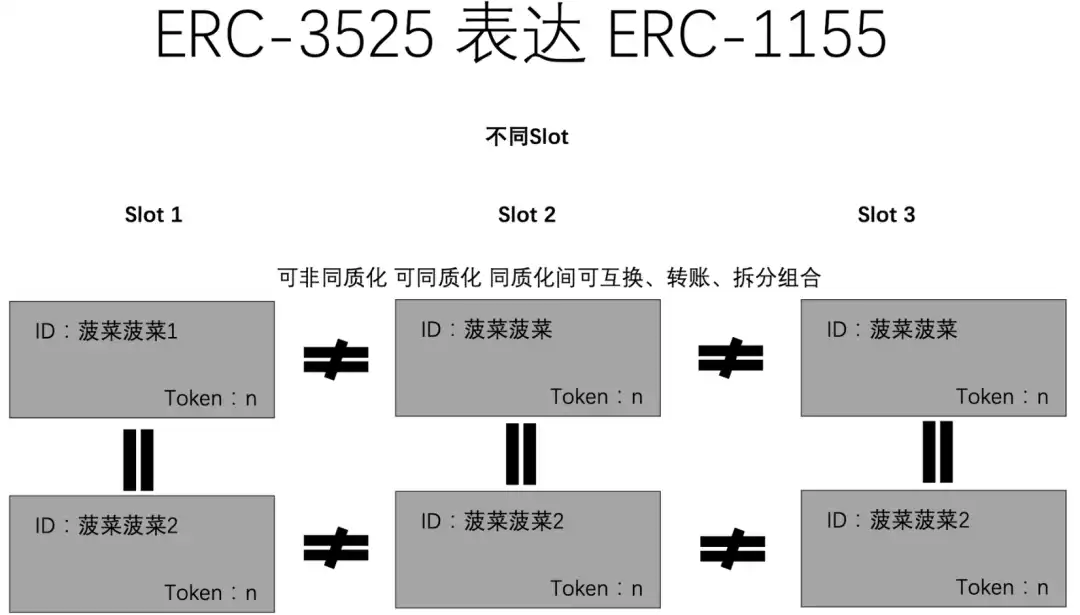
Expressing ERC-1155: When slots are different, having multiple IDs can represent multiple instances of tokens.
However, ERC-3525 is more than that. Above all, ERC-3525 can achieve the splitting of non-fungible tokens. For example, a bored monkey can be truly split into several parts rather than being fragmented into NFTs through an additional contract. For most people who first learn about ERC-3525, the common understanding may be to understand ERC-3525 as a super NFT that can be split and combined. There is no problem with this understanding, but this is just the tip of the iceberg and does not fully comprehend the greater potential of ERC-3525.
Universal Numeric Container:
To understand ERC-3525 as a universal digital container, it is necessary to understand that ERC-3525 is an Account Abstraction. As mentioned in the case of membership cards, ERC-3525 can realize the transfer between IDs, where the internal ID is essentially an account with the ability to receive, store, and send, like a basket filled with various digital assets. Since ERC-3525 is an abstract account, it means that we can separate the operation permission of an ID in a certain slot and grant it to other wallet addresses, not just the owner of this ERC-3525 smart contract.
The difference between the account abstraction of ERC-3525 and ERC-4337 is that ERC-4337 decouples the signature and ownership of the smart contract wallet, allowing for custom signature methods such as traditional account password operation of the wallet, while ERC-3525 still relies on EOA wallet accounts (wallets operated using private keys) for operation, and an ID can only receive assets under the same slot.
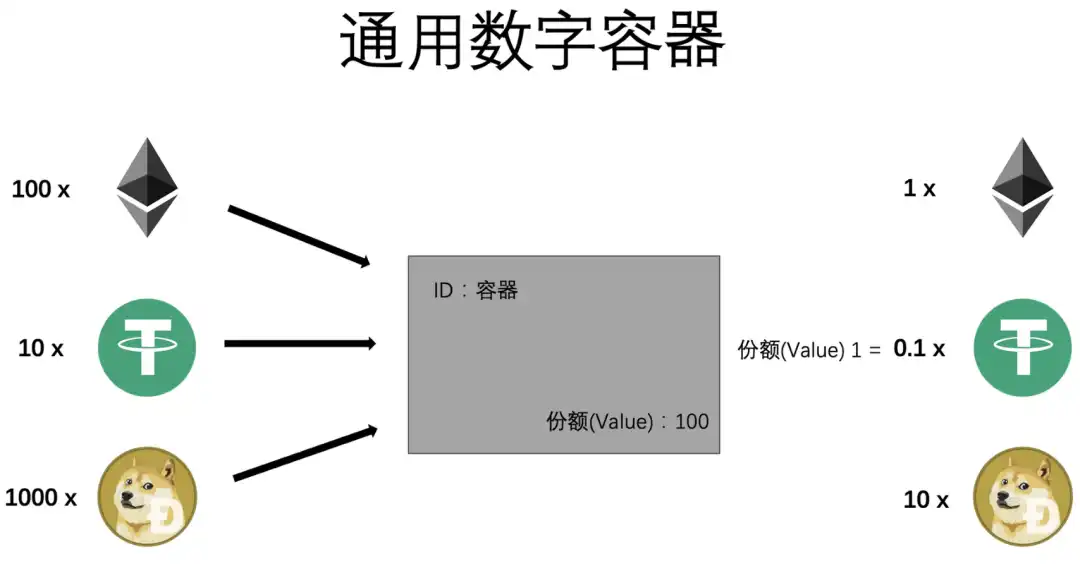
If the ID of ERC-3525 is understood as an account with receiving, storing, and sending functions, it means that it can serve as a container for digital assets. Any digital asset can be poured into this universal digital container as a solution and become a uniform solution. At this point, the Value of this ID becomes a share of a basket of assets.
For example, in a Slot, container A (ID: A) was filled with 100 bitcoins and 10 ethers. After entering the container as a solution, bitcoins and ethers will become a uniform solution. If the value of container A is evenly divided into ten parts, each split container will have the same 10 bitcoins and 1 ether. If this container is combined with another container with a different composition solution (100 Doge), the solution in the new container represents 10 bitcoins, 1 ether, and 100 Doge. Similarly, this container can be further split and combined, and the solution inside (Value) represents the share of this basket of assets.
Understanding this level allows you to feel the magic of ERC-3525. Through its complex data structure and flexible composability, you can create countless complex token structures in the digital world, just like Russian nesting dolls, where many layers of assets can be nested repeatedly in containers. This is very suitable for expressing some structured financial assets such as ABS, MBS, etc.
Visual Smart Contract:
ERC-3525, as a visual smart contract, is not difficult to understand in this context. It can be compared to a container with a real-time updated display screen, showing all the information and changes in the container, such as the components in a solution (which assets and what proportions). The visual feature makes it easier to manage and more transparent.
After the burst of the internet bubble, the United States launched a loose monetary policy with low interest rates to stimulate the economy, which led to more people taking out loans. If you have watched a movie called "The Big Short", you should be impressed by a scene in which a person can borrow money from a bank even without any collateral, and even in the name of his dog. Why can such outrageous situations happen? Are banks not afraid that these people will not repay the money? In fact, banks are not afraid because there is a financial derivative called MBS.
Mortgage-Backed Securities (MBS) is an asset-backed security whose income stream comes from a group of mortgage assets, such as residential or commercial mortgages. These loans are packaged and sold by loan providers (such as banks) to special purpose entities (SPEs), which then convert them into securities that can be sold to investors.
This operation essentially packages a group of mortgage loans into a new financial product and sells it to investors. For banks, this operation can transfer the original loan risk, obtain cash by selling these packaged mortgage loans, and earn interest rate spreads. Loans that are rated as high-risk, such as loans without income or collateral, are called subprime loans. This is why the 2008 financial crisis is called the "subprime crisis", because many defaults of subprime loans led to the collapse of the MBS market.
Since mortgages can be packaged into financial assets, other loans (such as student loans, car loans, and credit card loans) can naturally be packaged into financial assets as well. These assets are typically called asset-backed securities (ABS). The underlying logic of the returns of MBS and ABS financial derivatives comes from the interest and principal repayments of borrowers. These financial derivatives seem to have high returns, attracting a large number of investors, but problems also arise as a result.
In this model where risk can be transferred, banks only focus on increasing the number of loans and overlook the importance of loan quality. Many high-risk subprime loans are packaged into ABS and MBS. With the popularity of ABS and MBS, financial institutions even began to create more complex financial derivatives such as collateralized debt obligations (CDO).
If ABS and MBS are financial assets packaged from many loans, then CDO is a financial asset packaged from ABS and MBS, forming a more hierarchical financial product. Packaging assets of different qualities increases the diversity of investment portfolios, and sets different payment levels of subordination (higher yield but first to bear principal losses in default) and priority (lower yield but relatively safer principal in default). In theory, this can increase the overall stability of the investment portfolio and achieve a better Sharpe ratio (risk-return ratio).
However, this complex financial product has made it more difficult for investors to understand its true risks, and the moral risks of rating agencies have further exacerbated this problem. Some rating agencies will rate assets that should belong to a higher risk level as a lower risk level in order to attract clients, which further increases the risk.
Adding credit default swaps (CDS) and other insurance products to collateralized debt obligations (CDOs) further insures, splits, and repackages different levels of CDOs, mixing in other assets such as CDSs to create synthetic CDOs. In the end, people are completely unable to know which assets support the complex layers of financial derivatives. Many subprime loans were mixed into so-called low-risk financial derivatives, and distorted ratings allowed high-risk assets to be paired with extremely low premiums. After being packaged and sold to various brokers and investors, the leverage ratio of the entire financial system skyrocketed, becoming increasingly unstable.
With the start of the US interest rate hike, the increase in loan interest rates has led to many borrowers defaulting. This problem was initially most evident in the subprime loan market, but because subprime loans were packaged in ABS, MBS, and even CDOs, this problem quickly spread throughout the financial market. Many seemingly high-grade, low-risk financial derivatives suddenly exposed high default risks, and investors knew nothing about the true risks of these derivatives. Market confidence was severely hit, and there was a large-scale sell-off in the financial market. This was one of the main triggers of the 2008 financial crisis.
This situation is exactly caused by the disorderly, opaque, and overly complex structure of the financial market. However, ERC-3525, a visual smart contract, can solve this problem. ERC-3525 can realize complex financial derivatives, such as ABS, MBS, and CDO nesting. More importantly, its visual features can allow people to directly see the specific components included in these complex nested products, which plays an important role in risk control. In the context of 2008, even the most complex asset securitization products can calculate real-time objective ratings based on the yield and default rate of their underlying assets. The improvement of transparency, combined with the automatic execution of blockchain smart contracts, enhances the security and trust of transactions and prevents the accumulation of systemic risks.
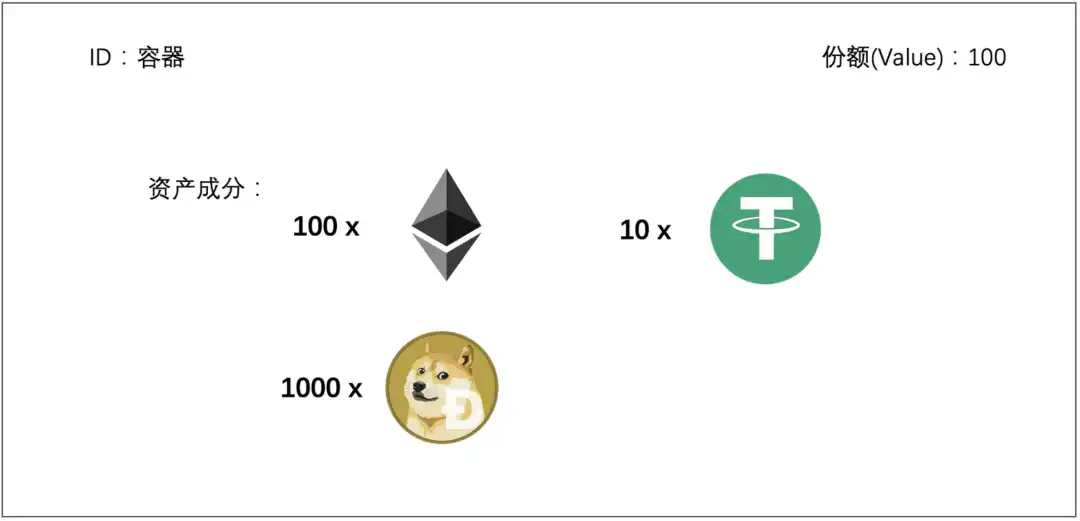
If ERC-3525 had been applied before 2008, every investor and market participant would have a clear understanding of their investment situation, and perhaps the crisis of that year would not have occurred. This shows how important the visualization of smart contracts in ERC-3525 is for the management of real-world assets on the blockchain (RWA) in the future.
What ERC-3525 application areas are worth paying attention to in the future?
As a super NFT and universal digital container that can be split and combined, ERC-3525's core competitiveness lies in its ability to achieve unparalleled flexibility and composability through data structure transformation, as well as ultimate transparency and execution convenience through its visual smart contract feature. This innovative structure gives ERC-3525 significant advantages in various fields, including but not limited to:
Real-World Assets (RWA) on the blockchain:
For the definition of Real World Assets (RWA), we can simply understand it as all assets outside of the blockchain system, including but not limited to securities such as currency, stocks, bonds, commodities, funds, as well as non-securities such as real estate, art and collectibles, agriculture, climate assets, and intangible assets such as carbon credits and intellectual property.
According to Citibank's latest research report "Money, Tokens and Games", it is expected that by 2030, up to $5 trillion of funds may flow into new forms of digital currency, such as Central Bank Digital Currency (CBDC) and stablecoins, with about half of the funds based on blockchain's distributed ledger technology. This prediction focuses on the continuous innovation of law and technology, and the tokenization of real-world assets (RWA) is seen as a key driving factor leading the blockchain industry into a market worth trillions of dollars. In fact, any asset that can be given value, whether it is wine or financial assets, may be tokenized, achieving a significant increase in liquidity and global trading through blockchain technology.
ERC-3525 has significant advantages in real-world securities assets. As a universal digital container, ERC-3525 can express almost all types of financial assets in the real world. Through the visualization function of smart contracts, it can clearly reveal the internal structure of these financial assets, greatly improving their transparency and presenting risks intuitively.
Not only that, in addition to traditional financial assets, ERC-3525 also demonstrates a new possibility in supply chain finance. With its unique properties, ERC-3525 can tokenize various assets in the supply chain, including raw materials, production equipment, inventory, accounts receivable, etc. As one of the major narratives of blockchain, supply chain is a significant area where ERC-3525 can disrupt the industry. To illustrate its disruptive potential in supply chain finance, let me give you an actual use case.
In supply chain finance, accounts receivable factoring is a common business model. It allows companies to sell their accounts receivable to a third party (usually a factoring company) at a discounted price in order to obtain necessary financing and improve their cash flow situation. However, in traditional supply chain finance models, this factoring service is usually only available to large companies and some reputable small and medium-sized enterprises, and most small and medium-sized enterprises often find it difficult to enjoy this service.
The root cause of this problem lies in the difficulty of verifying bills. Small and medium-sized enterprises generally lack sufficient credit support, and investors cannot conduct reasonable risk control on a large number of small and medium-sized enterprises. This leads to a common financing problem for small and medium-sized enterprises in reality. If small and medium-sized enterprises cannot accept delayed payment terms, it is difficult for them to receive orders from large enterprises. However, accepting orders from large enterprises will lead to tight liquidity and increase the risk of cash flow disruption for the enterprise.
Imagine if we tokenize payment receipts in this scenario. Using ERC-3525, we can create a pair of accounts: a payable account and a receivable account. These two accounts form a payment channel similar to quantum entanglement, where funds are automatically distributed to the receivable account through a smart contract as long as the buyer transfers money to the payable account. This means that no matter how many parts the receivable account is split into, and no matter who ultimately receives it, the funds will be transferred to the receivable account according to the predetermined ratio, greatly increasing the liquidity and composability of supply chain finance factoring business.
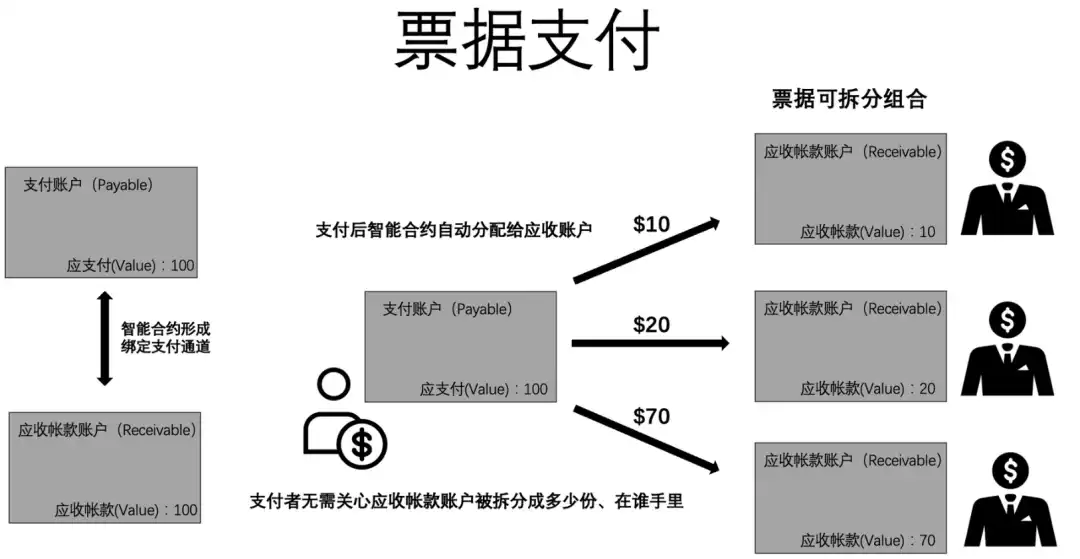
In traditional supply chain finance factoring business, the identification of the authenticity of bills has always been a problem. In Western countries, bills are usually printed by individual companies rather than through a unified channel, making it difficult to distinguish the authenticity of bills. At the same time, it is difficult for banks to use accounts receivable bills as collateral, because each pledge requires two companies to sign a contract to pledge the right to receive bill income, and default involves the transfer of payment objects. This greatly hinders the factoring business and financing of most small and medium-sized enterprises.
However, the use of blockchain technology can change this situation. Through smart contracts, we can add a confirmation step during the invoicing process. Once confirmed, the invoice will be generated with the confirmation signatures of both parties. This ensures that the invoice is generated in a state that has been confirmed by both parties. Considering that accounts receivable delinquency is actually equivalent to a form of loan provided by the seller to the buyer, if we can effectively solve the problem of invoice authenticity, the seller can rely on the buyer's reputation to sell the accounts receivable to a factoring institution at a certain discount rate, and obtain discounted funds.
For example, if a seller has a receivable of 1 million yuan and a factoring institution is willing to purchase this receivable at a discount rate of 90%, the seller can immediately obtain a cash flow of 900,000 yuan without waiting for the buyer's payment. This process essentially accelerates the flow of cash flow by transferring credit risk, which can be achieved through ERC-3525 and blockchain technology.
With the traceability and transparency of blockchain, the automatic execution and verification of smart contracts, and the convenience of ERC-3525, we can see that ERC-3525 has significant advantages in the tokenization of traditional financial assets, especially in supply chain finance. However, in the RWA field, the widespread application of blockchain technology requires the support of sovereign governments, regulated financial institutions, and large companies, which is in line with the relatively centralized nature of ERC-3525 in its technical structure. With the continuous updating and improvement of middleware facilities such as oracle, the on-chain of real-world assets will be a major narrative of ERC-3525 in the future, which is worth continuous attention.
Virtual assets or commodities:
除了代表金融资产以外,ERC-3525 can also be used to represent virtual digital goods or projects, such as virtual land, upgradeable/mergeable game items, virtual membership cards, gift cards, lottery tickets, etc. Among them, virtual land, game props, and membership cards are areas worth paying attention to. For the existing game props and virtual land system, ERC-3525 demonstrates higher possibility and flexibility, and ERC-3525 is backward compatible with the ERC-721 standard, which means that all protocols, platforms, and wallets that support the ERC-721 standard can integrate ERC-3525 relatively easily. In the future combination of games and blockchain, ERC-3525 has the potential to show higher playability.
With the launch of Starbucks Odyssey Plan, the integration of customer loyalty programs with Web3 has attracted widespread attention. This can be understood as a points-based membership card system, and Starbucks has a leading global customer loyalty program with tens of millions of active members in the United States alone. It is worth noting that membership cards may become a key scenario for Mass Adoption in Web3, which will help attract a large number of users into the world of Web3.
From the earlier cases of KFC and McDonald's, we can see that the ERC-3525 token standard has significant advantages in customer loyalty programs. It can achieve the transfer, storage, and receipt of tokens from ID to ID, and its Value can well represent the point value in the membership card ID. Therefore, ERC-3525 has high potential in this application scenario and may have greater potential than other token standards in the future.
Social, Identity, and Tokenized Account Fields:
Due to the composability of ERC-3525, it can express more data structures, which makes it more advantageous to use semi-fungible tokens (SFT) to express social graphs in current Web3 social fields, such as protocols like Lens, than non-fungible tokens (NFT). In addition, using ERC-3525 to implement Soul-Bound Tokens (SBT) can also express more attributes, such as quantifying specific data in SBT, such as a person's contribution in a certain event.
In addition, ERC-3525, as an account abstraction and digital container, can itself be used as a "wallet". Therefore, in addition to having the functions of a normal blockchain wallet, ERC-3525 also leaves room for other more imaginative innovations.
Summary
As a divisible and combinable super NFT, a universal digital asset container, and a visual smart contract, the positioning of ERC-3525 is not actually to solve the problem of value creation, but to solve the problem of value packaging. Digital assets can grow a dynamic and rich information interface, and can be fragmented, merged, packaged, combined, and programmed.
ERC-3525 has shown significant advantages in the future trends of Web3. Whether it is real-world assets (RWA), customer loyalty programs, or games, ERC-3525 has significant potential. Especially in the sub-field of real-world assets such as supply chain finance, ERC-3525 has overwhelming advantages compared to other standards. These development directions are worth our continued attention.
However, ERC-3525 is currently facing some challenges and resistance:
1. The high complexity has led to a high cognitive threshold, hindering people's general understanding and acceptance of ERC-3525.
2. The development difficulty of ERC-3525 is higher compared to standards such as ERC-20, ERC-721, and ERC-1155, placing higher demands on startup teams.
3. The application scenarios of ERC-3525 may involve sovereign governments and centralized guarantee agencies, which belong to the semi-centralized zone and may conflict with the absolute spirit of decentralization, and the impact on the values of the blockchain world is still unknown. However, precisely because ERC-3525 has not yet attracted market attention and has great potential, it is even more worthy of our close attention. We look forward to ERC-3525 playing an important role in the future mass adoption of Web3.
Reference:
[1]https://icg.citi.com/icghome/what-we-think/citigps/insights/money-tokens-and-games
[2]https://eips.ethereum.org/EIPS/eip-3525
[3]https://mp.weixin.qq.com/s/cf8_oDVGBSwXYqEWYmv8uA
[4]https://research.web3caff.com/zh/archives/1996
[5]https://sftlabs.io/2022/09/27/everything-about-fungible-semi-fungible-non-fungible-tokens/
[6]https://www.binance.com/zh-CN/news/top/7221255
Welcome to join the official BlockBeats community:
Telegram Subscription Group: https://t.me/theblockbeats
Telegram Discussion Group: https://t.me/BlockBeats_App
Official Twitter Account: https://twitter.com/BlockBeatsAsia

 Related Articles