LD Capital: Crypto asset management from the perspective of US stock index return enhancement strategy

Original Author: Yilan Liu, Jinze Jiang, Drake Zhang, LD Capital Research
Introduction
In recent years, the index products represented by ETFs in the traditional financial market have developed rapidly, showing that Smart Beta ETF-Active Management ETF the growth rate of market capital inflows is higher than that of ordinary indexes Characteristics of ETF products. The attention of the asset management industry has gradually shifted from ordinary index products to more innovative index product series, such as ESG ETFs, actively managed ETFs and thematic ETFs etc. Among them, active ETFs in the equity market have made new breakthroughs, attracting active transformation of OTC products, and becoming a hot spot in the development of active products in recent years. Global index providers are constantly innovating and improving the index system to meet new market demands, promote the industry's in-depth development of refinement and diversification, and promote continuous innovation of indexed products. Crypto index-enhanced products are still in a very early stage compared with traditional financial markets. With the growth of the overall encryption market value, the market growth space for index-enhanced structured products should also increase rapidly. We believe that the market size and status quo of US stock index funds and index enhanced funds/ETF have reference value for the development path of index enhanced funds in the encryption market, and believe that encrypted index enhanced funds can enhance their returns through these methods, whether it is Multi-factor quantitative stock selection model, subjective timing model, sector rotation model or stock index futures derivatives income enhancement model, to obtain excess returns that meet the needs of investors with different wind biases.
Scale and development trend of Hong Kong stock and US stock general index ETF and index enhanced fund/ETF
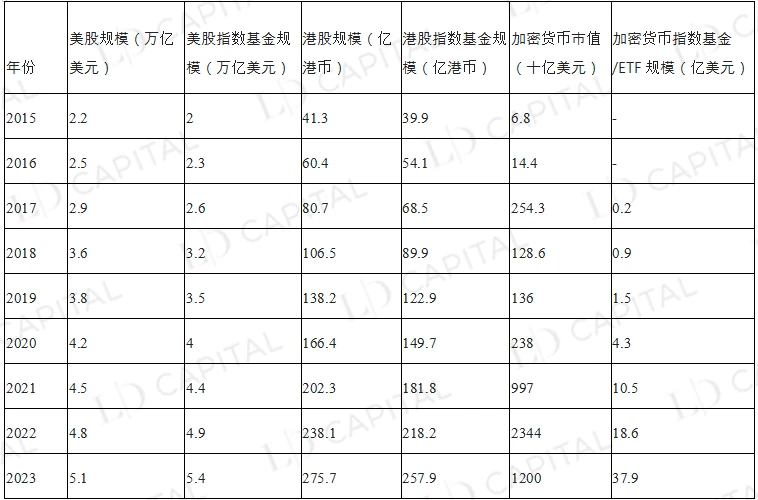
From 2015 to 2023 , whether it is the index funds of US stocks or Hong Kong stocks, or the scale of index-enhanced funds/ETF , they all showed steady growth, and the scale of index-enhanced funds/ETF ETF The growth trend of ETF is faster, with an increase of 10 times in 8 years, 2023 The scale has reached nearly that of ordinary index funds.
Table 1: From 2015 to 2023 , the total scale comparison of ordinary index funds and index-enhanced funds/ETFs in US stocks and Hong Kong stocks

& nbsp; source: Vettafi, Statista & Nbsp; & Nbsp; < /blockquote>
In the traditional financial market, the scale of index funds in US stocks and Hong Kong stocks even tends to exceed their corresponding market value, while the scale of index funds/ETFs in the encrypted market is far Short of its market capitalization, cryptocurrency index funds and exchange-traded funds (ETFs) have a promising future amid growing interest from traditional investors in crypto-asset management products.
Table 2: U.S. stocks, Hong Kong stocks, crypto market capitalization and the corresponding index fund/ETF scale comparison
Source: VettaFi, Statista
Index Enhance the active management characteristics of the fund
Index funds can track the characteristics of the index, such as tracking error, market value style, valuation style, industry weight ratio and individual stock weight Matching, to obtain the income (yield) brought by following the benchmark market.
The enhanced index fund strives to obtain additional income (yield) beyond the market through the active management of the fund manager, so that when the market falls, it will fall more than the underlying index When the market is rising, it can obtain more income than the tracking index, and strive to obtain relatively stable compound interest performance in the long-term dimension.
As far as tracking indexes are concerned, index enhancement funds can track a wide range of indexes, which can be broad-based indexes, single industry indexes or other themes index. Judging from the current market environment of U.S. and Hong Kong stocks, S&P 500 , Nasdaq-100, Russel l2 000, DJIA, HSI, HSCEI and other broad-based indexes are the mainstream choices for index-enhanced funds to benchmark at the end.
The way to increase the return of index funds
As the financial market continues to innovate, the index is enhanced Funds can obtain excess returns in a variety of ways, so as to achieve the effect of "enhancement" of returns. The income of the "enhancement" part of the index enhancement fund can be realized through, for example, multi-factor quantitative stock selection model, subjective timing model, sector rotation model, stock index futures derivatives income enhancement model, etc. These are the more common index enhancement products at present. Revenue Enhancement Pathway.
Quantified multi-factor enhancement strategy product
The goal of quantified multi-factor enhancement strategy is to Use multiple factors to pick stocks for better returns. These factors are divided into many dimensions, such as technical factors (market dynamics and technical indicators), macro factors, statistical data mining (machine learning, deep learning), fundamental factors, etc. From the perspective of fundamental factors, it includes company financial stability Sex, dividend yield, valuation, etc.
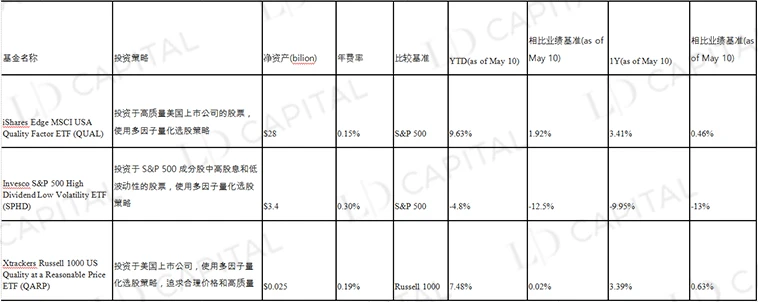
Table 3: Common multi-factor stock selection enhanced index funds in US stocks
Take Invesco S&P 500 High Dividend Low Volatility ETF (SPHD) as an example . SPHD tracks the S&P 500 High Dividend Low Volatility Index, adopts a multi-factor stock selection strategy, focusing on high dividend yield and low volatility stocks. It selects the 50 securities in the S&P 500 Index with the highest dividend yields and low volatility. Constituents are weighted by dividend yield, with an individual stock weight capped at 3% to ensure diversification. To maintain its low-volatility objective, the fund rebalances semi-annually, reevaluating stock picks based on updated dividend yield and volatility metrics. Due to its low volatility, the ETF typically outperforms the broader S&P 500 in bear markets, but can lag in strong bull markets.
SPHD 's yield enhancement comes in part from an overweight in high dividend and low volatility stocks. However, SPHD underperformed the benchmark S&P 500 in the nearly year-long interest rate environment. High-dividend stocks in these industries may perform poorly during the epidemic. In particular, the financial sector, which accounts for 26% of SPHD 's portfolio, has been hit hard by the recent banking crisis. The below-benchmark performance resulted in a larger decline in AUM .
Strictly speaking, SPHD and QUAL are considered partially passively managed funds using enhancements. These enhancements are designed to optimize specific elements of the portfolio, but the Fund's overall investment strategy remains focused on tracking specific indices. In addition to using passive management methods to track the index, QARP also uses some enhanced means and active management strategies to select the constituent stocks of the investment portfolio, so it is a typical active management fund.
When implementing a quantitative multi-factor enhancement strategy, it is necessary to consider the weight of different factors and the number of holdings in the portfolio. According to the actual situation, use different factor weights and holdings to achieve different investment goals. For example, use more financial stability and earnings stability factors to invest in solid stocks, or use more market momentum and technical indicators factors to invest in growth stocks.
Subjective timing enhancement strategy
As an investment strategy, subjective timing can be carefully Divided into multiple methods, including technical timing, fundamental timing, macro timing, emotional timing and event-driven timing. These methods are based on different analytical and decision-making factors and aim to identify market trends, values and opportunities for better decisions to buy, sell or adjust portfolios.
1. Technical Analysis Timing: Technical analysis is the method of identifying potential market trends by studying historical price and volume data. Investors can use technical analysis tools (such as trend lines, moving averages, relative strength index, etc.) to determine the direction, strength and turning points of the market, so as to determine when to buy or sell.
2. Fundamental analysis timing: Fundamental analysis focuses on the company's financial status, competitive advantage, industry status and other factors. Investors can evaluate the company's value and growth potential through in-depth research on the company's fundamentals. When the market price underestimates the true value of the company, investors can buy; when the market price overestimates the true value of the company, investors can sell.
3. Macroeconomic analysis and timing: The macro timing enhancement strategy is based on the impact of macroeconomic data on market trends to make timing judgments for more accurate asset allocation. These strategies typically involve the analysis of factors such as interest rates, inflation, monetary policy and geopolitics. For example, during an economic expansion, investors may increase their exposure to stocks; during a recession, investors may reduce their exposure to stocks or move to safer assets. Fund managers make strategic decisions to adjust their portfolios based on their outlook and expectations for global macroeconomic conditions. Compared with passive index funds that only track benchmarks, it can bring excess returns from macro timing.
4. Market sentiment analysis Timing: Market sentiment analysis focuses on the impact of investor sentiment and psychological factors on market prices. Investors can use market sentiment indicators (such as panic/greed index, investor confidence index, etc.) to judge whether the market is overly pessimistic or overly optimistic, and make timing accordingly. Buying when the market is overly pessimistic and selling when the market is overly optimistic may help investors obtain excess returns. Sentiment strategies are becoming more and more popular, and other sentiment strategy indicators include AAII Sentiment Index, VIX, Market Sentiment, Put/Call Ratio, etc.
5. Event-driven strategy timing: Event-driven strategies focus on specific events that affect company value (such as mergers and acquisitions, spin-offs, reorganizations, etc.). The timing of buying or selling can be determined based on the anticipation and analysis of these events.
Take Pacer Trendpilot US Large Cap ETF (PTLC) as an example, Pacer Trendpilot US Large Cap ETF (PTLC) is an exchange based on the US stock market Exchange-traded funds (ETFs) adopt active timing strategies. Its goal is to adjust its exposure to U.S. large-cap stocks according to market trends in order to achieve relatively stable investment returns.
The fund primarily tracks the S&P 500 Index and uses a timing strategy based on moving averages. When the S&P 500 is above the 200-day moving average and the closing price of the last five trading days is above the five-day moving average, the fund invests in the S&P 500 index with full position; when the S&P 500 moves in the 200-day When it is below the average line, the fund allocates 50% of its assets in the S&P 500 index and the other 50% in short-term U.S. Treasury bonds; when the five-day moving average of the S&P 500 is below the 200-day moving average for five consecutive trading days The fund will invest entirely in short-term U.S. Treasury bonds.
Observe the performance of Pacer Trendpilot US Large Cap ETF (PTLC) in some specific market environments, such as 2017 bull market, 2018 ;2017 In 2017 , the S&P 500 Index achieved a relatively high annual return, with an increase of approximately 21.8 % . For the year, the PTLC Fund returned approximately 20.4% , slightly underperforming the benchmark index. While PTLC captures some gains in rising markets, it has slightly underperformed the S&P 500 in this market environment due to management fees and transaction costs.
In 2018 the market environment fluctuated violently. The S&P 500 index rose sharply at the beginning of the year, but then there was a significant decline at the end of the year, and finally fell for the whole year About 4.4% . In contrast, PTLC performed better in 2018 with a return of around -3.7% for the year, achieving some degree of impairment relative to the benchmark index.
At the beginning of 2020 , the COVID-19 epidemic triggered a sharp shock in the global stock market. The S&P 500 index fell about 34% in a short period of time, but then rebounded strongly to gain about 16% for the year. PTLCs were relatively weak for the year, returning around 11.5% for the year. Although the fund achieved a certain degree of loss reduction through timing strategies during the market decline, its performance was relatively poor during the subsequent rebound process, resulting in a lower return than the benchmark index for the whole year.
Thus, in rising markets, PTLC performs similarly to the benchmark index; while in falling markets, the fund's timing strategy may help mitigate losses , but will not beat the benchmark in all market situations due to tracking error.
Sector rotation enhancement strategy
The sector rotation enhancement strategy is based on different factors before the market starts The business cycle of the sector rotates to determine who is about to lead, increase the allocation of upward trending industries or reduce the allocation of downturn industries (that is, industry "overweight" or "underweight"), and achieve higher than industry allocation by deviating from the tracking index. Excess returns that track the rise and fall of the index.
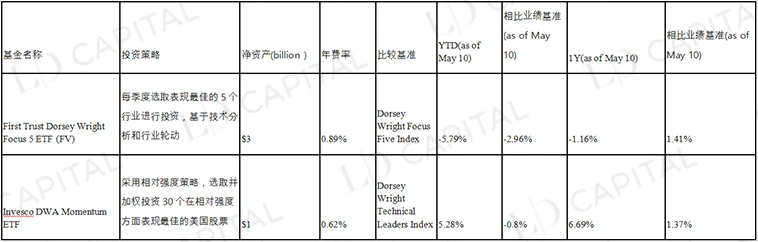
Table 4: Common industry rotation stock selection enhanced index funds in US stocks
Taking PDP (Invesco DWA Momentum ETF) as an example, PDP Tracks the performance of the Dorsey Wright Technical Leaders Index using a relative strength strategy that selects and weights investments in 30 the best performing U.S. stocks in terms of relative strength. Assuming that in the market, stocks in the technology sector are the best performers with high relative strength, PDP will select the stocks that are the best performers in the technology sector.
In order to execute the strategy, PDP periodically rebalances its positions to ensure continued investment in technology stocks with the highest relative strength. If the market environment changes, the relative strength of other industries starts to rise, such as the consumer goods industry. In such cases, PDP may adjust and weight its holdings in new best performing sectors based on new relative strength data and market trends.
Overall, PDP 's approach to strategy execution is based on relative strength stock selection, adjusted to market performance and trends. Stocks are selected based on relative strength, that is, performance relative to other stocks or sectors. By periodically rebalancing positions. The two funds in the table outperformed the benchmark performance returns in the one-year time dimension, but performed relatively poorly in YTD .
Derivatives Enhanced Strategy
Derivatives Enhanced Strategy is through the use of options, futures, mutual Switch to derivatives to enhance portfolio performance. These strategies often involve considerations of factors such as leverage, hedging risk and speculation.
Some derivatives enhancement strategies based on US stocks include
1. If the stock index futures contract is relatively Since the spot index has room for discount, you can simulate some index positions by investing in stock index futures, and at the same time obtain the enhanced income of negative premium convergence. If the point of the futures contract is lower than the real point of the spot index, buy the futures contract. Theoretically speaking, when the contract expires, the two points must be extremely close, so the longs who hold the futures contract during this period must earn a little more than the spot index. This method tracks the underlying index by allocating part of the funds in stock index futures, while the remaining idle funds are invested in fixed income or arbitrage strategies to obtain relatively stable returns.
2. Calendar Spread: Use the price difference between futures contracts of the same index with different expiration months to carry out arbitrage. When the forward contract has a higher premium than the near-term contract, you can establish a long position in the near-term contract and a short position in the forward contract at the same time. Over time, the price difference between these two contracts may converge, resulting in excess returns
3. Inter-market Arbitrage: When When there is a pricing difference between two highly correlated markets (such as commodities, interest rates, exchange rates, etc.), it is possible to take a long position in one market while taking a short position in the other, and over time, the two Pricing differences across markets may converge, leading to enhanced benefits.
4. Option strategy: Option is another common derivative, for example, by selling call options (Covered Call) to increase the return on existing stock investment . In this strategy, the fund owns a certain number of shares and sells a corresponding number of call options. This allows for the option premium to be collected, increasing the overall return on investment. But the risk with this strategy is that if the stock rises more than the option strike price, you may miss out on some of the potential gains.
5. Pairs Trading: This strategy involves two stocks in the same industry or highly correlated. When the price difference between two stocks exceeds the historical normal level, a long position can be established in a relatively undervalued stock, and a short position can be established in a relatively overvalued stock at the same time. Over time, the spread between the two stocks could converge, leading to excess returns.
Take the index enhancement fund ProShares UltraPro Short QQQ ETF (SQQQ) based on US stocks using derivatives enhancement strategy as an example,
ProShares The UltraPro Short QQQ ETF (SQQQ) provides returns -3 times the daily performance of the Nasdaq-100 Index using a market timing and derivatives augmentation strategy. This inverse leveraged ETF is designed for sophisticated investors who use swaps, futures contracts and Options and other financial instruments to gain short exposure to the Nasdaq-100 index. Therefore, SQQQ can magnify gains when the underlying index falls, but also magnify losses when the index rises.
Specifically, in the swap strategy, SQQQ obtains short exposure by signing swap contracts with other financial institutions. In a swap contract, SQQQ agrees to exchange the proceeds of an underlying asset (such as the Nasdaq-100 index) at a fixed price for a specified period of time. This allows SQQQ to gain short exposure to the Nasdaq-100 index without actually owning the stock.
In the futures contract strategy, SQQQ gains short exposure by selling Nasdaq-100 index futures contracts. With this method, SQQQ agrees to sell the underlying asset (Nasdaq-100 index) at a certain price on a certain date in the future. This strategy allows SQQQ to take a short position on the Nasdaq-100 index without actually owning the stock.
In the option strategy, SQQQ uses the purchase of put options to achieve short exposure. A put option gives SQQQ the right to sell the underlying asset (Nasdaq-100 index) at a specified price on a specified date in the future. Purchasing put options allows SQQQ to obtain income when the underlying asset falls, thereby realizing short exposure to the Nasdaq-100 index. SQQQ executes these transactions across multiple trading platforms and venues to ensure liquidity and the best prices. However, this ETF is generally considered a high-risk short-term investment and is not recommended for long-term holding.
Multiple enhancement strategies tracking the same index provide investors with suitable risk exposure
Even if the same index is tracked, by providing different index tracking strategies and leveraged products, investors can choose an index fund investment representative with suitable risk exposure according to their own risk tolerance, investment goals and expected returns. The following is an introduction to some series of products tracking Nasdaq-100 , most of which are passively managed, aiming to provide investors with different strategies for tracking the Nasdaq 100 index, in order to obtain corresponding exposure and income.
QQQ (Invesco QQQ Trust): As the core product of Invesco , QQQ ETF (AUM 175780 mln). It seeks to replicate the performance of the index, which includes the 100 largest non-financial companies listed on the Nasdaq stock market, by investing in the same securities in the same proportions as the index. QQQ is a market-cap-weighted ETF, meaning holdings are weighted by their market capitalization.
QTR (Global X NASDAQ 100 Tail Risk ETF) aims to track the performance of the Nasdaq-100 Index while reducing tail risk. The ETF invests in the same securities as QQQ, but also holds put options on the Nasdaq-100 to hedge against sharp market declines.
QQQM (Invesco Nasdaq-100 ETF): QQQM is a low-cost alternative to QQQ. It also tracks the Nasdaq-100 index, but with a lower expense ratio. The investment strategy and holdings are similar to QQQ but with lower fees, more cost-effective for long-term investors.
QQQN (Invesco NASDAQ-100 Triple Q Disruptive Innovators ETF) is an exchange-traded fund (ETF) launched by Invesco . The fund seeks to track the Nasdaq Q-50 Index, which includes non-financial companies ranked 101 to 150 on the Nasdaq Market by market capitalization. These companies are generally considered to be growth-stage businesses with innovative capabilities and breakthrough technologies. QQQN provides investors with exposure to a group of potential companies in the growth stage.
The strategy of QQQA (ProShares Nasdaq-100 Dorsey Wright Momentum ETF) is designed to track the performance of the Dorsey Wright NASDAQ OMX CTA Momentum Index and its enhanced strategies include Momentum strategies, which select stocks based on relative strength signals. Relative strength refers to the performance of an individual stock relative to the market or industry. Selects Nasdaq-100 index constituents that have performed well in the short term based on relative strength signals. Based on a momentum investing strategy, stocks are selected based on their relative strength and weights are adjusted accordingly. Stronger performing stocks will receive higher weights, while weaker performing stocks will receive lower weights or be excluded from the portfolio.
TQQQ (ProShares UltraPro QQQ): TQQQ designed to track the Nasdaq-100 High Beta Index, is a leveraged ETF designed to provide Nasdaq A three-fold increase in the Gram 100 index. It is designed to track the performance of the entire Nasdaq 100 index. Due to its leverage amplification effect, TQQQ will generally exhibit higher volatility and risk than indices.
QQQX (Nuveen NASDAQ 100 Dynamic Overwrite Fund): QQQX is an actively managed fund based on the Nasdaq-100 index. Overwrite strategy is adopted, that is, the strategy of holding Nasdaq-100 index constituent stocks and selling call options at the same time. Override strategies are designed to increase the income of a portfolio, in which the fund holds stocks in the Nasdaq-100 Index and simultaneously sells corresponding call option contracts. If the price of Nasdaq-100 index is lower than the exercise price of the call option on the expiration date, the call option will expire without exercise, and the fund can retain the premium received. In this way, the fund can obtain additional income by selling call options when the market trend is stable or falling.
The goal of the overwrite strategy is to use this additional income to enhance the return on the portfolio and provide some protection against downside risks in the market. However, selling call options while overriding the strategy also limits the portfolio's potential gains in a rising market, as the fund may be limited from gains when the call options are exercised.
Summary
Compared to US stocks-based equity ETF/Index Fund markets , The encrypted index-enhanced product market is still in a very early stage. With the growth of the overall encrypted market value, the growth space of the index-enhanced structured product market should also increase rapidly. We believe that various enhancement strategies of US stock index funds and index enhancement funds/ETF can correspond to the strategy construction of index enhancement funds in the encryption market. Encryption index enhancement funds can help investors with different wind biases to obtain corresponding risk exposures through these income enhancement methods, including multi-factor quantitative stock selection models, subjective timing models, sector rotation models or stock index futures derivatives income enhancement models, etc. and excess returns.
Welcome to join the official BlockBeats community:
Telegram Subscription Group: https://t.me/theblockbeats
Telegram Discussion Group: https://t.me/BlockBeats_App
Official Twitter Account: https://twitter.com/BlockBeatsAsia

 Related Articles