



Digital gold or Ethereum killer? Bitcoin stands at a crossroads.
Original Title: "Digital Gold or Ethereum Killer? Bitcoin Stands at the Crossroads"
Original Source: BitpushNews
On May 8th, Bitcoin experienced an unusual congestion, and Binance even had to temporarily suspend BTC withdrawal transactions. What is the main reason behind this congestion? The BRC-20 token was proposed as early as March, why did the trading volume only start to surge around April 19th? Is the Bitcoin network congestion due to the bull market? Behind this Bitcoin network congestion, BTC is actually facing an urgent problem, whether to be "digital gold" or become the "Ethereum killer"? This article will answer these questions one by one around the Bitcoin congestion event.
Why have Bitcoin transaction fees skyrocketed?
On May 8th, due to the skyrocketing Bitcoin transaction fees, Binance had to temporarily suspend Bitcoin withdrawal transactions. So, how astonishing was the increase in Bitcoin's block fees on May 8th? And what caused such an event to occur?
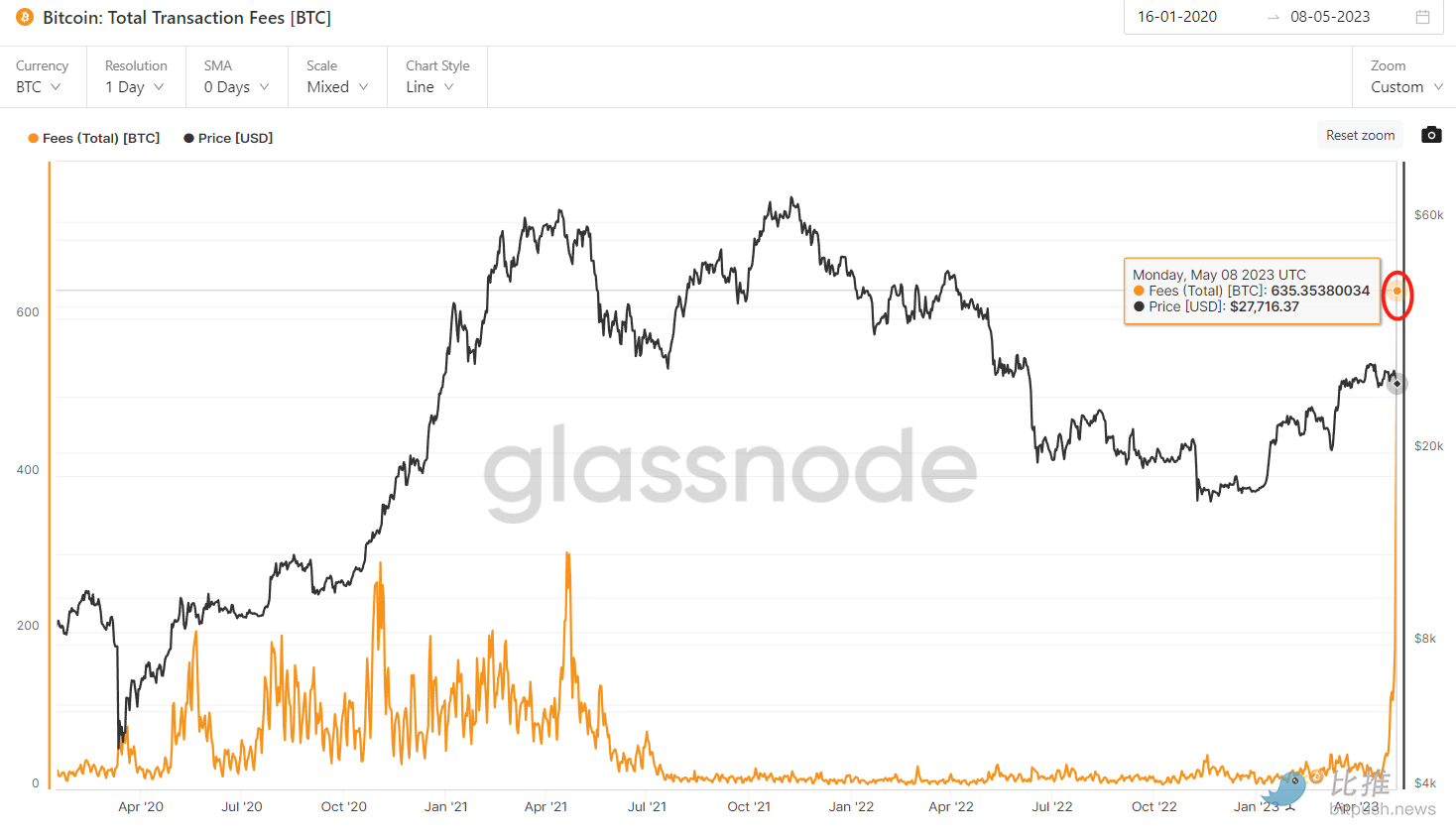
According to Glassnode data, Bitcoin's miner fees reached 635.35 BTC on May 8th, setting a new record in nearly four years. From the graph, it can be seen that Bitcoin's fees on May 8th were higher than the previous bull market peak. Specifically, as of 10:00 on May 8th, 141 blocks were mined by 8 miners in the past 24 hours, with an average block fee of about 3.16 BTC. In the past year, 53,393 blocks were mined by 20 miners, with an average block fee of about 0.15 BTC. This means that the average block fee in the past 24 hours has increased by about 21 times compared to the average level of the past year.
So why did Bitcoin transaction fees suddenly soar? The direct cause of the surge in Bitcoin block fees this time may be the chain transaction backlog caused by the accidental event of the competition for the longest chain of Bitcoin, which led to a direct surge in the transaction fees packaged on the chain after Bitcoin successfully mined a block. According to "Bitpush" report, BitMEX Research tweeted: "At 04:44 on May 8th Beijing time (block height 788686), Bitcoin had a chain fork with a length of 2, and there was a competition between Antpool and Foundry Pool USA. Antpool eventually won. The length of the chain fork on Bitcoin is very rare, and the last time may have been in November 2020." It can be said that the competition for the longest chain of Bitcoin directly caused the packaged transactions of the failed chain to be invalid, thereby causing a backlog of transactions on the chain. According to BTC.com data, after the Bitcoin network resumed mining at 15:59:31 on May 8th, three blocks have been produced, and the block rewards and transaction fees for each block are all more than 12 BTC and 6 BTC respectively. The mining pools are F2Pool, Foundry USA, and AntPool.
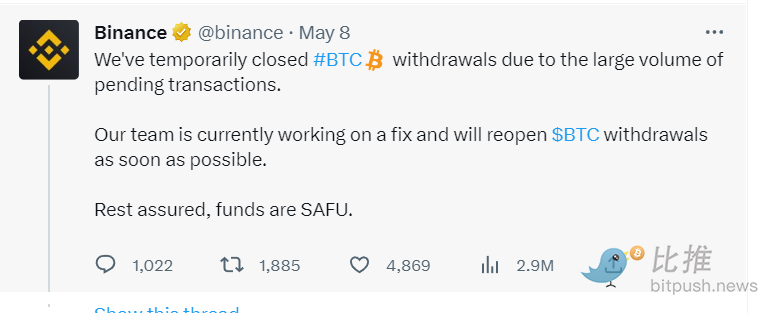
As a result, Binance had to suspend withdrawals and use higher transaction fees to resolve unprocessed BTC withdrawal transactions, which further pushed up the transaction fees for block packaging. On May 8th, Binance tweeted that due to the unexpected surge in BTC network fees, a large number of withdrawal transactions from Binance have not been completed due to the fees we set. The team is working hard to speed up the confirmation of all unprocessed transactions. Subsequently, they further stated that "due to the large number of unconfirmed transactions, BTC withdrawals have been temporarily suspended."
Who is clogging up Bitcoin?
From Glassnode data, it can be seen that the overall transaction volume on the Bitcoin network has been on the rise this year, which is mainly related to the "New Culture Movement" of Bitcoin that we mentioned earlier. However, after entering May, the growth trend of transaction volume on the Bitcoin network has clearly accelerated. What is the main reason behind this?
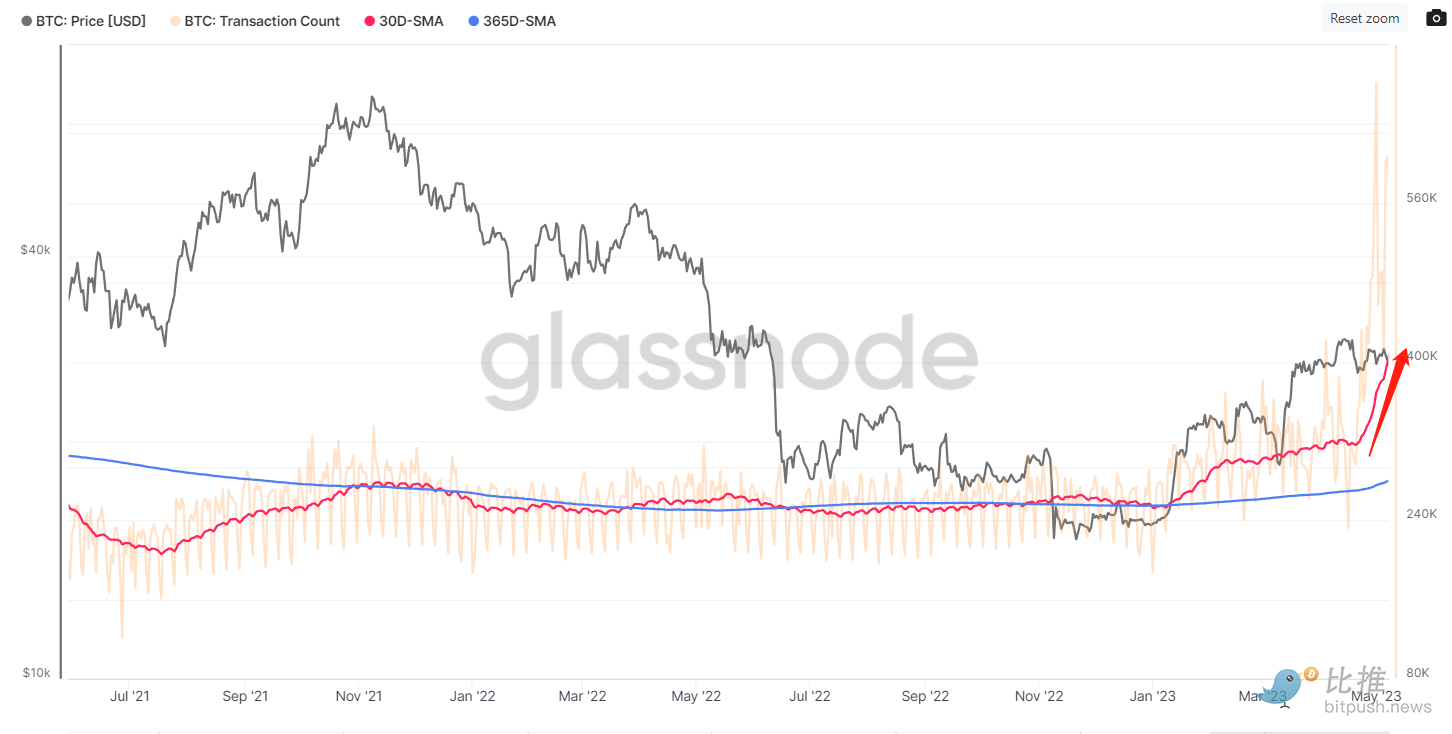
From the above chart, it can be seen that the surge in transaction volume on the Bitcoin network began around April 19th. According to data from Dune Analytics, the proportion of BRC20 on Bitcoin began to rise sharply from April 21st, and as of May 9th, it had reached 60.6%.
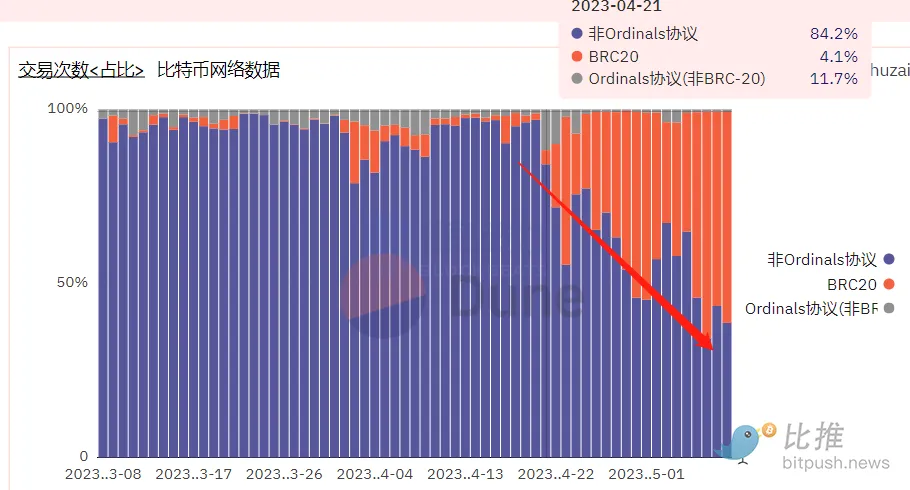
The BRC-20 token standard was created by the cryptocurrency community user @domodat on March 8, 2023. It is a standard for homogenized tokens on Bitcoin that leverages the inscription feature. The name "BRC-20" is borrowed from the Ethereum ERC-20 token standard and currently has three functions: deployment, minting, and transfer. With the popularity of BRC20, this has essentially led to the congestion problem mentioned earlier in the Bitcoin network. Specifically, if users want to transfer or mint BRC-20 protocol tokens, they must enter a new ordinal number. The Ordinals protocol will sort each "satoshi" and give them non-homogeneous properties. When "minting" Digital Artefacts, a Bitcoin transaction must be created, and some additional data, such as text, images, SCG, or HTML, must be stored in one of the output addresses, which is called an inscription. As a result, Ordinals created a fairly long queue in the Bitcoin memory pool. Since BRC-20 is about 10 times smaller than image inscriptions, the memory usage rate of the Bitcoin memory pool has been far below that of March, and network congestion has become more severe.

Behind the Congestion, How the Cryptocurrency Market is Changing
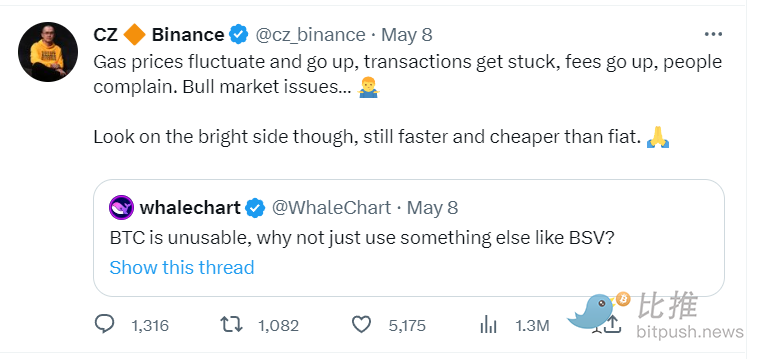
Regarding the congestion of Bitcoin, Binance CEO CZ tweeted on May 8th, "The fluctuation and rise of blockchain network miner fees, transaction congestion, and fee increases are all problems of the bull market. From a positive perspective, cryptocurrencies are still faster and cheaper than fiat currencies." So, is the congestion of Bitcoin really just a problem of the bull market? Bitcoin on-chain transactions are very active, which was indeed one of the main characteristics of the bull market before. However, this time it is probably not the case.
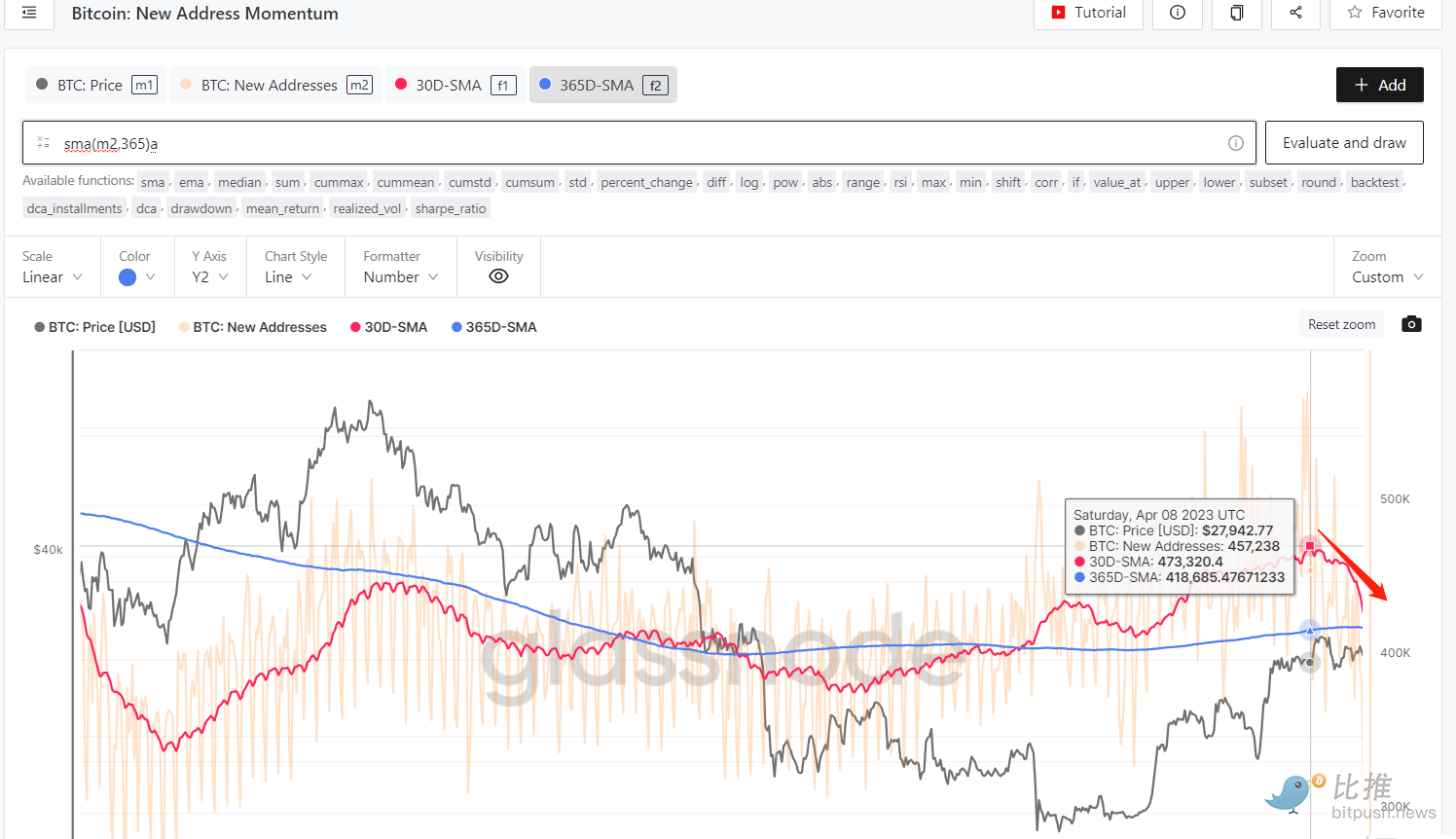
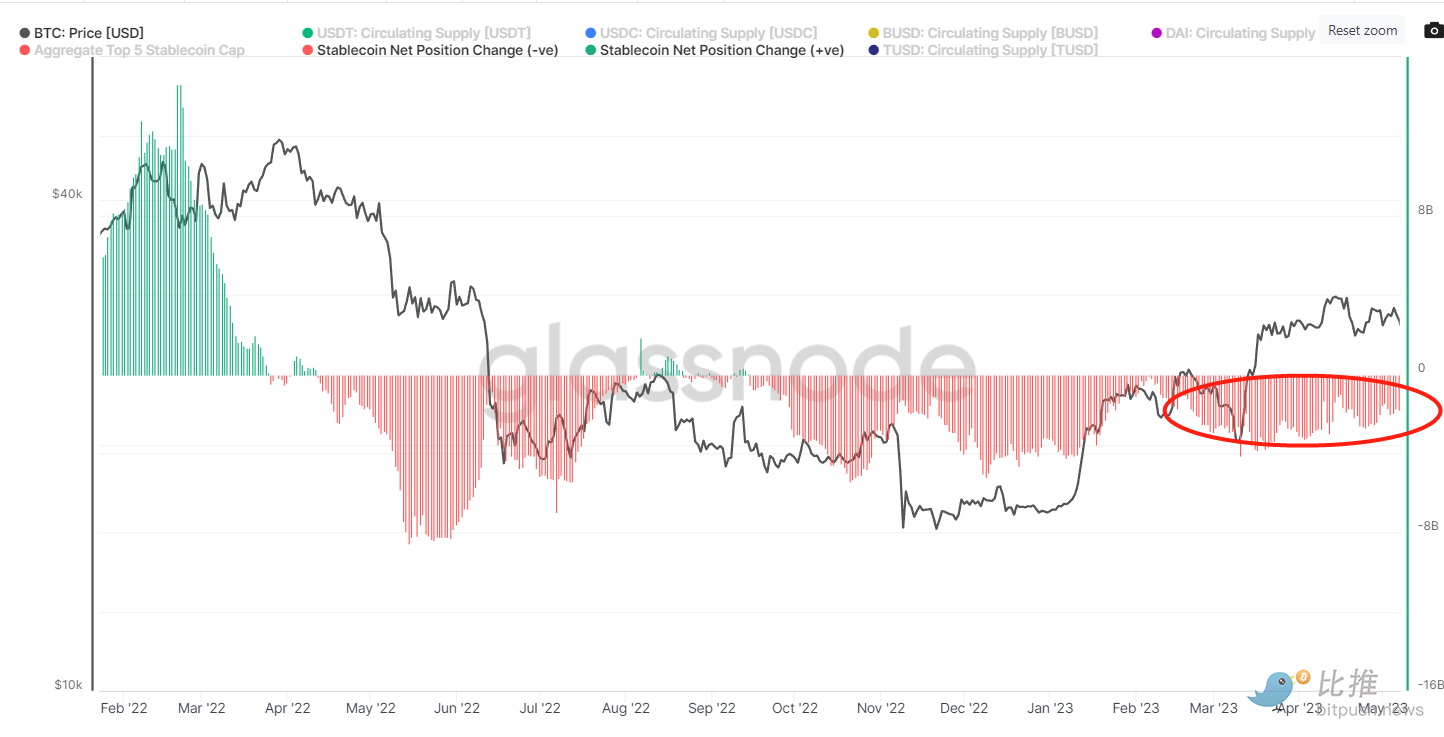
From the number of new Bitcoin addresses on Glassnode, it can be seen that the number of new addresses on the Bitcoin network has been continuously decreasing since April, indicating a decrease in new users. In addition, from the inflow and outflow of stablecoins, the overall outflow of funds has also been significant this year. Specifically, although Bitcoin has performed relatively strongly, the overall situation in the cryptocurrency market is not optimistic, which means that in the game of stock, Bitcoin is exhibiting a vampire effect.
According to a report from "Bitpush", a growing number of family offices are showing disinterest in cryptocurrency assets compared to two years ago. Family offices are wealth management companies that typically work with high net worth individuals and families. The survey was conducted in January and February and collected responses from 166 family offices worldwide. The report from Goldman Sachs also indicates that the capital market is cautious about cryptocurrency assets, and there is a lack of clear evidence of large capital inflows.
So what is the real reason for the active BRC-20 transactions on the Bitcoin chain? Actually, this is mainly due to the market entering the Meme hype stage. Let's consider a question, why did the BRC-20 token created by @domodat on March 8, 2023 suddenly become popular around April 20?
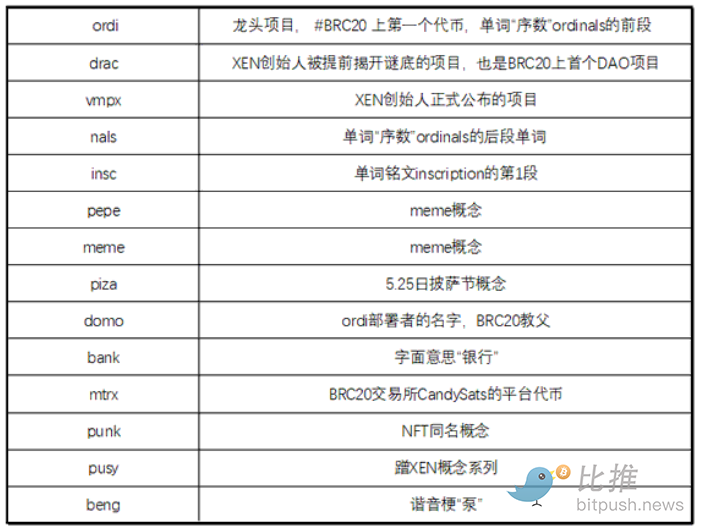
Using the recent popular PEPE as an example, it is mainly a Meme coin. In fact, due to the lack of smart contract functionality, the usability of BRC-20 is still very limited, and current use cases are mostly similar to meme coins, with functions limited to deployment, minting, and transfer. Therefore, the congestion of the Bitcoin network caused by this round of BRC-20 token is essentially the result of Meme token speculation.
From the perspective of market speculation, after the Shanghai upgrade on April 13th, Ethereum's previously hot staking track lost its speculative space. However, immediately following, Layer2 leader Arbitrum's coin issuance triggered widespread market attention. On April 19th, Arbitrum announced that it will distribute initial token allocations to DAOs that meet the conditions in the ecosystem, and distribute tokens afterwards. After the coin issuance expectations were fulfilled, the market began to look for new hotspots. It was at this time that, combined with the previous Bitcoin Ordinals, NFT trading had already gained popularity and capital accumulation. In the absence of speculative targets in the market, Meme tokens led by BRC-20 began to enter the public's view and were successfully ignited by speculation.
除了上面谈到这些,从长期来讲,比特币正在面临一次重大的选择,也就是 Meme 炒作之后,是回归中本聪设计的比特币路线,还是发展出一种新的特色路线。这个问题伴随比特币的拥堵,逐渐成为一个不可回避而需解决的问题。
Translation:Apart from the above-mentioned, in the long run, Bitcoin is facing a major choice, whether to return to the Bitcoin route designed by Satoshi Nakamoto after the Meme hype, or to develop a new distinctive route. This issue, along with the congestion of Bitcoin, has gradually become an unavoidable problem that needs to be solved.
Do "Digital Gold" or Become the "Ethereum Killer"
The appearance of this chain fork is rare, but as BitMEX Research pointed out, "given the recent increase in invalid blocks, this may not be surprising." This means that if the BRC-20 token continues to be popular, the frequency of similar incidents is likely to increase further. According to Forkmonitor's analysis, in this chain fork event, at block height 788686, 13 transactions involving 9.85805149 BTC were double-spent on the longest chain.
BRC-20 has many limitations, such as only allowing four characters as the currency name, inability to upgrade, and inability to cancel transactions, in addition to the double-spending risk. To replace BRC-20, developers have proposed ORC-20, which aims to eliminate these limitations and can be considered a hard fork of BRC-20. ORC-20 is backward compatible with BRC-20 and improves adaptability, scalability, and security, eliminating the possibility of double-spending. However, it seems that ORC-20 is only bringing Bitcoin issuance closer to ERC-20. So, why not use ERC-20? The future of Bitcoin as "digital gold" or a potential "Ethereum killer" remains uncertain, but there is no doubt that Bitcoin is at a crossroads.
Original article link
Welcome to join the official BlockBeats community:
Telegram Subscription Group: https://t.me/theblockbeats
Telegram Discussion Group: https://t.me/BlockBeats_App
Official Twitter Account: https://twitter.com/BlockBeatsAsia


