Panoramic interpretation of the executive layer: EVM stands out, and business capabilities are the key to success
Original source: excerpted from ELI NUSS, Stratos
Original compilation: Felix, PANews
Introduction: With years of technical development in the execution layer of the blockchain, scalability is no longer the main contradiction, but business development and the ability to attract interesting applications seem to be the key factors for the success of the project.
Introduction
Over the past year, the executive layer has become increasingly crowded . While Rollup has been around as a scaling solution for some time, adoption has only just begun. Over the past month, the Gas consumed by the Rollup contract accounted for more than 10% of Ethereum Gas total spending.
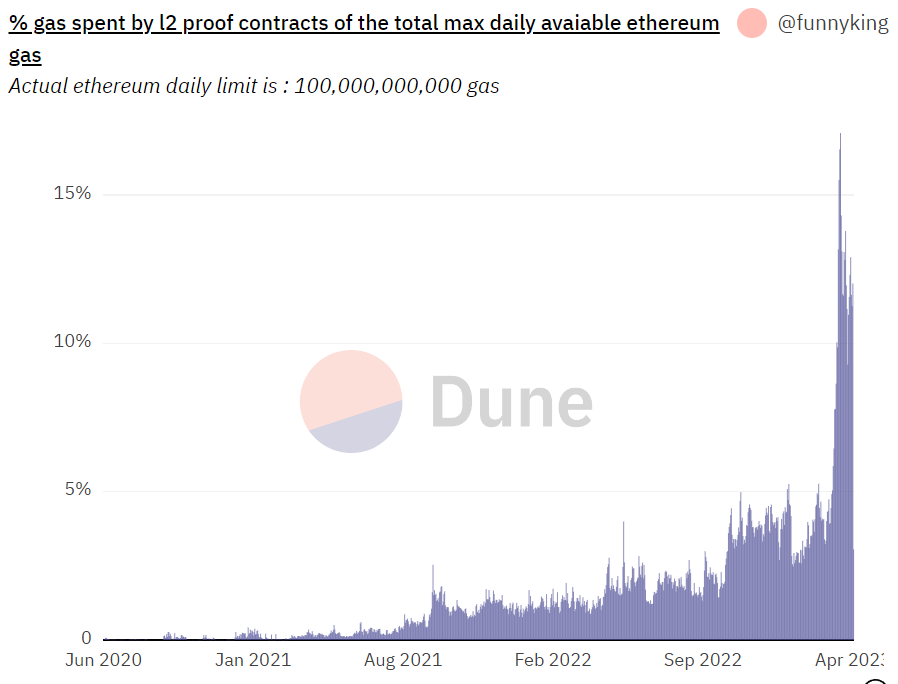
From funnyking Dune Dashboard
The traction of Arbitrum and Optimism , as well as the anticipated launch of products like zkSync, Starknet , have accelerated the pace at which new execution layers are built. Since 2018 more than 2 billion US$ of venture capital funding has entered this space. With dozens of projects currently under construction in the field, it is becoming increasingly challenging to keep track of them. Also, with the recent trend of rollup SDKs/rollup as a service provider, this situation is exacerbated.
Key Points
- In the long run, proof mechanisms will be an increasingly important Detailed work:
In the rich block space, the advantages of the validity proof (zk) execution layer over the fraud proof (optimistic) execution layer become less obvious. Optimistic design can be surprisingly good.
If/when zk gets better, the optimistic system can swap proofs of fraud for proofs of validity.
- As state growth is no longer the bottleneck, execution will be the new bottleneck. This presents an opportunity to improve execution design. In the long run, execution design can be the main differentiator. Deployment architecture will depend on economic preferences. More sovereignty -> more value capture -> less composability.
- Rollup frameworks and service providers will result in a large number of execution layers.
- It is expected that as the technology becomes more mature, the design space of the execution layer may be consolidated.
- Remaining issues: sorter decentralization, cross Rollup atomicity, ZK proof efficiency, sustainable token model.
- From an investor standpoint, the long-term winners in the executive-level market may have secured funding.
- Arbitrum is today the category leader in terms of technology and adoption. Optimism has been excellent at attracting teams to their OP Stack - most notably Coinbase creating its own Rollup: Base.
- The key to long-term success will be the ability to build a strong developer and user community, more important than any technical details.
The following will explore each of these points in depth, starting with how to segment the current market.
Market Segments
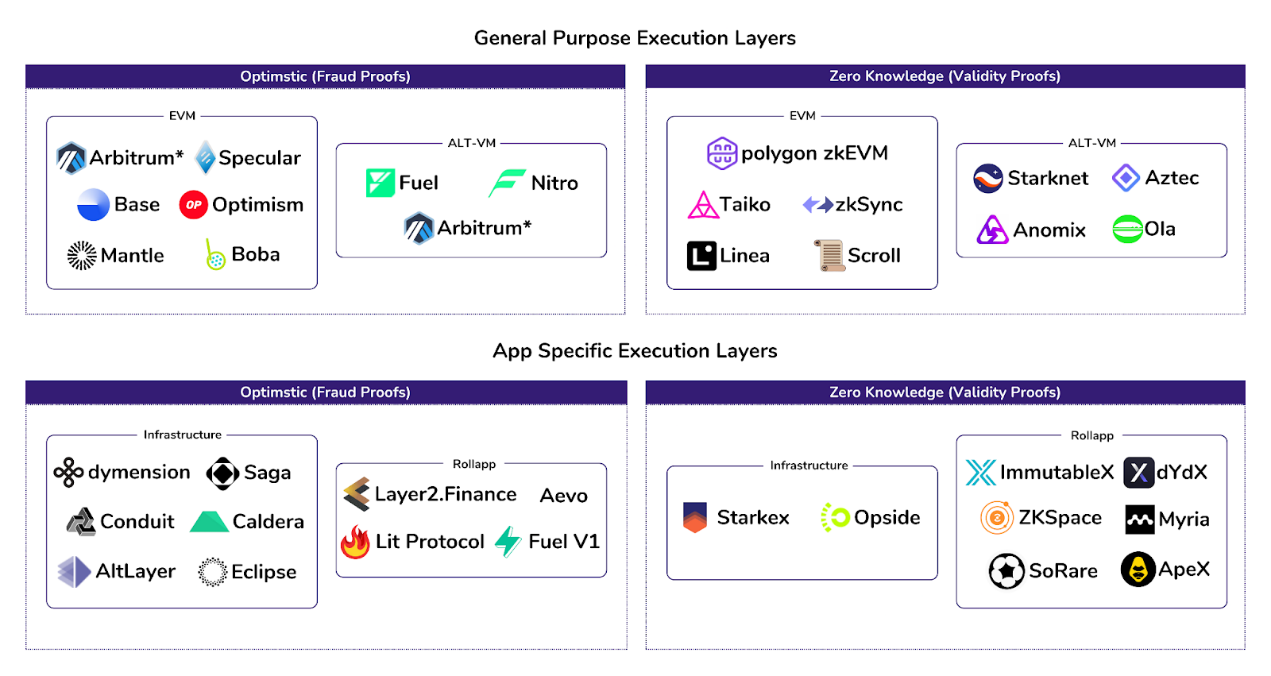
Usually, the executive layer differentiates based on proof mechanisms, either through fraud Proven "Optimistic", or "Zero Knowledge" through validity proof. Let's explore the differences and explain why there are more important differences in the long run: namely virtual machine (VM) design and deployment architecture.
Proof mechanism
When discussing the execution layer, the main difference to note is that Optimistic rollups (ORs) and zk-rollups (zkRs). Optimistic rollups use a fraud proof system to ensure the correctness of off-chain calculations, while zk-rollups use validity proofs to ensure the accuracy of off-chain processed data.
Evidence of fraud:
- an act Or transactions happen in a decentralized system.
- A participant (or group of participants) in the network asserts that the action or transaction is invalid.
- In case of dispute, participants can provide "evidence" in support of their claims. This proof is usually a small piece of data that can be easily checked by other network participants.
- Other network participants can independently verify the correctness of the proof without storing or processing the entire blockchain.
- If the evidence is found to be valid, the action or transaction is considered fraudulent and the network will take appropriate action (for example, punish the fraudster or reverse the transaction).
Certificate of validity:
- a Actions or transactions take place in a decentralized system.
- Participants responsible for an action or transaction create a Proof of Validity, a cryptographic proof that proves an action without revealing any unnecessary information or the correctness of transactions.
- A proof of validity is submitted to the network along with the action or transaction.
- Other network participants can then independently verify the correctness of the proof of validity. This process usually involves checking the mathematical properties of the proof without having to deal with the entire blockchain.
- If the validity proof is found to be correct, the action or transaction is considered valid and can be included in the blockchain. If the proof is invalid or not provided, the action or transaction will be rejected.
The key difference is that fraud provable systems rely on the assumption that there is always at least one honest verifier/orderer to catch fraudulent activity, whereas Validity proves that the system rejects fraudulent transactions in the first place. Validation-verified systems are generally considered more secure because they do not rely on any trust assumptions. However, validity proofs take a lot of time for more complex calculations, and the required infrastructure is very expensive. With zkSync recently open-sourcing their code base, the specification of the proof-of-run program has also been made public. The lowest level recommended option is a GPU system with more than 40 GB vram . Google Cloud costs about 6000 $ per month, which makes it unsuitable for large-scale decentralization. The pros and cons of each approach are explored in further detail below.
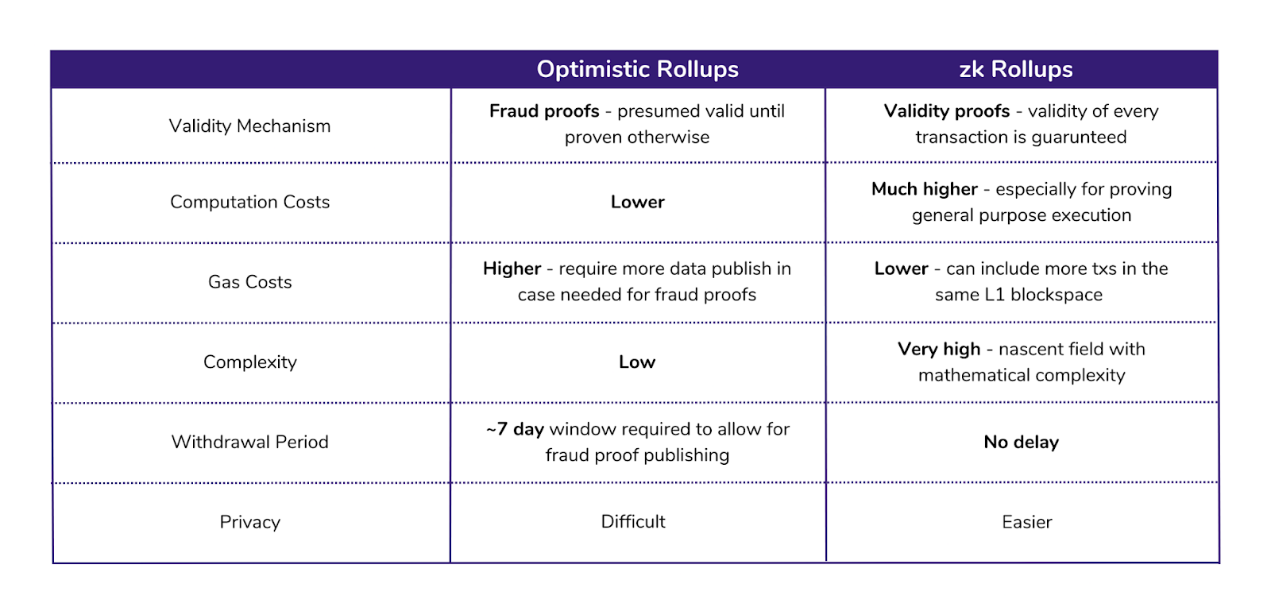
The main challenge of scaling blockchain today is how to, without increasing the degree of centralization, Controls state growth rate. Any increase in throughput will result in faster state growth, leading to increased costs of running the network and centralization issues. zk rollups (zkRs) have an advantage in this environment because they only need to publish proof data to the base layer, allowing more transactions to be included in a given amount of block space. However, with the resolution of the block space bottleneck (EIP-4844 new data processing services), optimistic rollups (ORs) may catch up or even exceed zkRs in terms of scalability. This is because zkRs still requires expensive authentication infrastructure. With larger block sizes, OR can worry less about the cost of data publishing and maximize throughput. zkRs can also use block space to grow larger, but to a lesser extent. Also, there is always overhead in running the validity proof procedure.
While the validity mechanism is an important technical topic at the moment, it is likely to be an implementation detail in the long run. The execution layer will focus on the system that offers the fewest tradeoffs for its use case. Additionally, projects running on fraud proofs today will be able to prove the validity of their virtual machines once the proof time/size of zk drops. For example, the mips provided by Optimism can become a zk Rollup through validity proofs. However, given the current state of the proof system, it may be too costly in the short term due to the scale of proofs required. The proof size is determined by the low-level opcodes supported by the virtual machine. Systems like Fuel may be better suited for validity proofs because the instruction set design is in some ways simpler than mips In either case, the point is that if/when zk becomes more superior, the fraudulent system will be able to switch. The main disadvantage these teams will face is a lack of expertise in zk but as spaces become more standardized and infrastructure optimized, this will become less of an issue.
Author ELI NUSS 's view is that in the long run, proof systems will not be the key differentiator as it is often portrayed today. But in this article, we will continue to consider the differences between the two.
Virtual Machine Design
A key difference is the virtual machine itself. To date, the primary software environment for smart contract execution has been the EVM. The developer community built around Solidity is very strong and accounts for the vast majority of smart contracts deployed. As expected, this resulted in most new Rollup and execution layers being built around the EVM . Both Optimism and Arbitrum are iterating, and teams from Scroll, zkSync, Polygon , and others are racing to deploy the first zkEVM.
The obvious benefit of this approach is that it is compatible with existing smart contract applications and accessible to the majority of the smart contract developer and user community. There is already a clear example of this in chains such as Binance Smart Chain, Avalanche, etc. While optimizing compatibility with existing smart contracts, these Ethereum alternatives are able to take advantage of Ethereum’s poor scalability and quickly attract applications on the Ethereum chain. In fact, this was also seen on early L2s like Arbitrum and Optimism . Nearly every major Ethereum application has deployed Arbitrum and Optimism.
However, there are significant drawbacks to using the EVM . By design, the EVM cannot execute transactions in parallel. There is an upper bound on throughput for L2 trying to scale the number of transactions it can run in a given period of time. This has not been a major problem so far, as the main bottleneck is still state growth. But as the block space gets bigger and bigger, the execution architecture will become more of a bottleneck.
Starkware, Fuel and others chose to build on new systems that could provide much higher throughput than EVM .
The network effects that have built up around the EVM over the years make it very unlikely that any of these new systems will surpass it. As written in the 2022 2022 Electric Capital Developer Report, Ethereum is undoubtedly the most active developer community. Therefore, an execution layer using the EVM will play an important role in the future.
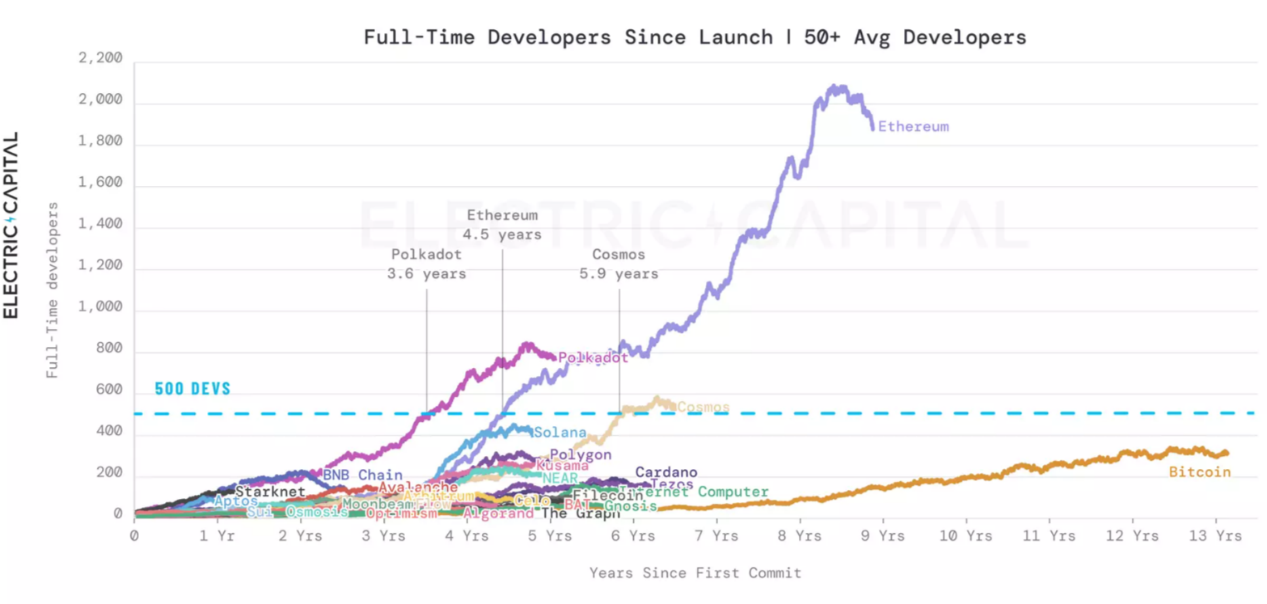
However, as the state growth bottleneck is alleviated, the need for a higher performance execution layer becomes more apparent. The recent Arbitrum announcement from Stylus highlights the need for an alternative to the current implementation design. In the long run, there may be some alternative VM category leaders that reach a similar size to other popular VMs.
Deployment Architecture
The last difference worth understanding is the configuration of how the execution layer is deployed. As mentioned earlier, by far the most common architecture is L2 smart contracts on Ethereum. Generally, these executive layers fall within the realm of sovereignty. On the one hand, you have fixed Rollups, and on the other hand, you have Sovereign Chain/Rollups, the definition of these designs is quite controversial, but for the purposes of this post, the classification system of Polynya will be used.
Enshrined rollups: These Rollups are integrated at the protocol level and do not rely on smart contracts or governance. This is the technical advantage they provide Rollup at the L1 level. The downside is that upgrades can be slow as they are tied to the consensus process of the underlying blockchain. As of now, Tezos is the only protocol moving in this direction.
Regular rollups: The security of these Rollups relies on smart contracts deployed on decentralized chains (such as Ethereum). They inherit the security of the underlying blockchain, but can be upgraded through Rollup 's governance. Includes Arbitrum and Optimism.
Validium: It is not Rollup but an execution layer, which settles proofs on external chains and uses different external chains to process data at the same time. If validity is proven, this construct is called Validium. Examples include ImmutableX and Sorare.
Optimistic chains: These chains operate similarly to Validiums in that they use external chains to store data. Additionally, there is a rollback mechanism where even if one (or both) of the validators disagree, the chain rolls back into a Rollup .
Sovereign rollups: These Rollups solve themselves, using only data and ordering from the data availability layer. All other logic is under the sovereignty of Rollup . This results in the experience most similar to L1, the main difference being how the DA is published. There are many projects planning to build Sovereign rollups, especially in the Celestia ecosystem.

These execution layers are designed with security, upgradeability and integration with the underlying blockchain in mind different trade-offs. In general, more sovereignty means fewer constraints on performance or autonomy, but introduces new risks in terms of upgradeability and security. Security and composability can also be more complex. Less sovereignty usually means the opposite. Perhaps the most important trade-off is economic considerations. The author ELI NUSS 's view is that the more sovereign the executive layer is, the more value will flow to that token. What is less clear is how tokens for regular rollups generate value or whether tokens are actually needed.
Depending on the specific requirements of the project or application, the developer will have to choose the most suitable type of Rollup in terms of security, decentralization and achieve the balance they want between scalability and economic preferences. It's also important to note that much of this is still theoretical. So far, we have seen little real progress on Regular rollups . The situation should become clearer over the next few months/years.
Execution framework/service
As expected, modularity in the blockchain space The trend has produced many rollup SDK/framework and rollup-As-a-service providers. Companies building in this space will raise 50 million over $50 million in 2022 alone. These solutions share the common goal of dramatically simplifying the process of creating new execution layers. Their goal is to simplify the development of the execution layer, similar to how the Cosmos SDK and Substrate facilitate the creation of layer 1 blockchains. Its vision is very similar to the theory of application chains, but these application chains do not rely on building L1 infrastructure, but can inherit security from existing L1. As highlighted by Mustafa of Celestia , it is important to understand the difference between the Rollup framework and rollup-As-a-service .
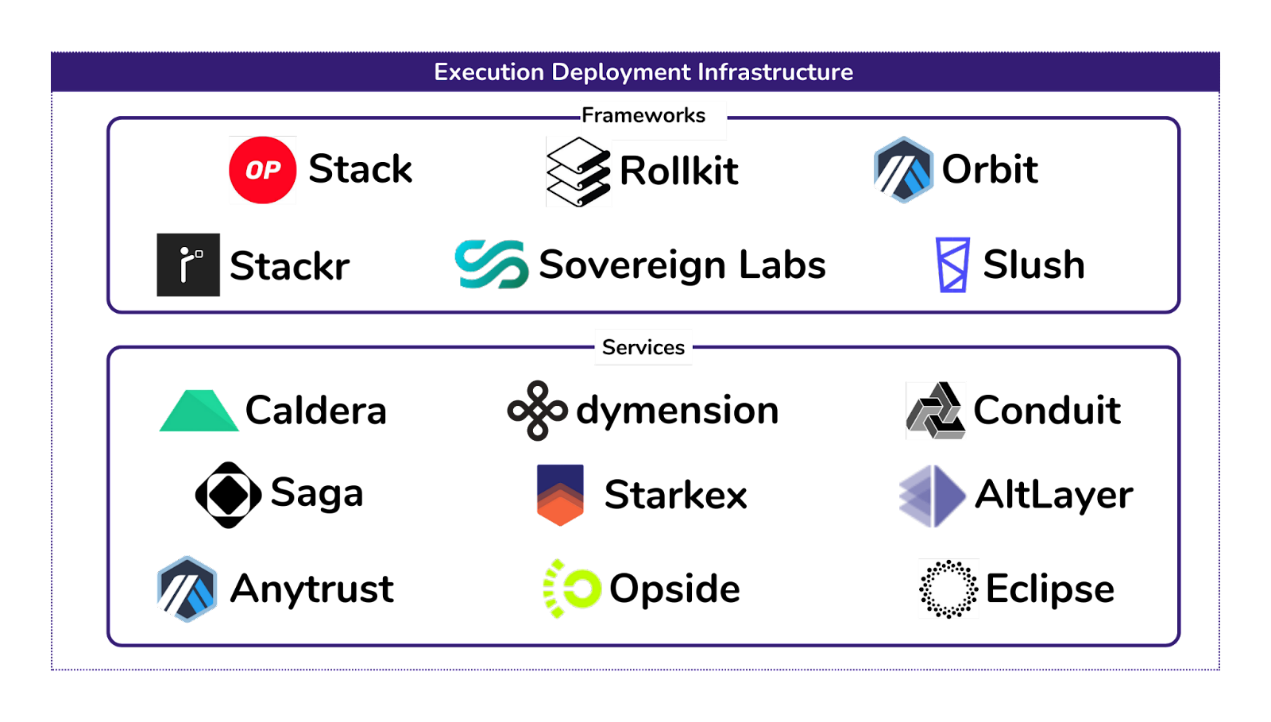
Framework refers to software that can be reused to build your own rollup . Serving, assisting in the deployment and actual operation of rollup . A good example to understand this is OP Stack and Conduit. OP Stack is developed by OP labs and implemented by Optimism,Base and other companies to build your own rollup. Conduit is a service provider that enables customers to deploy OP Stack rollups over infrastructure maintained by Conduit .
Different service providers have different frameworks and configurations. Some are configured as Sovereign rollups, some are configured as Regular rollups, some are designed as L2s, and some are designed as L3. These come with all the trade-offs mentioned above. Starkex can be said to be the first example of an integrated service provider, and it has great appeal to companies such as dY/dX, ImmutableX, Sorare , etc. These execution layers can be configured as Rollup using Ethereum to provide data availability, or as validation using external DA sources.
The idea behind these frameworks and services in general is that in the future there will be a need for Rollup / application-specific Rollup Therefore the deployment of Rollup needs to be very simple. Given the similarities to Cosmos Lisk, it's not surprising that many of these projects are being built within the Cosmos/Celestia ecosystem - Sovereign Labs and Rollkit for ;Celestia rollrolls designed framework, and Caldera, dimension, Eclipse , etc. are all services for Cosmos/Celestia . In the Ethereum ecosystem, OP Stack, Arbitrum Orbit and Stackr provide the optimistic framework, while Slush provides the zk framework. Ethereum-centric services include Starkex, Conduit and Opside.
Considering that state growth will no longer be a bottleneck in the future, it seems likely that a high-performance EVM replacement will be necessary - whether it is WASM , Fuel VM or something else, to be decided. Deployment architectures are a bit unpredictable, although this will mostly come down to economic considerations.
In order for the implementation layer to reach its final form, there are still some unresolved issues:
- Sequencer decentralization - Essentially all execution layers today rely on a central point. This negates many of the principles behind Rollups . This is an important next step for the Rollups team. There are also services like Astria, Radius and others that offer this.
- Across Rollup atomicity - Unless this is figured out, Rollup is meaningless for most financial applications.
- ZK Proof Efficiency - While zk proofs are improving faster than expected, the cost is still too high.
- Token Design - It's unclear if the executive layer will need its own token. Arbitrum and Optimism tokens are essentially governance tokens, they do not capture value like L1 tokens. These models are arguably unsustainable, but whether there are other meaningful token models requires more in-depth research.
It is clear that blockchain is approaching a tipping point where scaling is no longer an issue. In theory, decoupling execution from other layers allows for never-ending scaling. The Rollup framework and services will make deploying new Rollup trivial. The key question here is whether there will be enough demand to demand this scale. This issue is planned to be discussed in depth in a future article, but Polynya gives a good overview here.
Summary
Rollups and others The share of transactions on the execution layer will continue to grow in the coming years, especially as Ethereum and other base layers optimize to provide secure data availability for these execution layers.
Ultimately in the long run, business development and the ability to attract interesting applications will be a key factor in determining the success of the execution layer. In this highly competitive and rapidly evolving field, the ability to create a strong ecosystem is critical to driving growth. The performance gains brought about by these modular execution layers open the door to unique applications not previously possible on L1.
Overall, more than 2 billion $ of VC funding has been invested in Rollups Builders of , such as Arbitrum, Optimism, Starkware , and zkSync. While the design still has room to grow, it's likely that most of the VC returns will come from companies already in development. This is especially true for EVM style execution layers, where market leaders like Arbitrum, Optimism and zkSync have established themselves. Rather than EVM the future will be more interesting.
Original link
Welcome to join the official BlockBeats community:
Telegram Subscription Group: https://t.me/theblockbeats
Telegram Discussion Group: https://t.me/BlockBeats_App
Official Twitter Account: https://twitter.com/BlockBeatsAsia
 Related Articles