Detailed Cetus Protocol: Aptos and Sui Ecological Dex and Liquidity Protocol
Original title: " A detailed explanation of Sui and Aptos ecological Dex platform Cetus "
Original author: AC Capital
On May 2, Cetus announced the completion of its seed round of financing. OKX Ventures and KuCoin Ventures led the round, with participation from AC Capital, Comma3 Ventures, NGC Ventures, Jump Crypto, Animoca Ventures, IDG Capital, Leland Ventures, Adaverse, and Coin98 Ventures. The new financing will be used to support the initial development and growth of the platform and expand its market presence and customer base.

Cetus It is a Dex and flow based on Move ecology It uses an algorithm similar to uniswap V3 to build a centralized liquidity protocol and a series of subsidiary functions to provide DeFi users with the best trading experience and higher capital efficiency. At the same time, using the unique ecological features of SUI to create composable functions different from Uniswap.
01 Who is DEX for?
The on-chain encryption trading market is a relatively small but rapidly growing market. In such a market, the biggest characteristic is that the vast majority (and still being produced in large quantities every day) of asset types are low-liquidity and low-market-cap assets, and there is a strong demand for price discovery. In such a market situation, how to better discover prices and attract liquidity is a prerequisite for the prosperity of on-chain transactions. Therefore, we believe that DEX should serve LPs first.
What is the LP asking for? In different transaction scenarios, LPs have different demands. At the beginning of the year, we put forward the view that the audience determines liquidity, and divided the assets on the chain into two categories: mainstream assets (the top ten assets in the main public chain transaction volume) and long-tail assets. Their LP needs are inconsistent:
Mainstream LP: get more fee income, less impermanent loss (Uni V3 is better)
Long-tail asset LP: cheaper, controllable and flexible market capitalization strategy (Uni V2 is more convenient, and the cost of liquidity management is low)
In the long run, V3 with better capital efficiency is the trend, but because of this difference in demand, Uni V2 and V3 can always coexist in data. But the market will inevitably produce players who can meet the needs of both. In an emerging ecosystem like SUI, Cetus is a stronger candidate.
02 Cetus: Dex, the first centralized liquidity protocol in the Move ecosystem
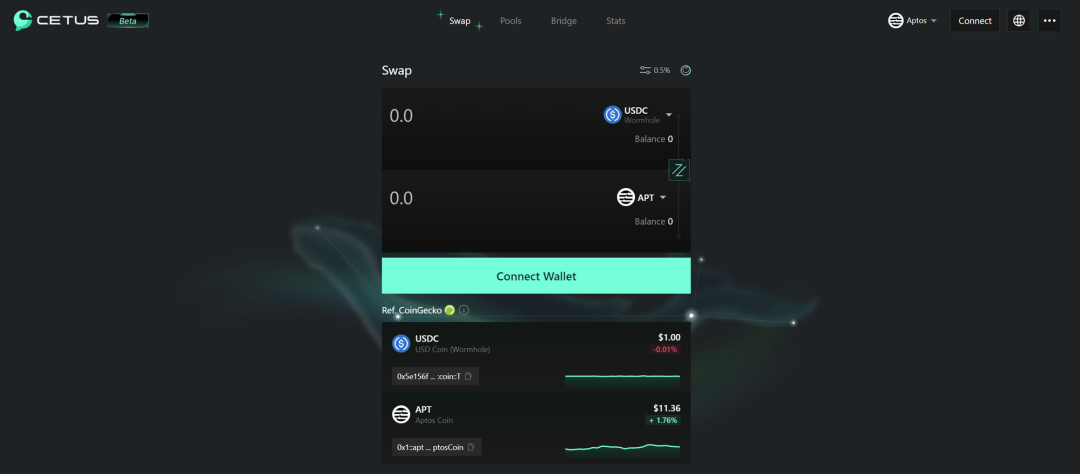
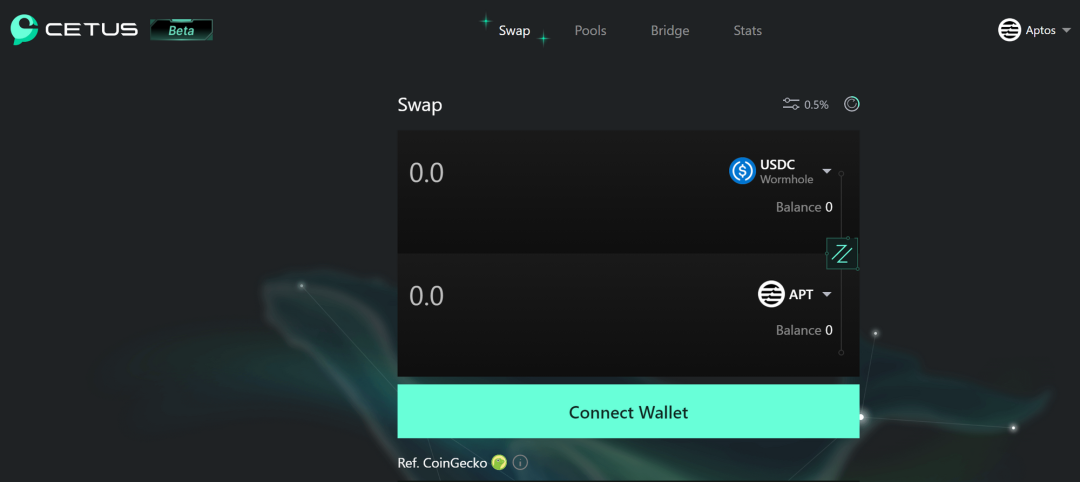
Cetus currently has Complete products including Swap, permissionless liquidity pool, and cross-bridge.
Concentrated liquidity
< br>
Cetus uses a centralized liquidity market-making algorithm similar to Uniswap V3. One LP can create multiple positions in the same pool. By setting different price ranges, LPs can simulate different price curves to realize their customization Strategy. When the price keeps changing with the execution of new swaps, the smart contract will consume all available liquidity in the current quotation range until the next price Tick is reached, at which point the contract will immediately switch to the new Tick, and the newly activated Tick Any dormant liquidity within the interval will be activated. At the same time, there is a correlation between the Tick interval and the level of transaction fees. The higher the fee, the closer the Tick points are.
By concentrating liquidity, LP can earn more transaction fees and have higher capital efficiency.
Unlicensed pool building
Before SUI, one of the representatives of the high-speed public chain was Solana, however, a major factor for the lack of stamina in the development of Solana's ecology is that there has been a lack of permissionless pool building DEX in the ecology for a long time. It is difficult for community native or MEME projects to rise, resulting in insufficient attention to the ecology, lack of new hot money, and becoming a "big household chain". For the rapid prosperity of the ecology of SUI today, the status of community native projects will play a decisive role. In Cetus, users can create liquidity pools without permission, and projects can launch new tokens on Cetus without permission. In this way, Cetus will attract more early project parties and quickly form pricing power for long-tail assets.
Flexible transaction fees
Cetus allows teams and users to choose custom transaction procedures Multiple pools can be set up for the same token with different transaction fee levels. Currently, 4 levels of transaction fees are allowed: 0.01%, 0.05%, 0.25%, and 1%. Through this design, the market is encouraged to find the most suitable liquidity allocation scheme by itself, providing greater flexibility for LPs and trading users. Low-volatility assets such as stablecoin trading pairs may be concentrated in pools with the lowest handling fees, and assets with high volatility or low trading volume may be concentrated in high-handling fee pools for hedging risks.
Automatic position management
Users can implement take-profit orders and limit orders based on range orders After the operation, the general user needs to exit the assets in the position in time after the position is broken, so as to avoid the spot price re-entering the price range. Users can also use a third-party position manager integrated with Cetus for management, thereby reducing the difficulty of liquidity management and facilitating long-tail asset LPs.
Composability
CETUS supports a high degree of composability, and other project teams can also use Integrate the Cetus SDK and easily create an interchange interface on your own front end to quickly access the liquidity of Cetus. For example, Typus, an option project within the ecosystem, realizes one-click hedging of long-tail assets through access to CETUS, and at the same time improves the liquidity and coverage of its own options. Safe cross-chain bridge The cross-chain bridge created by Cetus based on Wormhole was launched in November last year, allowing users to safely and conveniently cross-chain assets across nearly 20 public chains. Strongly associated token economic model Cetus has chosen the xToken economic model. By holding CETUS token and xCETUS, users can obtain agreement revenue sharing, which ensures the consistency of community and agreement interests.
03 Cetus team: mature centralized liquidity market-making algorithm development experience
Uniswap v3 is An innovation of the Defi architecture, the core of which is the Centralized Liquidity Market Making Algorithm (CLMM), which maximizes the capital utilization of LPs. But Uniswap instituted a commercial source code license in March 2021 to prevent others from forking its source code, which expired in April. On the EVM chain, competitors such as Pancake and Quickswap have launched V3 alternatives. But on non-EVM high-speed chains, there are fewer competitors on the CLMM track. In the future, the competition of CLMM-type DEX will tend to be on the operation side, and Uniswap, which is light on operations, will gradually become weaker. Behind Cetus is a Dex team with mature development and operation experience, and its APTOS version has been deployed and is running stably. Under the premise of guaranteed products, strong BD capabilities in the ecosystem, and continuous narrative capabilities in operations, the Cetus team is expected to gain the leading position in CLMM infrastructure on SUI.
04 Centralized liquidity agreement Bringing Defi innovation soil
< p>LP Automated Liquidity Management Agreement
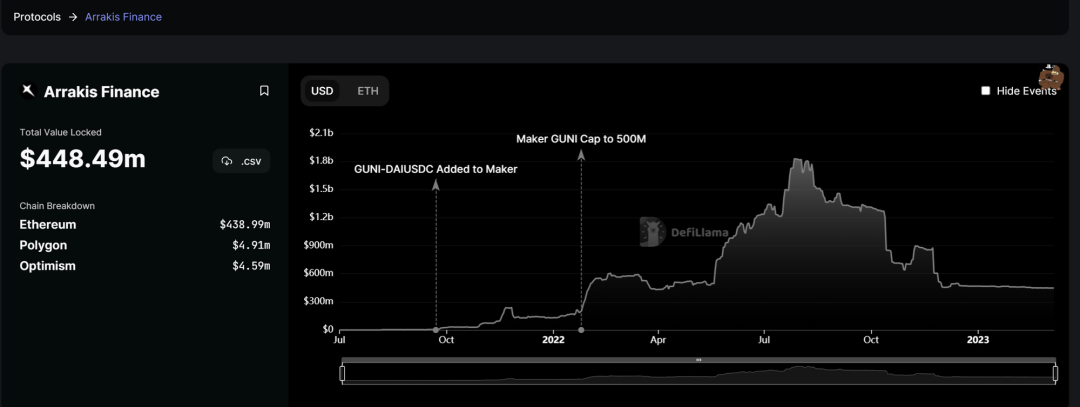
Under the centralized liquidity agreement, LP will generally choose to provide liquidity near the market price However, when the market price exceeds the range of the strategy, LP will not only face impermanent losses but will no longer be able to earn LP fees, and LP needs to actively deploy market-making strategies again. The automated liquidity management protocol came into being, which can help LPs automate market-making strategies. The TVL of leading projects such as Arrakis Finance has reached 440 million US dollars.
This type of protocol can also be implemented:
For LP mining of unilateral assets, LP can deploy initial liquidity in a slanted manner, such as only deploying project side tokens, and the agreement can help absorb basic assets such as USDT or ETH to make the liquidity combination reach a balance. Then with the transaction, the original assets of the project will be gradually converted into basic assets. In this case, it means that LP can achieve liquidity without selling its own tokens or stimulating external capital.
Issuing ERC20 LP tokens for LP providers. These LP tokens can not only flow, but also be re-mortgaged to further improve the capital efficiency of LP assets.
New Smart Pool and Leverage Mining
The previous passive liquidity mining also There is leveraged mining, but because the liquidity is evenly distributed, the comprehensive rate of return of leveraged mining is not ideal. Under the CLMM algorithm, the capital advantage is magnified, and professional quantitative institutions and market maker teams can achieve more granular results. Multi-customized strategies, Smart Pool can obtain funds from agreement users or lending agreements, and adopt active and robust strategies to obtain income, which is of great value to large-scale users with investment needs.
New Derivatives System
Under the CLMM system, while LP’s income increases, it also faces Higher impermanence risks. Under extreme market conditions, the liquidity in the LP setting range will be drained by arbitrageurs. How to construct derivatives that can hedge LP’s market-making risks to buffer the damage to LP’s interests caused by malicious smashing of projects? It's also a track worth watching.
Based on the composability advantages of the CLMM algorithm, there are still many potential Defi protocols that can be tapped, especially after the FTX thunderstorm and BUSD being regulated. The importance of Defi is becoming more and more evident, and the above three Defi products are just the tip of the iceberg.
05 Summary
We believe that the Cetus team has mature product delivery capabilities and a strong ecosystem A team with inter-BD capabilities and operational capabilities. They have a deep and unique understanding of the DEX product and track. We believe that Cetus has a high potential to become a leader in such a unique ecological track as SUI.
Original link
Welcome to join the official BlockBeats community:
Telegram Subscription Group: https://t.me/theblockbeats
Telegram Discussion Group: https://t.me/BlockBeats_App
Official Twitter Account: https://twitter.com/BlockBeatsAsia

 Related Articles