Bitcoin "Double Happiness": The halving narrative is launched, and the ecology ushers in a new era
Original title: "Bitcoin "Double Happiness": The halving narrative is launched, and the ecology ushers in a new era"
Original source: Vernacular Blockchain
Unknowingly, with the continuous change of "atypical bear market", the "halving" narrative that has never faded in the encrypted world is gradually approaching——The current block height is far from the remaining Bitcoin It has been less than a year since the halving, and the halving time is expected to be April 28, 2024, when the block reward will be reduced from 6.25 BTC to 3.125 BTC.
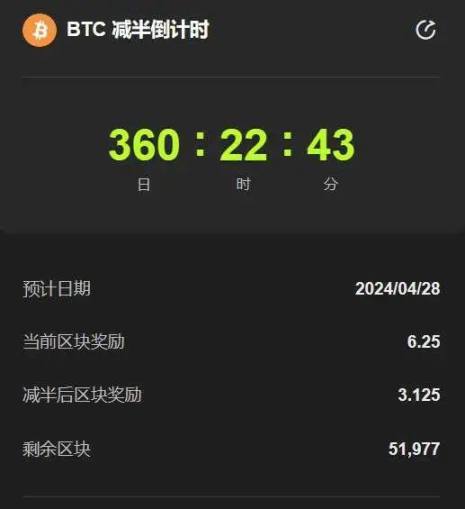
History always has a similar rhyme, but it is not a complete repetition. Facing the end of a new round of halving cycle, will 2023-2024 be a simple replica of 2019-2020?
Bitcoin’s "halving" narrative
We can simply understand The basic knowledge of Bitcoin halving: The mechanism design of Bitcoin determines that the role of miners is extremely important, and it is the cornerstone to maintain the transaction operation of the entire system. At present, the income of miners mainly comes from two parts-block rewards and Processing fee.
The initial block reward is 50 bitcoins, and the rule is that it is halved every four years. It has been halved three times, and now it is 6.25. The first halving will be in 2024, this will continue to decrease, and by 2140, Bitcoin will no longer have block rewards.
The handling fee will always exist, so after a round of halving, the block reward will gradually decrease or even approach nothing, In the future, the income of miners will become very simple, only service fee reward.
Wait until block rewards approach 0, miners' income model will change completely:
< br>
As block rewards gradually decrease until they tend to zero, the importance of handling fees will become higher and higher until they become the only source of income (this is why miners are obsessed with large blocks One of the reasons, because the larger the block, the more transactions can be packaged in the same time, and the higher the handling fee).
Although logically it is possible to make up for the loss of block rewards by increasing the handling fee like a seesaw,but the high handling fee is not conducive to Bit Coin promotion use:
Miners maintain the network to provide value, which is inseparable from sufficient interest incentives;
Users use the network to create value and cannot afford high handling fees;
p>
The feedback fine-tuning of the entire economic system of Bitcoin has always been in such uninterrupted contradictions, but it has always been able to achieve a dynamic equilibrium through sufficient games between all parties .
However, under the background that Bitcoin has been halved three times, the block reward has been reduced to 6.25, and the number of mined has reached more than 19 million. It is time to reconsider the situation and many things from a new perspective.
The new thinking of "BitcoinFi" behind BRC20
From the "London" of Ethereum in 2021 Upgrade", and then to "The Merge" in 2022, as well as the "Shanghai Upgrade" just completed this year and the next round of "Cancun Upgrade". Both occupy the main media coverage.
In stark contrast, the ecological level of Bitcoin is rarely widely discussed by the market, and even many industries of users have already felt that the development of Bitcoin may be at a standstill, which is almost the truest portrayal of the Bitcoin network development process being gradually ignored by the market.
It wasn’t until this year that Ordinals represented a new wave of “BitcoinFi” that all this began to gradually change.
Especially as a new Bitcoin NFT experiment based on Ordinals, the recent BRC20 narrative has begun to develop towards the attribute of "payment currency" for more than ten years (although during the There are disputes over payment and stored value) Bitcoin brings some completely different variables, and even begins to show signs of ecology similar to Ethereum.
At the same time, various controversies about "innovation" such as BRC20 are actually constantly sparking heated debates. It is useless to increase the programmability of coins, and the colored coins before N years have already sentenced this road to death.
In fact, since 2020, everyone seems to have gradually acquiesced in the positioning of Bitcoin as "digital gold", and forgot that it once caused heated debates and even forks in the industry The payment attribute of "global currency" seems to be less important in terms of technological application upgrades.
The refurbishment of "BitcoinFi" represented by Ordinals is also at the right time to some extent-at least the new ecological possibility given by programmability , we can explore and find an alternative and new miner incentive method after the block rewards continue to decrease in the future.
Just on May 3, Crypto Fees data showed that Bitcoin’s single-day transaction fee exceeded US$3.37 million, a new high since May 21, 2021. Compared with about US$370,000 on April 23, it soared more than 9 times within 10 days, and made persistent efforts on May 4, exceeding US$3.5 million.
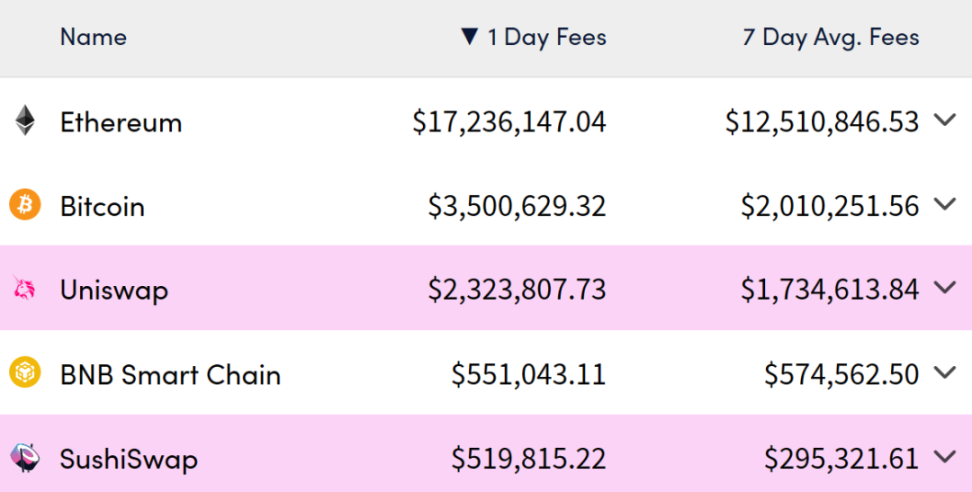
Crypto Fees May 4 data
The miners can be said to be earning a lot This also shows that in addition to block rewards, active ecological innovation and application attempts will greatly promote the pace of fee rewards gradually replacing block rewards.
After all, after the Ethereum transfer to PoS, there are still annual inflation rewards and a sufficiently large internal cycle of ecological handling fees to rely on; The "mined" block rewards and PoW's Monero is still used. Although miners' income is officially based on handling fees, they still retain a fixed block reward of 0.6 XMR.
As the new round of halving cycle draws to a close, Bitcoin also needs to explore more in advance for future changes and strive for margin, which should also be "BitcoinFi" should be refurbished after a few years.
Bitcoin's "change and invariance"
Of course, from another perspective , although most mainstream DeFi is still in the Ethereum ecosystem, the Bitcoin network is still evolving.
In particular, the previous Tarpoot upgrade brought new combinations and possibilities in performance, privacy, and even smart contracts to Bitcoin, as well as more complex programming ability.
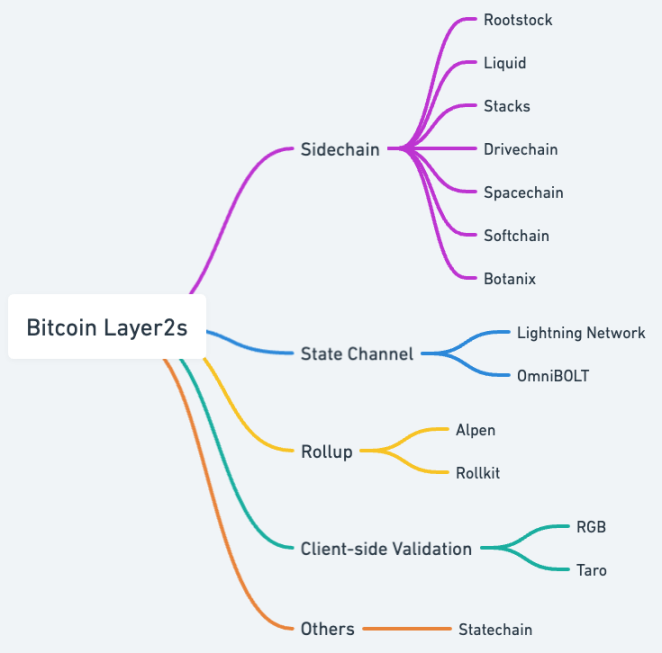
Bitcoin Layer 2 ecological overview, source: @hu_zhiwei
In general, in addition to the Layer 2 innovation of the "Lightning Network" that everyone is familiar with, Bitcoin Layer 2 such as side chains, Rollups, state channels, etc. are actually blooming:
b>
Such as RGB protocol, Slashtags (identity account, contacts, communication, payment serving Bitcoin lightning network ecology), integrating many P2P services The Impervious browser, Taproot-based asset protocol Taro, Lightning Token OmniBOLT, etc. are all worth looking forward to.
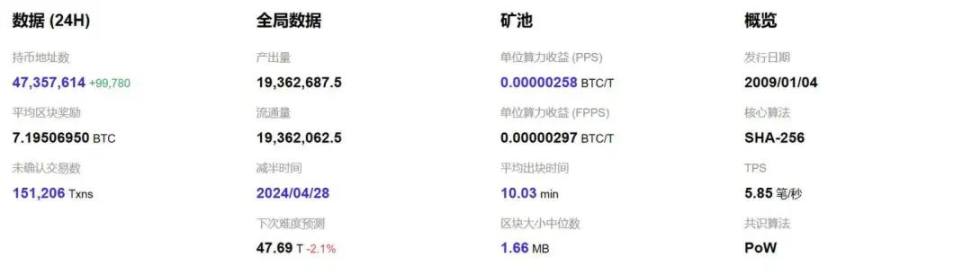
Now we are at the end of this round of halving cycle, and there is less than one year window left before the next Bitcoin,this It may also be the first time (or second time) that most practitioners and investors in this round have witnessed and experienced the Bitcoin halving "major event".
Especially with the reduction of Bitcoin block rewards to 3.125 pieces, the total number of Bitcoins that have been mined exceeds 19.35 million pieces, we may be far away from the real BTC's "Mining Tail Release Era" is getting closer and closer. This is a new variable that we rarely consider in the cycle dominated by block rewards in the past ten years.
History always has a similar rhyme, but it is not always completely repeated. Therefore, the new halving cycle starting in 2024 may be the biggest difference from 2016 and 2020. From this perspective, this is also the biggest uncertainty of various innovations such as "BitcoinFi".
Original text link
Welcome to join the official BlockBeats community:
Telegram Subscription Group: https://t.me/theblockbeats
Telegram Discussion Group: https://t.me/BlockBeats_App
Official Twitter Account: https://twitter.com/BlockBeatsAsia
 Related Articles