Analyze the application of blockchain technology in the development of artificial intelligence
Original title: "In-depth analysis: the application and necessity of blockchain technology in the development of artificial intelligence"
Original source: LegalDAOCN
ChatGPT is the fastest growing consumer app ever and growing rapidly.
But the truth behind AI is that humans are still needed to create, label and structure the training data - and training data is expensive. The downside is that as AI continues to advance, the need for feedback processing of data is growing exponentially; thus, how to manage the participants in the development of AI becomes a very important issue.
Some experts believe that when intelligent robots become widespread around the world, they are best controlled by a decentralized network and humans are motivated by to contribute datasets. Blockchain and tokens (tokens) can help in this process...but can blockchain save humanity from AI?
ChatGPT is not AGI (General Artificial Intelligence)
According to renowned AI researcher Ben Goertzel , ChatGPT is a big deal because “ChatGPT lets the founders of Google appear in the office for the first time in years!”. Goertzel is the founder of SingularityNET, a blockchain-based AI trading platform, and a staunch supporter of artificial intelligence AGI (AGI: Artificial General Intelligence, also known as "strong artificial intelligence") - letting computers think for themselves. That means he sees ChatGPT's shortcomings more clearly than most. (ChatGPT is a weak AI)
“The interesting thing about ChatGPT and other neural models is that they achieve a certain degree of generalization without much generalization Ability. By having so much training data, they have achieved a certain range of capabilities relative to human individuals... In other words, ChatGPT is actually a function achieved by brute force with so much data.”

Ben Goertzel and his robot Desdemona (How to use blockchain to prevent artificial intelligence from "killing humans")
“I wouldn’t be shocked if GPT-7 could do 80% of human work; it’s important, but it doesn’t mean they Can be human-level thinking machines. But they can do most human-level work,” Goertzel said.
Empirical logic is harder for AI than scraping internet information. Predicate logic means that humans know how to uncap a bottle, but an AI would need trillions of data to learn this simple task. Goertzel explained that good large language models (LLMs) can still translate language into putative logic, including paradoxical or self-contradictory logic.
"If you feed your AI the entire web, then almost any question you ask them can be answered on the web."
Goertzel is important in the field of AI mind research because he specializes in AGI. Goertzel said that he and 90% of his AGI colleagues believe that LLMs such as ChatGPT are somewhat distracting from the goal of "making AI think for itself". But he added that LLM could also facilitate and accelerate all the innovative work that could play a role in AGI. For example, LLM will speed up the progress of coding. LLM can even help ordinary people with no coding skills build mobile or web apps. This means that non-technical founders can use the LLM to build tech startups. "AI should democratize the development of software technology, and then go a little further and democratize the democratization of hardware technology development."
Goertzel founded SingularityNET , trying to use blockchain and open source technology to "distribute" the technical power to control AGI to everyone, rather than leaving it in the hands of a monopoly. Goertzel noted that ChatGPT and other text apps deploy open-source algorithms that are publicly visible. As such, the security infrastructure for their datasets, and how users can participate in this technological revolution, is at a critical juncture.
AI development has also received a lot of skepticism. In March, OpenAI co-founder Elon Musk and more than 1,000 other tech leaders called for a moratorium on AI development or the deployment of systems more powerful than GPT-4. Their open letter warns of "profound risks" for society and humanity. The letter proposes that the pause could provide time for AI systems to implement “shared safety protocols.” "If such a moratorium cannot be implemented quickly, the government should take action and impose a moratorium."
Goertzel is more optimistic about the potential of technology to improve our lives. began to study this field in the 1990s.

In the picture, Goertzel refutes Musk et al.'s point of moratorium on GPT-4 research: LLMs will not become AGI
< p>A reputation system is necessary
Humayun Sheikh is the founding investor of the famous AI research lab DeepMind, he Support the commercialization of early AI and deep neural network technologies. Currently, as CEO and founder of Fetch.ai, he leads the startup developing a deep technology for the "self-governing future."
He believes that the intersection of blockchain and AI is economically driven, because unless it is a very large company or organization, the money required to train an AI model it's very expensive. “The whole premise of cryptocurrencies is the democratization of technology and finance. We envision that, instead of just one monopoly entity having ownership of important AI models, blockchains can decentralize ownership among the people who contribute to its development.”
“One way we can keep users (people) engaged in the AI training and development cycle is to involve people from the beginning, This is why we insist on decentralizing AI technology. Whether it is letting people train AI from the beginning, or let them test and validate AI systems, ensuring that ordinary people can have partial ownership of AI models is a good way to let Users (people) stay in the "loop". We want to do that while grounding this democracy with the right incentives. ”
In order to achieve this goal, emerging reputation systems and decentralized social networks can be adopted. For example, Rejuve, an offshoot of SingularityNet, is tokenizing and crowdsourcing biological data submitted by individuals, hoping to use artificial intelligence to analyze it and cross-match it with animal and insect data to discover which parts of the genome allow We live longer. This is a "longevity economy" based on AI and Web3. In this case, participants participated in Open Science and contributed to the results, so data submitters should also be rewarded for their contributions.
“The development of AI relies on human training. Reputation systems can provide quality assurance for data, and decentralized social networks can ensure that various different ideas and perspectives.”
Sheikh noted that blockchain-based AI governance could also help, saying that by allowing everyone to see The collected data and indisputable record of decisions made ensures transparency and decentralization of decision-making. But blockchain technology is only one piece of the puzzle. "Rules and standards, as we've seen with DAOs, always require trusted governance," he said.
Goertzel noted: "You can't buy and sell credibility” and tokens have network effects. A blockchain-based AI reputation system can ensure consumers can distinguish between AI fakes (sic: AI fakes) and real people, while also ensuring transparency so that builders of AI models can be held accountable for their AI builds. In this view, some standard for tokenized measurement of reputation needs to be adopted in the blockchain community, and then in the mainstream tech ecosystem.
In turn, reputation systems can accelerate innovation in artificial intelligence. "It's not the path to quick money, but it's part of the blockchain's path to dominating the global economy. In the realm of reputation, blockchain has a bit of a "tragedy of the commons" (the tragedy of the commons is a problem in economics that happens to individuals When social welfare is neglected in pursuit of personal gain); but everyone will benefit from a shared reputation system.
Blockchain for Dataset Management
AI and data can do many things- - But governments around the world are very concerned about how they manage data.
The key question is who owns the dataset. The distinction between open source and closed source becomes blurred, and their interplay becomes very subtle. AI algorithms are often open source, but the parameters of the datasets and the datasets themselves are usually proprietary and closed, including ChatGPT.
The public does not know what data was used to train ChatGPT-4, so even if the algorithm is public, AI cannot replicate it. Various people have speculated that it was trained using data sets from Google and Twitter; Google has denied that it ever trained its own AI called Bard using the data and talking to ChatGPT, which further obscures who owns what (What ) and "How" questions.
Kai-fu Lee, a well-known AI venture capitalist, often says that open source AI is the greatest human collaboration in history, and AI research papers often include their datasets for reproduction, or for others to copy. But despite Lee's remarks, data are often mislabeled when they relate to academic research, Goertzel said. Even open datasets, such as academic papers, can be immature, mislabeled, useless and often difficult to reproduce.
Therefore, the combination of AI and blockchain will play a big role in the field of data preprocessing. There is an opportunity for crypto companies and DAOs to create tools for decentralized infrastructure for cleaning training datasets. Open source code is one thing, but protecting data is crucial.
Goertzel noted that "you need to have a way to get a real-time AI model, but at the end of the day, someone has to pay for the computer that runs the process," which could mean making users Paid access to AI through a subscription model; however, a token economy is a more "natural" choice. So why not incentivize good datasets for further research? "Data analysis pipelines" such as genomics data can be built by crypto companies/DAOs. LLMs can already do these things, but “most of these preprocessing steps can be done better in a decentralized way [distributed computers],” Goertzel said, “but it’s a lot of work to build it.”
Collaboration between humans and AI: Massive data needs responsible managers
Founder of Canada Ocean Protocol According to Trent McConaghy, a practical way to think about human-AI collaboration is the concept of "computer-aided design" (CAD, computer-aided design, which refers to the use of computers and their graphics devices to help designers do design work). Engineers have benefited from AI-powered CAD since the 1980s. "This is an important framework: Humans and computers working together to accomplish goals while leveraging the strengths of both," he said.
McConaughy began working for the Canadian government in the 1990s and spent 15 years developing AI-powered CAD tools for circuit design. He wrote the first major article on AI in 2016.
CAD provides us with a framework for practical human-AI collaboration. However, these AI-powered CAD tools still require data.

Image content: "Imagine hand-drawing a chip with 10 billion parts...but people do it anyway, do you know how? The answer is Using artificial intelligence...
McConaughy founded Ocean Protocol in 2017 to address this problem. Ocean Protocol is a public service network that can Safely share AI data while protecting privacy. "This is an AI technology that uses blockchain to improve the data situation for the people of the planet." Impressively, it is the sixth most active crypto project on GitHub.
Blockchain has many advantages to talk about in putting data into the hands of ordinary people. Like Goertzel, McConaghy believes distributed computing can make an important contribution to protecting AI from malicious use. IPFS, Filecoin, Ocean Protocol, and other distributed data controllers have undertaken this task over the past few years.
Data farming on Ocean (Original: Data farming) has inspired people to pick and choose high-activity data assets that they think can be used for AI development. Examples include Acentrik, an enterprise data marketplace, Algovera, an enterprise AI assistant, and Desights, a distributed data science competition protocol. “The problem for AI people is getting more data and more sources of data,” McConaghy said.
Blockchain can help AI share data securely (original training data, models, and original training predictions), with features such as immutability, provenance, censorship resistance, and privacy.
McConaghy sees this as a big plus in combining the two. "AI turns data into value, but humans must decide which are good data assets."
Ocean Protocol has further developed the foundation of an AI data economy. It tokenizes data assets, allowing people to issue valuable data as NFTs and tokens, hold them in wallets, sell them on data DEXs, and even manage them in data DAOs. Tokenizing data unlocks the data economy by leveraging DeFi tools; but will these efforts become mainstream before AI?

Trent McConaghy, founder of Ocean Protocol, aims to create a data trading market
Decentralization Computers can serve autonomous robots
AGI is when a computer starts to think for itself and builds a better version of its own source code. "A human-level AGI can read its own source code, existing mathematics and computer science, and can replicate itself to experiment and then build the next level - ASI artificial superintelligence," Goertzel explained.
In Goertzel's view, it is far better for the technology to be directed by everyone than to be controlled by a single technology company or country.
"If you deploy an AGI system to millions of computers around the world, no one can hold a gun and say "give me the system" to you - Blockchain solved the problem, right? Blockchain solves this problem better than it solves the monetary problem,” Goertzel argued.
Goertzel specifically defines AGI as "software or hardware that has powerful capabilities beyond its programming and training; it is capable of creating significant creative leaps beyond the information it acquires. ”
“According to my estimates, we are now only three to eight years away from human-level AGI, and then we can reach superhuman AGI in a few years. We are living in interesting times.”
In the medium term, which is the next three to five to eight years, we will see breakthroughs in AI that rely heavily on data , reach human levels, and then what happens after that? ”
Many agree that the next step in the evolution of AI could be one of the important use cases for blockchain governance. "AGI will bring world leaders together. AGI needs to be open source and run on millions of machines scattered around the planet," Goertzel said. "Therefore, no country can control it, and no company can control it."
Decentralized technology is not a perfect solution
;
Professor Kai, Professor of Computer Science and Engineering at the Hong Kong University of Science and Technology and a Distinguished Research Scholar at the International Computer Science Institute in Berkeley, agrees that the key bottleneck to democratizing AI is the hardware that runs it. Huge computing resources. But he is not sure that decentralized technology can be the perfect solution. "If we don't fix the problem at hand, we'll never get to the Terminator stage," he said. There is a problem of artificial intelligence tearing society apart in a subtle way; we need to solve the problem of human bias, and the problem of AI bias.
He said that decentralized technology is still highly experimental, and these Web2 problems must be solved first, because they are giving us current problems.
“AI often makes decisions on things that people don’t notice in their lives; search engines, YouTube, TikTok—they decide things you Often undetected, it creates more polarized views and leads to unsustainable domestic and geopolitical divisions."
Kay said that the dataset's Transparency is critical, but if a dataset is the entire internet, that dataset is effectively open source. He believes that Google is 100% trained on the Internet, and LLMs will soon quickly replace the search engine's algorithm; LLMs can be trained almost 100% from the Internet.
As such, Kay questions the notion that blockchain can solve the messy AI problem.
“The opposite of this statement [decentralized computing for artificial intelligence] is that AI is more autonomous and could lead to the Scenarios arise. This kind of distributed computing power is not the solution, because you can inadvertently lead to the emergence of legions of artificial intelligence. ”
So what is the best solution? “Decentralization has some benefits, but it’s not a panacea; Web2 has created a lot of unintended consequences, we need to learn from it, and recognize that blockchain is an underlying technology that can provide many advantages, but still not One-size-fits-all solution.”
But of course, not all data on the web is freely available: scientific research, medical data, personal data collected by apps, and others Vast amounts of privately owned data can be used to train AI.
One of the most useful tools, he says, is creating large-scale simulations to see how it all might play out. The question, he said, is “what should we decentralize, and what should we not decentralize.”
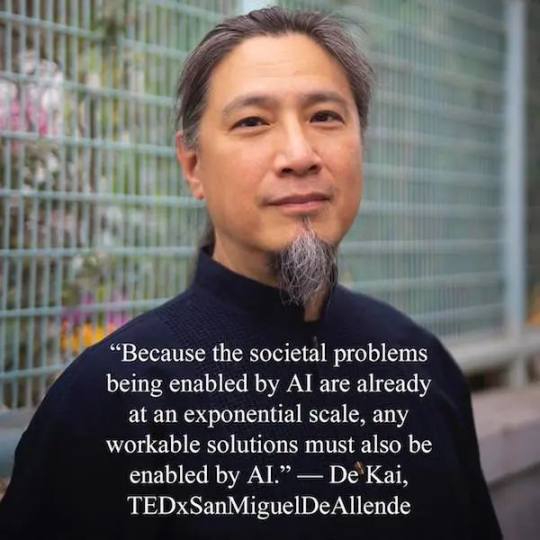
Since the social problems caused by AI have grown exponentially, any viable solution must also be realized by AI
Conclusion: Better data preprocessing is possible with blockchain
Therefore, the district What is the best combination of blockchain + AI? Sheikh believes: "It would be an excellent combination to see blockchain as a key part of mainstream AI development."
"We believe that AI models Having all the data you look at in one place is not the best way to develop AI. Instead, it will further accelerate adoption of AI by enabling humans who train models to own their own data and be incentivized based on how accurate they are with the results. Such a platform AI models on the Internet can be more scalable and sustainable, and have better security and privacy.”
De Kai is also concerned: “In One of the biggest mistakes we made with AI in the 70s-80s was assuming everything we did was right. We now have to test our assumptions again.”
Original link
Welcome to join the official BlockBeats community:
Telegram Subscription Group: https://t.me/theblockbeats
Telegram Discussion Group: https://t.me/BlockBeats_App
Official Twitter Account: https://twitter.com/BlockBeatsAsia

 Related Articles