How will the new generation of Tricrypto reshape the Curve ecosystem?
Original title: "Tricrypto: The Next Generation"
Original author: crv.mktcap.eth
Original compilation: Kxp, BlockBeats
< br>
Amidst the protracted crvUSD deployment, we noticed a larger and more impactful event: the deployment of Tricrypto Next Generation.
The previous generation of Tricrypto has been the backbone of Curve Finance since its launch, as this Blockworks dashboard from Dan Smith demonstrates:
< p>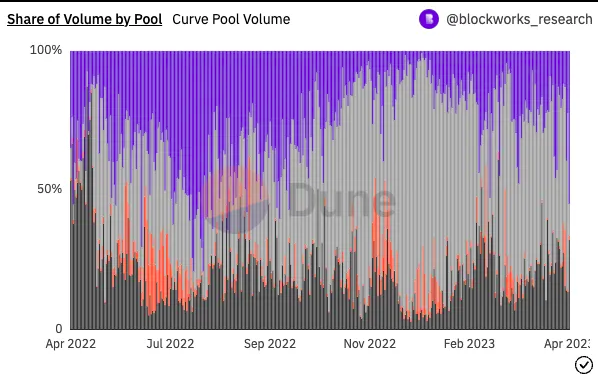
Tricrypto status quo
< p>We can see that most of Curve's daily trading volume comes from 3pool and Tricrypto. DeFi has many excellent assets, but all trading volume still comes from top assets. BTC, ETH, USDT, and USDC are four of the top five cryptos tracked by CoinGecko, accounting for 71% of the crypto market capitalization. As long as you cover those assets, you cover most of Crypto.
Tricrypto handles three of these assets (replacing BTC with WBTC), while 3pool grabs the largest two stablecoins. Therefore, these two pools are sufficient to handle the majority of Curve volume, leaving perhaps only 20% of volume captured by the remaining long-tail assets.
The roles of Tricrypto and 3pool in the Curve ecosystem are also very different. Trading between USDT-USDC is very razor-thin, but still makes for a good fee in the volume game, especially during periods of high volatility. And trading between volatile assets (WBTC, ETH, USDT) can generate more profits.
Since its launch, Tricrypto has provided Curve with trading on many of the top Crypto assets. Curve (the dark blue part in the picture) has always occupied its stable share of transactions, but it has never replaced Uniswap (the pink part in the picture).

This graph may surprise Curve backers feel depressed. In terms of slippage, the Curve v2 pool is theoretically better as it offers the best quotes. When will this change?
Gas efficiency is a major reason. Last summer, a landmark Delphi Digital report detailed the absolute status of the deal.

This amazing report reveals that, at about 2/ 3, Curve Tricrypto usually offers better quotes than Uniswap, with a difference of up to $5.81.
However, Curve Tricrypto tends to have higher gas fees. When gas fees are factored in, small traders may end up getting a lower value token just to save a few bucks in gas fees. Only those whales that conduct large transactions and do not consider gas fees to be a problem will prioritize transactions through Curve.
Through Arbitrum we can see how Tricrypto might perform if gas fees were irrelevant. On Arbitrum, Curve quoted better prices (including gas fees) and completely dominated the transaction volume. What if this effect appears on the mainnet?

Why Curve Tricrypto's gas fee Would it be higher, even if it uses the efficient Vyper? There are several reasons. First, the question is who pays the cost of rebalancing liquidity. On Uniswap v3, this cost is paid by those who provide liquidity, who must reallocate liquidity when the price changes. Curve v2 does not require liquidity providers to rebalance liquidity, so the cost of rebalancing is usually paid occasionally by traders who perform liquidity operations (i.e. trade or add or remove liquidity) in the pool.
Another key factor is that the first version of Tricrypto is not well suited for gas fee optimization. The pool uses a lot of cutting-edge and complex mathematical formulas, so it's hard to refactor those equations into their most efficient form, just to keep the pool working.
The latest Tricrypto NG involves a lot of theoretical mathematics. Whether you use ChatGPT or not, as long as you read the NG white paper on the first page of the website and find that the developers of Curve are some of the best in the business.

A lot of evidence shows that high gas fees will lead to user loss . Of course, experienced traders have no allegiance to either Curve or Uniswap, they only care about which engine can provide the best value at a certain moment.
So at the end of the day, we don't think traders should be trading directly on Curve or Uniswap. Both protocols should offer the best quotes they can, and users should simply grab the best rates from the DefiLlama meta-aggregator.
It would be great if Curve could reduce the gas fee by 1.5-2 times.
Future Development of Tricrypto
TNG provides various Improvements, including ERC20 compatibility, low gas fee approval methods, and better price oracles.
Probably the most groundbreaking change is simply a significant increase in gas efficiency: the author with the username "Fiddy" reasonably made gas fees about 50% cheaper .

We are writing a standalone article detailing the "crazy science" behind these optimizations, but early testing has shown that these optimizations do work.
On the old version of Tricrypto, if the most recent transaction is selected as a sample, the user needs to spend 279K Gas.

The result of testing the new version of the pool shows that this number has dropped to 183K , the test result is about 34% cheaper than before:

This Gas consumption is at the same level as Uniswap.

The actual gas price paid for using the new version of TNG is affected by multiple factors (for example, when the pool adjusts its liquidity), but it has been tested many times in a lab setting, and now we can finally see how it performs in real-world applications.

Please note that these pools may be useful for volatility trading assets Useful, but for transactions between stable assets, it would be more efficient to use a classic stablecoin pool.

We may also see this trigger a gas reduction fee competition. Maybe Uniswap will launch a Gas-optimized version. Beating Uni v3 in terms of gas consumption is probably impossible in my opinion. But if you consider the efficiency of the Curve AMM, you might see an interesting race.
So, I think the potential impact of this deployment may be bigger than crvUSD. More specifically, in the short term, I do think the Curve ecosystem will be more influenced by the new generation of Tricrypto. Over a longer time frame, crvUSD may reshape the entire ecosystem to a greater degree, but I don't think the impact will be realized until crvUSD starts taking other forms of collateral, which may be soon, Or maybe not.
I think we will see the results of the Tricrypto NG contract soon. First, we may see greater competition to trade the largest Crypto assets on-chain.

The premise of veCRV is that Curve Will be competitive to attract transaction volume and pass transaction fees to Stakers. Curve v2 has always been impressive with its ability to minimize slippage, and the gas optimization we are seeing now may help realize even more potential.
Of course, this may mean that users who will invest in current Tricrypto will be forced to migrate, so LP should be prepared to make some moves.
Another impact that may be more immediate to implement is Tricrypto: NG comes with an accompanying factory that allows anyone to start their own Gas-optimized Tricrypto without permission pool, which contains three assets.
We are already seeing advanced users thinking about what possibilities they can create with such a factory:


A lot of the excitement about the Curve ecosystem is how it can be leveraged by the wider DeFi community to launch interesting applications.
In this case, the fruit of the community's imagination may be much faster than we see from crvUSD, which may go through several cycles, Only then will it form the scale I expected.
Whatever the reality is, it's been an exciting week for the Curve fan-author.
For those interested in learning about specific changes within this pool, I recommend readers browse the Github repository where the code is well documented. Also, check out this early draft changelog where Several changes to achieve this efficiency are described.
Original link
Welcome to join the official BlockBeats community:
Telegram Subscription Group: https://t.me/theblockbeats
Telegram Discussion Group: https://t.me/BlockBeats_App
Official Twitter Account: https://twitter.com/BlockBeatsAsia

 Related Articles