Innovation of on-chain permaculture agreement
Innovations of On-Chain Perpetual Protocols Part 2
Original article by Frank Hu and Kester Wu
Kxp, Blockbeats
As the potential impact of FTX becomes apparent, the importance of decentralization and transparency is increasingly in focus. The migration of trading activity from CeFi to DeFi is no longer a question of "if," but "when."
Perpetuation agreements like GMX have grown significantly over the past few months, and GMX, with its unique design, has grown into an ecosystem of its own. The study was divided into two articles.
The first part can be found athereFind it.
In Part 2, we'll take a closer look at the GMX ecosystem and some of the interesting protocols built on top of it.
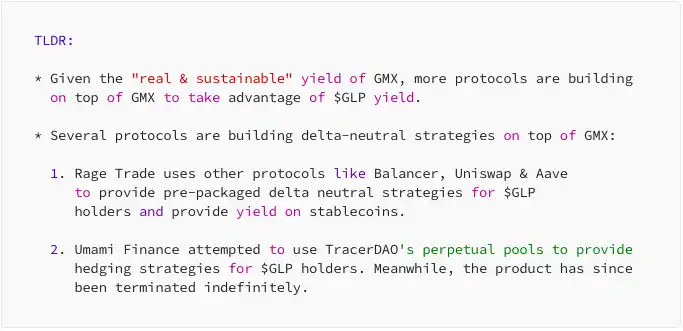
We mentioned in Part I that the risks of GMX LP are: 1) the amount of open interest (OI) on GMX and 2) volatility in underlying asset prices.
Some agreements have addressed the challenge of volatility in underlying assets.
Rage Trade
After a brief discussion with Rage Trade founder @crypto_noodles, we learned that the agreement is designed to do two things: 1) provide a pre-packaged Delta neutral strategy for GMX LP, and 2) provide more yield for stablecoin depositors.
Rage Trade's vision is to become Arbitrum's largest stablecoin farm by leveraging real and sustainable GLP revenue.
To achieve this, Rage Trade plans to offer two products, namely Junior Tranche (Risk-On Vault) and Senior Tranche (Risk-Off Vault).
The following simple workflow describes how Rage Trade's vault will work.

Rage Trade Workflow
Referring to the mind map above, the numbers/texts encoded in orange provide information about Junior Tranches and the numbers/texts encoded in blue provide information about Senior Tranche.
Start with Junior Tranche Speaking of:
1. Users participating in Junior Tranche deposit GLPS in Rage Trade's Risk-On Vault. Subsequent actions are handled entirely automatically by Rage's Treasury contract.
2. Rage Trade lends corresponding ETH and BTC lightning loans on Balancer based on the weight of ETH and BTC in the GLP pool.
3. Then sell the borrowed ETH and BTC on Uniswap as USDC. Create a synthetic short position.
4. In addition to the proceeds from the sale of ETH and BTC by Uniswap, Senior Tranche's USDC supplement will be deposited with Aave as collateral to borrow ETH and BTC.
5. Then use ETH and BTC borrowed from Aave to pay off the lightning loan from Balancer.
6. This whole process enables LP on GMX to enjoy the benefits of GLPS and effectively reduces the volatility of the underlying assets.
Next isSenior Tranche:
1. Users participating in Senior Tranche deposit USDC in Rage Trade's Risk-Off Vault.
2. Then lend the USDC to Junior Tranche to keep 1.5x health factor on Aave.
3. Senior Tranche participants receive revenue in two ways. First, USdcs deposited in Aave generate additional revenue.
4. In addition, a portion of GLP income is distributed according to the utilization rate of USdcs in the Senior Tranche. The calculation of utilization is illustrated in the mind map.
Rage Trade's performance in a back test using 1 year of GMX data is as follows:

Source: @crypto_noodles
Assuming ETH yields of about 20%, the "Risk-On" Vault/Junior Tranche would have a net return of about 24.8% after taking into account GLP earnings shared with Senior Tranche earnings. Please note that the "Risk-On" vault automatically compounds ETH rewards on a regular basis.
Conversely, if GLP holders were pure HODL, they would receive a net return of minus 3 per cent due to the decline in asset prices in the GLP pool.

Source: @crypto_noodles
Assuming a yield of about 20% on ETH, the "Risk-Off" Vault/Senior Tranche would have a net return of about 8.27% after factoring in GLP gains. The income can be broken down into two parts: 1) the interest on the loan on Aave generated an income of about 1.05%, and 2) the ETH income from GLP generated an income of about 7.22%.
The "return funnel" of two Tranches is shown below:

Rage Trade Yield Funnel
Key challenge
Rage Trade has built an amazing product. At the same time, the agreement faces two major challenges: 1) balancing risk and 2) relying heavily on GLP revenue.
Adjusting positions in the vault can occur under two conditions: 1) weight changes in the GLP pool or 2) ETH and BTC price changes.
Short positions on Aave are updated every 12 hours. This means that every 12 hours, if the price of ETH and BTC rises, GLP earnings will be made to repay the short position. Rage Trade maintains a health factor of 1.5 on its short position in Aave in order to improve capital efficiency.
If the prices of ETH and BTC spike during the allotted 12-hour window, there may be a possibility of liquidation on Aave.
In this case, participating users of Senior Tranche would lose the funds they lent Junior Tranche. And Junior Tranche participants may need to reduce their holdings in GLPS to become Delta neutral again, or lose their Delta neutral position altogether.

Source: GMX Statistics, GMX ETH Borrowing Rate, December 1, 2022
Naturally, the deal relies heavily on GLP revenues. This is not a systemic risk, but users should be aware of potential volatility in returns.
The team is very conservative based on the assumption that ETH yields will remain at 20%. Nevertheless, participants should be aware that ETH yields can fluctuate significantly.
Looking at the data of the past two months, the average borrowing rate of ETH is 26.5%. Despite this, ETH's yield fell below 20.0% on 44 occasions, with the lowest borrowing rate of about 9.1%.
Umami Finance
Umami Finance was founded to attract institutional capital to Web 3.0 with a "sustainable" 20% annualized interest rate.
Umami's USDC vault provides liquidity to the GMX and passes the proceeds of the GLP to depositors while hedging against unwanted market Delta.

Umami Finance Workflow
USDC Vault (out of service)
In operation, Umami's USDC vault earns GLP revenue by providing liquidity to GMX in return.
1. The user deposits the USDC into the USDC vault and gets a receipt Token -- ERC-4626 Token glpUSDC. Users can leave the vault at any time by exchanging glpUSDC on Uniswap for stablecoins.
2. The vault uses an undisclosed proportion of deposit liquidity to mint GLPS and charges a GMX transaction fee.
3. The remaining deposit liquidity was used to mint hedging derivatives of BTC and ETH on TracerDAO (now called Mycelium).
4. By buying leveraged tokens (3S-BTC/3S-ETH) to hedge, the Vault creates a short position in ETH and BTC.
5. This enables the vault to reap GLP gains (from transaction fees) while hedging BTC and ETH price fluctuations.
Tracer hedges derivatives
Umami uses Tracer's perpetuity pool to hedge against unwanted GLP price fluctuations. Tracer's perpetuating pools are synthetic derivatives that enable users to make leveraged long or short trades on assets. Each pool has an established risk limit (e.g. 3S BTC or 3L ETH).
These positions are non-liquidable and will be fully collateralized.

TracerDAO perpetuity pool
The perpetual pool is managed by a contract that transfers value between long and short sides of the mortgage pool based on the underlying price source:
1. The pool has two directions: long and short. The user deposits the USDC into the multi-sided side of the mortgage pool, casting multi-sided tokens, and vice versa.
2. Users can convert long/short tokens to USDC by burning any Token.
3. The value of tokens is determined by the ratio of collateral held on either side of the pool.
4. The amount of collateral held in short and long pools changes dynamically.
5. Every hour, rebalancing occurs and value is transferred from one side of the pool to the other. The number of transfers is determined based on the collateral ratio of the pool, which is calculated as follows:

Source: TracerDAO, Perpetual Pool Rebalancing
In the case of the one-double pool, collateral in the short pool is transferred to the long pool when the price of the underlying asset rises.

The calculation of value transfer will be divided into two steps:
1. Assuming a 5% increase in the underlying price, the value transfer is calculated as follows:

The amount transferred from the short pool is calculated as follows:

Non-linear benefits of TracerDAO perpetuation pool

Source: TracerDAO, Power Lever Diagram
This function will effectively prevent either party from losing all of its value. Although the liquidation risk is effectively eliminated, the return is greatly reduced. Looking at 2p long spot (green dotted line), 2x leverage yields 200% if the underlying asset appreciates 100%. However, under the power lever function, the return is reduced to about 75%.
The "revenue funnel" of Umami's USDC vault is shown below:

Major challenge
The TracerDAO perpetuation pool does not perform well
It is important to note that the hedge model of the USDC Vault does not result in complete Delta neutrality.
Despite the flawed design of TracerDAO's perpetuation pool, Umami may have used it as a hedging tool because they initiated early activities to support liquidity in the TracerDAO pool prior to the launch of the USDC Vault. The actual cost of hedging using these pools was much higher than expected.
The bias of the TracerDAO pool limits the scalability and performance of the vault
Similar to Rage Trade, the balancing risk remains in Umami's USDC vault.
The vault rebalances its Tracer hedges every 9 hours. If BTC or ETH is very volatile over a short period of time, this may adversely affect Delta neutrality.
The vault has now ceased operations
At the end of August 2022, Umami suspended the much-anticipated USDC vault because of what it claimed was an unsustainable 20% annual interest rate.

Source: Dune Analytics, @dbustos20
Naturally, when the public learned of the vault's poor performance and subsequent suspension, most of the vault depositors switched to glpUSDC.
Look into the future
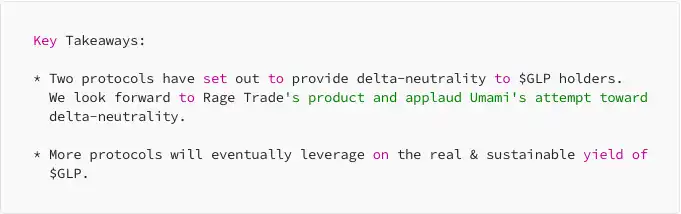
Both protocols above attempt to provide Delta neutrality for GLP pool LP. Umami Finance has said it will try again, while Rage Trade's product results are not yet visible.
The development of the GMX ecosystem is worth looking forward to.
At ByteTrade, we are actively building our Web3 operating system (OS) based on the open blockchain-Edge Node-client (BEC) architecture, a decentralized version of the original full-stack Internet Protocol that will attract a large number of users and decentralized Internet applications to implement Web3.0, And ultimately return ownership of the data to the user.
In addition to being a Web3 OS builder, ByteTrade is actively involved in incubating and investing early in Web 3.0 projects to build our Web3 OS ecosystem. We will provide practical assistance to Web 3.0 builders by providing them with a variety of resources, including but not limited to technical expertise, product definitions, business plans, GTM strategies, and funding.
Original link
Welcome to join the official BlockBeats community:
Telegram Subscription Group: https://t.me/theblockbeats
Telegram Discussion Group: https://t.me/BlockBeats_App
Official Twitter Account: https://twitter.com/BlockBeatsAsia

 Related Articles