An in-depth interpretation of the DeFi insurance project with financing of more than $10 million: Neptune Mutual
原文标题:《 深入解读融资超$1000 万 Defi 保险项目:Neptune Mutual 》
Original source: veDAO
Neptune Mutual is a decentralized insurance protocol, based on a parametric coverage model, dedicated to reducing the crypto market risk faced by policyholders. Currently Neptune Mutual has been deployed and tested on Ethereum and Arbitrum networks. Neptune Mutual was established in 2021. Up to now, Neptune Mutual has completed 3 rounds of financing with a total financing of more than 10 million dollars. What unique design of Neptune Mutual can be so favored by investment institutions?
First, parameter insurance model
The biggest innovation of Neptune Mutual agreement is: insurance model based on traditional parameter insurance design. Parametric Insurance is also called index insurance, The payout of parametric insurance does not depend on subjective artificial loss, but on the trigger of objective events. The biggest advantage of parametric insurance is reflected in the claim settlement process. There is no need to carry out complex on-site artificial loss determination, and insurance can quickly settle claims after contract parameters are triggered. On the one hand, it can provide more timely compensation for policyholders, and on the other hand, it can greatly reduce the cost of claims management of insurance companies.
Because Neptune Mutual is decentralized, its parameter insurance or the design of the claim process. It is different from the claims of other decentralized insurance projects, when the insurance event occurs, Neptune Mutual as long as there is a policy holder to claim, as long as the claim has been verified to be successful, all other such policy holders do not need to claim, can automatically get compensation, Each unit policy receives the same amount of Stablecoin payout (minus fees), and the policyholder receives a payout based on the number of unit policies held, although any policyholder can file a claim.
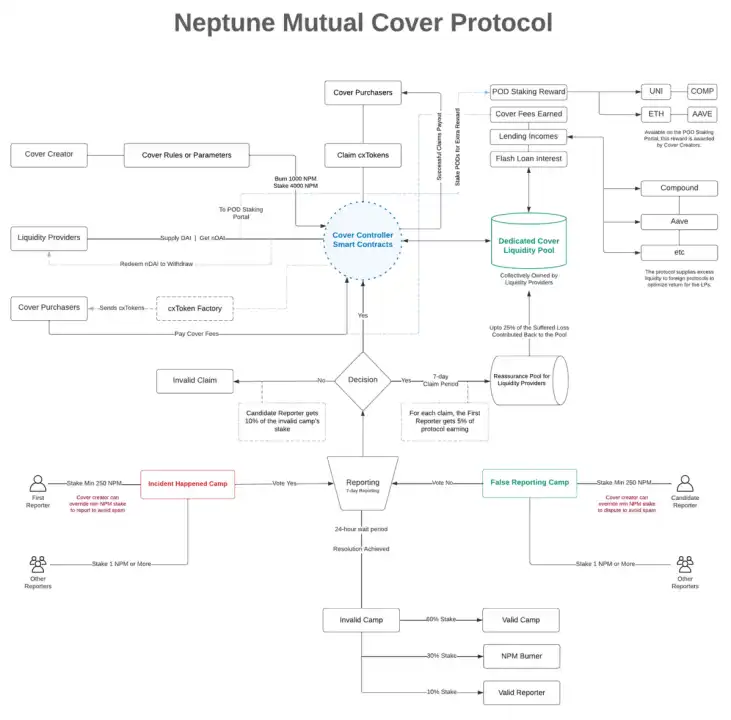
Compared with other decentralized insurance projects, Neptune Mutual has another difference: if the risk event is confirmed to happen, the policy user gets the claim, does not require the policy holder user really have financial loss. When a risk event occurs, the claimant or other holder of the same policy is paid without providing any evidence of loss, submitting data or screen shots. That is to say, if the user guesses or predicts the occurrence of a certain insured risk event of the smart contract, the user can buy the insurance policy even if he has no assets in the smart contract. When the risk event of the smart contract really happens, as long as the agreement verifies the occurrence of the risk event, all the insurance holders can get the payment within a few days. The amount paid is the amount that the insured person can claim in the event of a risk event that was determined by the user at the time of the insurance.
Neptune Mutual agreement at present only smart contracts and exchange type of insurance, other types of parametric insurance is still in planning, the following from and other decentralized insurance projects (the current most successful insurance project) to see the advantages and characteristics of Neptune Mutual insurance agreement.
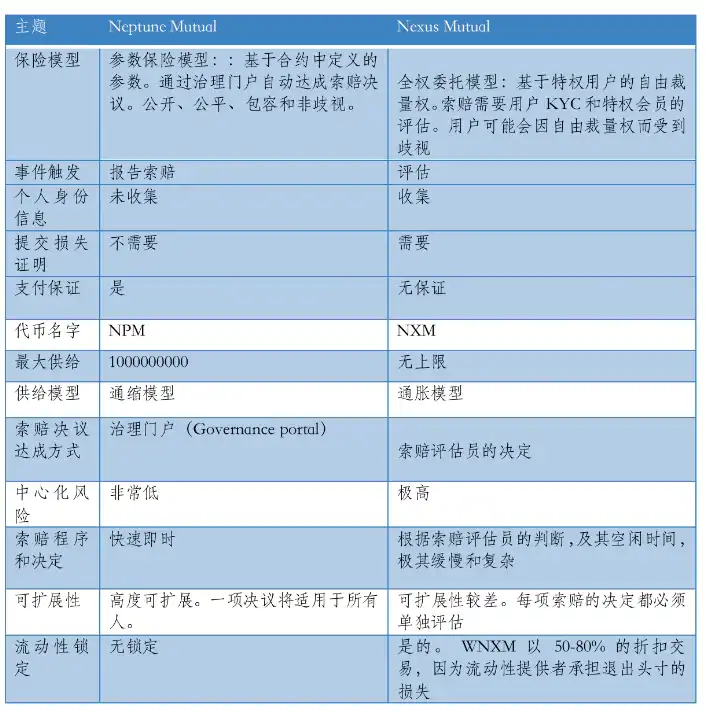
Ii. Underwriting pool design
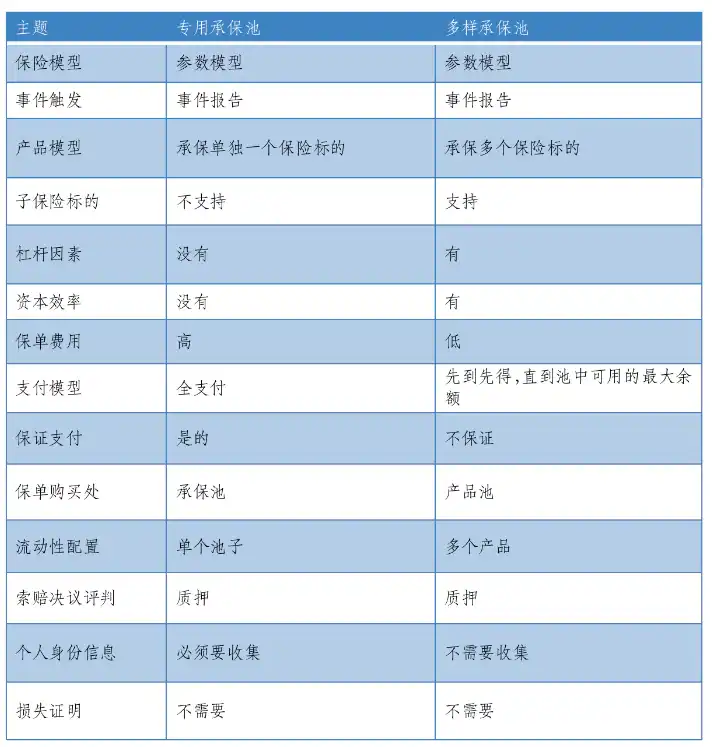
The underwriting pool of Neptune Mutual Agreement can be similarly divided into "dedicated" and "diversified" underwriting pools, and the guaranteed payment is only applicable to the dedicated underwriting pool. Dedicated underwriting pools have no capital efficiency, leverage, or support for insurance sub-products. Diversified underwriting pools can support sub-product insurance and jointly underwrite a variety of insured subjects with additional leverage and capital efficiency. The following table presents some important differences and similarities between "dedicated" and "diversified" underwriting pools.
Iii. Creators of insurance contracts for liquidity providers
Currently, insurance contract creation can only be done by invitation. Any whitelisted user with an NPM token can create an insurance contract. The creator must destroy 1000 NPM tokens to avoid junk, suspicious and unintelligible insurance contracts. In addition, the contract creator must pledge 4,000 NPM tokens or more. In the absence of any underwriting liability, the insurance contract creator can choose to submit a proposal to terminate the insurance contract, but it needs to be voted on through the agreement governance process or at the discretion of the Neptune Mutual team.
As new insurance contracts are created, a dedicated liquidity pool is created. Each liquidity pool is jointly owned by liquidity providers, who provide liquidity, share the benefits, and share the losses in the event of a claim. The working capital pool is not part of the Neptune Mutual Agreement.
Before providing liquidity, the liquidity provider needs to analyse the insurance contract to see if it meets its risk appetite. Liquidity providers can provide liquidity with DAI, USDC, or other supported stablecoins. When providing liquidity, the liquidity provider must also provide 250 NPM or more (as specified by the insurance creator).
The liquidity provider will receive a POD (Proof of Deposit) token when providing liquidity. POD tokens are assets that generate income (or loss). Pods can be redeemed during the withdrawal period to retrieve stablecoins.
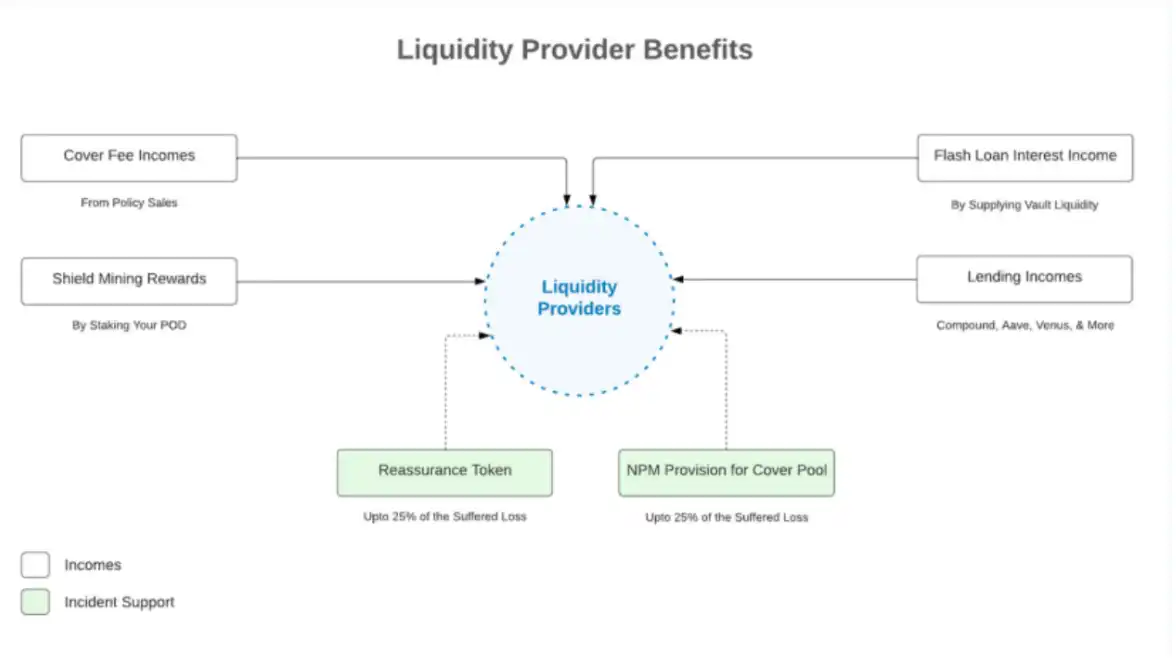
The liquidity provider has access to the income from policy premiums paid by insurance buyers. All premiums paid by insurance buyers are automatically added to the pool. At the end of each month, the underwriting commitments expire, freeing up liquidity again for users to buy insurance. Policy fee income (in stablecoins) added to the liquidity pool over time increases the price of the POD. As a liquidity provider, you get the income from the insurance without having to redeem the POD.
The excess funds of the agreed capital pool also support flash lending and lending business in the case of risk control, to obtain more sources of income for the capital pool.
POD pledge award
The creator of the insurance contract may offer additional incentives to the POD pledge. The reward payout awarded to the pledgee is not in stablecoins, but in project tokens underlying the insurance contract.
Iv. Commission and income
Purchase insurance
Anyone holding 1 or more NPM tokens can purchase insurance contracts for up to 3 months. KYC is not required. To ensure a successful settlement, the agreement will restrict liquidity providers from withdrawing liquidity for a certain period of time, which means that the agreement will lock up assets in the pool for a certain period of time. The cost of expired policies is automatically accumulated in the pool.
Commission and income
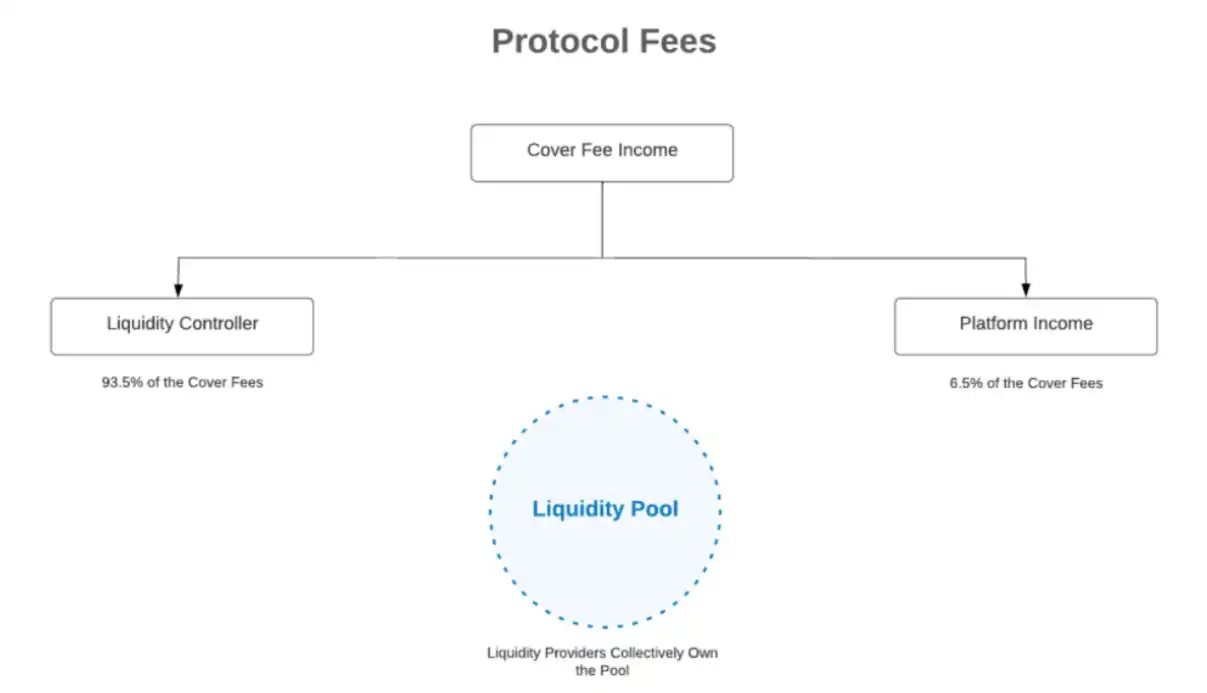
The agreement automatically deducts 6.5% of the cost of a policy at the time of purchase. Commission income is mainly used to guide and own long-term liquidity and fund protection pool. In order to build the community, a portion of the revenue will also be awarded to the administrator of the agreement.
V. Economic model
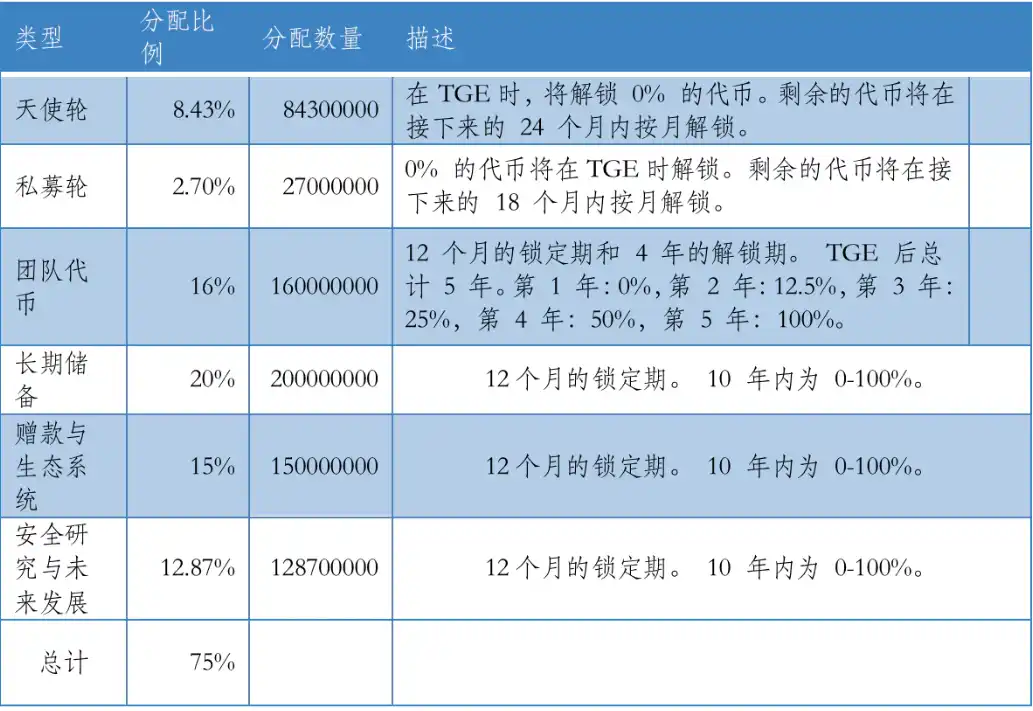
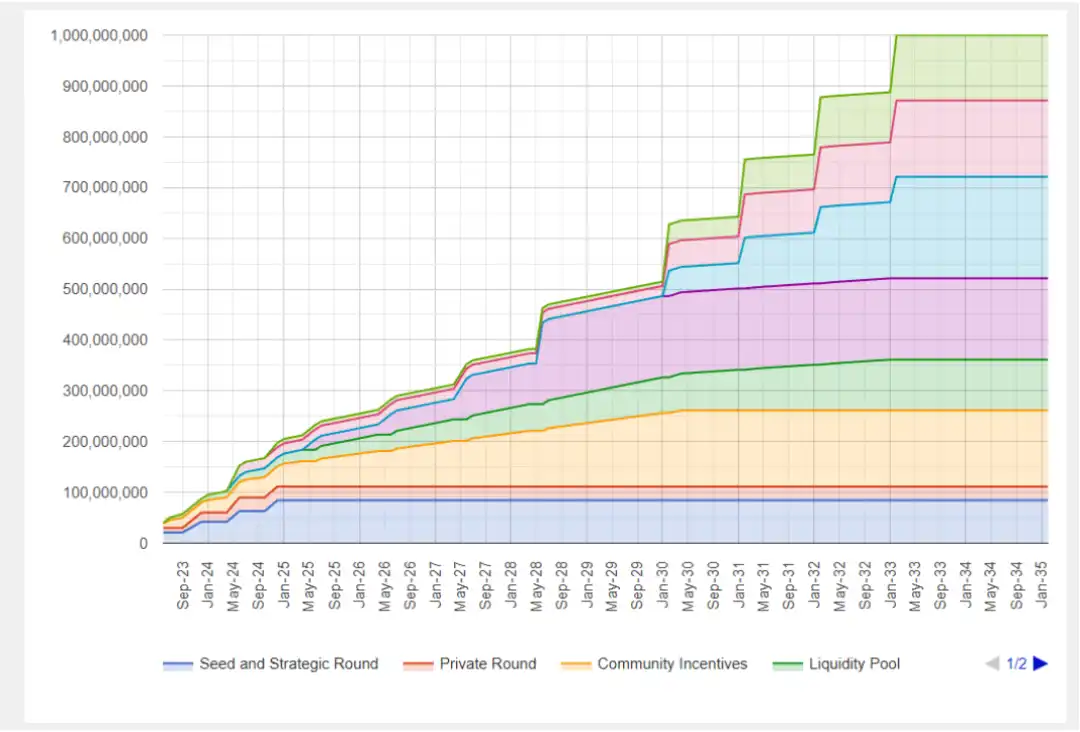
There is no fixed supply of Neptune Mutual Tokens (NPMS), but the maximum number of tokens that can be minted is limited to 1 billion tokens. It will take about 10 years for all NPM tokens to be fully issued by mid-2033. Tokens that have been allocated to strategic and institutional investors are subject to a cliff period and lock-in schedule of up to 2 years, depending on the region. Team tokens will be released linearly over the next five years, which will result in a total token lock-in of about seven years.
Locked tokens: Release and circulation
No lock-in token
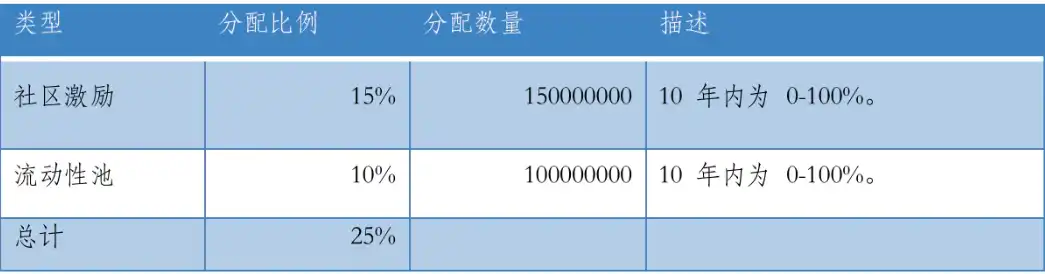
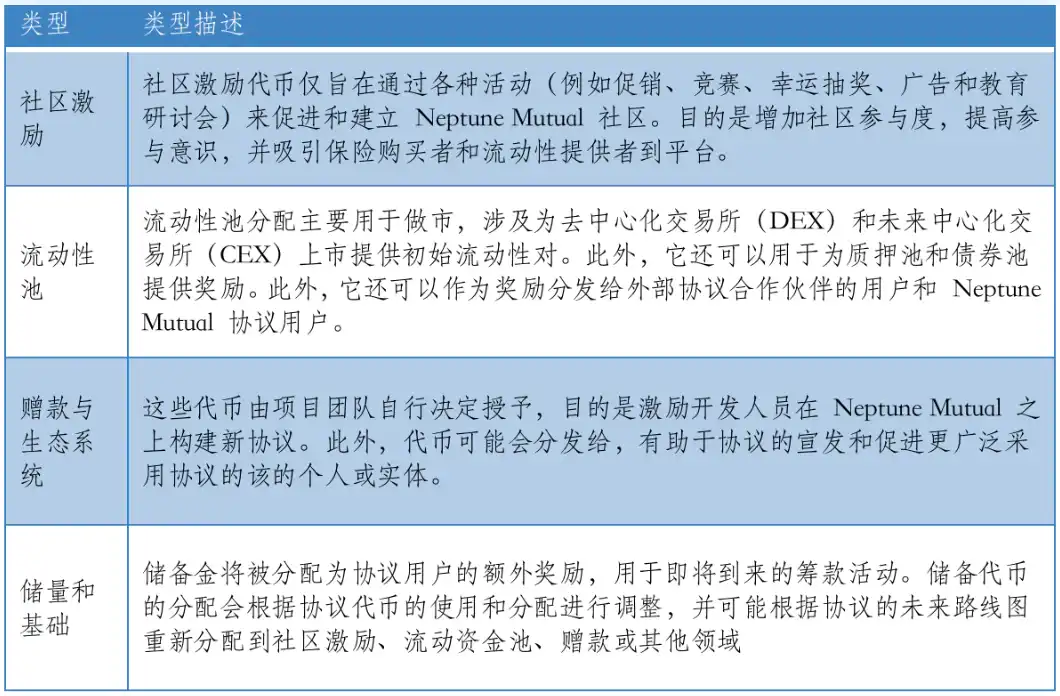
The allocation of community incentive tokens helps improve the liquidity of the protocol's underwriting pool and the protocol-owned liquidity, with the overall goal of supporting Ethereum-based protocols and covering smart contract risk. The allocation time of these tokens depends on protocol usage, because a high initial activity may deplete the allocation faster, while a low initial use will cause the allocation to be allocated over a longer period of time. If these allocations are exhausted, the agreement may consider adjusting other kinds of allocations to increase community incentives and working capital pool allocations.
Tentative token Offering Schedule
Creditor's rights mechanism
The bond mechanism was inspired by OlympusDAO's conceptualized Protocol-Owned Liquidity function. However, unlike the former, NPM tokens are not unlimited and inflationary, so the agreement will not have ongoing bond activity. The bond pool feature will only be announced during the season. A fixed allocation of NPM tokens is provided at a discounted price for each season of bond pool availability.
As a user, the user can use the bond mechanism to convert the user's NPM/DAI pair tokens into discounted NPM tokens after waiting one week (lockup period). After the user's lockup period, users can receive discounted NPM tokens instead of Uniswap v2 LP tokens. The agreement uses Bond to channel POL (Protocol-Owned Liquidity), increase the depth of NPM token liquidity on DEX, and raise underwriting risk capital for eligible insurance contract projects.
Vi. Financing Information
Up to now, Neptune Mutual has completed 10.3 million dollars. The seed and strategic round raised $5 million from Fenbushi, Coinbase Ventures, Animoca Brands, GBV Capital, Huobi, OKX and others. A private round financing of $5.3 million was completed, XT.com, Gate io, Bitmart, LD Capital, Mapleblock Capital, Pulsar Global, The DuckDao, Dweb3, Lux Capital, Cabin VC, Poolz Finance, BSC Army, Whitelist Ventures, CryptoLark, etc.
The Neptune Mutual Cover Protocol is currently in the early stages of development. The project decided to conduct any ICO, IDO, IEO public offering and instead allocate all tokens from the public offering to the community.

7. NFT drops and tokens
According to information provided in the project's documentation, the project has allocated a large number of tokens to be airdropped to the protocol's users in the coming months and years. Neptune Mutual's NFT collection will be divided into the following categories - Free to Mint and Soulbound.
Free to Mint NFT is exclusive art that can be minted for free. In Neptune Mutual, users can gain these NFTS by interacting with the platform to gain experience. Airdropped NFTS, on the other hand, are distributed to individuals and do not require any form of payment or compensation. These NFTS can be offered as promotional incentives or as rewards for participation in specific events or activities.
Project users can earn points by interacting with the agreement in a number of ways: they can buy insurance policies, provide liquidity, or both. Earn a certain amount of points for a chance to earn airdrops of NFT and token NPM. However, to cast a higher level of NFT, you must first cast a lower level of NFT. The higher the NFT level, the more NFT airdrops and token airdrops you earn.
Original link
Welcome to join the official BlockBeats community:
Telegram Subscription Group: https://t.me/theblockbeats
Telegram Discussion Group: https://t.me/BlockBeats_App
Official Twitter Account: https://twitter.com/BlockBeatsAsia

 Related Articles