LD Capital: 50% off ETH Opportunity or Trap? In-depth analysis of the Grayscale Trust

原文标题:《 「Trend Research by LD Capital」五折买 ETH 机会还是陷阱?深入解析 Grayscale 信托 》
Source: LD Capital
Abstract
Grayscale trust shares, which are still trading at a discount of around 50% to net asset value (NAV), look particularly attractive in 2023, when the crypto market has rebounded sharply from last year's deep bears and many may still "jump on board";
Based on Ethereum's Web3 core infrastructure position, we are bullish on the Ethereum Trust (ETHE) rebound in the potential bull market in the Grayscale trust product matrix;
There has historically been a long-term premium or discount. The reasons for the contortion include lock-in subscription, higher reachability of products than ETH spot, more suitable for traditional financial sector institutions and small retail investors than the cost of keeping their own private keys;
At present, the reason of long-term discount is mainly related to the product structure similar to closed fund which cannot be redeemed directly. In addition, the limitation of arbitrage opportunities, forced liquidation of large speculators, discount of opportunity cost and impact of competitive products are also reasons.
The market's expectation of a return to parity after the negative premium trend takes hold in mid-2021 is getting longer and longer, which we estimate was over 14 years at the end of last year and is now down to around 10 years. We think this forecast is still too long, the implied recovery time may fall to less than 2 years is reasonable when optimistic expectations come;
There are seven things that can cause the discount to narrow or even disappear: It includes open redemption of ETH spot (divided into two situations of redemption obtaining SEC exemption and ETF conversion application passing), redemption exemption obtaining, product dissolution and liquidation, Grayscale's own repurchase, the development of arbitrage strategy and the improvement of market confidence, and the decline of opportunity cost contribute to discount repair;
The product hasn't gone through a full "cycle" since it was created in 2019. We believe that a full cycle should follow the cycle of premium parity and discount parity premium. At present, ETHE product is only halfway through the cycle. We believe that if you bet on a potential bull market, ETHE is more resilient, as evidenced by its 1.7 times rise in ETH since the beginning of the year;
However, historical measurements show a poor risk-reward ratio. Table 1 shows that ETHE is weaker than ETH/USD in almost all respects. That means if you're prepared to hold it for the long term, you might want to do some targeted yield strengthening or risk underperforming the market if a bull market doesn't arrive quickly.
summary
In 2023, the cryptocurrency market became the focus of investors again, with BTC and ETH leading the global asset class. However, many investors still haven't recovered from their bear market mentality and haven't grasped this investment opportunity in time.But in the Grayscale Trust's GBTC and ETHE products, investors still have access to discount buying opportunities of nearly 50 percent.
Because we believe that the Ethereum Network (ETH) will be the core infrastructure for mainstream Web 3 applications in the future, in addition to being able to handle traditional capital spillovers like BTC, it will also have the advantages that Web 3 ecological applications bring, Therefore, this article will pay special attention to the discount phenomenon and potential investment value of Grayscale's trust product ETHE, and discuss in detail the possible reduction or even disappearance of this phenomenon, as well as the appropriate reasons for professional investors to enter the crypto market. In addition, we will also analyze the legal structure and potential risks of this product.
Grayscale Bitcoin Trust was launched as early as September 2013. The person who created the trust (grantor trust) is the owner of the assets and properties in the trust and retains the full control of the assets in the trust. This is similar in practical purposes to closed-end funds. Under this particular structure, it allows investors to indirectly own the assets in the trust by purchasing beneficial rights. Similar to closed-end funds, trustee trusts generally do not allow investors to redeem their shares at any time.
Grayscale Ethereum Trust (formerly known as the Ethereum Investment Trust) (the "Trust") is a statutory trust in the State of Delaware that was established on December 13, 2017 and began trading in July 2019. Adopted the same trust structure as GBTC.
The advantage of using the trust structure is that the trust will not trade, buy, or sell Ethereum or its derivatives on any exchange, so it can avoid the jurisdiction of the appropriate regulatory authorities and facilitate the product launch as soon as possible, although it is not clear whether ETH will fall under the jurisdiction of the CFTC or the SEC.
First, a brief look at the main differences between ETHE and ETH:
Different ways of investment
The fund is a listed trust regulated by the Securities and Exchange Commission, making it easier for institutions to manage their balance sheets; Trading through a general securities account makes it easier and cheaper than cryptocurrency exchanges; The ability to act as an IRA and 401(K) with investment tax benefits; No need to learn how to manage a cryptocurrency wallet. No need to worry about losing your private key or getting your wallet hacked.
Different supply
There is no cap on the total ETH supply, while ETHE availability is subject to Grayscale's distribution schedule;
Different market demand
As it is an investment product, the market needs of ETHE differ from those of ETH. Some institutional and individual investors may prefer to invest in ETHE, while ordinary digital currency traders may prefer to trade ETH;
other
Investors will not be able to redeem underlying ETH assets or equivalent US dollars from Grayscale for the time being; ETHE charges an annual management fee of 2.5 per cent of net asset value; ETHE cannot participate in on-chain actions such as DeFi mining.
Theme 1: Why the severe discount?
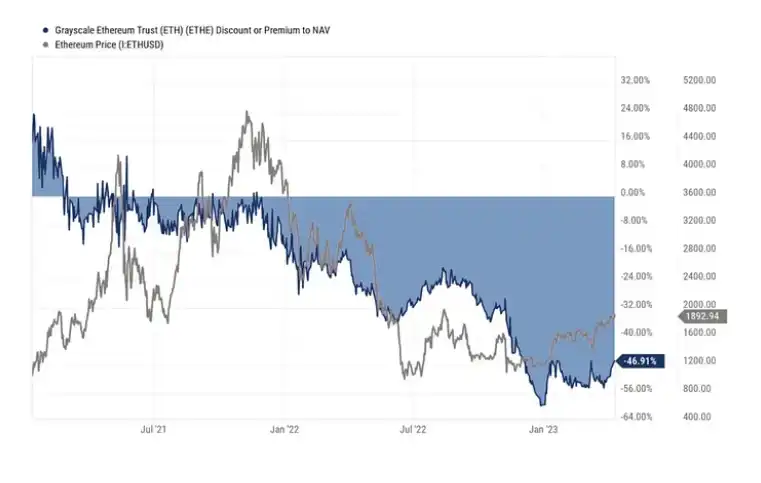
ETHE's price should theoretically fluctuate around the value of its ETH holdings, but in practice its secondary price performance has not been fully correlated and it has historically maintained a contortion premium to ETH for long periods of time since its listing in 2019, which exceeded 1,000% at the start of its listing in 2019. ETHE entered negative premium mode in February 2021 and has remained so far.
Figure 1: Historical discount premium and ETH price trend
Source: Graysacle, Trend Research
Grayscale's crypto trust shares are like closed funds,This resulted in a very limited market supply in the early days. Second, due to the immaturity of the cryptocurrency market,xuMulti-investors don't know how to buy and store cryptocurrencies,As a result, Grayscale's crypto trust, which can be purchased directly on the U.S. stock brokerage platform, was sold at a premium.
As you can see, the absolute value of the premium in ETHE's history reached its highest on June 21, 2019. ETHE traded on the secondary market at a high premium until the first negative premium in February 2021, after which the market was in a bull market. As more index products that track bitcoin/Ethereum prices increase the number of investment options available to investors, ETHE has started trading on the secondary market at a more parity to NAV.
On June 29, 2021, GBTC's application to convert to an ETF was rejected by the SEC, and Grayscale sued the SEC just an hour later, which further amplified the discount. From mid-2021 to the end of 2022, as the overall digital currency market peaked and weakened, large speculators led by several failed crypto companies such as 3AC Capital and BlockFi were forced to sell their fund shares due to excessive leverage or financial constraints.Even though the market was at a discount and they couldn't wait,That, too, has further widened the discount.
Figure 2: Change in discount/premium Vs. ETH price trend since the first negative premium appeared in early 2000s
Sources: Tradingview, Trend Research
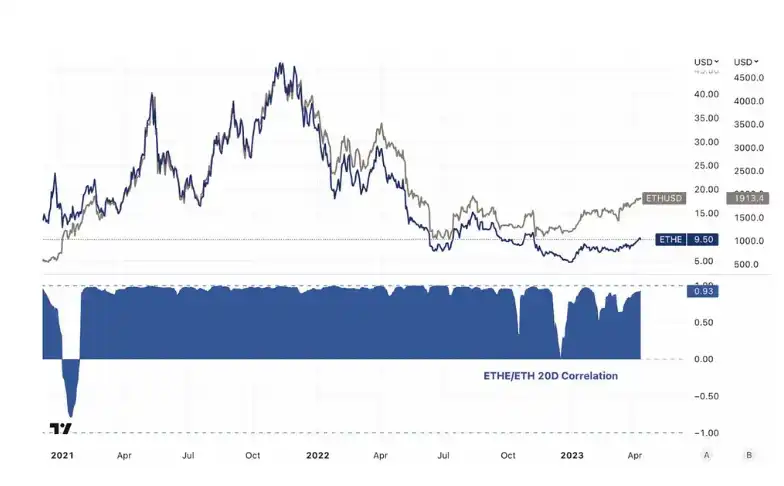
Figure 3: Correlation of ETHE and ETH prices has been very high most of the time
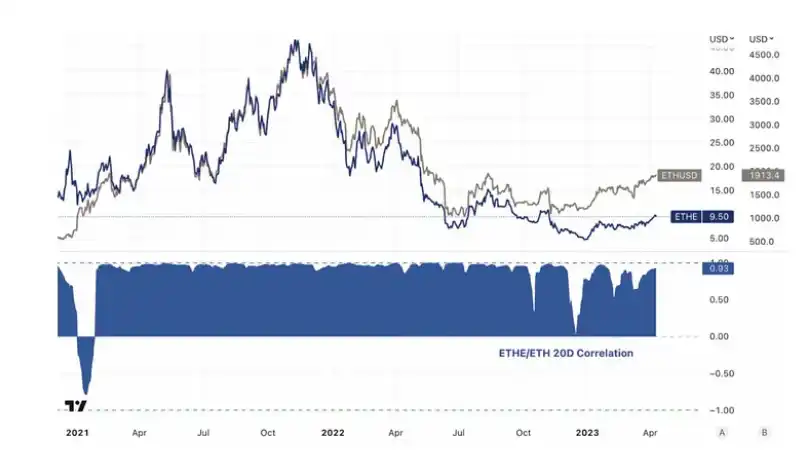
Sources: Tradingview, Trend Research
In conclusion, the reason behind the negative premium/contortion is the fund product structure that cannot be redeemed directly by Grayscale. The reasons for the contortion include that the reachability of the product is higher than that of ETH spot, and the ETHE is more suitable for the investment of traditional financial institutions and small white retail investors than the cost of keeping private keys. Balance sheet entry, tax advantages and helping investors bypass compliance-related issues; The reasons for negative premium include the fund structure that cannot be redeemed directly, the limitation of arbitrage opportunities, the discount of opportunity costs, and the impact of competitive products, which are mainly introduced below.
1. Fund structures that cannot be called directly
Only Authorized Participants (AP) authorized by Grayscale under legal documents may purchase and redeem ETH directly from Grayscale. AP is required to meet certain eligibility requirements and regulatory requirements, including being a registered broker or dealer, and must meet certain regulatory standards. According to the rules, every 100 shares of the trust share is a group, and AP can purchase at least one group at a time, and can only use ETH spot exchange.
So far, there are only two aps. Prior to October 3, 2022, DCG's Genesis Global Trading, Inc. Is the only AP; Grayscale Securities will become the sole AP of the trust after October 3, 2022.
So Grayscale is acting as a primary dealer, and other investors can only buy the shares that come out of their hands. So while some institutions may be able to subscribe to ETHE at the original primary market price, as a rule,They are not direct subscribers and have no right to redeem. There are probably two main reasons why these institutions are doing this. One is the arbitrage opportunity when they see a premium in the secondary market, and the other is to use Grayscale as a custodian to avoid the risk and cost of managing the private keys themselves.
Currently, the Trust does not operate a share redemption program, and therefore AP and its customers cannot redeem shares through the Trust. As a result, participants are unable to take advantage of arbitrage opportunities when the secondary market price deviates from the net value per share held by Trust ETH assets, which makes it difficult to recover the price gap when there is a discount. If redemption is possible directly, market participants can buy trust shares at a low price in the secondary market and redeem ETH with higher value from the fund, thus reducing the discount.
2. Limitation of arbitrage opportunities
The inability to redeem directly limits arbitrage opportunities, which are less noticeable in bull markets when there is a contango than in bear markets when there is a negative premium.
In the traditional ETF market, arbitrage opportunities arise when the demand for ETFs increases or decreases the market price relative to net asset value resulting in mispricing of premiums or discounts. Such mispricing tends to quickly correct itself through arbitrage.
There are two main arbitrage modes. One is the basic arbitrage between ETF shares that can be subscribed and redeemed quickly and the underlying asset; the other is the strategy arbitrage of CTA that cannot be subscribed and redeemed quickly.
Base arbitrage
At a premium, investors will carry out arbitrage by subscribing to ETF shares from fund companies and then selling them in the secondary market. This will reduce the demand/price of ETFs.
In the case of discount, ETF is purchased in the secondary market and the fund company redeems the higher value for arbitrage; This will increase the demand/price for ETF shares.
CTA strategy arbitrage
For ETFs that are difficult to subscribe or redeem in a timely manner, regression can be used to bet on the spread between the underlying ETF assets and ETF shares. When the premium is to a certain extent, go long the underlying assets and short ETF shares; When the discount reaches a certain level, short the underlying asset and go long ETF shares.
The scope for this strategy is influenced by the channel of value convergence. In the ETHE case, since value regression relies primarily on regulatory judgment rather than some definitive action by market participants (e.g. foreclosure), the uncertainty is higher, resulting in a wider spread that the market can tolerate.
Figure 4: Historical discount premium rate Vs. number of shares in circulation
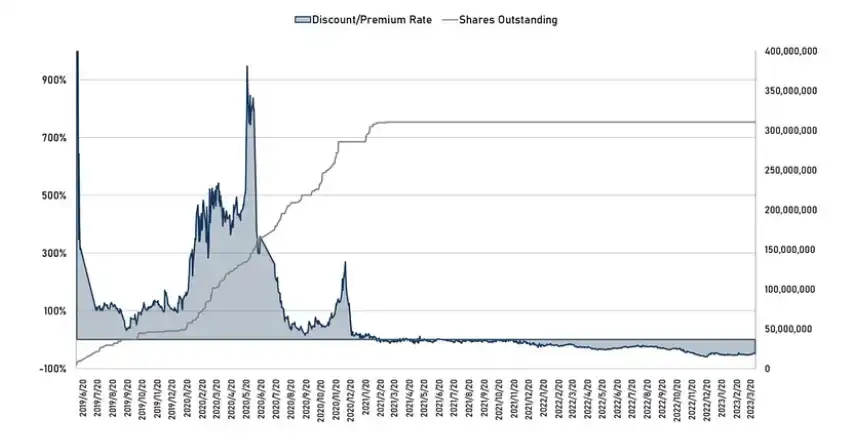
Source: Graysacle, Trend Research
As you can see from the chart above, after the premium has narrowed,After the spring of 2021, positive base arbitrage ceased to exist and new trust share subscriptions ceased.
There is also a classic case of a closed fund that cannot be foreclosed in the traditional market. This is the stock of Buffett's Berkshire Hathaway. As an investment company, its stock price may be affected by fluctuations in the price of the shares of the companies it holds in its portfolio, but ordinary investors cannot demand that Berkshire Hathaway pay out its assets. Nor can they readily subscribe to the company's new shares.
But Berkshire Hathaway's stock has been trading at a premium to its net asset value for decades, thanks largely to founder Warren Buffett's successful investing record and market position. At some point, however,The premium is likely to fall, reflecting a change in the market's view of companies.
In March 2020, for example, Berkshire Hathaway's stock was down about 30%, causing the company's stock to trade at a significant discount. The discount likely largely reflects concerns about the COVID-19 pandemic and Berkshire Hathaway's exposure to industries affected by the pandemic, such as travel, aviation and finance.
Going back to the case of ETHE, it is held for a minimum of six months after the primary subscription before it becomes available in the secondary market, so the underlying arbitrage path of contango exists but takes longer. But after the first negative premium appeared in February 2021, investor subscription activity in the primary market came to a near standstill, apparently because the negative premium base arbitrage needed redemption support and Grayscale's timeline for opening the scheme was unclear. As a result, it is hard to see how the closed shares will return to a premium, as Berkshire Hathaway's shares have, in a situation where its investment strategy has little advantage over holding cash.
Second, as the overall digital currency market has peaked and weakened, institutional selling has been led by large speculators, including Three Arrow Capital (3AC) and BlockFi (BlockFI), which have already failed crypto companies, from GBTC, ETHE To make money by arbitrage the base of a huge premium,They did a lot of subscription -- waiting six months to sell -- and then were forced to sell because they were too leveraged or financially stretched, even though the market was at a discount and they couldn't wait. For example, public information shows that DCG was forced to sell about 25% of its ETHE position at half price earlier this year due to financial problems, amplifying the negative premium.
Figure 5: Performance of ETHE and ETH2021 mid-year highs to late 2022 lows:
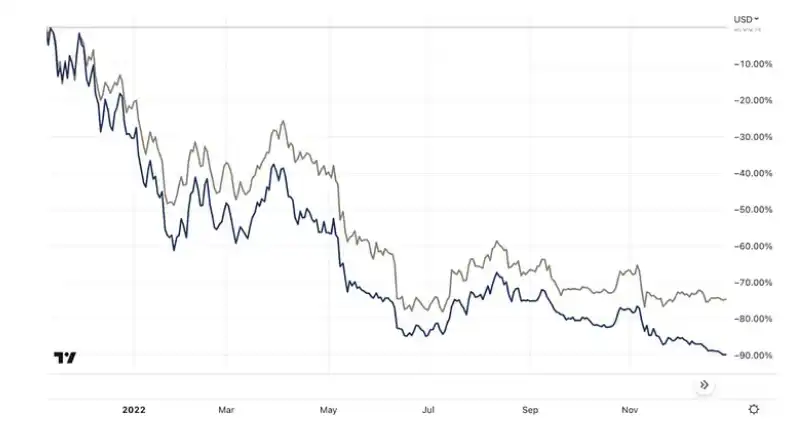
Sources: Tradingview, Trend Research
3. Discount opportunity cost
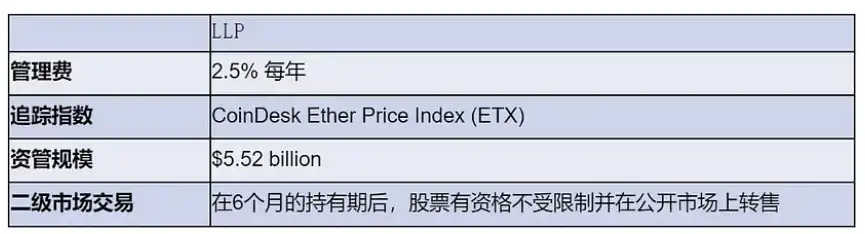
Table 1: Relevant legal/financial Information (As of March 31, 2023)
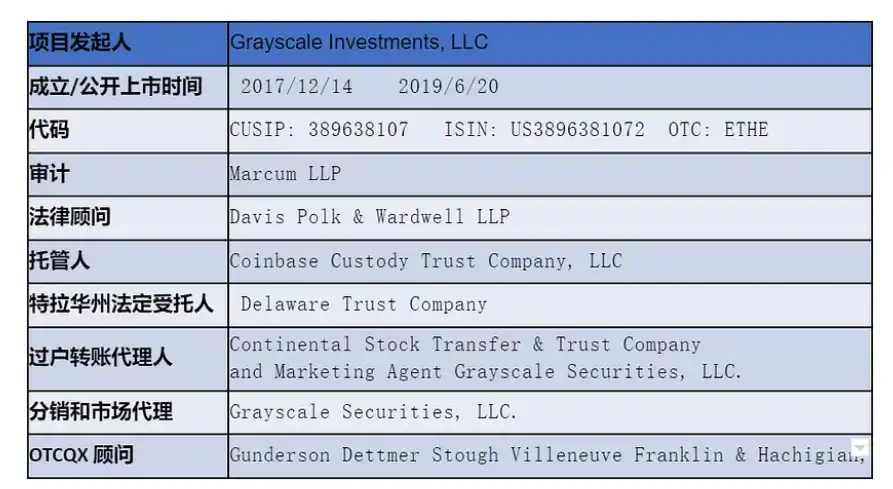
Source: Graysacle, Trend Research
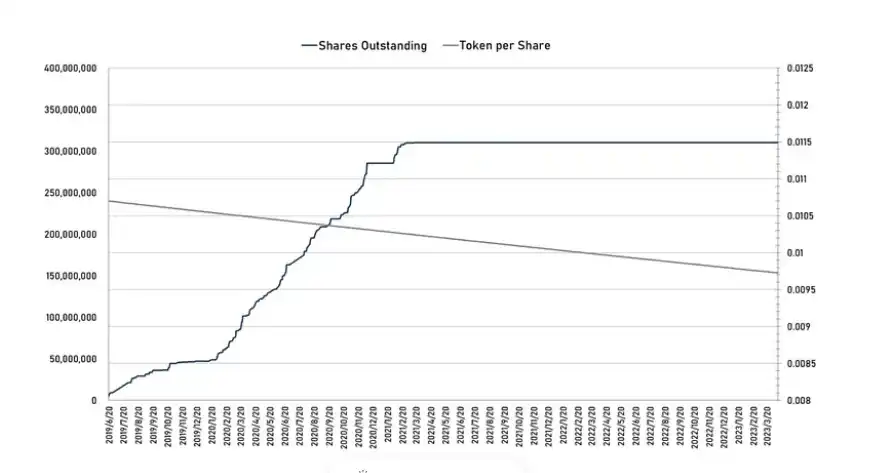
Grayscale Ethereum Trust's management fee is 2.5% per annum of net asset value (NAV). Grayscale will deduct the estimated accrued but unpaid expenses of the trust from its ETH holdings on a daily basis in the public data, so the amount of ETH represented by ETHE per share is gradually decreasing, as can be seen in the figure below.
Figure 6: Number of Shares in circulation (left) Vs. number of ETH held in trust for each share (right)
Source: Graysacle, Trend Research
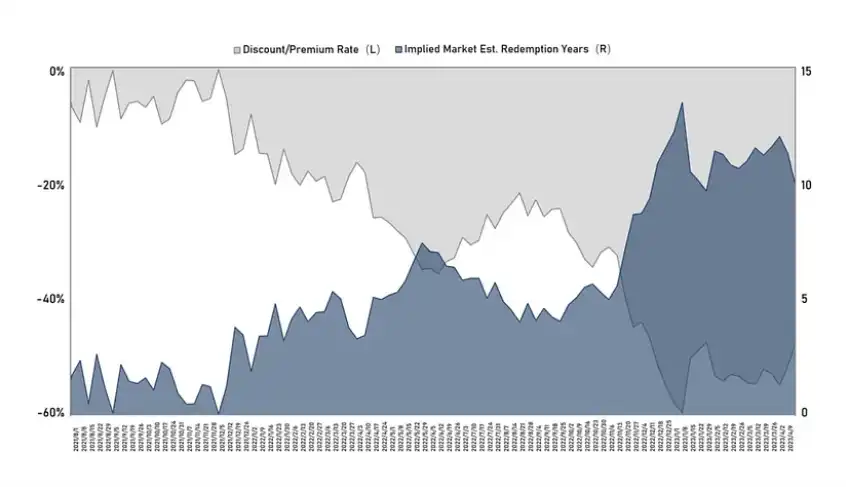
If nothing else, today's discount can be understood as a discount to the opportunity cost of the position. Therefore, based on the discount rate of the secondary market X and the opportunity cost of the position Y, we can invert the implied time T that the market expects to redeem or recover the NAV parity. We assume that the potential growth expectation of NVA is 0, and assume that:
(1-Y)^T=1+X
T=ln(1+X)/ln(1-y)
Figure 7: Historical discount Vs. implied market expected callable (recovery parity) time in years
Source: Graysacle, Trend Research
As you can see from the chart above, the expectation of a return to parity is getting longer and longer as the negative premium trend takes hold in mid-2021. It was over 14 years at the end of last year due to regulatory clampdown + market chill, and is now down to around 10 years. However, we believe this forecast is still too long, and it is reasonable to expect that the implied recovery time may fall to less than 2 years when the optimistic forecast arrives. The most pessimistic estimates of how long it will take for the products to be liquidated may be in line with pricing in more than 10 years, after all, it took only nine years for Mt.Gox to liquidate its assets.
4. Impact of competitive products
Prior to 2019, there were few competitors to Grayscale's trust products. On February 18, 2021, Purpose bitcoin ETF, a Canadian fund that invests directly in bitcoin, officially began trading and quickly accumulated over $1 billion in assets within a month. The 1% management fee is less than half of GBTC's, and its ETF structure can closely track bitcoin, making it more attractive than Grayscale's offering.
Just two months later, on April 17, Canadian regulators approved three Ethereum ETFs at the same time, They are Purpose Investments' Ethereum ETF (ETHH), Evolve Capital Group's Ethereum ETF (ETHR) and CI Global Capital Management's Ethereum ETF (ETHX), all of which went public on April 20. Management fees for the three Ethereum ETFs differ slightly, with CI Global at 0.4 percent, Evolve at 0.75 percent, and Purpose Investments at 1 percent, according to the three websites. On its first day of trading, Purpose's Ethereum ETF attracted C $26.46 million (US $21.32 million), Evolve's ETHR raised C $2.22 million (US $1.79 million), CI Global's ETHX has 2.25 million Canadian dollars (US $1.81 million) in assets.
Three days later, on April 23, Canada's fourth Ethereum ETF also began trading on the Toronto Stock Exchange. It was launched by Canadian digital asset manager 3iQ and investment firm CoinShares, offering trading in Canadian dollar shares (ETHQ) and US dollar shares (ethq.u).
In addition, there are more ETH futures ETFs, related stocks, including listed companies holding coins, and listed companies in mining and asset management business, which increase their market share. These diversified investment channels weaken the scarcity of Grayscale trust products for traditional financial investment institutions and retail investors. Becomes a competitive factor that Grayscale has to consider.
Theme 2: When discounts are likely to shrink - Disappear
There are seven things that can cause the discount to narrow or even disappear: It includes open redemption of ETH spot (divided into two situations of redemption obtaining SEC exemption and ETF conversion application passing), redemption exemption obtaining, product dissolution liquidation, Grayscale's own repurchase, development of arbitrage strategy and improvement of market confidence, and decline of opportunity cost contribute to discount repair.
1. Improved regulatory environment -- ETF application approved
According to Grayscale's most recent FORM 10-K filing for the end of 2022, they continue to believe that their trust will be able to initiate redemption programs after the ETF conversion is approved by the SEC. Although the SEC had already rejected the application to convert GBTC to an ETF, a federal appeals court judge in March questioned whether the SEC was right to do so, given that the agency had previously approved bitcoin futures ETFs.
It should be noted that Grayscale has only filed an ETF conversion application for the GrayscaleBitcoin Trust (GBTC) and has not announced plans to convert the Grayscale Ethereum Trust (ETHE) into an ETF. But recent developments have certainly been positive, and at the most recent hearing, held on March 7 of this year, Grayscale argued that there were inconsistencies in the criteria applied by the SEC because they had approved applications for bitcoin futures ETFs but had consistently rejected applications for physical bitcoin ETFs.
Grayscale thinks that since the two products have the same underlying assets and their prices are derived from Bitcoin, Wall Street regulators should treat these products similarly, but they don't. Grayscale claims the regulator's actions are arbitrary and capricious, and thus violate U.S. federal law. The SEC responded that it had been applying the same standards, but that the products were actually different. According to the SEC, the bitcoin futures market is regulated by the CFTC, making it different from physical BTC ETFs, which they consider unregulated.
Before the hearing, Bloomberg analyst Elliot Stein argued that the SEC has an advantage in the lawsuit and that their chances of winning are much higher than GBTC issuers because courts tend to defer to federal agencies because they are experts in their fields. However, after hearing the latest arguments, Elliot Stein gave Grayscale a 70 percent chance of winning. A GBTC approval would also be an immediate boost to ETHE sentiment. It's important to note, however, that unlike BTC's futures based ETF, which has been approved for listing by the SEC, the SEC has yet to approve any Ethereum-based funds for listing, due to the ongoing debate over Ethereum's legal status.
2. Improved regulatory environment -- become a registered investment company or be recognized as a commodity
The Grayscale Ethereum Trust (ETHE) is a registered investment trust rather than a registered investment company. Specifically, a trust established under the laws of a particular state and registered with the Securities and Exchange Commission (SEC) under an exemption provided by the Securities Act of 1933. This means that ETHE is not required to comply with certain requirements under the Securities Act of 1933, such as public disclosure and registration.
However, if the SEC determines that a trust needs to be registered as an investment company under the Investment Company Act of 1940, Grayscale believes that in such a case the trust structure could be dissolved and its shares may be converted into stock, but this is a guess, depending on the circumstances of the company and the regulatory opinion, as well as the rules of the exchange.
It is also a possible regulatory direction if it is considered a commodity portfolio that needs to be registered and regulated with the CFTC under the Commodity Trading Act.
3. Obtain redemption waivers
In fact, Grayscale once offered a redemption program, but the program was shut down in 2016 after the SEC accused it of violating Regulation M.Specifically look at The SEC is concerned that the Grayscale Trust's share redemption at the same time it creates new shares could affect market prices and lead to market manipulation, insider trading or unfair trading practices.As a result, Grayscale has since suspended its GBTC redemption program and has continued to do so in subsequent trust offerings such as BCH and ETHE to ensure that its trading practices comply with applicable regulations and regulatory requirements.
Since Grayscale does not believe that the SEC would consider exempting the continuing redemption program at this time, the Trust has no action to seek relevant regulatory approval from the SEC.
However, the possibility of actively seeking such exemptions in the future cannot be ruled out, although the timing and probability of success are uncertain. And developing redemptions would reduce Grayscale's income as trustee,It may not have enough motivation to pursue redemption waivers.
If such a waiver is granted and Grayscale agrees to the redemption, the redemption plan can proceed. The redemption program will enable authorized participants (AP) to arbitrage opportunities when the market value of the trust shares diverges from the ETH holding value, minus the value of fund fees and other liabilities. This arbitrage opportunity may be monopolized by AP, or it may be transferred to customers by AP. It is not clear at this time, because at present only AP affiliated company of Grayscale is the exclusive AP, and monopolization may cause concerns of unfair competition.
4. Relationship between discount and market sentiment, development of arbitrage strategies and market confidence
Previously, we discussed the problem that the discount arbitrage path is not smooth, which leads to the obvious repair of the discount. But on the other hand, because of the existence of CTA strategy, when the crypto market as a whole enters a positive momentum, even if it is still unable to redeem, arbitrage traders may compress the discount range. That's because the product hasn't gone through a full cycle since it was created in 2019. We believe that a complete cycle should be followed. Premium parity Discount parity Premium The first half of the cycle has been completed by ETHE product.
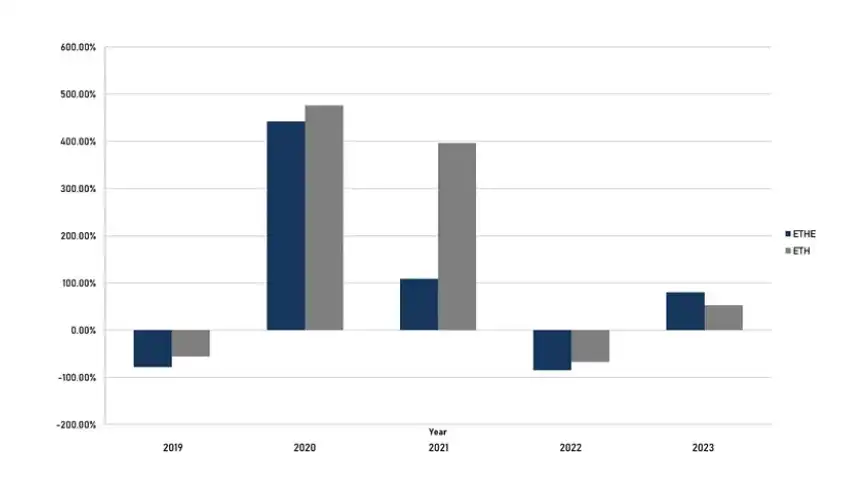
Figure 8: Annual Return ETHE Vs. ETH (It can be seen that the long-term performance on an annual basis is not as good as ETH)
Source: Graysacle, Trend Research
Figure 9: Monthly Return ETHE Vs. ETH (It can be seen that the elasticity of ETHE is larger than ETH on short cycle performance)
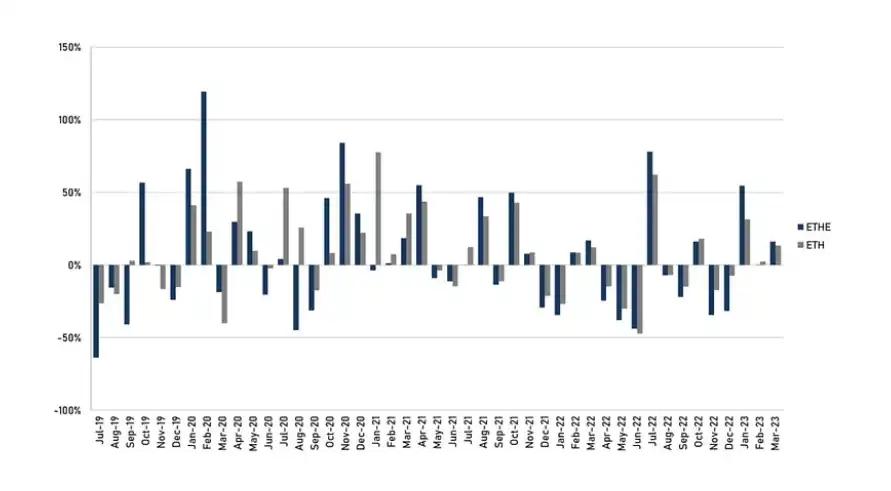
Source: Graysacle, Trend Research
As you can see from the chart above comparing annual and monthly returns,The 2019-2022 period is a "premium at par discount" cycle, which can be interpreted as a de-bubbling cycle. ETHE does not have excess returns and is not a good investment option during this period.However, as ETHE product is more resilient than ETH itself, it should generate better positive returns in future "discount parity premium" repair cycles, and in fact this is evident from the performance comparison of the past 3 months of this year, which is 1.7 times higher than ETH.
5. Failure to convert the final dissolution and liquidation of ETF trust
If neither redemption exemption nor ETF conversion approval is granted, if this situation continues for too long, Grayscale will face significant pressure to liquidate and dissolve due to continued withholding of fund management fees, which could trigger investor dissatisfaction. Once liquidation is confirmed, the discount to NAV in the secondary market is likely to recover quickly.
Alameda Research, an affiliate of the virtually bankrupt FTX, sued Grayscale Investments and its owner, DCG Group, in March 2023, attacking Grayscale for charging high fees, Alameda has refused to allow investors to withdraw from GBTC and ETHE, saying it is suffering "hundreds of millions of dollars in losses" as a result of the structure. Similar cases are likely to increase over time.
In addition, according to the filing, other key circumstances that could trigger early termination and liquidation of the ETHE Trust include:
U.S. federal or state regulations require the Trust to close, or force the Trust to liquidate its ETH, or seize, seize, or otherwise restrict the use of the Trust's assets;
Grayscale may choose to dissolve the trust to avoid unnecessary legal liability and financial risk if the CFTC or regulators such as the SEC and FinCEN determine that the trust is subject to certain rules and regulations;
Grayscale believes that the risks, costs and benefits of trust assets are not proportional to expenses;
The trust licence is revoked;
The inability of the Trust to convert or make it impractical for the Trust to make reasonable efforts to convert Bitcoin into U.S. dollars;
The custodian resigns or is dismissed without a replacement; The trust becomes insolvent or bankrupt.
6.Grayscale buys back on its own
Assuming an extreme scenario in which Grayscale is willing to repurchase all outstanding shares of the market at a lower cost than NAV, and decides to take the trust private or dissolve and liquidate, such an operation would clearly be profitable. And the announcement of a large buyback program would help boost market confidence, which could help the discount return.
Digital Currency Group, Grayscale's parent company, has announced trust share repurchase plans totaling up to $1 billion in 2021 and 2022. Since then, however, GBTC has continued to trade at a discount to NAV, probably because the buybacks are tiny relative to the tens of billions of dollars in total assets under management, although secondary market buybacks have helped narrow the spread.
In addition, Michael Sonnenshein, CEO of Grayscale 2022, mentioned in his year-end letter to investors that if the GBTC ETF does not materialize, one of the ways for investors to unlock it is to offer to buy it out, such as buying back up to 20 percent of GBTC's outstanding shares. If that happens, it should cover all its trust products and the discount is likely to narrow.
7. Opportunity cost drops
Now the discount part of what we talked about in theme 2 can be understood as discounting the opportunity cost, so if you have Grayscale A cut in overheads, or a fall in market risk-free rates, would help narrow the discount based on the same expectation of a return to parity. Indeed, Grayscale CEO Sonnenshein mentioned the possibility of cutting fees in March.
Even with the current 10.5 forecast unchanged, run a simple simulation:
A 1-percentage-point decline in the 10-year Treasury and management fees, when the opportunity cost is 3.91% annualized, helps narrow the discount from -47.3% to -34.2%.
If each decreases by 1.5 percentage points, then the opportunity cost is 2.91% on an annualized basis, and the discount may narrow to -26.7%.
If each decreases by 2 percentage points, then the opportunity cost is 1.91% annualized, then the discount will narrow to -18.35%.
Figure 10: Simulation of possible discount narrowing due to a decline in the risk-free rate
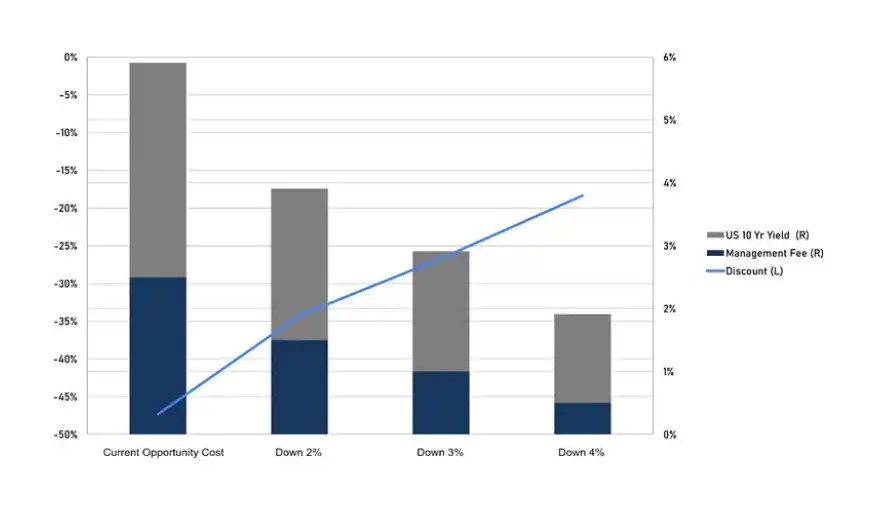
Sources: Graysacle, Trend Research
Theme 3: Why It's Good for Professional Investors to bet on crypto markets.
1. Advantages of Grayscale digital currency trust products in terms of accessibility, balance sheet entry, cost advantages over keeping your own private keys, investment tax advantages, and as of now, ETHERemains the only "stock" offered by the U.S. stock market that uses physical Ethereum as its primary asset.
In particular:
Accessibility:Grayscale digital currency trust shares can be traded through common U.S. stock brokerages, which means investors can buy and sell these products more easily. By contrast, trading through cryptocurrency exchanges or other channels may involve more risk and fees.
Balance sheet Management:Grayscale Digital Currency Trust products are a security product, which means professional investors don't have to worry about how to handle their digital assets on the balance sheet and can more easily incorporate them into their portfolios.
Hosting cost advantage:Grayscale's digital currency trust product is likely to have a lower cost than a digital currency that holds its own private key. For example, when buying digital currency on-chain, investors may have to bear higher learning costs and network fees. In addition, it may face the risk of disclosure when keeping the private key, and the possibility of completely unable to recover the asset once lost. When buying and selling Grayscale digital currency trust products, investors pay only the commissions and fees associated with securities trading.
Investment tax advantages:Grayscale digital currency trust products are considered securities under U.S. tax law and therefore may enjoy the same investment tax benefits as other securities. For example, investors who sell Grayscale digital currency trust products after holding them for more than a year may be able to enjoy a lower capital gains tax rate.
2. If betting on a potential bull market, there is greater flexibility in the ETHE:
The bull rally since the end of 2022, with a peak of 107% compared to ETH's 61%, shows that quite a lot of pessimism has been facled into the discount cycle, so when the market rebounds, ETHE is more resilient than ETH and is a better bet for the bull market.
Figure 11: Comparison of bottom gains since year-end ETH2022
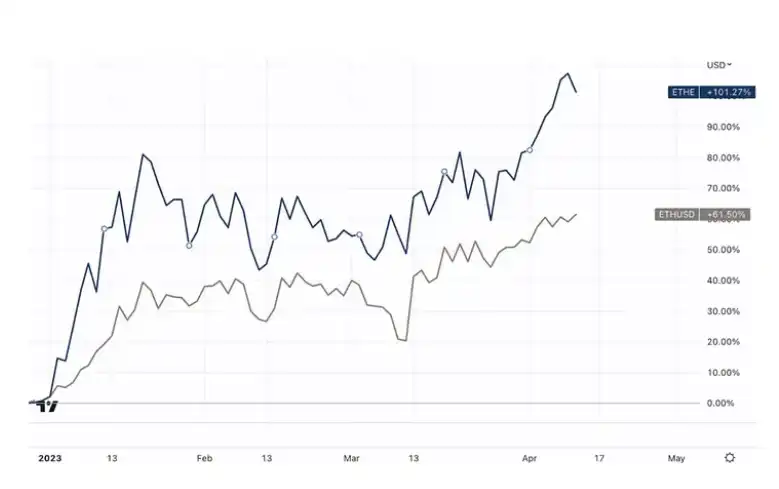
Sources: Tradingview, Trend Research
Theme 4: The risks of investing
1. Policy and institutional risks
The designation of ETH or any other digital asset as a "security" may adversely affect ETH and the value of the stock;
Restrictions in any jurisdiction on the use of ETH, verification activities or the operation of the Ethereum network or digital asset market may adversely affect the value of the stock;
Regulatory changes or interpretations may force trusts to register and comply with new regulations, which may incur additional expenditure on trusts;
Grayscale's affiliate is the only institution that can create or destroy fund shares. Whether due to regulatory restrictions or technical reasons, the amount of issuance and destruction may not be effectively adjusted according to market demand, which may lead to frequent sharp deviation from NAV in secondary market trading prices.
2. Statistical characteristic risk
ETHE has historically had a poor risk-reward ratio, as Table 2 shows in almost all respects its weak performance relative to ETH/USD. That means if you're prepared to hold it for the long term, you might want to do some targeted yield strengthening or risk underperforming the market if a bull market doesn't arrive quickly.
Table 2: Risk and Return Metrics (Jul 2019 -- Mar 2023)
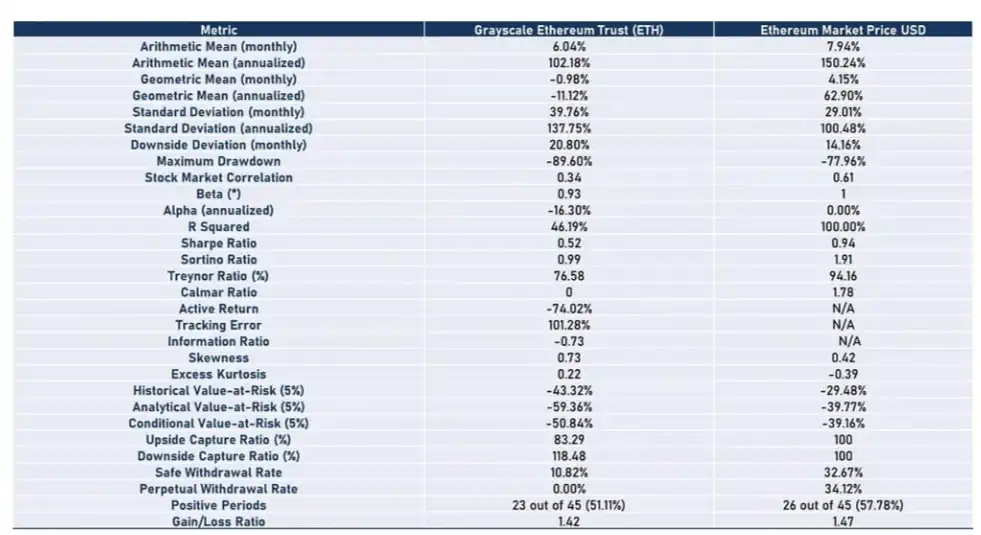
Source: Graysacle, Trend Research
Yield:ETH outperformed ETHE Ethe Ethe Ethe Ethe Ethe Ethe Ethe Ethe Ethe Ethe Ethe Ethe Ethe Ethe Ethe Ethe Ethe Ethe Ethe Ethe Ethe Ethe Ethe Ethe Ethe Ethe Ethe Ethe Ethe Ethe Ethe Ethe Ethe Ethe Ethe Ethe Ethe Ethe Ethe In particular, on an annualized basis, the Ethereum dollar reached 150.24%, while the grayscale Ethereum Trust was only 102.18%. In terms of annualized geometric average return, Ethereum dollar is at 62.90%, while grayscale Ethereum Trust is at -11.12%.
Risk-adjusted return:From the perspective of Sharpe ratio, Sotino ratio, Treanor ratio and other risk-adjusted return indicators, the performance of ETHE after risk-adjusted return is weaker than ETH.
Volatility:ETHE has a higher volatility (standard deviation) of 137.75%, which means that investors may be exposed to greater risk of price volatility. In contrast, ETH has a low volatility of 100.48%.
Maximum retracement:ETHE's maximum retracement reached -89.6 percent, higher than Ethereum dollar's -77.96 percent, meaning that in past performance, ETHE has lost more in the worst case scenario.
Active return and information ratio:The active return of -74.02% and the information ratio of -0.73 mean that the Grayscale Ethereum Trust performed poorly in active management compared to the Ethereum dollar, although this was largely due to price fluctuations in the secondary market rather than a reduction in active trading in the fund's holdings.
How to ensure crossing the bull and bear with the benefit enhancements will be explored in the second of a series of reports.
Original link
Welcome to join the official BlockBeats community:
Telegram Subscription Group: https://t.me/theblockbeats
Telegram Discussion Group: https://t.me/BlockBeats_App
Official Twitter Account: https://twitter.com/BlockBeatsAsia

 Related Articles