Unveiling Two Major Innovation Projects: Reshaping Ethereum Layer 2 Scaling and Decentralized Storage Domain
Original Title: " Other than the Four Arbitrum, Optimism, Starknet, and Zksync, Here Are Some Ethereum L2 Projects Worth Paying Attention To "
Original Source: "Biteye" Community
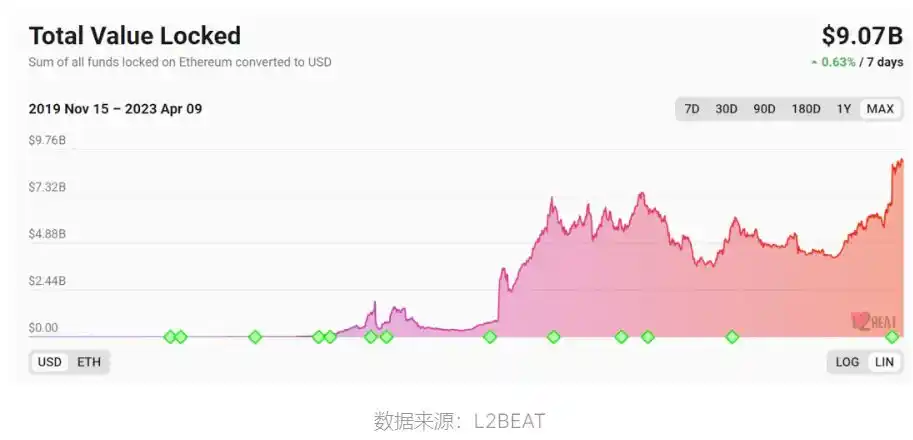
Since the ARB token was launched, the total value locked in Layer 2 has reached a new all-time high. The growth trend of the Layer 2 total staking amount indicates that Ethereum's technical upgrade is a highly certain Web3 long-term narrative. The Layer 2 Four Kings Arbitrum, Optimism, Starknet, Zksync, and the rising star Scroll have received the majority of the market's attention.
However, various capital and studios have positioned themselves early in these star projects, so the dividends for ordinary users may be relatively small. If you want to continue to bet on the Ethereum technical upgrade narrative, ordinary users may consider focusing their energy on some L2 public chains and infrastructure projects with both technical and narrative qualities but relatively lower popularity.
Below, we have discovered two projects focusing on ETH L2, modularity, and data availability as the narrative axis.
01Mantle: Modular Re-Staking Chain
Mantle Network is an Ethereum modular re-staking Rollup Layer 2 scaling solution developed by BitDAO, providing EVM compatibility.
Currently, Mantle has launched on the public testnet. However, the introduction promoted by Mantle's official account specifically mentions that its governance token is the governance token already issued by BitDAO, $BIT. Additionally, as mentioned in the Mantle documentation, its DA node incentives are paid in $BIT. Therefore, Mantle is unlikely to issue a new token, making it difficult to replicate the wealth effect seen in airdrops of chains like Arb and Apt.
However, it is important to note that the lack of profit from airdrops does not mean there are no good opportunities. Due to the reasons mentioned above, most people have not paid much attention to Mantle and its ecosystem. Often, overlooked assets are the ones that, when diligently researched, can yield good returns. Moreover, Mantle is one of the rare targets in the market that combines modularity with the Ethereum Layer 2 concept. Regardless, it is worth delving into.
Firstly, Mantle Network, similar to Arbitrum, Optimism, and other Layer 2 networks, is a kind of Optimism Rollup. It provides scalability to the ETH mainnet by bundling multiple transactions together and submitting them to Ethereum for state storage, achieving secure, fast transactions, and low transaction costs.
However, the difference between Mantle and highly homogenized Arbitrum and Optimism lies in the fact that Mantle has taken a differentiated technical path from other L2 solutions. Below, we will introduce the technical differences between Mantle and the current mainstream L2 solutions:
Modular Design
Typical Optimism Rollups rely on Ethereum for data availability, final settlement, and serve as the execution layer for fraud proofs, where only client execution is done off-chain, and all other operations are posted and verified on Ethereum.
On the other hand, the technical stack of Mantle is characterized by modularity, meaning that the core operations of the blockchain—execution, consensus, settlement, data availability—are all performed on dedicated layers. By splitting operations into specialized layers, modularity can make the network more efficient, achieve better overall performance, and lower costs.
Furthermore, a modular blockchain can more easily adopt new technologies, such as using zk-Rollups or zkEVMs to replace the consensus mechanism.
Currently, blockchain technology is still in a very early stage, with rapid technological upgrades. Old public chains that do not have a strong community consensus like BTC or ETH and do not timely update their technology to keep up with the latest trends are destined to be phased out and abandoned by the market. Modular blockchains can follow the latest technology at a lower development cost, ensuring that the project can sustain long-term operation.
Decentralized Sequencer
The sequencer on an L2 chain has privileges or, in other words, is the only entity able to submit transaction batches to L1, which means a significant advantage. The sequencers of Arbitrum and Optimism currently operate in a centralized form, and there have been multiple sequencer failures leading to chain halts.
However, Mantle is very visionary and plans to decentralize their sequencer, eliminating reliance on a single sequencer to avoid single points of failure or censorship.
Data Availability
DA is the ability to store and view data submitted to the blockchain. The traditional operation mode of Optimism Rollups is to publish transactions and store them on L1, requiring a large amount of block space (this will be somewhat alleviated post Proto Danksharding).
Typical Optimism Rollups usually retain a challenge period of 7-14 days, after which transactions can be finalized. For ZKs, they publish a validity proof on L1, maintaining verifiability for 30 days before the data is cleared, and their transactions have immediate finality but require significant processing power to create proofs.
By utilizing Eigenlayer, Mantle can address the current challenges of long confirmation times and compute power (proof generation) in L2.
Through Re-Staking, L1 validators in Mantle can choose to use their staked $ETH as collateral to provide data availability services.
Mantle first secures its security from Ethereum via Rollup, and when using a data availability layer built on Eigenlayer, Mantle leverages re-staked ETH to reutilize Ethereum-level security, inheriting Ethereum's security for DA.
In simple terms, after applying DA, Mantle does not publish data to the ETH mainnet, but to an EigenDA secured by re-staked ETH, which can be understood as inheriting a highly decentralized new chain DA built on Ethereum's security. This significantly improves throughput and scalability, enabling the construction of new types of dapps.
According to Mantle's website roadmap information, Mantle launched its testnet on January 10, and the mainnet launch date is TBD, providing ample time to strategize and interact with ecosystem projects on the testnet.
02EthStorage: Ethereum Layer 2 Storage
EthStorage is a programmable dynamic storage L2 solution based on Ethereum data availability.
Most existing L2 solutions, such as Optimism/ZK Rollup, focus on scaling Ethereum's computational capacity, i.e., higher transactions per second. However, with the rise of NFTs/DeFi/etc. dApps, the need for storing large amounts of data while reusing Ethereum mainnet security has also surged.
Layer 2 storage infrastructure is a major direction in the often-overlooked L2 space. Like traditional L2 logic, the original intention is to leverage Ethereum mainnet security for scalability.
EthStorage's storage function mainly serves two business areas: Web3 app data storage and DA scaling. Both of these main businesses, when taken separately, represent highly anticipated tracks, making EthStorage well worth paying attention to.
Web3 Storage and Linking
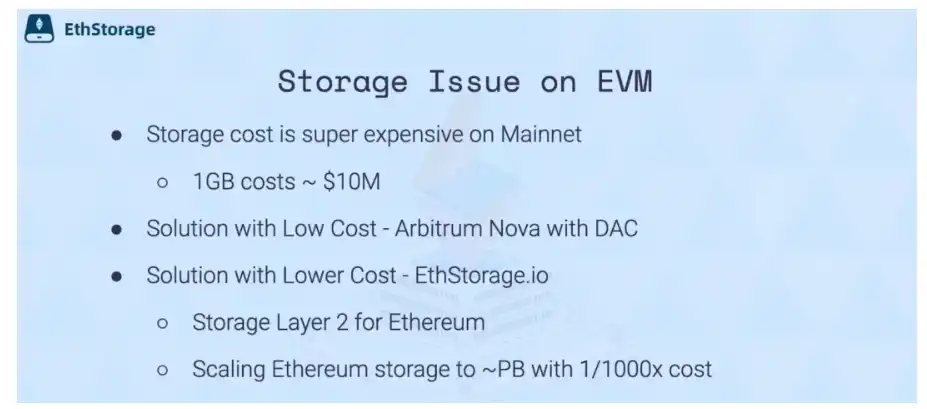
In theory, as long as a website's content is stored on the Ethereum blockchain, the entire site can be accessed via a browser, achieving decentralized website data storage and censorship resistance. However, the cost of doing so is very high.
For example, 1GB of on-chain data would cost nearly a million dollars. This is prohibitive for many Web2 applications and even many NFTs. Second-layer storage solutions can help alleviate some cost issues, and the new standard is very useful for DApps or websites that may face censorship risks.
Concentrating on expanding Ethereum's storage capacity, EthStorage is a path to extend programmable storage to hundreds of TB or even PB on the Ethereum L2. EthStorage will significantly reduce the cost of storing large amounts of data on Ethereum, bringing the cost savings to 1% to 0.1% of what it used to be.
Built on the Ethereum network, EthStorage can achieve a more decentralized network with near-similar operating costs compared to existing solutions. EthStorage is highly integrated with the EVM and compatible with tools such as Solidity, Remix, Hardhat, and MetaMask. The EthStorage team has currently received a data availability research grant from the Ethereum Foundation.
Today, most of us access the Internet using the well-known Hypertext Transfer Protocol (HTTP). When an internet user clicks a link or enters a website address, the computer uses an HTTP request to fetch information from a centralized server, such as a website or image.
With the advent of EIP-4804, accessing decentralized data through links via EthStorage becomes possible.
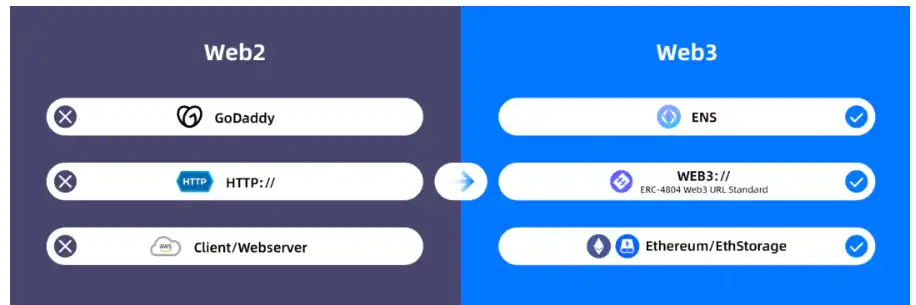
EthStorage has proposed EIP-4804/W3IP-1, "Web3 URL to EVM Call Message Translation," which translates HTTP-style Web3 URLs into EVM call messages.
Currently, reading data from Web3 relies mainly on Web3 agents to connect to Web3 blockchains. This translation is mostly done by third-party agents, such as dApp websites/node service providers/etherscan, which are all beyond the user's control.
This standard aims to provide users with a way to access Web3 content directly without relying on third parties. Furthermore, it enables interoperability with other URI-compatible standards implementations, such as SVG.
ERC-4804 will support "dynamic data," allowing people to leave likes and comments on websites and interact with the content. As a native Ethereum standard, this standard also makes it easier to interact with other blockchains.
According to the ERC-4804 specification, internet users can type "web3://" in their browser (instead of "http://") to directly open DApps (such as Uniswap or on-chain NFTs). This is because this standard allows users to directly execute queries to the Ethereum Virtual Machine (EVM).

Currently, EthStorage has launched its testnet, and many top protocols have deployed their websites on the testnet. In addition, initiatives such as Vitalik Buterin's blog, decentralized Dropbox, dynamic NFTs, etc., have also released testnet versions.
EthStorage's Twitter followers have just exceeded 1,000, which is very early for a public chain infrastructure project that has received funding from the Ethereum Foundation, making it a project worth a closer look.

What are your thoughts on the two projects mentioned above? Feel free to join us and engage in further discussions. Moving forward, we will continue to bring you more early-stage alpha projects.
Original Article Link
Welcome to join the official BlockBeats community:
Telegram Subscription Group: https://t.me/theblockbeats
Telegram Discussion Group: https://t.me/BlockBeats_App
Official Twitter Account: https://twitter.com/BlockBeatsAsia

 Related Articles