Is Danksharding the future of Ethereum sharding

原文标题:《 IOSG Weekly Brief | 扩容杀手锏 Danksharding 会是以太坊分片的未来吗 #114 》
原文来源: IOSG
Part.1 Insight
By Gokhan Er, IOSG Ventures
This article is only for the purpose of industry learning and exchange, and does not constitute any investment reference.
Is Danksharding the future of Ethereum sharding?
Vitalik's much-discussed "endgame" vision of blockchain architecture has been roughly distilled into the following three points:
- Centralized block producers
- Trustless and decentralized block validation
- Anti-censorship mechanism, so that these block producers have no incentive to review transactions.
With the rise of MEVs and cross-domain MEVs, it is clear that the generation of blocks is destined to become increasingly centralized due to the benefits and economies of scale of producing blocks simultaneously in many domains (such as Rollups). Under this mechanism, a single block producer can capture arbitrage opportunities between different Rollups and layer1.
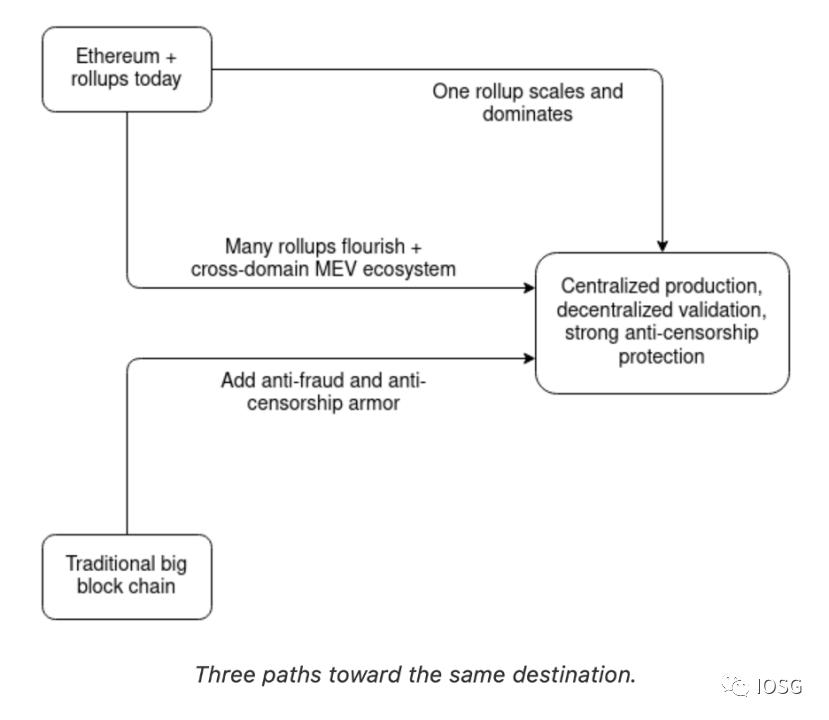
(Photo credit: https://vitalik.ca/)
Vitalik goes even further, arguing that today's "big block" type blockchains (Solana, BCH, etc.) need to follow a similar architecture if they want to simultaneously achieve decentralization, circumvention of censorship, and expansion. Given the network effects of Rollups or cross-domain MEVs, the centralization of block producers is largely unavoidable, so accepting this fact and adjusting it at the protocol level to ensure that block producers do not interfere with the security and censorship resistance of Layer1 should be our best option.
Naturally, a controversial buzzword "Danksharding" in the Ethereum community for the protocol layer recently caught our attention. Before deconstructing this technology, let's introduce PBS as an important design to help us understand Danksharding better.
PBS: Block proposer and builder separated
If centralized block production is an inevitable reality, the most feasible solution to prevent more centralization is to separate block production from block validation (proposal).
We know that in the current architecture, there is usually only one party doing the block production (miners), and they choose which transactions they undertake directly from the Mempool and create blocks by undertaking those transactions. In addition, the more complex these miners' tasks, the more value they can capture, leading to the centralization of miners.
In the design of PBS, the roles of the builder are separate. They select deals from mempool, ranking them with the goal of maximizing profits. Once they have created a list of transactions they want to undertake, they submit their bid to the verifier (block proposer). In this case, the task of the verifier (block proposer) is to select the highest bidder to create the block. The block proposer simply collects transactions from the mempool and creates a crList, which is simply a list of transactions in the block. The block proposer passes this crList to the block builder. The block builder reorders the transactions in the crList as he wishes to maximize his MEV extraction. Thus, block proposers have no say when it comes to how transactions are sorted, but by providing the builder with a list (crList) of block transaction information, they ensure that all transactions from Mempool enter the block uncensored.
Thus, the design of PBS is actually to establish a firewall and market between proposers and builders. While the work of a block producer will become complex and centralized, it is critical to ensure that the validation node is run at a very low cost by a generic server (as opposed to a sophisticated server run by a block producer). This is possible thanks to the PBS program.
With that in mind, let's go back to Danksharding.
What is Danksharding? Why is the whole world talking about it?
First, let's explain the origin of the name Danksharding. Danksharding is named after Ethereum developer Dankrad Feist, who replaced the previous parallel data sharding model and redesigned the system around cross-domain MEV resistance (thus maximizing chain security and decentralization). Previous sharding designs had no PBS, and each shard and beacon chain had an independent validator. This design is based on the old belief that having as many shard verifiers as possible maximizes censorship resistance.
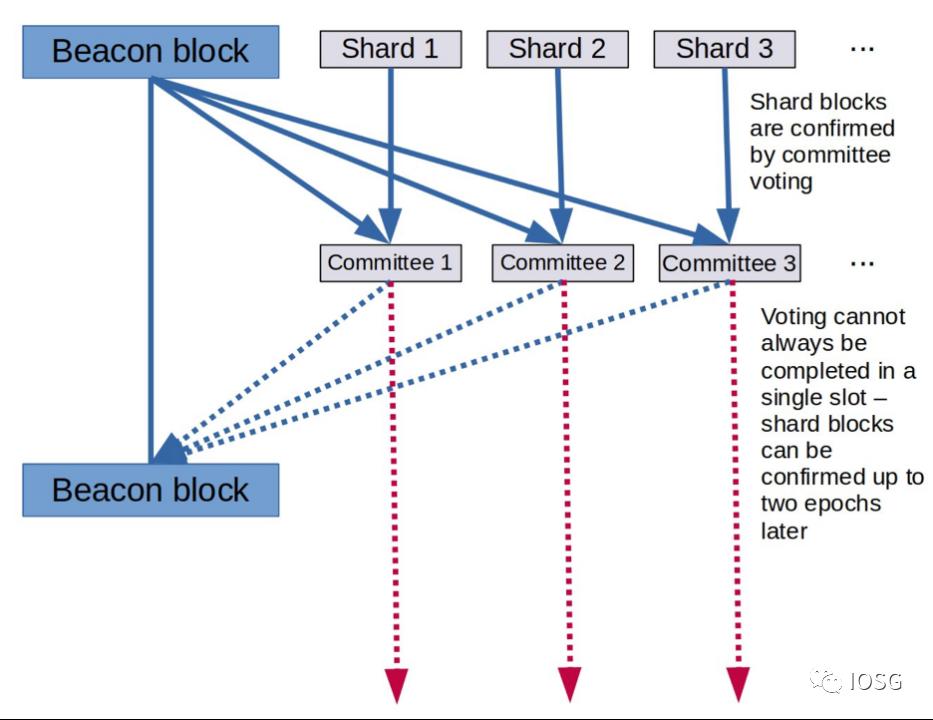
Dude, What's the Danksharding Situation?
However, as the issue of MEV becomes more and more intractable, the need to separate block builders from their proposers becomes a big one. This separate block creator and block proposer structure (PBS) is the only solution to democratize the MEV issue and prevent it from further compromising the security of the protocol.
Back to Danksharding, Dankrad's basic design concept is: in any shard design, there are MEV opportunities under the multi-shard architecture, causing the problem of centralized multi-shard builder. The only way to solve this problem is to implement this PBS architecture. The existence of block proposers discovers and solves the centralization of block creation and fundamentally prevents any behavior that endangers security on the chain.
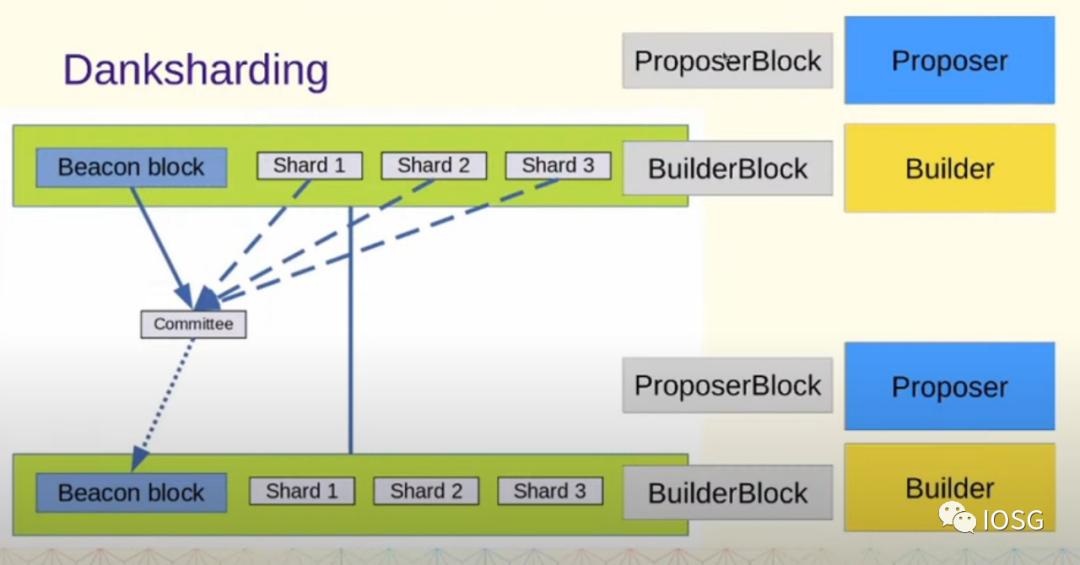
Dude, What's the Danksharding Situation?
In this new design, the beacon block will contain all the shard blocks, and all beacon blocks and shard data will be uniformly authenticated by a Committee of verifiers. As a result, transactions in the same beacon block can access sharded data and even get synchronous transactions between rollup and Layer1, simplifying the rollup structure greatly and eliminating issues like confirmation delays.
So what about Danksharding's anti-censorship situation? Can centralized block creators still review specific transaction records by participating in the same block? CrLists' innovation solves the problems mentioned above.
The block proposer's responsibility is to list all the transactions they see in mempool. The block builder then extracts a hash from the list and proves that all the data in the list is included. However, recent discussions indicate that the design of the proposer and validator and the crList tools are yet to be finalized. The upgraded version of Data Sampling is also another important design of Danksharding, which can ensure that all data will not be stored unnecessarily when beacon nodes provide data. It will not be described here.
In general, Danksharding still has many advantages worth paying attention to:
More and more simple fragmentation design, the new model will make the original work a hundred times less.
Based on the PBS model, block creators, whether complex or advanced, are not a problem for Ethereum security. This allows Ethereum to increase the block size without worrying about centralization.
The combination of shard data and beacon chain data will speed up the synchronization of Layer1 and ZK rollup, thus simplifying the rollup structure.
CrLists ensure that L1 does immediate transaction verification (similar to the same concept on Layer2).
Cross-shard MEVs will be democratized (just as Flashbots did), and potential verifier centralization problems can be prevented.
Danksharding, as a new model proposed by the core researcher of Ethereum a month ago, is still in its infancy, and the model will have more innovation and optimization in the future. However, it can be seen that ethereum sharding plans will be a steady step by step forward. Let's see!
Part.2 Investment and financing events
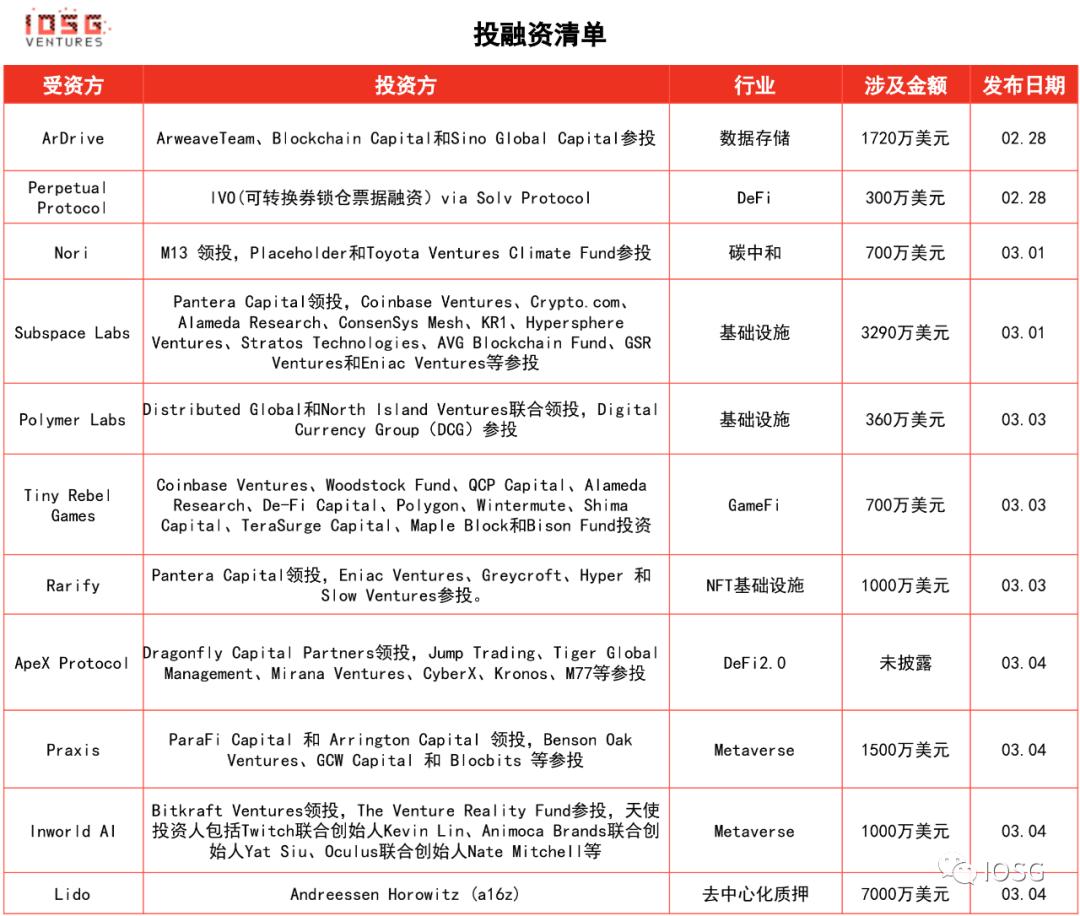
ArDrive has raised $17.2 million in seed funding
* Storage applications
ArDrive, a blockchain-based permanent storage application, has raised $17.2 million in seed funding from ArweaveTeam, Blockchain Capital and Sino Global Capital.
ArDrive currently holds more than 6 million files from around the world, including text, articles, photos and videos. While many users trust services like Dropbox or Google Drive to manage their data, which could be affected by a data breach, ArDrive allows users to maintain ownership and control of their data on the Arweave blockchain.
ArDrive is already being used to archive documents related to the Conflict between Russia and Ukraine.
Perpetual Protocol has raised $3 million through Solv Protocol
* DeFi
Perpetual Protocol's IVO project financing through THE NFT Financial Ownership market Solv Protocol has closed for a total of us $3 million.
On January 17, Perpetual Protocol announced a $4 million convertible note financing facility with a 5% APR using its Solv Protocol platform.
Nori has raised $7 million in Series A funding
* carbon neutral
Nori, A carbon-neutral blockchain app, has raised $7 million in Series A funding, led by M13, Placeholder and Toyota Ventures Climate Fund.
The team said that after this round of financing, it will focus on the development of mainnet Token NORI related functions.
Nori is a blockchain-based carbon removal marketplace founded in 2017 and headquartered in Seattle, Washington. Nori currently achieves carbon removal by supporting farmer, a mobility provider, to adopt a renewable agriculture program that sequestration co2 from the atmosphere. In the future, Nori will introduce a variety of carbon removal methods. Nori provides transparency and prevents double computation by casting NFT on the Ethereum blockchain.
Subspace Labs has raised $32.9 million in strategic funding, led by Pantera Capital
* Infrastructure
Layer 1 storage and computing network developer Subspace Labs has raised $32.9 million, led by Pantera Capital, Coinbase Ventures, Crypto.com, Alameda Research, ConsenSys Mesh, KR1, Hypersphere Ventures, Stratos Technologies, AVG Blockchain Fund, GSR Ventures and Eniac Ventures were among the investors.
With this funding round, Subspace Labs plans to triple the size of its protocol engineering team, expand its integration team to connect more deeply with projects in the Dotsama and Ethereum ecosystem, and build a product team focused on Subspace Meta Services (SMS), Infrastructure portal into subspace network.
Polymer Labs completed a $3.6 million seed round, led by Distributed Global
* Infrastructure
Polymer Labs, an infrastructure provider focused on THE IBC protocol, announced a $3.6 million seed round led by Distributed Global and North Island Ventures, with Digital Currency Group (DCG) participating.
Polymer Labs' infrastructure is designed to extend the IBC protocol, which was originally developed for the Cosmos ecosystem to provide a way for different blockchains to easily communicate with each other. Polymer Labs is still in its early stages and has yet to issue a token, but development will ultimately be managed by PolymerDAO.
Rarify closed A $10 million Series A funding round at A $100 million valuation, led by Pantera Capital
* NFT
NFT infrastructure startup Rarify has raised $10 million in Series A funding at A $100 million valuation, led by Pantera Capital, with Eniac Ventures, Greycroft, Hyper, and Slow Ventures. The money will be used to accelerate hiring and product launches.
Rarify currently provides a commercial API infrastructure for markets and applications to build an end-to-end NFT experience. The company also provides real-time apis to access historical data on NFT assets across multiple blockchains, which companies can use when building decentralized finance and markets products.
Praxis completed $15 million Series A financing, Paradigm and others participated in the investment
* Metaverse
Crypto city community Praxis has completed A $15 million Series A funding round with Paradigm, Alameda, Three Arrows Capital, Apollo Projects, Robot Ventures and other investors. The financing will be used to build up its real estate, governance and engineering teams.
Praxis closed a $4.2 million seed round late last year.
Inworld AI closes $10 million in funding led by Bitkraft Ventures
* Metaverse
Inworld AI, an AI-driven avatar platform, has raised $10 million in funding, led by Bitkraft Ventures and with The Venture Reality Fund. Angel investors include Twitch co-founder Kevin Lin, Animoca Brands co-founder Yat Siu, Oculus co-founder Nate Mitchell and others. The round will be used to expand its team.
The company plans to launch its Creator platform later this year, which will offer integration with game engines and meta-universe applications.
A16z invested $70m in Lido, a decentralised pledge platform
* Staking
A16z announced that it has invested $70 million in Lido, a decentralized pledge platform, and uses Lido to pledge part of ETH held by A16Z on the beacon chain.
A16z says ethereum's upcoming transition from proof of work (PoW) to proof of stake (PoS) has the potential to have a cascading effect across cryptography. There are still significant hurdles to pledging ETH, with a minimum of 32 ETH required to run a node. Lido provides one of the easiest ways to pledge ETH and other PoS assets, while striving to achieve decentralization through DAO governance, so A16Z chooses to invest in Lido.
Lido offers liquidity pledge solutions for ETH and public chains such as Solana and Terra, allowing users to pledge their ETH, SOL and other tokens without locking up or minimum deposits.
Tiny Rebel Games has raised $7 million
* GameFi
Web3 virtual pet game Tiny Rebel Games has announced a $7 million funding round led by Fabric Ventures, Animoca Brands, Dapper Labs, SkyVision Capital, CMT Digital, Sfermion, Spin Master, Distributed Capital, A41 Ventures, Fourth Revolution Capital, 6th Man Ventures, ReadyPlayerDAO, Double Peak Group, Pirata Capital Management, Triangle Capital, etc. Angel investors include EA executive vice President Kristian Segerstrale and others.
Web3 virtual pet game Tiny Rebel Games is made by Petaverse Network, and the funding round will be used to accelerate its pet metaverse "Petaverse" initiative to support a wider variety of digital pets, more brand partnerships and better gaming experiences.
ApeX Protocol closed a seed round led by Dragonfly Capital
* DeFi2.0
ApeX Protocol, a DeFi 2.0 derivative agreement, has completed a seed round led by Dragonfly Capital Partners. Jump Trading, Tiger Global Management, Mirana Ventures, CyberX, Kronos, M77 and others participated. The financing was used to further its development and marketing efforts.
The ApeX Protocol, incubated by Davion Labs, is a decentralized and unmanaged derivatives protocol dedicated to creating perpetual contracts for any token pair. ApeX allows users to trade crypto derivatives directly on the Ethereum blockchain without any intermediary. This protocol provides flexibility as users can create contracts on any underlying asset while maintaining control of their private keys.
The ApeX beta version was launched on The Arbitrum main network on February 28.
Blue cursor subsidiary intends to participate in a16Z's blockchain seed fund
* fund
A-share listed company Blue Cursor issued A statement saying, Andreessen Horowitz(" A16Z ") intends to invest up to $35 million of its own capital to subscribe to the CNK Seed Fund I and CNK IV being raised by Andreessen Horowitz(" A16Z ") as its limited partner.
According to the announcement, the fund will be managed by a management fee of 2.5% per year, with a reduction of 0.25% per year for years 8 to 10. Carry Interest is 25% on the part where the net investment income is 1-2 times and 30% on the part where the net investment income is more than 2 times. The target fund invests in: blockchain underlying technology, smart contracts, blockchain vertical domain technology and other ancillary blockchain infrastructure. Announcement, the United States blue label investment this together with the specialized investment institutions to enhance their understanding of the global chain block technology development and the coordinated development of its yuan business universe of possibilities, and to further improve the efficiency of the fund management and use, contribute to the company's high quality resource acquisition and configuration capabilities, harvest the potential return on investment.
Part.3 Project progress after IOSG investment
Kava Network launches $750 million incentive program for on-chain developers
* Layer1
Kava Network launches "Kava Rise", a $750 million programmatic on-chain developer incentive program designed to bring innovative developers from DeFi, GameFi and NFT industries to the Kava Network.
Using a programmatic funding model, Kava Rise plans to distribute 200 million Kava over 4 years, of which 62.5% of all block rewards will be allocated to developers building apps on Kava Ethereum and Cosmos Co-Chains, with the remaining 37.5% going to the pledges, Rewards will be distributed transparently along the chain based on usage.
Mask Network plans to launch Next.ID and an eco-fund this year
* Web3.0
Mask Network released its roadmap for 2022, including its plan to integrate into Instagram, optimize its integration with Facebook and Minds.com, launch the self-developed DID system Next.ID, co-launch the ecological Mask Network fund with strategic investors, support more blockchain, etc.
Mask Network also stated that its long-term mission includes creating MaskDAO, an efficient and autonomous builder and trading community, as well as strategic investments in SocialFi, DeFi, Metasexes, GameFi and other related areas.
Swim Protocol will launch mainnet Alpha on March 9th
* Many chain AMM
Swim Protocol has announced that the Alpha version of its mainnet will be released on 9 March and will support Solana, Ethereum and BNBChain, with additional blockchains to follow soon. Swim Protocol is a multi-chain AMM for native assets designed to make cross-chain bridging easier. The Swim Protocol solution also significantly reduces many of the barriers users face when performing cross-chain transactions, enabling true interoperability between the various blockchain networks.
1Inch launches P2P transactions that allow both parties to complete transactions directly
* DeFi
1Inch Network, a decentralized transaction aggregator, has launched P2P transactions, allowing users to complete transactions directly with counterparties.
The process provides the counterparty with an address, the user enters the address in the P2P option of the DApp, the transaction can then create a P2P order at any price agreed upon or the current market price, and the user can then send the counterparty a URL containing the P2P order signed by the sender via email or any other means. The counterparty can complete the transaction by filling in the order and paying the Gas fee.
Router Protocol Integrates the C-chain of the Avalanche network
* Infrastructure
The Router Protocol cross-chain communication infrastructure project integrates c-chain of the Avalanche network to enable communication between Avalanche and other supported blockchains, such as Polygon and BSC. This integration enables users to purchase digital assets on Polygon or BSC in a single transaction without leaving the Avalanche network.
Note: C-chain is an abbreviation of Contract Chain, one of the three chains built into Avalanche. The other two are the X-chain and p-chain. All of this is authenticated and secured through a primary network.
Astar Network main Network added the cross-chain bridge function
* Boca parallel chains
Boca ecosystem smart contract platform Astar Network has added a cross-link bridge function to its portal, allowing users to cross assets from Ethereum to Astar Network.
Acala formally enables ACA Staking
* boca DeFi
Acala unveils ACA Staking. ACA is a fixed billion Staking, non-inflationary, and this is rewarded with the repurchase of ACA by network surplus.
Today, owners of ACA Staking can be rewarded for engaging in Staking on the Acala DApp page.
Cosmos Eco-mobility Pledge Protocol Quicksilver plans to launch the test network in the second quarter; Evmos announced the official launch of the main network, airdrop pickup will be open
* Infrastructure
Quicksilver, a liquidity pledge agreement that grew out of Chorus One, plans to launch its beta network in the second quarter. As a native Cosmos blockchain, once online, it will seek to extend support across multiple areas of the Cosmos ecosystem.
Joe Bowman, a former Chorus technology manager, founded Ingenuity late last year to work with two other Chorus team members to create Quicksilver, a mobile pledge protocol that Chorus participated in a seed round of funding. Quicksilver spun out of Chorus One on Feb. 1 and released the white paper yesterday.
Cosmos EVM Network Evmos has announced that the main network is officially online. Ethereum user airdrop pickup will be open on March 4. Cosmos Hub/Osmosis user airdrop pickup will take longer due to IBC proof messages being processed.
Part.4 Industry pulse
Hedge fund giant Citadel will explore the market making business of cryptocurrencies
* AMM
Citadel founder and CEO Kenneth Griffin said the company will explore market making in cryptocurrencies in the coming months. Kenneth Griffin said, "Cryptocurrencies are one of the great stories of the financial world in the last 15 years. Today cryptocurrencies have reached a $2 trillion market cap and we have to seriously consider becoming a cryptocurrency market maker in terms of helping institutions and investors solve their portfolio allocation issues. It's fair to assume that over the next few months, you'll see us in the crypto market-making business.
E-commerce giant Shopify has teamed up with NFT foundry platform Manifold to launch the NFT creator tool
* NFT
Manifold has partnered with Shopify to launch the NFT creator tool, Manifold Bridge, which can be easily configured and applied to the ERC-721 and ERC-1155 standard NFT. Integrating Shopify with the official Manifold X Shopify application enables creators to specify specific physical goods to be purchased or claimed by a verified NFT holder.
Chainlink provides prophet service for zkSync2.0 test network
* Infrastructure
Chainlink provides prophet service for zkSync2.0 test network. Developers will use Chainlink to access off-chain data to build more advanced smart contract applications.
On February 22, zkSync 2.0 was officially launched, which is the first EVM-compatible ZK Rollup on the Ethereum test network.
Aave initiated a new proposal to add ENS to Aave V2 as collateral assets; StETH has been supported as collateral
* DeFi
The Aave community put forward a proposal to add ENS (Ethereum Domain name Service) tokens to Aave V2 as collateral assets, freeing additional liquidity for all ENS holders. Voting on the proposal will close at block height 14321279 (00:00 on March 5).
Aave has officially backed stETH as collateral, founder Stani.eth tweeted. Users can deposit stETH into the Aave agreement and use it as collateral to apply for a loan.
Circle has temporarily banned fiat payments from all Russian accounts
* Policy regulation
According to a post on USDC publisher Circle's website, the United States and The United Kingdom imposed broad economic sanctions aimed at holding Russia accountable after the Russia-Ukraine war. To comply, Circle has temporarily banned all fiat currency payments from accounts in Russia, including those from Russian-issued cards.
The original link
Welcome to join the official BlockBeats community:
Telegram Subscription Group: https://t.me/theblockbeats
Telegram Discussion Group: https://t.me/BlockBeats_App
Official Twitter Account: https://twitter.com/BlockBeatsAsia
 Related Articles