Current status, opportunities, and challenges of the decentralized stablecoin leader Liquity.

Original Title: "Business Status, Opportunities, and Challenges of Decentralized Stablecoin Leader Liquity"
Source: Mint Ventures
Foreword
Recently, with the suspension of BUSD issuance and the USDC anchor event, as well as the launch of LQTY on Binance, decentralized stablecoins and Liquity have once again become a hot topic in the market.
We have been following Liquity since its launch in 2021 and have completed an article titled "Liquity: The Rising Star of the Stablecoin Market". Now, a year and a half has passed, and although Liquity, which adheres to the concept of no governance, has not updated at the protocol level, there are Lego products based on its underlying technology, such as Chicken Bonds.
In this article, we will analyze the business development of Liquity and its competitive advantages and disadvantages compared to other stablecoin protocols, hoping to provide readers with more perspectives on Liquity and stablecoins.
This article is written by the author based on project information and market background at the time of writing. Due to the author's knowledge and information limitations, there may be errors in data, facts, and analysis in this article, and all content in this article does not constitute investment advice.
2. Project Overview
2.1 Project Business Scope
Liquity's only business is stablecoins.
2.2 Project History and Roadmap
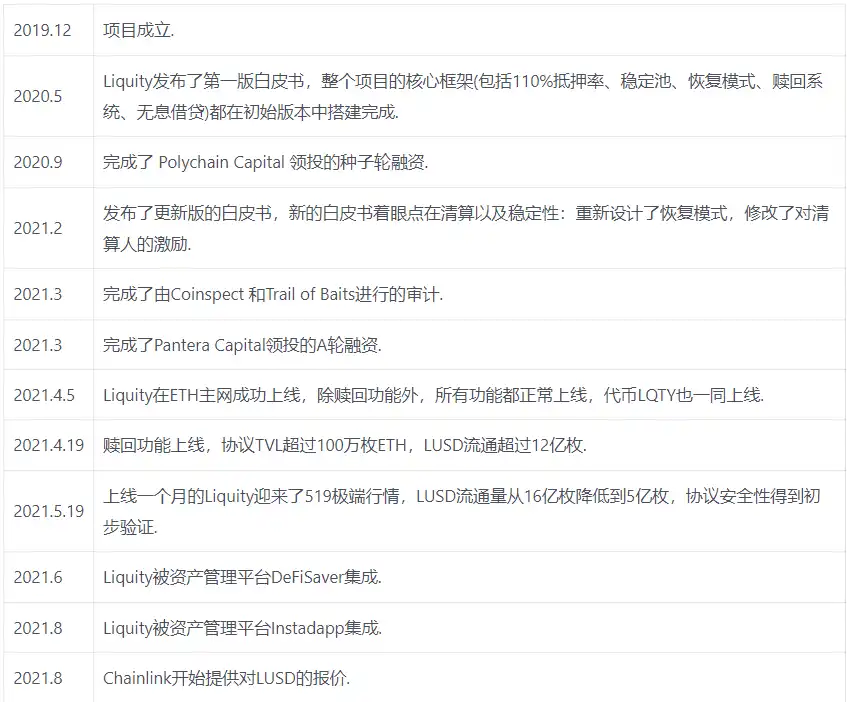
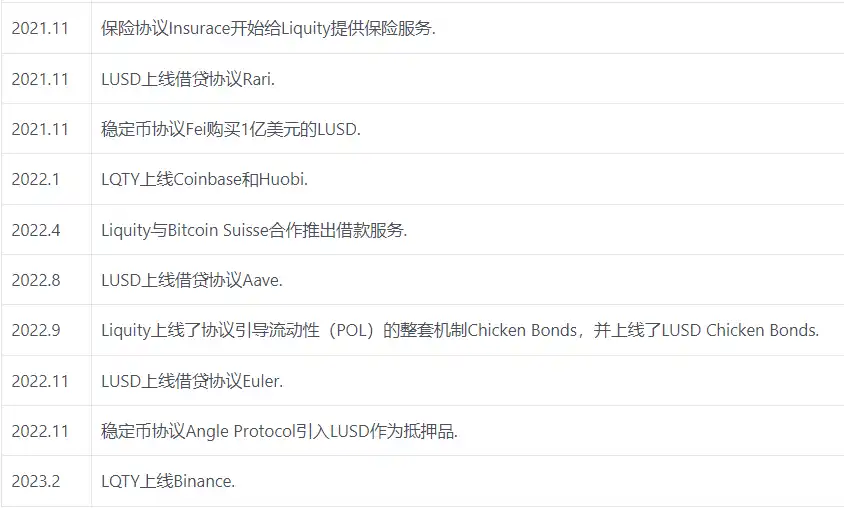
Here are the important milestones of the Liquity project since its creation, as of March 2023.
2.3 Core Team
Liquity is a real-name team, with two core members based in Europe. The founder, Robert Lauko, was previously a researcher at Difinity and was mainly responsible for the overall protocol design. The other co-founder, Rick Pardoe, is mainly responsible for development work. The overall team size is around 10 people.
For more team information, please refer to the "Team" section in the previous Liquity research report. This article will not repeat the information.
3. Business Analysis
3.1 Track Analysis
Liquity belongs to the stablecoin - decentralized stablecoin track.
Stablecoins are the most network-effect-driven track in the DeFi field, and have achieved development significantly above the industry average growth rate in the previous cycle. Regarding the value of the stablecoin track, we have detailed analysis in the Reflexer report. Our core viewpoint is as follows:
Due to its ease of settlement and better alignment with the habits of the general public, stablecoins have replaced BTC/ETH as:
The settlement currency for spot trading and new derivatives such as perpetual contracts, which are highly popular in the market, is the settlement currency for most project parties and venture capital institutions involved in investment and financing activities.
Reflected in data, it means that the growth rate of stablecoin market capitalization exceeds the average growth rate of the cryptocurrency market, and the magnitude of the pullback is also smaller than the market average.
Stablecoins, as the designated settlement currency for cryptocurrencies, have a solid position in the minds of all market participants. The market size of stablecoins will develop in sync with the overall size of the cryptocurrency market, and there is still significant room for growth.
In the past two months of March and April, two important events have occurred that have affected the stablecoin market landscape:
At the end of February, regulatory agency New York Department of Financial Services (NYDFS) ordered stablecoin issuer Paxos to halt the issuance of BUSD. Paxos also received a "Wells notice" from the US Securities and Exchange Commission (SEC) regarding BUSD-related issues and may face charges of illegal securities issuance. Following this, Binance has been seeking stablecoin issuance partners globally while also supporting TUSD. Additionally, Binance has turned its attention to decentralized stablecoins, with Liquity's LUSD being one of the few fully decentralized stablecoins on the Ethereum network. Binance also launched LQTY on February 28th.
In early March, the US banking crisis was triggered by the bankruptcy of Silicon Valley Bank (SVB). As Circle had $3.3 billion deposited in SVB, this event also caused USDC to break its peg and drop below 0.9. Decentralized stablecoins such as DAI and FRAX, which heavily rely on USDC, also broke their pegs, causing significant fluctuations in the stablecoin market. Although the Federal Deposit Insurance Corporation (FDIC) quickly took over SVB and the Federal Reserve launched the Bank Term Funding Program (BTFP) to address banking risks, USDC quickly returned to its peg. However, due to the high penetration of USDC, DAI, and FRAX in the DeFi world, this event still sparked discussions about the decentralization of stablecoins. As a result of this event, the circulation of LUSD also increased from $230 million to $260 million.
These two things have triggered a trust crisis in centralized/semi-decentralized stablecoins in the market, as well as a revaluation of the value of decentralized stablecoin protocols.
In short: The stablecoin business has a solid foundation, vast potential, and still has decent room for growth.
In the stablecoin subdivision track, along with the recent regulatory pressure on stablecoins and the risk events of centralized stablecoins due to real-world assets, decentralized stablecoins have more development space due to their resistance to censorship and trustlessness, as well as their lower current level of development.
3.2 Business Situation
Due to its ungoverned nature, Liquity has very few updates at the protocol level after going live. In the nearly two years since its launch, the only significant update at the use case level was the LUSD Chicken Bonds, which went live at the end of September 2022. Let's first briefly understand what Chicken Bonds are.
3.2.1 Chicken Bonds
The Chicken Bonds launched by Liquity are strictly speaking a set of solutions that can incentivize POL (Protocol Owned Liquidity). The first product module is the LUSD Chicken Bonds. The goal of Chicken Bonds is to help the protocol guide liquidity with the lowest possible cost while providing users with more robust capital protection. The Chicken Bonds plan to launch a version that can be applied to other protocols in Q2 of this year. For simplicity, in the following text, Chicken Bonds refers to LUSD Chicken Bonds.
Within the Chicken Bonds product, the following concepts exist:
bLUSD: boosted LUSD, is the unit of Chicken Bonds. Through a series of settings in Chicken Bonds, bLUSD can provide higher returns than LUSD, hence its name. bLUSD can always be redeemed for LUSD from Chicken Bonds. LUSD bond NFT: LUSD bond can be exchanged for bLUSD according to the preset time-yield curve.
Chicken Bonds divides its funds into three pools internally:
待定池:Pending Bucket, all funds participating in Chicken Bonds will first enter the Pending Bucket.
储备池:Reserve Bucket, a concept in the internal accounting process of Chicken Bonds. The LUSD in the pool can receive all the profits generated by the LUSD in Chicken Bonds (including the pending pool, permanent pool, and reserve pool). The LUSD in the reserve pool corresponds to the redemption of bLUSD.
永久池: Permanent Bucket, the LUSD in this pool does not belong to users, but to the Liquity protocol.
Its detailed meaning in the business, we will use the example of Alice participating in Chicken Bonds with 10000LUSD to illustrate to everyone:
Step 1 to participate in Chicken Bonds is to use LUSD to purchase bonds. After using 10000 LUSD to purchase bonds, Alice will not directly receive bLUSD, but will receive an LUSD bond NFT. At the same time, all the LUSD that Alice invests will be deposited into the Stability Pool of Liquity through B.Protocol. B.Protocol will periodically convert the LQTY rewards and ETH liquidation profits obtained from the Stability Pool into LUSD for compounding. In the internal accounting of Chicken Bonds, all LUSD invested in Chicken Bonds are initially in the pending pool, but their profits are allocated to the reserve pool of bLUSD (Alice does not have bLUSD at this time, which means that she has transferred the LUSD profits to the reserve pool).
2. After obtaining the LUSD bond NFT, Alice has two options: she can claim bLUSD (Chicken in) or cancel the bond (Chicken Out). The claim can happen at any time, and the amount that can be claimed varies according to a preset curve. The graph below shows the relationship between the claimed amount and time, with the horizontal axis representing time and the vertical axis representing the amount. Alice initially invested 10,000 LUSD (represented by the purple horizontal line "Bonded tokens" in the graph), and based on the current redemption price of bLUSD (i.e. the net asset value of bLUSD) at the time of investment, she can calculate the maximum amount of bLUSD she can claim (represented by the red horizontal line in the graph). As we can see, the amount of bLUSD that Alice can claim (represented by the blue curve in the graph) gradually increases over time, starting from 0, and the rate of increase gradually decreases. This means that in the initial stage, Alice can claim bLUSD at a faster rate, but the rate of increase slows down over time. However, the amount of bLUSD that Alice can claim will not exceed the maximum limit (the blue line will approach the red line infinitely, but will not be equal).
Get the corresponding income curve from https://docs.chickenbonds.org/faq/economic-design
3. If Alice pays a 3% fee to claim, she will receive the corresponding bLUSD according to the curve (segment AB in the figure). At this time, although Alice's 10000 LUSD is still in the stable pool without any changes, the part of LUSD corresponding to the bLUSD held by Alice has entered the Reserve Bucket from the Pending Pool in the internal accounting of Chicken Bonds, and the 3% fee along with the LUSD given up for early claim (segment BC in the figure) has entered the Permanent Bucket.
Although from the perspective of a single user, the later they claim bLUSD, the more bLUSD they can receive. However, from the perspective of overall profit, it is not necessarily true that the later they claim bLUSD, the higher their profit will be. This is because bLUSD itself is also appreciating (from the mining revenue of all three pools of LUSD), and the profit from the increase in bLUSD net value obtained by users who claim bLUSD too late will decrease. Therefore, logically, the ideal time to claim bLUSD is when the growth rate of claimable bLUSD (i.e. the speed at which the curve in the above graph rises) equals the growth rate of bLUSD net value. However, this is not a result that can be calculated by a formula, but rather a result generated by the free game of the participants.
4、After obtaining bLUSD, Alice can redeem or sell bLUSD, both of which result in exchanging bLUSD for LUSD. However, redemption corresponds to retrieving LUSD principal and earnings from the reserve pool in proportion, while selling is achieved through Chicken Bonds official incentive bLUSD+LUSD-3CRV LP.
5、Alice can also choose to cancel the bond (Chicken Out) before receiving it. After cancellation, Alice can receive her invested 10000 LUSD, which will be directly withdrawn from the pending pool. However, the profits earned by Alice's 10000 LUSD in the stable pool will not be returned to her, but will be distributed to other people in the reserve pool.
6. The liquidity of the perpetual pool belongs to the agreement, but the agreement only owns the principal. The income generated by the assets in the perpetual pool also belongs to the reserve pool. The funds in the perpetual pool are allocated in accordance with the solution that is more beneficial to the stability of the protocol in the stable pool and Yearn. If invested through Yearn, the obtained LUSD-3CRV LP tokens will be invested in Convex, and the income will also be periodically converted into LUSD to achieve compound interest.
From the above, we can see that the key reason why bLUSD can generate higher returns is that all the profits generated by the three pools will be given to the reserve pool. Since the reserve pool corresponds to the net value of bLUSD, this can also enable bLUSD to obtain higher returns than simply depositing LUSD into the stable pool. At the same time, the higher the proportion of the pending pool and the permanent pool to the total TVL, the higher the APR of bLUSD will be (because more principal generates profits). For example, when Chicken Bonds was just launched, the APR of bLUSD once exceeded 50%. However, as time passed, the APR of bLUSD gradually decreased as the TVL in the pending pool decreased. Since most users in the pending pool have just deposited into Chicken Bonds, this also makes Chicken Bonds have a certain Ponzi property: the more new users, the higher the returns for old users; the more new users, the higher the returns for old users; if new users stop entering, the return rate for old users will also decrease.
The following image shows the situation of LUSD in these three pools:
LUSD Chicken bonds fund distribution information source https://liquity.app/#/bonds
The TVL of the reserve pool accounts for 69% of the total TVL of Chicken Bonds. As we mentioned earlier, all the profits generated by LUSD within Chicken Bonds will be given to the reserve pool. This means that 69% of LUSD has obtained all the profits of LUSD. bLUSD amplifies the profits of the underlying assets (LUSD stored in the stable pool) by 1.44 times (100/69). Currently, the APR of LUSD in the stable pool is 7.35%, and the APR of bLUSD is 11%. The ratio of the two is also very close to 1.44.
If we set aside the concepts of the reserve pool, stability pool, and permanent pool in Chicken Bonds' internal accounting, and observe the actual flow of LUSD deposited by users, we can see quite clearly:
We can also see that Chicken Bonds did not expand Liquity's underlying assets or introduce new product types. The increase in bLUSD earnings is entirely due to the zero-sum game between current LUSD holders. Chicken Bonds did not bring new users or use cases to Liquity. Its growth is not driven by organic demand from users, but rather by the early Ponzi structure.
From the overall distribution and changes of TVL, this point can also be confirmed:
Early on, due to the extremely low amount of bLUSD in the reserve pool (as claiming bLUSD early on would result in losses), Chicken Bonds experienced rapid growth in TVL due to the high bLUSD APR. TVL remained on a linear upward trend until January of this year.
Before and after January this year, many LUSD holders chose to claim their rewards, resulting in an increase in bLUSD and a decrease in its yield. As a result, the overall TVL slowly reached its peak.
Starting from January, more and more users have been canceling (chicken out) bLUSD, reflected in the continuous decrease of TVL, especially around February 1st, the TVL of the entire Chicken Bonds rapidly decreased from 60 million US dollars to around 30 million US dollars, and currently TVL is less than 20 million US dollars. Moreover, the growth of new users for Chicken Bonds has stalled.
And under the Chicken Bonds mechanism, so far, the vast majority of participating users in Chicken Bonds (including those who have not yet claimed bLUSD, those who have claimed bLUSD, and those who have cancelled their claims) are in a loss-making state compared to simply depositing in the stable pool. The initial stage of Chicken Bonds has a long-term and huge negative feedback for all participating users, which will seriously affect the expansion of the Chicken Bonds product. As shown in the figure below, the profit and loss situation of Chicken Bonds users who have claimed and cancelled (i.e. all Chicken Bonds users) is represented by red and green dots respectively, and the size of the dots represents the position size. We can see that, after six months of Chicken Bonds operation, the vast majority of participants are still in a loss-making state or have already lost and exited.
Additionally, as the name suggests, Chicken Bonds have certain bond-like properties, and users must sacrifice liquidity in stages to earn profits. However, for Chicken Bonds products, the profits from sacrificing liquidity are not high (in the DeFi world, a 10% APR without locking is not particularly difficult to obtain), and this type of profit may even decrease over time (because the proportion of the reserve pool to the total TVL will continue to increase), which is also a significant factor that may limit the future development of Chicken Bonds.
Regarding Chicken Bonds, the Liquity team has a fairly detailed document available for reading. Interested readers can go there to learn.
3.2.2 Liquity Business Development Status
In this section, we mainly analyze the historical development of LUSD through LUSD circulation history data and LUSD distribution situation.
Liquity was launched during the peak of the bull market. With its excellent stable pool-debt redistribution-recovery mode of liquidation mechanism design, the stable pool can naturally liquidate others, as well as the high Framing APR of LQTY in the early stage of launch, it attracted many users to use Liquity's products. Within less than a month after the launch, the circulation of LUSD quickly exceeded 1 billion, and at its peak, the circulation of LUSD reached nearly 1.6 billion US dollars, with the protocol's TVL exceeding 1.1 million ETH (4.6 billion US dollars).
Following the 5.19 market crash, which validated Liquity's core mechanism, the protocol's TVL plummeted and the circulation of LUSD dropped to less than 500 million. Subsequently, the circulation of LUSD gradually increased as the market rebounded, reaching 930 million US dollars by the end of November 2021. During the 2022 crypto bear market, the circulation of LUSD also declined to around 500 million. Then, from May to July 2022, UST, Three Arrows, and Celsius collapsed one after another, causing a severe liquidity crisis in the market. The circulation of LUSD dropped to a minimum of 158 million, less than one-tenth of the peak. Of course, the entire decentralized stablecoin track was severely impacted during this phase, and the issuance scale of stablecoin protocols decreased one after another.
Starting from February 23rd, the LQTY and USDC de-pegging incidents on Binance brought Liquity a decent increase in users. Currently, the issuance scale of LUSD is 268 million, ranking third among all decentralized stablecoins, second only to DAI, FRAX, and USDD. Achieving this scale is not easy.
According to user data, the number of users who have opened Troves in Liquity (i.e. users who have collateralized ETH to generate LUSD) has exceeded 1,000, and the current number of Troves is close to the historical high of 1,300. Especially since February of this year, this data has achieved a 15% increase, which also shows that recent stablecoin risk events have provided reverse assistance to the promotion of LUSD.
However, the use case expansion of LUSD is relatively average, and there is no obvious effect.
From the distribution of LUSD: Currently, a total of 64.6% of LUSD exists in the stability pool. Although the yield in the stability pool includes not only LQTY token incentives but also ETH liquidation rewards, since its launch, Liquity has liquidated a total of 1378 ETH, while the number of LQTY token incentives has approached 24 million, regardless of the ETH/LQTY price at any time, the difference between the two is at least one order of magnitude. This indicates that users generate LUSD to earn the LQTY reward for issuance in the stability pool. In other words, the current largest use case for LUSD is not "organic," especially in the case of a decrease in LQTY incentives in the future. There are doubts about whether Liquity's stability pool can maintain this scale, and we will discuss this in detail in 3.4.3.
Except for the Stability Pool, LUSD is distributed more widely on the Optimism network (2.4% share, Liquity has received a lot of OP token incentives from the Optimism team), Uniswap V3 (1.3% share), and the LUSD-3CRV pool on Curve (1.2% share). The overall share of LUSD in these scenarios is not high, partly because most of Liquity's incentives are used for the Stability Pool, and there are not many incentives for other scenarios.
Currently, there are no centralized exchanges that support LUSD as a trading pair, and there are not many use cases for LUSD in offline payments. We have also compared the daily trading volume, transfer quantity, and number of holders of LUSD with DAI and FRAX, which are also decentralized stablecoins. Additionally, we have chosen USDC, the most active stablecoin on the ETH network, for comparison.
We can see from the data of trading volume, transfer number, and number of holders that LUSD and FRAX, which currently has a circulation of 1.04 billion, are very close. Of course, this is also related to the fact that about 785 million of FRAX's circulation currently comes from AMO. After removing this part of FRAX, the actual amount of FRAX held by users is about 255 million, which is very close to the market value of LUSD's circulation. Compared with DAI, the current leader in decentralized stablecoins, LUSD has a gap of about 20 times in trading volume and transfer number, and an even larger gap in the number of holders. This also shows the first-mover advantage brought by the obvious network effect in the stablecoin race.
Compared with USDC, even DAI has a difference of orders of magnitude in terms of trading volume and transfer activity. This shows that centralized stablecoins are indeed more in line with user habits for stablecoins at present, and on the other hand, it also shows the potential of the decentralized stablecoin track.
In summary, after two years of development, Liquity's business development is average compared to industry leader DAI, and there is still a large gap. Recent risk events with other stablecoins have to some extent promoted the promotion of LUSD, but the overall use case expansion of LUSD is relatively ordinary.
3.3 Liquity's Competitive Advantages
Liquity is currently the leader in the fully decentralized stablecoin industry. However, in reality, LUSD's competitors are not only fully decentralized stablecoins, but also "partially decentralized" stablecoins such as DAI and FRAX, as well as centralized stablecoins such as USDT and USDC. Of course, the direct competitors of LUSD are still decentralized stablecoins.
3.3.1 Decentralization
The most obvious advantage of Liquity and LUSD is their complete decentralization. Currently, LUSD is only generated through over-collateralization with ETH, which is a completely decentralized asset. Therefore, LUSD is also a completely decentralized asset. The advantages of decentralization can be clearly felt from the regulatory events mentioned in the previous two months:
The stablecoin issuer Paxos has been ordered by its regulatory authority to stop issuing the stablecoin BUSD, which will be "zeroed out" within the next year. Neither LUSD, DAI, nor FRAX have a regulatory body that can require them to completely cease operations, although MakerDAO and Frax may face increased regulatory scrutiny due to their current or future RWA (real-world asset) businesses. However, when it comes to the life or death of stablecoin businesses, the antifragility of any decentralized stablecoin is far greater than that of centralized stablecoins.
The USDC anchor event highlights the advantages of fully decentralized stablecoins like LUSD over semi-decentralized stablecoins like DAI/FRAX. USDC has always been far superior to USDT in terms of compliance and transparency, which is why DAI and FRAX chose USDC. However, the recent anchor event caused by its RWA risk was unexpected by most market participants. This also shows that risks always appear where people least expect them. Mechanically speaking, LUSD does not rely on any other centralized stablecoins, which can avoid any operational risks of centralized stablecoin issuers, their credit risks, and the operational risks and counterparty risks of their real-world assets.
Other decentralized stablecoins listed above, except for sUSD and LUSD, have a considerable degree of dependence on other centralized stablecoins.
Currently, more than 60% of DAI's reliance is on centralized stablecoins.
FRAX's centralized stablecoin asset accounts for over 75% of its collateral (based on the Decentralization ratio provided by Frax);
Decentralized stablecoins such as alUSD, DOLA, and agEUR have more than half of their collateral composed of other stablecoins (USDT, USDC, DAI) or yield-bearing tokens from other DeFi protocols. Their dependence on centralized stablecoins also exceeds 60%.
Regarding the significance of decentralization, the market has already had a relatively sufficient understanding, especially after Binance listed LQTY, which was also a great advertisement for Liquity. Looking ahead, under the obvious trend of strong regulation in the United States, any regulatory action against stablecoins could be an opportunity for Liquity, and Liquity will still benefit in the long term from its decentralized nature.
3.3.2 Excellent Mechanism Design
In the article "Liquity: The Rising Star of the Stablecoin Market", which can be found at https://research.mintventures.fund/2021/07/09/liquity%E7%A8%B3%E5%AE%9A%E5%B8%81%E5%B8%82%E5%9C%BA%E7%9A%84%E5%90%8E%E8%B5%B7%E4%B9%8B%E7%A7%80/, we have provided a detailed introduction to the overall mechanism of Liquity. We are very optimistic about the overall mechanism design of Liquity. Even after nearly two years, we have not seen any new stablecoin products that can come close to Liquity in terms of mechanism design. In summary, the excellent aspect of Liquity's mechanism design lies in:
Liquity ensures that the price of LUSD is roughly fixed between 0.995 and 1.1 at the protocol level, providing convenient arbitrage opportunities for all users in the market outside of this range. This achieves relatively rigid price stability under the premise of complete decentralization, which gives all market participants a good expectation of stability.
Due to the existence of a stability pool and the pre-agreement of the stability pool as a liquidator, Liquity has achieved real-time liquidation without the need for complex auction processes. Real-time liquidation can eliminate potential security risks caused by network congestion in extreme situations, effectively ensuring the security of the protocol. At the same time, the stability pool also provides a natural use case for LUSD. As the stability pool can obtain liquidation penalties, LUSD in the stability pool can usually earn higher returns when the market experiences a sharp decline. In addition to the stability pool, Liquity's liquidation system also includes a debt redistribution-recovery mechanism to address potential shortcomings in the liquidation pool, achieving a considerable degree of security. This has been demonstrated by Liquity's successful navigation of the market's volatile fluctuations since its launch two years ago.
Reflecting the token use case level, Liquity does not need to act as the final lender of the system like MKR and FLX. Due to the protocol security being fully guaranteed by the stability pool-debt redistribution-recovery mode, Liquity allows users to borrow with a collateral ratio of 150% (in fact, risk assessment agency Gauntlet suggests that Liquity change this value to 130%) to achieve high capital efficiency. In a sense, Liquity has achieved the impossible triangle of stablecoins (decentralization-price stability-capital efficiency): at the core mechanism level, Liquity chooses price stability and decentralization, but Liquity also allows some users to achieve up to 89% capital efficiency (with a minimum collateral ratio of 110%) based on their own needs at specific stages, almost reaching the upper limit of capital efficiency that decentralized stablecoins can support.
Under the excellent mechanism design mentioned above, Liquity has been forked the most among stablecoin protocols. According to DeFiLlama's statistics, a total of 16 protocols have forked Liquity, far more than MakerDAO and Frax Finance's 4. Liquity's excellent mechanism design is the root of its long-term development support.
3.4 Liquity's Competitive Disadvantages
Compared to other stablecoin projects, Liquity has many innovative features in its protocol, some of which are controversial and have brought some competitive disadvantages to the protocol.
3.4.1 No Governance
无治理是 Liquity 一个非常值得讨论的特性。Liquity 对于无治理的坚持是非常彻底的,包括团队自身并不运行任何前端,以及协议参数都是由预先写好的算法来进行更新,任何人都不可能更新 Liquity 协议的代码,因而代币 LQTY 并没有治理功能,而仅是分享协议铸造和赎回费的收入。
Translation:Non-governance is a very worthy feature to discuss in Liquity. Liquity is very thorough in its insistence on non-governance, including the team not running any front-end and the protocol parameters being updated by pre-written algorithms. No one can update the Liquity protocol code, so the LQTY token does not have governance functionality, but only shares the income from protocol minting and redemption fees.
There are many benefits to Liquity from the lack of governance, including:
To avoid conflicts between the actions of individuals or small groups and the long-term goals of the entire protocol, as well as to avoid boring protocol politics. The former has countless examples, such as the DeFi education fund incident of Uniswap, trust issues that have arisen with SushiSwap and the Abracadabra team, and so on. The latter is exemplified by the entire process of choosing a cross-chain bridge when Uniswap crosses to the BNB Chain, with different interest groups discussing and voting on whether to choose Layerzero or Wormhole.
The security of the protocol has been further guaranteed. Liquity has been running for 2 years without any security incidents, which is very rare in the lending/stablecoin protocol space. Even Compound, which is as robust as Liquity, once experienced excessive COMP issuance due to incentive parameter issues. Moreover, since Liquity does not update its code, the likelihood of code issues decreases over time.
Further decentralization at the protocol level. In the current Dapp architecture, front-end modules still have some dependence on centralized services, but Liquity can eliminate this dependence at the protocol level since it does not run any front-end. From a practical standpoint, this has clear benefits, such as Liquity being able to avoid situations like Uniswap and Aave accidentally banning users due to errors from some API providers, as seen in the OFAC sanctions on Tornado Cash incident.
The author says that the lack of governance is a disadvantage of Liquity, mainly because the feature of no governance will limit the use case expansion of the Liquity protocol and its adaptability to new changes.
As mentioned earlier, the current use case expansion of LUSD is not considered successful, partly due to the lack of governance. Liquity has only reserved 2 million LQTY tokens for reserves, and the remaining LQTY tokens have already been designated for specific purposes in the code and cannot be changed. This makes it difficult for Liquity to expand its use cases and engage in operational activities, such as Liquity's minimal involvement in the Curve war - the largest narrative in the stablecoin field in 2022.
For example, after the ETH Merge and the Shanghai upgrade, ETH will increasingly participate in staking. A large portion of the ETH circulating on the mainnet may exist in the form of Liquid Staking Derivatives (LSD) through staking. In this case, it is necessary to discuss whether stablecoin protocols that use ETH as collateral need to support LSD and how to support it. However, under Liquity's non-governance mechanism, the protocol cannot adapt to these new changes unless a new version is released. If it does not adapt to these changes, up to 40%-50% (assuming an ETH staking rate of 40% to 50%) of ETH may not be used as collateral for LUSD, which will further limit the ceiling of Liquity, which only uses ETH as collateral.
The author believes that the willingness to govern is also a manifestation of the team's willingness to take responsibility for project development at some level. Although the DeFi world already has some clear business models and protocols that are in an absolute leading position in various fields, if we look at the development and innovation of DeFi from a five-year or even ten-year perspective, it is still very rapid, and competitors in various fields are still emerging. In the constantly changing external environment, a team that strives to be responsible and has a deep understanding of the industry is the key to any project's long-term success.
Looking at the development process of DeFi OG, it is not difficult to see the importance of governance and team:
Despite already dominating the market with V2, Uniswap has released a V3 version of their product and has since expanded into NFT trading-related businesses.
Aave has undergone various changes in its business model and boundaries, from its initial Peer 2 Peer lending product under ETHLend, to its Peer 2 Pool product, and later to Aave v3 and the newly launched stablecoin GHO.
Synthetix has come a long way from its stablecoin in version 1 to the derivative trading market on the Ethereum mainnet in version 2, which had less than 50 traders in the long term. With the launch of Optimism network, the daily trading volume reached as high as $500 million. Now, with the newly designed version 3, the product is still not exactly what they imagined, but it has made significant progress.
Curve's entire protocol design revolves around governance, and the team has launched version 2 of Curve to enter into non-pegged asset trading. Additionally, they are preparing to launch crvUSD.
Currently, the leading "decentralized" stablecoin protocols, MakerDAO and Frax Finance, are also actively adjusting their protocols to respond to changes:
MakerDAO's stablecoin has evolved from SAI (the single-collateral version of DAI) to DAI, and then to 312. It has launched the Stable Vault and PSM (Price Stability Module) to stabilize prices, and the D3M (DAI Direct Deposit Module) to actively adjust market supply and demand, as well as promote the landing of RWA (Real World Assets). Recently, MakerDAO has also prepared to expand its lending business and enter the LSD market, and has undergone organizational changes - splitting MakerDAO into more sub-DAOs to accelerate business progress. Although the promotion of PSM and RWA businesses has made MakerDAO more and more decentralized and trustless, it is still a more favorable choice for DAI and MKR holders at the time.
Frax was originally introduced as an algorithmic stablecoin. When the narrative of algorithmic stablecoins was no longer recognized by the market, Frax promptly launched the AMO (Algorithmic Market Operations) module to take on supply and demand adjustments. Since then, Frax has expanded its business to FPI, Fraxswap, Fraxlend, and Staking, and has actively participated in the Curve War. The business boundaries continue to expand, and the market capitalization of FXS token has also been rising.
Changes in the direction of protocol business or updates to the protocol module, such as those mentioned above, are difficult for Liquity to achieve without governance. I believe that governance-free can be the ultimate pursuit of stablecoin protocols. When the entire protocol has reached a mature state of development, governance-free can help maintain security and avoid the various problems that may arise from human governance. However, in the current booming development of the entire DeFi and even Web3 field, which has only just begun for less than 5 years, voluntarily giving up the right to change will make it difficult to respond to subsequent environmental changes and fierce competition from later entrants.
3.4.2 Protocol Fee Structure
One other topic worth discussing about Liquity is the issue of interest-free lending and the overall fee structure of the protocol. Liquity does not charge interest on loans, but instead charges a fee for minting and redeeming, which is controlled by a pre-set algorithm. However, for the majority of the time that the Liquity protocol is running, this fee is set at 0.5%.
Looking at all decentralized stablecoin protocols, we can see that (excluding liquidation income), they typically generate revenue through the following three methods:
1. By collecting interest. This is relatively easy to understand. Generating stablecoins by mortgaging other assets can be understood as mortgage loans, which require payment of interest. This is also the most traditional way for stablecoins to charge fees, such as MakerDAO's DAI. Except for the DAI generated by the PSM module, all other DAI stablecoins need to pay interest (Stability Fee). Different Vaults charge different interest rates, and the interest rate parameters can be modified through governance.
2. By charging casting/redemption fees. Users only need to pay a certain proportion of fees to the protocol when casting stablecoins or redeeming collateral. Protocols that adopt this charging method usually encourage users to hold their stablecoins for a long time.
3. Through open market operations. This refers to the stablecoin protocol party mastering a certain way to directly mint or burn its stablecoin, and sending it to the corresponding mining pool to obtain profits. Typical examples include MakerDAO's D3M and Frax Finance's AMO module.
Let's take a look at several ways to earn income through decentralized stablecoin protocols:
MakerDAO's revenue acquisition methods are 1 and 3.
Frax Finance's revenue acquisition methods are 2 and 3.
Representing the stablecoin protocol in the hot DeFi 2.0 concept at the end of 21 and the beginning of 22, abracadabra (with stablecoin MIM) has two ways of earning income, which are 1 and 2.
Another representative of DeFi 2.0 is the stablecoin protocol Alchemix (with the stablecoin being ALUSD), which is relatively unique in that the protocol does not directly charge users interest or fees, but instead takes a 10% cut from the profits generated by user assets. This approach can essentially be seen as 1, but with interest payments taking on a different form. The revenue generation method for Liquity is 2, while another completely decentralized stablecoin, Reflexer Finance, uses method 1 to generate revenue.
Only having the 2 fee structure has many issues. On one hand, the income generated is usually sporadic and unstable. However, the more serious issue is that it can cause stablecoin protocols to not be able to continuously profit from the scale of the stablecoins issued.
For stablecoin project parties (or governance token holders), from the perspective of the asset-liability table of the stablecoin protocol, the circulating stablecoins are their liabilities, and the protocol needs to bear the responsibility of redemption; while users' collateral is their assets. If they cannot profit from the stablecoin scale, it means that the increase in their liability scale cannot correspond to the increase in their income level. However, the increase in liability scale actually implies a larger scale of risk bearing, which presents an obvious risk-return mismatch, which is very unfavorable for the protocol owner (LQTY holder).
As we previously calculated in the Reflexer Finance research report, Liquity's fee structure results in a much higher P/S valuation compared to MakerDAO and Reflexer.
Another intuitive feeling is that the Staking APR of LQTY is very low, with an average of around 5% over the past year. However, LQTY does not have governance functions, and the only use case is to Stake to obtain the protocol's minting and redemption fees. This low APR is also not conducive to community cohesion.
In fact, for stablecoin protocols, charging minting fees is more effective than charging interest in the early stages of protocol expansion, as it allows the fees to be "pre-distributed" to participating users and helps the protocol overcome the cold start phase. At the same time, the high yield of the token also helps to increase community cohesion. When Frax was first launched, the protocol only had minting/redemption fees, but less than three months after launch, they proposed the concept of AMOs and successfully launched various AMOs including investment, lending, and liquidity in October 2021. Their protocol revenue sources became more complex and diverse, and revenue levels also increased significantly.
During the first year of Liquity's protocol launch, the Staking yield of LQTY was also relatively high, with an average APR of over 30%. If the charging method can be modified in the future, and users can generate long-term returns by holding LUSD through interest charges or public market operations, the protocol may have the potential for a more effective resurgence.
Unfortunately, under Liquity's non-governance model, such adjustments are not possible.
3.4.3 Insufficient Future Incentives
Regarding the incentive issue, we need to review the token distribution of LQTY. The total amount of LQTY is 100,000,000 (one hundred million), which was released together with the Liquity mainnet on April 5, 2021. 35.3% of the tokens are allocated to the Liquity community, including:
32,000,000 LQTY tokens are allocated to the LQTY reward pool. These tokens are used to incentivize stable pool deposits, and the cumulative issuance follows the function: 32,000,000 (1 – 0.5^n), where n is the number of years after issuance. This means that the issuance gradually decreases, with 16 million tokens distributed in the first year, and 8 million tokens distributed in the second year;
1,333,333 LQTY tokens will be distributed to the LP of LUSD-ETH Uniswap pool within six weeks after the protocol goes live.
2,000,000 LQTY tokens are reserved for the community reserve fund.
From the distribution of LQTY allocated to the community, we can see that the main incentive for LQTY is the stability pool, with 90% of LQTY allocated to it. When Liquity first launched, the returns from the stability pool were quite high, staying above 20% for most of 2021. Such high and stable returns on a stablecoin are enough to attract users to use Liquity.
Currently, Liquity has been online for nearly 24 months, and only 8 million LQTY tokens are reserved for the stability pool. From April 2023 to April 2024, 4 million LQTY tokens can be released. Based on the current price of 2.2U, the remaining LQTY tokens for stability pool incentives in the next year will only be worth 8.8 million USD. Meanwhile, the circulating supply of LUSD is 268 million tokens. On one hand, the incentive effect of LQTY on LUSD in the stability pool is weakening, and APR below 10% or even 5% (8.8/268=3.7%) will become the norm. It is questionable whether the same scale can be maintained under such low APR. On the other hand, it will become more difficult to incentivize more users to participate in the Liquity protocol through stability pool incentives.
The author believes that the Liquity protocol has not yet grown to the point where it can maintain the same scale without incentives (let alone growth), but LQTY has no inflation plan, and future development may face more challenges.
3.5 Summary
In this article, we analyze the product logic and development of Liquity's innovative product, Chicken Bonds, as well as Liquity's business development. Overall, Liquity has successfully survived the volatile market for the past two years and has become one of the top four decentralized stablecoins in terms of issuance size, which is a remarkable achievement. However, in terms of use case expansion, Liquity's performance is relatively average.
In addition, we analyzed the competitive advantages and disadvantages of Liquity: in the current stablecoin market, with its completely decentralized narrative and excellent product mechanism design, the gradually increasing stablecoin regulation can be seen as a sustained positive for Liquity, as it can provide the market and users with more decentralized stablecoin options that are more in line with the spirit of cryptocurrency. However, Liquity's lack of governance and fee structure issues also affect the expansion of LUSD use cases and the protocol's ability to generate higher revenue. In addition, the amount of LQTY reserved for future incentives is limited, and Liquity still faces significant challenges in its future development.
4. Reference
https://www.chickenbonds.org/blog-posts/where-does-the-amplified-yield-in-chicken-bonds-come-
fromhttps://docs.chickenbonds.org/https://dune.com/chickenbonds/lusdhttps://dune.com/dani/Liquity
https://dune.com/chickenbonds/lusdhttps://dune.com/dani/Liquity
https://dune.com/dani/Liquity
原文链接Translation:
Original article link
Welcome to join the official BlockBeats community:
Telegram Subscription Group: https://t.me/theblockbeats
Telegram Discussion Group: https://t.me/BlockBeats_App
Official Twitter Account: https://twitter.com/BlockBeatsAsia

 Related Articles