What advantages does Arthur Hayes's favorite LSD rookie, ether.fi, have

Original article by Leo, BlockBeats
Ethereum Shanghai upgrade ended, enabled the pledge withdrawal function, user pledge ETH can be redeemed, means ETH pledge will become the mainstream narrative, but also completely pave the way for LSD track protocol development, LSD track scale expands. For ETH pledge income, we are eager for high ETH pledge yield, some want to fully decentralized, non-escrow (keep one's private key), there is no LSD project on the market to combine these two points well. Next, I would like to introduce a LSD track potential protocol dedicated to non-escrow, continuous pledge incomeether.fi.
Unlike other pledge income protocols, etherfi is a decentralized, non-escrow entrusted pledge protocol that allows the pledor to control their keys throughout the pledge process from creation to redemption and can exit the verifier at any time to reclaim their ETH, thereby preventing the node operator, Doing a good job of "Your keys, Your crypto," ether.fi reduces the risk for all parties, including node operators who no longer need to keep wallets connected or rely on trusted intermediaries for coordination.
An introduction to ether.fi
Before ether.fi, there were many entrusted pledge solutions on the market, but ether.fi believes that decentralized, unmanaged pledge solutions are the most basic infrastructure of Ethereum in the future. The ether.fi mechanism also allows the creation of a node service marketplace where the pledge and node operators can register nodes to provide infrastructure services.
In addition, ether.fi is a BitMEX co-venture backed by Arthur Hayes, which is funded by the Arthur Hayes Family Office Fund, Maelstrom.
The ether.fi mechanism and roadmap
There are four types of users on ether.fi: pledgees who are Bond holders, pledgees who only hold eETH, node operators, and node service users. The following figure shows the ETH pledge mechanism.
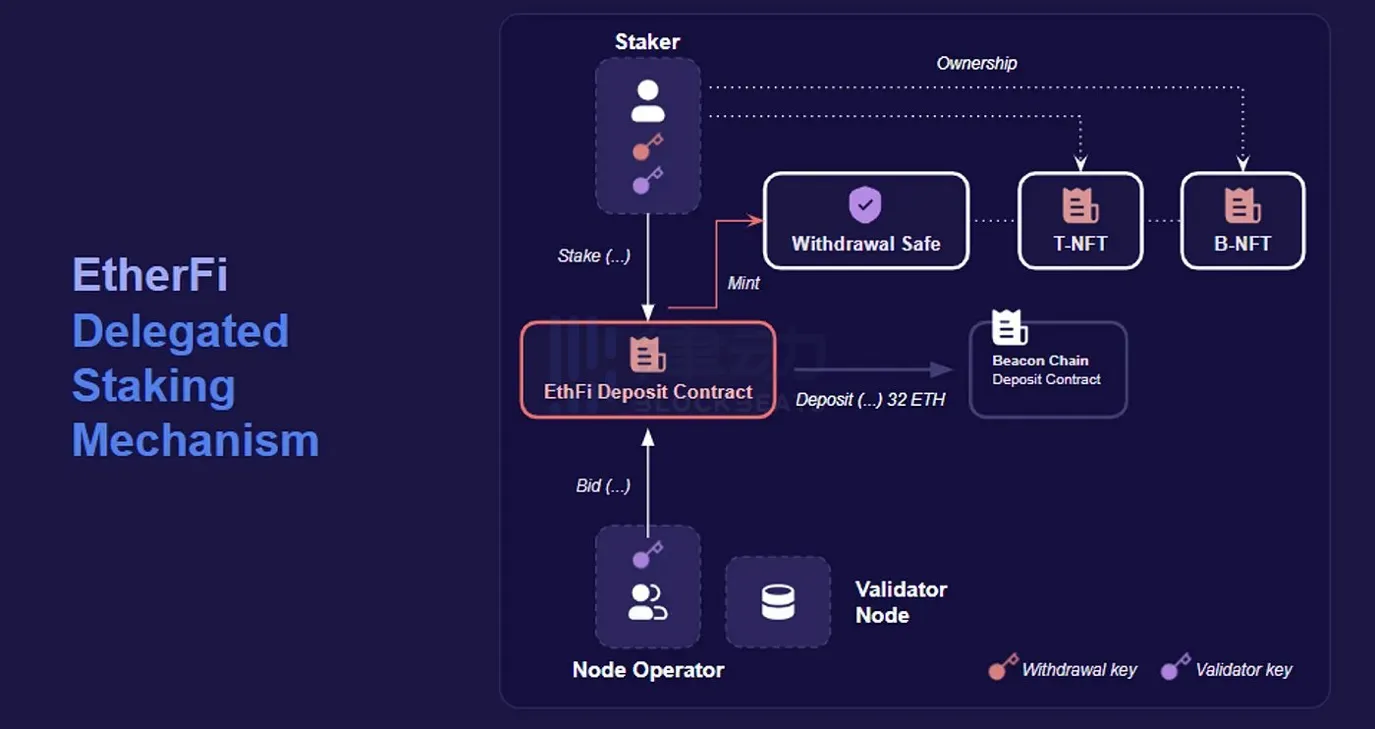
The mechanism facilitates the development of a market for node services where node operators and pledges can register their nodes to provide infrastructure services.
The ether.fi roadmap is planned in three phases, with the goal of achieving more radical decentralization at the end of each phase.
The first stage: entrusted pledge: April 30, 2023;
Phase 2: Working Capital Pool: 2Q2-3Q2023;
Phase 3: Node Services: Q1 to Q2 2024.
The first stage: entrusted pledge
ether.fi plans to migrate the early ETH pledge pool to the V1 liquidity pool on the main network on April 30, during which pledge users will receive eETH (which can be exchanged back for ETH) and have the opportunity to earn rewards.
Compared to other entrusted pledge agreements, ether.fi has two highlights:
- The pledge generates and holds its own pledged ETH key; For most entrusted pledge agreements, it is often the pledgor who deposits their ETH and matches it with the node operator, who then generates and holds the pledge certificate. In theory, this approach can also make the protocol unmanaged, but in practice, in most cases, it is managed or semi-managed. This could expose the pledge to significant and opaque counterparty risk.
- After each deposit of ETH (32 ETH or its multiples), ether.fi triggers the auction mechanism, and the winning node operator runs the authenticator. Two NFT (T-NFT, B-NFT) for user withdrawal security are generated. T-NFT stands for 2 ETH and is soul bound, the only way to recover 2 ETH is to exit or completely withdraw the validator.
The second stage: liquid capital pool
Pledgers with less than 32 ETH, or who do not want the responsibility of monitoring the verifier node, can participate in ether.fi pledge by casting eETH in the NFT liquidity pool, which contains a mix of assets consisting of ETH and T-NFT. At any given time, ETH accounts for only a small portion of the pool assets.
ETH depositors are minted eETH to the depositor, and T-NFT holders can deposit it into the pool and receive eETH matching the price. If the liquidity in the pool is sufficient, the user can convert eETH 1:1 into ETH at any time. If the liquidity is insufficient, the Swap trigger will cause the verifier to exit.
The large amount of pledge (B-NFT) will get a higher pledge yield, put the large amount of ETH (32ETH multiples) into the pool and enter the queue to distribute the B-NFT. These pledgers are Bond holders, and when the number of ETH in the working capital pool exceeds the maximum threshold, the next Bond holder in the queue is assigned B-NFT, generating the private key and triggering the pledge process, of which 32 ETH are pledged and two NFT are cast: T-NFT goes into the pool, B-NFT goes to the bondholder; When the number of ETH in the liquidity pool falls below the minimum threshold, an exit request is triggered on the first holder of the T-NFT.
When the verifier exits, T-NFT and B-NFT are destroyed and ETH (minus fees) is deposited in the working capital pool.
Stage 3: Node services
It's too early to tell at this stage, and a lot of decisions have yet to be made, but in the future, aeether.fi may be planning to work with EigenLayer to support its node service layer mechanism.
Air-drop interaction
ether.fi is currently in the early stage of adoption, but its official website Doc has confirmed that the token is ETHFI, and its interaction is relatively simple, click The website of ether.fi, connect wallet, deposit ETH, cbETH, wstETH, rETH, sfrxETH (minimum 0.1).
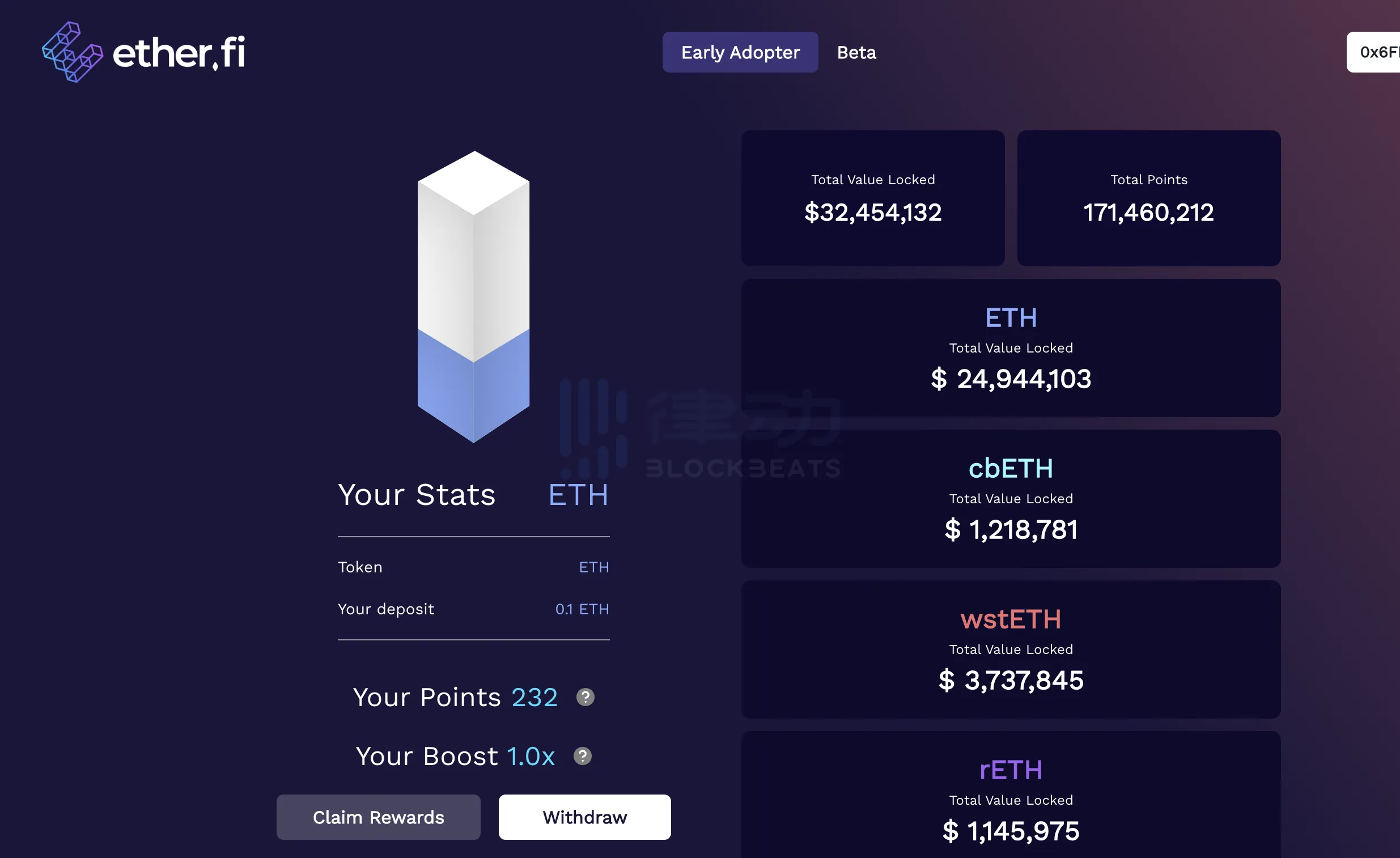
The interface will display the credits obtained and the multiple of credits obtained (increased from 1 to 2 in a month). The probability of credits is related to the ETHFI token to be airdropped, and credits can be rewarded when the project is officially launched on the main Ethereum network, and pledged to increase revenue.
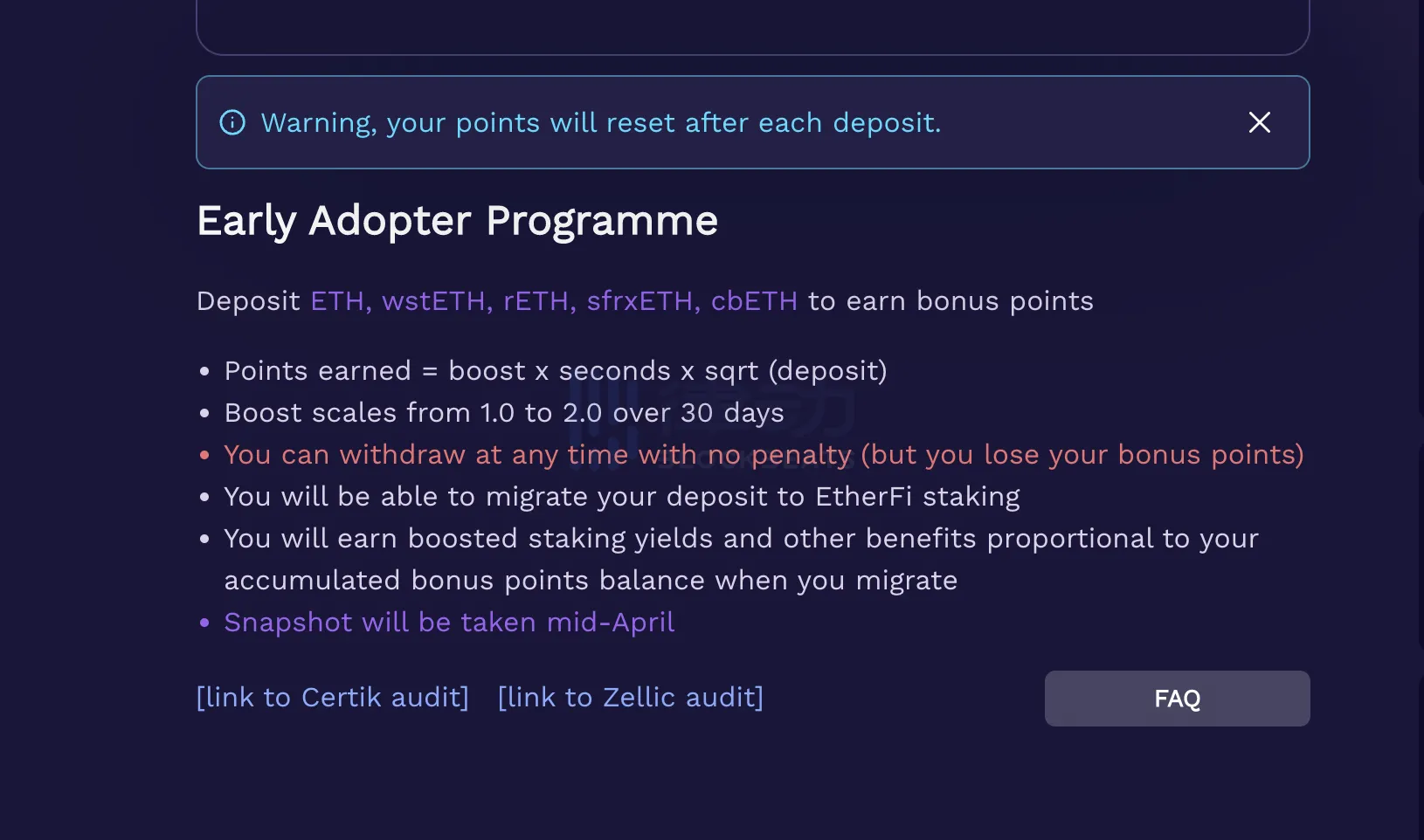
Integral = multiple (boost) x amount of ETH stored in time x;
The multiple goes from 1 to 2 in a month;
Users can put forward the pledged ETH at any time, but will lose points;
Users can receive the corresponding multiple of revenue and other benefits;
Snapshots will be taken in mid-April.
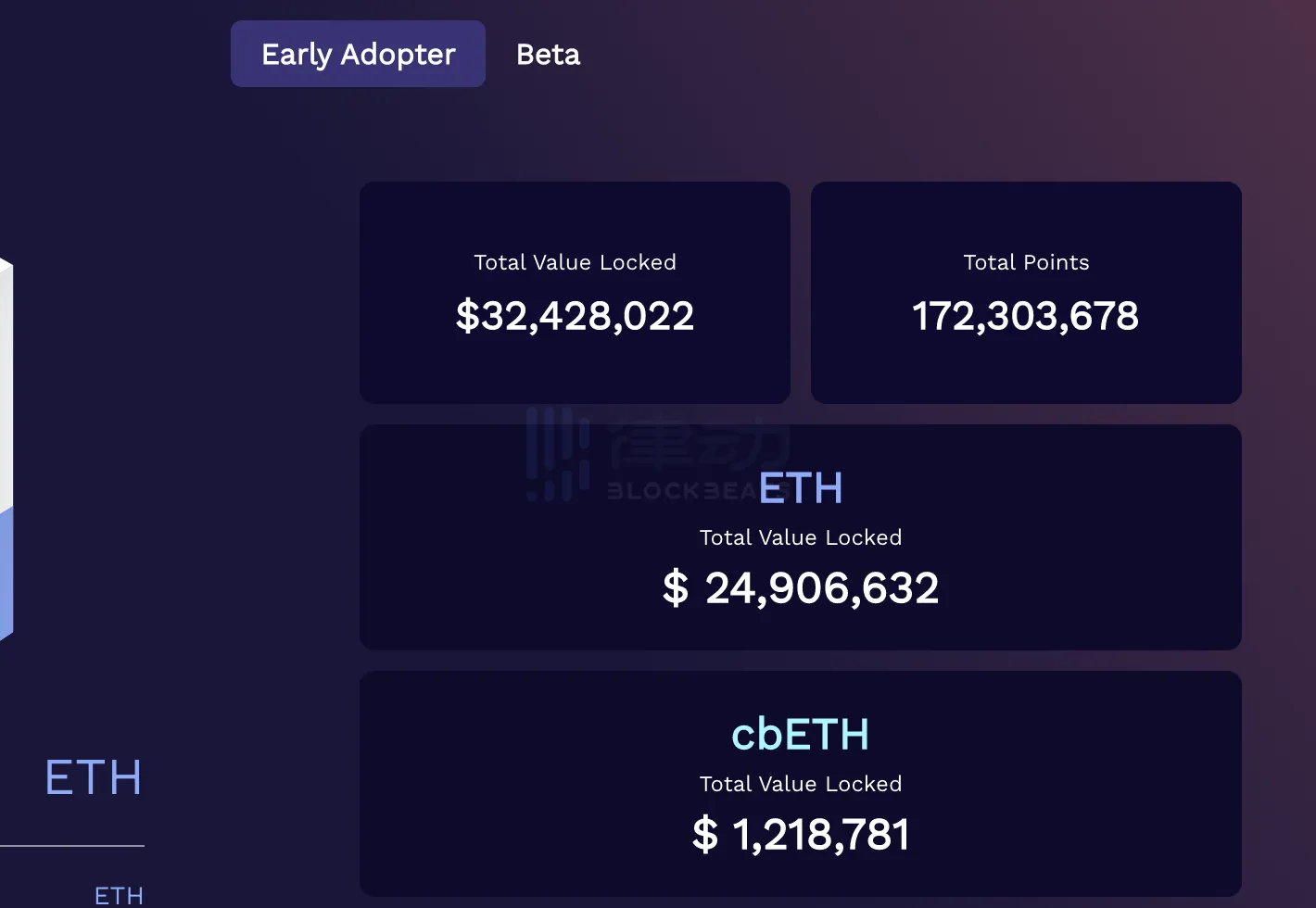
As of this publication, TVL has exceeded $32.42 million on ether.fi, and the project is audited by Certik and Zellic.
Teams and partners
The key members of the team are:
Mike Silagadze: Founder and CEO of ether.fi, CEO of Gadze Finance, a quantitative DeFi fund, and founder of Canadian higher education platform Top Hat ($130 million Series E funding in 2021);
Rok Kopp, Chief Customer Officer and former SaaS enterprise leader;
Chuck Morris, Vice President of Engineering;
Seongyun Ko, Senior Software Developer;
Nicky Khorasani, software developer;
The partners are:
Finoa, a cryptoasset custodian platform for institutions;
Kiln, institutional pledge platform;
DSRV, blockchain infrastructure solutions;
Chainnodes, blockchain infrastructure service provider;
Obol, distributed validator technology (DVT) provider;
ALLnodes, unmanaged node operation service provider.
The investors are:North Island Ventures,Purpose Unlimited,Version One Ventures,Chapter One, Node Capital,Arrington Capital
In addition, BitMEX co-founder Arthur Hayes previously reported that Maelstrom, a member of the Arthur Hayes Family Office Fund, is also bullish on ether.fi and is investing in the project.
conclusion
Earlier, the unmanaged liquidity pledge platform ether.fi announced the completion of $5.3 million in financing, following the momentum of LSD, confirmation of token, unmanaged pledge, sustainable high yield, institutional optimism, high TVL during the early bird period and has been increasing, That's reason enough for you to be bullish on ether.fi, and see what happens next. Click to enter On ether.fiunderstand
(BlockBeats note: Pay attention to distinguish the real and fake social media accounts of the project, there is a fake account of the project on Twitter)
DROR, snapshot time is near, don't forget to interact and become an early adopter to get rewarded when you go live on the main net. And, what if the credits are related to dropping tokens?
Welcome to join the official community of BlockBeats:
Welcome to join the official BlockBeats community:
Telegram Subscription Group: https://t.me/theblockbeats
Telegram Discussion Group: https://t.me/BlockBeats_App
Official Twitter Account: https://twitter.com/BlockBeatsAsia