Goldman Sachs turns bullish on Robinhood: Rothera's highest valuation could reach $19.5 billion

TL;DR
Rothera, the prediction market exchange co-invested by Robinhood and SIG, quickly climbed into the global top five after launch, with revenue in its first 41 days of operations annualizing to roughly $150 million.
Goldman Sachs projects Rothera will contribute $307 million in revenue in 2027, accounting for 5% of Robinhood's total revenue; by 2028, that share could rise to 6%.
Rothera's competitive edge stems from Robinhood's roughly 14 million monthly active users, SIG's market-making capabilities, and retail fee rates significantly lower than other prediction market exchanges.
Goldman Sachs expects Robinhood's prediction market revenue to reach $943 million and $1.15 billion in 2027 and 2028, respectively, exceeding market consensus by 10% and 14%.
Rothera can explain part of Robinhood's current elevated valuation, but even excluding this business, the valuation of Robinhood's remaining operations remains at historical highs.
Breaking into Global Top Five Within Months of Launch
Robinhood is evolving prediction markets from a fast-growing brokerage offering into a trading infrastructure it partially controls and operates.
Goldman Sachs highlighted Rothera in its latest report. This is a prediction market exchange in which Robinhood, Susquehanna International Group (SIG), and MIAX hold 45%, 45%, and 10% stakes, respectively. Robinhood is the controlling party, so it consolidates all of Rothera's revenue and expenses into its financial statements, then allocates 55% of net income to other shareholders through non-controlling interests.
This means all revenue generated by Rothera is reflected in Robinhood's top line, but only 45% of net income ultimately belongs to Robinhood shareholders. Understanding this accounting relationship is key to assessing Rothera's actual contribution.
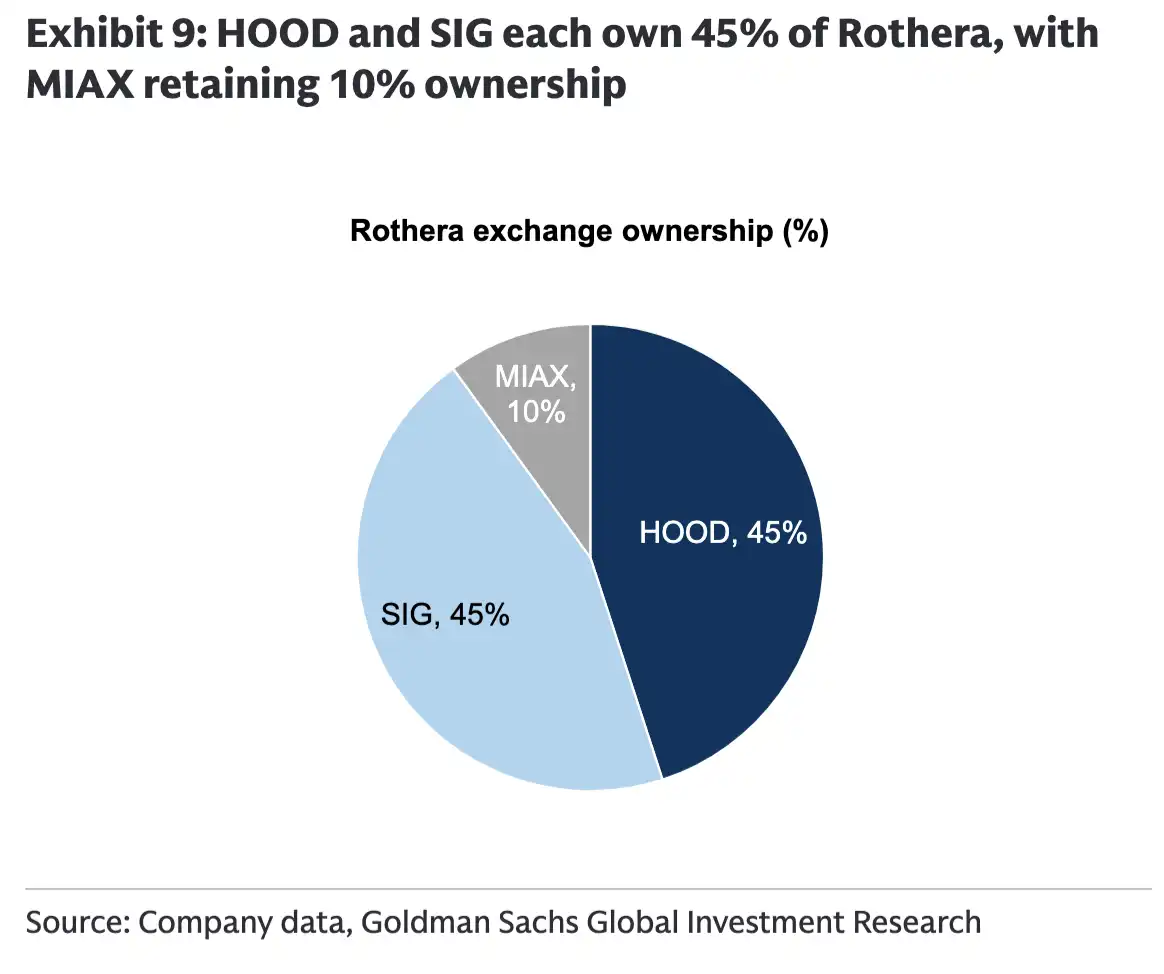
Caption: Robinhood consolidates all of Rothera's revenue and expenses, but only 45% of net income is attributable to Robinhood.
Rothera has ramped up rapidly since its launch in late May 2026. In its first 41 days of operations, Rothera generated approximately $17 million in revenue, annualizing to about $150 million, with Goldman Sachs estimating its pre-tax margin has already reached 45%.
The growth in trading volume is even more striking. Rothera completed only about 2 million contracts in May, which surged to 2.09 billion in June, approximately 1.688 billion in July, before pulling back to 593 million in August.
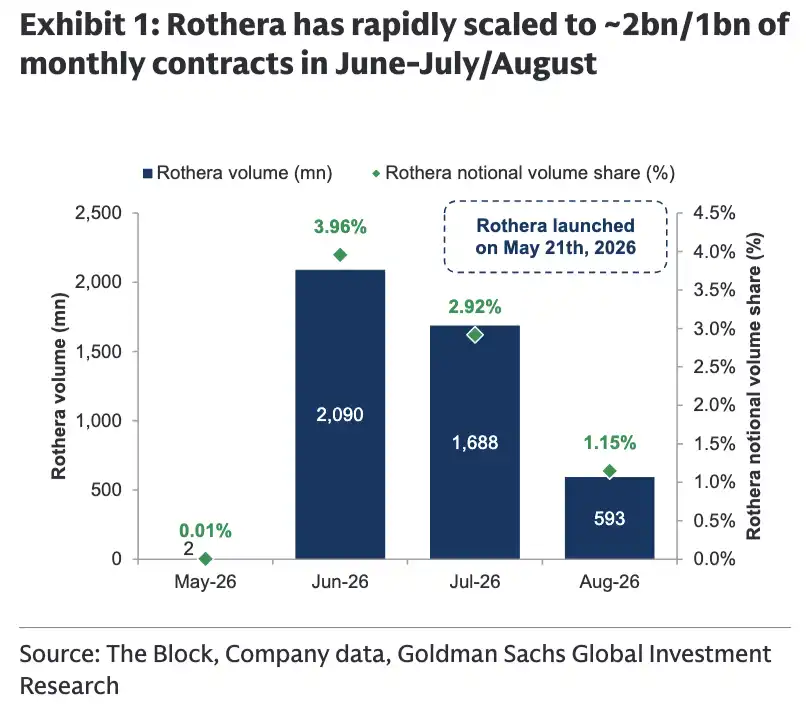
Rothera launched in May 2026, with contract trading volume surpassing 2 billion in June before retreating thereafter.
By notional trading volume, Rothera became the world's third-largest designated contract market for prediction markets in July 2026, and ranked fifth in August, joining the top tier alongside platforms such as Kalshi, Polymarket, Crypto.com, and Opinion.
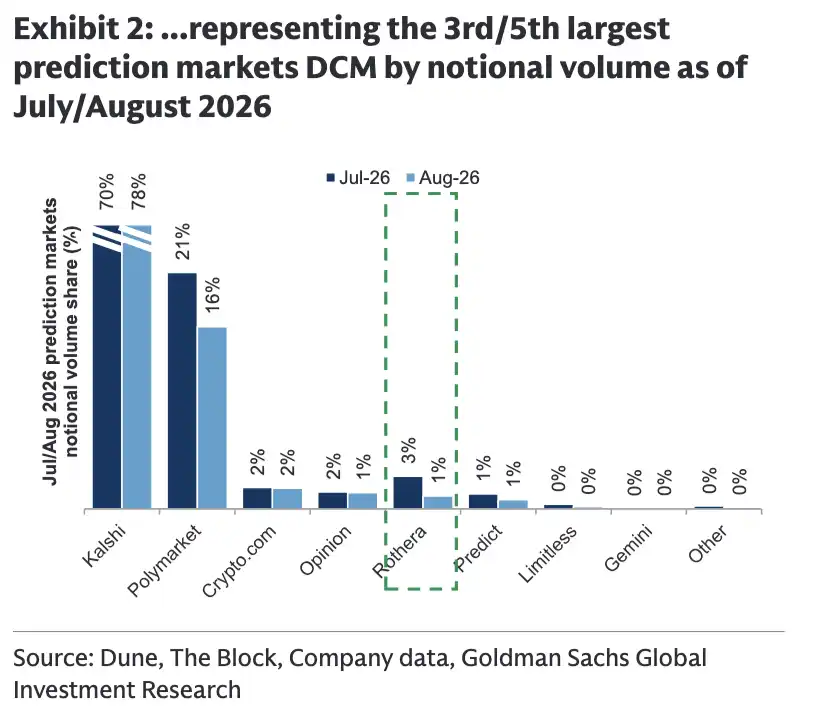
By notional trading volume, Rothera ranked as the world's third- and fifth-largest prediction market DCM in July and August 2026, respectively.
However, Rothera remains in its early expansion phase. Its share of notional trading volume slipped from roughly 3% in July to about 1% in August, and both volume and rankings remain susceptible to sports event schedules, trending events, and market cycles. Breaking into the global top five in the short term demonstrates Robinhood's ability to drive user traffic, but it is not yet enough to confirm that Rothera has established a stable market position.
Rothera initially offered almost exclusively sports event contracts, only adding political and economic products in August 2026, with each category accounting for about 1% of trading volume that month. This means Rothera's current activity remains highly dependent on the sports market, and product diversification is just getting underway.
For Robinhood, Rothera's significance also lies in a shift in its business model. Previously, Robinhood offered prediction market trading to clients primarily as a futures commission merchant (FCM), routing orders to designated contract markets such as Kalshi and ForecastEx. Robinhood collected brokerage-side fees, while external exchanges earned matching and clearing fees.
With Rothera's launch, Robinhood can now participate in both the brokerage and exchange segments, retaining within its own ecosystem a portion of the revenue that previously flowed to external platforms. Prediction markets are thus no longer just a trading product for retail clients—they are also becoming an entry point for Robinhood to extend into trading infrastructure.
How Can Low Fees Unlock Liquidity?
Whether prediction markets can reach scale hinges on liquidity. Compared with stock markets, prediction markets feature a vast array of contracts across different topics, outcomes, and timeframes, making trading volume more prone to fragmentation. If buyers and sellers are insufficient, spreads widen and user experience deteriorates, further dampening market activity.
Goldman Sachs believes Rothera possesses two liquidity sources that are difficult to replicate.
The first source is Robinhood's retail customer base. As of the report's release, Robinhood had approximately 14 million monthly active users. As more prediction market orders are routed to Rothera, these customers can consistently supply retail flow to the exchange.
The second source is SIG's market-making capability. SIG is not only a major global market maker but also holds a 45% equity stake in Rothera, giving it an incentive to continuously provide quotes and liquidity on the platform. Robinhood supplies retail orders while SIG handles liquidity absorption and matching—a combination that forms the foundation of Rothera's early expansion.
Low fees are another advantage Rothera leverages to attract more order flow.
Goldman Sachs estimates that most of Rothera's event contracts trade at prices concentrated between $0.25-$0.30, or symmetrically in the $0.70-$0.75 range. Based on its dynamic fee model, the average taker fee at the exchange level for retail clients is approximately 0.38%-0.42% per $1 notional contract, significantly lower than the roughly 1.17%-1.31% charged by other major prediction market exchanges.
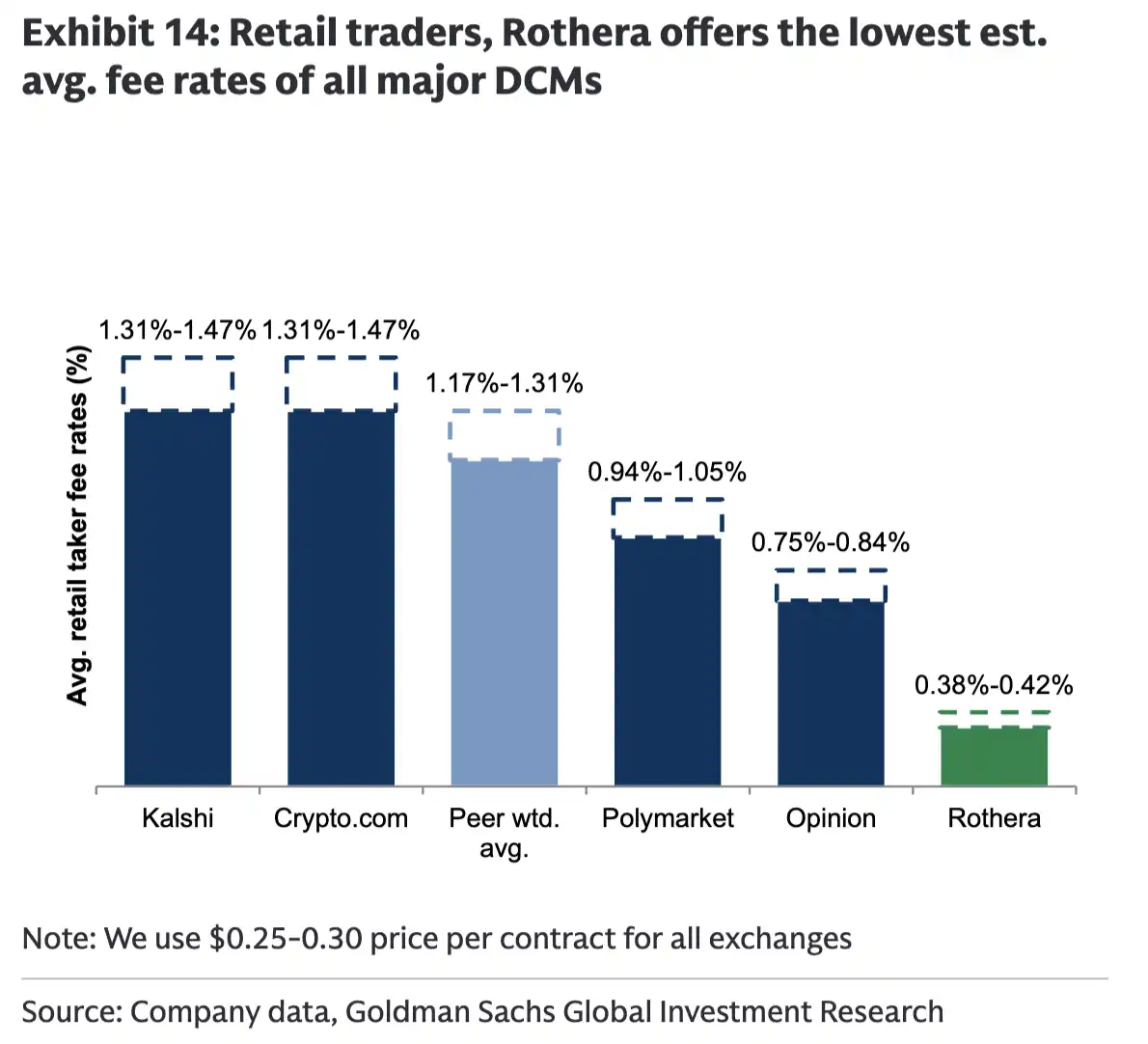
Goldman Sachs estimates that among major prediction market DCMs, Rothera offers the lowest average fees for retail traders.
Rothera does not employ a uniform fee structure but rather a dynamic model tied to contract prices and trader type. The closer a contract price is to $0 or $1, the lower the trading fee; the closer it is to $0.50, the relatively higher the fee. Professional trading firms and market makers also pay higher fees than ordinary retail customers.
The purpose of this pricing approach is to lower retail participation costs while charging professional institutions more, thereby supporting platform liquidity.
Robinhood also adjusted its prediction market fee model after Rothera's launch. Previously, customers paid a fixed total fee of approximately 2%; after adopting variable pricing and routing a portion of orders to Rothera, Goldman Sachs estimates the average total fee paid by customers has fallen to 1.31%-1.42%, representing savings of roughly 29%-34%.
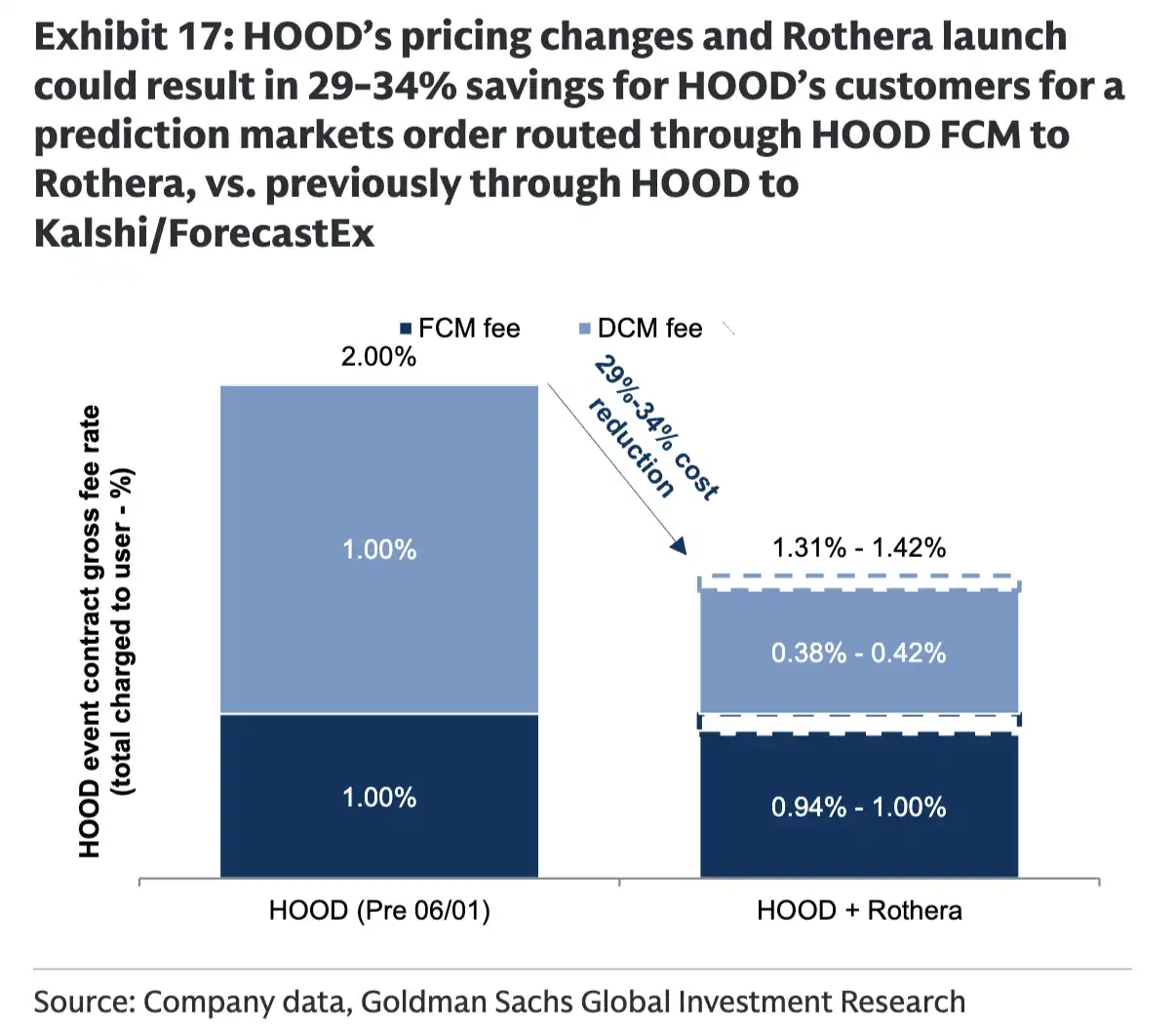
With floating pricing and order routing to Rothera, Robinhood customers' total fee rate is expected to drop from 2% to 1.31%-1.42%.
For Robinhood, lower customer fees don't necessarily mean a corresponding decline in platform revenue. Since the company earns both brokerage-side fees and Rothera's exchange fees, Goldman Sachs estimates that, before deducting non-controlling interests, Robinhood's nominal total take rate could rise from roughly 1.25% previously to 1.31%-1.42%.
However, only 45% of Rothera's net profit is attributable to Robinhood. After accounting for non-controlling interests distributed to other shareholders, Goldman Sachs estimates Robinhood's effective prediction market take rate at approximately 1.11%-1.19%, slightly below the prior level of around 1.25%.
Therefore, the value of this model lies primarily in long-term scale, not in an immediate boost to effective fee rates. Robinhood is essentially trading away some near-term revenue for lower customer costs, higher trading volume, and stronger control over trading infrastructure.
Rothera currently has only one FCM connected: Robinhood. If lower fees can attract other brokerages to join, the exchange could capture order flow beyond the Robinhood ecosystem and create a virtuous cycle of "lower fees – more volume – deeper liquidity." But until external brokerages onboard at scale, Rothera remains highly dependent on internal order flow from Robinhood.
How much revenue can prediction markets contribute to Robinhood?
Goldman Sachs projects Rothera's revenue will grow from $87 million in 2026 to $307 million in 2027, and further to $444 million in 2028, representing 2%, 5%, and 6% of Robinhood's total revenue in those respective years.
Over the same period, Rothera's net profit attributable to Robinhood is expected to reach $14 million, $58 million, and $94 million, respectively. As early-stage investments taper off and revenue scales up, the fixed-cost leverage of the exchange business is poised to unlock. Goldman Sachs believes its profit margin could converge toward the 55%-70% range typical of mature derivatives exchanges over the long term.
Rothera is just one part of Robinhood's prediction market business. Beyond exchange revenue, the company also earns prediction market revenue from the brokerage side. Goldman Sachs estimates Robinhood's total prediction market net revenue will reach $657 million in 2026, grow to $943 million in 2027, and hit $1.15 billion in 2028, accounting for 12%, 14%, and 15% of the company's total revenue, respectively.
Among them, Rothera's share of Robinhood's prediction market revenue is expected to rise from approximately 13% in 2026 to 33% in 2027, further reaching 39% in 2028. This means Rothera will gradually evolve from a supplementary revenue stream in the prediction market business into a key component of it.
The prediction market is also the primary reason Goldman Sachs' revenue expectations for Robinhood exceed the market consensus. Goldman Sachs' forecasts for prediction market revenue from 2026 to 2028 are 4%, 10%, and 14% above the market consensus, respectively, while total revenue forecasts for the same period are 2%, 3%, and 3% higher, respectively.
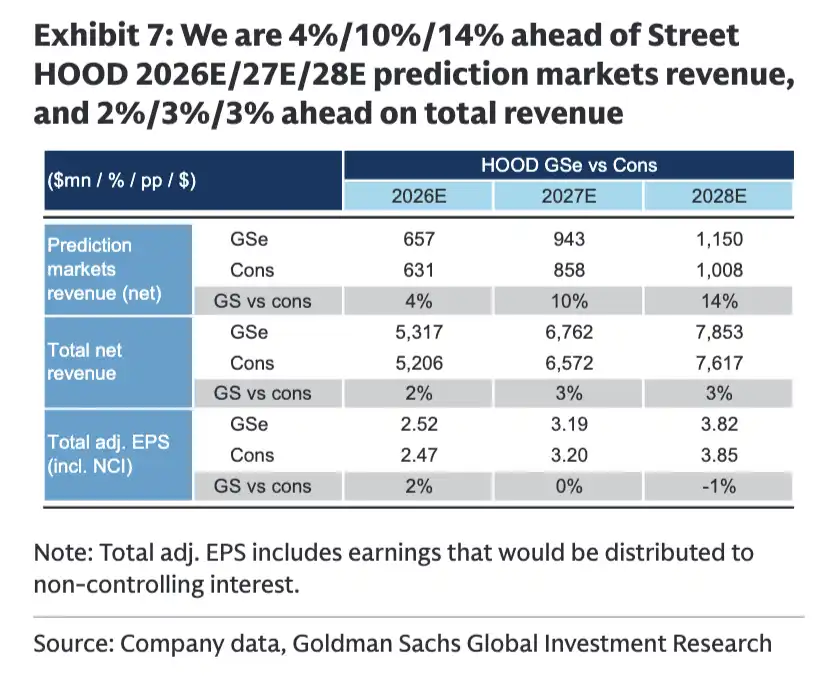
Goldman Sachs expects Robinhood's prediction market net revenue in 2027 and 2028 to be 10% and 14% above the market consensus, respectively, but the revenue advantage does not fully translate into an EPS advantage.
However, the upward revision in prediction market revenue has not fully flowed through to earnings per share. Goldman Sachs' forecast for Robinhood's adjusted EPS in 2027 is broadly in line with the market consensus, and in 2028 it is even approximately 1% below consensus. This indicates that beyond revenue growth, non-controlling interest allocations, product investments, and cost structure will still impact ultimate shareholder returns.
Rothera may also enter other exchange-traded products in the future. Goldman Sachs specifically highlighted perpetual futures, noting that its exchange licenses could provide room for product diversification. However, this is currently closer to a potential option and is not yet suitable for inclusion as certain revenue. Whether related products can be launched still depends on regulatory approvals, market demand, and specific execution progress.
Highest valuation at $19.5 billion—what does the bull case require?
Goldman Sachs conducted a sensitivity analysis of Rothera's 2027 revenue, profit, and potential value under three scenarios: base, bull, and bear.
In the base scenario, Goldman Sachs expects Rothera's 2027 revenue to reach $307 million, with net profit of approximately $129 million, of which net profit attributable to Robinhood is approximately $58 million. This corresponds to an overall equity value for Rothera of approximately $5.1 billion to $5.4 billion, with value attributable to Robinhood of approximately $2.3 billion to $2.5 billion, equivalent to $2.50 to $2.69 per share.
In the bull scenario, Rothera's 2027 revenue could reach $359 million to $906 million, with net profit attributable to Robinhood of approximately $71 million to $195 million, corresponding to an overall equity value of $6.7 billion to $19.5 billion, with value attributable to Robinhood of approximately $3.0 billion to $8.8 billion, equivalent to $3.30 to $9.64 per share.
Under a bear-case scenario, Rothera's 2027 revenue could be as low as $91 million to $242 million, with net profit attributable to Robinhood of approximately $15 million to $44 million, corresponding to an overall equity value of $1 billion to $3.6 billion. The value attributable to Robinhood would be roughly $500 million to $1.6 billion, equivalent to $0.52 to $1.76 per share.
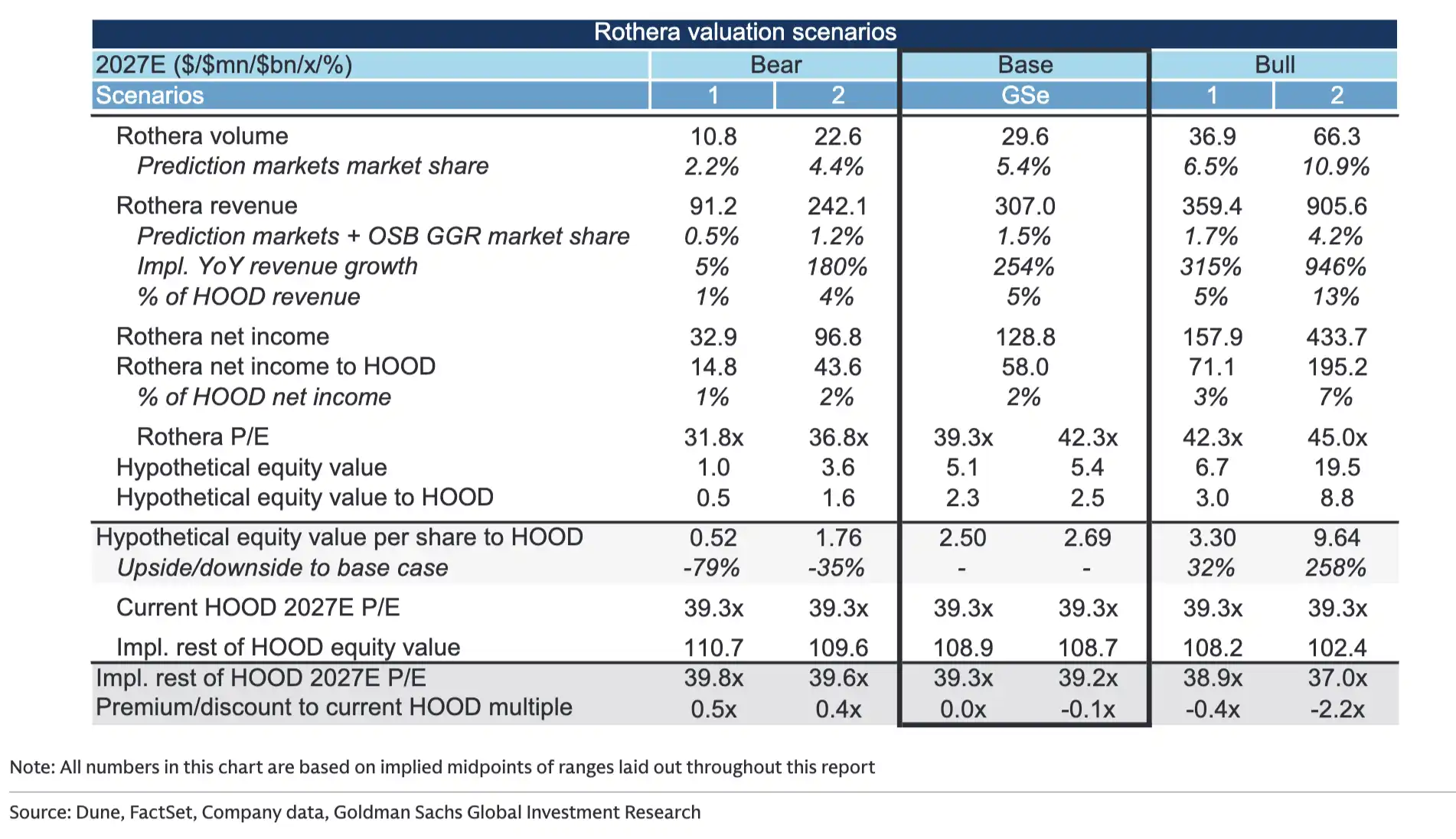
Across different growth scenarios, Goldman Sachs estimates Rothera's overall equity value at approximately $1 billion to $19.5 billion; the value attributable to Robinhood is roughly $500 million to $8.8 billion.
Goldman Sachs combined the gross gaming revenue of prediction markets and online sports betting into a single addressable market, citing the high overlap between the two product categories. Its estimates show that the combined annualized revenue pool for both was approximately $18 billion in 2026, potentially growing to $20 billion to $21 billion by 2027.
Within this market scope, Rothera's base-case scenario corresponds to roughly a 1.5% revenue share; the bull case is approximately 1.7%-4.2%; and the bear case is 0.5%-1.2%.
The top-end valuation of $19.5 billion implies fairly aggressive growth assumptions: Rothera's 2027 revenue would need to reach $906 million, representing year-over-year growth of 946%; Robinhood would need to continue routing substantial order flow to the platform; SIG would need to sustain market-making support; more external FCMs would need to join; and the product scope would need to expand beyond sports contracts to politics, economics, and other derivatives.
This also explains why Goldman Sachs' valuation range is so wide. Rothera's value depends not only on overall prediction market growth, but also on whether it can transition from being an internal Robinhood trading venue into independent infrastructure capable of attracting other brokers and traders.
Rothera also helps explain, to some extent, Robinhood's current elevated valuation. Robinhood currently trades at approximately 39.3 times Goldman Sachs' FY+2 forecast earnings, placing it at the 87th percentile of the company's valuation range over the past five years, indicating that the market has already priced in higher growth expectations.
After stripping out the value attributable to Robinhood from Rothera, the remaining business trades at approximately 39.2-39.3 times FY+2 earnings in the base case; 37.0-38.9 times in the bull case; and roughly 39.6-39.8 times in the bear case.
This does not mean the rest of Robinhood's business is already cheap. Even under the base-case scenario, the valuation of the remaining business sits at the 87th percentile historically and remains notably above the average for brokers and crypto-related companies. Goldman Sachs is willing to accept this premium, primarily based on Robinhood's projected 22% revenue growth between 2026 and 2028, as well as the company's faster pace of product launches.
Rothera provides a new support for Robinhood's valuation, but its investment thesis still rests on sustained delivery of high growth. Whether trading volumes hold up, whether external brokers are willing to join, whether non-sports contracts can reach scale, and whether regulators allow continued product expansion will all determine where Rothera ultimately lands within the $1 billion to $19.5 billion valuation range.
What can be confirmed at this point is that prediction markets have evolved from a new Robinhood product into a key variable influencing its revenue expectations and valuation framework. Whether Rothera can convert short-term trading momentum into a stable liquidity network will be critical to whether Robinhood's next-phase growth narrative holds up.
Welcome to join the official BlockBeats community:
Telegram Subscription Group: https://t.me/theblockbeats
Telegram Discussion Group: https://t.me/BlockBeats_App
Official Twitter Account: https://twitter.com/BlockBeatsAsia