a16z releases 2023 "State of Cryptocurrency" report: The United States is losing its lead in Web3
Original title: "a16z: 7 revelations from [the state of cryptocurrency in 2023]"
Original author: Daren Matsuoka, Eddy Lazzarin, Robert Hackett, and Stephanie Zinn
Original translation: MarsBit
Emerging technologies develop in cycles; in cryptocurrencies, this includes periods of high activity followed by the so-called crypto winter. In the period marked by our current annual "State of Cryptocurrency" report, it would be easy for a casual observer to overlook the rapid progress being made in the cryptocurrency industry. Major infrastructure improvements like Ethereum mergers - major achievements in decentralization and open source development - simply do not make headlines as often as high-profile bankruptcies, explosions, and closures.
Our 2023 report aims to address the imbalance between the noise of fleeting price changes and data that tracks important signals, including lasting progress in Web3 technology. Overall, the report reflects a healthier industry than market prices might indicate, with a steady cycle of development, product launches, and continued innovation.
This year, we also launched something new: the State of Crypto Index, an interactive tool that tracks the health of the cryptocurrency industry from a technical rather than a financial perspective. To provide a more accurate and nuanced measure of the state of crypto, the index represents the weighted average monthly growth of 14 industry metrics — from the number of verified smart contracts to the number of trading wallets, and more.
In other words, the index shows the rate of innovation and Web3 adoption in one chart. The tool is also interactive, so you can tweak the parameters to form your own opinion.
Some key takeaways:
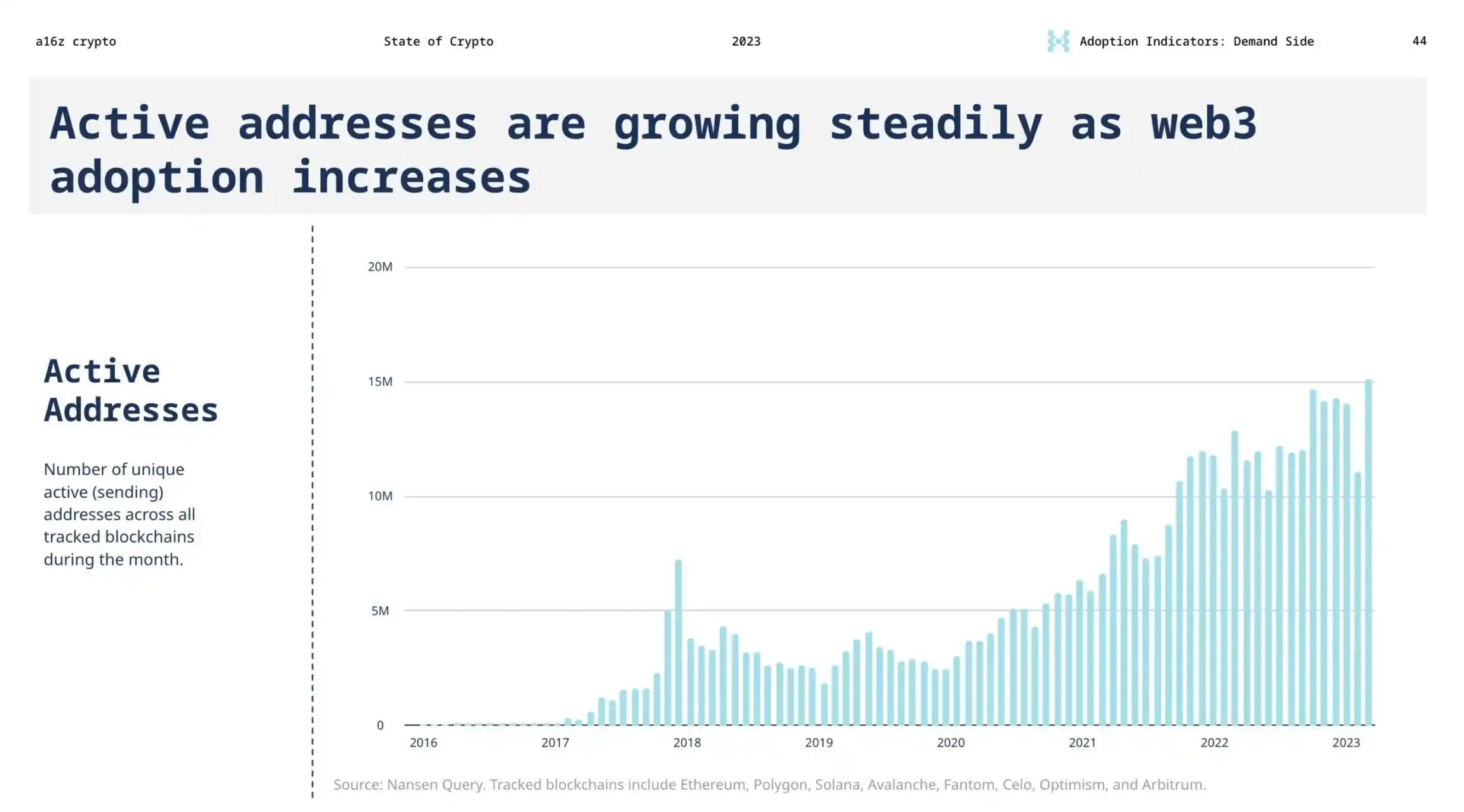
Blockchain has more active users, and more ways to participate. Active addresses hit an all-time high last month — 15 million — doubling over the past two years as more applications and services, like on-chain games, offer new ways for people to participate.
DeFi and NFT activity appear to be on the rise again as promising new uses and applications emerge. After a period of wild speculation and a subsequent lull, more people appear to be buying NFTs in recent months. Meanwhile, on decentralized exchanges, trading volume exceeded $100 billion last month, the third consecutive month of positive growth in trading volume.
The number of active developers in the crypto industry remains steady. Builders attracted by 2020’s bull run are sticking around. Nearly 30,000 developers contributed to or built on crypto projects last month, a steady increase of more than 60% over the past three years.
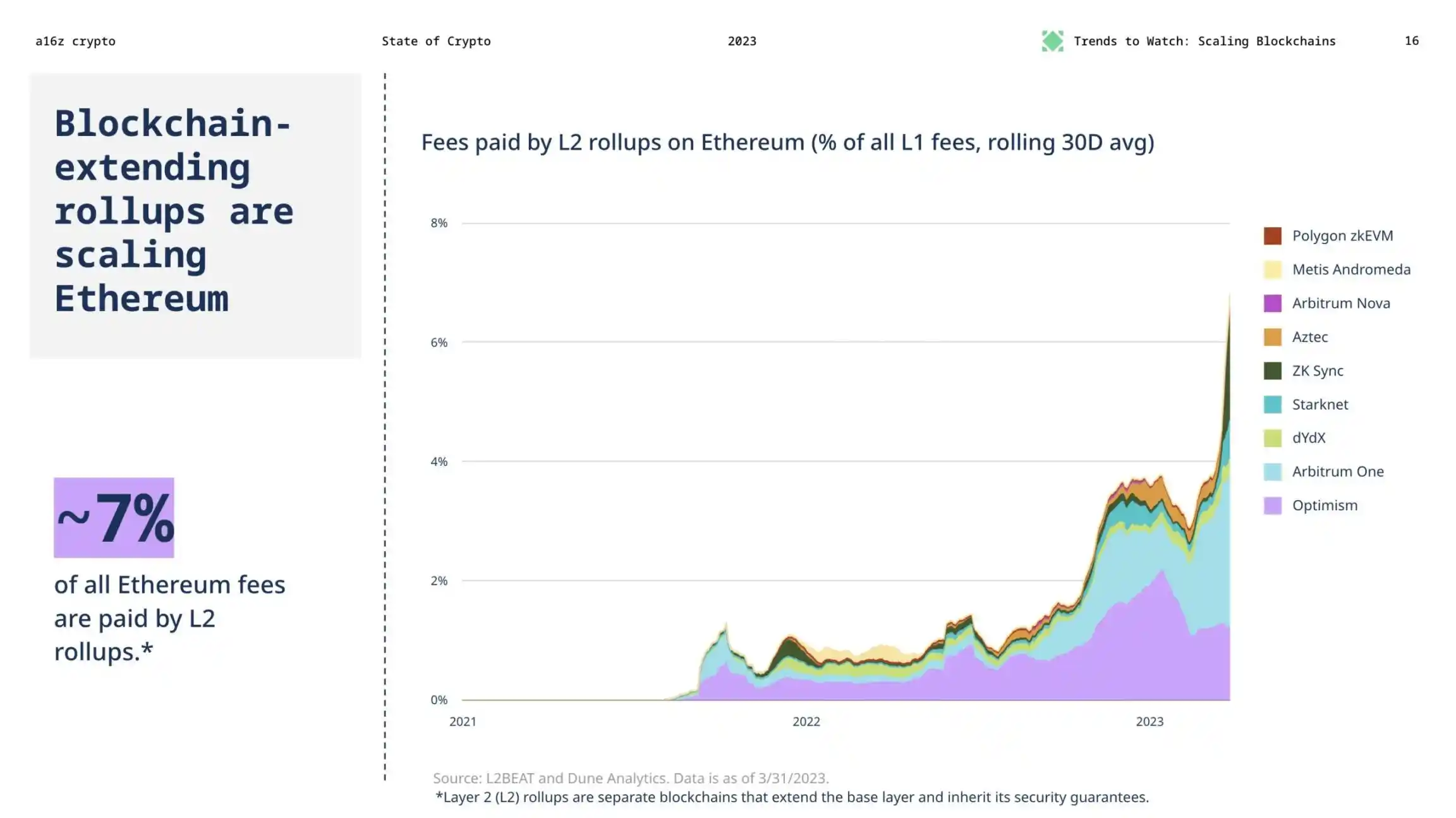
Blockchains are scaling via promising new paths. A plethora of protocols and projects are working to scale blockchains, leveraging a number of different approaches and technologies to facilitate more transactions. Last year, “Layer 2” (L2) scaling solutions accounted for 1.5% of total fees paid on Ethereum. Today: 7%.
New technologies that were once nearly impossible are becoming a reality. We’re seeing decades of work on “zero-knowledge” systems advance at an incredible pace, which will further unlock blockchain scalability and a new class of privacy-preserving applications (not to mention applications in AI). The data shows positive trends in ZK-related research, developer activity, and usage.
The US is losing its lead in Web3. The ratio of cryptocurrency developers based in the US to the rest of the world fell 26% between 2018 and 2022. Careful regulation has encouraged cryptocurrency builders to innovate and develop these technologies safely in the US.
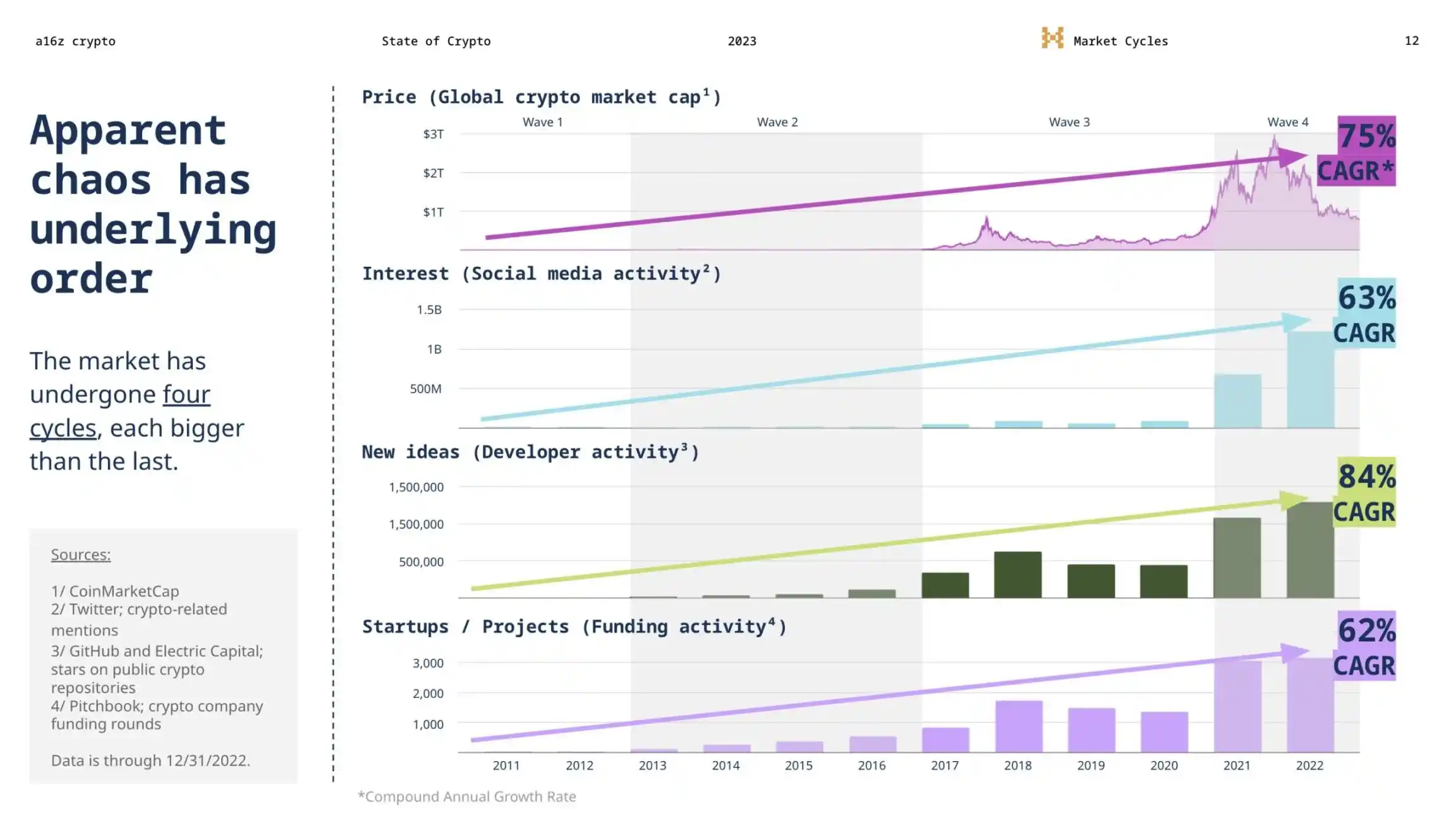
Zoom in to show progress across key metrics. Market capitalization, developer activity, and funding activity have all grown steadily over the past decade. Looking back from short-term volatility, a more predictable pattern emerges: a price-innovation cycle, where price fluctuations drive the development of new ideas.
7 Takeaways from The State of Crypto in 2023
1. Blockchain has more active users, and more ways to get involved
Prices have stabilized this year from 2021’s dizzying highs. The industry appears to be stabilizing: speculation has cooled, and the story of how people are using and interacting with Web 3 in a lasting, organic way is starting to unfold.
We’re seeing more monthly active addresses — unique addresses transacting on-chain each month — than ever before. Last month, we saw 15 million sending addresses, more than double what we saw two years ago when prices were still high. One possible explanation: the growing number of ways to engage with blockchain and Web3 applications. From DeFi to Web3 games — over 700 of which launched in the last year — all kinds of new applications are creating addresses for their users to interact with, without the need to download or connect a wallet.
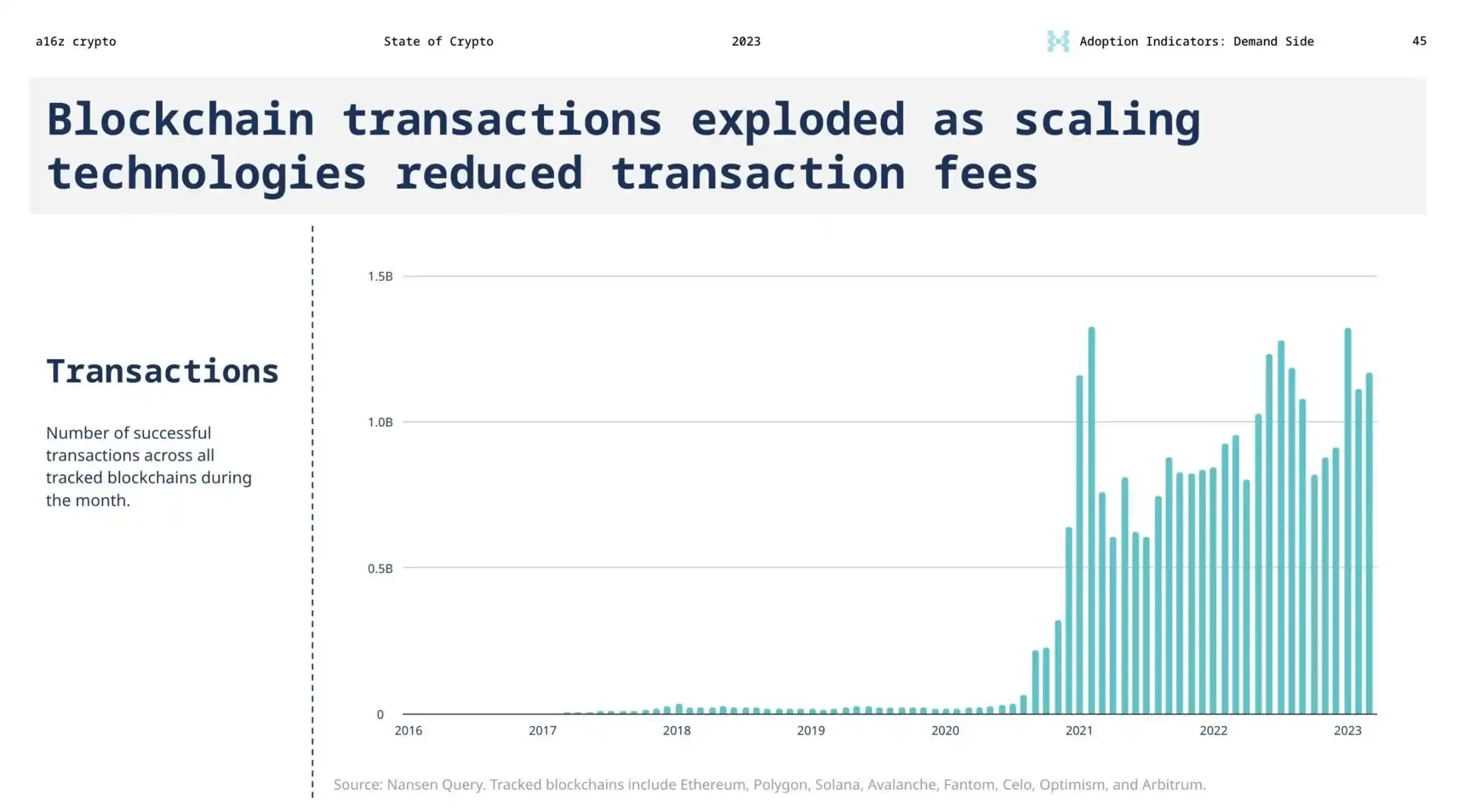
Better tools and scaling technologies are also attracting more transactions at lower gas fees. Notably, the total number of blockchain transactions has grown by more than 50% over the past two years.
2. DeFi and NFT activity appears to be rising again as promising new uses and applications emerge
Meanwhile, DeFi and NFT activity appears to be rising again after falling from their 2021 highs. As speculation cools, more organic uses appear to have emerged, including lending, remittances, art, collectibles, on-chain games, and more.
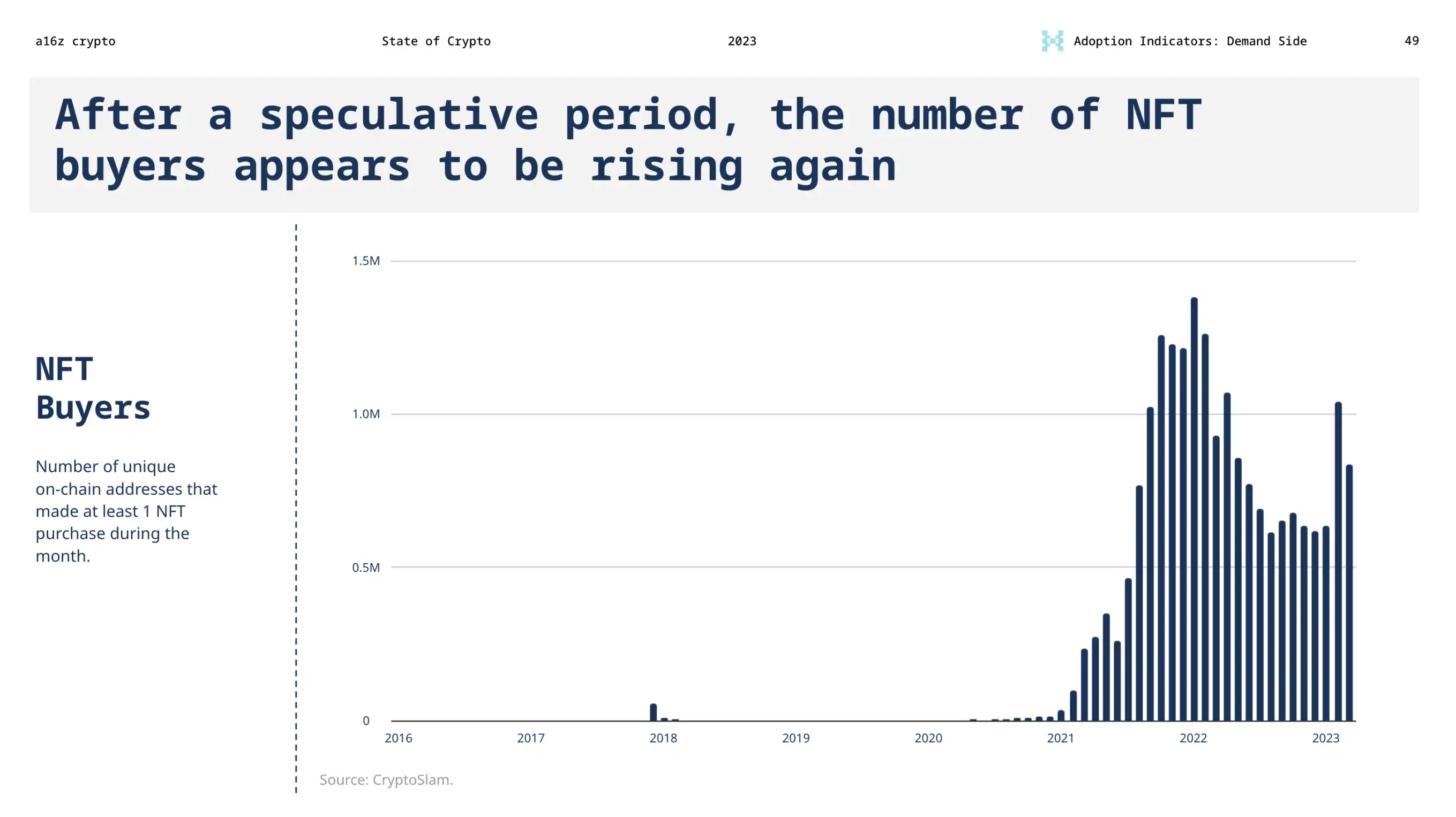
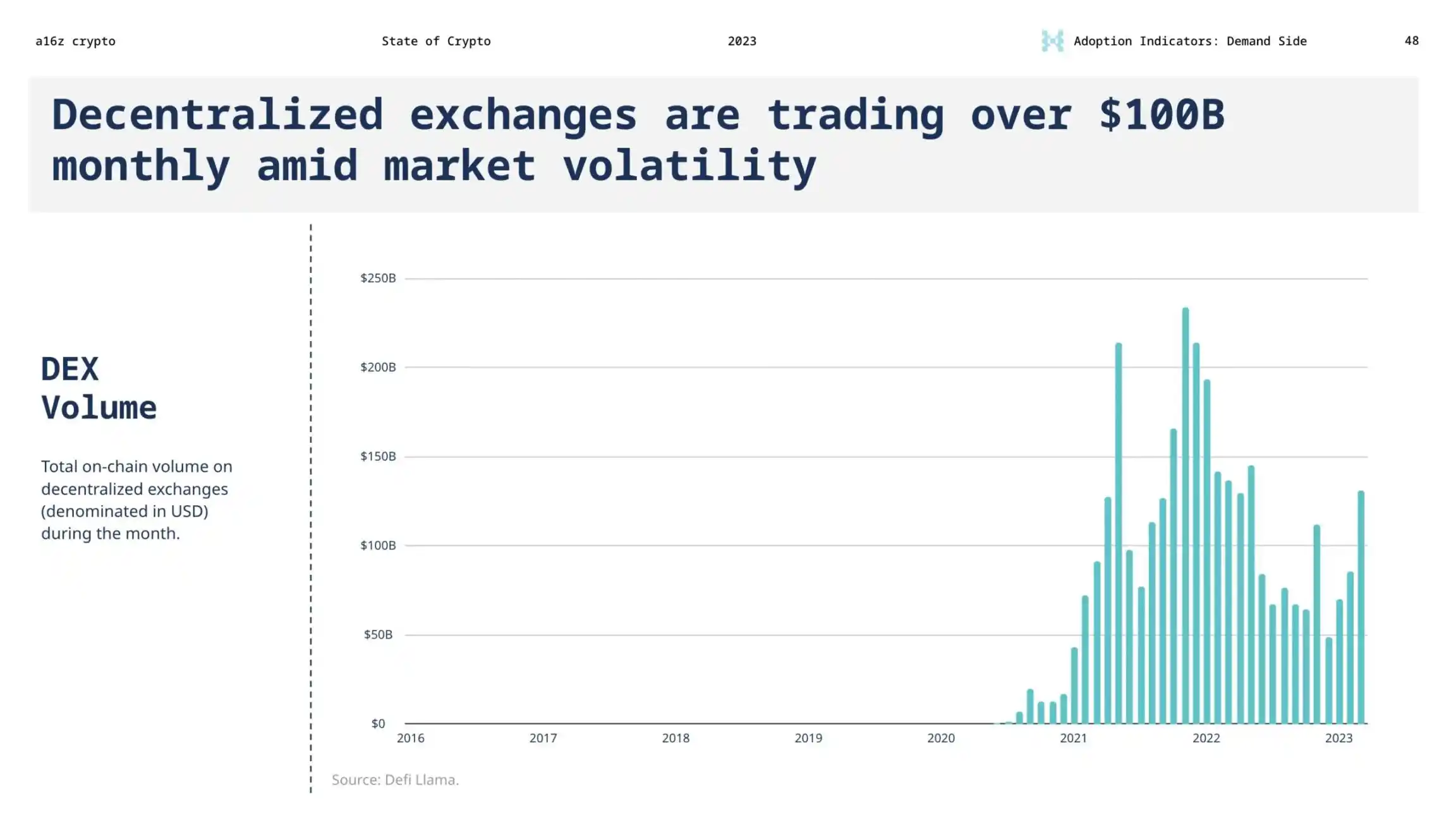
However, the promise of NFTs and decentralized finance — to change the economics of the internet — remains. For example, in recent months, we have seen an uptick in both NFT buyers and DEX trading volume. In fact, Uniswap — a decentralized exchange — has had higher trading volume than Coinbase — the largest centralized exchange in the United States — for the past two months in a row.
Users and creators benefit from Web3’s structurally lower “take rate” — the share of revenue that platform owners take from users. In crypto, users truly own their digital goods, and importantly, they can take those goods to any platform they like.
The easier it is for people to switch platforms, the more competition can heat up, and the less the platform can extract from users (or suddenly change its rules for users). Low platform pricing power tends to lead to lower take-up rates.
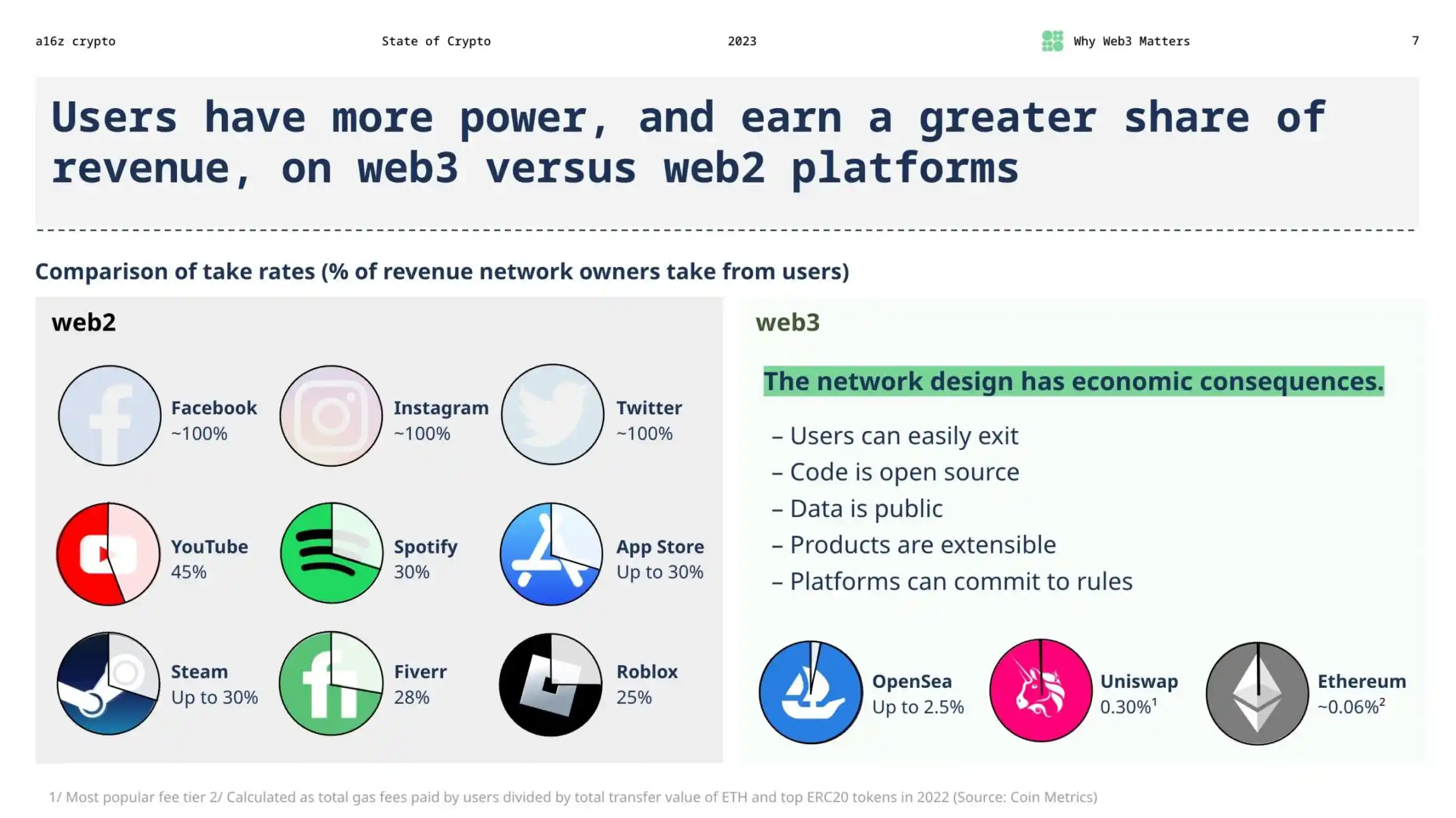
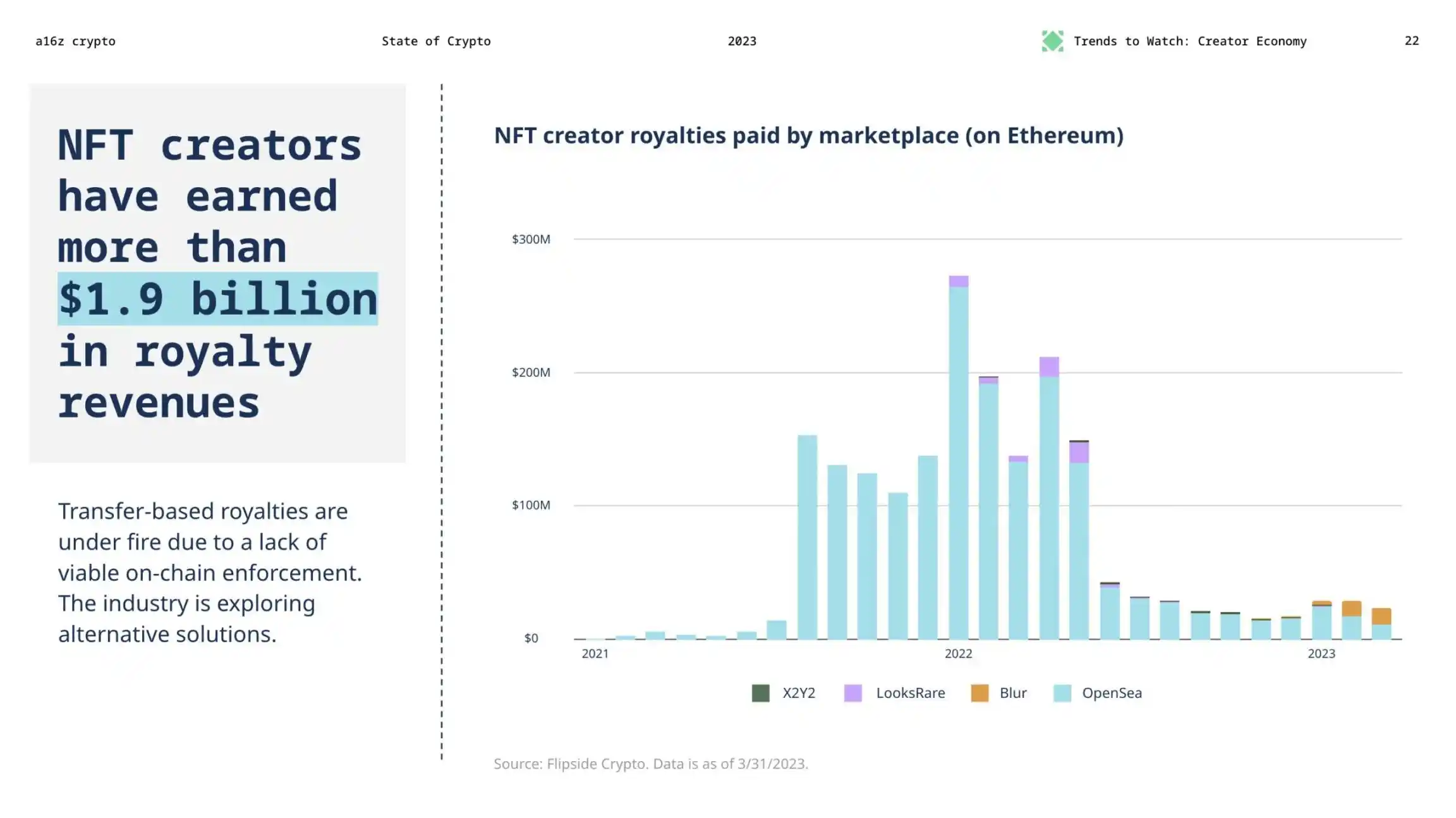
Over the past two years, NFT markets have paid out nearly $2 billion worth of royalties to creators in secondary sales. Compare this to Web2, where Meta, for example, is setting aside $1 billion for creators by 2022. This comparison is even more staggering considering that Meta’s platforms — Facebook, Instagram, WhatsApp, etc. — have around 3.74 billion monthly users, while Web3’s current user base is estimated to be in the tens of millions.
It’s worth noting that Web3’s yields have a tendency to decline over time. While Web3 creator royalties are constantly evolving as best practices and technology in the space evolve, we expect more innovation and experimentation here.
3. The number of active developers in the crypto industry remains stable
Prices can be misleading, especially without understanding the dynamics of Web3 technology and the growing ecosystem of builders.
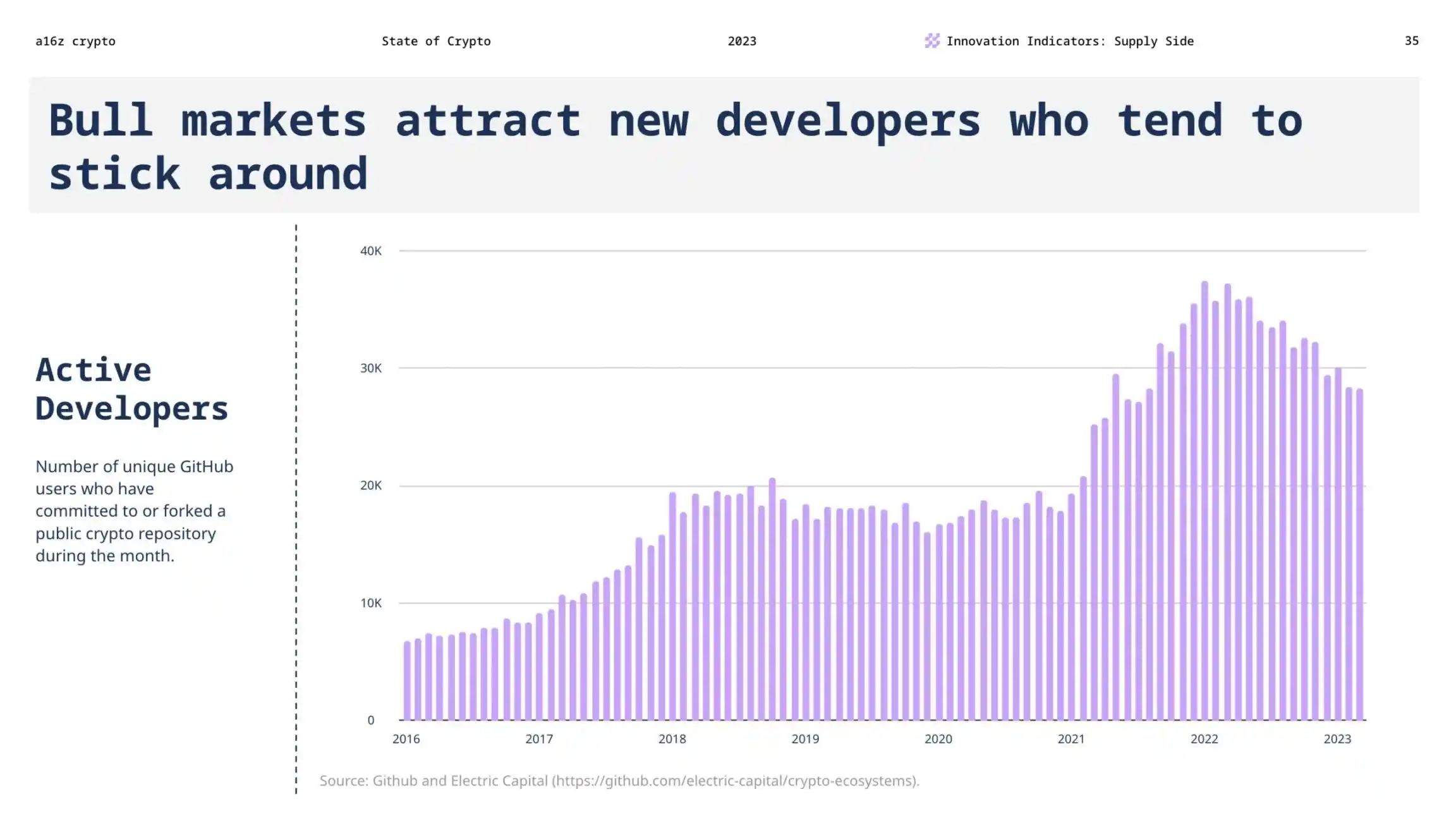
It is worth noting that crypto as a whole has and continues to have sustained growth. Today, the crypto industry has nearly 30,000 monthly active developers. And since the start of the 2020 bull run, this is a steady increase of 60%, suggesting that developers who may have been attracted by the initial price increase are sticking around.
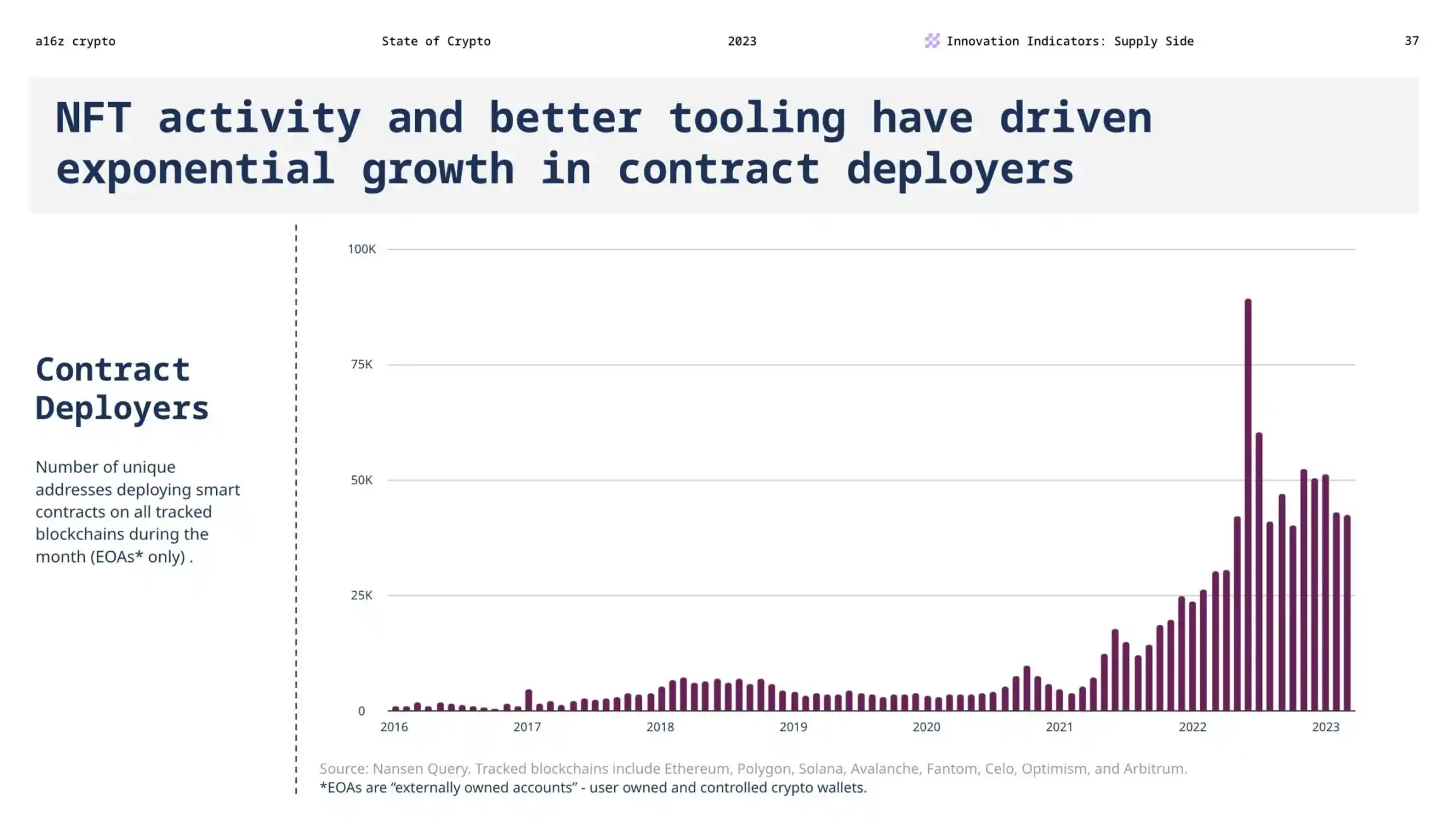
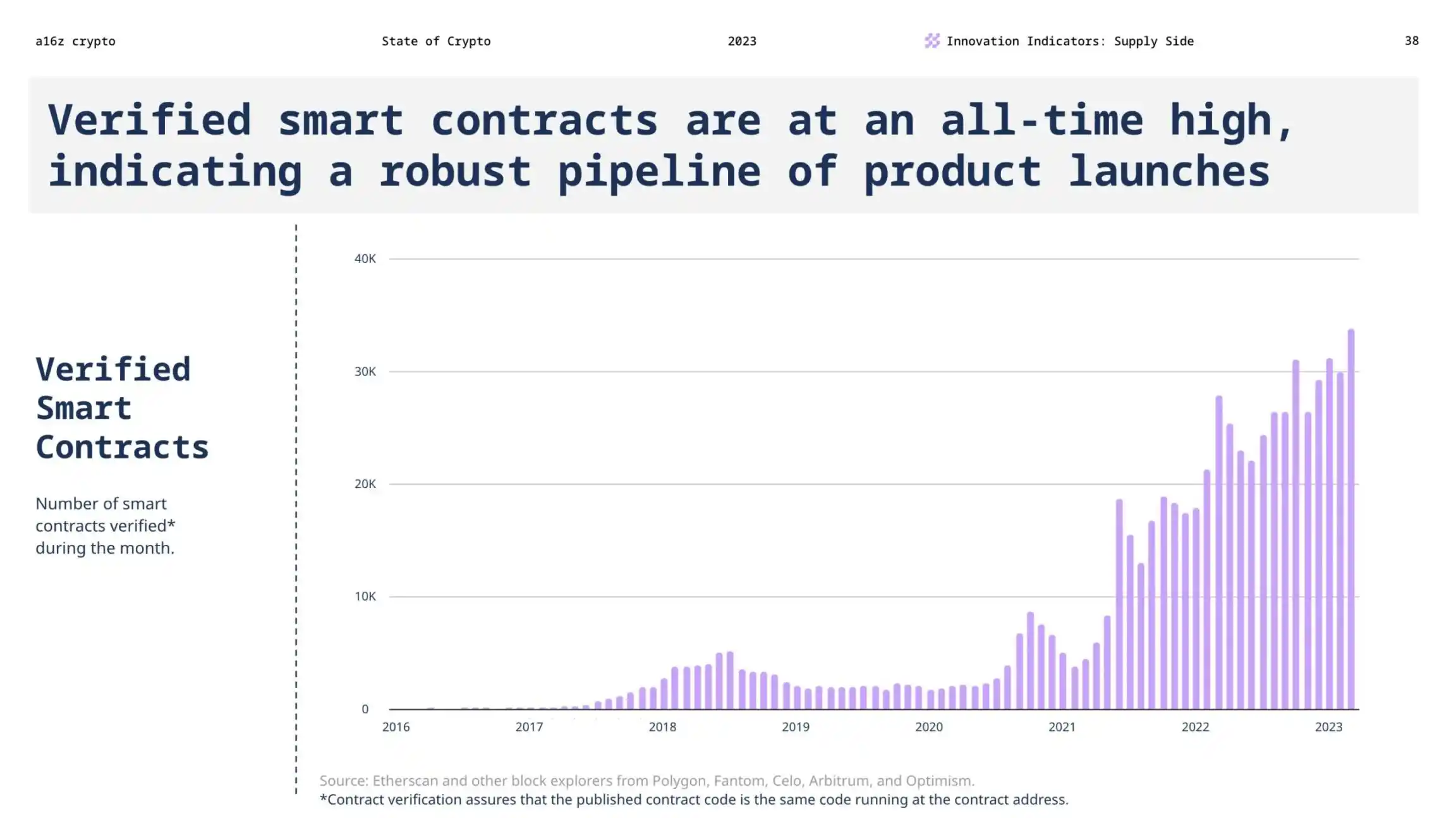
As for what they’re building: Nearly 50,000 unique addresses deployed smart contracts last month, up 40% this year alone. More of these contracts are being validated, and more of the core developer base is being used to interact with them, than we’ve ever tracked before.
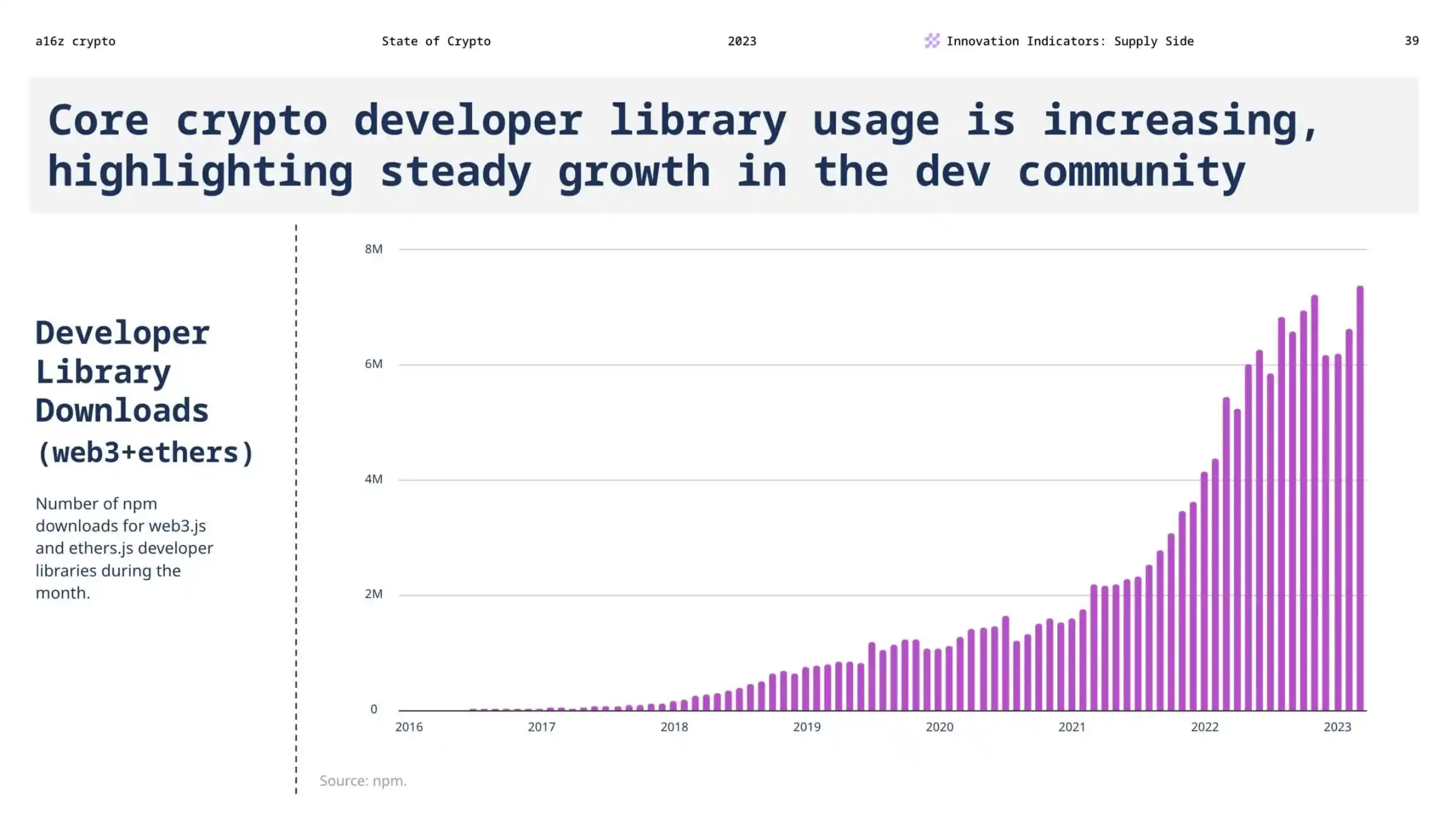
A key feature of cryptocurrency — an open-source, decentralized computing platform — is that a project can function as a multiplier when its composable components are reused, recycled, and adapted by others. Composability is to software (as a16z crypto founder and managing partner Chris Dixon puts it) what compound interest is to finance: an exponential force.
“There are all kinds of exponential forces in the world that are worth paying attention to because they can be indicators of rapid future growth. In hardware, the most powerful exponential force is Moore’s Law. In finance, it’s compound interest. In software, it’s composability.”
Think about Uniswap: it started as a protocol for exchanging tokens, and it has evolved into critical infrastructure that enables a new ecosystem of DeFi applications.
4. Blockchains are scaling through promising new paths
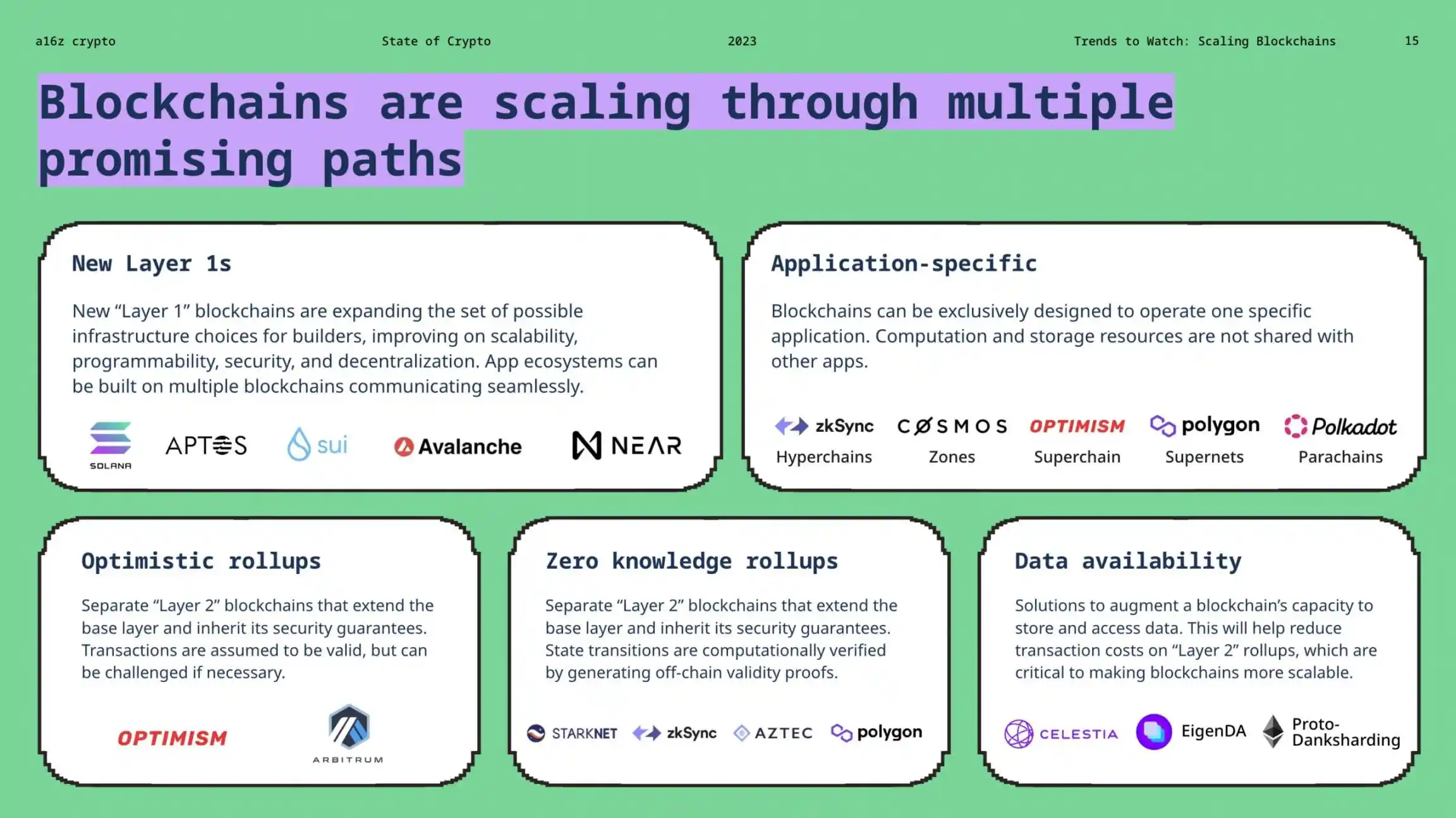
Blockchains are scaling to welcome more people, more transactions, and more complex applications. We are seeing many promising new paths right now; it’s a dynamic design space for Web3 developers trying to solve foundational challenges.
Let’s start with “Layer 2” blockchains: technologies that aim to scale the underlying Layer 1 blockchains (like Ethereum) by providing more block space, increasing transaction throughput, and reducing fees. Last year, L2 accounted for 1.5% of fees paid on Ethereum. Since then, this share has more than quadrupled to 7% of total fees paid on Ethereum — indicating that more applications are choosing to build on L2. We expect this trend to continue and benefit end users.
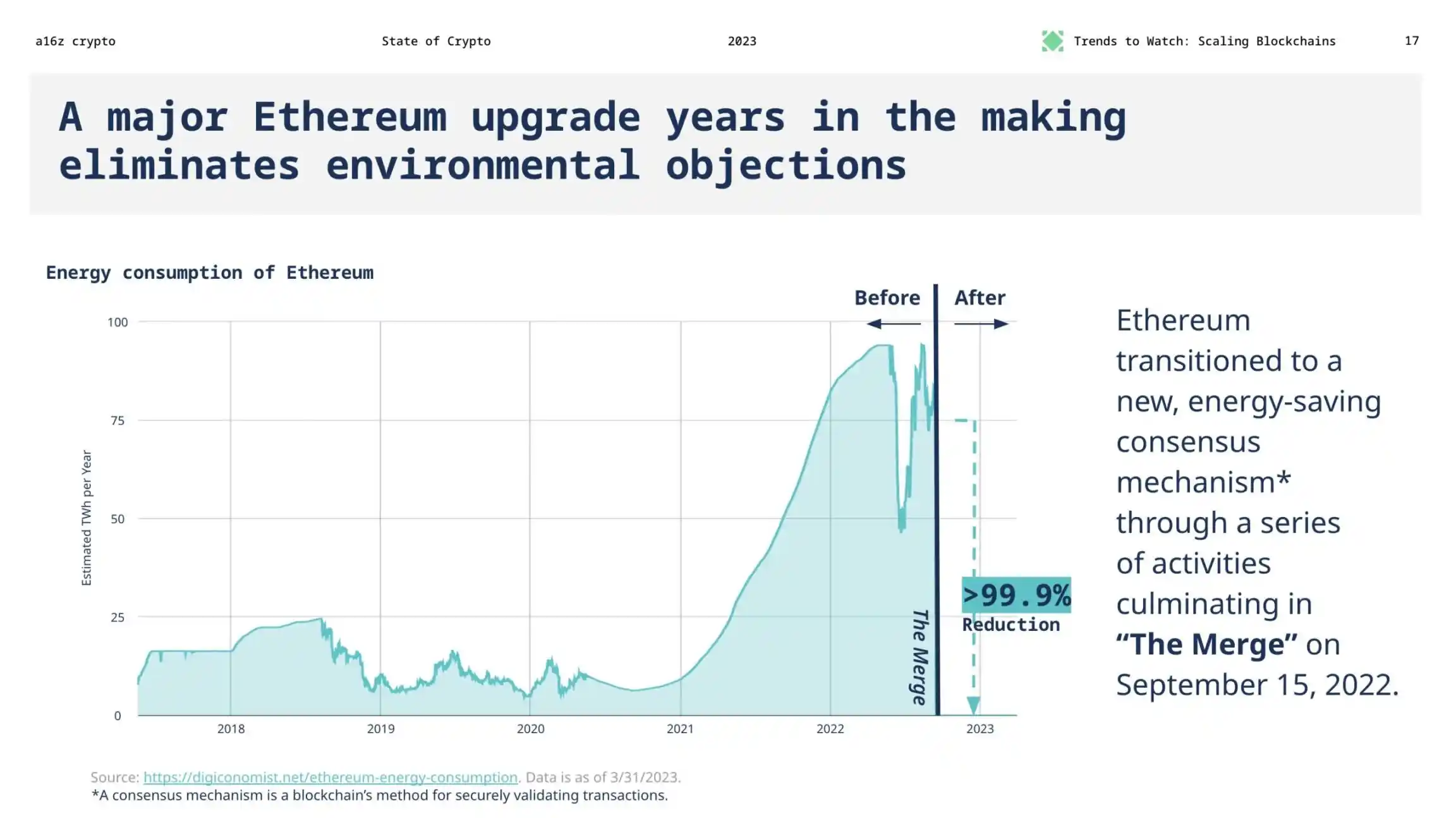
Finally, one of the most significant events in the history of open source development — given the scope of the challenge, the nature of distributed coordination, and more — occurred last fall. Ethereum underwent a major upgrade when the network transitioned from a “proof of work” to a “proof of stake” consensus mechanism. The “merge” marks an architectural shift that massively reduces Ethereum’s energy footprint:
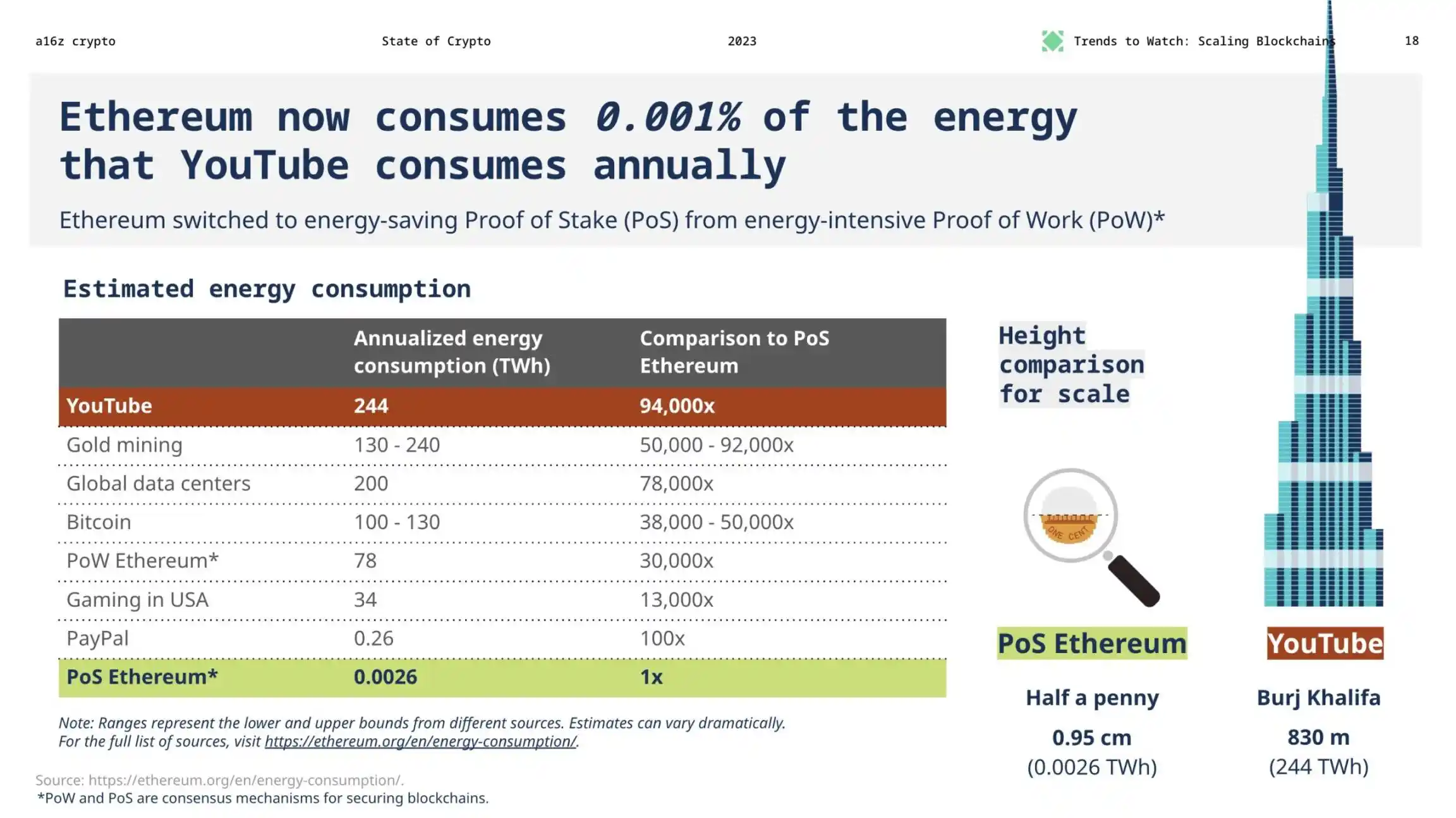
Compared to Web2 giants: YouTube consumes an estimated 244 terawatt hours per year, or 94,000 times the energy of Ethereum.
5. New technologies that were once nearly impossible are becoming a reality
Over the past year, we’ve seen rapid progress in the field of “zero-knowledge” systems — powerful foundational technologies that unlock blockchain scalability, while new use cases have proliferated, including privacy-preserving applications and verifiable computation that enable decentralized machine learning/AI. These systems, including zero-knowledge proofs, involve cryptographic methods of proving or verifying that a set of facts is true, without revealing any information about those facts.
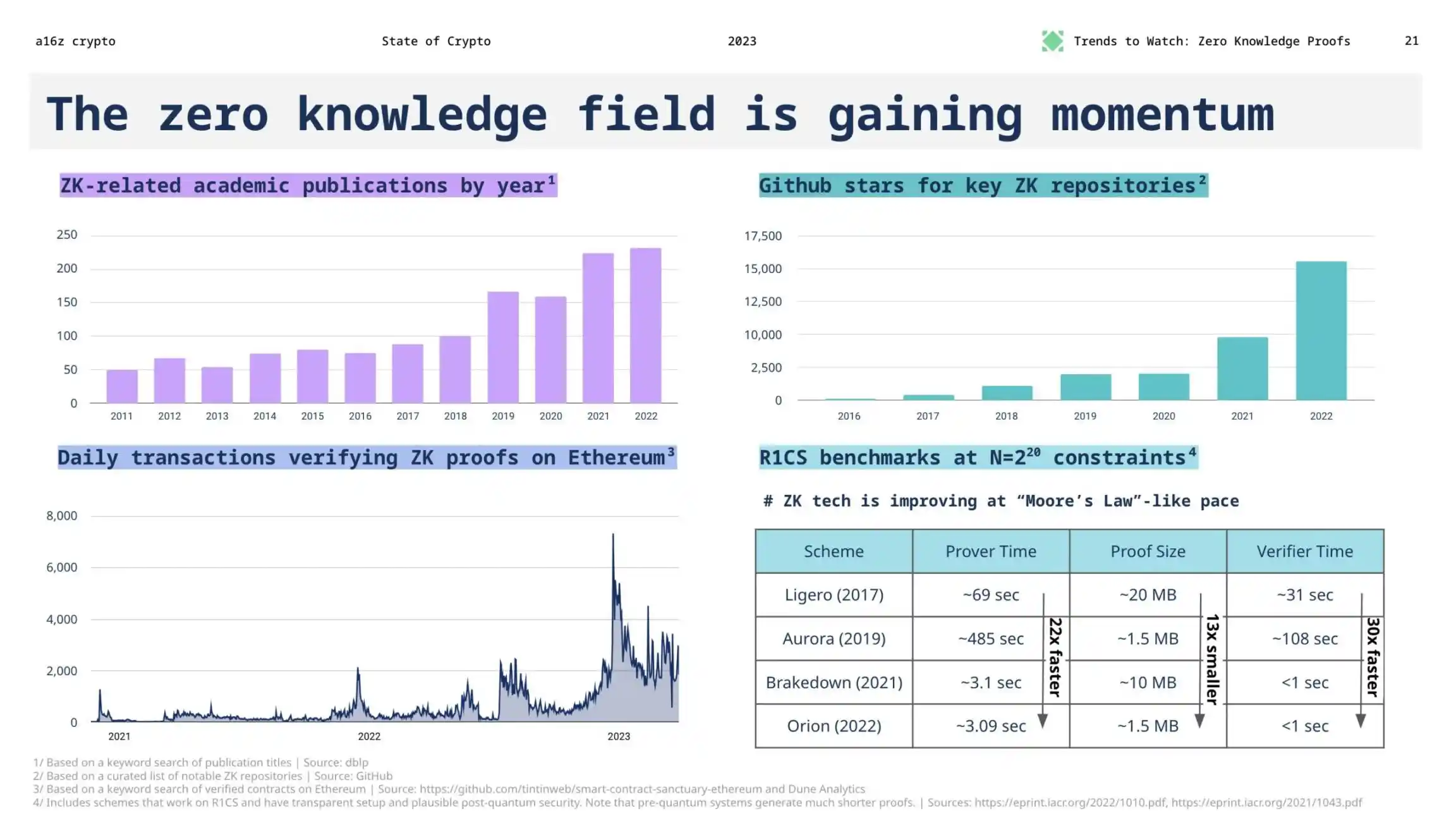
This work, decades in the making, has moved from theory to practice in the past few years. We seem to be seeing technology follow a “Moore’s Law” pace here. While there are many nuances to evaluating benchmarks, the accelerated progress, from provers and verifiers to circuits and hardware, is incredible.
6. The U.S. is losing its lead in Web 3
As an emerging set of technologies, cryptocurrencies require thoughtful policy and regulatory guardrails to grow safely and meet their economic potential for the U.S. economy.
There’s a lot of debate, but little regulatory clarity, which is holding back Web3’s growth. As a result, the U.S.’s lead may be slipping. Between 2018 and 2022, the ratio of cryptocurrency developers based in the U.S. to those in the rest of the world fell by 26%.
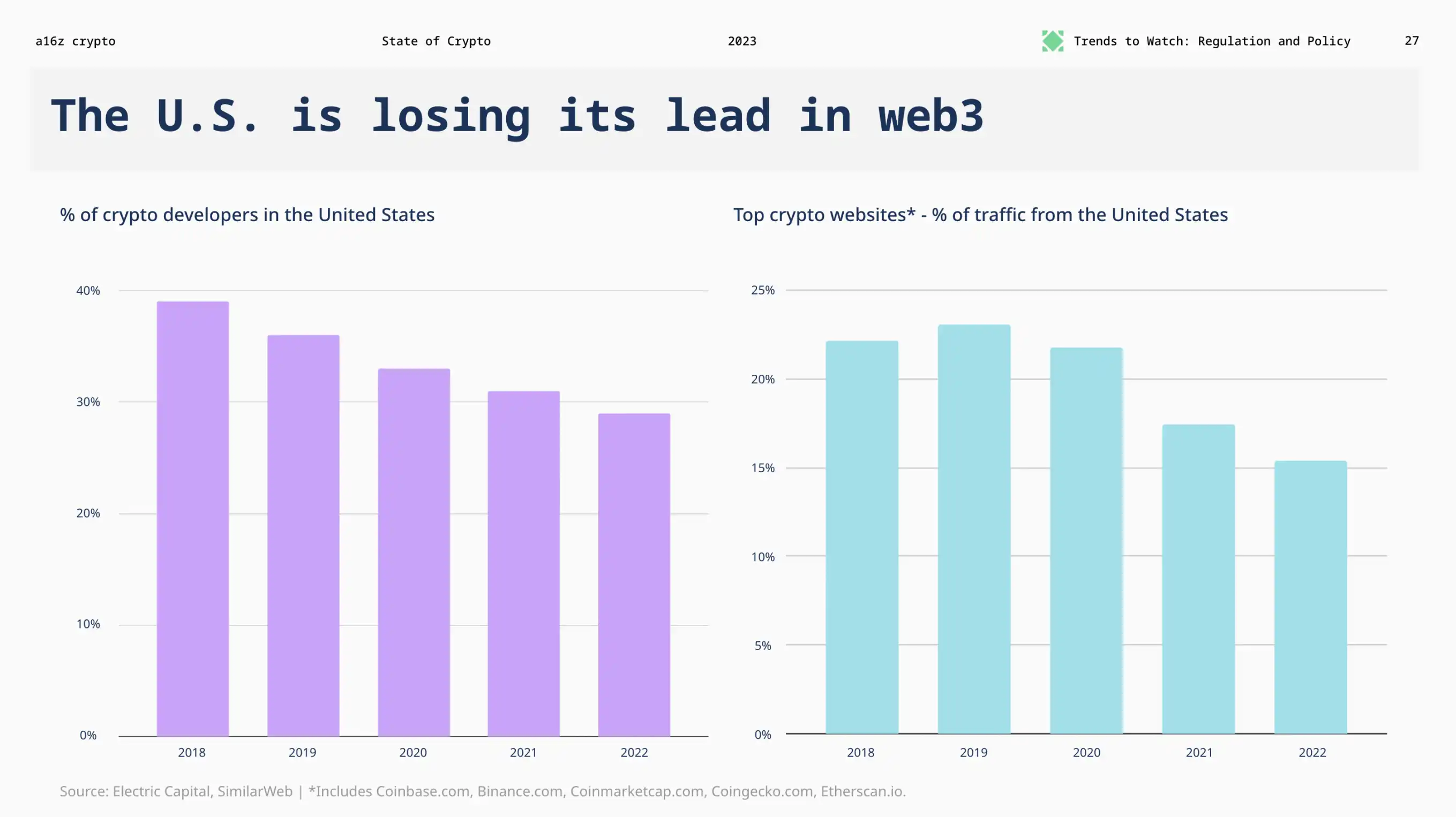
However, there are some positive signs — including a growing bipartisan push for legislation that could provide much-needed clarity. We hope that momentum will continue, and that policymakers will fight for the future and potential of these technologies.
7. Zooming in on progress across key metrics
We’re still in the early days of Web3, but we’re no longer at the beginning. Stepping back from the short-term volatility reveals a more predictable pattern: a steady product cycle that’s markedly different from the financial cycles that get so much attention in the media.
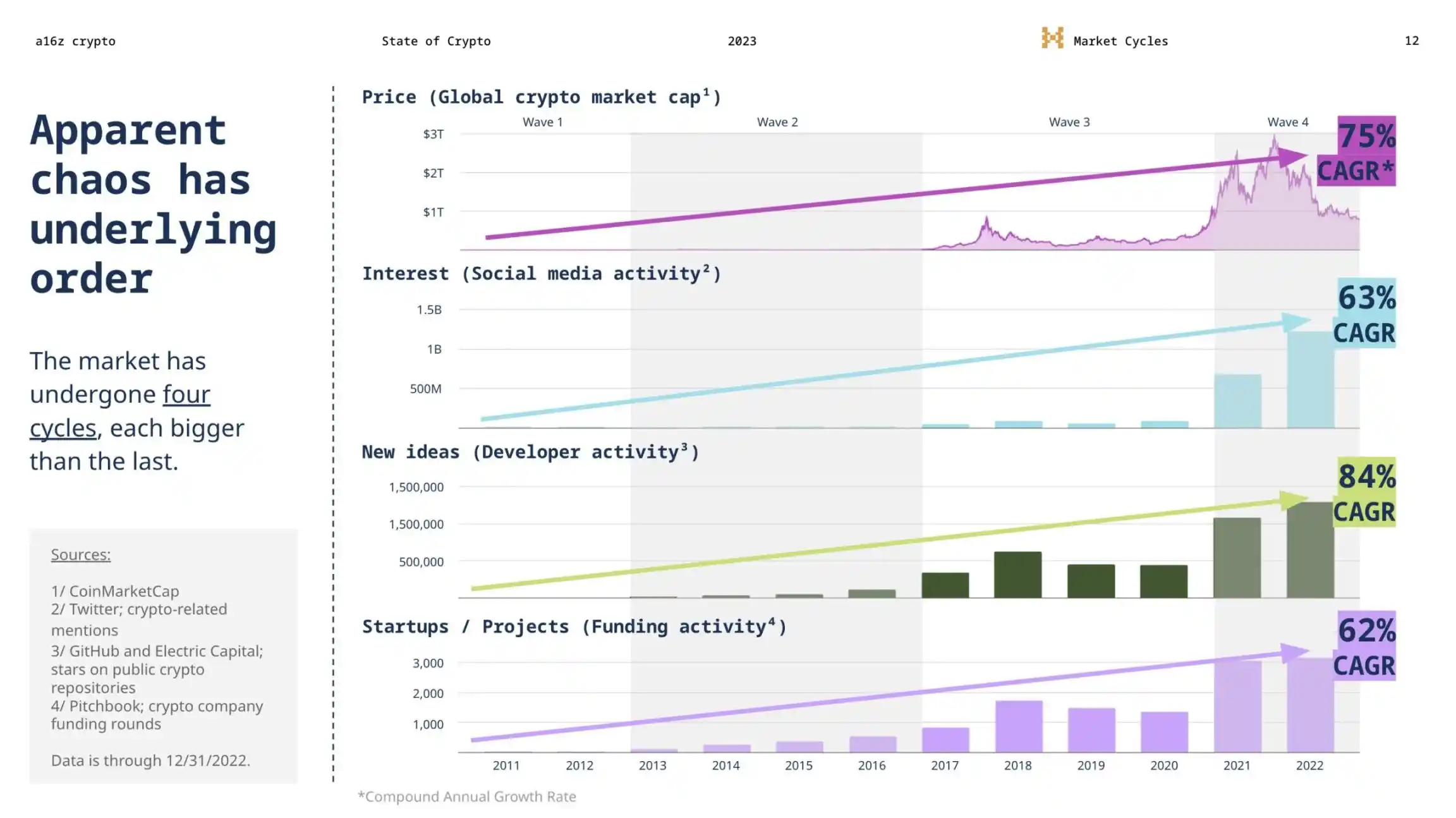
We have stressed the importance of the "price-innovation cycle" - the observation that price and development activity are intertwined in a positive feedback loop - many times; it is a useful mental model for navigating market cycles and understanding the metrics that drive them. When cryptocurrency prices rise, more people become interested and join in. This attention, in turn, inspires (and funds) new ideas, startups, and projects, some of which lead to greater adoption in the long run.
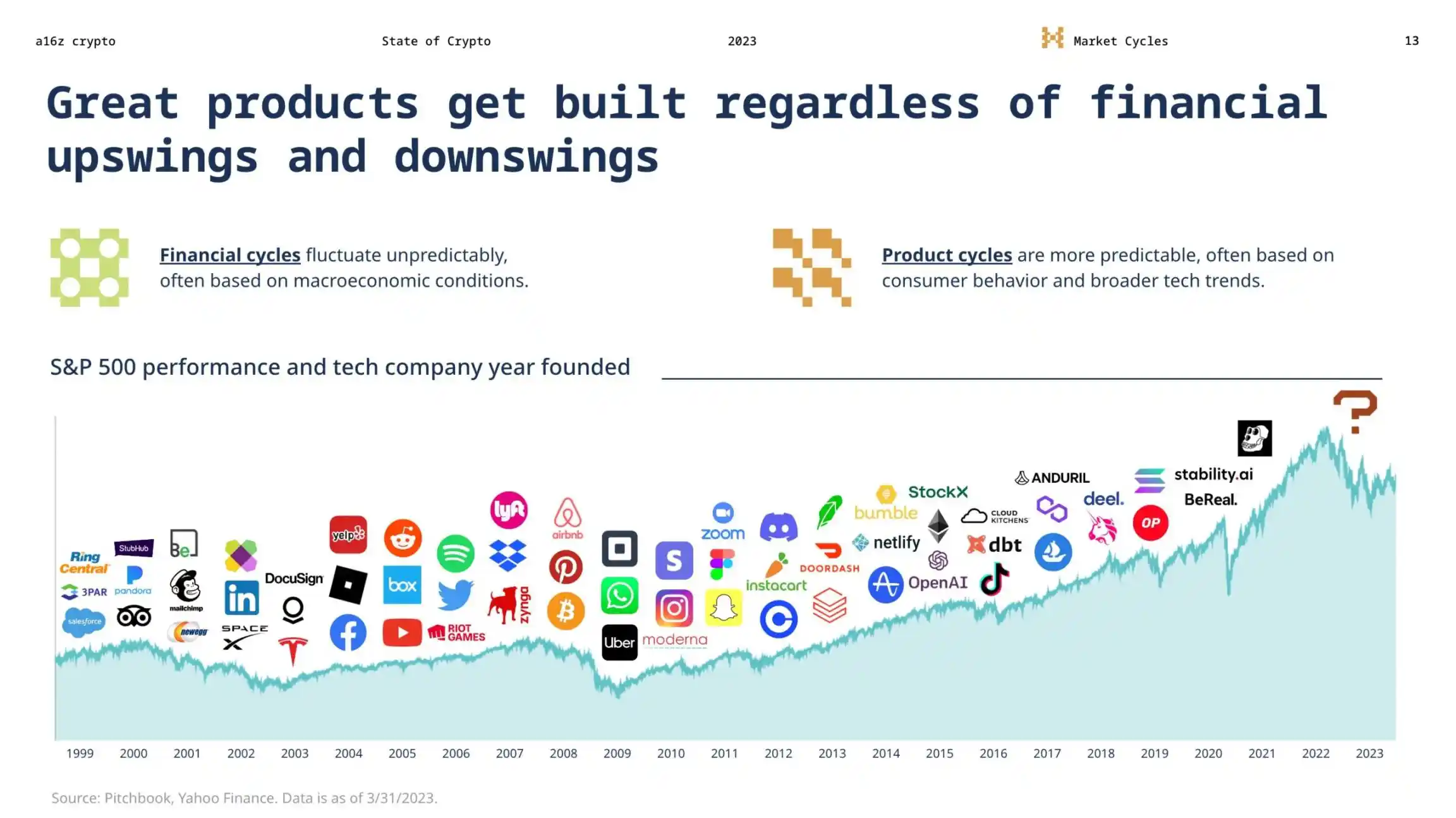
These cycles move industries in waves of technology over time. We may be in the middle of the fourth such cycle since Bitcoin’s creation in 2009. Over the long term, many indicators appear to be trending steadily upward.
That’s why focusing on short-term market movements—and not paying enough attention to underlying technical trends—can obscure the bigger picture. It’s also why we asked ourselves: What if there was a way to track enduring progress along a more meaningful dimension than financial data?
So we created the State of Crypto Index, a regularly updated and interactive index to track the industry’s progress.
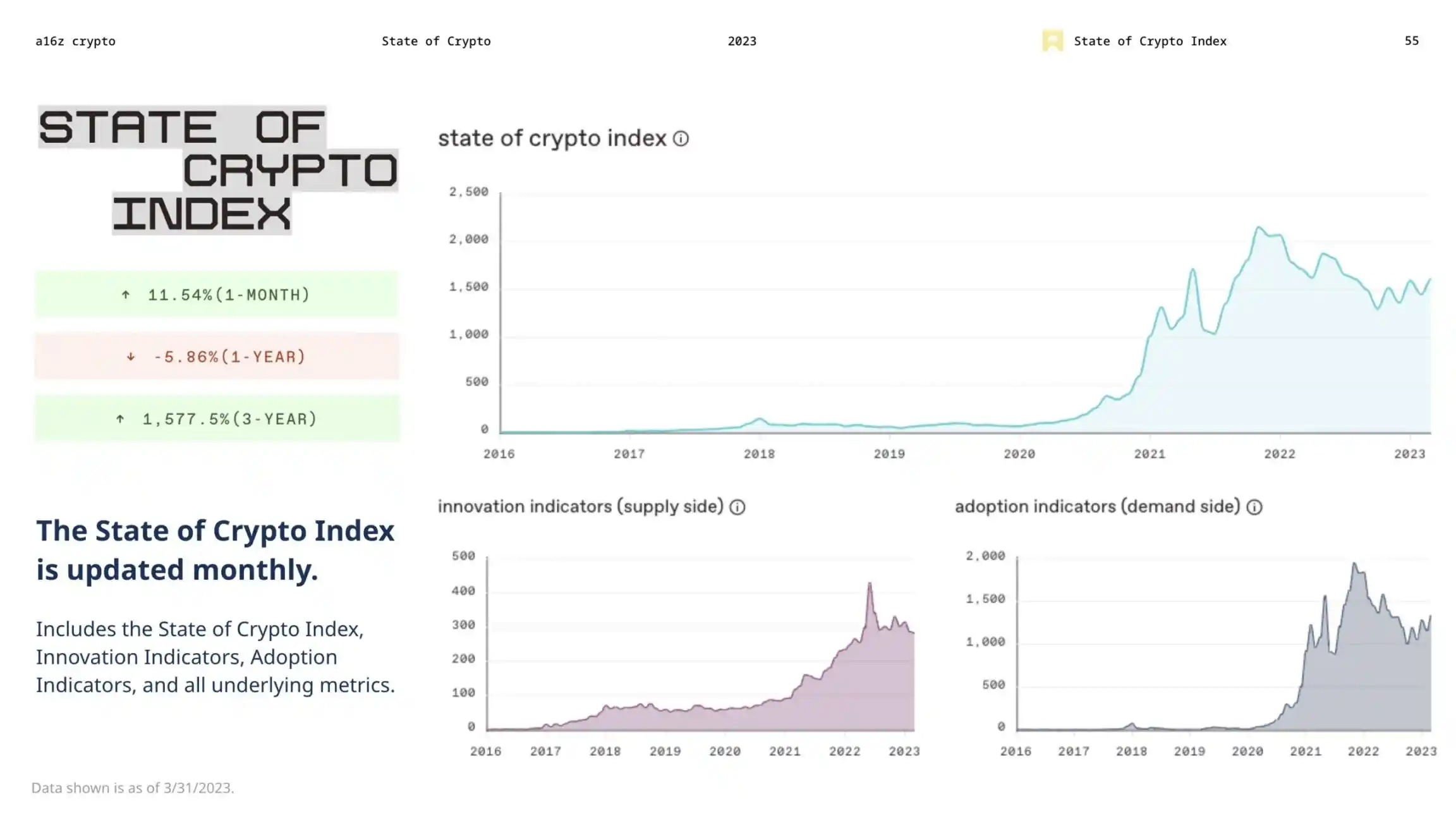
More specifically, the index shows the weighted average monthly growth across a set of key industry metrics. Next to the index, you can view all of the metrics — a set of supply-side and demand-side measurements that serve as indicators of Web3 innovation and adoption, respectively — and the assumptions under which they are mixed.
The default view simply presents one interpretation of the underlying data, weighted to our preferences. We will continue to evolve this tool. But you can explore and adjust the parameters yourself now. Be sure to share your findings with us on Twitter, Farcaster, and elsewhere; we will highlight the most informative and interesting insights.
Original link
Welcome to join the official BlockBeats community:
Telegram Subscription Group: https://t.me/theblockbeats
Telegram Discussion Group: https://t.me/BlockBeats_App
Official Twitter Account: https://twitter.com/BlockBeatsAsia

 Related Articles