Facing the future, how will Solana DeFi develop
Original author: Sitesh Kumar Sahoo, Yash Agarwal, Anna Yuan
Solana has a thriving DeFi ecosystem, which Credit to its community of innovative builders: from trading and investing platforms, to CLOBs that rival the depth of Nasdaq, to derivatives, DEXs, DEX aggregators, and more. This article aims to provide a comprehensive overview of the DeFi ecosystem on Solana, focusing on the main players and future trends. By analyzing the strengths and limitations of these projects, Solana's unique products are presented, as well as the comparison with other DeFi ecosystems.

< /p>
DeFi overview
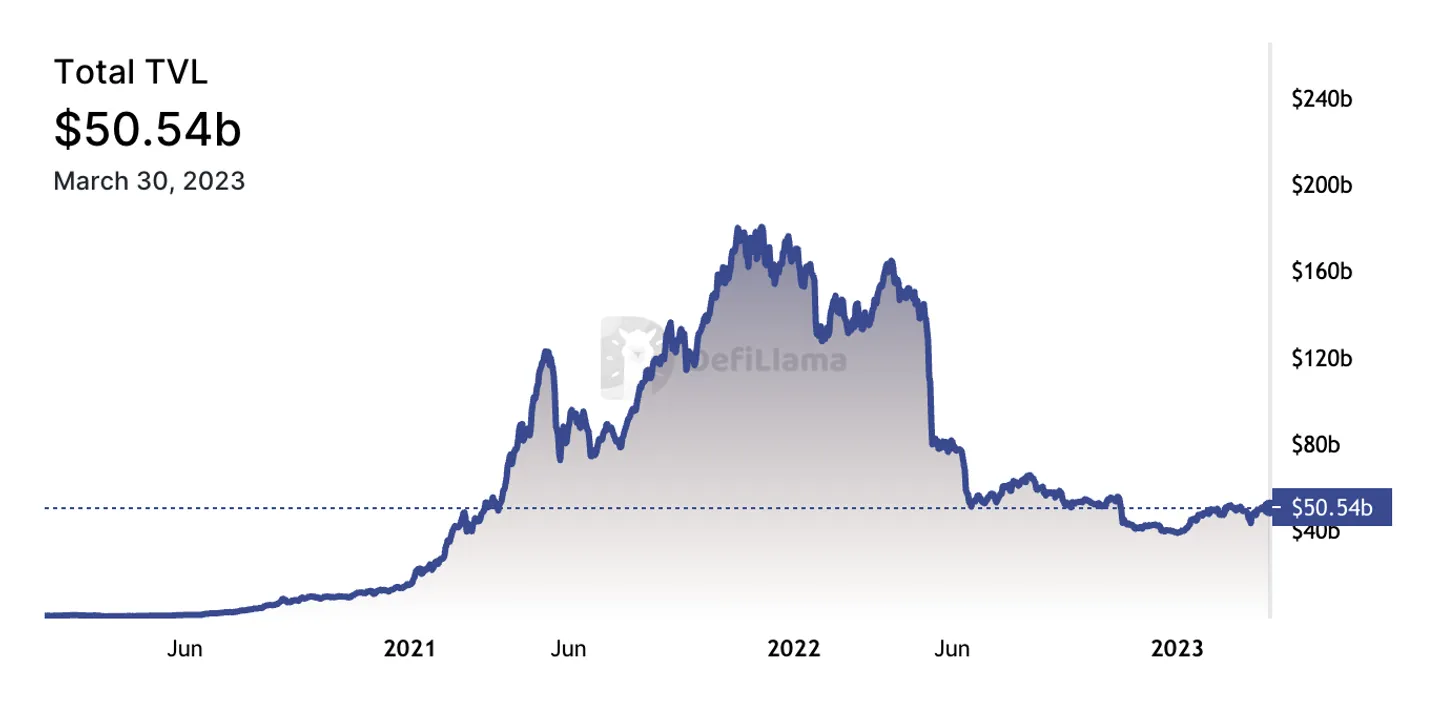
From the summer of DeFi in 2020 to the end of 2021, DeFi However, in 2022, DeFi experienced a sharp decline. A series of events that disrupted the ecological balance contributed to this decline, mainly due to centralized institutions (BlockFi, 3AC, Celsius, FTX, etc.) that took huge risks in customer deposits , due to the inter-borrowing behavior of these institutions and the use of illiquid assets as collateral, the price was inflated, and their sabotage behavior eventually led to its downfall and also undermined the overall development of DeFi.
Looking back at the TVL lost to DeFi after each of these disruptive events, you will see that they caused The scale of the damage was huge, with TVL plummeting $60 billion following the Terra crash in May, followed by an ongoing liquidation event in June that cost another $25 billion, but the worst crash was the FTX event in November, which cost around 100 million The loss of billions of dollars affected the entire ecosystem.
Native tokens for most DeFi protocols are now down 80-90% from all-time highs . Since TVL is usually denominated in USD standards, the price drop has a deeper impact on DeFi.
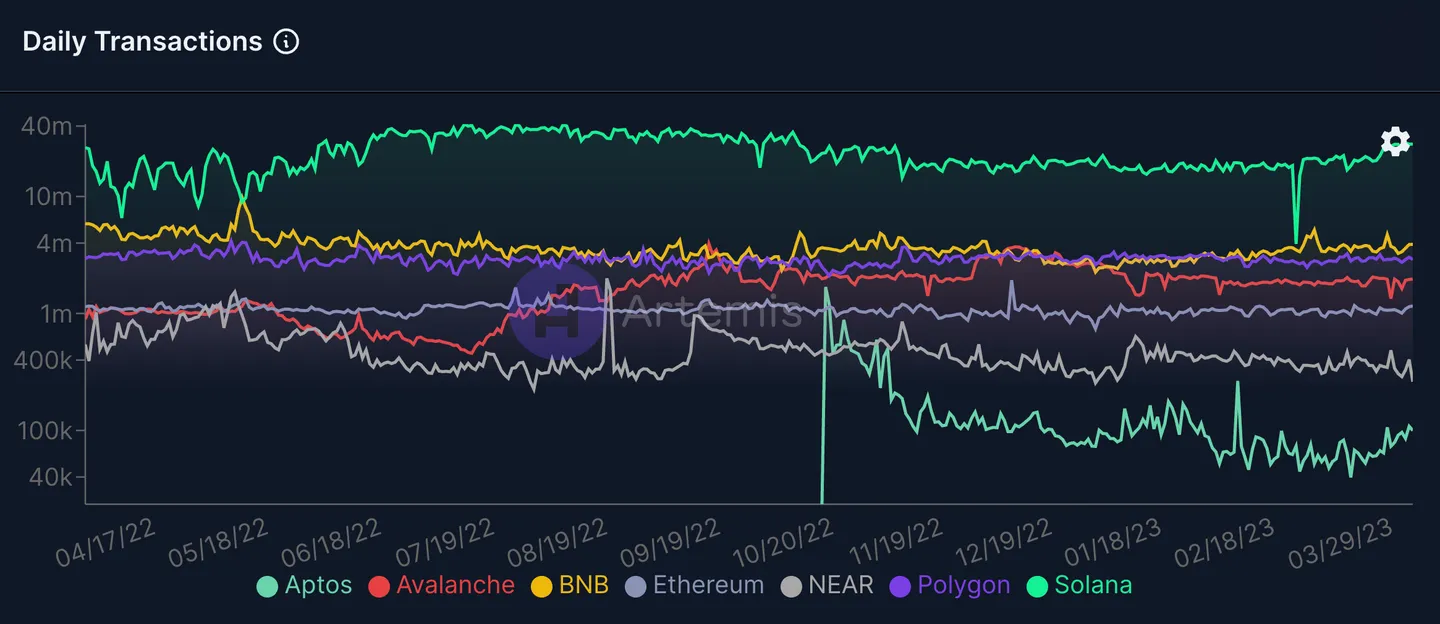
However, despite the significant drop in TVL, the Daily transactions were not significantly impacted, and if each chain's transaction volume reflects its daily active users, then Solana does well, with daily transaction data outperforming all other chains (in order to be fair, we do not take Solana's votes into account transactions), not only because of Solana's high throughput, but also because of the growing number of projects and developer activity in the ecosystem.
Solana DeFi Overview
Compared to EVM DeFi, the Solana ecosystem is younger and smaller, but it is also thriving, because many products that cannot be built on the Ethereum chain can be deployed on Solana , but Solana DeFi is not a low-level version of EVM DeFi, but refers to a new design, which can also bring more value to stakeholders. For example, an order book like CLOB could bring something like TradeFi to DeFi thanks to efficient price discovery and liquidity.
In November 2022, due to the impact of FTX, the Solana ecosystem suffered a severe blow, many On-chain project teams either have funds on the FTX exchange or are supported by FTX and Alameda. At that time, although Solana DeFi had just recovered from the $100 million loophole in Mango Markets, faced with the evaporation of liquidity after the FTX bankruptcy, the amount of locked positions on the chain quickly plummeted from $1 billion to nearly $300 million, and the SOL token was also short-lived. It fell from $35 to less than $14 in a few days, more than half its value.


Solana is a capital efficient chain
TVL Data can be misleading because repeated statistics and calculations can exaggerate data indicators. The "DeFi Velocity" indicator may better reflect the activities on the chain. The value of this indicator = 24-hour DEX transaction volume / blockchain lock-up volume. The higher the value, the more active the DeFi ecosystem.

The concept of "Velocity" is not new, in TradFi , "Velocity" refers to the speed at which money changes hands in an economy. A high velocity is often seen as a sign of a strong economy because it indicates that money is being used repeatedly to buy goods and services. Another way to evaluate "Velocity" is capital efficiency. A high "DeFi Velocity" indicates that asset transactions are active and capital is being quickly put into use.
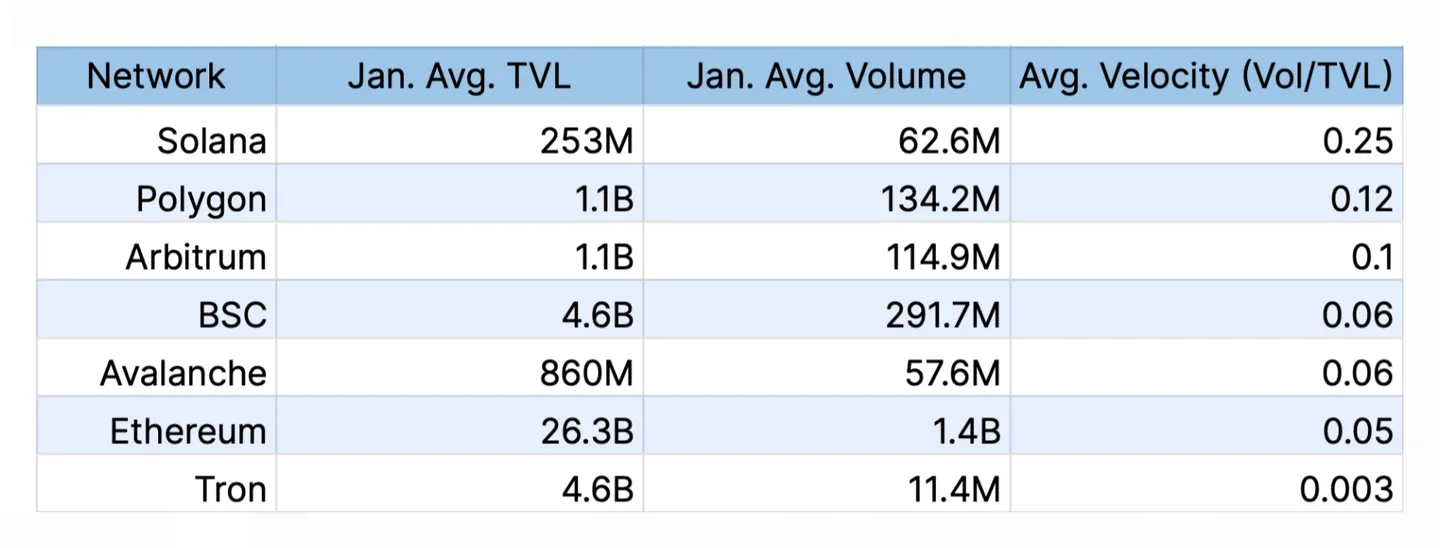
Solana has high "DeFi Velocity" compared to other networks, January 2022, Solana The "DeFi Velocity" of Solana is 0.25, at least twice that of other networks, indicating that Solana's DeFi ecosystem is more active than its competitors (albeit on a smaller scale). Even excluding the abnormal situation caused by the Bonk token effect from "January 3rd to 8th", Solana still achieved the highest DEX transaction volume of the month (the transaction volume exceeded 150 million US dollars, accounting for about 30% of the total lock-up volume on the chain. 2/2), when its "DeFi Velocity" was 0.21.
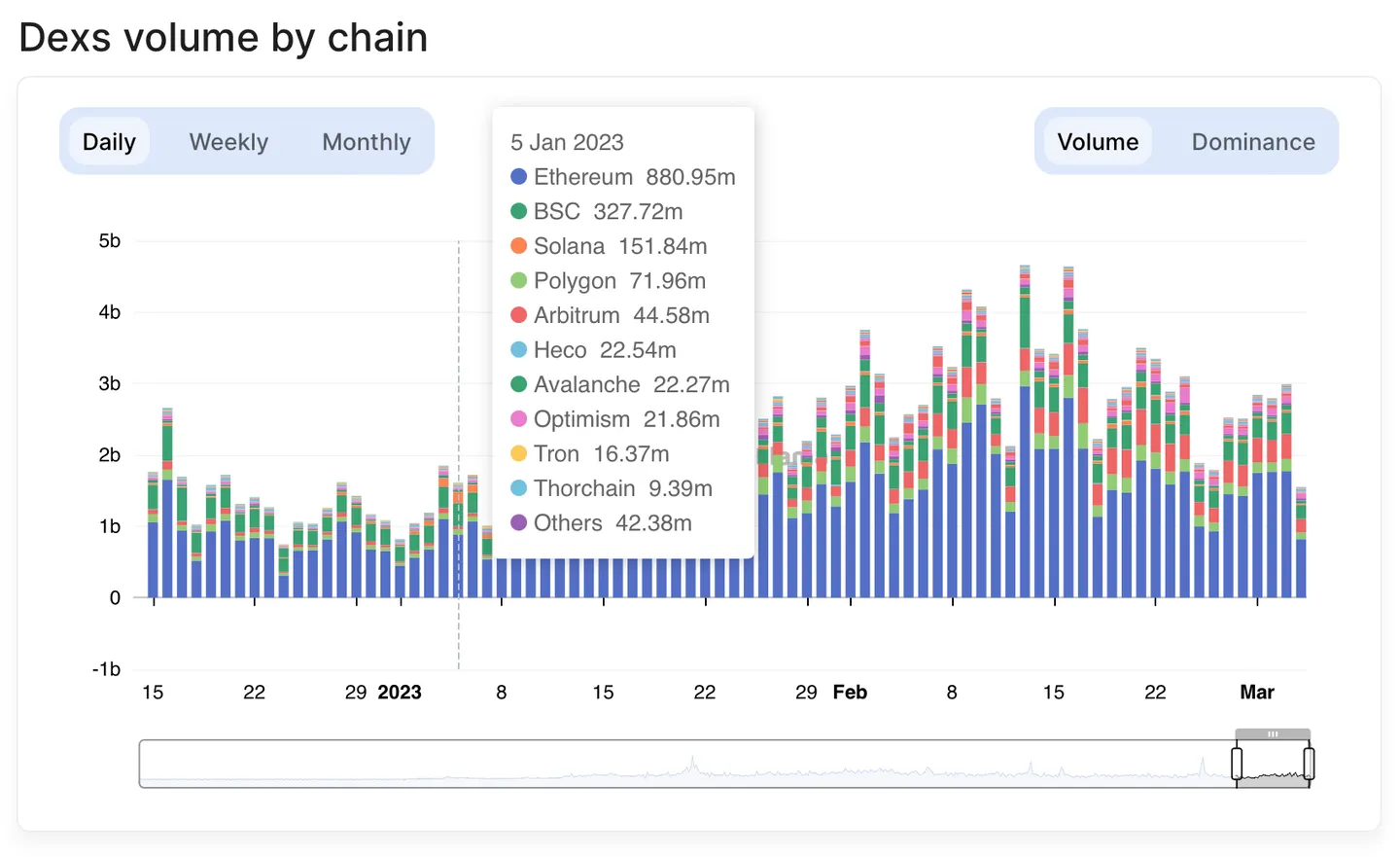
Although the TVL of BNB, Avalanche, Ethereum and other chains is higher than Solana, the transaction ecology of these networks is Weaker than Solana, it also shows that "DeFi Velocity" will more accurately describe economic activities on the chain than TVL. Tron's "DeFi Velocity" is only 0.003, indicating that the activity of funds on its chain is not high. For the "DeFi Velocity" indicator, please refer to Kamino Finance's article.

Next, let us learn more about each DeFi categories or themes, analyzing their advantages, limitations and potential opportunities:
DEX, The advanced road of CLOB and AMM
Last year, the FTX crash hurt users and It has caused a huge crisis of trust among users in the encryption industry, and has also prompted more and more people to realize the importance of transparent and auditable public ledgers. Unlike centralized trading platforms, DeFi is a safer and more transparent choice for users, because fund custody will be maintained more transparently. In addition to DEX competitors, we have also seen semi-custodial exchanges and wallets begin to explore multi-party Innovative technologies such as computing (MPC) and threshold signatures to ensure the safety of users' funds while providing them with a familiar CEX user experience.
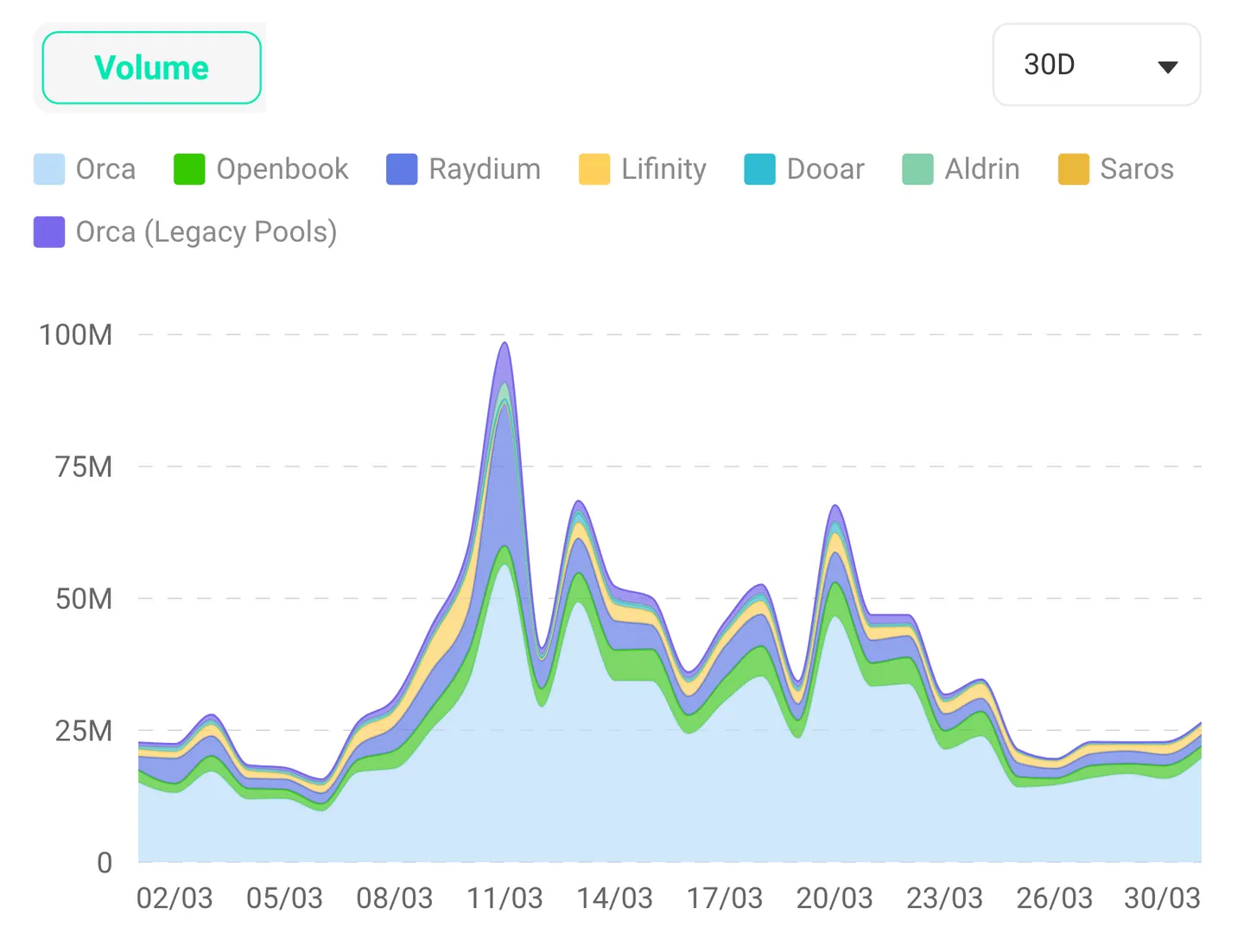
Orca has become the most important DEX on Solana, and its transaction volume has reached more than 74%, followed by These are OpenBook, Raydium, Lifinity, and Aldrin. Even so, we are still seeing projects like Root Protocol being built on Solana, a hybrid DEX that combines the efficiency of AMMs with the flexibility of order books.
More and more crypto-native users are shifting from CEX to DEX, and starting to use DEX Conduct self-custodial transactions. However, a major obstacle to the widespread adoption of self-hosted exchanges is user experience. Although some EVM DEXs have high transaction volumes, most DEXs use additional token incentives to attract transaction volume. If the user experience gap does not narrow significantly , it will be difficult for DEX to surpass CEX in terms of volume and liquidity.
CLOB Status
First, a brief history of Web 3. In the early days of FTX, SBF talked to every major L1 in the market, looking for a blockchain that would power his on-chain CLOB vision. After stress testing the then-unknown new chain Solana in 2020 and following a 3am call with Anatoly, Project Serum was launched on Solana.
Serum was one of the first CLOBs on Solana and fueled the growth of Solana DeFi. Traders can experience a decentralized version of their familiar order book in TradFi. After the FTX crash, the DeFi community forked the Serum code and named it OpenBook.
There are now two real-time CLOBs on Solana: the widely adopted OpenBook and a The alternative Phoenix developed by Labs, for detailed articles about OpenBook, refer to this article.
In addition, both projects are open source.
OpenBook employs cranking - an operationally intensive and centralized process to ensure correct order match. Transaction processing is batched at regular intervals, this solution enables transactions to be processed immediately and reduces the possibility of run-ahead and other forms of market manipulation. While Phoenix’s original design required institutional market makers to disclose their identities or be whitelisted, their V2 will enable permissionless and anonymous liquidity provision.
For builders, here are some opportunities to consider:
Design Choice: One way to design the order book is as a separate application Chains, although there is a trade-off of atomic composability, typical examples like dYdX v 4 or Sei, which allow customizability via the Solana Virtual Machine (SVM) without compromising Solana's speed and low cost. However, exchanges like dYdX v3 or 0x would allow off-chain order books, they may have chosen a different approach to transaction design.
Scalability: Jump Crypto's second validator client, Firedancer, will be on Solana Launched, it will be interesting as it may further improve Solana's performance by 10x or more, Firedancer has 1M+ TPS in the test environment, opening up new possibilities for on-chain high frequency trading and derivatives trading sex.
New Markets: Markets can be established through new applications and asset classes, from operating imports to Licensing order books for merchandise goods to trading collectibles like rare liquors; the opportunities are endless.
On-Chain Forex Market Use Cases
Forex is a huge market with over $6 trillion traded daily and many Web 3 players are paying attention this opportunity. Uniswap and Circle released a research paper describing the different models and roles of “trading platforms” and “tokenized cash issuers” to facilitate the on-chain FX market. The paper argues that AMMs will reduce the likelihood of flash crashes during periods of high market volatility.
We disagree: CLOB is a better market structure than AMM for Forex market , because the price impact is less and the trade execution is better. The foreign exchange market is a key link in driving global economic activity. As the most liquid market in the world, the FX market has order books with a microstructure that AMMs simply cannot compete with. Ask any large market maker in this space and they would rather offer liquidity on a LOB (limit order book) than an AMM.
EVM-based chains have oracle-based synthetic FX markets, but fiat-backed stablecoins Still limited to major currencies such as the dollar, euro and yen. However, as more and more native stablecoins are launched on Solana, we expect to see more complex FX transactions between stablecoin pairs.
Lending: Beyond Speculation
Decentralized lending provides users with access to capital without an intermediary. We can classify lending activity according to the type of guarantee: crypto-backed and real asset (RWA) backed.
Encrypted Asset Security
Solana has seen the emergence of various decentralized lending protocols that operate on a collateralized basis. The most notable of these are Solend, Port Finance, Francium, Tulip, Hubble Protocol (actually the only remaining player in the overcollateralized stablecoin market), Jet Protocol, marginfi, Ratio Finance, and Larix.
Bull markets build a lot of lending infrastructure, while bear markets enable users to pressure test. A well-designed infrastructure should allow users to obtain loans quickly and easily with minimal friction, and Solana does a great job of this. This efficiency refers to the speed and ease of the lending process.
Nevertheless, leading protocols like Solend struggle due to lack of liquidity, but they A potential solution is proposed in V2. Mortgage loans do not solve many real-world problems and are mainly used for speculative purposes such as leveraged trading. This is why the collapse of FTX has seriously affected the crypto industry, because the FTX price obtained by the oracle does not match the actual price.
If we look at the EVM blockchains, they have strong mortgage projects like lock AAVE with a position of up to $4.8 billion (as of February 2023), AAVE has been aggressively liquidating all of its loans while innovating on multiple fronts such as the yield-generating GHO stablecoin, cross-chain lending, Centrifuge's RWA program and quick loans.
Here are some areas of potential we see:
Business on the chain: bring more business to the chain, and cooperate with multi-signature providers such as Squads, with low mortgage rate (~ 100-150%) or even under-collateralized (mortgage rate <100%) to provide loans, a group of decentralized institutional underwriters can act as validators of the agreement, they are like multi-signature guardians, approving loans for on-chain entities, loan details can all be placed on-chain and if necessary to encrypt.
Tokenize real world assets and put debt on chain. Projects such as Centrifuge, Figure and the recent Apollo deal are exploring this space by tokenizing assets such as real estate, invoices and royalties, which aim to create new investment opportunities and make capital more accessible to businesses. If successful, it could lead to a significant expansion of the mortgage lending market and bring more real-world use cases to DeFi.
Aave's GHO provides an ideal case study for a loan agreement that can also build on Solana. In the coming months, there are other projects worth watching on the Solana chain, such as:
marginFi: marginfi has raised more than $1.5 million through self-funding, and its structure is also changing to a prime brokerage model. Assets on marginfi can be used to do long Zeta, Drift or Cypher.
Solend v2: Solend is one of the largest lending projects on After many "practical" tests and lessons learned, Solend V2, a further optimized lending protocol, has been launched. Click to view its white paper (https://v2.solend.fi/).
RWA is collateral security
For lenders, verified on-chain assets and real-time balance tracking functions not only help them quickly Making lending decisions can also reduce risk. Finding the ideal business model and regulatory framework is extremely challenging. Lenders such as Celsius, BlockFi and Hodlnaut have previously encountered problems. Because of the way these traditional lenders operate, borrowers and The money lent is not transparent.
RWA Use Case: Credix Finance
Credix funding has been surging, with more than $200 million in committed credit, and it is building a credit ecosystem designed to Bridge the gap between institutional borrowers and investors by providing liquidity and creating attractive risk-adjusted investment opportunities. Credix uses consumer loans, such as auto loans and invoices, and invoices receivable as collateral for its loan pool. Additionally, some of these loans are underwritten by established secondary insurers such as MunichRE.
The RWA project also attracts capital from other ecosystems, such as Credix Finance, which from Solana and Ethereum Aggregate USDC, but build an execution layer on top of Solana.
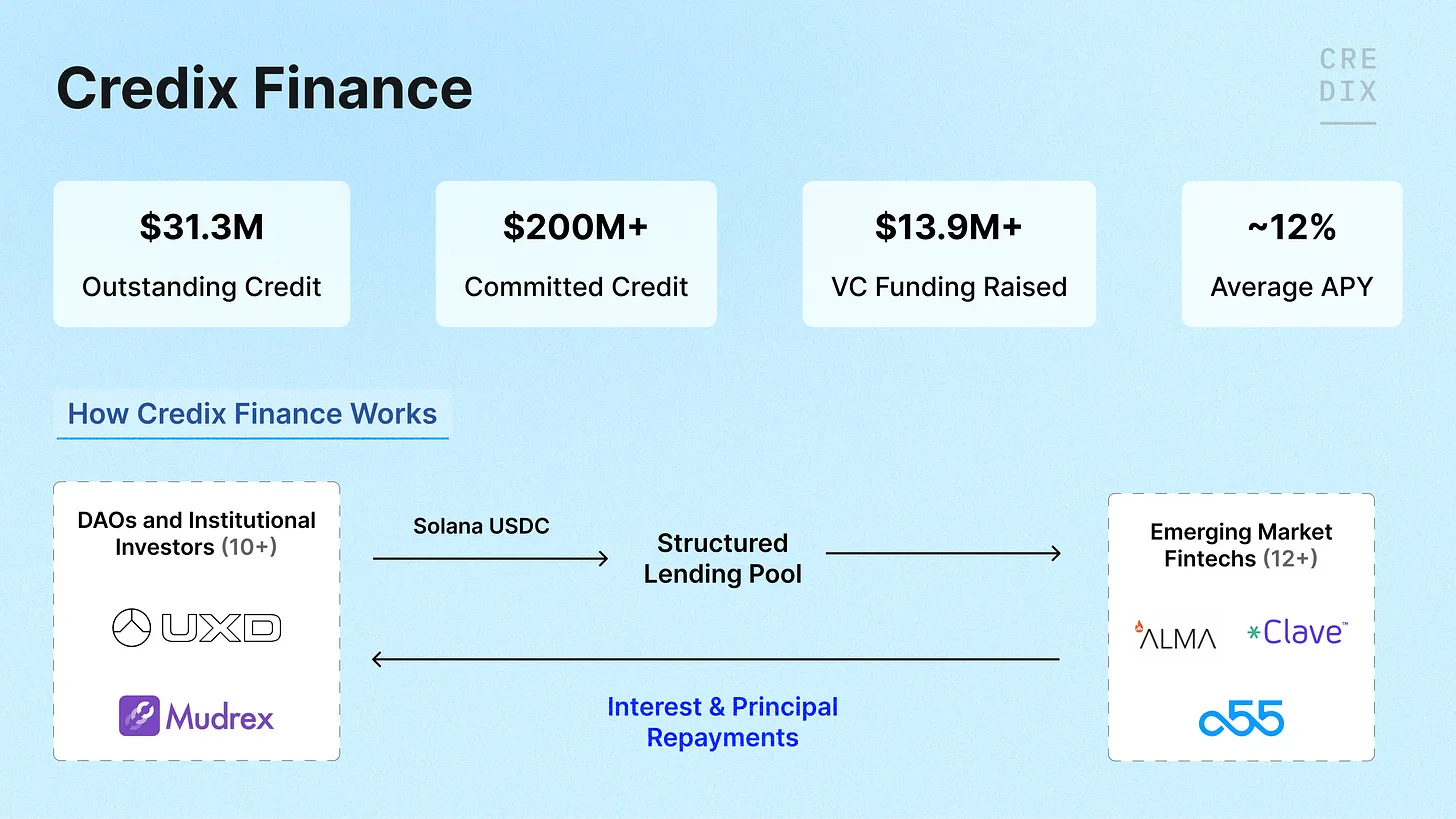
Credix is based on two main ideas:< /p>
Interesting investment opportunities exist in emerging markets that investors can access because of institutional borrowing in these markets People often encounter geographic or capacity constraints when looking for funding. Credix solves this problem by giving these borrowers access to funds and credit that they would not otherwise have access to. As a result, fintech companies and non-bank loan originators in emerging markets can raise debt funds internationally with lower friction and interest rates.
DeFi offers investment options based on tangible assets rather than the volatility of cryptocurrencies. Credix intends to provide investors with a more stable and predictable investment environment by linking DeFi investments to tangible assets with low beta coefficients of crypto assets.
Click here to read about Credix use case study.
Some potential opportunities in the RWA area include:
< /p>
The necessity of RWA token standards: Standards enable different entities to maintain unanimous. For example, the standard for packing and shipping physical goods in containers has lowered shipping costs and fueled a surge in global trade. Likewise, establishing a standard for RWA on how assets are originated, categorized, packaged, and distributed is critical to improving market efficiency and better price discovery.
Strong Identity Protocol: Decentralized IDs and verifiable credentials that can be used across protocols are An essential part of a seamless user experience. Although several on-chain implementations have been built (mainly around DAOs and governance), these tools have not been successful in attracting users. Therefore, the opportunity to solve the problems of anonymous users and lending accountability is enormous. Adoption of these projects can be accelerated by incorporating these identity technologies into common multi-factor authentication systems such as Gitcoin passports or encrypted soul-bound NFTs.
Enhancing the competitiveness of the derivatives market
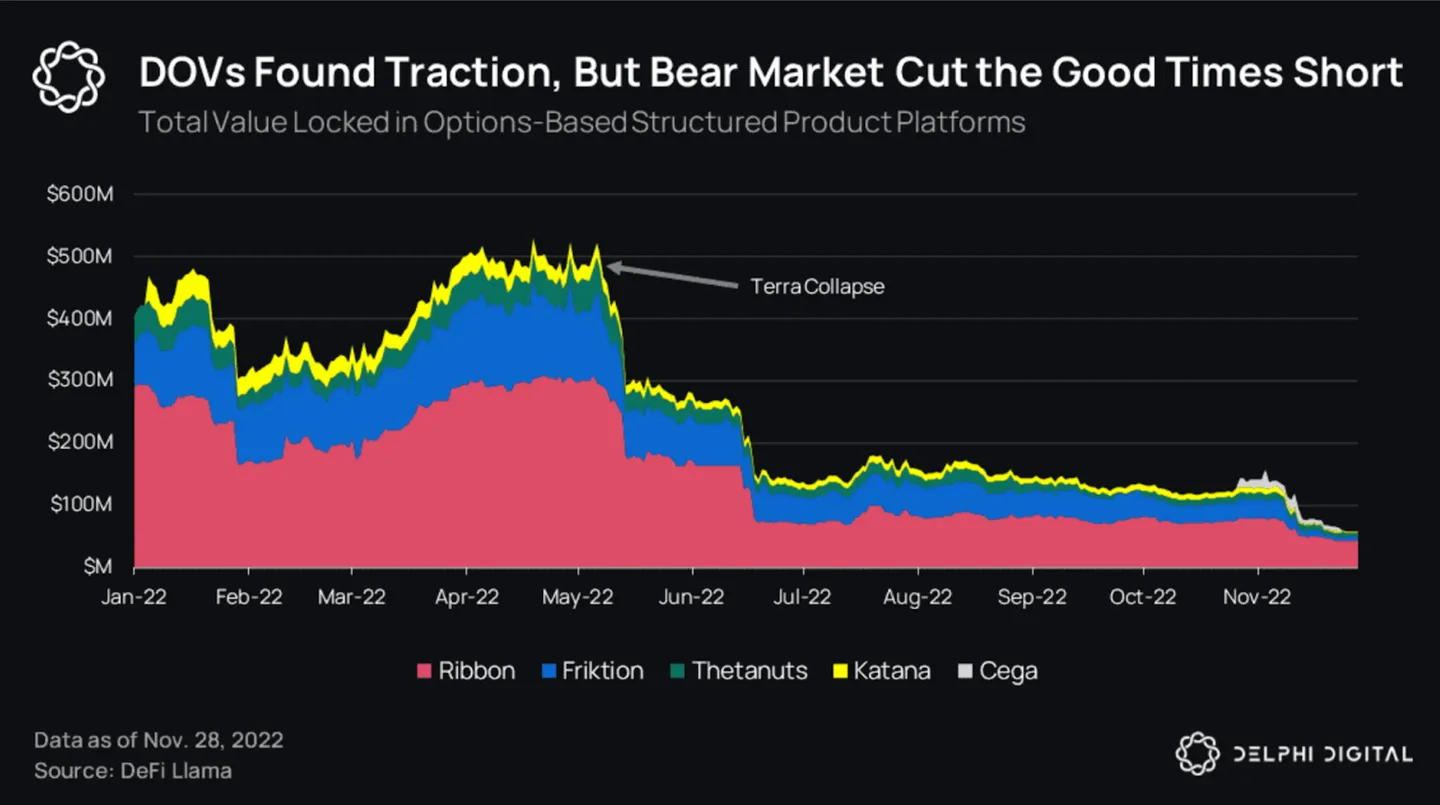
Before the FTX crash, the DeFi options market relatively strong. As an on-chain primitive, Ribbon introduces a systematic option sales vault, the model is simple: market makers are incentivized to provide users with the necessary liquidity and profit handsomely from management fees or performance fees. To hedge their positions and earn the spread, market makers are encouraged to buy call options from users of Ribbon and then sell call options like they do on centralized derivatives exchanges like Deribit.
After the FTX crash, many market makers took a risk-averse Withdrawal of liquidity. Rebuilding liquidity and confidence in the Solana ecosystem and the options market is the first priority before complex structured options products are offered at scale. At this stage, the market for structured products is still much smaller than expected, so products with better risk-reward structures are needed to cater to retail investors.
While the options-based derivatives market is struggling with the shutdown of protocols like Friktion, Solana Chain The next batch of derivatives infrastructure is being built, such as Fusion. Unlike traditional protocol token airdrops, option airdrops allow the community more flexibility in how they contribute and protect tokens from instant dumping.
Some derivatives protocols that are actively being built and worth watching:
Drift Protocol: Drift Protocol is a decentralized exchange designed to Minimize slippage, fees, and price impact on all transactions, and address inefficiencies by bringing a centralized liquidity engine on-chain. Drift Protocol has three sources of liquidity:
-Constant Liquidity (Constant Liquidity), which is Drift Protocol's virtual AMM, is designated as a source of support for liquidity, which can be Inventory adjusts its bid-ask spread;
-JIT-liquidity, which is a short-term Dutch auction in which market makers compete at or above the auction price ;
- Decentralized Limit Order Book (DLOB) paired with Keeper Bots' off-chain order monitor, providing traders with low slippage and depth fluidity.
Cypher: Cypher is a Solana blockchain-based trading platform and margin engine that enables users With the ability to trade spot, futures, perpetual contracts and options markets from segregated accounts or across margin trading accounts, the platform also offers a mobile trading experience optimized for convenience and time efficiency. Through the native lending pool, Cypher supports margin trading, allowing users to launch any derivatives with a specified return function.
Cypher supports two liquidation models, public liquidation and private liquidation, which share the same liquidity and order books. Public Clearing allows anyone to transact on it and is a permissionless margin layer. In contrast, private liquidations are reserved for institutional partners and can reduce margin requirements for greater capital efficiency.
Hxro: Hxro allows users to trade futures, options and perpetual contracts on Solana. Create a decentralized exchange service for these financial contracts.
As of April 3, the cumulative transaction volume of the Hxro network was $232.83 million, with a 30-day average $3 million in daily trading volume (including derivatives and pari-share trading volume)
With several community initiatives such as OpenHxro and Convergence With the advancement of partnerships such as RFQ and Degen Ape, Hxro may build a more integrated ecosystem.
Vyper Protocol, currently in public beta and unaudited, allows users to license-free Create, trade and settle on-chain derivatives in a decentralized and decentralized manner.
Allow trading any asset or data source supported by oracle machines such as Pyth and Switchboard, users can build customized derivatives according to their specific needs , or you can choose from a variety of pre-existing options.
In addition, Ribbon Finance, PsyFinance, Mango Markets, Cega, Zeta Markets and Dual Finance are A number of other protocols operate in the derivatives and structured products space. Recently, Mango Markets has also launched V4, and another project Devol Network (currently in beta and will launch the mainnet in June) also supports on-chain options trading.
A case of stable and perpetual transactions on Solana
Solana needs a reliable perpetual trading platform that can provide a CEX-like experience to To attract active traders to join the ecosystem, a potential solution is to build a derivatives trading platform on the Solana blockchain to provide products such as perpetual contracts, options and synthetic assets. The platform should provide first-class user experience, high leverage Rates and competitive fees to attract traders, while also exploring features such as a hybrid liquidity model combining AMMs and order books with cross-margining, as well as mobile-friendly interfaces and advanced APIs for traders and liquidity providers.
In order to distinguish from other platforms, Wormhole on the Solana blockchain can be used to provide cross- Chain derivatives, and use CLOB to extract liquidity and funds from other chains, building a derivatives market on the Solana chain can draw inspiration from other chains such as GMX, dYdX, and Gains Network.

Liquidity staking is a capital efficient choice, It utilizes collateralized assets as collateral, providing greater participation and capital flow across the market than traditional financial systems.
December 2020, Lido will allow anyone to Earn Ethereum's pledge income easily. Ethereum users using Lido remove the choice between DeFi yields and staking yields. By staking on Lido and then using the stETH they earned in DeFi, they can now earn yield at the same time. Currently, Lido is multi-chain, supports many chains including Solana, and leads TVL among other LSD protocols. Now that Jito Labs redistributes MEV through its validator client, the LSD craze for Solana may start again. Maximum mineable value (MEV) refers to on-chain activities that generate economic gain by exploiting market inefficiencies. By providing additional rewards to individuals who operate jito SOL clients, the jito SOL staking pool enables distributed value capture across many validators. On the other hand, this could lead to a risk of centralization over time.
As of March 30, JitoSOL offers approximately 6.80% equity APY, on par with Solana's Marinade (6.84%) and other leading staking pools like Lido (6.7%). It's important to note that each provider calculates APY differently. For example, Marinade shows the APY for the last 14 days, while Lido shows the highest APY for the last 14, 30, or 90 days or since launch. Some other players against Solana include Quarry Protocol, which was the #1 Solana TVL-ranked protocol back in early '22. Still, when the rewards model started to dry up, Quarry Protocol began to lose popularity, and its Twitter and community performance is currently inactive.

< /p>
Untapped synthetic assets and prediction markets
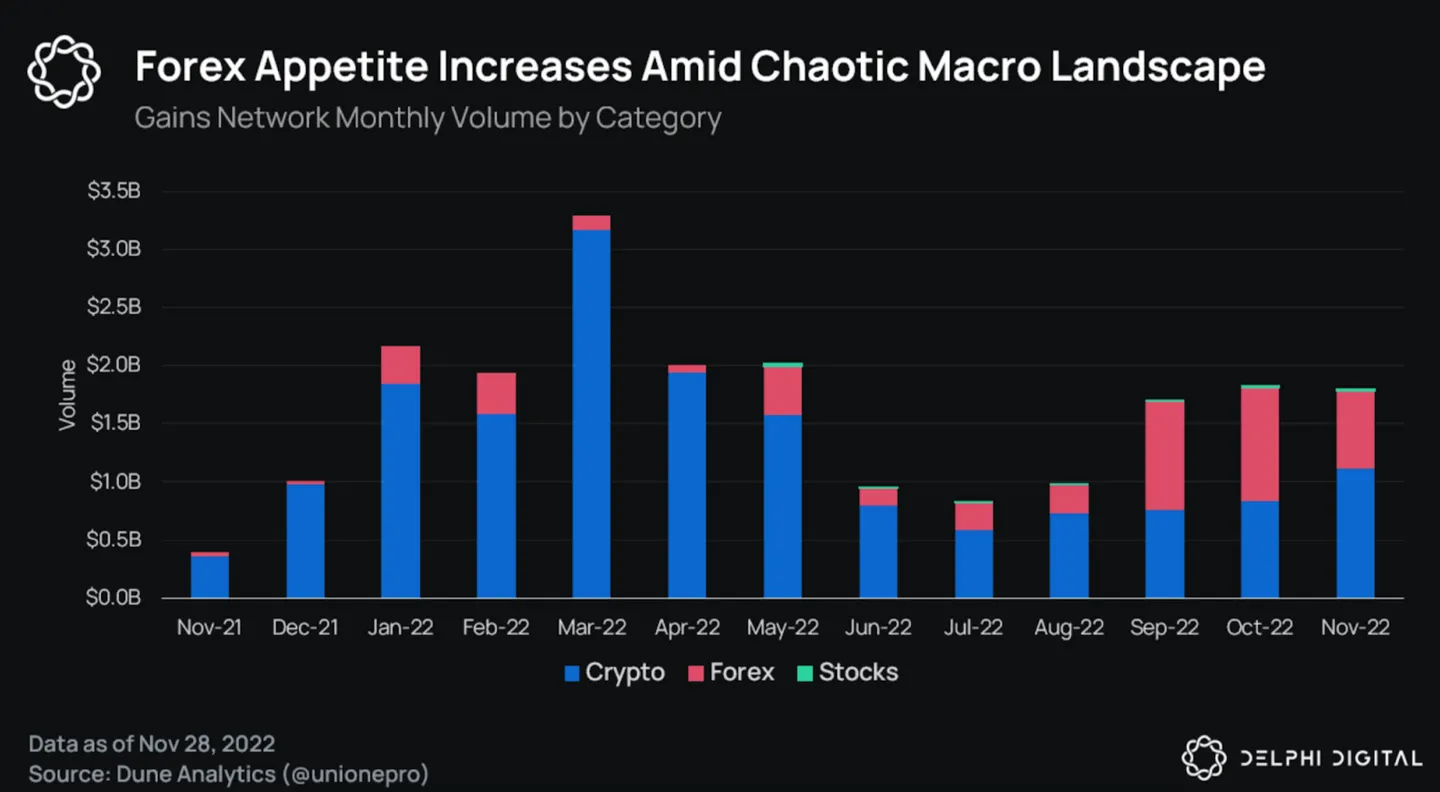
Using oracles to get synthetic The easiest way to gain leveraged exposure to assets is through GMX and Gains Network. In September and October, the majority of Gains Network's trading volume consisted of foreign exchange transactions. With GMX’s significantly expanded user base and upcoming synthetic assets, FX volumes on EVM-based chains could soar in 2023. A robust composition protocol utilizing oracles like Switchboard and Pyth is inevitable.
The prediction market provides users with the opportunity to bet on the outcome of future events. Solana is a high-throughput Blockchain, therefore, can leverage its fast and scalable infrastructure to handle high volumes of transactions and power prediction markets. A few examples:
-Aver Exchange is a peer-to-peer betting and prediction platform on Solana, It eliminates the traditional notion of a "bookmaker" in sports betting;
-Hedgehog is a Another prediction market that generates passive income for liquidity providers;
-Monaco Protocol for Solana Prediction markets on the network provide open-source infrastructure;
-Vyper Protocol allows transactions to be structured as numbers Event/prediction markets for options.
While Solana has strong strengths in the prediction market space, some weaknesses may limit its growth , such as lack of user adoption - Solana is a relatively new blockchain platform, and its prediction markets may not have as much user adoption and sufficient liquidity as Ethereum, compared to other networks, the number of prediction markets currently available on Solana Very limited. Not only that, but the process of understanding and participating in these markets can be complex and intimidating for users unfamiliar with the concept of prediction markets, thus discouraging potential users from participating in the market, thereby limiting its overall adoption and potential impact. However, prediction markets attract non-crypto-native users who can learn about tokens through games before participating in the DeFi ecosystem.
Another major threat is competition from other platforms such as Polymarket on the Polygon blockchain , these platforms already have large user bases and more prediction market options due to the size of their respective ecosystems. There is also the issue of regulatory challenges, as the prediction markets industry remains largely unregulated, and pressure from regulation may present challenges in the future as governments take steps to regulate.
Using UX Aggregators to Improve DeFi Experience
< /p>
As the main point of the user interface, the liquidity aggregator sits on top of the liquidity aggregation layer and owns the consumers. Because of this, they are likely to become the main user-facing layer of DeFi. Although users own their own information through on-chain addresses, and switching costs are low, making money in the DeFi field is not easy. Wallet-native swaps currently trade at around 85 bps, while fees on centralized exchanges are much lower. UX aggregators should develop creative monetization strategies without compromising usability.
User experience aggregators offer a considerable advantage to novice crypto users, although they are primarily geared toward Encrypt native users. UX aggregators should provide a level of freedom while providing an efficient UX by limiting access to security protocols and issuing alerts for high-risk coins.
There are currently hundreds of DEXs with tradable liquidity, such as Jupiter on Solana, And liquidity aggregators such as 1inch and Paraswap obtain quotes from various DEXs to find the best execution price for users. This saves users the hassle of visiting various DEXs to find the best price or sticking to a single DEX. As the DeFi ecosystem develops, liquidity aggregation may surpass DEX. It will adapt to different protocols that support these operations, and aggregators for other DeFi products will inevitably appear.
Jupiter is one of the most innovative liquidity aggregators on Solana (November 2021 Launched in March), and quickly became Solana's main liquidity aggregator, with a transaction volume of more than 27 billion US dollars and 500,000 users. Jupiter's platform allows users to find the best price on the Solana network and execute trades across multiple DEXs. While there are DEX aggregators on many major chains, few have features like limit orders.
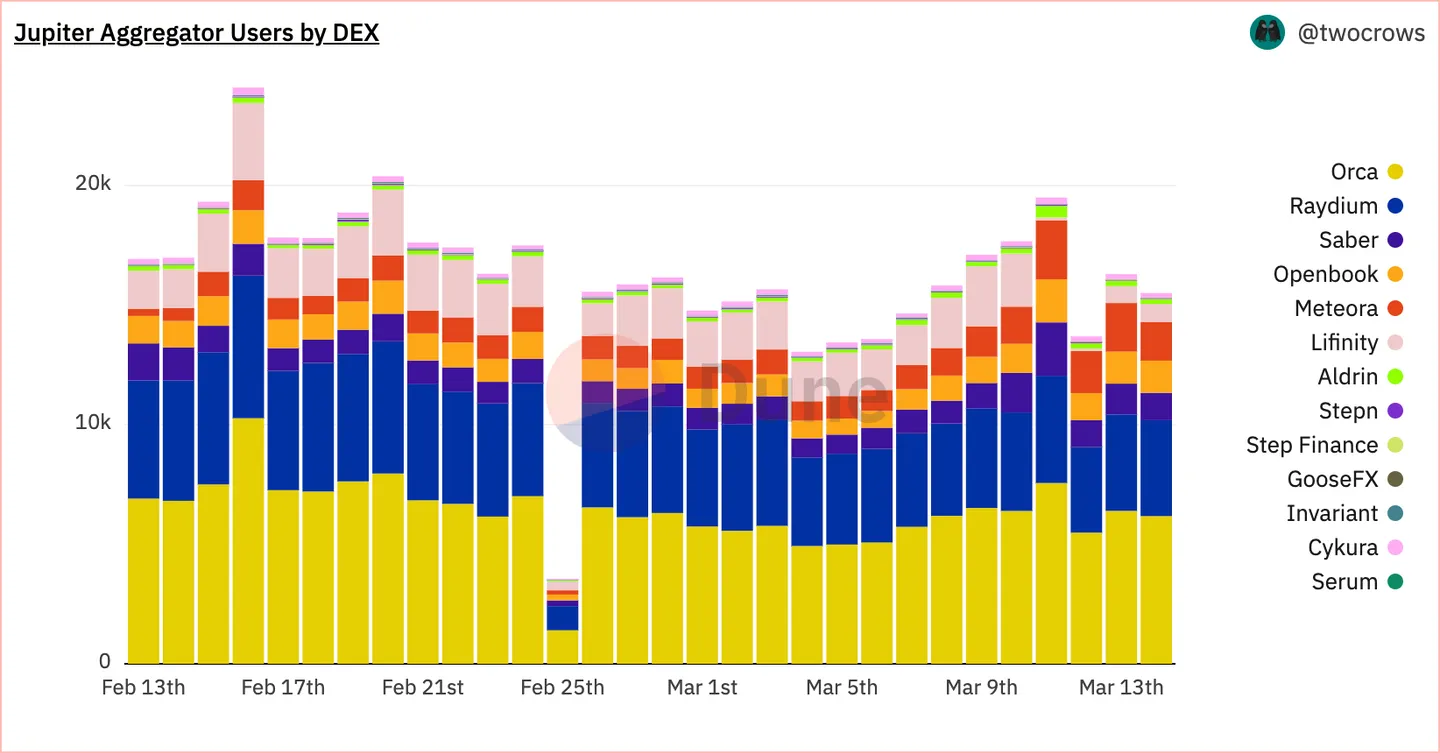
Jupiter continues to experience high transaction volumes, making It became the most used project on Solana. In fact, Jupiter already accounts for 41% of Solana’s daily non-voting transaction volume. A notable aspect of Jupiter’s recent success is its participation in the BONK craze, which has driven a lot of trading activity on the platform.
Jupiter's success is a testament to the growing popularity of DeFi applications, as well as liquidity aggregators Role in Facilitating Trading of Multiple Indices. Liquidity aggregators like Jupiter are likely to continue to play an important role in the DeFi ecosystem as more users enter the DeFi space and seek the best price and execution.
Some exciting opportunities for builders in the aggregator space are :
Building a complete DeFi UX aggregator, users can In it access multiple opportunities such as swaps, yield opportunities, borrow rates, perpetual futures executions, cheapest/most expensive option premiums and more. This could be similar to Step Finance, but with a friendlier UX and a mobile-first approach, like Solana's super Backpack app.
Ingress/egress aggregator similar to Jupiter: it will help pool liquidity, Help users find the best route with the lowest cost, and unified KYC to abstract the entrance of each platform, and have a better fraud detection engine, significantly increasing the UX of consumer applications. Most importantly, attract more non-custodial on/off ramp solutions and partner with local fintech companies to support non-card local payment methods to provide users with comprehensive options.
Enhanced Portfolio Management Analysis
Symmetry, Step Finance, and Sonar Watch are all portfolio management and analysis tools for the Solana ecosystem. These platforms help users track the real-time performance and value of their positions on Solana, including mining, staking, and other yield strategies, and one of the distinctive features is that it allows anyone to create or buy indices. Sonar watch also has sophisticated tools such as DEX manager and IL calculator.
However, compared to more comprehensive multi-chain platforms such as Zapper, Solana-based portfolio The management app has limited functionality; it may become less attractive for users who want a more comprehensive portfolio management and analysis solution. Competition is also fierce, as there are many established multi-chain platforms such as DeFiYield, CoinStats, and Starlight. This may lead to limited adoption of these platforms, as switching costs for these applications are not high.
Adding new users is a slow process: fiat currency deposits/withdrawals are not yet widespread However, self-regulation still needs to be improved.
Building a Mobile-Friendly Dashboard Application
The Solana ecosystem still lacks sticky consumer apps, especially mobile apps, so it needs to Excellent products, so that more people will learn to self-regulate. At this stage, most of the projects receiving attention in the Solana ecosystem are speculative-based products that have not yet focused on practical use cases such as loans, insurance, and other financial services, nor catered to transactions that seek to profit by trading and investing in different DeFi tokens makers and investors.
While most crypto apps are exploring mobile functionality, for portfolio management projects In other words, having a mobile app is especially important, with many users turning on their computers simply because they have too many portfolios, or want to avoid some of the unnecessary friction that comes with their phones.
As the DeFi market continues to grow, Solana’s on-chain portfolio management and analytics platform Provide rich data insights and analysis to help users navigate and get the most out of the ecosystem, thereby helping users make more informed investment decisions. Having a mobile application that allows users to display all the information of the portfolio at the touch of a finger will undoubtedly be a game changer, and platforms like Saga have already appeared on the Solana chain.
Insurance
< br>
As more and more users enter the field, users need to manage their own risk and protect their investment, which provides insurance providers with Provides a broad market that can provide insurance to help users protect against potential losses. As an example, Amulet has created an open risk protection model that brings exciting opportunities to the entire risk protection space. The traditional insurance industry is built on a centralized model, which often results in high costs, slow processing times, and poor coverage. limited issues.
Decentralized insurance protocols can provide more affordable and efficient solutions that eliminate Intermediary and management costs, able to provide users with more comprehensive and affordable insurance coverage options.
NFT Finance
Solana is the second largest NFT blockchain by transaction volume and has the most active NFT community. The NFT finance (NFT-Fi) space is also heating up with products like Frakt, Rain, and Sharky that allow users to lend or trade NFT options. In the future, we will see more Solana DeFi and NFT hybrid products emerge.
Scaling Bridges and Oracles: Connecting DeFi Infrastructure
< br>
Wormhole and Pyth are leading the bridging and oracle space in Solana DeFi, yet we've seen a lot of progress in this space.
Interoperability protocols and cross-chain bridges:
Cross-chain interoperability is an important aspect of the DeFi ecosystem. Wormhole is a messaging and interoperability protocol that connects multiple blockchain networks to provide cross-chain compatibility. Its backdrop is strong, with $25 billion in capital inflows around March 2022. Wormhole has an ever-expanding ecosystem of protocols that leverage its capabilities.
Another highly anticipated cross-chain protocol is Circle’s cross-chain transfer protocol, which burns and mints tokens on the source chain and target chain To realize the USDC bridge. Portal Token Bridge (Wormhole itself), Atlas, Allbridge, and Mayan Finance (public beta, unaudited) are currently the main protocols that provide cross-chain transfers and exchanges, although these cross-chain bridging services provide users with many benefits, such as free Permissioned transactions and smart contract composability, but also bring many problems, such as security.
The alternative solution to "token bridge" is the "full chain" that combines CEX and token bridge DEX", you can think of it as a kind of "Uniswap for bridging transactions". Like Uniswap, anyone can add liquidity to various encrypted assets, but instead of wrapping tokens, the sender converts tokens into local bridging tokens, and then the receiver obtains bridging tokens through the local chain of DEX and converts them back to The required token. However, this method will also cause problems, such as: the intermediate chain will have its own loopholes, and Swap transactions will also bring additional fees and slippage.

< /p>
The main problem of Solana ecology is over-reliance on Wormhole as the only cross-chain liquidity. All bridging transactions are built on Wormhole and use it as the core message layer. In contrast, most cross-chain bridges focus on EVM and Cosmos-based blockchains. For non-Solana cross-chain bridges, due to the different operating environments, adding Solana blockchain requires additional development work, but even so, there should be more cross-chain bridges in the next few months that will add support for Solana.
Some good opportunities in the field of cross-chain interoperability include:
b>
Native Asset Swap: "Unseal" encapsulated assets on the target chain is a huge headache, sometimes it takes 10-20 minutes, sometimes it takes days. "Native Asset Swap" may be the answer to this kind of problem. In this process, USDC on the target chain (such as Ethereum) creates new encapsulated assets when the source chain (such as Solana) is destroyed. Since assets like USDC Interoperable between blockchains, Circle's cross-chain transfer protocol can provide a wide range of seamless applications in payments and lending.
Cross-chain identity: With the development of the identity market on the chain, the Interoperability will bring huge opportunities and will also allow developers to more easily request user information from other networks. Currently ENS (Ethereum Name Service) is one of the largest identity ecosystems, if developers can build a "login with ENS" system on Solana or Sui by accessing users' cross-chain data (xData), the prospect will be what kind? Essentially, an end user's avatar, name, wallet address, and other details can be read by applications on other blockchains, eliminating the need for users to repeatedly upload this information across different blockchains. From this perspective, "how to build cross-chain reputation" may be another place worthy of attention.
Good user experience and trustworthy cross-chain Dapp: Dapp needs to provide The user experience is comparable to that of the program, so that the user will not be aware of what is being processed in the background, so it must be ensured that nothing will be lost during the data transmission process, and the independent states on different blockchains will be brought together through the bridge, all Everything must be fully protected. Because at the end of the day, if there is a problem with user funds, it will be the worst user experience.
Oracle
To access off-chain data, you need an "oracle machine", which is also a bridge from the encrypted world to the outside world. Launched on devnet in April 2021 and then on Solana mainnet in August 2021, in just over a year, Pyth captured over 90% of Solana's addressable market's total security value, 55 More than 10,000 client downloads.
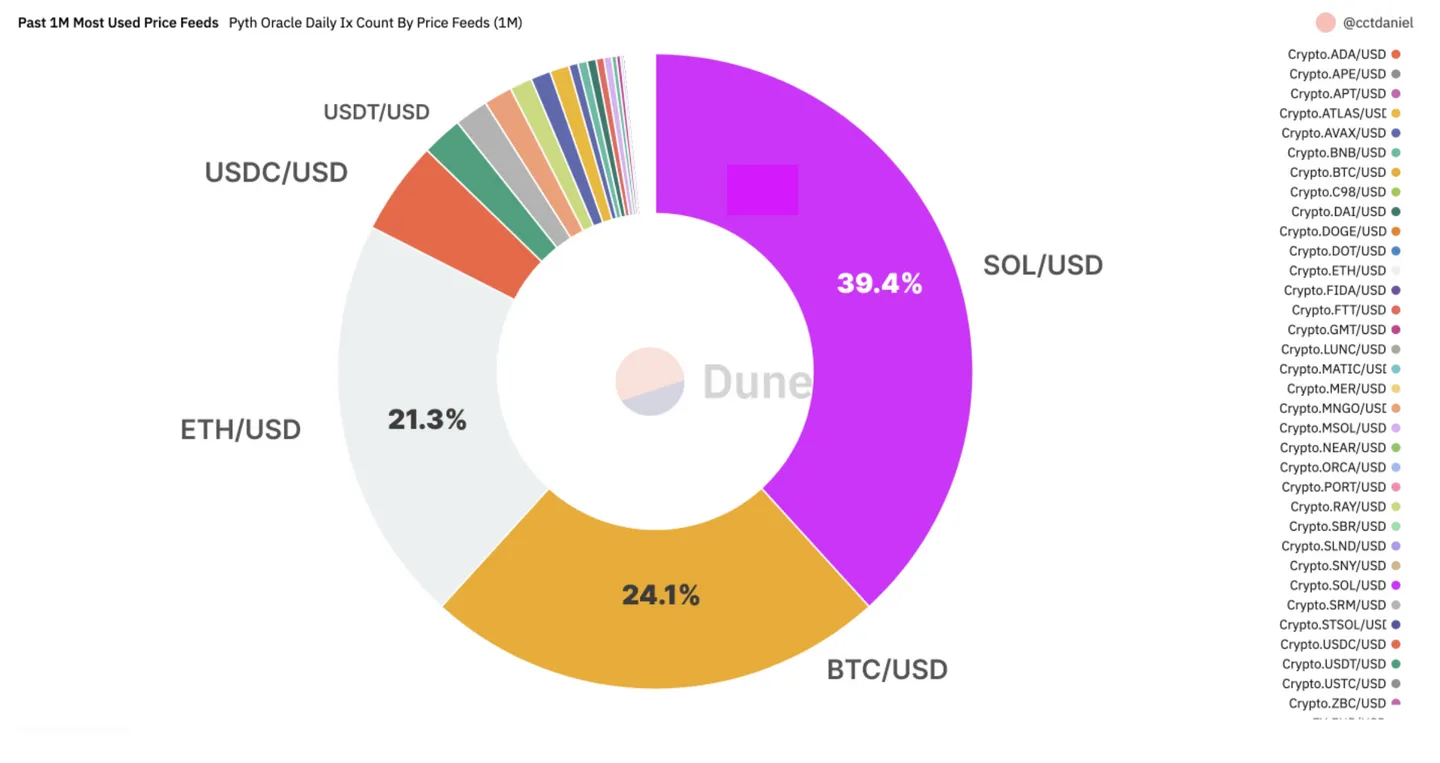
Pyth dominates Solana though (>90% market share), but there are other players on the Solana blockchain, such as Switchboard. In the Ethereum ecosystem, established players like ChainLink have posed a serious threat to oracles on Solana. In contrast, ChainLink has more than 1,000 data consumers, supports more than 12 blockchains, and secured a total value of $75 billion at its peak in December 2021, with a cumulative transaction value of more than $6 trillion. Currently, the data source is dominated by stablecoin trading pairs; however, as more and more applications and financial assets are on-chain, the demand for reliable external data will grow exponentially.
Potential use cases for oracles include:
Real-world assets on-chain: As more and more real-world assets (such as trade finance, Income-based financing, carbon credits, and real estate) on-chain, users will have a strong need for reliable data on these external assets. For example, if someone wanted real estate in New York to be traded on-chain, they would need a real estate price oracle through which they could obtain a reliable and robust price feed. At this stage, a project worthy of attention in this field is Parcl, which can help users access synthetic assets through AMMs, thereby tracking the global transaction price changes of real estate assets. In addition, Homebase on the Solana blockchain has also built a platform that allows users to invest in tokenized residential real estate for as little as $100 and obtain fractional ownership through NFT.
Weather, Politics and Sports: Since oracles are currently focusing on "financial market" data, There are not many oracle services in the fields of weather, politics and sports, so there are a lot of new opportunities. The typical use case here is prediction markets, where smart contracts need reliable data sources to settle bets related to topics such as sports. But for providers of weather, political and sports oracles, finding reliable data publishers is key.
DeFi organization formation
Achieving a coordinated balance among Solana DeFi players is more important than ever.
Risk management organization: can be constructed as a risk DAO or advisory committee to conduct research and Risk Analysis. These entities can publish public “risk analysis dashboards” with key indicators of the Solana ecosystem, and provide paid research, risk assessment frameworks, and risk rating services for DeFi projects.
Build a research and development laboratory similar to Proximity Labs, focusing on providing services for DeFi projects and Web 2 Enterprises provide DeFi-related research and development services. Proximity has been a major driver of DeFi in the NEAR ecosystem, and the project recently established a $10 million developer fund to fund and invest in new development teams, giving a huge boost to virtual order book transactions on NEAR.
Another idea is to build a DeFi project alliance to manage key assets such as OpenBook, Wrapped BTC/ETH, etc. public DeFi products and align incentives with key stakeholders.
Safer and more stable DeFi on Solana
The importance of security in DeFi cannot be overemphasized. Some people have used and attacked various DeFi protocols, such as Wormhole, Nirvana Finance, Crema Finance, Mango Markets, etc. Such attacks can result in significant financial losses, which shows that DeFi needs to pay more attention to security measures. The truth is, retail investors and institutions are losing real money as a result of these acts of vandalism. In all of these cases, hackers managed to exploit both code-level flaws and platform-level (i.e. oracle) flaws that could have been avoided by having a trusted third party audit the codebase, or by focusing on every single one that could lead to any Product decisions in questionable situations are avoided.
With increasingly sophisticated types of DeFi attacks, protocols must The product has in-depth understanding. There is a need for standard security measures for anyone building a DeFi protocol to ensure the entire ecosystem is protected. This may include security audits, open-source code repositories, and frequent code reviews to fix potential vulnerabilities.
Finally, Solana can no longer experience downtime due to stale asset prices, halted trading activity, etc. , downtime affects the DeFi ecosystem more than any other industry. Maintaining 100% uptime is critical to the long-term success of Solana DeFi.
Conclusion: Solana DeFi 2.0
While Solana DeFi has its fair share of issues, we believe 2023 will be the year that many of them are resolved. Overall, we will see Solana DeFi focus on:
Going mobile: Solana SAGA's flagship mobile phone, which will adopt a series of mobile-friendly standards such as Solana mobile stack, Solana payment and xNFT, will promote the mobile transformation of Solana DeFi, leading to the rise of super applications and user experience aggregators.
Tokenization of Assets: The credit market has started tokenization on Solana We will see more credits, such as personal loans, trade finance, income-based financing, carbon credits, etc. being tokenized. However, given Solana's high performance, the tokenization of high-frequency trading assets such as foreign exchange and stocks will be a direction worthy of attention.
Welcome to join the official BlockBeats community:
Telegram Subscription Group: https://t.me/theblockbeats
Telegram Discussion Group: https://t.me/BlockBeats_App
Official Twitter Account: https://twitter.com/BlockBeatsAsia

 Related Articles