Evolution of the Swastika Parsing Curve: A Path to protocol sustainability beyond token design
Evolution of the Swastika Parsing Curve: A Path to Protocol Sustainability Beyond Token Design
Original source: TEDAO
"Preface"
The last cryptocurrency bull market saw projects blossom and new narratives emerge, such as DeFi Summer, X to Earn, etc. The popularity of the market has brought more attention to Token price and Token economics,But often ignore the actual value and sustainability of the project, easy to enter the mood of FOMO.But as the market turned sour, the true value of many projects was exposed.Such as Terra/Luna, FTX And so on, the value is gone after the crash. Therefore, we need to calm down, reflect and summarize the reasons behind successful and sustainable projects.
As in V God: As described in Beyond Token Economics, successful sustainable projects need multiple elements, not just Token economics, because the crypto market is no longer a single Token economy mechanism competition, it has evolved into a "business & incentives & Governance "three aspects of comprehensive power game.
Many projects have explored the secrets of success, and as a result, Web3.0 & have spent The leader in the field, Curve The growth path can provide useful experience and inspiration for other projects. This paper aims to:
1. Take Curve protocol as an example.By dividing the evolution of Curve into different stages (as shown in the table below), its development trajectory and success path can be understood more comprehensively and systematically. (Note: "Curve X.0 stage" refers to the growth stage of Curve, such as stage 1.0; "Curve VX.0" refers to the functional version of the protocol, such as Curve V1.0)
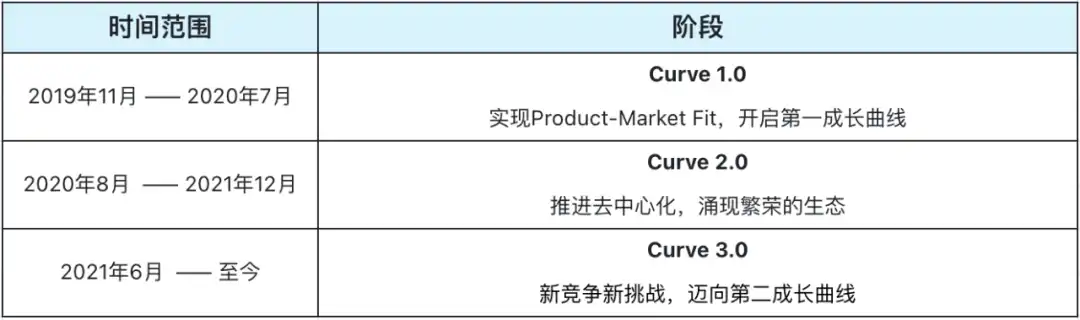
2. Explore the important facts and key measures behind the development of Curve. These key points, which may have been overlooked or not mentioned in other articles, are the cornerstones behind Curve sustainability. passSummarize the successful rules and patterns of Web3.0 project, and provide useful inspiration and reference for other projects.
Note: The content and ideas in this article are not intended to promote the Curve protocol or any other protocol. This article is purely for discussion purposes and should not be construed as investment advice.
"Curve 1.0 phase" : realize PMF and open the first growth curve 2019.11 2020.7 & have spent
1. The background of Curve's birth: the scale of stablecoin continues to expand, CEX and DEX High transaction cost
Around 2019, with the continuous development of the crypto market, especially the rise of DEFI, the types and scale of stablecoins (dollar-linked assets such as $USDT and $DAI, etc.) and other linked assets such as $wBTC and $renBTC) keep increasing. Demand for transactions is growing rapidly. For example, from $24 billion in Q1 2019 to $79 billion in Q3 2019, stablecoin volume increased by 229%. . This has created a whole new market segment around these assets.
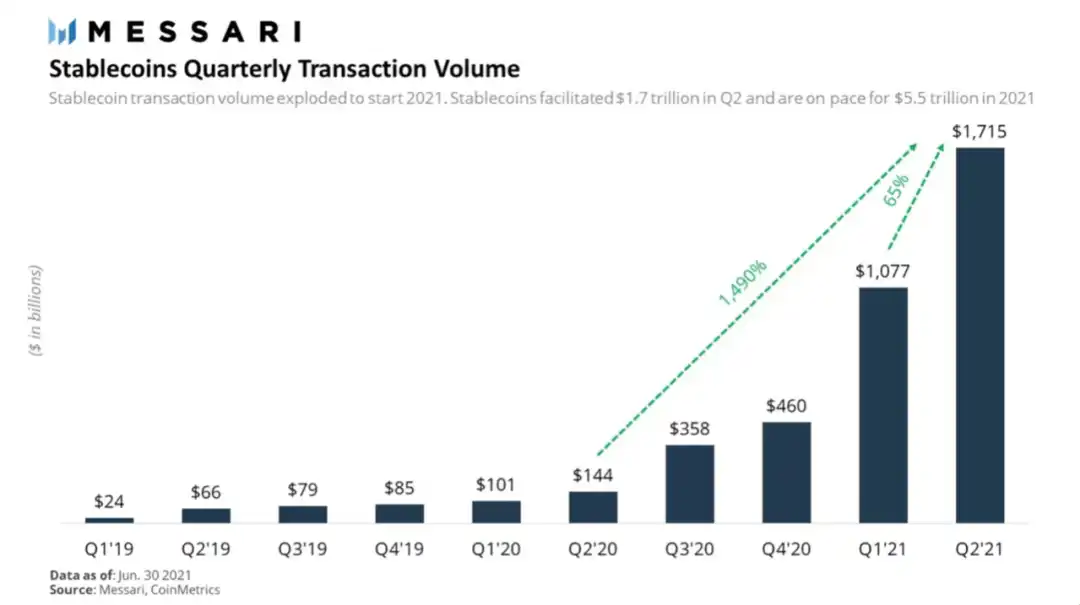
Photo credit: Messari
At the time, however, the biggest problem for issuers of linked assets such as stablecoins was how to ensure that the asset's price did not get out of line with the anchor price, while providing excellent low slip depth at the anchor price point. However, using the mainstream CEX or DEX to trade these assets can result in high processing fees and high slip points.
For example, at that time. Uniswap On V1, most of its liquid capital pool consists of $ETH. To trade a pair of stablecoins on the platform, users need to make two transactions and pay two transaction fees. Stablecoin transactions tend to be large and people are more sensitive to transaction costs. So publishers need to find better trading solutions.
2. Business mechanism: The original stablecoin AMM solves market pain points
Aiming at the above Market pain points, Curve proposes an innovative Automated market Makers (Automated Market makers). AMM, which focuses on trading stablecoins and other linked assets. Protocol founder Michael Egorov published the "StableSwap" white paper in November 2019, and the product V1 version is in 2020. Year 1 Month officially online.
Curve uses an AMM trading mechanism between a constant sum (x+y=const) and a constant product (Uniswap xy=const) function. Specifically, this mechanism creates a relatively flat curve near the equilibrium point of the curve, similar to a constant sum function, to keep the price relatively stable, It makes the two ends more inclined, kind of like a constant product function, so that it provides liquidity at every point on the curve. Here is a schematic of the mechanism:
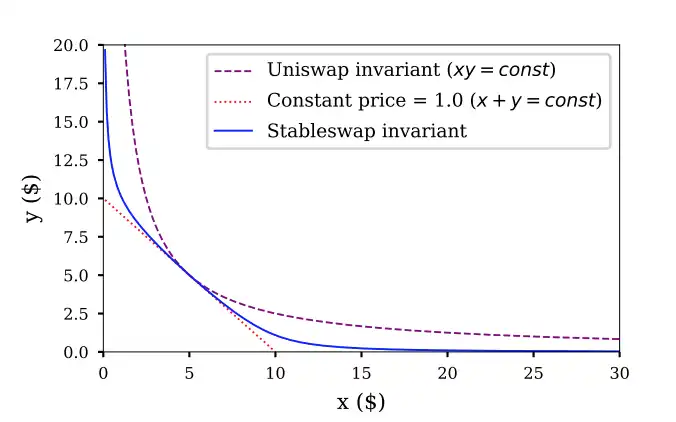
Image credit: Curve
Compared to the mainstream constant product AMM (e.g. Uniswap), Curve has been optimized by design,It achieves low slip point, low transaction commission and low risk of volatile loss, which makes it able to meet the demand of huge stablecoin transactions.Convert from $DAI to $USDC at that time; For example, the slip point of Uniswap is about 0.80% And the slip point of Curve is only 0.06% . .
3. The protocol is online but no Token is issued: Verify Product-Market Fit
Contrary to many people's expectations, Curve was not released when it went liveRow Token,Protocol governance is also centralized. However, it has achieved natural growth through successful collaboration with other agreements.
In the initial stage, Curve and Partnerships with DEX aggregators such as 1inch.exchange have attracted early adopters. And dYdX, Compound, Aave The integration of such platforms not only allows users to enjoy easy transactions, but also gains other considerable rewards. In addition, Curve is associated with Synthetix, Ren and others have jointly launched a new liquidity incentive pool to provide liquidity incentives, thus guaranteeing a minimum slip point for transactions between linked assets $sBTC, $renBTC and $wBTC. These successful partnerships got more users actively involved and helped Curve's transaction volume grow steadily.
In the six months from its launch to July 30, 2020, Curve has accumulated more than 8,000 users, and the cumulative transaction volume has reached $1.5 billion, ranking the top four in DEX in the first half of this year. This result validates Product-Market-Fit and provides a solid foundation for the Curve platform to steadily grow in appeal and revenue.
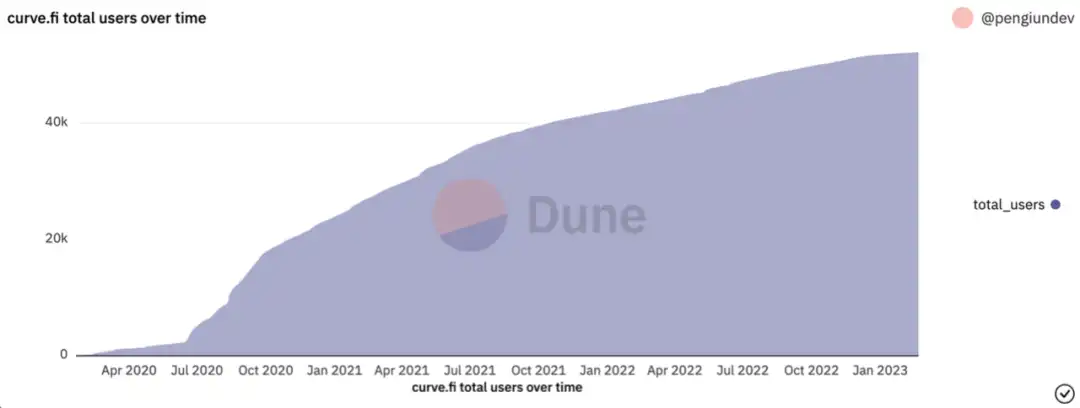
Photo credit: dune.com
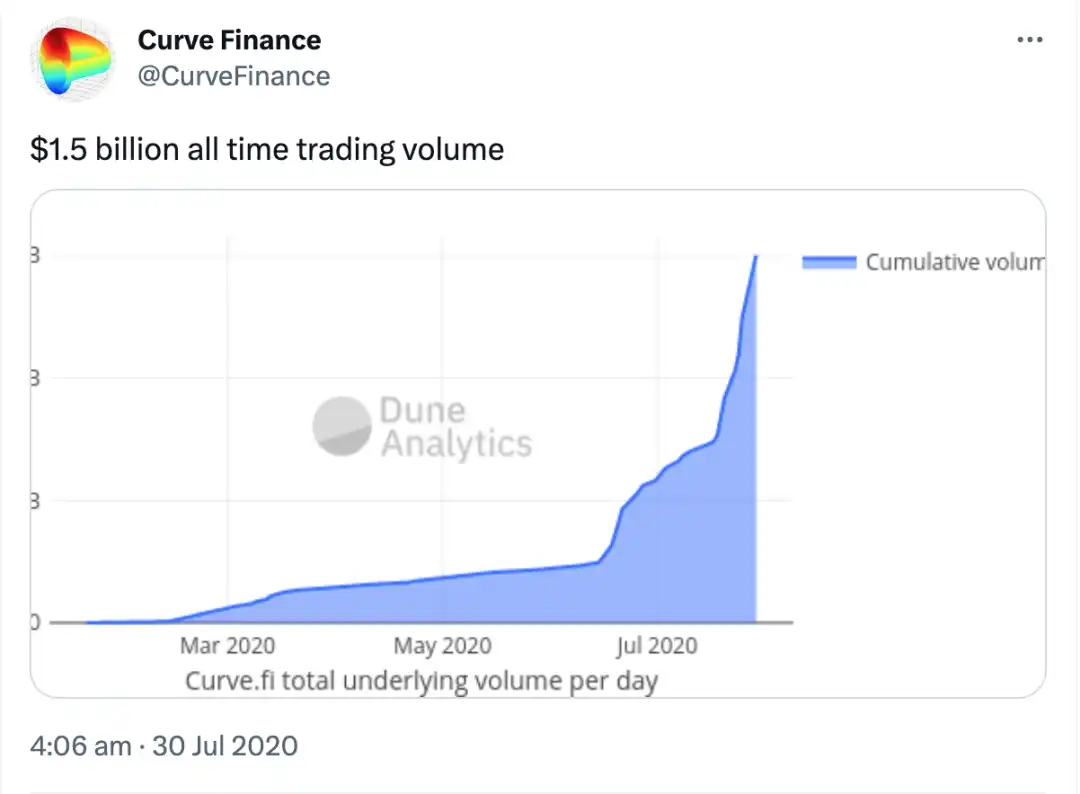
Image credit: Curve
4. Comments and Insights on Curve 1.0 : PMF Is the first element of Web3.0 protocol success
Token economy design was once seen as a panacea, just like Curve's veToken economy model, which has been touted as the secret to Curve's success. In fact, successful projects like Uniswap and Curve didn't issue tokens at all in their initial launch. Therefore, we should tell you not to be too keen on Token economy design,PMF is the first element of Web3.0 protocol success.
The Token economy, while an important part of protocol design, can indeed engage users and incentivise community building. However, the Token economy design without PMF support, no matter how perfect, cannot attract sufficient market demand and users, and the project is difficult to succeed. Jesse Walden, former managing partner of Andreessen Horowitz, also pointed out that in the early stages of building Web3.0 protocols, the only thing that mattered was Product-Market Fit.
Issuing tokens too early, not only has no benefit, it may bring negative effects. (Note: We will not discuss "Token required" protocols such as Bitcoin, Ethereum, etc.) Studies have shown thatPremature issueTokenIt undermines the intrinsic motivation of users, making them focus on profit rather than the value and experience of the product itself. As God V said: the first law of Token economics is: do not take advice on Token economics from people who use the term "Token economics".
So how to achieve Product-Market Fit?In Web3.0, to implement Product-Market Fit, you must first find a market opportunity or pain point. This means getting to know your target audience, their likes and needs, and the gaps in the market.Then think about the business: how to build a product to meet the needs of the market. Attention to detail to ensure that the product can solve the pain points in the market and can meet the real needs of users;Finally, verify the PMF: By focusing on metrics such as customer satisfaction, retention, and revenue, verify that the agreement can grow naturally, rather than depending on itTokenEconomic incentive. It should be mentioned that in Curve 1.0, the protocol is technically decentralized, but it is still decentralized in terms of economy and governance (note: "Product" in Product-market Fit here refers to the protocol in Web3.0).
"Curve 2.0 Stage" : Promoting decentralization and emerging prosperous Ecology;
1. Introduce tokens and initiate veToken mechanism to promote economic decentralization and build long-term consensus
After verifying PMF and achieving natural growth, Curve launched Token$CRV and introduced the pioneering veToken mechanism in August 2020 in order to further promote the development of the protocol. veToken, short for "Voting Escrow Token", is a voting governance mechanism. This mechanism allows users to Lock protocol tokens into a smart Contract called a "Voting Lock Contract" (" Vote lock contract ") in order to obtain a certain number of Vetokens, or voting rights for the governance of the agreement. The veToken mechanism is designed to encourage users to hold their tokens for the long term and promote greater incentive alignment between participants, thereby improving the supply and demand of tokens and providing a sustainable governance foundation for the agreement.
| TokenDistribution and distribution: A continuous balance of incentives to promote economic decentralization
The maximum supply of $CRV is 3.03 billion. Initial supply of 1.3 billion (43% of total issue ) The distribution modes include: 5% to early stage liquidity providers. 30% To the team and the investors. 3% To employees. 5% For community reserve. The rest. 57 per cent will gradually release incentives as future liquidity providers, with no linear unlocking time frame until the issuance ceiling is reached. The Token release cycle is long, with only about 75% of the total supply released by 2026. .
In terms of the distribution of tokens, not only are early contributors considered, but there is also room for future participants, thus incentivize more people to participate and facilitate the development of the protocol. Over time, tokens are dispersed to a high degree and will not be concentrated in the hands of a few people, avoiding excessive concentration of economic rights and thus promoting the decentralization of the economy.
Curve In order to ensure sufficient liquidity of its trading platform, the Agreement allocates a total of 62% of $CRV supply to the liquidity provider as a reward (note: on Curve, the liquidity provider can receive a 50% share of transaction costs in addition to the $CRV reward). Such incentives are designed to reduce trading slippage by improving liquidity, thus attracting more participants and increasing volume.
|TokenValue capture for agreements: Build a "long-term consensus" and lay the foundation for decentralization of governance
The veToken mechanism introduced in Curve protocol requires users to lock a certain amount of $CRV tokens to Curve . DAO For a period of time in exchange for $veCRV representing voting rights in governance. $CRV/$veCRV captures the value of the agreement adequately, and the transaction cost generated by the Curve platform will be allocated to the holder of $veCRV in proportion (see the of the following five Rights and Interests for details; 3 Smaller), which means that the value of the Token grows with the success of the protocol.
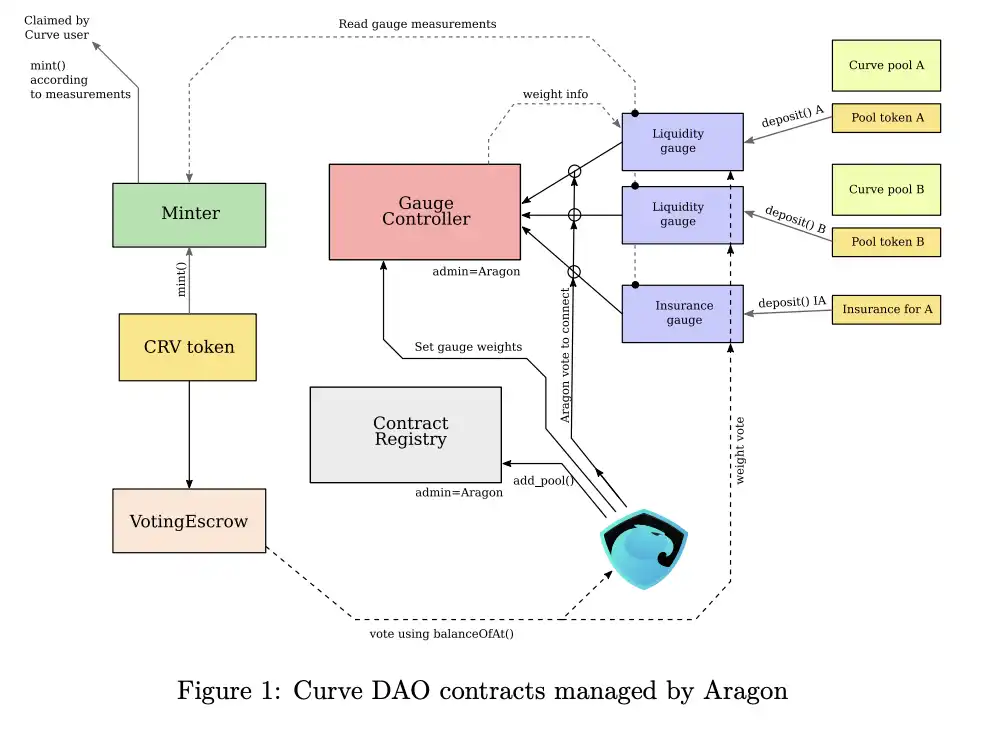
Image credit: Curve
Holders of $veCRVToken will enjoy the following five benefits:
(1 ) Governance voting rights on the allocation of $CRV incentives: $veCRV holders can participate in periodic voting to determine the weight of the allocation of incentives among various liquidity pools in the Curve, thus influencing how much $CRV emissions incentives each liquidity pool gets. This is the core of the equity.
(2 ) Other governance voting rights: Participate in the governance of Curve DAO, and can submit proposals and vote on proposals, involving the addition of liquidity pool, the parameter setting and modification of the agreement, etc.
(3 ) Obtain the transaction commission of the platform: Share the transaction commission of the agreement according to the number of $veCRV, and the proportion of sharing is 50% of the total commission . Divided into 3 CRV Token Issuance (3 CRV is a stablecoin exchange pool. POOL liquidity POOL Token (hereinafter referred to as "LP" ), which can be converted into 1: 1 into other stablecoins, among which 3 POOL consists of $DAI, $USDC and $USDT).
(4 ) Increase the liquidity provider's market-making returns: When the liquidity provider locks in $CRV, it can increase the $CRV reward they get for pledging LP in the Curve pool (up to 2.5 times). The amount of $CRV needed to increase revenue depends on the amount of LP and the Curve pool the provider is in. See the link for details.
(5 ) The longer $CRV is locked up, the greater the amount of $veCRV and the corresponding rights and interests. The specific rules are as follows:
i. The longer the user locks the warehouse $CRV, the more $vecrVs are obtained. Specifically, one $CRV Token in a lock-up will earn one $veCRV for four years, while only 0.25 $veCRV in a lock-up for one year. The maximum lockup period is 4 Years.
ii. As the $CRV of the lock-in warehouse gradually approaches the expiration time, the number of the corresponding $veCRV will linearly decay. For example, the lock bin. After 4 years of $CRV, the user's initial 1 $veCRV Token decays to 0.75 after 1 year.
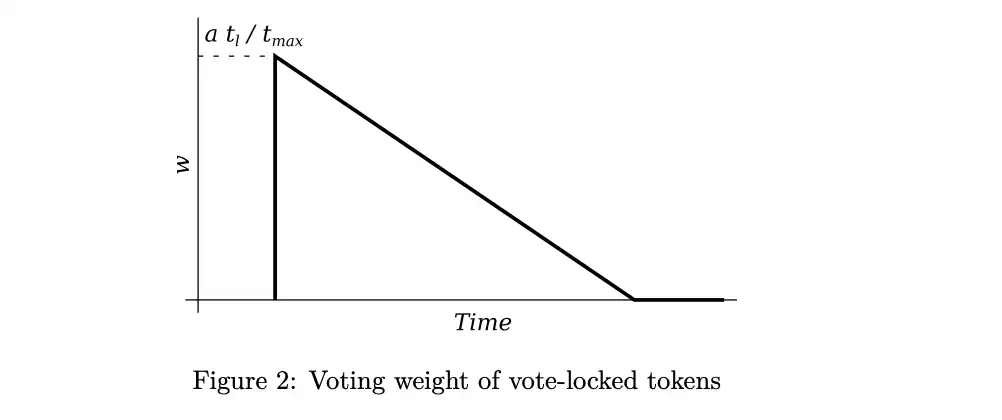
Image credit: Curve
iii. The process of locking up $veCRV is irreversible, which means that the user must commit to hold $CRV for a long time. Meanwhile, $VecrVs are also non-transferable, that is, $VecrVs held by users cannot be transferred to other addresses during the locked period.
The veToken mechanism allowsTokenLong-term holderToken withThe success of the support agreement builds a "consensus" among the holdersThis consensus not only helps to increaseTokenValue, and also laid the foundation for decentralized governance of the agreement,This is because it is based on equal rights and participation among Token holders, thus ensuring a fair and transparent governance process.It is important to emphasize that the "decentralization of governance" discussed in this article is a broad concept that includes multiple levels and types of governance structures and multiple paradigms, not just a narrow concept of direct, first-tier governance.
The issuance of the protocol Token $CRV and the pioneering veToken mechanism have contributed to the continued growth of the protocol TVL and trading volume. From August 2020 to February 2021, half a year after $CRV Token goes online, the TVL of the agreement will be changed from $ 136.96 & have spent M increases to $ 3.8 & have spent B, cumulative trading volume from $ 12.15 & have spent B increases to $ 129.46 & have spent B. Although high incentives for liquidity providers bring high inflation of $CRV, which may dilute the rights and interests of Token holders, the rapid rise of Curve business volume has boosted the steady growth of $CRV lock-up, reduced the circulation supply of additional tokens, and helped stabilize the price of $CRV.
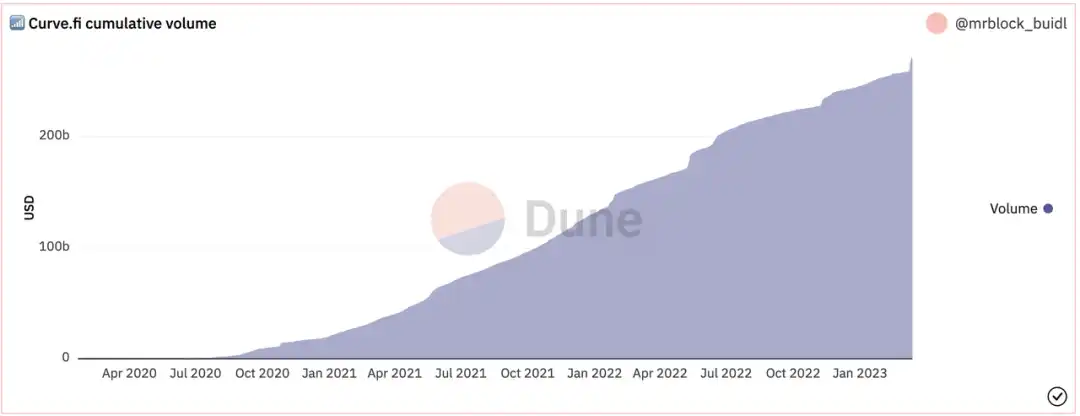
Photo credit: dune.com
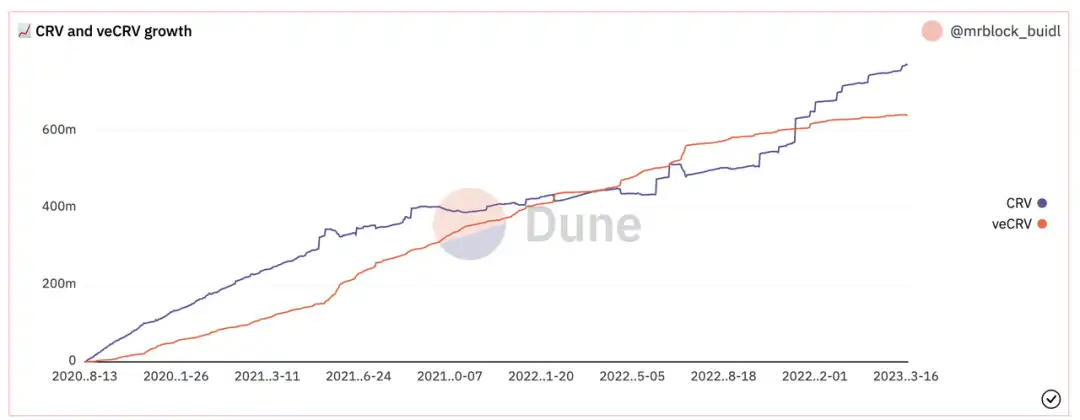
Photo credit: dune.com
2. Economic decentralization breeds prosperity, and governance becomes more decentralized
The continuous growth of Curve TVL and trading volume, as well as the multiple rights and interests brought by veToken mechanism to $veCRV holders, make stakeholders gradually realize that holding $veCRV, especially enjoying the governance voting rights of $CRV award distribution, can bring more liquidity and benefits for themselves. Plays a huge role in the success of their respective projects. Therefore, $CRV/$veCRV becomes the focus of contention by all parties, thus launching a war for governance rights of Curve.
Emergent representative projects such as Convex, Votium, yBribe, Redacted, etc., contended for the right of Curve governance. These projects encourage more people to participate in governance and vote, and promote decentralization of governance by increasing the real benefits of voting rights in governance. This paper focuses on key events and representative items that occurred in Curve 2.0. It's important to note that the Curve ecology includes many other items, but we won't go into details here. For more detailed information about ecology, please refer to the Curve ecological map and related descriptions made by Mr. @Block in November 2022.
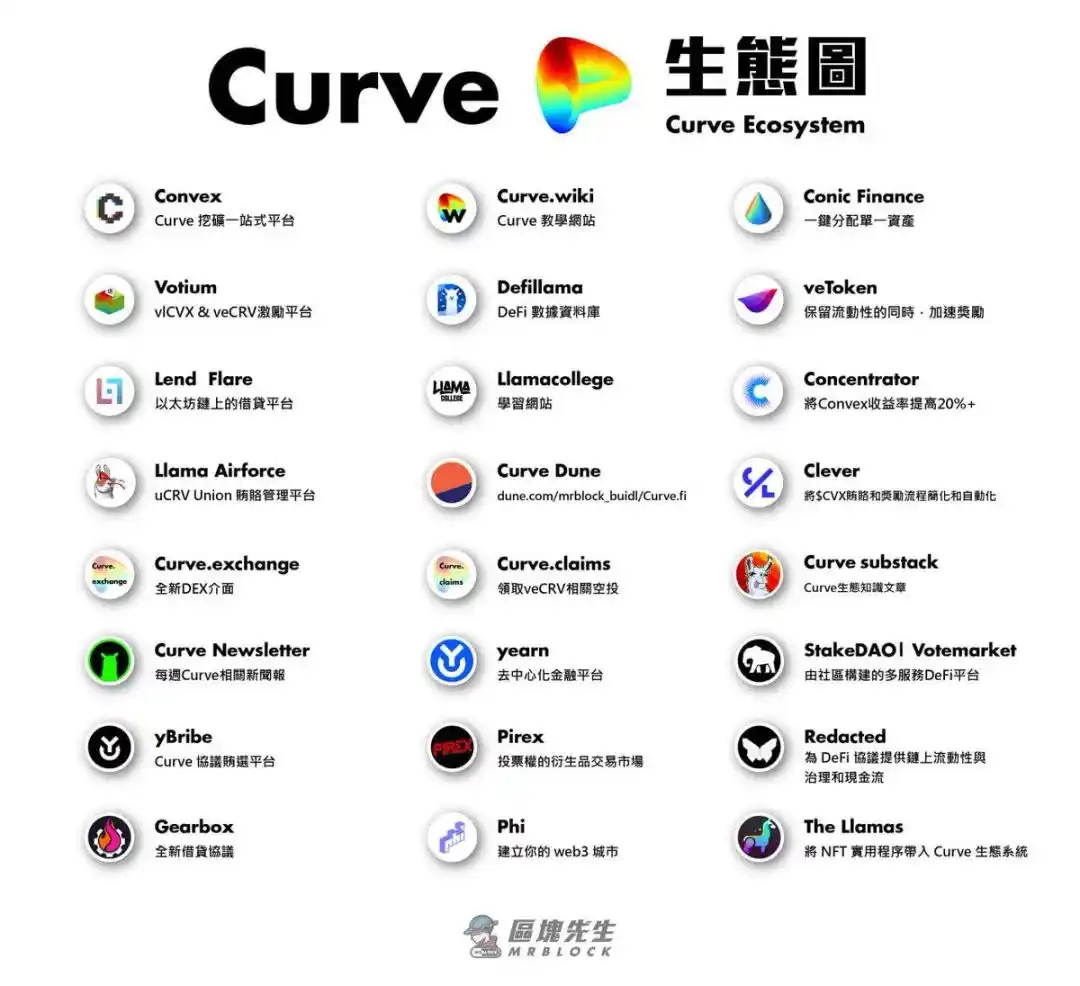
Photo credit: twitter@MRBLOCK
| Yearn and Convex Curve open governance voting for the war
Curve is Yearn and Harvest because of its stable earning capacity, high capital capacity and good security. The main source of income for aggregators such as Finance. These aggregators help users manage and enhance asset returns, leveraging the advantage of scale to maximize returns by focusing users' crypto assets on Curve. However, having enough $veCRV can control the voting power of Curve governance and improve the reward distribution and revenue. In order to provide users with higher profits and expand their business, aggregators have launched a competition for the voting rights of Curve governance.
(1 ) Yearn accumulates a large amount of $CRV to boost earnings, threatening the governance of Curve
In the early days when $CRV went online, Yearn adopted various strategies to accumulate a large number of $CRV tokens to increase revenue and influence the decision-making power of Curve. This includes introducing a Backscratcher machine gun pool, aggregating assets of liquidity providers and $CRV holders, centralizing deposits to Curve for higher yields, and in Sushiswap The $yveCRV/$ETH liquidity pool is launched to allow $CRV holders to enjoy the rights and interests of $veCRV while avoiding the restrictions of $veCRV lock, and the liquidity of $yveCRV/$ETH pool is improved through the partnership with SushiSwap. This increases the demand for $yveCRV.
However, in the early stage of Token issuance, the number of Token circulation is small and the distribution is not dispersed enough. A large amount of $CRV leads to centralized governance, which affects the development of Curve protocol.
(2 ) Convex's control of voting rights in Curve helps to decentralize governance and aggregate more liquidity for Curve
Convex Yearn breaks the dominant role of Yearn in the accumulation of $CRV/$veCRV. As a Curve-based revenue aggregator, Convex aims to maximize returns for Curve liquidity providers and $CRV holders. In the early days of its launch, the Convex Convex has quickly outstripped its competitors in the number of $CRVS it has accumulated. Not only does it have the support of the Curve team and the trust of the community, but it also enhances the earnings of Curve liquidity providers and $CRV pledgers at a lower cost. The key advantage lies in the protocol Token $CVX, which has a unique Token incentive mechanism and distribution beneficial to the community. The amount of $CVX issued and the $CRV earned by the Convex on Curve; Quantity linkage. The total supply is capped at 100 million pieces. 10% Leave to the Convex team, 3.3 percent was allocated to investors and the remaining 86.7 percent to community incentives. In the governance mechanism, the Convex With veToken voting, $CVX holders are required to lock in their tokens for a period of time (at least 16 weeks) to obtain $vlCVX, or governance voting rights. Since the Convex protocol has a large number of $VecrvTokens and is included in the Curve governance whitelist, it can participate. Curve's voting program and passes governance voting rights to $vlCVX holders.

Credit: Convex
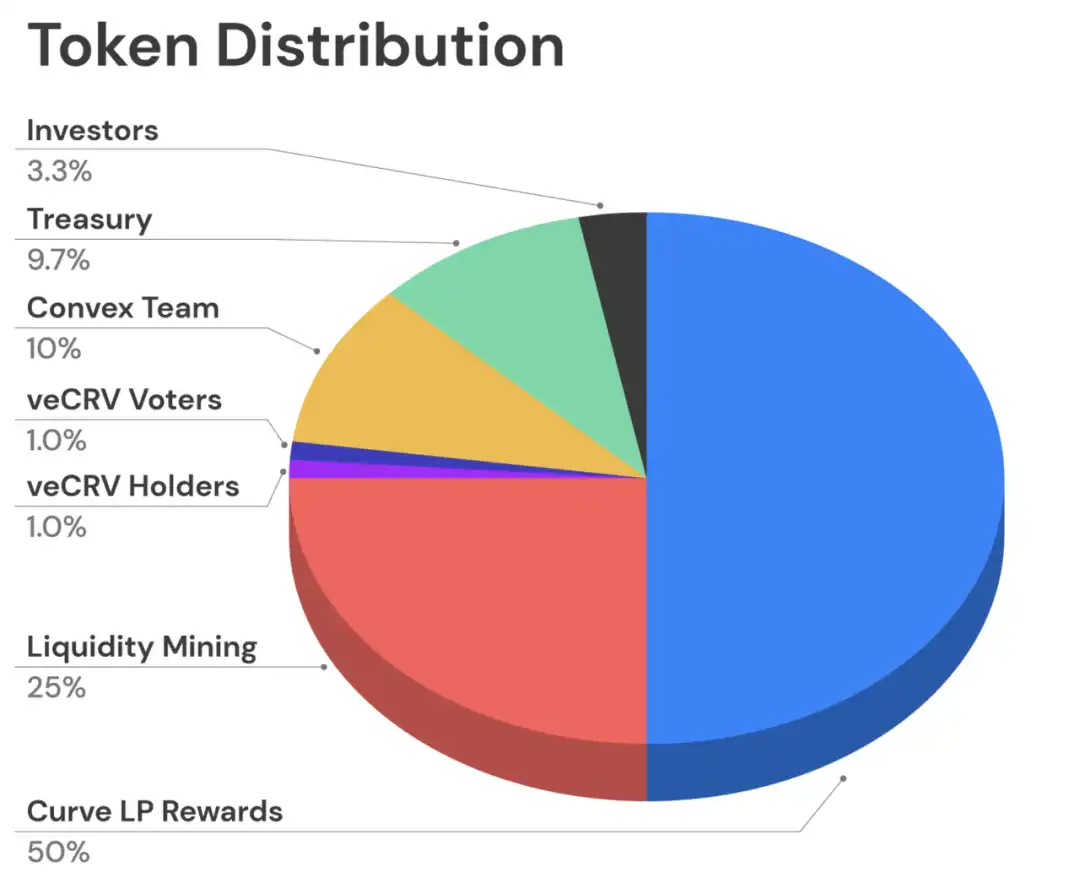
Credit: Convex
The $CVX Token mechanism provides holders with more incentives and agreement governance rights, attracting a large number of Curve liquidity providers and $CRV holders, as well as competitors such as Yearn, Stakedao and other agreements to invest assets in the Convex. Up to 2022 In January 2003, the Convex Convex had secured nearly half of the $veCRV available to effectively determine the $CRV award allocation. Although the Convex Convex holds a large amount of $CRV, which raised concerns about the centralization of the governance rights of Curve, in fact, by using the Token economy model, it promoted the decentralization of the Convex, including economy and governance. So to speak,Convex controls the votes, in effect ensuring that the Convex convexes. On the basis of the overall benefits of the protocol, it is another effective path to promote the decentralization of Curve governance.Convex, Yearn, etc., compete for the right of governance, forming a huge black hole of attention, so as to provide more liquidity for Curve. The mostFinally, Convex successfully controlled the voting rights of Curve governance, which facilitated the formation of a liquidity ecology surrounding Curve.
| stable currency project to join governance voting for the war
Many issuers of stablecoins and other linked assets, such as Frax and Lidos, which require large amounts of liquidity to support the trading and conversion needs of their issued assets. Around 2021, Curve has the advantage of providing a low slip point, low fee trading experience, "sourcing" a lot of liquidity by rewarding $CRV, compared to other centralized trading platforms CEX and decentralized trading platforms DEX like Uniswap, As well as low barriers, no licensing, and composability.
Therefore,Issuers of linked assets such as stablecoins have chosen to create their own exchange pools on the Curve protocol to gain more liquidity and participants. This has led to a surge in demand for Curve voting rights. First, access to Curve's core liquidity pool must hold a significant number of votes, supported by community voting. As the total amount of $CRV in circulation increases, the threshold will continue to rise. Once in the pool, issuers need to gain more voting power to achieve greater liquidity depth.
With the continuous emergence of linked asset projects such as stablecoins, the battle for liquidity on Curve ecology has been started, resulting in pairs . Curve large demand for governance voting rights.
| bribery platform for retail strength rise, promote decentralization management
Since the launch of $CRV, Curve voting rights have played an increasingly important role in the success of various projects, such as stablecoin issuers and revenue aggregators. However, a large number of retail investors who hold voting rights lack the motivation to participate in voting because they cannot directly benefit from voting, and the project side needs enough voting rights to influence the award distribution of $CRV. To solve this market pain, Votium and Bribe platforms bribe. Crv. finance based on crv voting rights were launched successively in August 2021.
theseThe platform allows projects to provide incentives to holders of voting rights in CRVS to obtain voting rights, thereby enabling holders to obtain actual economic benefits and promoting their participation in agreement governance voting.This not only helps decentralizing governance by avoiding the need for a small number of large holders to determine agreement direction and reward allocation, but also enhances the governance utility of $CRV/$veCRV and promotes Token demand. On the other hand, Stablecoin project parties can obtain liquidity at a lower cost, making the Curve ecology more attractive, but this also intensifies competition among project parties.
The emergence of various bribery platforms provides more ways for project parties to obtain liquidity, which further escalates the liquidity war.
| Redacted further enhance the income of the vote, implement governance decentralization to the greatest extent
Although the appearance of bribery platform improves the participation in Curve governance, there are also problems of unfairness and opacity, which may lead to malicious voting and improper behavior. Therefore, it is necessary to weigh the advantages and disadvantages when adopting this approach to ensure the fairness and transparency of the agreement governance. To this end, Redacted's forked agreement as Olympus DAO emerged in December 2021, focused on providing governance services for the Curve ecosystem.
Redacted attracted a large number of participants through the incentive of the offering agreement $BTRFLYToken, gaining a large number of Curve voting rights. The first product to go live was a platform called Hidden Hand, where users delegated their voting rights to Hidden Hand, and Hidden Hand sold those votes to external agreements that needed them. And redistribute the bribe rewards of these external agreements to users, agreement vaults, and $BTRFLY pledges. All voting processes and revenue maximization are handled by Hidden Hand.
Redacted has also expanded its practice into governance rights management in other ecosystems, introducing new products and upgrading the Token economy.
Compared to traditional "bribery platforms",The emergence of Redacted further improved the income of voting rights in Curve, encouraged more people to participate in the governance of Curve agreement, and further promoted the decentralization of governance of Curve. However, there is no single answer or optimal solution to good decentralized governance. Different projects need to choose their own governance methods and mechanisms according to their own needs and situations. Curve's governance decentralization is only one of the paradigms. This paper does not mean to take Curve's governance paradigm as an industry benchmark, but introduces specific cases to let readers have a deeper understanding of the practice and application of decentralized governance.In the analysis and evaluation of decentralized governance, the process and mechanism of governance, the degree of decentralization, community participation and governance efficiency, governance transparency and security, innovation and sustainability can be considered. 5 The evaluation is carried out on each dimension.
3. Comments and insights from Curve 2.0: Decentralization of economy and governance contributes to the emergence of rich ecology
Curve has been trading more than $6 billion a month since it began in March 2021. Part of the reason is that the crypto industry was on the rise at the time and crypto asset market capitalization was hitting new highs. Curve 2.0 phase is the key moment of Curve protocol development, shows how the decentralization of economy and governance in the Web3.0 environment promotes ecological self-organization and growth, as well as the generation of Curve network effects.
Curve protocol cleverly integrates $CRV and veToken mechanism, closely connecting multi-stakeholders such as Token holders, liquidity providers and protocol developers, realizing more harmonious benefit distribution and promoting the pace of economic decentralization. Help decentralize governance by establishing a long-term "consensus" that allows only long-term Token holders to vote in governance. This decentralized approach has motivated many stakeholders to actively join the Curve ecosystemWe need to work together and rationally to inject strong impetus into ecological development. Thanks to the vigorous development of Curve ecology, liquidity and market trading volume keep rising, and these two factors encourage each other, forming a positive feedback cycle. This cycle further promotes the efficiency and scale growth of the whole ecology, and network effects begin to show.
In the Web3.0 era, the ecosystem is very important to the protocol, and it can bring a lot of value to the protocol. First, a thriving ecosystem attracts more users and liquidity, thus boosting the protocol's market share and competitiveness. Secondly, the development of the ecosystem helps to provide more functions and application scenarios, create a better user experience for participants and enhance their loyalty. In addition, it can lead to more innovation and development opportunities, creating more room for the agreement to grow.Finally, network effects brought about by the ecosystem will further strengthen the competitive advantage of the protocol. Decentralization of economics and governance is seen as a fundamental and key tool to drive ecological enrichment and increase the value of agreements.
However, when building a healthy and sustainable ecology, we need to focus on positive externalities. Take Tokemak, a liquidity management protocol emerging in 2021 as an example. Although it tries to build a liquidity management market by learning from Curve ecology, its business model is limited to buying and distributing liquidity, and it lacks cash flow generated by trading business, so it is difficult to achieve a balance of payments. Therefore, it is difficult to maintain this model in the long term. We need to recognize that it is not enough to rely solely on decentralized design of technology, economics and governance to attract ecological players.Without sustained value creation, ecology will not be sustainable in the long run.
"Curve 3.0 stage" : New competition and new challenges, towards the second growth curve
Curve promotes the implementation of protocol network effects by introducing Token and veToken mechanisms, and has achieved phased success. However, in order to achieve the sustainable development of the protocol, Curve still faces many challenges and doubts.
1. Fierce competition in DeFi: Curve faces challenges from homogeneous and non-homogeneous competitors
Competition in the DEFI space is fierce, and Curve's revenue growth is challenging, with significant risk of revenue decline.There are competitors from the same business, through technological innovation to seize business revenue.For example, In May 2021 Uniswap launched version 3 of the protocol, which uses a centralized liquidity algorithm mechanism to improve Stablecoin market makers' capital utilization efficiency and reduce traders' transaction rates and slip points, thus threatening Curve's share of stablecoin trading. Based on the comparison between Curve and Uniswap stablecoin transaction volume in the figure below, it can be seen that Uniswap has gradually increased its market share in stablecoin transaction volume relative to Curve since the launch of Uniswap V3.
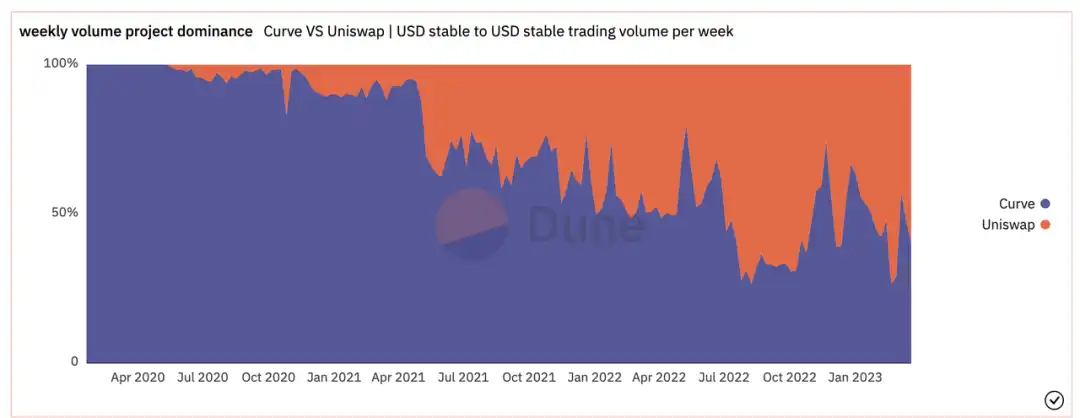
Photo credit: dune.com
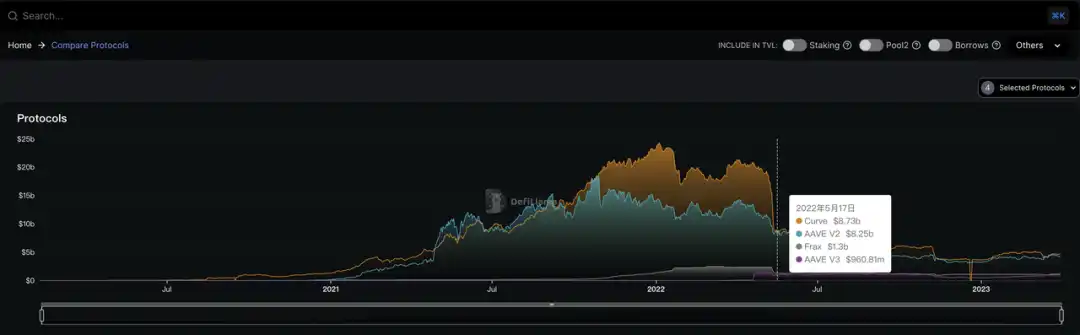
There are also competitors from non-homogenous businesses, TongOverexpand its product and service line to attract a wider audience and ensure that its platform can meet the different needs of users to compete for business revenue. For example, lending protocol Aave plans to launch its own native Stablecoin, while Stablecoin issuer Frax has launched its own trading and lending platform aimed at expanding DEFI's full-stack business to attract more user inflows. Looking at the TVL trend chart below, we can see that Curve used to have a significant advantage, but has now lost ground. More than. In addition, the gap between Curve and Frax gradually decreases.
2. Sustainability challenge of Curve Token economy: Diminishing marginal benefit and bubble risk
The Token economics of Curve has indeed brought a lot of liquidity to Curve, thus promoting the flourishing development of ecology and the increasing transaction volume. However, whether this model is sustainable has been debated. The data show that the efficiency of using funds (transaction volume/total lock-in value) in the Curve is low, despite increased liquidity through incentives. whenAfter liquidity reaches a certain critical point, the enhancement effect on the transaction volume and business revenue of the agreement begins to weaken significantly, which is "diminishing marginal benefit". This shows that high inflation cannot increase transaction volume forever, and diminishing marginal benefits should be emphasized.
It is more important to continue adoption after liquidity has reached a critical pointHigh inflation incentives may allowToken quiltOverestimate and cause bubbles, impeding the future development of the agreement. To be specific,
1 ) Some participants are overly optimistic about the agreement due to the high liquidity brought by high inflation, which leads to the overvaluation of Token prices. But high inflation did not bring a parallel rise in trading volumes, leading to bubbles.
2 ) Consume the future value of the agreement. If the supply of tokens exceeds the actual demand too quickly, the bubble in Token prices could burst, causing the value of the tokens to fall, thus damaging the future value of the agreement.
3 ) High inflation raises the cost of entry for latecomers to the deal, who need to buy more tokens to get the same number of rewards. This may cause the latecomers to lose the opportunity to participate in ecological construction and limit the potential of ecological development.
It should therefore focus on boosting trading volumes rather than relying solely on high inflation to stimulate liquidity. In the face of competitive pressures, bubbles and Pond's doubts, Curve may have recognised the importance of volume and value creation and started a second growth curve. New business directions it is exploring include 1 ) Expanding "volatile asset" trading; 2 ) The launch protocol has its own stablecoin.
3. Release V2 version of Curve to expand trading objects and compete for trading income of "volatile assets"
Innovation and adaptation are key to staying competitive in the evolving DeFi world. With Uniswap V3 coming in 2021 5 Curve released version V2 of the protocol in June of the same year. Through technological innovation, Curve has upgraded its market-maker model to enable it to support trading in "volatile assets." The move marks Curve's foray into the market for trading beyond stablecoins and other linked assets, further enriching its footprint. The Curve of Curve V2 (orange line) is located between the constant product curve (dashed line) and Curve V1 (blue line), and the end of the curve gradually converges to the constant product curve. This improvement makes V2 not only retain the advantages of low slip point and high liquidity of V1 curve in the smooth region, but also overcome the problems of insufficient liquidity at the tail end and lagging response to price changes. In addition, V2 has a unique internal prognosticator. EMA mechanism prevents external risks, improves liquidity concentration and reduces gratuitous losses. Meanwhile, the dynamic nature of V2 Curve further improves the capital efficiency of curve.
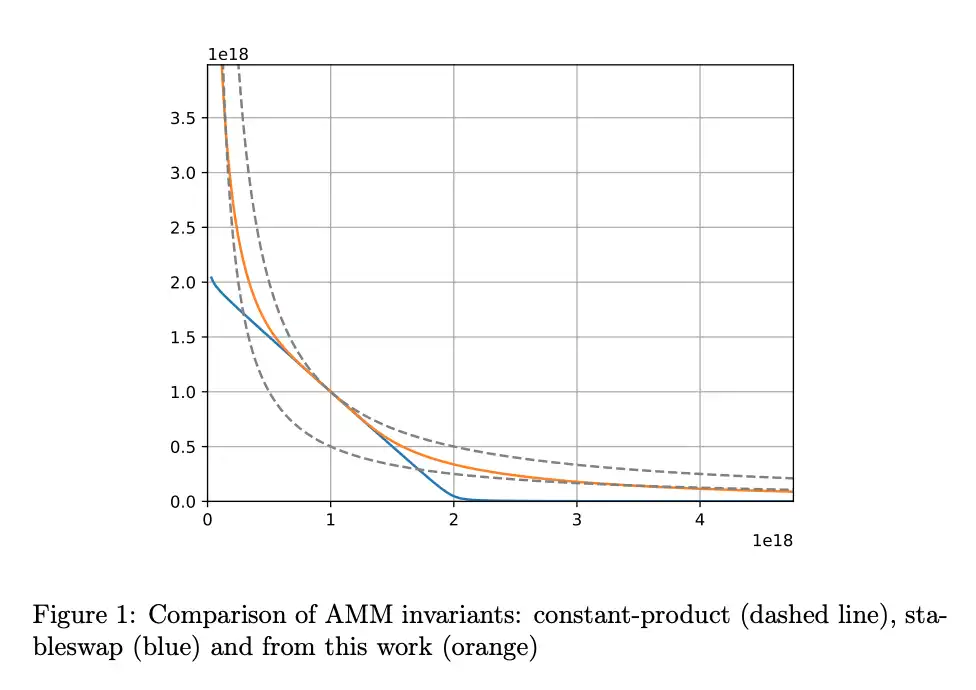
Image credit: Curve
While Uniswap V3 has taken a bite out of stablecoin trading volumes since its launch, Curve V2 has also started to attract trading volumes from volatile assets to expand its user base. Currently on Ethereum, tricrypto 2($USDT/$WBTC/$ETH) is currently the largest liquidity pool at Curve V2, and the latest daily trading volume has reached $ 6600 Ten thousand. In terms of the proportion of the trading volume of the decentralized trading platforms in the market, since. Uniswap V3 & The gap between them has not changed significantly since Curve V2 came online. Refer to the chart below.
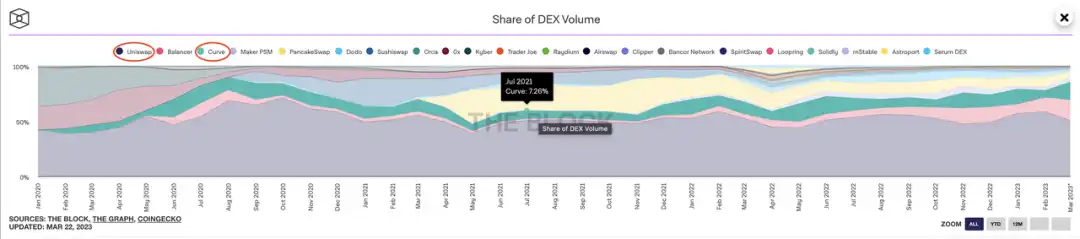
Photo credit: THE BLOCK
4. Curve launches its Stablecoin offering program to expand its revenue stream
In May 2022, Terra /Luna's stablecoin $UST suddenly collapsed, causing market turmoil and affecting many similar assets. Curve's stablecoin trading business has also been affected. In response to this challenge, Curve first disclosed plans to release Curve overmortgaged Stablecoins in June of the same year and published a white paper on the subject in November. The goal is to create a new revenue stream for the Curve protocol, attract more liquidity and boost the price of $CRV.
To achieve this, Curve's white paper proposes the innovative Lending-Liquidating AMM Algorithm (" LLAMMA ") and PegKeeper. LLAMMA is a new settlement mechanism created by Curve, which realizes continuous settlement and de-liquidation through AMM algorithm, reducing bad debt risk and user losses. PegKeeper is used to maintain the anchor value of the protocol stablecoin.
After the Curve Stablecoin white paper was released, the market reacted positively, which was reflected in the rapid increase of the price of $CRV. Although the $CRV price has fallen sharply in the past, the release of the white paper gives the market confidence and anticipation for Curve's future expansion of new business. At present, Curve has not officially issued stablecoins, and the specific performance needs to be observed after its launch.
5. Comments and Insights from Curve 3.0: Continuous value creation is the core goal of Web3.0 protocol
The Web3.0 field is still in the early stage of development, and the external environment is changing rapidly. Especially in the DEX field, the competition is extremely fierce. Although network effects also play an important role, Web3.0 and Web2.0 have different monopolistic characteristics,Web3.0 & have spent Features such as decentralization, openness and interoperability, as well asTokenIncentives, community-driven, and innovative technologies make it easier for users to move quickly between protocols and DApps, leading to more cutthroat competition.
In such a fierce competition, the core goal of Web3.0 protocols should be to continuously create value, rather than merely pursue Token price increases, so as to ensure the sustainable development of the protocols. The agreement should adopt a reliable mechanism to avoid short-sighted behavior to damage the agreement. In addition,Just as nbsp; a16z Eddy Lazzarin, CTO of crypto,TokenDesign is better called protocol design, which is a very early field. Because"Token"Design" is only a part of "protocol design" and one of the auxiliary means to create value by protocol. The real value comes from "protocol design", including but not limited to business establishment logic,TokenIncentive mechanism, community governance, etc.
Taking Curve as an example, the protocol has made many efforts in product iteration, Token design and ecological construction, hoping to achieve sustainable development in the process of continuous innovation. However, in this process, bubbles caused by excessive incentives should be prevented, and even Pond's doubts should be triggered, thus affecting the steady development of the agreement.Incentives can only really grow a business if they are properly designed and used, otherwise they risk simply bluffing and selling the future rather than delivering real value.
In this context, designing token-based economic systems is undoubtedly a world-class challenge. Because this economic system is a complex and rapidly evolving open game system, it is the field of Nobel-level research. In view of this, we need to guide the design from the perspective of Token dynamics and Token engineering to ensure the sustainability of the protocol.At the same time, in order to assist the optimization of the design, Agent-Based simulation technology can be used to further understand and optimize the protocol design and improve the core competitiveness of the protocol.
"At last"
By sorting out and analyzing the evolution of Curve protocol, this paper summarizes the rules and experience applicable to the success of Web3.0 protocol.
The core goal of the Web3.0 protocol is "continuous value creation". To achieve this goal, the protocol needs to be implemented in the beginning. PMF. Only by implementing PMF can we attract more participants and promote the rapid development of the protocol. Token economy design should be reasonable, Token can be used to raise start-up funds, encourage users to participate actively. But overuse of Token economy may cause bubbles and even threaten the sustainable development of the agreement. Therefore,The project side needs to ensure thatTokenEconomics underpins the long-term health of the agreement, not impedes its success.
In addition, in the Web3.0 ecosystem, the transition from a centralized team to a decentralized community is a key component. In this process, the protocol needs to first ensure that the protocol itself is technically decentralized to avoid the appearance of centralized nodes or institutions. At the same time, the distribution of Token issuance also needs to avoid excessive concentration and realize economic decentralization. Decentralize governance as much as possible and involve the community in the governance process of the agreement.
However,In the Web3.0 world, cryptocurrency markets are volatile, with bulls and bears alternating rapidly.At the same time, Web3.0 is still in its infancy, users are easy to lose, and market competition is becoming increasingly fierce. So agreements need to succeed sustainably, not all at once. For Web3.0 protocol, sustainable success is a new proposition that needs to be explored continuously.
For example, in the pursuit of sustained success, whether the project governance chooses to be completely decentralized, or appropriately retain the role and influence of the core team on a decentralized basis? And pursue the perfection of decentralized governanceIs it reasonable and necessary? All these problems need to be discussed in depth.
How can we overcome the challenges of dealing with the high level of internal and external "uncertainty" that the protocol faces? While uncertainty cannot be eliminated, we can use tools to iterate and optimize the protocol.At present, there is not a tool on the market that is easy to operate, intuitive and visual, but also has the extensibility and flexibility for complex systems, which can assist protocol design. cadCAD is highly customizable and extensible, but not easy to use and intuitive; Machination is not Agent-Based modeling, so it cannot deal with complex situations. The new venture HoloBit is the first code-free, visual, Agent-Based modeling and simulation platform for protocol design and optimization that seems to offer the best of both worlds. The platform has not been officially launched yet, so it is worth looking forward to.
In conclusion, the key to the success of Web3.0 protocol lies in the implementation of PMF, the establishment of appropriate incentive mechanism, the shift to decentralization, and the ability to adapt to internal and external changes. Although there is no one universal approach for all Web3.0 projects, it is hoped that the rules and experiences summarized in this article will provide useful ideas and suggestions for the construction of Web3.0 projects and help to build a more healthy and sustainable protocol.
Original link
Welcome to join the official BlockBeats community:
Telegram Subscription Group: https://t.me/theblockbeats
Telegram Discussion Group: https://t.me/BlockBeats_App
Official Twitter Account: https://twitter.com/BlockBeatsAsia

 Related Articles