



The 'zkEVM multi-client problem' that Vitalik Buterin was most concerned about finally has a solution.
Original Title: "Solution to Vitalik Buterin's Concerns about 'zkEVM Multi-Client Problem' Finally Found"
Source: Odaily Planet Daily
On March 31st, Vitalik Buterin, co-founder of Ethereum, published an article on his official blog titled "How will Ethereum's multi-client philosophy interact with ZK-EVMs?" In the article, he shared his thoughts on "an aspect of the Ethereum ecosystem that has not been fully discussed but is very important." He delved into the technical challenges, ecosystem trade-offs, and potential solutions for creating a multi-client ecosystem for ZK-EVM.
Next, let's decipher the key points of this article.
Zk-EVM's Multi-Client Issue
Vitalik Buterin believes that ZK-EVM will become an important component of Ethereum Layer 1 security and verification processes in the future. Zero-knowledge (ZK) technology also allows developers to prove the authenticity of transactions or messages without revealing any additional information.
This means that one party can convince the other that the message they have sent is true and valid without revealing any knowledge beyond the validity of the message. However, according to Vitalik Buterin's analysis, the privacy-preserving properties of zero-knowledge proof technology may disrupt the wider EVM landscape, as there are subtle differences in how Ethereum clients implement protocol rules.
Currently, the layer 2 protocol in ZK Rollups has successfully utilized zero-knowledge proof technology to help scale the Ethereum blockchain by bundling multiple transactions into one proof. However, as ZK-EVM develops to verify transaction execution on the mainnet, Vitalik Buterin believes that "ZK-EVM has actually become the third type of Ethereum client, just as important to the security of the Ethereum network as the current other execution clients and consensus clients."
However, once ZK-EVM is considered as a third type of Ethereum client, Vitalik Buterin raised the following question:
"In fact, how do we create a 'multi-client' ecosystem for verifying the correctness of Ethereum blocks based on zero-knowledge proofs?"
With the continuous expansion of the Ethereum ecosystem, Vitalik Buterin hopes to maintain the advantage of the "multi-client concept" while utilizing the functionality of ZK-EVM to improve the scalability, security, and decentralization of the Ethereum network.
According to Vitalik Buterin, the main technical challenges of using zero-knowledge proof technology for multiple clients are related to delays and low data efficiency. In addition, due to different interpretations of protocol rules or specific implementations of ZK-EVM, different Ethereum clients also handle zero-knowledge proofs differently.
So, how can these problems be solved? Vitalik Buterin has provided a solution -
ZK-EVM Multi-Client Solution
Despite the challenges mentioned above in the Ethereum ecosystem, Vitalik Buterin believes that creating an open, multi-client ZK-EVM ecosystem is entirely feasible and beneficial for Ethereum's security and decentralization. The following image visualizes the use of various different clients in the consensus and execution layers of the Ethereum ecosystem.
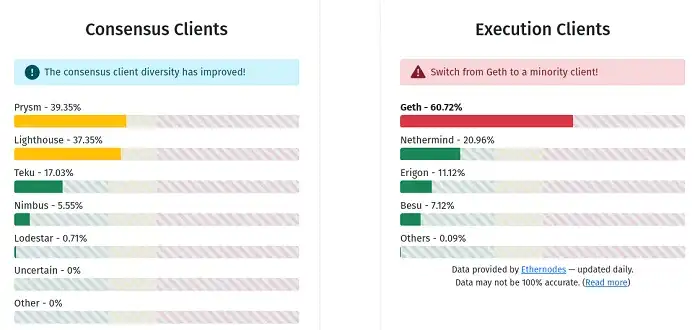
Source: vitalik.eth.limo
Vitalik Buterin believes that having multiple clients can reduce the risk of a single catastrophic error occurring during implementation, thereby increasing the security and decentralization of the network, which could cause the entire Ethereum network to crash. In addition, the concept of multiple clients also helps prevent power from being concentrated within a single development team or organization, thereby better achieving network decentralization.
Regarding the aforementioned ZK-EVm multi-client issue, Vitalik Buterin proposed three possible solutions:
1. Single ZK-EVM: Abandoning the multi-client paradigm, choosing a single ZK-EVM to verify blocks.
2. Multiple closed ZK-EVMs: a specific set of multiple ZK-EVMs reach consensus and have a consensus layer protocol rule, which means that a block needs proof from more than half of the ZK-EVMs in the set to be considered valid.
3. Multiple open ZK-EVMs: Different clients have different ZK-EVM implementations, and each client waits for proof compatible with its own implementation before accepting a block as valid.
Against the backdrop of ZK-EVM, Vitalik Buterin supports the third solution, which is an open ecosystem of multiple client ZK-EVM implementations. He believes that different clients have different ZK-EVM implementations, and each client waits for proof of compatibility before accepting a block as valid.
"To me, the third solution seems ideal, at least until and unless our technology improves to the point where we can formally prove the equivalence of all ZK-EVM implementations..."
Not only that, once the technology improves to the point where ZK-EVM implementation becomes somewhat standardized, Vitalik Buterin believes that the solution will be to choose the most effective option, and he also thinks that 'the challenges of the third solution seem to be smaller than those of the other two options, at least for now.' However, Vitalik Buterin has proposed that the open use of multiple ZK-EVMs may face two major challenges:
Delay Challenge: Malicious attackers may delay the release of a block, as well as a proof that is valid for one client. Generating a proof that is valid for other clients actually takes a long time (even if it is, for example, 15 seconds). This period of time is long enough that it may create a temporary fork and interrupt the chain of several slots.
Low data efficiency: One benefit of ZK-SNARKs is the ability to remove data from a block that is only related to verification (sometimes referred to as "witness data"). For example, once you verify a signature, you don't need to store the signature in a block. Instead, you can store a single proof that confirms all signatures in the block are valid. However, if you want to generate multiple types of proofs for a block, you need to actually publish the original signature.
How will ZK-EVM enter Layer 1 in the future?
Option 1: Limit Layer 1 and force almost all activity to move to Layer 2
As time goes on, Vitalik Buterin suggested reducing the gas target of each block in Layer 1 from 15 million to 1 million, which is enough to include one SNARK and some deposit and withdrawal operations, but not much else, thus forcing almost all user activity to move to Layer 2 protocols.
Option 2: SNARK Verification Layer 1
Vitalik Buterin has stated that it is possible to write more SNARK code to verify blockchain consensus, but this will be a challenging engineering problem. Currently, it takes several minutes to several hours for ZK-EVM to verify Ethereum blocks. If this solution is adopted, it will require:
(i) Improve Ethereum itself to remove components that are not friendly to SNARKs.
(ii) Can significant efficiency gains be obtained through specialized hardware?
(iii) Improving architecture through more parallelization.
Summary
Vitalik Buterin summarized that a lot of work is needed to promote a well-functioning open multi-client ZK-EVM ecosystem. However, the good news is that most of the work to achieve this goal is already happening or will happen in the future because:
1. Ethereum already has multiple powerful ZK-EVM implementations.
2. The work on lightweight clients such as Helios and Succinct may ultimately evolve into more comprehensive SNARK verification of the Ethereum blockchain's PoS consensus layer.
3. The client may start trying to use ZK-EVM to prove its Ethereum block execution, especially when the stateless client does not need to directly re-execute each block to maintain the state. It may verify the Ethereum block by re-executing them from the client and then transition to most clients verifying the Ethereum block by checking the SNARK proof.
4、ERC-4337 and PBS ecosystem may soon start using BLS and proof aggregation technologies, which can save a lot of gas costs.
It is worth mentioning that Vitalik Buterin has also praised the rapid development of artificial intelligence technology recently. He believes that the progress of artificial intelligence can "accelerate" the development of ZK-EVM. "In the long run, of course, anything is possible. Perhaps AI will strengthen formal verification, making it easy to prove that ZK-EVM implementation is equivalent and identify all errors that cause differences between them."
Original article link
Welcome to join the official BlockBeats community:
Telegram Subscription Group: https://t.me/theblockbeats
Telegram Discussion Group: https://t.me/BlockBeats_App
Official Twitter Account: https://twitter.com/BlockBeatsAsia







