Under the Layer2 trend, how to break through the dilemma of liquidity fragmentation

TokenMore
With the rapid development of blockchain technology, the crypto world has entered the era of multi-chain coexistence. Blockchain's impossible triangle of "security, scalability and decentralization" has spawned thousands of tokens and hundreds of chains. From the public chain narrative dominated by L1 in the last cycle to the Optimism and Arbitrum in the current cycle, Layer2 is the future trend, but it also leads to the fragmentation of liquidity.
According to data platform Defillama, there are currently 177 chains with a total TVL of $47.84b, and the total market value of stablecoin on the chain is $133.08b. How to maximize the use of these assets and integrate information, the interaction between these chains is very important, because only interoperability can ensure that different chains can communicate with each other and maintain global state and token liquidity.
Interoperability is the key to enabling blockchain technology to be scalable and interconnected, allowing different blockchain networks to work together to achieve a wider range of applications and a better user experience while each is responsible for its own tasks.
Interoperability solution
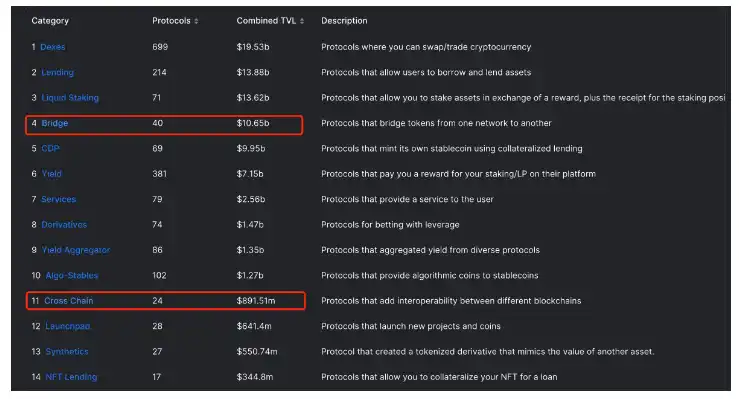
Based on the principle of interoperability, there are three common solutions. One of the most common methods is to build a bridge between the two blockchains, allowing users to transfer tokens and other information from one network to the other. According to Defillama's platform data, cross-link bridge plus cross-link agreements currently cost $11.5 billion in TVLS. 40 Bridges and 24 protocols have been included.
The second is to act as a connection layer between different blockchains, the intermediate chain, which verifies and forwards messages between chains. The advantage is that it is cheap, but prone to security degradation due to a single point of failure. Currently, the two most notable protocols that fall into this category are Polkadot and Cosmos. For Ethereum, they are separate new ecosystems, with a similar horizontal scaling approach, intended to create another blockchain universe. Their solution to interoperability is to reinvent from the ground up, rather than solve the existing multi-chain coexistence problem.
The third is to run a light node on the chain. A light node is a node type that stores only a portion of the ledger's transaction history and connects to the full node for enhanced verification. The light-node on-chain approach is very safe, but also costly. Examples of light node forms include LayerZero and Wormhole.
LayerZero
LayerZero is a full-chain interoperability protocol designed to deliver lightweight messages across chains. LayerZero introduces the concept of ultralight nodes on top of light nodes, providing the security of light nodes at a more cost effective price, similar to intermediate chains. Users operate seamlessly across multiple chains, and solving this problem with Bridges requires a separate bridge for each pair of chains, each requiring its own interface and code. With LayerZero, all chains can be connected to each other through a single interface and code, which makes multi-linked Dapps much easier to use. The information conveyed is no longer limited to a single asset. State sharing, bridge, lending, swap, governance can be realized.
LayerZero raised hundreds of millions of dollars back in 2022 at a valuation of up to $1 billion and is growing fast. Is not issued in the project everyone expects.
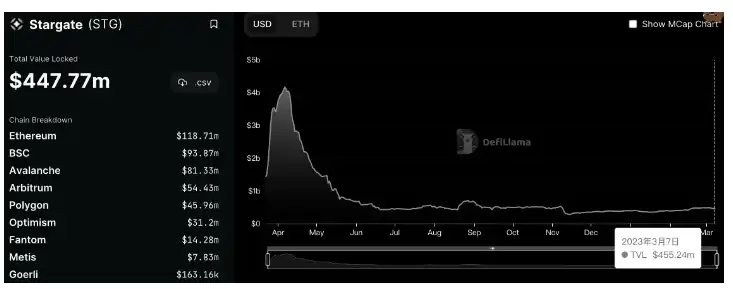
Current LayerZero implementations include Stargate. Stargate is a liquidity transfer protocol that leverages LayerZero's generic messaging to enable cross-chain liquidity transfers of native assets. TVL has captured $447 million so far.
Source: defillama.com
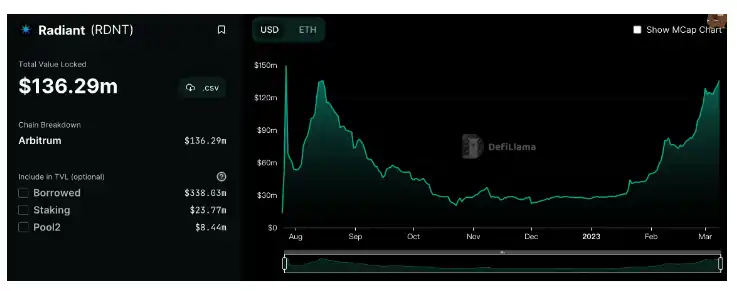
The largest lending protocol on Arb will use LayerZero's technology directly in future iterations, and version V1 is based on Stargate. Visible technology development difficulty is not small. But the simple version so far has raked in $136 million, far surpassing the $65.14 million the AAVE V3 brought in.
Source: defillama.com
Wormhole
Wormhole is a decentralized, universal messaging protocol that connects to multiple blockchains. Wormhole addresses this issue by monitoring messages sent by smart contracts on multiple chains. This is achieved through the Wormhole core layer, a core contract deployed on each chain to route incoming messages to the target chain, which is a core capability of the common messaging protocol mentioned earlier. A total of 19 Wormhole nodes form a monitoring network protection system. Wormhole's solution is relatively slow from the user's perspective.
Wormhole is not only a general interoperability protocol, but also an ecosystem and platform for developers to extend the decentralized computing space. Wormhole consists of multiple modular switching components that can be leveraged independently and support a growing number of composable applications being built by multiple teams.
Wormhole's current TVL is $290 million. ETH chain accounts for a very large proportion, and TVL distribution is very uneven compared with STG.
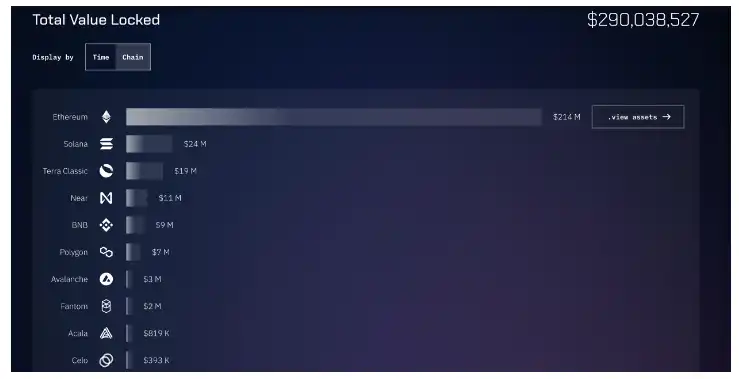
Source: wormhole.com
As a result of a draft proposal in February to launch Uniswap V3 on the BNB chain, what tools should be used to implement cross-chain governance and messaging between Ethereum and BNB chains? Wormhole and LayerZero have also started a dispute between Wormhole and Layerzero, despite the VC interest dispute behind it. Technically, LayerZero says its architecture is more decentralized, Uniswap has autonomy to control inter-chain messaging, Wormhole relies on 19 verifiers to collude with malicious attacks, etc. The debate content is very exciting, specific can refer to.Reopening Uniswap: The Battle of the Top VC's Interests .
In addition to the above low-level technical solutions, there is another direction worth exploring, namely the operating system direction.
An "operating system" that makes things easier
Infrastructure such as LayerZero solves the problem of multi-chain interactions such as assets. But back to the operation level, the user's operation is still very tedious, and it needs to have the basic cognition of Web3 to interact. Therefore, DappOS proposes a solution to deal with public chain, DApps and cross-chain operations between users in a more convenient way.
What is DappOS?
According to the official introduction, DappOS is inspired by the mobile device operating system and aims to be a Web3.0 converged multi-link operating system. Aimed at public chain virtualization, it helps users manage the running protocols of numerous DApps. Through SDK, virtual wallet and dApp, the integrated platform can not only realize multi-link deployment with one button for developers, but also help users easily access any dApp, making dApp as easy to use as Web 2.0 Apps. The idea behind this protocol is to create a channel between the user and the cryptographic infrastructure (common chain, cross-chain bridge, etc.). Users just need to learn how to use DappOS, which will take care of all the complex operations involved in interacting with the cryptographic infrastructure.
Unlike other infrastructure solutions, Dappos introduces an account abstraction that helps users automate operations and further simplifies cross-chain interactions.
In the Dappos ecosystem, users can create a unified account that can be used across different blockchain networks and does not need to know the details of those networks. Dappos also implements multi-link deployment for developers through SDK, virtual wallet, dApp, and integration platform.
In summary, Dappos makes it easier for users to work with blockchain applications by introducing features such as account abstraction and automation. Dappo works in conjunction with other cross-chain bridge protocols to provide a better user experience.
DappOS is also one of the finalists for Season 5 of Binance Labs' incubation program.
How DappOS is implemented
DappOS V1 consists of two main parts:
DappOS Account is an implementation of an account abstraction layer that virtually unified all accounts, allowing users to easily manage virtual wallets and ignore the complex experience of multiple chains. It also includes the ability to recover deleted mnemonics by mistake, and users can reset their accounts through other devices or even third-party KYC services.
DappOS Network is a distributed network that helps users interact with their dappOS accounts. It allows users to transact across different chains, bridge assets, and pay for using the dappOS network.
The whole process usually includes the following steps:
The user creates an order by signing, which includes fees for interaction, asset bridging, and use of the DappOS network on one or more blockchains.
DApps sends the order to the DappOS Network through JSON-RPC.
DappOS Network will entrust the order to one of the unauthorized nodes, and guarantee that the order can be successfully executed, otherwise the node will compensate for the user's loss.
The selected node executes the order and sends the result back to the DappOS Network, which then forwards it to Dapps. If the order executes successfully, Dapps receives the result and performs the necessary actions. If that fails, Dapps can choose to retry the order or report the error to the user.
DappOS is forward-looking
One of the futuristic applications of DappOS is to enable users of BNB Ethereum and other chains to directly use applications on other chains through multi-link interconnection. For example, we can connect to BNB wallet and make transactions on Avalanche DEX platform GMX. Booking is available on the Optimism Perpetual platform. Understand this layer, then the imagination space becomes enormous.
DappOS 'virtual wallet concept coincided with the Account Abstraction mentioned in the BNB link technology Roadmap 2023. The Account abstraction and wallet services would allow users to have higher privacy and security in transactions as there would be no need to connect the wallet directly. Users can seamlessly access Web3 using Web2 habits. In addition to social recovery of wallet, it also has functions such as small transaction, greatly reduced GAS fee and batch transaction processing. DappOS will also achieve the function of multi-chain polymerization on this basis.
Web3 identity will become part of the critical infrastructure, enabling users to have a Web2 smooth experience with Web3 dApps through authentication services. This will help expand the community of Web3 users by allowing custom users to set up and support Web2-style social interactions, lowering the barriers to entry for new users.
As Michael Li, vice president of data at Coinbase, said of DappOS, "DappOS creates a common platform to connect technologies between different blockchains, thereby providing a better experience for developers and users in the Web3 world."
DappOS fills some of the gaps in some of today's interoperability solutions. Let's take DappOS and GMX as an example.
How does a unified operating system boost the derivatives circuit
BNB Chain: Derivatives are expected to be critical to DeFi development this year
In 2022, the story of decentralized derivatives became popular, moving classic operations from off-chain orders to full-chain ones. The decentralized spot and permanent exchange GMX is extremely bright.
GMX has maintained steady and strong growth since its launch at AVAX in 22 years. It had a brilliant year in 2022. Its LP token GLP steadily provides a return of over 20% of the ETH standard. According to defillama and tokenterminal, TVL has reached $662 million with an average 30-day active user of 2.49k. GLP synthetic assets will play an important role in DeFi, with 28 projects based on GMX Legos spanning vaults, lending, social trading, options and more.

Source: defillama.com
The development and expansion of the derivatives circuit has two basic factors, assets and users. How do you bring a lot of off-chain assets up the chain? Although DeFi's overall TVL has reached a lock-up value of $49.7 billion, there is still a lot of room for expansion compared to real world assets. Bringing real world assets (RWA) into the DeFi market is an important topic.
At the user level, on January 31, DappOS partnered with GMX to launch a pilot version of GMX supported by dappOS. Users can directly access the GMX deployed on the Avalanche using the BNB OP Polygon network. As shown in the figure below, BNB network has 1 million daily active users. GMX can capture users of BNB network without deploying BNB network contracts. Users can use GMX directly with the BSC wallet. This is just the initial version of DappOS, which will gradually be iterated to use virtual wallet accounts directly, regardless of the existence of the chain. DappOS makes DeFi intuitive by simplifying multiple steps for users, allowing seamless cross-chain access to GMX. Good user experience will promote the further development of GMX and enable the developers of GMX to focus more on the development and upgrade of their own product functions.

Source: tokenterminal.com
Currently, GLPS pledged through dappOS's active page can also earn 3 times the APY revenue,https://gmx.dappos.finance/buy/glp?ref=yudan
In addition to GMX, Makerdao, Avalanche, Perpetual, Quickswap, and others have started working with dappOS to make it easier to use Dapps.
How much demand can DappOS cover in a multi-link era?
Cross-chain agreement TVL $11.5 billion (annual growth rate of over 10%)
Total DEX trading volume is $100 billion
Active Wallet 120m (distributed on multiple chains)
These numbers continue to grow, and more and more Dapps based on multi-link will become active developers. Taken as a whole, the potential demand for DappOS will be astronomical.
summarize
As more and more developers contribute to the growth of Web3.0, we can see the whole ecosystem becoming more complete. In the past, MultiChain and LayerZero solved the problem of asset interworking; in the later, DappOS solved the problem of user experience and the difficulty of multi-chain deployment operation for developers. However, the current infrastructure and applications are not fully mature and comprehensive, and entering the crypto world still requires a high level of awareness and threshold, which makes it difficult for a large number of users to easily enter it. Therefore, in addition to technical improvement, product optimization and user experience improvement also become very important. As an operational protocol, DappOS will play an important role in bridging the relationship between DApps and users, bringing hundreds of millions of users into the Web3.0 world and powering the entire ecosystem.
The next popular King app may be in the DEX space. If DappOS lives up to the vision it describes, it will be well worth looking forward to.
This article uses data as of March 9, 2023
Original link
Welcome to join the official BlockBeats community:
Telegram Subscription Group: https://t.me/theblockbeats
Telegram Discussion Group: https://t.me/BlockBeats_App
Official Twitter Account: https://twitter.com/BlockBeatsAsia