Week 13 On-Chain Data Analysis: Long liquidation pressure rises, market sentiment overall neutral with a cautious bias.

Original Title: "Like the Constant of the Moon, Like the Rising of the Sun | WTR 3.20"
Original Author: WatchToweR Crypto
This Week Review
This week from March 14th to March 20th, the highest price of Bingtang Orange was around $28483, and the lowest was close to $23888, with a fluctuation range of about 19%.
Observing the chip distribution chart, there is a large amount of chip transactions around $28143, which will provide certain support or pressure.
• Analysis:
1. $23000 ~ $29500, approximately 1.68 million coins;
2. $18500 ~ $22500, approximately 2.7 million coins;
• The probability of not breaking below $18000 ~ $20000 in the short term is 72%.

Important News
Economic News
1. In February, the PPI (Producer Price Index) in the United States decreased by 0.1% on a month-on-month basis, which was lower than the expected 0.3%. The previous value was 0.7%.
a. Year-on-year growth was 4.6%, lower than the expected value of 5.4% and lower than the previous value of 6.0%. It is the lowest year-on-year growth since March 2021.
b. The core PPI excluding food, energy, and trade increased by 0% on a month-on-month basis, lower than the expected 0.4% and the previous value of 0.5%.
2. The year-on-year growth rate of the US CPI in February was 6%, in line with the expected value of 6%, but lower than the previous value of 6.4%. It has been declining for eight consecutive months and hit a new low since September 2021.
a. Core CPI YoY growth was 5.5%, in line with the expected 5.5% and lower than the previous value of 5.6%. It has been declining for six consecutive months, reaching a new low since December 2021.
b. Core CPI increased by 0.5% on a month-on-month basis, slightly higher than the expected 0.4%, and the previous value was 0.4%, reaching the highest level in five months, indicating that inflation still has elasticity.
3. The Federal Reserve launched an emergency financing tool for banks this week called the Bank Term Funding Program (BTFP), which provides loans of up to one year to banks that pledge US Treasury bonds, institutional debt, mortgage-backed securities (MBS), and other eligible assets as collateral.
a. 11 banks including Bank of America, Citigroup, JPMorgan Chase, and Wells Fargo deposited a total of $30 billion uninsured deposits into First Republic Bank.
4. Moody's, an international credit rating agency, has lowered the outlook for the entire US banking system from stable to negative.
a. Moody's has downgraded the bond rating of Signature Bank (stock code SBNY) to junk status and will cancel its future ratings;
b. Six American banks have been listed on the watchlist for possible downgrades in the future, including First Republic Bank (FRC), Zions Bancorp (ZION), Western Alliance Bancorp (WAL), Comerica Inc (CMA), UMB Financial Corp (UMBF), and INTRUST Financial.
5. The European Central Bank announced a 50 basis point interest rate hike, marking the sixth consecutive rate hike by the ECB.
6. Due to investors' concerns about Credit Suisse's default risk, the bank's credit default swap (CDS) prices have risen to their highest level since the 2008 financial crisis.
a. Credit Suisse Group borrowed CHF 50 billion from the Swiss National Bank through secured loans and short-term liquidity loans to enhance liquidity;
b. UBS is in talks over the weekend to partially or fully acquire Credit Suisse.
7. In January, the domestic holding of US Treasury bonds decreased by $7.7 billion compared to the previous month, marking the sixth consecutive month of reduction and the total holdings hitting a new low since May 2010 for five consecutive months.
a. Since May last year, the position has been below one trillion US dollars for nine consecutive months.
b. Japan holds the most US bonds in January, followed by China domestically in second place.
8. This week, both WTI and Brent crude oil fell to their lowest levels since the end of 2021; the price of gold rose to a new high since April 2022, and achieved the largest weekly gain in three years.
Encryption Ecology News
On April 12th, E Ethereum launched an upgrade on the mainnet in Shanghai, which will enable staking for E Ethereum withdrawals.
2. The fourth largest mutual fund company in the world, Fidelity Investments, has officially opened up cryptocurrency trading exposure to retail investors. Investors can directly purchase Bitcoin and Ethereum without commission through its stock trading client.
3. CNHC Group, a stablecoin issuer, has completed a $10 million Series A+ funding round with KuCoin Ventures as the lead investor and IDG Capital as a participant. (Pegged to offshore RMB at a 1:1 ratio)
4. This week, Tether issued an additional 1 billion USDT on the Tron network and 1 billion USDT on the Ethereum network, for a total of 2 billion USDT.
5. This week, Circle redeemed 2.9 billion USDC and minted 700 million USDC.
6. CB announces a new strategic partnership with Standard Chartered Bank, allowing Singaporean customers to transfer funds in or out through local banks.
7. CB: Has been working with the Commodity Futures Trading Commission (CFTC) in the United States to promote the launch and operation of its derivatives platform as soon as possible, which will be a big event for the US cryptocurrency market.
8. Zhishang Exchange: Launching futures contract trading for Dashan, providing compensation based on specific events, and offering investors a fully regulated trading platform to enter the sugar orange market.
Long-term Insight: Used to observe our long-term situation; Bull market/bear market/structural change/neutral state.
Mid-term exploration: used to analyze what stage we are currently in, how long this stage will last, and what situations we will face.
Short-term observation: used to analyze the short-term market situation; as well as the possibility of certain directions and events occurring under certain conditions.
Long-term Insight
• New capital and the proportion of long-term investors' accumulation
• Global profit percentage
• Overall spot selling pressure
• Derivative Empty Model
(The proportion of new funds and long-term investors accumulation in the following figure)

The current short-term funds, or new funds, are not significant in total amount, and there is no significant trend of inflow.
Long-term investors have accumulated to historical highs. From this holding structure, it looks somewhat similar to the state in 2016 and 2019.
(See the following chart for the percentage of total profits across the entire network.)

The percentage of overall profits on the network has reached a high point in the past six months, and there may be more selling pressure in the future due to the impact of profit-taking.
Whenever the profit percentage reaches a high level across the network, it often indicates that the market will face a significant risk of retracement.
(See the chart below for overall spot selling pressure)

The overall selling pressure of spot goods is still manageable, and it has not reached the levels seen in 2016 and 2019.
From the perspective of spot selling pressure, the market is healthier than it was at that time.
In addition to the squeeze caused by long-term participants buying spot goods, the impact of derivatives is also important in driving market growth.
(See the Derivative Shorting Model in the following figure)

• Purple line: Derivative short-selling index.
One of the main factors contributing to the market growth from early March until now is the short squeeze of derivatives.
The observation and attention to the rolling empty of the same derivatives from different perspectives are equally important for the future.
Bearish reverse blind obedience or become fuel for market rise.
Rolling empty is also extremely important for the next medium and short term.
Mid-term exploration
• Non-zero balance address
• On-exchange liquidity support band.
• Network sentiment positivity
• Long-term and short-term chip segmentation
• Accumulation trend 分
• Short-term profit takers and short-term participants.
On-exchange growth: there are signs of recovery and it is above the liquidity support zone.
(The number of non-zero balance addresses in the following figure)

Blue area: Non-zero balance address change rate.
Red line: number of non-zero balance addresses.
During the period of low market sentiment and despair at the 16000 price level, the total number of addresses on the chain did not experience significant growth.
However, when the market began to experience a bearish trend, the price attracted new users to enter the market.
The current growth may be a confidence-based prosperity construction.
Of course, the growth in the market may represent the willingness of some long-term funds, although the market has been positively influenced by the sentiment of derivatives.
However, thinking the other way around, perhaps the future market cannot be absent from the participation of derivatives.
(See the in-house liquidity support band in the following figure)

Yellow area: market price > short-term participant cost.
Red area: the difference between market price and short-term cost.
Blue line: Short-term participant supply
Observing the liquidity of short-term participants cannot be separated from the overall supply, which plays a crucial role in this observation.
From the yellow area, it can be observed that once short-term participants are in a state where the market price is greater than the current price, they may enter a more comfortable state because they are on average in a "floating profit" state. Participants anchored by floating profits may be more willing to hold their chips.
Or, it could be said that the risk of a liquidity collapse in the current market has not yet occurred.
However, once their cost line is breached, it may trigger a certain degree of panic, and new funds need to be injected to make up for the supply on the market.
Application method:
This supply status can be used to observe the emotional state of market liquidity and serve as a warning line for judging medium-term risks.
Of course, it is necessary to measure the throwing pressure status in the field, and this model only serves as a warning.
(See Figure: Network Sentiment Positivity)
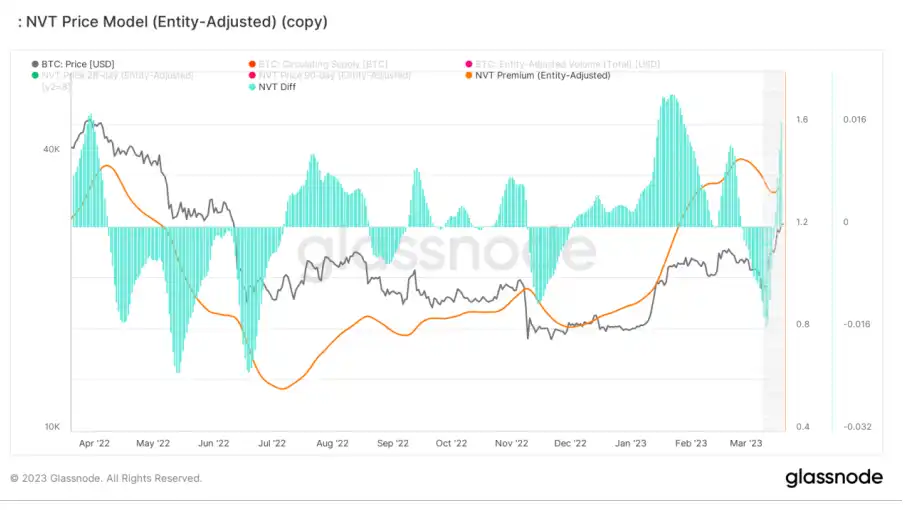
The on-chain transaction sentiment has rebounded well, and from the current actions in the market, it may take some time before the slowdown occurs.
Group status rating: The distribution of short-term and long-term chips is relatively balanced, with 1-10k large volume addresses holding more coins.
(The following image shows the distribution of long-term and short-term chips.)
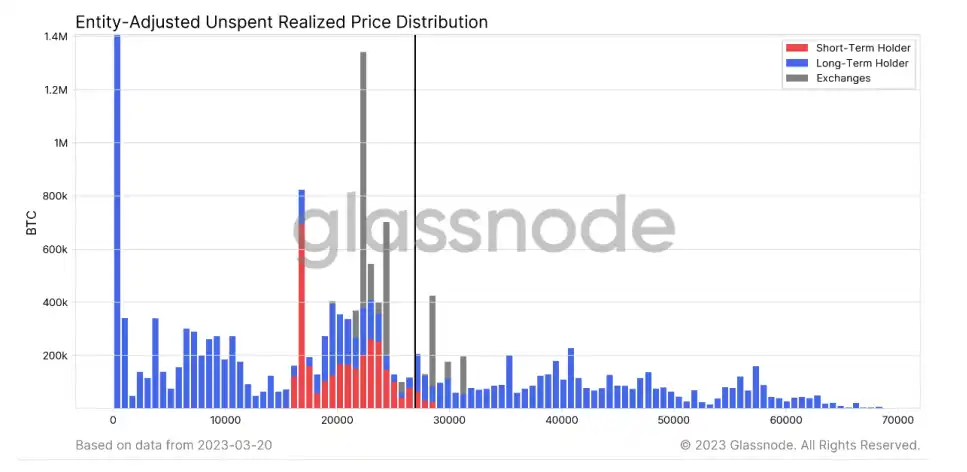
From the above picture, it can be seen that,
1. From the perspective of cost anchoring, the current price may be in a long-term and short-term weight balance, and the weight of short-term and long-term is not too clear when there is no overall selling pressure released in the market. Of course, from a micro perspective, long-term chips still slightly outweigh short-term chips.
2. On the other hand, the current nearby chips are still relatively thin. Even if the market is supported by overall liquidity, information still needs to be obtained from the chip structure. In a shrinking environment, a healthier way may be for the chips to stay safely transferred in this area.
3. At the same time, according to the "Weekly Review" chip chart, 26770 may be the support level formed by the current upward movement of chips, which may determine the key dividing line in the medium term.
(See Figure: Accumulation Trend)

From the trend of accumulation:
Addresses holding large amounts of coins are mainly in the 100-1k and 1-10k range, while the performance of other addresses is relatively normal at present.
These two major groups hold very important weight, and their movements may affect the future behavior of the market.
Due to the shallow depth here, if these two groups hold such a large amount of coins, they may be the group that has "decisive significance" in the short to medium term.
(The short-term profit takers and short-term participants in the following figure)

Currently, short-term participants are in a state of structural profit squeeze.
More than 95% of short-term traders are in a profitable state. They may encounter structural resistance in the process of participating in the market's upward trend driven by capital.
Short-term Observation
• Derivative risk coefficient
• Option intention transaction ratio
• Derivative trading volume
• Option implied volatility
• Profit and loss transfer amount
• New addresses and active addresses added.
• Ice Sugar Orange trading platform net position
• Auntie Trading Platform Net Position
• High-weight selling pressure
• Global purchasing power status
• Stablecoin trading platform net position
• Underlying transaction platform data
Derivative rating: Entering the danger zone, with increased risk.
(See Figure Derivative Risk Coefficient)

Last week, there was a sharp short-selling trend as the derivative risk factor decreased.
The risk coefficient of derivatives has reached the danger zone this week, indicating that the pressure of long liquidation will increase.
(The following image shows the option intention-to-trade ratio.)
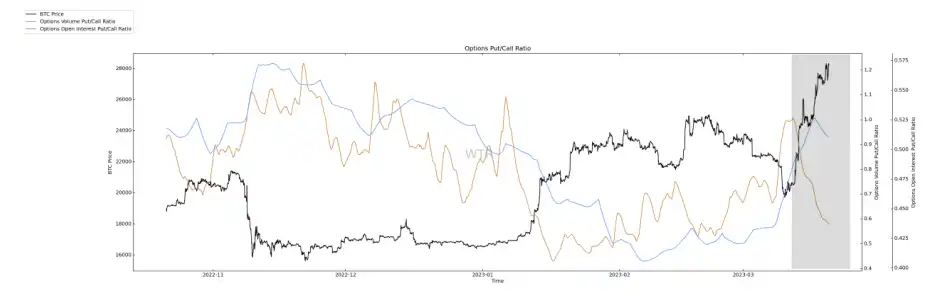
Last week, while prices were rising, the trading volume of options sharply decreased, and the ratio of short to long positions slightly declined, but remained at a high level.
(See chart for trading volume of derivatives)

As mentioned in last week's report, the increase in trading volume of derivatives is a positive signal, and it has indeed triggered a round of short selling frenzy.
After the price increase, the trading volume of derivatives has dropped significantly. If the trading volume of derivatives continues to remain at a low level this week, it indicates that the market dominated by derivatives will come to an end.
(See the implied volatility of options in the following figure.)

The volatility of implied volatility of options has intensified, reflecting the increased activity of option traders in the current market and the strengthening of their betting intentions.
Emotional state rating: Neutral with a cautious bias.
(See figure: Profit and Loss Transfer Amount)

The current loss transfer amount is at a relatively low level. The profit transfer amount saw a slight decline last week as prices continued to rise.
Indicates that the current market sentiment may be neutral to cautious. There is no clear buying or selling direction in the market, and more signals or events are needed to guide the market trend.
(The following image shows the "New Address" and "Active Address")

The overall number of new and active addresses is relatively high, indicating a good level of market activity at present.
Spot and selling pressure structure rating: More inflow of chips, increasing market selling pressure.
(The net position of the Bingtang Orange trading platform is shown in the following figure.)

At the current price level, the net position of the sugar orange trading platform is accumulating a large inflow, indicating an increase in selling pressure in the spot market.
(Net position of E-Tai trading platform as shown in the following figure)

E's current trading platform net position is in a net outflow state.
(See the figure below for high-weight selling pressure)

There is currently no high-weight selling pressure.
Purchasing Power Rating: Global purchasing power is increasing, but stablecoin purchasing power is decreasing.
(下图 全球购买力状态)
Translation:(See the following image for the global purchasing power status.)

After the sustained loss of global purchasing power, purchasing power in all regions turned positive last week, with Europe showing the strongest performance.
(Net position of USDC trading platform as shown below)
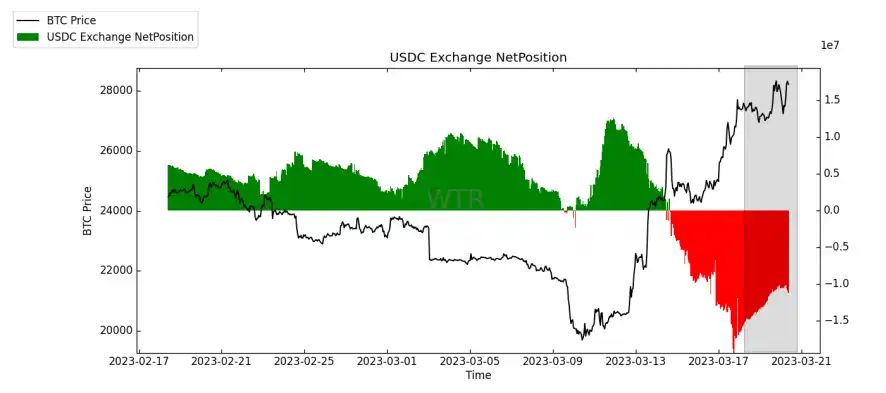
A large amount of USDC has flowed out due to the collapse of Silicon Valley Bank, resulting in a decline in purchasing power of the stablecoin it represents.
Currently, USDC has not yet restored its anchoring to the US dollar.
(Net Position of USDT Trading Platform as shown below)

USDT outflow has not stopped, but its continuous issuance on the chain has increased its market share in the stablecoin market, and its purchasing power weight has increased.
Off-chain transaction data rating: 25450 indicates a willingness to buy, while 29000 indicates a willingness to sell.
(See Coinbase off-chain data below)

There is a willingness to purchase at the price points of 23770 and 24850.
There is a willingness to sell at the prices of 29000, 30000, and 31000 without considering the context and industry-specific terms. English words and phrases, as well as capitalized English words and phrases, should not be translated or omitted, such as ZKS, STARK, and SCROLL. If there are English characters in the a link, they should be returned directly without translation, and the a tag should not be omitted. When there are only punctuation marks in the content, the punctuation marks should be returned as they are. HTML tags in the content, such as
, , , and, should not be translated. If there are English characters in the HTML tags, they should be omitted and returned directly. The content in the a link should be preserved. All Chinese characters should be translated.
(See Binance off-chain data below)
25450 is willing to buy at this price;
There is a willingness to sell at prices of 28500, 29000, and 29300 in the encryption industry.
(See Bitfinex off-chain data below)
There is a willingness to sell at the price of 29100.
This Week's Summary:
Summary of News:
1. In the past week, faced with the successive bankruptcies of the banking industry, in order to avoid potential domino effects, the Federal Reserve's emergency assistance tool BTFP created new liquidity, which the market interpreted as a disguised QE.
2. This week's PPI data was weak, while core CPI remained high. The risks in the banking industry continue to grow and the market has not fully digested them. The task of suppressing inflation by the Federal Reserve has become more complicated, and whether or not to raise interest rates next week has become an unknown variable.
3. Market forecast: March or May may be the last month for interest rate hikes, and there may be a rate cut later in the year.
4. During this banking risk outbreak, not only did hedging funds flow into gold, but also into big cakes and U. People's inner anchoring has changed.
On-chain Long-term Insights:
1. Long-term investors have accumulated to historical highs. From this holding structure, the overall situation is somewhat similar to the state in 2016 and 2019;
2. The percentage of overall profits on the network has reached a high point in the past six months, and there may be more selling pressure from profit-taking in the future;
3. The overall spot selling pressure has not reached the levels seen in 2016 and 2019, and is relatively healthy compared to those two time periods.
4. One of the main factors driving the market growth from early March to now has been the short selling of derivatives, with the blind following of bears fueling the market's growth.
• Market tone:
The current situation is similar in structure to that of 2016 and 2019.
It should be noted whether long-term participants are leaving quickly and the issue of derivative short selling. This determines whether the market structure and trend is similar to 2016 or 2019.
On-chain Mid-term Exploration:
1. There is still good growth in the on-site market;
2. The current support level for the chips has shifted to the position of 26770, which may be a more critical position in the medium term;
3. Currently above the liquidity support zone, this model may have certain benchmark value in the medium term.
4. The market may not have entered a slowdown phase at present;
5. The balance between long-term and short-term chips is relatively even here, with slightly more long-term chips.
6. The groups with 100-1k and 1k-10k coins hold a significant amount of coins, and their behavior may have a "decisive" impact in the short to medium term;
7. Short-term traders are once again facing "structural profit squeeze" situations.
• Market tone:
彷徨
translates to "hesitation" in English.
This is a relatively shallow depth, with the possibility of a large group controlling the direction. At the same time, it is at a critical point of profit margin compression, and there may be significant fluctuations in the medium term that need to be guarded against.
Strategy suggestion: Be cautious of volatility, and strategies with high risk control weight may be more suitable.
On-chain short-term observation:
1. The risk coefficient of derivatives reaches the danger zone, and the pressure of long position liquidation increases.
2. The trading volume of derivatives is relatively low; derivative traders are starting to wait and see;
3. The overall market sentiment is neutral with a cautious bias.
4. Trading platform data shows an accumulation of chip inflows and an increase in selling pressure;
5. Global purchasing power is recovering, stablecoin purchasing power is declining.
6. The purchasing power weight of the stablecoin represented by USDT has increased;
7. Underlying transaction data shows a willingness to buy at the price of 25450 and a willingness to sell at the price of 29000;
8. The probability of not breaking below $18000 ~ $20000 in the short term is 72%.
• Market tone:
The market is facing uncertainty and a lack of clear trading direction. Investor sentiment is neutral with a cautious bias, and selling pressure has increased.
Strategy recommendation: It is better to adopt a defensive strategy.
Risk Warning:
The above are all market discussions and explorations, and do not constitute directional opinions on investment; please be cautious and prevent market black swan risks.
This article is from a submission and does not represent the views of BlockBeats.
Welcome to join the official BlockBeats community:
Telegram Subscription Group: https://t.me/theblockbeats
Telegram Discussion Group: https://t.me/BlockBeats_App
Official Twitter Account: https://twitter.com/BlockBeatsAsia



 Related Articles