IOSG Ventures: How FVM unlocks Filecoin's innovative use cases comprehensively?

Original Title: "IOSG Weekly Brief | How FVM Unlocks Filecoin's Innovative Use Cases?"
Original Author: Siddarth, IOSG Ventures
What is FVM and why is it needed?
Protocol Labs has mentioned their three-stage plan for a decentralized internet, which is as follows:
Establish the world's largest decentralized storage network.
Introduce and protect humanities data.
Bring search and computation capabilities into data to build scalable applications.
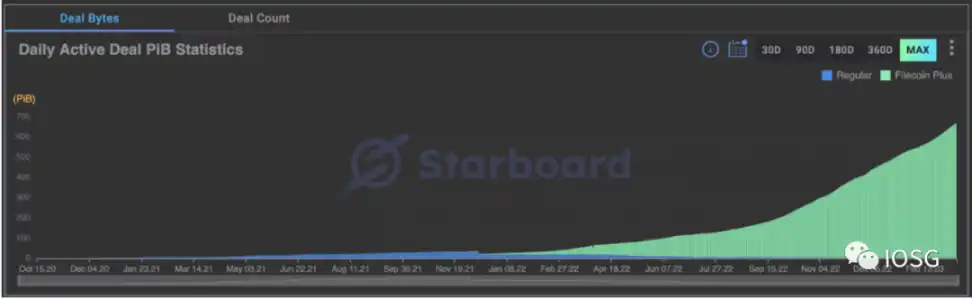
Filecoin has achieved the first step and become the largest decentralized data custodian with over 661.54 PiB of data storage. The storage market of Filecoin continued to grow in the fourth quarter of 2022, with active transactions increasing by 117%, a year-on-year increase of 1,798%.
Filecoin's next step is to help introduce and protect humanistic data, which will be an ongoing process. To achieve the third step, new infrastructure needs to be established to help retrieve and compute data, otherwise Filecoin will only become a hard drive stack for archived data around the world.
This gave birth to the Filecoin Virtual Machine (FVM). By integrating the virtual machine into the Filecoin protocol, developers can create decentralized applications (dApps) based on the Filecoin storage network, execute smart contracts in a secure and reliable manner, and create additional value layers on existing Filecoin data.
FVM is designed to execute smart contracts on the Filecoin network. When deploying smart contracts, they are compiled into WASM bytecode. This allows developers to create useful applications that comply with immutable rules, unlocking various use cases such as bringing all of Filecoin's markets on-chain, permanent storage, DataDAOs, and more. While all of this is great, we have seen many chains fail without a good developer experience and a lack of developer market.
Filecoin has decided to launch and support FEVM. When an EVM is deployed to FEVM, it will be compiled into WASM and an actor instance will be created in FEVM to run the EVM bytecode. Then, the user-defined FEVM actor can interact with the Filecoin network through built-in Market and Miner APIs.
This is a crucial step for Filecoin, as EVM-based development has been proven to have a good developer experience and a large existing developer community. By providing a secure and reliable environment for executing smart contracts, Filecoin VM helps unleash the full potential of the Filecoin protocol, bringing new innovative applications to decentralized storage and computing.
FVM Unlock Use Case
Although FVM can be used to build many different use cases, Protocol Labs and the FVM team have put together a "Request for Startups" list that they believe is crucial for the prosperity of the Filecoin ecosystem. Here are some of the key points in the list:
DataDAOs
ML Model Storage and Enhancement [via DataDAOs]
Storage entrance [via DataDAOs]
Pay-per-use [via DataDAOs]
Game [via DataDAOs].
Social [via DataDAOs]
Decentralized Science [via DataDAOs]
Tracking and reducing Filecoin's carbon emissions.
Hardware collateralized lending
Permanent storage
Storage automation (copying and repairing)
Untrusted FIL + Notary
KYC and claims proof.
Decentralized Data Aggregator
Access Control
According to Protocol Labs, the asterisk represents the importance of a project's existence on the Filecoin network. Readers may have noticed the repeated mention of DataDAOs, but what are they and why are they important?
DataDAOs
The saying "data is the new oil" has been circulating in recent years. The world's largest internet companies have always believed that data is their most valuable resource, whether for internal use (market/user insights) or external data sales. Why is data valuable? Data is only valuable when it can generate insights, and to generate insights, the data itself needs to be computed and analyzed.
It is impossible to monetize data on the chain in the current state of Filecoin, because the storage protocol is peer-to-peer, transactions are conducted off-chain, and settlement is conducted on-chain. Monetizing data requires infrastructure to establish access control systems, subscription payment systems, data enhancement, packaging, and more.
This is what FVM can unlock, using a decentralized and community-centered approach. DataDAO is a type of DAO, whose mission revolves around the protection, generation, enhancement, and promotion of data sets that stakeholders deem valuable.
Each stakeholder of DataDAO can now be incentivized in various ways, with SPs responsible for storage and preservation, replication staff ensuring local and fast availability, data providers now able to receive compensation for the sale of any of their data, data experts able to participate in data packaging, and ML engineers able to receive compensation for providing models that can run on encrypted data, thereby increasing the value of the data.
We can view data as a value spectrum:
Raw data (least valuable)
Packaging data
Data calculation.
Verifiable computation (most valuable)
Before FVM, raw data and packaged data could be uploaded to Filecoin, but access control could not be performed on-chain. Now, FVM can be used for data computation (e.g. AI/ML models, NFT creation, etc.). Although complex and heavy computations cannot currently be run on-chain in Filecoin due to insufficient computing power of Filecoin nodes, this indicates a clear scope for off-chain Dcompute platforms to interoperate with Filecoin.
Solutions like Bacalhau are dedicated to achieving data-driven computing and have close interoperability with Filecoin. Bacalhau is a relatively new project that can make the Filecoin network more valuable by allowing data stored within Filecoin itself to become more valuable.
DataDAO does not need to cover the entire data value chain in its initial state. While this may be the ultimate goal of DataDAO, many DataDAOs have already begun working in specific verticals or use cases. Some notable examples include:
Lagrange DAO: A DAO for realizing data value and decentralized science (DeSci). It provides a space for data sharing and analysis for DeSci.
GlacierDAO: A DAO that replicates an open Git repository containing public interest code. Additionally, it allows users to pool funds to support the replication of these repositories on the Filecoin network.
SPN DAO: A DataDAO that allows consumers to convert credit card transaction data into assets, enabling them to directly control the use and monetization of their data.
Although DataDAO currently focuses on data collection and management, to enhance the value chain, computation data and DCompute infrastructure will be needed. Work has already been done in this area, with a focus on Filecoin projects including:
Bacalhau: Bacalhau is a platform that enables fast, efficient, and secure computing by running jobs at the location where data is generated and stored. Users can simplify existing workflows without the need for extensive and widespread rewrites by running any Docker container and WebAssembly image as a task.
Shale: Shale is working hard to bring cloud computing to Filecoin, allowing storage providers to utilize existing storage capacity for computing and directly compete with other cloud storage providers such as AWS and Google Cloud. Public users will have the opportunity to rent computing instances from storage providers and access Filecoin+ storage transactions through local networks. This is a solution similar to Akash Network and StackOS, but with a greater focus on computing Filecoin data.
DataDAO is a unique use case that can only be unlocked in a decentralized end-to-end manner through the Filecoin network.
Resolve Existing Issues
Filecoin was initially just a storage protocol in its early stages. However, a constantly evolving protocol inevitably faces many problems that need to be addressed, such as:
Even if my SP is punished due to the lack of stored data, how can I repair or retrieve my data?
I have high-quality content that needs to be delivered through a caching layer for my distributed website, and all of my transactions with SP are done offline.
If I have enterprise-level data, how can I control access to my data on Filecoin? There are many other questions as well.
Filecoin is working hard to address these issues, such as FVM and Retrieval Markets. FVM unlocks the possibility of creating and incentivizing data replication on Filecoin, so even if one SP fails, data can still be retrieved or repaired from other nodes.
Retrieval Markets will help create a decentralized CDN network, which is very beneficial for Web3 social and gaming projects. FVM can be used to establish an access control platform with end-to-end data encryption. Projects like Medusa are making efforts in this direction while also considering additional interoperability layers with other chains.
Strengthening the demand for DCompute infrastructure
In distributed data storage systems like Filecoin, it can be difficult to perform computations on the data because it may reside in many different nodes that are far apart. Aggregating the data and then performing computations on it would completely undermine the purpose of a decentralized storage system.
With the world moving towards AI model training on large datasets, storing these datasets on Filecoin has enormous economic value (due to low costs), but currently building training models on these systems is very difficult.
ChatGPT (GPT-3) was trained on a computer with 1000 V100 GPUs (each GPU has a computational speed of approximately 147 TFLOPs), at an average cost of around 10 million US dollars.
Stable Diffusion was trained on 256 A 100 GPUs with a cost of nearly $600,000 each.
This requires immense computing power, and the current minimum requirement for Filecoin nodes is 8-core GPU and 128 GB RAM. Filecoin alone cannot cope with the computing-intensive internet era we live in.
There are two methods to solve this problem:
By setting very high minimum computing requirements for storage, Filecoin becomes a computing powerhouse. This transformation cannot be achieved overnight. It must be a gradual process.
Outsource the computation of data on Filecoin to third-party Dcompute platforms, such as Bacalhau and Shale (centered around Filecoin), or other solutions such as Akash Network and StackOS.
Another issue is that many trained models have already been built, and if data needs to be ported to Filecoin, the computing network must also be able to support existing models built using TensorFlow, Ray, and other tools.
In the short term, the author believes that decentralized cloud computing networks such as Shale and Akash will win in the market because they are easy to deploy and require less development costs. In the long term, Filecoin must also strive to become a computing power, either by upgrading existing resources or finding more efficient decentralized computing methods.
Rex St.John proposed a longer-term solution in his article "Harvested Compute and Pervasive AI: The Protocol Labs Bull Thesis". He suggested that the Filecoin network should focus on using RaspberryPi and Nvidia Jetson to support computing, as the number of these units is already available in the market and can more consistently support node bootstrapping.

Original Link
Welcome to join the official BlockBeats community:
Telegram Subscription Group: https://t.me/theblockbeats
Telegram Discussion Group: https://t.me/BlockBeats_App
Official Twitter Account: https://twitter.com/BlockBeatsAsia

 Related Articles