Working on the incentive layer, how is Merkl building a new incentive paradigm on Uniswap V3

为了激励集中流动性 AMM 中的流动性,Angle 推出了 Merkl,一个新的激励 Uniswap V3 类型流动性资金的机制平台。任何 DAO 或个人都可以在 Merkl 定制激励 Uniswap V3 的类型和方式,包括设置自己的分配参数来鼓励更严格的范围等等。Merkl 能凭借这些新功能,成为最有效和灵活的方式激励 Uniswap V3 矿池吗?
Angle & Merkl
Angle is a decentralized, capital-efficient and over-secured Stablecoin protocol launched in November 2021. On September 28, 2021, Angle completed a $5 million seed round of funding led by a16z. Divergence Ventures, including Fabric VC, Wintermute and Divergence Ventures. Angle can be used to issue stable coins called agTokens, designed to reflect the value of the assets to which they are attached. The protocol consists of several different modules, or sets of smart contracts, from which stablecoins can be issued or minted.
At the same time Angle introduced its first stablecoin agEUR with a single coin module (core module), it also introduced a lending module that allowed Angle Stablecoin to be borrowed as collateral. The agreement also participates in the Direct deposit module, also known as Algorithmic Market Operations (AMO), allowing it to enhance the liquidity of agTokens among other agreements.
Although the Merkl mechanism is built and maintained by Angle Labs, it is separate from the Angle protocol.
What is Merkl
Essentially, Merkl is a mechanism platform for incentivizing Uniswap V3 type liquidity funds, Liquidity providers (LP) on Uniswap V3 and other types of AMMs with centralized liquidity can be compensated by persons incentivizors (incentivizors) from one or more pools.
Incentivisers enjoy a great deal of flexibility in how they allocate rewards: they can choose to reward more LPs that offer more single token liquidity, or they can better reward LPs that set a tight range and get more transaction fees from their location. They can also choose whether to incentivize excess liquidity, or whether to give holders of certain tokens enhanced rewards.
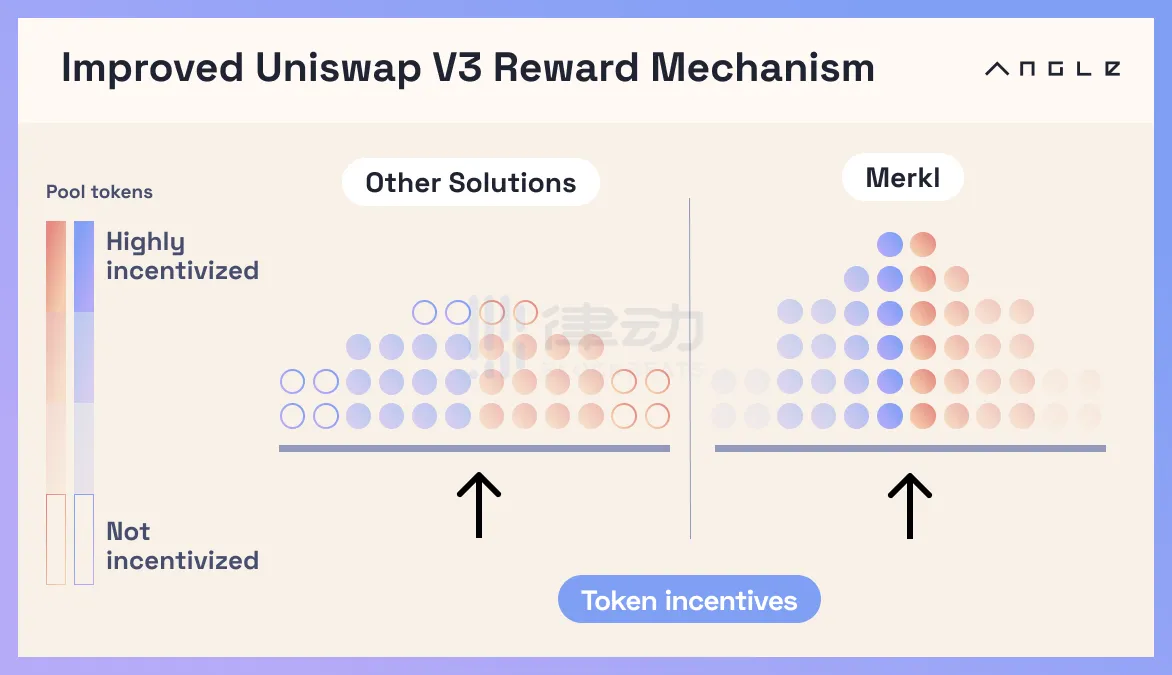
使用 Merkl 无需承担任何资金风险,也不需要 LPs 执行任何特定的智能合约交互:他们可以保留流动性,同时仍然获得奖励。他们还可以自定义自己的仓位,以最大化从费用和激励中获得的收益,享受 AMMs 集中流动性类型所提供的所有可能性。
Merkl 与 Gamma 或 Arrakis 等流动性仓位管理者兼容。这意味着可以通过 Gamma 在池子上提供流动性,并获得奖励,而无需执行任何进一步的操作(无需抵押 Gamma 或 Arrakis 代币)。因此,在池子上没有其他流动性提供者的情况下,使用 Merkl 来激励池子与通过抵押合约激励 Arrakis 或 Gamma 代币完全相同。
Merkl 对激励收取低维护费用。除了在领取奖励时消耗的燃气外,流动性提供者使用该平台没有任何成本。
How does Merkl run the new paradigm Incentive?
Merkl is based on a non-chained script that looks at the data of the motivated pools on a given chain, calculating rewards for the stakeholders of all those pools. Based on this, the script aggregates all the reward allocation data into a Merkle tree, which is then compressed into Merkle roots and pushed up the chain to allow LPs to capture its rewards. The script is run periodically for a fixed period of time. This means that each time the script is run, it only looks at the on-chain data associated with that particular time period.
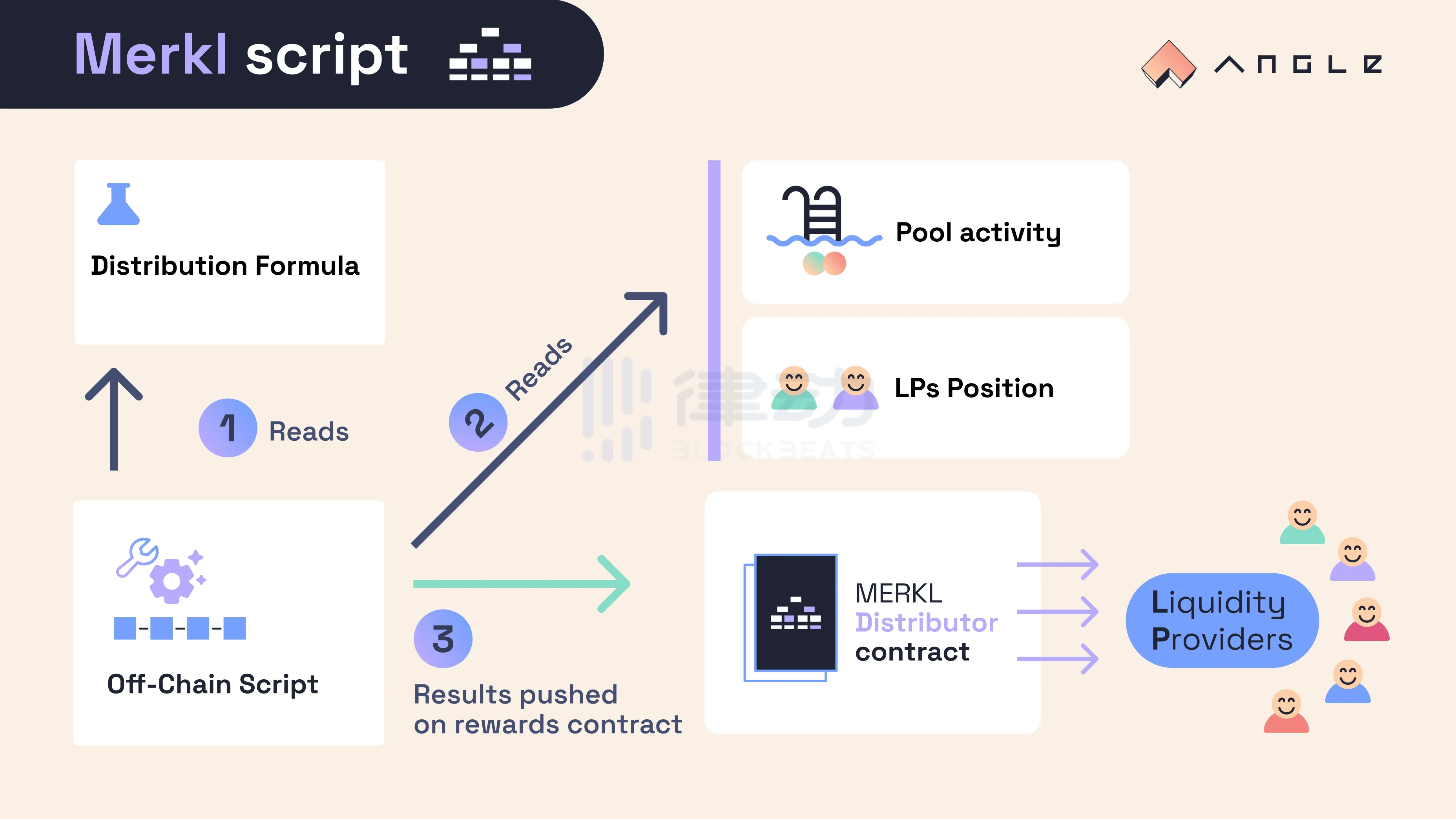
Customizable allocation formulas
严格来说,对于一个有两个令牌(A 和 B)的池,脚本会查看在运行期间在池中发生的交换,并根据持仓期间赚取的手续费(代表池使用的流动性)、在池中掉期期间持有的 TOKEN A 和 TOKEN B 份额计算奖励分数。 激励者可以为每个参数分配不同的权重,也可以通过允许持有特定令牌(例如 veANGLE 或 veCRV)的地址获得更高奖励,来进一步定制池的奖励分配。在一个特定的时间段内,该池内位置的确切分配公式如下:

Era length & Dispute period
The time period in which the script runs (also known as the epoch) depends on the chain and is the actual time between reward distributions. Epoch lengths are generally between 2 hours and 3 days, for example if Ethereum epoch lengths are 1 day, Uniswap V3 LPs can earn up to a maximum of new rewards per day on Merkl.
由于 Merkl 基于的脚本聚合了同一条链上所有支持的 AMM 的所有池,对不同池有流动性的液性提供者可以在每个纪元结束时一次性获得全部奖励。此外,由于系统依靠单个 Merkle 根处理每条链的分发,流动性提供者可以在一次交易中获取所有令牌奖励(来自潜在的许多集中流动性 AMM 上的不同池)。
To allow anyone to participate in the system without approval, and to reduce the system's exposure to potential hacks or failures, each new Merkle root update is followed by a dispute period, allowing anyone to challenge the results. The new Merkle root of the aggregate chain's reward allocation data is valid only after this disputed period. Disputes can be triggered by sending a predefined number of dispute tokens (most likely agEUR) to the award distribution contract.
During the dispute, the Merkle root of the award distribution contract was frozen until its last valid version. The dispute may be deemed valid, in which case the person who filed the dispute will receive a refund, the disputed Merkle root will be revoked, or it will be invalid. In the last case, the person who filed the dispute loses its funding, and the dispute period is restarted from scratch (meaning that the tree in question is still not considered valid). Disputed tokens, numbers, and lengths can be obtained by directly querying contracts that handle constant rewards.
Cost structure
Merkl can be used free of charge by the liquidity provider to claim incentives, and a 3% maintenance fee will be charged when the motivator sends the incentive amount. This fee may be waived for pools that contain certain specific approval tokens. For example, there is no charge for a reward sent to a reward pool containing agEUR or other Angle protocol stablecoins.
How can liquidity providers use Merkl to draw incentives?
As a liquidity provider, Merkl allows users to set allocation formulas based on the pool of motivators by defining their own funding positions to optimise returns on AMMs such as Uniswap V3.
To get the rewards listed on Merkl, offer liquidity directly on AMM (for example, UniswapV3) or on a supported liquidity manager. The main choices that need to be made when adding liquidity are: the width of the capital range, the split between the two tokens.
Once liquidity is provided, there are no additional steps required to start receiving rewards and you will be able to claim them directly from the Merkl page or any other MerKl-integrated application. In particular, you don't need to place your token anywhere else.

How does the project use Merkl to allocate incentives?
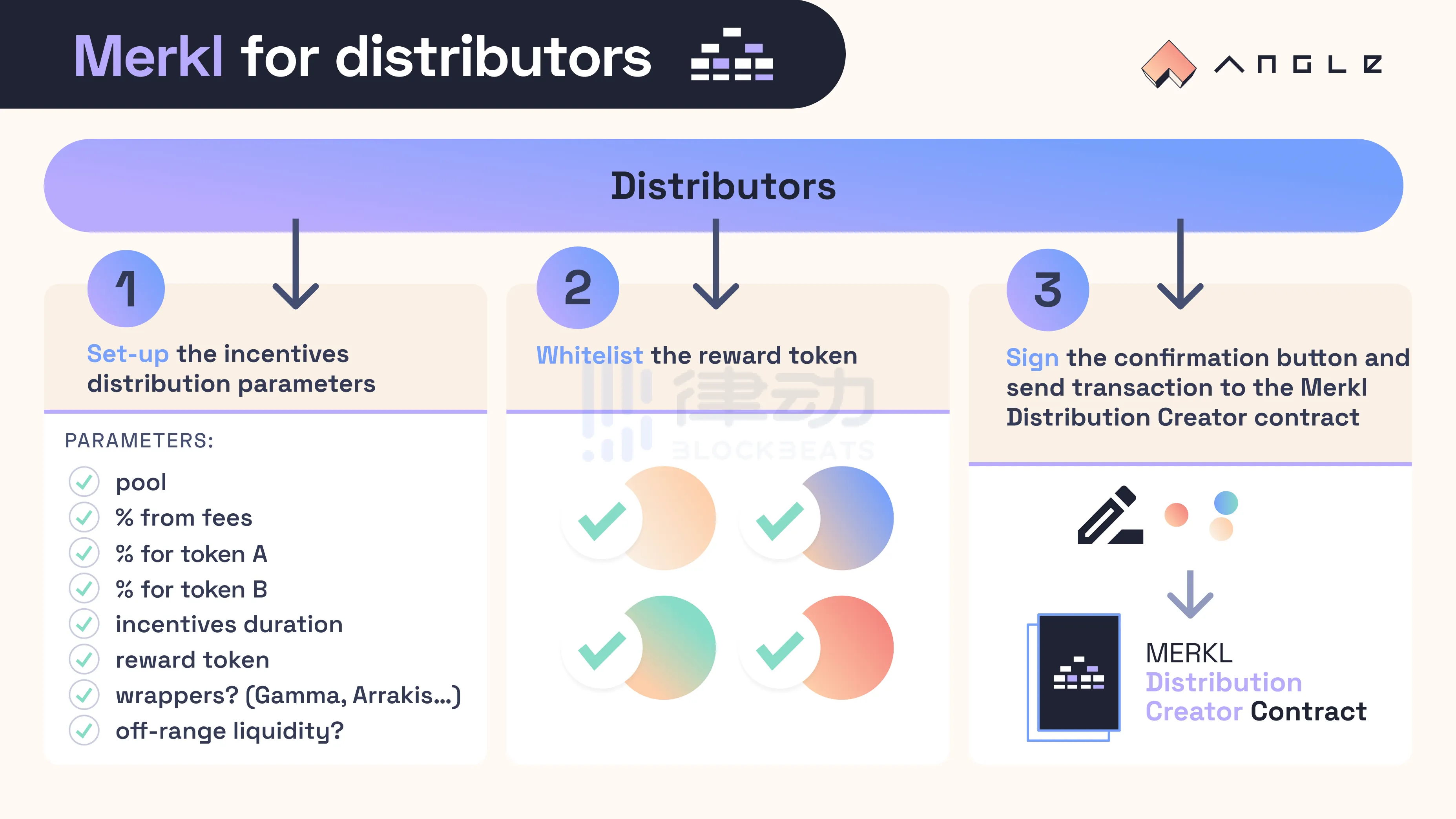
Any DAO or individual who wishes to motivate the pool can use Merkl and customize its allocation to get the desired type of liquidity. Once on the official website, you simply fill in the address of the mine pool to be incentivise, the address of the reward token, and the amount of the reward to be sent within the selected distribution period.
Reward tokens need to be whitelisted before they can be used, and for whitelisted tokens, a minimum amount needs to be sent in order for the allocation to be considered valid. If the reward token you want to use is not already whitelisted, you can leave an official message on the Merkl channel on the Angle Discord server.
Then customize any allocation formula parameters that can be customized. When complete, the application will prompt you to sign a disclaimer message and then publish the transaction that sends the token to the distribution contract. Addresses holding money can claim rewards at the end of each epoch based on how they provide liquidity in the pool.
Blockbeats reminds: Use Merkle at your discretion due to significant delays in Merkle root updates on the chain and possible flaws in the script or infrastructure used to update results on the chain.
Welcome to join the official BlockBeats community:
Telegram Subscription Group: https://t.me/theblockbeats
Telegram Discussion Group: https://t.me/BlockBeats_App
Official Twitter Account: https://twitter.com/BlockBeatsAsia