How to define the primary base rate in the crypto world?

Original article by Colin Li, Mint Ventures researcher
This article belongs to Mint Ventures The #Mint Clips series. Mint Clips It is our thoughts on industry events, internal and external communication. In contrast to our # Deep Study and # Track Scan series, Mint Clips It does not discuss specific projects, but presents "periodic insights" about specific issues.
The narrative of the "bond market" in the blockchain industry has gradually been taken seriously by the market and various investors, includingMulticoin CapitalEt al discuss the development pattern of the "interest rate market" and invest in related subjects during that period. However, even on the basis of the "entry of institutional investors" at that time, "Rapid development" is expected, the bond market in the chain world has not erupted, the related target TVL and other indicators remain at a low position, we did not see the "bond market" boom in this cycle.
So is there a bond market in the on-chain world? Encrypted native crypto native What is the likely pattern of bond market development? To answer these questions, an important starting point is to think about the crypto-native risk free rate, which is a cornerstone of the direction of bond markets because it is an important part of the discount factor for crypto-native assets. By thinking about the "risk-free rate," we know what kind of economic activity is likely to match risk to return in crypto markets.
1. 公链的叙事
How to treat the public chain has long been one of the important topics for many investment institutions and researchers to think about. From USV nbsp; Joel Monegro In 2016 In 1999, the author of theFat protocolThe concept of "is deeply rooted in people's hearts, and has been considered by many investors as an important starting point for the public chain narrative until now.
2021 1, Tascha Proposed the "public chain"Country valuation"Logic, at that time in the market of the mainstream use of stock valuation model to evaluate the way of public chain, and believe that currency exchange rate model to value the public chain is more useful. 2022 By Jake Brukhman, 2001. Also proposed, blockchain technology is a new way of human collaboration, more like aPublic goodsBut blockchain holds the potential for profit.
Public chain provides a series of basic services, and no project based on public chain can stand on its own. From this perspective, I personally prefer to elevate the narrative of public chain from "company" to "country". Since the public chain is regarded as the state, it is natural to discuss the risk-free interest rate of the "state", which is the cornerstone of the pricing of the "state" assets.
When we start from a "national" narrative, the next step is to define currency. A country's currency is, of course, issued by its own "authority". In the blockchain world, the token of a public chain should be treated as the currency of that chain. For example, Ethereum's ETH, Solana nbsp; SOL, Fantom nbsp; FTM Etc.
2. Potential risk-free interest rate
The risk-free interest rate does not include credit risk, term risk, etc. Generally in the traditional world, it is regarded as the interest rate of short-term Treasury bonds, or the benchmark interest rate set by the central bank.
If we separate the nominal risk-free rate, we can see that one part is price expectation (inflation) and the other part is the growth expectation of the economy itself (real interest rate). The well-known Taylor Rule of the central bank benchmark interest rate pricing model also indicates that the risk-free rate is affected by these two factors. Of course, this rate still assumes that the country is relatively stable and that regulators are not undermined. So under the risk-free rate, it's not absolutely risk-free.
Now take a look at some of the major rates in the crypto market.
2.1. Stablecoin lending rate
Some investors in the market use stablecoin lending rates as risk-free rates in crypto markets. For example, USDC, USDT In Aave, Compound The interest rate at which it borrowings.
But if we think, USDC/USDT Such as directly anchoring the dollar price, is not a public chain token, from this point of view can not be used as a risk-free interest rate of the public chain itself.
USDC The price relationship between these stablecoins and public chain tokens is more like the exchange rate of foreign currencies, the interest rates of the two currencies, and the different interest rates between the dollar and other national currencies in an offshore center.
2.2. Native Token Borrowing rate
ETH, SOL There are pools of loans in the loan agreements, and the interest rates are very low most of the time. To exist. Aave In ETH For example, most of the time. ETH Interest rates are low.

Source:https://app.aave.com/reserve-overviewIn the graph, the higher interest rates occurred. ETH 2.0 & have spent The upgrade succeeds.
However, the lending of public chain tokens is subject to default risk and liquidity risk. The former is the counterparty risk caused by the lending and borrowing, while the latter is the overall market risk, which is not included in the "risk-free rate". So such lending rates cannot be used as a benchmark for the "risk-free rate".
2.3. Public chain POS/POW Rate of return
Whether POS Again POW Mechanisms, in order to keep the chain running, need to be miners /validator Offer certain rewards. This rate of return includes the new issuance of public chain tokens, the inflation of "national money", as well as the level of activity on the chain.
Take POS For example, MEV The main sources are: arbitrage, liquidation, sandwich attack, all related to the intensity of the activity on the chain. From Ethereum MEV The daily profit can also be seen in a bull market. MEV More than the bear market. MEV That's a lot less.
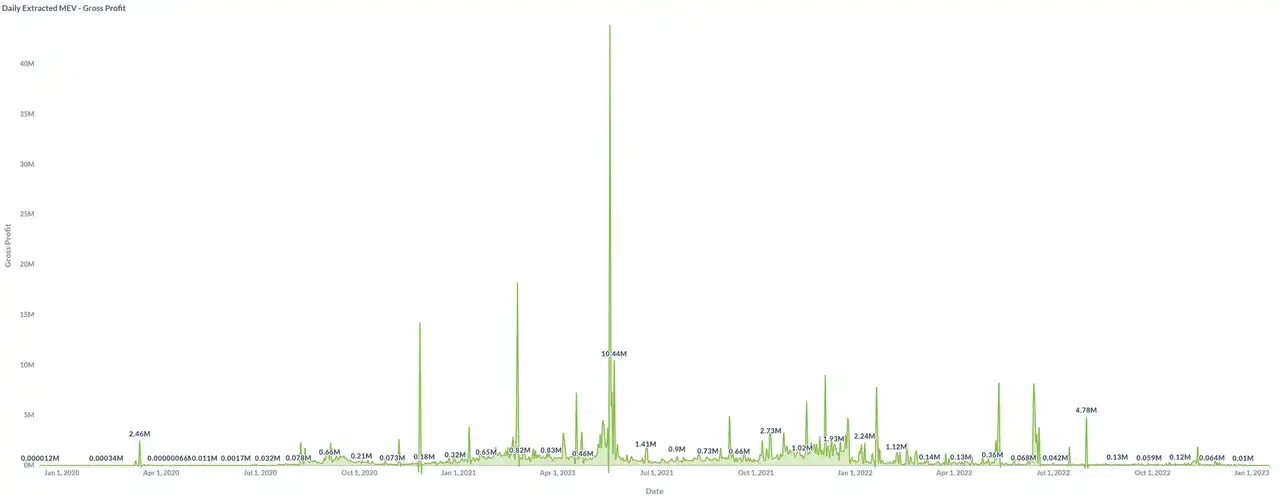
Source:https://explore.flashbots.net/
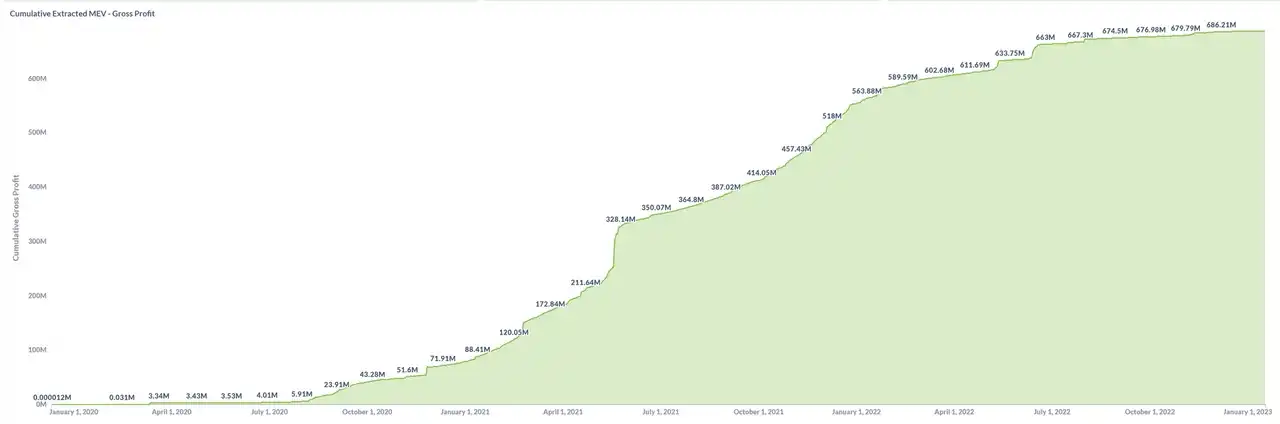
Source:https://explore.flashbots.net/
Another related indicator -- on-chain gas fee It also shows the corresponding characteristics.
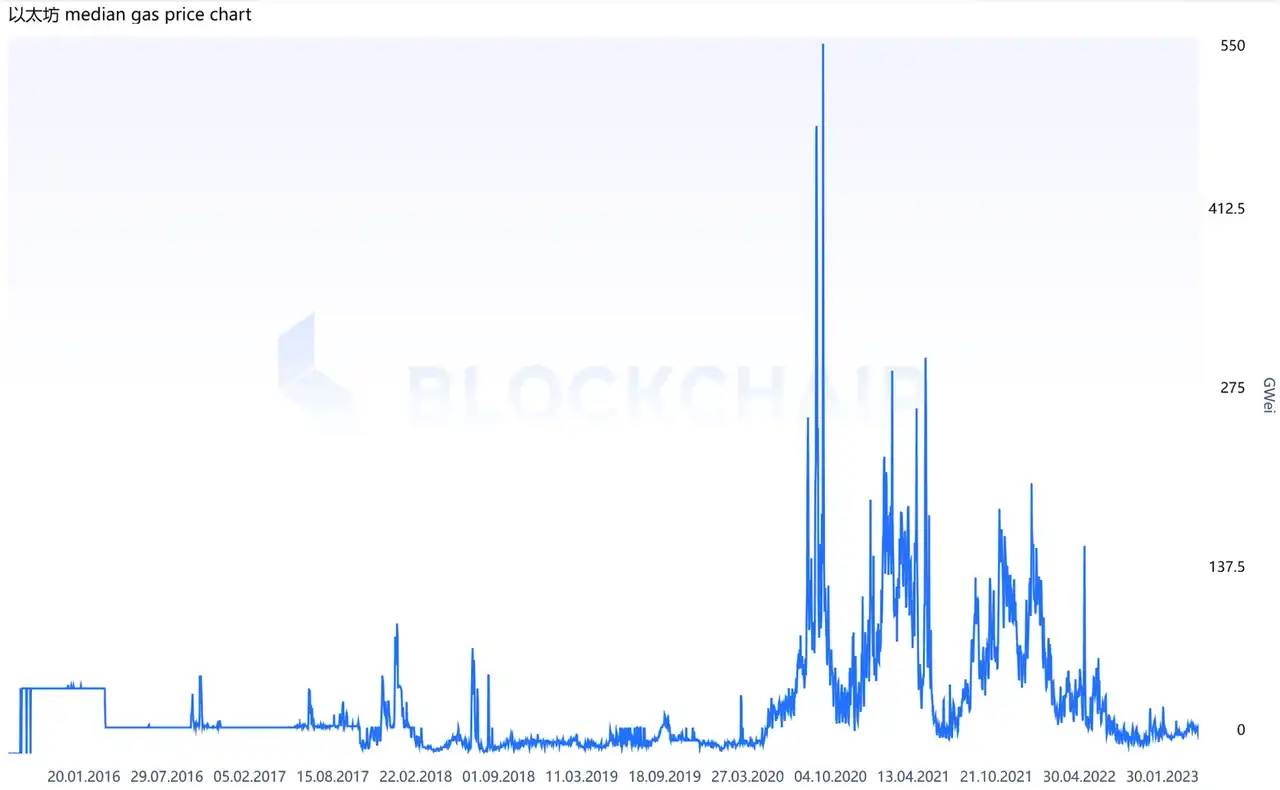
Source:https://blockchair.com/zh/ethereum/charts/median-gas-price
However, from a risk point of view, Are yields really completely risk-free? Not really.
To achieve this revenue, you need to take hardware, software (client), network risks, etc., but these risks are necessary to keep the public chain running smoothly. What's more, POS Returns also include potential. slashing Fine, but this is still a public chain operation can not avoid the risk.
In general, miners /validator On the one hand, it includes the inflation of the public chain token; on the other hand, it also has the income of the activity degree on the chain, which is better than the previous two interest rates. Yields are more closely aligned with the "risk-free rate" under the "national" narrative.
2.4. Understand interest rates in other currencies
Some friends may have such a question: "A lot of my operations on the chain are executed with the class USDC Stablecoin type, why can't I use stablecoin interest rate as the risk-free rate"?
Well, first of all, The interest rate of ", "is generated by users' borrowing behavior, which contains potential default risk and term risk. These risks are mainly generated by users' on-chain activities, including possible credit problems of counterparties. This is inconsistent with the" risk-free interest rate ", which only reflects the basic situation of money supply and economic growth.
Secondly, under the "national" narrative, public chain coins serve as the local currency of public chain, and other currencies should be regarded as "foreign exchange". Different from a country in the traditional sense, under normal circumstances, a country can only use its own currency for daily production and operation activities with the support of a violent institution. However, in the cryptocurrency market, there is no violent institution and some mechanism that mandates that only public chain coins can be used as the payment currency for any activities. Therefore, public chain seems more like an extremely open "country". Accept any currency as instrument of payment. Therefore, stablecoins and other non-public currencies can be regarded as "foreign exchange".
3. POS The basic use of yield
The risk-free interest rate is a perspective to observe the overall situation of "public chain countries". The actual interest rate can assist in judging the maturity of the ecology, and also has certain guiding significance for investment strategy.
Now let's look at some of the public chains. POS Rate of return, let's pick it up here. TVL In 1 Over $100 million, yes. POS Public chain items that yield and continue to inflate. Overall, the picture is very similar to that of the real world: the more mature the economy, the lower the interest rates it offers.
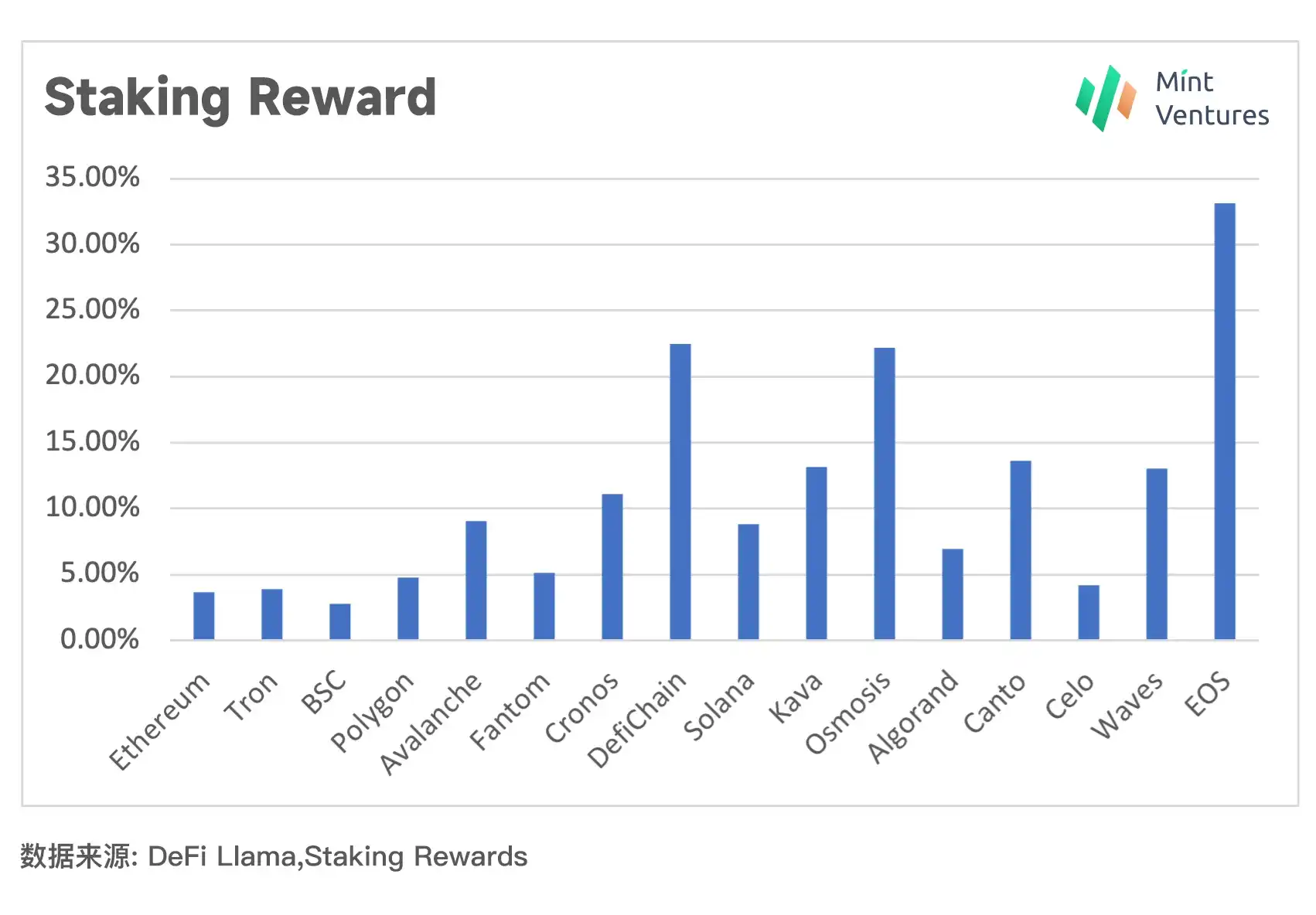
Data sources: DeFi Llama, Staking Rewards
Now let's look at the level of real interest rates. The level of real interest rates in an economy is mainly related toEconomies' potential growth, demographics, and asset returns divergeIndeed, healthy economies have positive real interest rates. Then, mapped to the domain of public chain, "population" can correspond to the number of addresses, the number of active addresses, and "potential growth rate" can correspond to the number of transactions, transaction costs, the growth rate of deployed contracts, etc.
StakingRewards adjusted reward is given, which is calculated by adjusting for the inflation of network supply. adjusted reward It can represent the real interest rate. As you can see from the chart below, most public chain projects are still growing.
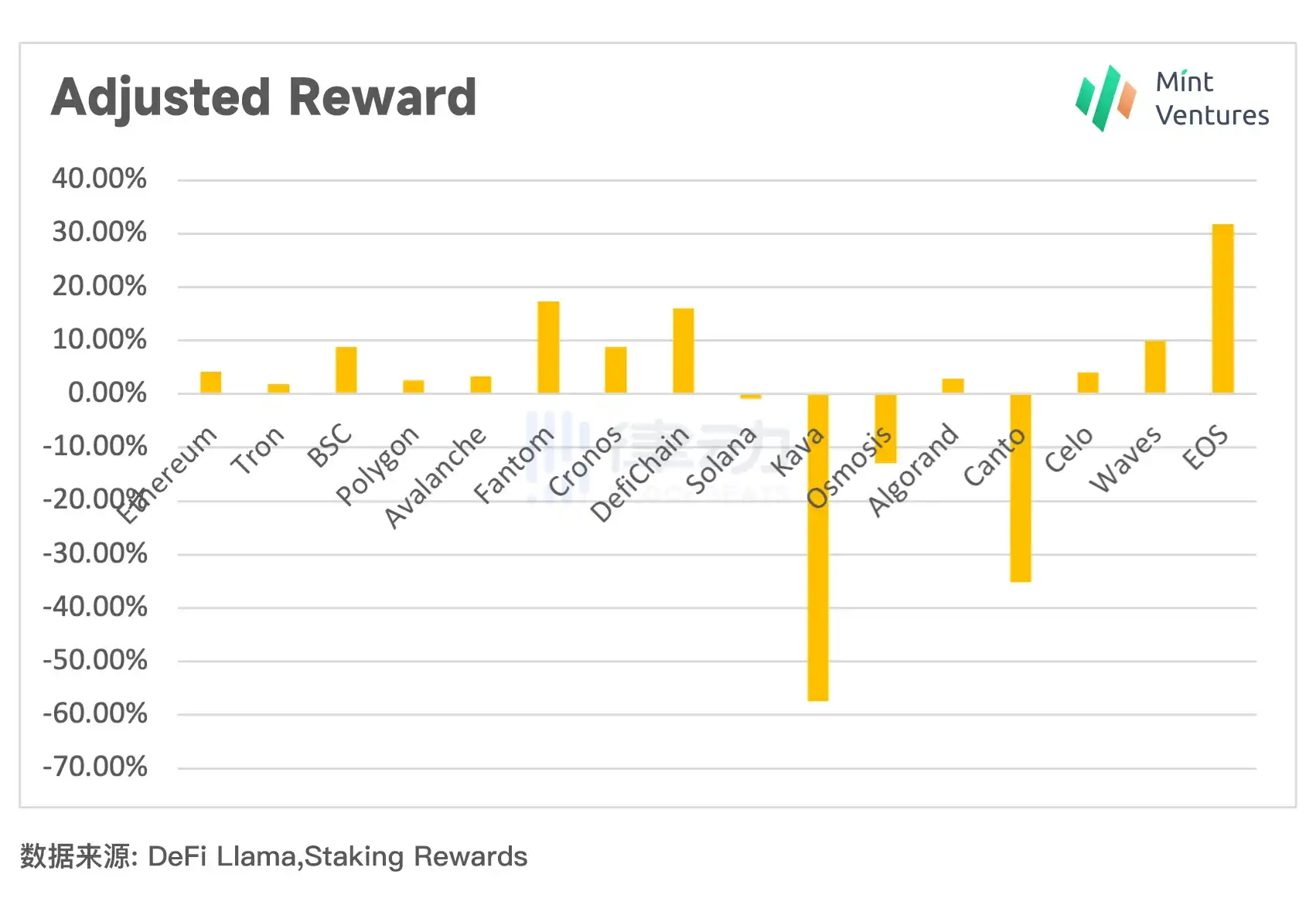
Data sources: DeFi Llama, Staking Rewards
By simple observation POS Yield TVL The ranking is conducive to the deployment of different public chain investment strategies: for steady investors, should look for POS Yields are low and realistic. POS The public chain project with a positive rate of return is taken as the target library; For aggressive investments, perhaps the profit and loss ratio is greater than that of larger projects. POS Yields are high and realistic. POS In a public chain with a negative yield.
After we've talked about the risk-free rate for the public chain, it's natural to want to use the risk-free rate in the pricing of the market. Directly related to the level of interest rates is the lending market and the bond market. The lending market is familiar, but the bond market has been tepid. In the next installment, we will discuss the current state of the bond market and discuss where the market is headed.
References:
1.Exploring the Opportunity for DeFi Interest Rate Markets, Multicoin Capital
2.Fat Protocols, USV
3.Price layer 1 blockchain tokens like countries, Tascha Labs
4.Crypto Networks Are Monetizable Public Goods, Jake Brukhman
5.Determinants of the real interest rate,European Central Bank
Welcome to join the official BlockBeats community:
Telegram Subscription Group: https://t.me/theblockbeats
Telegram Discussion Group: https://t.me/BlockBeats_App
Official Twitter Account: https://twitter.com/BlockBeatsAsia